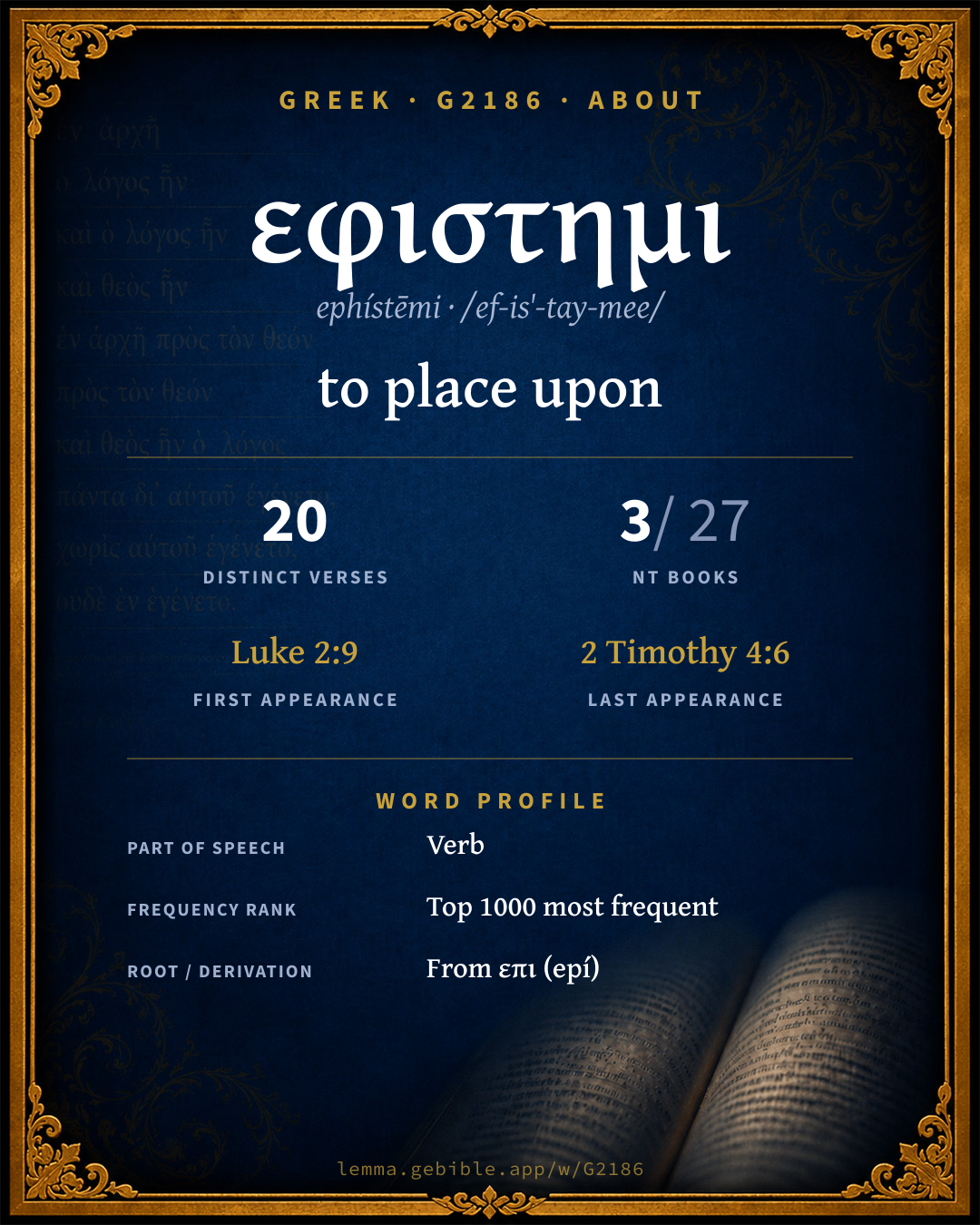
ἐφίστημι
to place upon
Full lexicon entry — Thayer's Greek Lexicon
From Thayer's Greek Lexicon
Where this word appears
See every Aorist-tense verb in the Greek New Testament →
Grammar key — what these labels mean
Part of speech
- Verb
- An action or state-of-being word.
Tense
- Aorist
- Action viewed as a simple whole, without regard to duration — often past (perfective aspect).
- Perfect
- A completed past action with continuing present results.
Voice
- Active
- The subject performs the action.
Mood
- Indicative
- States a fact or asks a factual question (the mood of reality).
- Participle
- A verbal adjective (“writing,” “having written”).
- Imperative
- Expresses a command or request.
- Subjunctive
- Expresses probability, purpose, or possibility (the mood of contingency).
Case
- Nominative
- The case of the subject (and the predicate nominative).
- Accusative
- The case of the direct object and of extent.
Person
- 3rd person
- The one spoken about (“he / she / it / they”).
- 2nd person
- The one addressed (“you”).
Gender
- Masculine
- Grammatically masculine.
- Feminine
- Grammatically feminine.
Number
- Plural
- More than one.
- Singular
- One.
2 verses where G2186 appears in the Perfect tense in the Book of Acts. Filtered view — show all forms. Click any verse to open its interlinear word-by-word view. Verse text shown in the World English Bible for context — . Each verse’s Greek form is shown with its reference; the English is not keyword-highlighted, since the data carries no word-level English alignment. Use “Compare translations” on any verse to read it across multiple English versions. This concordance covers the Greek New Testament; Septuagint (Greek Old Testament) occurrences of this word are not indexed here.
Acts
- Acts 22:20 ἐφεστὼς perf act ptcp nom sg masc When the blood of Stephen, your witness, was shed, I also was standing by, and consenting to his death, and guarding the cloaks of those who killed him.'
- Acts 28:2 ἐφεστῶτα perf act ptcp acc sg masc The natives showed us uncommon kindness; for they kindled a fire, and received us all, because of the present rain, and because of the cold.
About this entry
At a glance — auto-summarized from this page’s data, not written by a person. Every figure links to its source below. This summary describes the numbers; it doesn’t interpret them.
εφιστημι — transliterated ephístēmi — is a Greek verb carrying the sense “to place upon.” More than half of its appearances fall in Acts. It appears 20 verses across 3 books of the Greek New Testament, among its uncommon vocabulary. Debuting at Luke 2:9, it then recurs through the corpus. Related forms include επι, επαγγελλω and επαγω. Each statement above links to its evidence; the full detail follows below.
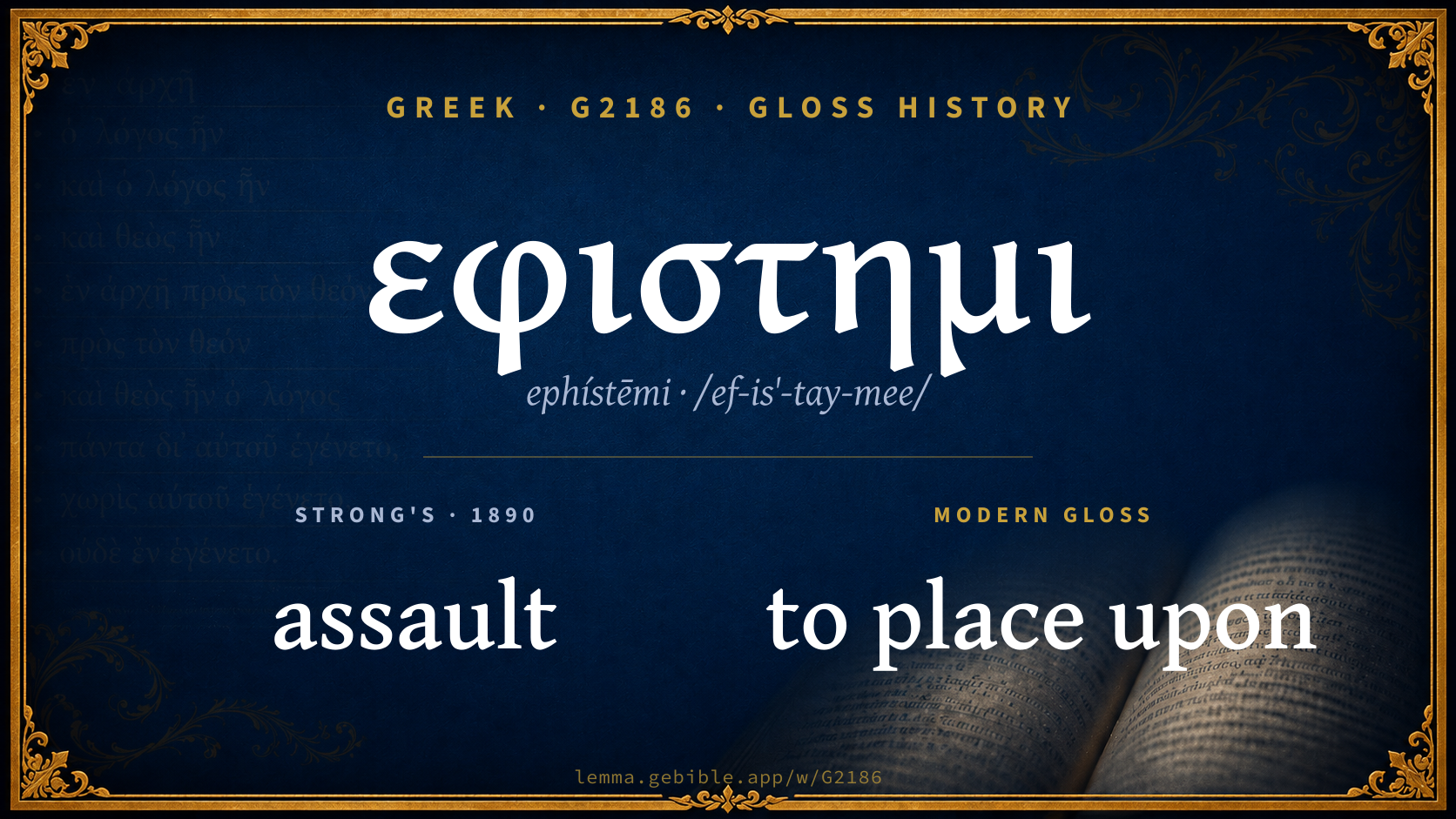
Gloss history
Strong's 1890 vs modern scholarship
About this word
Strong's G2186 catalogs a Greek word from the Greek New Testament.
These counts are not copied from any lexicon or concordance. They are computed here, from the morphology-tagged Greek New Testament. What Lemma adds →
- 20
- distinct verses
- The word appears in 20 distinct verses.
- 3 / 27
- NT books
- The word appears in 3 of 27 New Testament books.
- #622
- by frequency
- Top 1000 most frequent Greek words (rank 622 of 5,347 Greek words by occurrence).
View all 20 occurrences in the concordance →
By section of the New Testament
By traditional corpus
Conventional, traditional groupings — biblical authorship is debated, so this is a traditional corpus grouping, not an authorship claim. Some books belong to more than one corpus (Luke is in both the Gospels and the Lukan corpus, and so on), so these shares overlap and need not total 100%. Each figure is a share of the word’s 20 distinct verses.
- Lukan (Luke–Acts) 18 verses · 90%
- Gospels 7 verses · 35%
- Pauline corpus 2 verses · 10%
How translations render this word
Counts come from each version’s own published word-to-Strong’s tagging or interlinear alignment — an approximate guide to how each version renders this word, not a word-level alignment the data otherwise carries. Because each total is that version’s own tagged count, the per-version totals vary from one another and need not match the appearance or distinct-verse counts above. These counts may also differ from a printed concordance because Lemma counts each distinctly tagged rendering and does not collapse phrase taggings into a single head-word total. This is a fixed set of word-tagged versions (KJV, ASV, BSB, ULT) and does not change with the reading translation you choose elsewhere. Each version’s license is shown beside its name below (and on Sources).
- King James Version: Came upon 5×, Come 2×, Stood 2×
- American Standard Version: Came upon 3×, Stood by 3×, Stood 2×
- Berean Standard Bible: Stood beside 2×
- unfoldingWord Literal Text: Coming up 2×, Stood 2×
King James Version Public Domain
Renders G2186 across 22 tagged occurrences — most commonly:
Plus 11 renderings that appear only once — usually multi-word phrases or single function words the recovered tagging swept in, not distinct renderings.
American Standard Version Public Domain
Renders G2186 across 21 tagged occurrences — most commonly:
Plus 13 renderings that appear only once — usually multi-word phrases or single function words the recovered tagging swept in, not distinct renderings.
Berean Standard Bible Public Domain
Renders G2186 across 20 tagged occurrences — most commonly:
Plus 18 renderings that appear only once — usually multi-word phrases or single function words the recovered tagging swept in, not distinct renderings. Not rendered by a distinct English word in 1 further occurrence.
unfoldingWord Literal Text CC BY-SA 4.0
Renders G2186 across 22 tagged occurrences — most commonly:
Plus 18 renderings that appear only once — usually multi-word phrases or single function words the recovered tagging swept in, not distinct renderings.
Senses in Thayer's
The 1 sense Thayer's distinguishes for this word, in lexicon order (not ranked by frequency or importance). The full entry — with sub-senses — is in the Lexicon Entry tab.
- to place at, place upon, place over
Word origin
Derived from επι (epí) (G1909) — upon.
Forms in the corpus
The 10 distinct written forms G2186 takes in the Greek New Testament, most frequent first — each parse links to that tense’s occurrences in the concordance.
| Form | Parsing | Example | Uses |
|---|---|---|---|
| ἐπέστησαν epéstēsan | Verb, Aorist, Active, Indicative, 3rd person, Plural | Luke 20:1 | 5 |
| ἐπιστὰς epistàs | Verb, Aorist, Active, Participle, Nominative, Singular, Masculine | Luke 4:39 | 4 |
| ἐπέστη epéstē | Verb, Aorist, Active, Indicative, 3rd person, Singular | Luke 2:9 | 2 |
| ἐπιστάντες epistántes | Verb, Aorist, Active, Participle, Nominative, Plural, Masculine | Acts 6:12 | 2 |
| ἐπιστᾶσα epistâsa | Verb, Aorist, Active, Participle, Nominative, Singular, Feminine | Luke 2:38 | 2 |
| ἐπίστηθι epístēthi | Verb, Aorist, Active, Imperative, 2nd person, Singular | 2 Timothy 4:2 | 1 |
| ἐπιστῇ epistē̂ | Verb, Aorist, Active, Subjunctive, 3rd person, Singular | Luke 21:34 | 1 |
| ἐφέστηκεν ephéstēken | Verb, Perfect, Active, Indicative, 3rd person, Singular | 2 Timothy 4:6 | 1 |
| ἐφεστὼς ephestṑs | Verb, Perfect, Active, Participle, Nominative, Singular, Masculine | Acts 22:20 | 1 |
| ἐφεστῶτα ephestō̂ta | Verb, Perfect, Active, Participle, Accusative, Singular, Masculine | Acts 28:2 | 1 |
Same root — word family
Other Thayer's entries built from the same root as G2186, grouped by Strong’s listed origin. These share a root / origin per the lexicon — not necessarily a shared meaning. Each links to that word’s own entry.
Derives from
Shares the same root
- επαγγελλω epangéllō G1861 to announce
- επαγω epágō G1863 to bring upon
- επαγωνιζομαι epagōnízomai G1864 to contend
- επαθροιζω epathroízō G1865 to gather together
- επαινεω epainéō G1867 to approve
- επαινος épainos G1868 approval
- επαιρω epaírō G1869 to lift up
- επαισχυνομαι epaischýnomai G1870 to be ashamed
- επαιτεω epaitéō G1871 to ask repeatedly
- επακουω epakoúō G1873 to give ear to
- επακροαομαι epakroáomai G1874 to listen to
- επαν epán G1875 after
- επαναγκες epánankes G1876 necessarily
- επαναγω epanágō G1877 to lead back
- επαναμιμνησκω epanamimnḗskō G1878 to remind
- επαναπαυομαι epanapaúomai G1879 to rest upon
- επανερχομαι epanérchomai G1880 to return
- επανισταμαι epanístamai G1881 to raise up against
- επανορθωσις epanórthōsis G1882 correction
- επανω epánō G1883 above
- επαρκεω eparkéō G1884 to avail
- επαρχια eparchía G1885 office of governor
- επαυλις épaulis G1886 farm
- επαυριον epaúrion G1887 the next day
+110 more words share this root (not shown).
Derived from this word
Proper names from this root
People and places named from this root — a name, not an additional meaning of the word.
Compare all same-root words → Showing 4 of 138 — not the complete family. 1 of the same-root words is a proper name (a person or place). They share a root, not necessarily a meaning.
Septuagint usage
The same Greek word εφιστημι appears 63 times in the Greek Old Testament (Septuagint), across 62 verses in 22 books.
- 63
- LXX occurrences
- Tagged occurrences of this Greek word in the Septuagint.
- 62
- verses
- Distinct Septuagint verses containing this word.
- 22 / 39
- OT books
- The word appears in 22 of the 39 Old Testament books.
Sample Septuagint occurrences
- Genesis 24:43 ἐπιἵστημι
- Exodus 1:11 ἐπιἵστημι
- Leviticus 17:10 ἐπιἵστημι
- Numbers 1:50 ἐπιἵστημι
- Joshua 6:26 ἐπιἵστημι
- Judges 3:19 ἐπιἵστημι
- Ruth 2:5 ἐπιἵστημι
- 1 Samuel 17:31 ἐπιἵστημι
- 2 Samuel 1:10 ἐπιἵστημι
- 1 Kings 2:46 ἐπιἵστημι
- 2 Kings 4:38 ἐπιἵστημι
- 1 Chronicles 18:3 ἐπιἵστημι
Septuagint occurrences (same lexeme)
Every verse where the same Strong’s number (G2186) appears in the Greek Septuagint — showing the first 50 of 62. Verse text shown in the World English Bible for context; the Greek form is the matched word — the English is not keyword-highlighted.
- Genesis 24:43 ἐπιἵστημι Behold, I am standing by the spring of water. Let it happen, that the maiden who comes forth to draw, to whom I will say, Give me, I pray you, a little water from your pitcher to drink.
- Exodus 1:11 ἐπιἵστημι Therefore they set taskmasters over them to afflict them with their burdens. They built storage cities for Pharaoh: Pithom and Raamses.
- Exodus 7:23 ἐπιἵστημι Pharaoh turned and went into his house, neither did he lay even this to heart.
- Leviticus 17:10 ἐπιἵστημι "'Any man of the house of Israel, or of the strangers who live as foreigners among them, who eats any kind of blood, I will set my face against that soul who eats blood, and will cut him off from among his people.
- Leviticus 20:3 ἐπιἵστημι I also will set my face against that person, and will cut him off from among his people because he has given of his seed to Molech, to defile my sanctuary, and to profane my holy name.
- Leviticus 20:5 ἐπιἵστημι then I will set my face against that man, and against his family, and will cut him off, and all who play the prostitute after him, to play the prostitute with Molech, from among their people.
- Leviticus 20:6 ἐπιἵστημι "'The person that turns to those who are mediums, and to the wizards, to play the prostitute after them, I will even set my face against that person, and will cut him off from among his people.
- Leviticus 26:17 ἐπιἵστημι I will set my face against you, and you will be struck before your enemies. Those who hate you will rule over you; and you will flee when no one pursues you.
- Numbers 1:50 ἐπιἵστημι but appoint the Levites over the Tabernacle of the Testimony, and over all its furnishings, and over all that belongs to it. They shall carry the tabernacle, and all its furnishings; and they shall take care of it, and shall encamp around it.
- Numbers 14:14 ἐπιἵστημι and they will tell it to the inhabitants of this land. They have heard that you Yahweh are in the midst of this people; for you Yahweh are seen face to face, and your cloud stands over them, and you go before them, in a pillar of cloud by day, and in a pillar of fire by night.
- Numbers 23:6 ἐπιἵστημι He returned to him, and, behold, he was standing by his burnt-offering, he, and all the princes of Moab.
- Numbers 23:17 ἐπιἵστημι He came to him, and, behold, he was standing by his burnt offering, and the princes of Moab with him. Balak said to him, What has Yahweh spoken?
- Joshua 6:26 ἐπιἵστημι Joshua charged them with an oath at that time, saying, Cursed be the man before Yahweh, that rises up and builds this city Jericho: with the loss of his firstborn shall he lay the foundation of it, and with the loss of his youngest son shall he set up the gates of it.
- Joshua 7:26 ἐπιἵστημι They raised over him a great heap of stones, to this day; and Yahweh turned from the fierceness of his anger. Therefore the name of that place was called "The valley of Achor" to this day.
- Joshua 8:29 ἐπιἵστημι The king of Ai he hanged on a tree until the evening: and at the going down of the sun Joshua commanded, and they took his body down from the tree, and cast it at the entrance of the gate of the city, and raised thereon a great heap of stones, to this day.
- Judges 3:19 ἐπιἵστημι But he himself turned back from the quarries that were by Gilgal, and said, I have a secret errand to you, king. He said, Keep silence. All who stood by him went out from him.
- Ruth 2:5 ἐπιἵστημι Then said Boaz to his servant who was set over the reapers, Whose young lady is this?
- Ruth 2:6 ἐπιἵστημι The servant who was set over the reapers answered, It is the Moabite lady who came back with Naomi out of the country of Moab:
- 1 Samuel 17:31 ἐπιἵστημι When the words were heard which David spoke, they rehearsed them before Saul; and he sent for him.
- 1 Samuel 22:17 ἐπιἵστημι The king said to the guard who stood about him, Turn, and kill the priests of Yahweh; because their hand also is with David, and because they knew that he fled, and didn't disclose it to me. But the servants of the king wouldn't put forth their hand to fall on the priests of Yahweh.
- 2 Samuel 1:10 ἐπιἵστημι So I stood beside him, and killed him, because I was sure that he could not live after that he was fallen: and I took the crown that was on his head, and the bracelet that was on his arm, and have brought them here to my lord.
- 2 Samuel 8:3 ἐπιἵστημι David struck also Hadadezer the son of Rehob, king of Zobah, as he went to recover his dominion at the River.
- 1 Kings 2:46 ἐπιἵστημι So the king commanded Benaiah the son of Jehoiada; and he went out, and fell on him, so that he died. The kingdom was established in the hand of Solomon.
- 1 Kings 16:34 ἐπιἵστημι In his days did Hiel the Bethelite build Jericho: he laid the foundation of it with the loss of Abiram his firstborn, and set up the gates of it with the loss of his youngest son Segub, according to the word of Yahweh, which he spoke by Joshua the son of Nun.
- 2 Kings 4:38 ἐπιἵστημι Elisha came again to Gilgal. There was a dearth in the land; and the sons of the prophets were sitting before him; and he said to his servant, Set on the great pot, and boil stew for the sons of the prophets.
- 1 Chronicles 18:3 ἐπιἵστημι David struck Hadarezer king of Zobah to Hamath, as he went to establish his dominion by the river Euphrates.
- Ezra 16:1 ἐπιἵστημι
- Ezra 18:13 ἐπιἵστημι
- Job 7:20 ἐπιἵστημι If I have sinned, what do I do to you, you watcher of men? Why have you set me as a mark for you, So that I am a burden to myself?
- Job 14:20 ἐπιἵστημι You forever prevail against him, and he passes; You change his face, and send him away.
- Job 34:2 ἐπιἵστημι "Hear my words, you wise men; Give ear to me, you who have knowledge.
- Job 42:3 ἐπιἵστημι You asked, 'Who is this who hides counsel without knowledge?' Therefore I have uttered that which I did not understand, Things too wonderful for me, which I didn't know.
- Proverbs 9:18 ἐπιἵστημι But he doesn't know that the dead are there, That her guests are in the depths of Sheol.
- Proverbs 22:17 ἐπιἵστημι Turn your ear, and listen to the words of the wise. Apply your heart to my teaching.
- Proverbs 23:5 ἐπιἵστημι Why do you set your eyes on that which is not? For it certainly sprouts wings like an eagle and flies in the sky.
- Proverbs 27:23 ἐπιἵστημι Know well the state of your flocks, And pay attention to your herds:
- Isaiah 1:26 ἐπιἵστημι I will restore your judges as at the first, And your counselors as at the beginning. Afterward you shall be called 'The city of righteousness, A faithful town.'
- Isaiah 3:4 ἐπιἵστημι I will give boys to be their princes, And children shall rule over them.
- Isaiah 21:4 ἐπιἵστημι My heart flutters, horror has frightened me; the twilight that I desired has been turned into trembling to me.
- Isaiah 41:20 ἐπιἵστημι that they may see, and know, and consider, and understand together, that the hand of Yahweh has done this, and the Holy One of Israel has created it.
- Isaiah 41:22 ἐπιἵστημι Let them bring forth, and declare to us what shall happen: declare you the former things, what they are, that we may consider them, and know the latter end of them; or show us things to come.
- Isaiah 63:5 ἐπιἵστημι I looked, and there was none to help; and I wondered that there was none to uphold: therefore my own arm brought salvation to me; and my wrath, it upheld me.
- Jeremiah 5:27 ἐπιἵστημι As a cage is full of birds, so are their houses full of deceit: therefore they are become great, and grew rich.
- Jeremiah 21:2 ἐπιἵστημι Please inquire of Yahweh for us; for Nebuchadrezzar king of Babylon makes war against us: peradventure Yahweh will deal with us according to all his wondrous works, that he may go up from us.
- Jeremiah 26:14 ἐπιἵστημι But as for me, behold, I am in your hand: do with me as is good and right in your eyes.
- Jeremiah 27:44 ἐπιἵστημι
- Jeremiah 28:12 ἐπιἵστημι Then the word of Yahweh came to Jeremiah, after that Hananiah the prophet had broken the bar from off the neck of the prophet Jeremiah, saying,
- Jeremiah 28:27 ἐπιἵστημι
- Jeremiah 30:13 ἐπιἵστημι There is none to plead your cause, that you may be bound up: you have no healing medicines.
- Jeremiah 36:10 ἐπιἵστημι Then read Baruch in the book the words of Jeremiah in the house of Yahweh, in the chamber of Gemariah the son of Shaphan, the scribe, in the upper court, at the entry of the new gate of Yahweh's house, in the ears of all the people.
These are occurrences of the same Greek lexeme (G2186) in the Septuagint — not a translation of any one Hebrew word. The store carries no word-level Hebrew↔Greek alignment, so no Hebrew original is asserted here. Counts come from the recovered LXX Strong's tagging — high-frequency vocabulary is well covered, while rare or late forms may be untagged — so they reflect tagged occurrences and may slightly undercount.