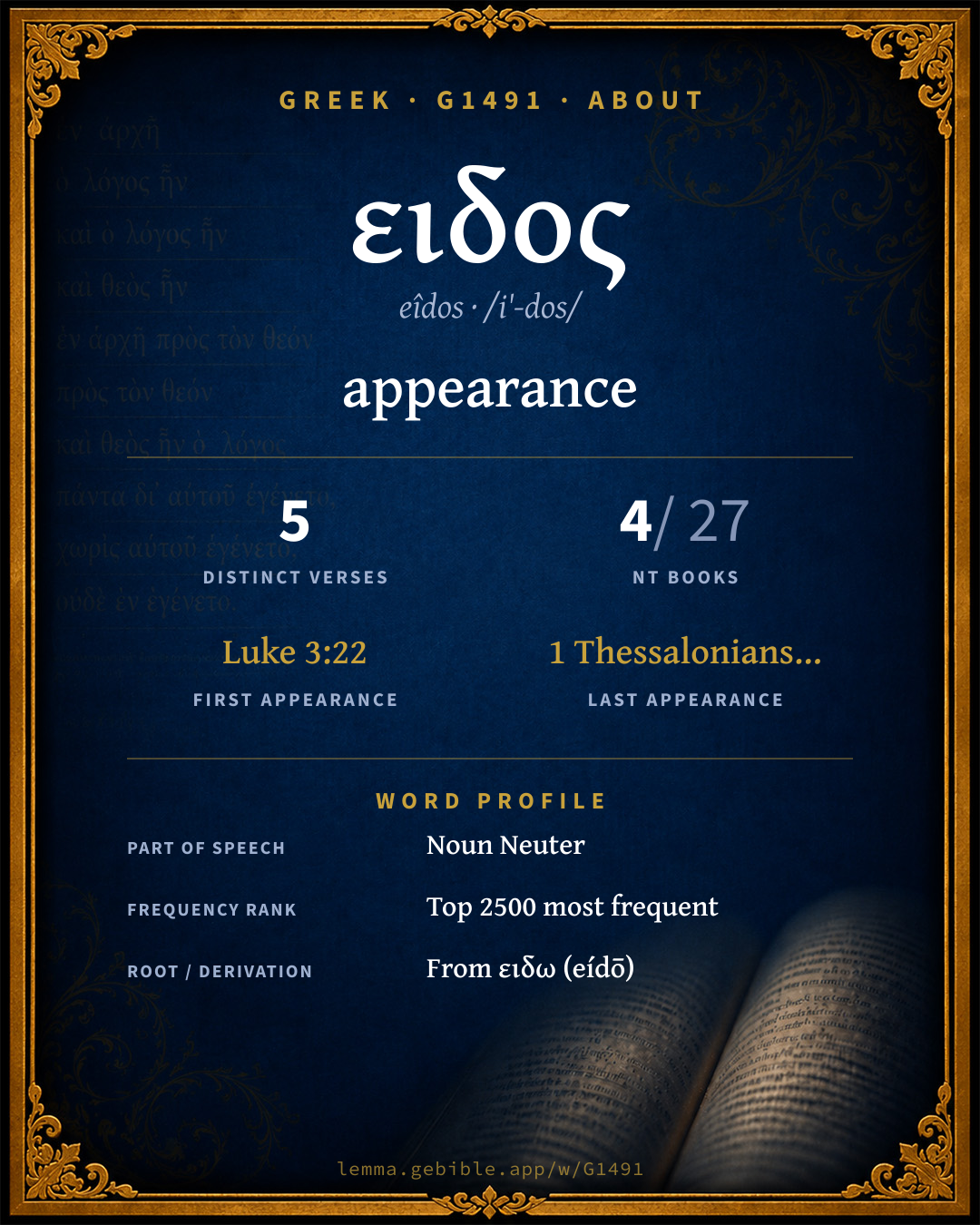
εἶδος
appearance
‘appearance’ is one of 2 main senses fuller range ↓
Full lexicon entry — Thayer's Greek Lexicon
From Thayer's Greek Lexicon
Where this word appears
Grammar key — what these labels mean
Part of speech
- Noun
- A naming word — a person, place, thing, or idea.
Case
- Genitive
- The case of source, possession, or “of” — answers “whose / from what.”
- Accusative
- The case of the direct object and of extent.
- Dative
- The case of the indirect object, means, or location — “to / for / with / in.”
- Nominative
- The case of the subject (and the predicate nominative).
Gender
- Neuter
- Grammatically neuter.
Number
- Singular
- One.
Every verse where G1491 appears in the Book of John — 1 distinct verse. Click any verse to open its interlinear word-by-word view. Verse text shown in the World English Bible for context — . Each verse’s Greek form is shown with its reference; the English is not keyword-highlighted, since the data carries no word-level English alignment. Use “Compare translations” on any verse to read it across multiple English versions. This concordance covers the Greek New Testament; Septuagint (Greek Old Testament) occurrences of this word are not indexed here.
John
About this entry
At a glance — auto-summarized from this page’s data, not written by a person. Every figure links to its source below. This summary describes the numbers; it doesn’t interpret them.
ειδος (eîdos) is a Greek noun most often rendered “appearance.” With only 5 verses it sits in the long tail of Greek New Testament vocabulary. Luke dominates its distribution — 2 of 5 verses. Debuting at Luke 3:22, it then recurs through the corpus. Its lexical range runs to 2 senses. The sections below give every sense, occurrence, and version rendering.
Gloss history
Strong's 1890 vs modern scholarship
About this word
Strong's G1491 catalogs a Greek word from the Greek New Testament.
These counts are not copied from any lexicon or concordance. They are computed here, from the morphology-tagged Greek New Testament. What Lemma adds →
- 5
- distinct verses
- The word appears in 5 distinct verses.
- 4 / 27
- NT books
- The word appears in 4 of 27 New Testament books.
- #1,648
- by frequency
- Top 2500 most frequent Greek words (rank 1,648 of 5,347 Greek words by occurrence).
View all 5 occurrences in the concordance →
Most concentrated in
- Luke 2 verses 40%
- John 1 verse 20%
- 2 Corinthians 1 verse 20%
By section of the New Testament
By traditional corpus
Conventional, traditional groupings — biblical authorship is debated, so this is a traditional corpus grouping, not an authorship claim. Some books belong to more than one corpus (Luke is in both the Gospels and the Lukan corpus, and so on), so these shares overlap and need not total 100%. Each figure is a share of the word’s 5 distinct verses.
- Gospels 3 verses · 60%
- Lukan (Luke–Acts) 2 verses · 40%
- Pauline corpus 2 verses · 40%
- Johannine 1 verse · 20%
How translations render this word
Counts come from each version’s own published word-to-Strong’s tagging or interlinear alignment — an approximate guide to how each version renders this word, not a word-level alignment the data otherwise carries. Because each total is that version’s own tagged count, the per-version totals vary from one another and need not match the appearance or distinct-verse counts above. These counts may also differ from a printed concordance because Lemma counts each distinctly tagged rendering and does not collapse phrase taggings into a single head-word total. This is a fixed set of word-tagged versions (KJV, ASV, BSB, ULT) and does not change with the reading translation you choose elsewhere. Each version’s license is shown beside its name below (and on Sources).
- King James Version: Shape 2×
- American Standard Version: Form 3×
- Berean Standard Bible: Form 3×
- unfoldingWord Literal Text: Form 3×
King James Version Public Domain
Renders G1491 across 5 tagged occurrences — most commonly:
Plus 3 renderings that appear only once — usually multi-word phrases or single function words the recovered tagging swept in, not distinct renderings.
American Standard Version Public Domain
Renders G1491 across 5 tagged occurrences — most commonly:
Plus 2 renderings that appear only once — usually multi-word phrases or single function words the recovered tagging swept in, not distinct renderings.
Berean Standard Bible Public Domain
Renders G1491 across 5 tagged occurrences — most commonly:
Plus 2 renderings that appear only once — usually multi-word phrases or single function words the recovered tagging swept in, not distinct renderings.
unfoldingWord Literal Text CC BY-SA 4.0
Renders G1491 across 6 tagged occurrences — most commonly:
Plus 3 renderings that appear only once — usually multi-word phrases or single function words the recovered tagging swept in, not distinct renderings.
Senses in Thayer's
The 2 senses Thayer's distinguishes for this word, in lexicon order (not ranked by frequency or importance). The full entry — with sub-senses — is in the Lexicon Entry tab.
- the external or outward appearance, form figure, shape
- form, kind
Word origin
Derived from ειδω (eídō) (G1492) — to see.
From G1492 ; a view that is form (literally or figuratively): - appearance fashion shape sight.
— Strong’s Exhaustive Concordance (1890), public domain.
Forms in the corpus
The 3 distinct written forms G1491 takes in the Greek New Testament, most frequent first — each parse links to that case’s occurrences in the concordance.
| Form | Parsing | Example | Uses |
|---|---|---|---|
| εἶδος eîdos | Noun, Accusative, Singular, Neuter | John 5:37 | 2 |
| εἴδους eídous | Noun, Genitive, Singular, Neuter | 2 Corinthians 5:7 | 2 |
| εἴδει eídei | Noun, Dative, Singular, Neuter | Luke 3:22 | 1 |
Same root — word family
Other Thayer's entries built from the same root as G1491, grouped by Strong’s listed origin. These share a root / origin per the lexicon — not necessarily a shared meaning. Each links to that word’s own entry.
Derives from
Shares the same root
- ιδε íde G2396 behold
- ιδεα idéa G2397 appearance
- ιδου idoú G2400 behold
- ισος ísos G2470 equal
- ιστορεω historéō G2477 to examine
Derived from this word
Proper names from this root
People and places named from this root — a name, not an additional meaning of the word.
Compare all same-root words → Showing 4 of 10 — not the complete family. 1 of the same-root words is a proper name (a person or place). They share a root, not necessarily a meaning.
Septuagint usage
The same Greek word ειδος appears 47 times in the Greek Old Testament (Septuagint), across 43 verses in 16 books.
- 47
- LXX occurrences
- Tagged occurrences of this Greek word in the Septuagint.
- 43
- verses
- Distinct Septuagint verses containing this word.
- 16 / 39
- OT books
- The word appears in 16 of the 39 Old Testament books.
Sample Septuagint occurrences
- Genesis 29:17 εἶδος
- Exodus 24:10 εἶδος
- Leviticus 13:43 εἶδος
- Numbers 8:4 εἶδος
- Deuteronomy 21:11 εἶδος
- Judges 13:6 εἶδος
- 1 Samuel 14:3 εἶδος
- 2 Samuel 11:2 εἶδος
- Esther 2:2 εἶδος
- Job 33:16 εἶδος
- Proverbs 7:10 εἶδος
- Song of Solomon 5:15 εἶδος
Septuagint occurrences (same lexeme)
Every verse where the same Strong’s number (G1491) appears in the Greek Septuagint. Verse text shown in the World English Bible for context; the Greek form is the matched word — the English is not keyword-highlighted.
- Genesis 29:17 εἶδος Leah's eyes were weak, but Rachel was beautiful and well favored.
- Genesis 32:31 εἶδος The sun rose on him as he passed over Peniel, and he limped because of his thigh.
- Genesis 32:32 εἶδος Therefore the children of Israel don't eat the sinew of the hip, which is on the hollow of the thigh, to this day, because he touched the hollow of Jacob's thigh in the sinew of the hip.
- Genesis 39:6 εἶδος He left all that he had in Joseph's hand. He didn't concern himself with anything, except for the food which he ate. Joseph was well-built and handsome.
- Genesis 41:2 εἶδος Behold, there came up out of the river seven cattle, well-favored and fat-fleshed, and they fed in the reed-grass.
- Genesis 41:3 εἶδος Behold, seven other cattle came up after them out of the river, ill-favored and lean-fleshed, and stood by the other cattle on the brink of the river.
- Genesis 41:4 εἶδος The ill-favored and lean-fleshed cattle ate up the seven well-favored and fat cattle. So Pharaoh awoke.
- Genesis 41:18 εἶδος and, behold, there came up out of the river seven cattle, fat-fleshed and well-favored. They fed in the reed-grass,
- Genesis 41:19 εἶδος and, behold, seven other cattle came up after them, poor and very ill-favored and lean-fleshed, such as I never saw in all the land of Egypt for ugliness.
- Exodus 24:10 εἶδος They saw the God of Israel. Under his feet was like a paved work of sapphire stone, like the skies for clearness.
- Exodus 24:17 εἶδος The appearance of the glory of Yahweh was like devouring fire on the top of the mountain in the eyes of the children of Israel.
- Exodus 26:30 εἶδος You shall set up the tent according to the way that it was shown to you on the mountain.
- Exodus 28:33 εἶδος On its hem you shall make pomegranates of blue, and of purple, and of scarlet, around its hem; and bells of gold between them round about:
- Leviticus 13:43 εἶδος Then the priest shall examine him; and, behold, if the rising of the plague is reddish-white in his bald head, or in his bald forehead, like the appearance of leprosy in the skin of the flesh,
- Numbers 8:4 εἶδος This was the workmanship of the lampstand, beaten work of gold. From its base to its flowers, it was beaten work: according to the pattern which Yahweh had shown Moses, so he made the lampstand.
- Numbers 9:15 εἶδος On the day that the tabernacle was raised up, the cloud covered the tabernacle, even the Tent of the Testimony: and at evening it was over the tabernacle as it were the appearance of fire, until morning.
- Numbers 9:16 εἶδος So it was continually. The cloud covered it, and the appearance of fire by night.
- Numbers 11:7 εἶδος The manna was like coriander seed, and the appearance of it as the appearance of bdellium.
- Numbers 12:8 εἶδος with him will I speak mouth to mouth, even manifestly, and not in dark speeches; and the form of Yahweh shall he see: why then were you not afraid to speak against my servant, against Moses?
- Deuteronomy 21:11 εἶδος and see among the captives a beautiful woman, and you have a desire to her, and would take her to you as wife;
- Judges 13:6 εἶδος Then the woman came and told her husband, saying, A man of God came to me, and his face was like the face of the angel of God, very awesome; and I didn't ask him whence he was, neither did he tell me his name:
- 1 Samuel 14:3 εἶδος and Ahijah, the son of Ahitub, Ichabod's brother, the son of Phinehas, the son of Eli, the priest of Yahweh in Shiloh, wearing an ephod. The people didn't know that Jonathan was gone.
- 1 Samuel 16:18 εἶδος Then answered one of the young men, and said, Behold, I have seen a son of Jesse the Bethlehemite, who is skillful in playing, and a mighty man of valor, and a man of war, and prudent in speech, and a comely person; and Yahweh is with him.
- 1 Samuel 22:15 εἶδος Have I today begun to inquire of God for him? be it far from me: don't let the king impute anything to his servant, nor to all the house of my father; for your servant knows nothing of all this, less or more.
- 1 Samuel 25:3 εἶδος Now the name of the man was Nabal; and the name of his wife Abigail; and the woman was of good understanding, and of a beautiful face: but the man was churlish and evil in his doings; and he was of the house of Caleb.
- 2 Samuel 11:2 εἶδος It happened at evening, that David arose from off his bed, and walked on the roof of the king's house: and from the roof he saw a woman bathing; and the woman was very beautiful to look on.
- 2 Samuel 11:16 εἶδος It happened, when Joab kept watch on the city, that he assigned Uriah to the place where he knew that valiant men were.
- 2 Samuel 13:1 εἶδος It happened after this, that Absalom the son of David had a beautiful sister, whose name was Tamar; and Amnon the son of David loved her.
- Esther 2:2 εἶδος Then said the king's servants who ministered to him, Let there be beautiful young virgins sought for the king:
- Esther 2:3 εἶδος and let the king appoint officers in all the provinces of his kingdom, that they may gather together all the beautiful young virgins to Shushan the palace, to the house of the women, to the custody of Hegai the king's chamberlain, keeper of the women; and let their things for purification be given them;
- Esther 2:7 εἶδος He brought up Hadassah, who is, Esther, his uncle's daughter: for she had neither father nor mother, and the maiden was fair and beautiful; and when her father and mother were dead, Mordecai took her for his own daughter.
- Job 33:16 εἶδος Then he opens the ears of men, And seals their instruction,
- Job 41:10 εἶδος None is so fierce that he dare stir him up. Who then is he who can stand before me?
- Proverbs 7:10 εἶδος Behold, there a woman met him with the attire of a prostitute, And with crafty intent.
- Song of Solomon 5:15 εἶδος His legs are like pillars of marble set on sockets of fine gold. His appearance is like Lebanon, excellent as the cedars.
- Isaiah 52:14 εἶδος Like as many were astonished at you (his visage was so marred more than any man, and his form more than the sons of men),
- Isaiah 53:2 εἶδος For he grew up before him as a tender plant, and as a root out of a dry ground: he has no form nor comeliness; and when we see him, there is no beauty that we should desire him.
- Isaiah 53:3 εἶδος He was despised, and rejected by men; a man of suffering, and acquainted with disease: and as one from whom men hide their face he was despised; and we didn't respect him.
- Jeremiah 11:16 εἶδος Yahweh called your name, A green olive tree, beautiful with goodly fruit: with the noise of a great tumult he has kindled fire on it, and the branches of it are broken.
- Jeremiah 15:3 εἶδος I will appoint over them four kinds, says Yahweh: the sword to kill, and the dogs to tear, and the birds of the sky, and the animals of the earth, to devour and to destroy.
- Lamentations 4:8 εἶδος Their visage is blacker than a coal; they are not known in the streets: Their skin cleaves to their bones; it is withered, it is become like a stick.
- Ezekiel 1:16 εἶδος The appearance of the wheels and their work was like a beryl: and they four had one likeness; and their appearance and their work was as it were a wheel within a wheel.
- Ezekiel 1:26 εἶδος Above the expanse that was over their heads was the likeness of a throne, as the appearance of a sapphire stone; and on the likeness of the throne was a likeness as the appearance of a man on it above.
These are occurrences of the same Greek lexeme (G1491) in the Septuagint — not a translation of any one Hebrew word. The store carries no word-level Hebrew↔Greek alignment, so no Hebrew original is asserted here. Counts come from the recovered LXX Strong's tagging — high-frequency vocabulary is well covered, while rare or late forms may be untagged — so they reflect tagged occurrences and may slightly undercount.