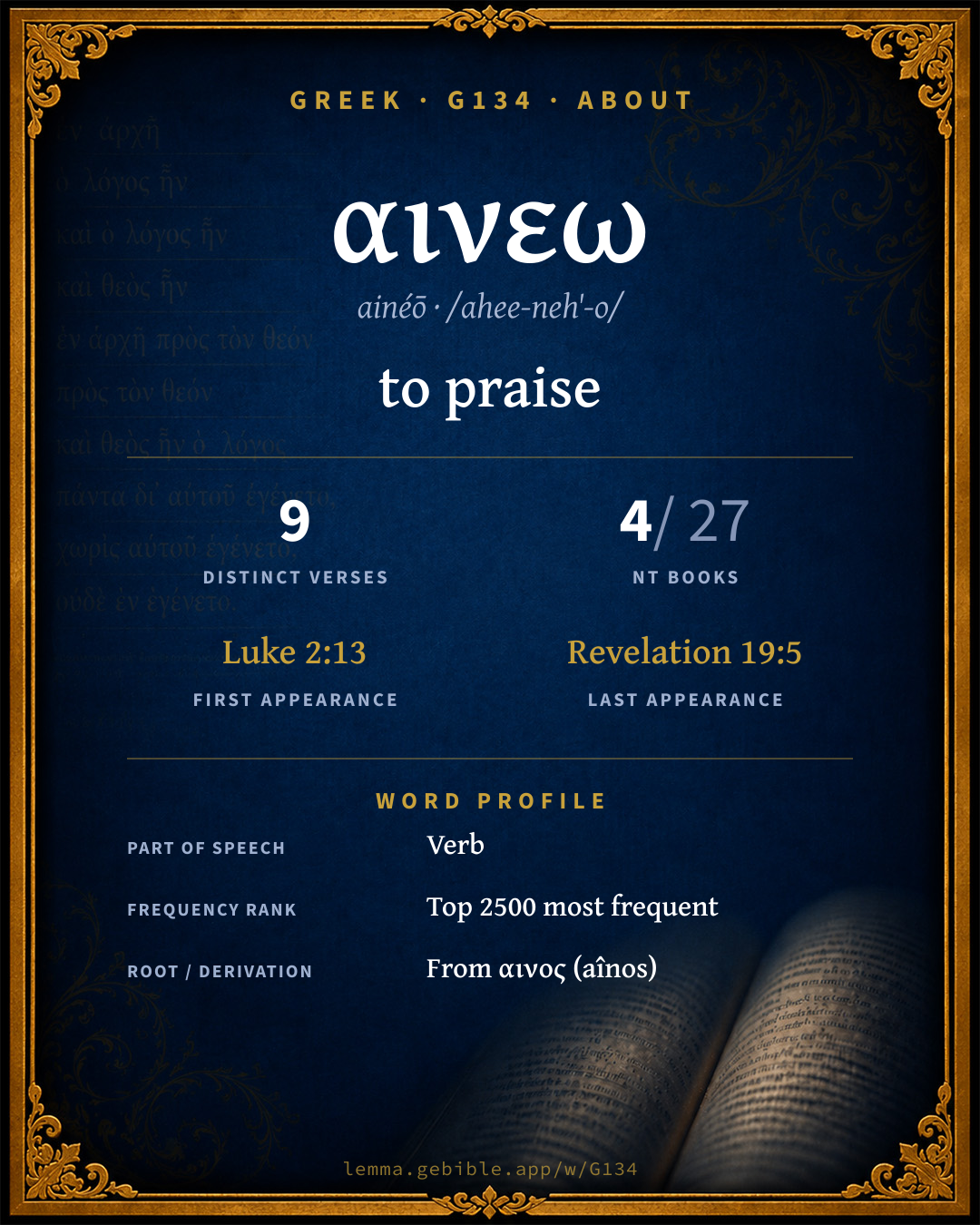
αἰνέω
to praise
‘to praise’ is one of 3 main senses fuller range ↓
Full lexicon entry — Thayer's Greek Lexicon
From Thayer's Greek Lexicon
Where this word appears
Grammar key — what these labels mean
Part of speech
- Verb
- An action or state-of-being word.
Tense
- Present
- Ongoing or general action in present time (imperfective aspect).
Voice
- Active
- The subject performs the action.
Mood
- Participle
- A verbal adjective (“writing,” “having written”).
- Imperative
- Expresses a command or request.
- Infinitive
- A verbal noun (“to write”), unmarked for person or number.
Case
- Nominative
- The case of the subject (and the predicate nominative).
- Accusative
- The case of the direct object and of extent.
- Genitive
- The case of source, possession, or “of” — answers “whose / from what.”
Person
- 2nd person
- The one addressed (“you”).
Gender
- Masculine
- Grammatically masculine.
Number
- Plural
- More than one.
- Singular
- One.
Grammatical forms
- Verb, Present, Active, Participle, Nominative, Plural, Masculine 3 times (33%)
- Verb, Present, Active, Imperative, 2nd person, Plural 2 times (22%)
- Verb, Present, Active, Infinitive 1 time (11%)
- Verb, Present, Active, Participle, Accusative, Singular, Masculine 1 time (11%)
- Verb, Present, Active, Participle, Genitive, Plural, Masculine 1 time (11%)
- Verb, Present, Active, Participle, Nominative, Singular, Masculine 1 time (11%)
Parsed forms decoded from the imported morphology (Robinson–Tischendorf, public domain), counted across 9 parsed occurrences — not distinct verses.
Every verse where G134 appears — 9 distinct verses across 4 books. Click any verse to open its interlinear word-by-word view. Verse text shown in the World English Bible for context — . Each verse’s Greek form is shown with its reference; the English is not keyword-highlighted, since the data carries no word-level English alignment. Use “Compare translations” on any verse to read it across multiple English versions. This concordance covers the Greek New Testament; Septuagint (Greek Old Testament) occurrences of this word are not indexed here.
Luke 4 verses
- Luke 2:13 αἰνούντων pres act ptcp gen pl masc Suddenly, there was with the angel a multitude of the heavenly host praising God, and saying,
- Luke 2:20 αἰνοῦντες pres act ptcp nom pl masc The shepherds returned, glorifying and praising God for all the things that they had heard and seen, just as it was told them.
- Luke 19:37 αἰνεῖν pres act inf As he was now getting near, at the descent of the Mount of Olives, the whole multitude of the disciples began to rejoice and praise God with a loud voice for all the mighty works which they had seen,
- Luke 24:53 αἰνοῦντες pres act ptcp nom pl masc and were continually in the temple, praising and blessing God. Amen.
Acts 3 verses
- Acts 2:47 αἰνοῦντες pres act ptcp nom pl masc praising God, and having favor with all the people. The Lord added to the assembly day by day those who were being saved.
- Acts 3:8 αἰνῶν pres act ptcp nom sg masc Leaping up, he stood, and began to walk. He entered with them into the temple, walking, leaping, and praising God.
- Acts 3:9 αἰνοῦντα pres act ptcp acc sg masc All the people saw him walking and praising God.
Romans 1 verse
Revelation 1 verse
About this entry
At a glance — auto-summarized from this page’s data, not written by a person. Every figure links to its source below. This summary describes the numbers; it doesn’t interpret them.
αινεω — transliterated ainéō — is a Greek verb carrying the sense “to praise.” It first appears in Luke 2:13. The Greek New Testament uses it across 9 verses — uncommon. More than a third of its appearances fall in Luke. Its lexical range runs to 3 senses. See the sense tree, 9-verse concordance, and the renderings breakdown below.
Gloss history
Strong's 1890 vs modern scholarship

About this word
Strong's G134 catalogs a Greek word from the Greek New Testament.
These counts are not copied from any lexicon or concordance. They are computed here, from the morphology-tagged Greek New Testament. What Lemma adds →
- 9
- distinct verses
- The word appears in 9 distinct verses.
- 4 / 27
- NT books
- The word appears in 4 of 27 New Testament books.
- #1,140
- by frequency
- Top 2500 most frequent Greek words (rank 1,140 of 5,347 Greek words by occurrence).
View all 9 occurrences in the concordance →
By section of the New Testament
By traditional corpus
Conventional, traditional groupings — biblical authorship is debated, so this is a traditional corpus grouping, not an authorship claim. Some books belong to more than one corpus (Luke is in both the Gospels and the Lukan corpus, and so on), so these shares overlap and need not total 100%. Each figure is a share of the word’s 9 distinct verses.
- Lukan (Luke–Acts) 7 verses · 78%
- Gospels 4 verses · 44%
- Johannine 1 verse · 11%
- Pauline corpus 1 verse · 11%
- Revelation 1 verse · 11%
How translations render this word
Counts come from each version’s own published word-to-Strong’s tagging or interlinear alignment — an approximate guide to how each version renders this word, not a word-level alignment the data otherwise carries. Because each total is that version’s own tagged count, the per-version totals vary from one another and need not match the appearance or distinct-verse counts above. These counts may also differ from a printed concordance because Lemma counts each distinctly tagged rendering and does not collapse phrase taggings into a single head-word total. This is a fixed set of word-tagged versions (KJV, ASV, BSB, ULT) and does not change with the reading translation you choose elsewhere. Each version’s license is shown beside its name below (and on Sources).
- King James Version: Praising 6×, Praise 3×
- American Standard Version: Praising 5×, Praise 2×
- Berean Standard Bible: Praising 5×, Praise 3×
- unfoldingWord Literal Text: Praising 5×, Praise 3×
King James Version Public Domain
Renders G134 across 10 tagged occurrences — most commonly:
Plus 1 rendering that appears only once — usually multi-word phrases or single function words the recovered tagging swept in, not distinct renderings.
American Standard Version Public Domain
Renders G134 across 8 tagged occurrences — most commonly:
Plus 1 rendering that appears only once — usually multi-word phrases or single function words the recovered tagging swept in, not distinct renderings.
Berean Standard Bible Public Domain
Renders G134 across 8 tagged occurrences — most commonly:
unfoldingWord Literal Text CC BY-SA 4.0
Renders G134 across 8 tagged occurrences — most commonly:
Senses in Thayer's
The 3 senses Thayer's distinguishes for this word, in lexicon order (not ranked by frequency or importance). The full entry — with sub-senses — is in the Lexicon Entry tab.
- to praise, extol, to sing praises in honour to God
- to allow, recommend
- to promise or vow
Word origin
Derived from αινος (aînos) (G136) — saying.
From G136 ; to praise (God): - praise.
— Strong’s Exhaustive Concordance (1890), public domain.
Forms in the corpus
The 6 distinct written forms G134 takes in the Greek New Testament, most frequent first — each parse links to that tense’s occurrences in the concordance.
| Form | Parsing | Example | Uses |
|---|---|---|---|
| αἰνοῦντες ainoûntes | Verb, Present, Active, Participle, Nominative, Plural, Masculine | Luke 2:20 | 3 |
| αἰνεῖτε aineîte | Verb, Present, Active, Imperative, 2nd person, Plural | Romans 15:11 | 2 |
| αἰνεῖν aineîn | Verb, Present, Active, Infinitive | Luke 19:37 | 1 |
| αἰνούντων ainoúntōn | Verb, Present, Active, Participle, Genitive, Plural, Masculine | Luke 2:13 | 1 |
| αἰνοῦντα ainoûnta | Verb, Present, Active, Participle, Accusative, Singular, Masculine | Acts 3:9 | 1 |
| αἰνῶν ainō̂n | Verb, Present, Active, Participle, Nominative, Singular, Masculine | Acts 3:8 | 1 |
Same root — word family
Other Thayer's entries built from the same root as G134, grouped by Strong’s listed origin. These share a root / origin per the lexicon — not necessarily a shared meaning. Each links to that word’s own entry.
Derives from
Shares the same root
Derived from this word
Compare all same-root words → They share a root, not necessarily a meaning.
Septuagint usage
The same Greek word αινεω appears 97 times in the Greek Old Testament (Septuagint), across 80 verses in 12 books.
- 97
- LXX occurrences
- Tagged occurrences of this Greek word in the Septuagint.
- 80
- verses
- Distinct Septuagint verses containing this word.
- 12 / 39
- OT books
- The word appears in 12 of the 39 Old Testament books.
Sample Septuagint occurrences
- Genesis 49:8 αἰνέω
- 1 Chronicles 16:4 αἰνέω
- 2 Chronicles 5:13 αἰνέω
- Ezra 3:10 αἰνέω
- Job 33:30 αἰνέω
- Psalms 17:4 αἰνέω
- Proverbs 31:28 αἰνέω
- Song of Solomon 6:9 αἰνέω
- Isaiah 38:18 αἰνέω
- Jeremiah 4:2 αἰνέω
- Daniel 2:23 αἰνέω
- Joel 2:26 αἰνέω
Septuagint occurrences (same lexeme)
Every verse where the same Strong’s number (G134) appears in the Greek Septuagint — showing the first 50 of 80. Verse text shown in the World English Bible for context; the Greek form is the matched word — the English is not keyword-highlighted.
- Genesis 49:8 αἰνέω "Judah, your brothers will praise you: Your hand will be on the neck of your enemies; Your father's sons will bow down before you.
- 1 Chronicles 16:4 αἰνέω He appointed certain of the Levites to minister before the ark of Yahweh, and to celebrate and to thank and praise Yahweh, the God of Israel:
- 1 Chronicles 16:7 αἰνέω Then on that day David first ordained to give thanks to Yahweh, by the hand of Asaph and his brothers.
- 1 Chronicles 16:10 αἰνέω Glory you in his holy name; Let the heart of them rejoice who seek Yahweh.
- 1 Chronicles 16:35 αἰνέω Say you, Save us, God of our salvation, Gather us together and deliver us from the nations, To give thanks to your holy name, To triumph in your praise.
- 1 Chronicles 16:36 αἰνέω Blessed be Yahweh, the God of Israel, From everlasting even to everlasting. All the people said, Amen, and praised Yahweh.
- 1 Chronicles 16:41 αἰνέω and with them Heman and Jeduthun, and the rest who were chosen, who were mentioned by name, to give thanks to Yahweh, because his loving kindness endures forever;
- 1 Chronicles 23:5 αἰνέω and four thousand were doorkeepers; and four thousand praised Yahweh with the instruments which I made, [said David], for giving praise.
- 1 Chronicles 23:30 αἰνέω and to stand every morning to thank and praise Yahweh, and likewise in the evening;
- 1 Chronicles 29:13 αἰνέω Now therefore, our God, we thank you, and praise your glorious name.
- 2 Chronicles 5:13 αἰνέω it happened, when the trumpeters and singers were as one, to make one sound to be heard in praising and thanking Yahweh; and when they lifted up their voice with the trumpets and cymbals and instruments of music, and praised Yahweh, [saying], For he is good; for his loving kindness endures forever; that then the house was filled with a cloud, even the house of Yahweh,
- 2 Chronicles 6:26 αἰνέω When the sky is shut up, and there is no rain, because they have sinned against you; if they pray toward this place, and confess your name, and turn from their sin, when you do afflict them:
- 2 Chronicles 7:3 αἰνέω All the children of Israel looked on, when the fire came down, and the glory of Yahweh was on the house; and they bowed themselves with their faces to the ground on the pavement, and worshiped, and gave thanks to Yahweh, [saying], For he is good; for his loving kindness endures for ever.
- 2 Chronicles 8:14 αἰνέω He appointed, according to the ordinance of David his father, the divisions of the priests to their service, and the Levites to their offices, to praise, and to minister before the priests, as the duty of every day required; the doorkeepers also by their divisions at every gate: for so had David the man of God commanded.
- 2 Chronicles 20:19 αἰνέω The Levites, of the children of the Kohathites and of the children of the Korahites, stood up to praise Yahweh, the God of Israel, with an exceeding loud voice.
- 2 Chronicles 20:21 αἰνέω When he had taken counsel with the people, he appointed those who should sing to Yahweh, and give praise in holy array, as they went out before the army, and say, Give thanks to Yahweh; for his loving kindness endures forever.
- 2 Chronicles 23:12 αἰνέω When Athaliah heard the noise of the people running and praising the king, she came to the people into the house of Yahweh:
- 2 Chronicles 31:2 αἰνέω Hezekiah appointed the divisions of the priests and the Levites after their divisions, every man according to his service, both the priests and the Levites, for burnt offerings and for peace-offerings, to minister, and to give thanks, and to praise in the gates of the camp of Yahweh.
- Ezra 3:10 αἰνέω When the builders laid the foundation of the temple of Yahweh, they set the priests in their clothing with trumpets, and the Levites the sons of Asaph with cymbals, to praise Yahweh, after the order of David king of Israel.
- Ezra 3:11 αἰνέω They sang one to another in praising and giving thanks to Yahweh, [saying], For he is good, for his loving kindness endures forever toward Israel. All the people shouted with a great shout, when they praised Yahweh, because the foundation of the house of Yahweh was laid.
- Ezra 15:13 αἰνέω
- Ezra 22:24 αἰνέω
- Ezra 22:36 αἰνέω
- Job 33:30 αἰνέω To bring back his soul from the pit, That he may be enlightened with the light of the living.
- Job 35:14 αἰνέω How much less when you say you don't see him. The cause is before him, and you wait for him!
- Job 38:7 αἰνέω When the morning stars sang together, And all the sons of God shouted for joy?
- Psalms 17:4 αἰνέω As for the works of men, by the word of your lips I have kept myself from the ways of the violent.
- Psalms 21:24 αἰνέω
- Psalms 21:27 αἰνέω
- Psalms 34:18 αἰνέω Yahweh is near to those who have a broken heart, And saves those who have a crushed spirit.
- Psalms 55:11 αἰνέω Destructive forces are within her. Threats and lies don't depart from her streets.
- Psalms 62:6 αἰνέω He alone is my rock and my salvation, my fortress. I will not be shaken.
- Psalms 68:31 αἰνέω Princes shall come out of Egypt. Ethiopia shall hurry to stretch out her hands to God.
- Psalms 68:35 αἰνέω You are awesome, God, in your sanctuaries. The God of Israel gives strength and power to his people. Praise be to God!
- Psalms 73:21 αἰνέω For my soul was grieved. I was embittered in my heart.
- Psalms 83:5 αἰνέω For they have conspired together with one mind. They form an alliance against you.
- Psalms 99:4 αἰνέω The King's strength also loves justice. You do establish equity. You execute justice and righteousness in Jacob.
- Psalms 106:32 αἰνέω They angered him also at the waters of Meribah, So that Moses was troubled for their sakes;
- Psalms 108:30 αἰνέω
- Psalms 112:1 αἰνέω Praise Yah! Blessed is the man who fears Yahweh, Who delights greatly in his commandments.
- Psalms 112:3 αἰνέω Wealth and riches are in his house. His righteousness endures forever.
- Psalms 113:25 αἰνέω
- Psalms 116:1 αἰνέω I love Yahweh, because he listens to my voice, And my cries for mercy.
- Psalms 118:164 αἰνέω
- Psalms 118:175 αἰνέω
- Psalms 134:1 αἰνέω Look! Praise Yahweh, all you servants of Yahweh, Who stand by night in Yahweh's house!
- Psalms 134:3 αἰνέω May Yahweh bless you from Zion; Even he who made heaven and earth.
- Psalms 144:2 αἰνέω My loving kindness, my fortress, My high tower, my deliverer, My shield, and he in whom I take refuge; Who subdues my people under me.
- Psalms 145:1 αἰνέω I will exalt you, my God, the King. I will praise your name forever and ever.
- Psalms 145:2 αἰνέω Every day I will praise you. I will extol your name forever and ever.
These are occurrences of the same Greek lexeme (G134) in the Septuagint — not a translation of any one Hebrew word. The store carries no word-level Hebrew↔Greek alignment, so no Hebrew original is asserted here. Counts come from the recovered LXX Strong's tagging — high-frequency vocabulary is well covered, while rare or late forms may be untagged — so they reflect tagged occurrences and may slightly undercount.