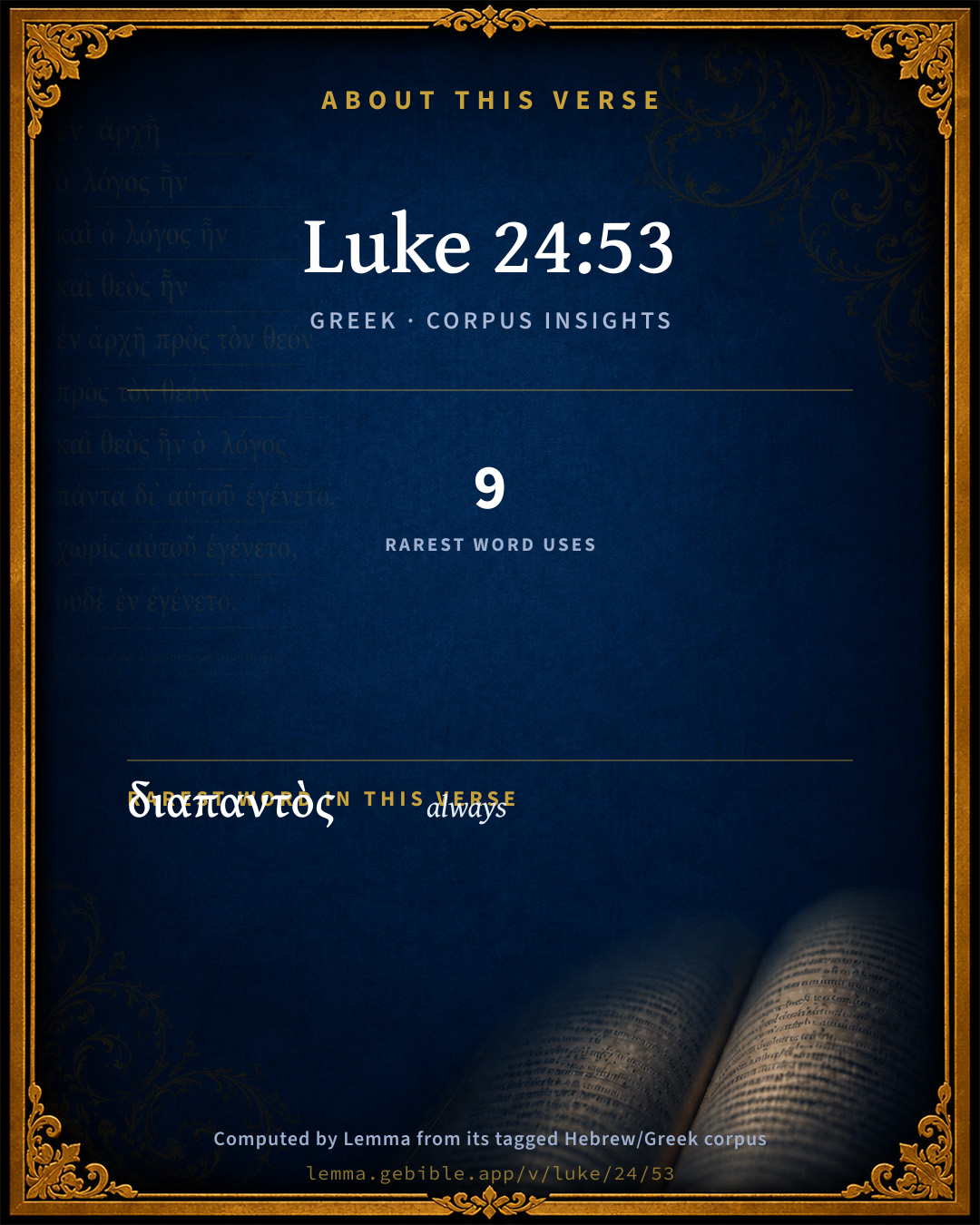
Luke 24:53

Greek (Tischendorf 8th ed.) Luke 24:53 appears in the Greek New Testament. The text above is from the Tischendorf 8th edition. Each word links to its Strong’s number and a concise gloss. Click any word for its full Thayer’s Greek Lexicon entry.
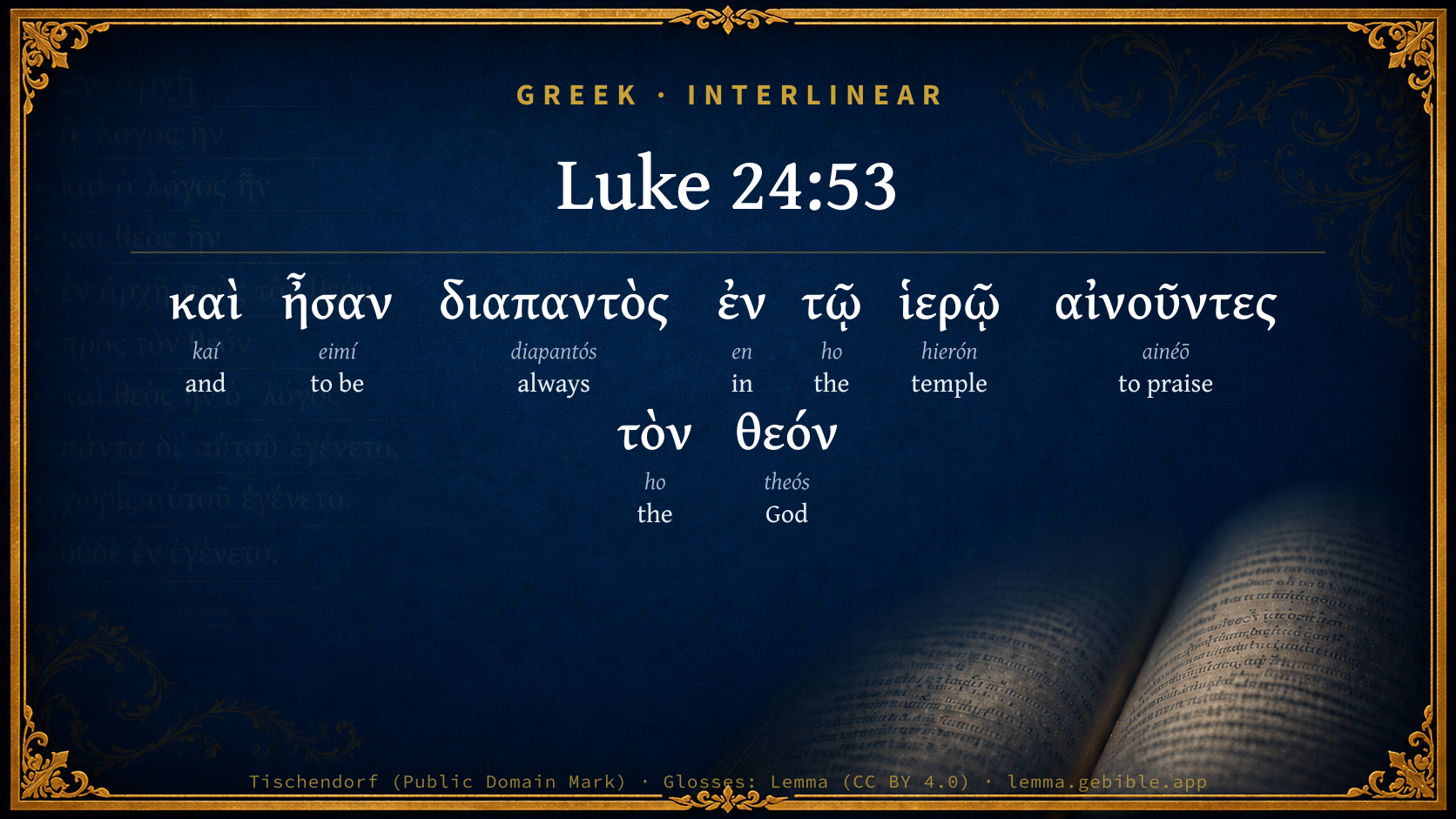
Download image
Cite this verse

Luke 24:53 (World English Bible). Public Domain. Lemma interlinear Bible study tool, https://lemma.gebible.app/v/luke/24/53.

Show BibTeX & RIS
BibTeX
RIS
English Translation
and were continually in the temple, praising and blessing God. Amen.
World English Bible · Public Domain
Download a study sheet

One document with this verse’s original text, its word-by-word gloss line, the meaning frame, cross-references with their text, attributed commentary, and full source and license credits — printable, and it pastes into notes with its structure intact.

This verse Autodidact and up

Study sheet (.html) Plain text (.txt)

A passage Seminary Student

Up to 50 verses in one chapter. A passage sheet keeps up to 6 commentary sources and 12 cross-references per verse, in the order this page ranks them, and says so on the sheet whenever that leaves anything out. Ask for a single verse and you get the Autodidact verse sheet above.

Everything on this page stays free to read, with no account — the sheet is a download of what is already on screen, not access to it.

Want to remove ads? Support Godless Engineer
Compare translations 3

The same verse in 3 English versions, stacked beneath the original-language interlinear above. Click any original word for its lexicon entry.

Each is an independent rendering of the whole verse — the interlinear is not word-aligned to these translations.

Highlighted words mark where these versions differ — a whole-verse word diff, not a word-by-word alignment.

  • World English Bible Public Domain
    and were continually in the temple, praising and blessing God. Amen.
  • King James Version Public Domain
    And were continually in the temple, praising and blessing God. Amen.
  • unfoldingWord Literal Text CC BY-SA 4.0
    and they were through all in the temple, blessing God.

unfoldingWord Literal Text — © unfoldingWord, licensed CC BY-SA 4.0. Word-aligned USFM3 via Door43 (git.door43.org/unfoldingWord/en_ult).

Versions to compare (up to 4)

3 of 4 selected

Show all 19 translations

Every available English version of this verse, each an independent rendering of the whole verse.

  • World English Bible Public Domain
    and were continually in the temple, praising and blessing God. Amen.
  • Berean Standard Bible Public Domain
    praising God continually in the temple.
  • Majority Standard Bible Public Domain
    praising and blessing God continually in the temple.
  • King James Version Public Domain
    And were continually in the temple, praising and blessing God. Amen.
  • American Standard Version (1901) Public Domain
    and were continually in the temple, blessing God.
  • Revised Version (1885) Public Domain
    and were continually in the temple, blessing God.
  • Geneva Bible (1599) Public Domain
    And were continually in the Temple, praysing, and lauding God, Amen.
  • Douay-Rheims (1899) Public Domain
    And they were always in the temple, praising and blessing God. Amen.
  • Young's Literal Translation Public Domain
    and were continually in the temple, praising and blessing God. Amen.
  • Literal Standard Version CC BY-SA 4.0
    and were continually in the temple, praising and blessing God. Amen.
  • Unlocked Literal Bible CC BY-SA 4.0
    They were continually in the temple, blessing God.
  • unfoldingWord Literal Text CC BY-SA 4.0
    and they were through all in the temple, blessing God.
  • Darby Bible Public Domain
    and were continually in the temple praising and blessing God.
  • World Messianic Bible Public Domain
    and were continually in the temple, praising and blessing God. Amen.
  • Webster's Bible Public Domain
    And were continually in the temple, praising and blessing God. Amen.
  • Free Bible Version CC BY-SA 4.0
    They spent all their time in the Temple praising God.
  • Bible in Basic English Public Domain
    And they were in the Temple at all times, giving praise to God.
  • Text-Critical English NT CC BY 4.0
    And they were continually in the temple courts, praising and blessing God. Amen.
  • Tyndale New Testament (1534) Public Domain
    and were continually in the temple praysinge and laudinge God. Amen.

Literal Standard Version (2020), Covenant Press — licensed CC BY-SA 4.0. Text via the HelloAO Bible API (eBible.org). Unlocked Literal Bible (unfoldingWord) — licensed CC BY-SA 4.0. Text via the HelloAO Bible API (eBible.org). unfoldingWord Literal Text — © unfoldingWord, licensed CC BY-SA 4.0. Word-aligned USFM3 via Door43 (git.door43.org/unfoldingWord/en_ult). Free Bible Version, Dr. Jonathan Gallagher — licensed CC BY-SA 4.0. Text via the HelloAO Bible API (eBible.org).

Word by word

More ways to search: Search by grammar → Find every occurrence → Compare this word →

Practice this passage: Drill this verse → Learn its vocabulary →

About this verse

These counts appear in no published source. They are computed here, from the morphology-tagged text and Lemma’s own curated glosses. What Lemma adds →

9
words
8
distinct lemmas
Gospels
section

Notable vocabulary

The rarest word here is διαπαντὸς always G1275 — appearing just 9 times in the whole Greek New Testament.

Shared distinctive vocabulary

διαπαντὸς always G1275 occurs in 9 verses of the Greek New Testament. Also found in:

Repetition

A word recurs within this verse:

Cross-references

5

Topical passages linked to Luke 24:53 in the Treasury of Scripture Knowledge — connected by theme and wording, ordered by reader-vote popularity; previews shown in the World English Bible.

  • Mark 16:20 They went out, and preached everywhere, the Lord working with them, and confirming the word by the signs that followed. Amen.
  • Matthew 28:20 teaching them to observe all things that I commanded you. Behold, I am with you always, even to the end of the age." Amen.
  • Acts 2:46–47 Day by day, continuing steadfastly with one accord in the temple, and breaking bread at home, they took their food with gladness and singleness of heart,
  • Acts 5:41–42 They therefore departed from the presence of the council, rejoicing that they were counted worthy to suffer dishonor for Jesus' name.
  • Revelation 22:21 The grace of the Lord Jesus Christ be with all the saints. Amen.

Cross-references courtesy of OpenBible.info (CC BY 4.0).

Where the printed editions differ

3 variants

Places in this verse where the major printed Greek editions disagree on the wording in a way that affects the translation — a comparison of editions, not a manuscript-by-manuscript collation. The editions are the modern critical texts (Nestlé-Aland 28/27, SBL, Westcott-Hort, Tregelles, Tyndale House) and the traditional texts behind the KJV (the Textus Receptus and the Byzantine/Majority text). It is not a claim about which reading is original.

  1. Editions differ
    διὰ

    “through”

    In NA28NA27TynSBLWHTregTR»1Byz Not in TR
  2. Extra text
    αἰνοῦντες καὶ

    “praising and”

    In TregTRByz Not in NA28NA27TynSBLWH

    αἰνοῦντες καὶ (ainountes kai) 'praising and' is only in traditional manuscripts (Treg+TR+Byz)

  3. Extra text
    ἀμήν¶

    “Amen”

    In TRByz Not in NA28NA27TynSBLWHTreg

    ἀμήν¶ (amēn) 'Amen' is only in traditional manuscripts (TR+Byz)

Textual data: Translators Amalgamated Greek New Testament (STEPBible TAGNT) · CC BY 4.0.

Commentary

Notes on Luke 24:53 from classic Christian and Jewish commentators (each source and its license shown beneath its notes). The classic Christian expositions comment on the surrounding passage and are grouped to its opening verse, so a note may address several verses; the Jewish commentaries on the Tanakh (Rashi and others) are per-verse, so they appear only where the commentator wrote on this verse.

Lemma curates 59 commentaries, every one of them public domain or Creative Commons licensed, each selected and text-cleaned for this edition rather than reprinted as found. About our sources →

Tyndale Open Study Notes

Tyndale Open Resources

24:53 The Temple was a place of worship as well as of sacrifice. The apostles continued in their Jewish manner of worship because their goal was not to create a new religion but to announce the fulfillment of Scripture’s promises of salvation through Jesus the Messiah.

Tyndale Open Study Notes — © Tyndale Open Resources, licensed CC BY-SA 4.0. Text via the HelloAO Bible API.

Bengel's Gnomon

Johann Albrecht Bengel

Luk 24:53. Διαπαντὸς ἐν τῷ ἱερῷ, continually in the temple) ch. Luk 2:37 [“Anna—departed not from the temple, but served God with fastings and prayers night and day”].—αἰνοῦντες, praising) which is the fruit of joy.[276]

[276] Bengel, J. A. (1860). Vol. 2: Gnomon of the New Testament (M. E. Bengel & J. C. F. Steudel, Ed.) (A. R. Fausset, Trans.) (117–225). Edinburgh: T&T Clark.

Bengel's Gnomon of the New Testament — English translation (T&T Clark, Edinburgh, 1860) — public domain. Text from a community e-Sword module.

Meyer's Critical & Exegetical Commentary

Heinrich August Wilhelm Meyer

Luk_24:53. Καὶ ἦσαν διὰ παντὸς ἐν τῷ ἱερῷ] κατὰ τοὺς καιροὺς δηλονότι τῶν συνάξεων, ὅτε εἶναι ἐν αὐτῷ ἐξῆν, Euthymius Zigabenus. The popular expression διὰ παντός is not to be pressed (comp. Luk_2:37), hence it does not exclude the coming together in another locality (Act_1:13; Act_2:44) (in opposition to Strauss). Comp. Lechler, Apost. u. Nachapost. Zeitalt. p. 281. Moreover, after the pouring forth of the Spirit, they continued as pious Israelites daily in the temple, Act_2:46; Act_3:1.

Meyer — Critical and Exegetical Commentary on the New Testament — English translation by Peter Christie, edited by Frederick Crombie (T&T Clark, 1880) — public domain. Text from a community e-Sword module.

Expositor's Greek Testament

ed. W. Robertson Nicoll

Luk 24:53 . διὰ παντὸς ( χρόνου understood), continually, i.e. , at the hours of worship when the temple was open. By frequenting the temple the disciples remained faithful to the programme “beginning at Jerusalem”. To the Jew first, and with the Jew as far and as long as possible: such was Lk.’s habitual attitude; manifest throughout in the Gospel and in Acts.

The Expositor's Greek Testament, edited by W. Robertson Nicoll (1897–1910) — public domain. Text from a community e-Sword module.

International Critical Commentary

53. ἧσαν διὰ παντὸς ἐν τῷ ἱερῷ. These words are to be taken together: ἦσαν does not belong to the participle, and this is not an example of the periphrastic imperf. (Hahn). The continued attendance of the disciples in the temple is recorded in the Acts (2:44, 3:1, 5:21, 42). It savours of childish captiousness to find a contradiction between διὰ παντός here and Act 1:13, where it is stated, and 2:44, where it is implied, that the Apostles were sometimes elsewhere than in the temple. No reasonable critic would suppose that διὰ παντός is meant with absolute strictness. It is a popular expression, implying great frequency in their attendance both at the services and at other times. Comp. what is said of Anna, 2:37, which is stronger in wording and may mean more.

Lachm. Treg. WH. Weiss write διὰ παντός, while Tisch. Wordsw. and the Revisers prefer διαπαντός. Comp. Act 2:25, Act 2:10:2, Act 2:24:16; Mat 18:10; Mar 5:5, etc.

εὐλογοῦντες. The reading is uncertain. There is little doubt that αἰνοῦντες καὶ εὐλογοῦντες (A C2 X Γ Δ Π, c f q Vulg. Syr-Pesh. Syr-Harcl. Arm.) and εὐλογοῦντες καὶ αἰνοῦντες (Aeth.) is a conflation. But is αἰνοῦντες (D, a b d ff2 I Boh. Aug. Tisch.) or εὐλογοῦντες (א B C* L, Syr-Sin. Syr-Hier. Weiss, WH. RV.) the original? The fact that αἰνοῦντες is a favourite word with Lk. does not turn the scale in its favour: εὐλογοῦντες might be corrected to αἰνοῦντες for this very reason. See WH. 2. p. 104, where the distribution of evidence in this and similar instances of conflation is tabulated. Comp. 9:10, 11:54, 3:18. See Introduction, p. 73.

The various conjectures as to why the disciples were so joyous and thankful may all be right: but they remain conjectures. Because of the promised gift of the Spirit (Euthym.); because of the Lord’s teaching and blessing (Mey. Weiss); because of His glorious return to the Father, which was a pledge of the victory of His cause (Godet); because His Ascension confirmed all their beliefs and hopes (Maldon.); because His presence with God was a guarantee for the fulfilment of His promises and an earnest of their own success (Hahn).

Ἀμήν: probably not genuine, but a liturgical addition. It is absent from א C* D L Π, several cursives, a b d e ff2l Syr-Sin. etc.

Western Non-Interpolations

Unless Mat 27:49 and Luk 12:11 (ἢ τί) are to be regarded as examples, all the instances of Western non-interpolations are found in the last chapters of S. Luke. In ch. 24. they are surprisingly frequent. The opposite phenomenon of interpolation is among the most marked characteristics of the Western texts. And although omissions also are not uncommon, yet Western omissions for the most part explain themselves as attempts to the sense more forcible.

But there are cases in which the absence of words or passages from Western authorities, and their presence in other texts, cannot be explained in this way. In these cases the more satisfatory explanation seems to be that it is the other texts which have been enlarged, while the Western documents, by escaping interpolation, have preserved the original reading in its simplicity.

It is evident that these insertions in the original text (if insertions they be) must have been made very early: otherwise they could not have become diffused in every text excepting the Western. Alexandrian corruptions which have spread widely are a common phenomenon. But these insertions have a different aspect; and neither internal nor external evidence favours such a thoery of their orgin. We must look elsewhere for an explanation. That the original readings should be preserved nowhere else but in a text which is wholly Western is so unusual a result that there is nothing extravangant in assuming an ususual cause for it.

It must somtimes have happened in acient times that authors, having published their Ms. and caused it to be mulitplied, afterwards issued revised copies with corrections and insertions. In the cases before us “the purely documentary phenomena are compatible with the supposition that the Western and the NonWestern texts started respectively from a first and a second edition of the Gospels, both conceivably apostolic (WH. ii. p. 177).” This conjectural source of variations, viz. changes made in later copies by the authors themselves, is accepted by Scrivener as a general possibility (Scriv-Miller, i. p. 18), and is suggested as specially applicable to the latter part of S. Luke’s Gospel (ii. pp. 298, 299 n.). Blass regards this as highly probable with regard to the Acts. Lk. made a rough copy first on cheap material, and then a better copy to give to Theophilus, who was a person of distinction. In this second copy he made alterations. But both remained in existence and became the parent of other copies, the Western text being derived from the rough draft, and the more widely diffused text from the presentation copy.1 Salmon thinks that something of the same kind “took place with St. Luke’s Gospel; and that in the case of the Gospel, as well as in that of the Acts, it was the first draft which went into circulation in the West.” He supposes that the second edition of the Gospel was about contemporary with the Acts, and that between the two writings Luke had conversed with a witness able to give him additional information about Lord’s sayings and the Ascension. Having just written the full account of the latter in the Acts, he added a word or two to Luk 24:51, Luk 24:52. “And since in Luke’s account of the dying words of Stephen (Act 7:59, Act 7:60) we find an echo of two of the utterances which the common text of St. Luke’s Gospel places in the mouth of the dying Saviour, I find it hard to regard the coincidence as fortuitous, and but the lucky hit of an unknown interpolator” (App. to Hist. Int. to N.T. 7th ed.p. 603). See also Rendel Harris, Four Lectures on the Western Text, camb. 1894, p. 62. A theory such as this certainly is very welcome as an explanation of Luk 22:43, Luk 22:44 and 23:34a, although neither of them can be called Western non-interpolations. But in other cases the apparent insertions are perhaps scarcely worthy of so high an origin: e.g. the non-Westem insertions in 24:3, 6, 9 seem to be about an a level with Western insertions. See WH. ii. pp. 175-177.

The question cannot be regarded as settled ; but, assuming that there are such textual phenomena as Western non-interpolations, the more manifest examples are Luk 22:19b, Luk 22:20, Luk 22:24:3, Luk 22:6, Luk 22:9, Luk 22:12, Luk 22:36, Luk 22:40, Luk 22:51, Luk 22:52. To which may be added as a possible instance in a secondary degree 22:62.

(I) 22:19b, 20. τὸ ὑπερ ὑμῶν διδόμενον … ἐκχυννόμενον.

Evidence for the passage:—

א A B C A F G H K L M (P R defective here) S F C X Γ Δ Λ Π and all cursives.

Almost all Versions.

Marcion or Tertull. Cyr-Alex.

Evidence against the passage:—

D omits.

a d ff2 i l omit.

be Syr-Cur. omit and put vv. 17, 18 in the place of the omitted passage, so that the verses run—16, 19a [b], 17, 18, 21, 22, etc. Syr-Sin. has an elaborate transposition:—16, 19a, b, 20a, 17, 20b, 18, 21, 22, etc. It also exhibits considerable changes in the wording.

But in order to appreciate these various attempts to get rid of the difficulty involved in the ordinary text, owing to the mention of two cups, it is necessary to see them in full in a tabular form.

Cod. Veron. (b). Cod. Palat. (e).

19 et accepto pane gratias egit et fregit et dedit illis dicens hoc est corpus meum 17 et accepto calice gratias egit et dixit accipite hoc et dividite inter vos 18 dico enim vobis … … veniat. 21 veruntamen ecce, etc. 19 et accepit panem et gratias egit e fregit et dedit eis dicens hoc est corpus meum 17 et accepto calice gratias egit et dixit accipite vivite inter vos 18 dico enim vobis … … veniat. 21 veruntamen ecce, etc.

It is obvious that these two Latin texts represent one and the same Greek original. There is much more difference between the two Syriac Versions, of which Syr-Cur., agrees more with the Latin texts than with its fellow.

Syr-Cur. Syr-Sin.

19 And He took bread and when He had even thanks, He brake it, and gave to them, saying, This is My body, which (is given) for you: this do in remembrance of Me. 17 And He received a cup, and when He had given thanks, He said, Take this and divide it among yourselves: 18 for I say to you. I will …come. 21 But behold, etc. 19 And He took bread and gave thanks over it, and brake, and gave unto them, saying, This is My body which I give for you: thus do in remembrance of Me. 20 And after they had supped, 17 He took the cup, and gave thanks over it, and said, Take this, share it among yourselves. 20 This is My blood, the new testament. 18 For I say unto you, that henceforth I will not drink of this fruit until the kingdom of God shall come. 21 But nevertheless behold, etc.

(2) 24:3. After σῶμα the words τοῦ κυρίου Ἰησοῦ.

Evidence for the words:—

Amost all Greek MSS.

Most Versions.

Evidence against the words:—

D omits the whole, 42 omits κυρίου.

a b d e ff2 l r omit the whole. Syr-Cur. Syr-Sin. Sah. omit κυρίου.

Nowhere else in the true text of the Gospels does ὁ κύριος Ἰησοῦς occur but it may be right in the appendix to Mk. (16:19).

In the remaining instances only the evidence against the passage need be ated.

(3) 24:6. οὐκ ἔστιν ὧδε, ἀλλὰ ἡγέρθη.

D omits the whole. C* omits ἀλλά.

a b d e ff2 l r* omit the whole. C substitutes resurrexit a mortuis, which perhaps is an independent insertion. Syr-Pesh. g2 omit ἀλλά. Aeth. transposes, omitting ἀλλά: ἡγέρθη, οὐκ ἔστιν ὦδε, exactly as Mar 16:6, which is the probable source of the insertion : comp. Mat 28:6.

Marcion apud Epiph. seems to have omitted all but ἠγέρθη.

(4) 24:9. ἀπὸ τοῦ μνημείου.

D omits.

a b c d e ff2 l r omit.

(5) 24:12. Ὁ δὲ Πέτρος … γεγονός.

D omits.

a b d e l r omit. Syr-Harcl.* omits at the beginning of one lection, but perhaps accidentally.

(6) 24:36. καὶ λέγει αὐτοῖς, Εἱρήνη ὑμῖν.

D omits.

a b d e ff2 l r omit.

G P 88 127 130 after ὑμῖν add from Joh 6:20 ἐγώ εἰμι, μὴ φοβεῖσθε. cf Vulg. Syrr. (Pesch. Harcl. Hier.) Arm. and some MSS. of Boh. after vobis add ego sum nolite timere. Aeth, adds nolite timere, ego sum. Probably from Joh 20:19. Tisch. and Weiss omit. WH. place in double brackets.

(7) 24:40, καὶ τοῦτο εἰπὼν … καὶ τοὺς πόδας.

D omits.

a b d e ff2 l r Syr-Cur. omit. Syr-Sin. is here defective, but apparently contained the verse.

Probably an adaptation of Joh 20:20. Tisch. and Weiss omit. WH. Place in double brackets.

(8) 24:51. καὶ ἀνεφέρετο εἰς τὸν οὐρανόν

א*D omit.

a b d e ff 2 l* omit. Syr-Sin. condenses, omitting διέστη and είς τὸν οὐρανόν: “He was lifted up from them.” Syr-Pesh. is defective.

Aug. omits once and inserts once.

Tisch. Weiss omit. WH. place in double brackets.

(9) 24:52. προσκυνήσαντες αὐτὁν.

D omits the whole.

a b d e ff2 l Syr-Sin. omit the whole.

Aug. omits the whole.

c Vulg. omit eum.

Tisch. and Weiss omit: WH. place in double brackets.

It will be observed that throughout these instances the adverse witnesses are very much the same. The combination D, a d e l prevails throughout; and in almost all cases these are supported by b and ff27 and very often by r also. In 22:62, which was mentioned as a secondary instance of possible non-interpolation, D deserts its usual allies. The verse is found in all Greek MSS. and in all Versions, excepting a b e ff2 il * r.

Interpolations in the Sinaitic Syriac

Some of these have been pointed out in the notes; e.g. pp. 53, 449, 468, 507, 540, 543, 556. But there are others which are of interest; and in some cases they are peculiar to this MS.

1:3. to write of them one by one carefully unto thee.

1:6. blameless in all their manner of life.

1:12. was troubled and shook.

1:13. for behold, God has heard the voice of thy prayer.

1:49. name is glorious and holy.

1:64. the string of his tongue was loosened.

2:10. as they told them about what they had seen and heard, wondered and were astonished.

2:20. glorifying God, and talking about the things.

2:22. according as it is written in the law of Moses.

2:37. the rest of her life she was in widowhood.

2:39. Now Joseph and Mary, when they had fulfilled in the temple on the first-born all that is written in the law.

2:41. at the feast of unleavened bread of the passover.

2:44. supposed that He had gone out with their company … sought for Jesus among the men of their company.

3:4. make straight in the plain a path for our God.

3:6. the glory of the Lord shall be revealed, and all flesh shall me it together.

4:1. the Holy Spirit led Him and took Him out to the wilderness, that He might be tempted of Satan, and He was there forty days. And after forty days that He had fasted, He hungered.

4:6. All these kingdoms and their glory which are committed to me will I give Thee, all this power and glory, because that a me He gave it.

4:23. done in Capernaum, ye will say to Me, do also here.

5:3. Jesus went Up and sat down in it, and said, Take it from the dry land a little way on the water.

5:7. They were nearly sinking from the weight of them.

6:40. There is no disciple who is perfect as his master in teaching.

6:45. from the evil treasure that is in his heart (A C).

6:48. when the rivers were full, they beat upon that house.

7:15. that dead man was raised and sat up.

8:10. but to those without it is not given to them to know.

8:13. receive it hastily with joy (Cur.).

8:29. brake his bonds, and cut them, and was led.

8:44. the fountain of her issue of blood was stanched.

9:6. when His apostles had gone out they went about among the villages and the cities.

9:36. in the sight of men they told nothing.

9:40. they were not able to deliver him (comp. Cur.).

9:48. he that is small and is a child to you (comp. Cur.).

9:61. to them of my house, and I will come (Cur.)

10:25. while He said these things, a certain (Cur. Lat. Vet.).

11:1. after He had ceased from prayer (Cur.).

11:29. no sign from heaven shall be given unto them, but the sign of Jona the prophet (A C, etc.).

11:36. thy body, when there is in it no light that shines, is dark.

11:53. And as He said these things (A) against them in the sight of all the people (D, Cur.).

12:7. the very hairs of the hair of your head are numbered (21: 18).

12:56. this time and its signs ye do not desire to prove (Cur.).

13:13. immediately her stature was made straight.

13:23. a certain man came, asking Him, and said.

14:1. they watched what He would do (Cur.).

14:13. call the poor, and the blind, and the lame, and the afflicted (order), and the outcasts, and many others.

14:21. and the outcasts (order changed).

14:22. yet there is room at the feast (Cur.).

15:13. because he was living wastefully with harlots (Cur.).

16:23. And being cast into Sheol, he lifted up (Harcl.).

18:24. when Jesus saw that he was sorrowful, He said (A D, Cur.).

18:32. spit in His face, and shall scourge Him (Cur.).

18:36. when he heard the voice of the multitude (Cur.).

19:39. Good Teacher, rebuke Thy disciples, that they shout, not (Cur.).

20:9. planted a vineyard, and surrounded it with a hedge.

20:16. when they heard these things, they knew certainly that He spake this parable about them (from v. 19).

20:23. Why tempt ye Me? Show Me a penny (A C D, Cur., etc.).

20:24. And they shewed it to Him, saying, Cæsar’s (C L, etc.).

20:29. There were seven brethren amongst us (D, Aeth.).

20:30. the second took the woman, and he also died childless.

20:34. The children of this world beget and go on begetting, and marry and are given in marriage (comp. D, Cur. Lat. Vet.).

20:37. Moses shewed, when God spake with him from the bush.

20:41. How say the scribes concerning the Christ (Cur.).

21:11. great earthquakes in divers places, and pestilences places, and famines.

21:18. one hair of the hair of your head (12:7).

21:25. distress upon the earth, and weakness of the hands of the nations (comp. Cur.).

21:30. shoot forth and yield their fruit (comp. D, Lat. Ver.).

21:34. by the eating of flash and with the drunkenness of wine.

22:58. Let alone, man, I know Him not.

22:68 answer, nor even let Me go (A D, Cur., etc.).

23:15. nothing that is worthy of death did he find against Him, nor has anything worthy of death been done by Him.

23:20. again Pilate called them, and said unto them, because he was willing to release Jesus, Whom will ye that I release unto you?

23:23. their voice prevailed, and the chief priests were with them.

23:37. Saying, Hail to Thee ! If Thou be the King of the Jews, save Thyself. And they placed also on His head a crown of thorns (D, Cur.).

23:52. This man, who had not consented to the accusers.

24:52. bowed their heads and looked on the ground for their fear. These men said unto them (Cur.).

24:10. Mary the daughter of James.

24:19. in power and in deed and in word.

24:22. went to the sepulchre, where He had been laid (Cur.).

24:23 We have seen angels there, and we were amazed, and they said about Him that He was alive (Cur.).

24:33. And He hath appeared.

Wsctt. Westcott.

Vulg. Vulgate.

Cov. Coverdale.

RV. Revised Version.

Rhem. Rheims (or Douay).

AV. Authorized Version.

De W. De Wette.

Nösg. Nösgen.

Alf. Alford.

Mey. Meyer.

A A. Cod. Alexandrinus, sæc. v. Once in the Patriarchal Library at Alexandria; sent by Cyril Lucar as a present to Charles 1. in 1628, and now in the British Museum. Complete.

C

C. Cod. Ephraemi Rescriptus, sæc. 5. In the National Library at Paris. Contains the following portions of the Gospel: 1:2-2:5, 2:42-3:21, 4:25-6:4, 6:37-7:16, or 17, 8:28-12:3, 19:42-20:27, 21:21-22:19, 23:25-24:7, 24:46-53.

These four MSS. are parts of what were once complete Bibles, and are designated by the same letter throughout the LXX and N.T.

D D. Cod. Bezae, sæc. vi. Given by Beza to the University Library at Cambridge 1581. Greek and Latin. Contains the whole Gospel.

X X. Cod. Monacensis, sæc. ix. In the University Library at Munich. Contains 1:1-37, 2:19-3:38, 4:21-10:37, 11:1-18:43, 20:46-24:53.

Syrr. Syriac.

Cur. Curetonian.

Sin. Sinaitic.

Pesh. Peshitto.

Harcl. Harclean.

Hier. Palestinian (Jerusalem).

Sah. Sahidic.

Arm. Armenian.

Aeth. Ethiopic.

אԠא Cod. Sinaiticus, sæc. iv. Brought by Tischendorf from the Convent of St. Catherine on Mt. Sinai; now at St. Petersburg. Contains the whole Gospel complete.

B B. Cod. Vaticanus, sæc. 4. In the Vatican Library certainly since 15331 (Batiffol, La Vaticane de Paul 3, etc., p. 86).

L L. Cod. Regius Parisiensis, sæc. viii. National Library at Paris. Contains the whole Gospel.

Latt. Latin.

Orig. Origen.

Eus. Eusebius of Cæsarea

TR. Textus Receptus.

G G. Cod. Harleianus, sæc. ix. In the British Museum. Contains considerable portions.

Boh. Bohairic.

Δ̠Δ. Cod. Sangallensis, sæc. ix. In the monastery of St. Gall in Switzerland. Greek and Latin. Contains the whole Gospel.

§ Found in Luke alone.

K K. Cod. Cyprius, sæc. ix. In the National Library at Paris. Contains the whole Gospel.

Cod. Am. Codex Amiatimus.

Luth. Luther.

WH. Westcott and Hort.

Win. Winer, Grammar of N.T. Greek (the page refers to Moulton’s edition).

Tisch. Tischendorf.

Treg. Tregelles.

Wetst. Wetstein.

Grot. Grotius.

Beng. Bengel.

Wordsw. Wordsworth (Chr.)

Burton. Burton, N.T. Moods and Tenses.

U U. Cod. Nanianus, sæc. x. In the Library of St. Mark’s, Venice. Contains the whole Gospel.

S S. Cod. Vaticanus, sæc. x. In the Vatican. The earliest dated MS. of the Greek Testament. Contains the whole Gospel.

Ξ̠Ξ. Cod. Zacynthius Rescriptus, sæc. viii. In the Library of the Brit. and For. Bible Soc. in London. Contains 1:1-9, 19-23, 27, 28, 30-32, 36-66, 1:77-2:19, 21, 22, 33-39, 3:5-8, 11-20, 4:1, 2, 6-20, 32-43, 5:17-36, 6:21-7:6, 11-37, 39-47, 8:4-21, 25-35, 43-50, 9:1-28, 32, 33, 35, 9:41-10:18, 21-40, 11:1, 2, 3, 4, 24-30, 31, 32, 33.

Jos. Josephus.

R R. Cod. Nitriensis Rescriptus, sæc. 8. Brought from a convent in the Nitrian desert about 1847, and now in the British Museum. Contains 1:1-13, 1:69-2:4, 16-27, 4:38-5:5, 5:25-6:8, 18-36, 39, 6:49-7:22, 44, 46, 47, 8:5-15, 8:25-9:1, 12-43, 10:3-16, 11:5-27, 12:4-15, 40-52, 13:26-14:1, 14:12-15:1, 15:13-16:16, 17:21-18:10, 18:22-20:20, 20:33-47, 21:12-22:15, 42-56, 22:71-23:11, 38-51. By a second hand 15:19-21.

Tert. Tertullian.

Tyn. Tyndale.

Gen. Geneva.

Wic. Wiclif.

Ign. Ignatius.

Cypr. Cyprian.

Aug. Augustine.

Euthym. Euthymius Zigabenus.

Maldon. Maldonatus.

1 Apostolorum Acta, Fr. Blass, Gœttingen, 1895, § 13, p. 32.

F F. Cod. Boreeli, sæc. ix. In the Public Library at Utrecht. Contains considerable portions of the Gospel.

M M. Cod. Campianus, sæc. ix. In the National Library at Paris. Contains the whole Gospel.

Epiph. Epipnamus.

Lat. Vet. Vetus Latina.

International Critical Commentary — older volumes (1896–1929), various authors — public domain. Text from a community e-Sword module.

Jamieson, Fausset & Brown

Robert Jamieson, A. R. Fausset & David Brown

were continually in the temple--that is, every day at the regular hours of prayer till the day of Pentecost.

Next: John Introduction

Jamieson, Fausset & Brown — Commentary Critical and Explanatory on the Whole Bible (1871) — public domain (CC PDM 1.0). Text via the HelloAO Bible API.

Adam Clarke's Commentary

Verse 53. Were continually in the temple] Especially till the day of pentecost came, when they received the promise, mentioned Lu 24:49.

Praising and blessing God.] Magnifying his mercy, and speaking good of his name. Thus the days of their mourning were ended; and they began that life upon earth in which they still live in the kingdom of God. May the God of infinite love give the reader the same portion in time and in eternity, through the same glorious and ever-blessed Jesus! Amen and amen.

THERE are various subscriptions to this book in the MSS. and versions. The following are the principal.

Through the assistance of the Most High God, the Gospel of St. Luke the physician, the proclaimer of eternal life, is finished. ARAB.-The most holy Gospel of Luke the Evangelist is completed. SYR. - The end of the holy Gospel according to Luke - written in Greek - published in Alexandria the Great, - in Troas, - in Rome, - in the confines of Achaia and Baeotia, - in Bithynia, - in Macedonia, - in the Italic (or Latin) character, fifteen years after the ascension of Christ.

It is likely, the word Amen was added by the Church, on the reading of this book; but there is no evidence that it was affixed by the evangelist. It is omitted by some of the best MSS. and versions.

It is evident that, at the conclusion of this Gospel, St. Luke passes very rapidly over a number of interesting circumstances related by the other evangelists, and particularly by St. John, concerning the last forty days of our Lord's sojourning on earth; but, to compensate for this, he has mentioned a variety of important particulars which the others have passed by, a list of which I think it necessary to subjoin. It seems as if the providence of God had designed that none of these evangelists should stand alone: each has his peculiar excellence, and each his own style and mode of narration. They are all witnesses to the truth in general; and each most pointedly to every great fact of the Gospel history. In each there is something new; and no serious reader ever finds that the perusal of any one supersedes the necessity of carefully consulting and reading the others. The same facts and doctrines are exhibited by all in different points of view, which renders them both impressive and interesting; and this one circumstance serves to fix the narrative more firmly in the memory. We should have had slighter impressions from the Gospel history, had we not had the narrative at four different hands. This variety is of great service to the Church of God, and has contributed very much to diffuse the knowledge of the facts and doctrines contained in this history. Parallel passages have been carefully studied, and the different shades of meaning accurately marked out; and the consequence has been, what the wisdom of God designed, the fuller edification of the faithful. It is not the business of a commentator to point out beauties in the composition of the sacred text. Many might be selected from the evangelists in general, and not a few from Luke, who not only tells a true story, but tells it well; especially when he has occasion to connect the different parts of the narration with observations of his own. But this is his least praise: from his own account we learn that he took the utmost pains to get the most accurate and circumstantial information relative to the facts he was to relate: See Clarke on Lu 1:3. While, therefore, he thus diligently and conscientiously sought for truth, the unerring Spirit of God led him into all truth. Even he who expected the revelation of the Almighty, and to be inspired by the Holy Spirit, that he might correctly, forcibly, and successfully proclaim the truth and righteousness of his Maker, must stand upon his watch, and set himself upon his tower, and watch to see what God would speak IN him, Hab 2:1. In a similar spirit we may expect the fruits of these revelations. He who carefully and conscientiously uses the means may expect the accomplishment of the end.

I cannot close these observations with a more profitable word than what is contained in that truly apostolic and sublime prayer for the second Sunday in Advent; and may he who reads it weigh every word in the spirit of faith and devotion! "Blessed God! who hast caused all holy scriptures to be written for our learning; grant that we may in such wise hear them, read, mark, learn, and inwardly digest them, that, by patience and comfort of thy holy word, we may embrace and ever hold fast the blessed hope of everlasting life, which thou hast given us in our Saviour Jesus Christ!"

Now to him that loved us, and washed us from our sins in his own blood, and hath made us kings and priests unto God and his Father, to Him be glory and dominion for ever and ever! Amen.

FACTS AND CIRCUMSTANCES RELATED AT LARGE BY ST. LUKE, WHICH ARE EITHER NOT MENTIONED AT ALL, OR BUT VERY TRANSIENTLY, BY THE OTHER EVANGELISTS.

The conception of Elisabeth, Lu 1:5-25.

The salutation of Mary, Lu 1:26-38.

Mary's visit to Elisabeth, Lu 1:39-56.

The birth of John the Baptist, Lu 1:57-79.

The decree of Caesar Augustus, Lu 2:1-6.

Apparition of the angel to the shepherds, Lu 2:8-20.

The circumcision of Christ, Lu 2:21.

The presentation of Christ in the temple, Lu 2:22-38.

Dispute with the doctors when twelve years of age, Lu 2:40-52.

Chronological dates at the commencement of our Lord's ministry, Lu 3:1; Lu 3:2.

Success of the preaching of John the Baptist, Lu 3:10-15.

Christ's preaching and miraculous escape at Nazareth, Lu 4:15-30.

Remarkable particulars in the call of Simon, Andrew, James, and John, Lu 5:1-10.

The calamities that fell on certain Galileans, Lu 13:1-9.

Mission of the seventy disciples, Lu 10:1-16.

The return of the seventy disciples, with an account of their success, Lu 10:17-24.

Story of the good Samaritan, Lu 10:25-37.

Cure of the woman who had been diseased eighteen years, Lu 13:10-20.

The question answered, Are there few that be saved? Luke 13:22; Luke 13:23.

Curing of the man with the dropsy, Lu 14:1-24.

Difficulties attending the profession of Christianity, to be carefully preconsidered, Lu 14:25-35.

Parable of the lost sheep, and the lost piece of money, Lu 15:1-10.

Parable of the prodigal son, Lu 15:11-32.

Parable of the unjust steward, Lu 16:1-18;

Parable of the rich man and the beggar, Lu 16:19-31.

Various instructions to his disciples, Lu 17:1-10.

The refusal of the Samaritans to receive him into their city, Lu 9:52-56; Lu 17:11.

The cleansing of the ten lepers, Lu 17:12-19.

The Pharisees ask when the kingdom of God should come, and our Lord's answer, Lu 17:20-37.

The Pharisee and the publican, Lu 18:1-14.

Account of the domestic avocations of Martha and Mary, Lu 10:38-42.

The account of Zaccheus, Lu 19:2-10.

The parable of the nobleman that went to obtain a kingdom, Lu 19:11-28.

Pilate sends Jesus to Herod, Lu 23:6-16.

Account of the women that deplored our Lord's sufferings, Lu 23:27-32.

Remarkable particulars concerning the two thieves that were crucified with our Lord, Lu 23:39-43.

Account of the two disciples going to Emmaus, Lu 24:13-35.

Remarkable circumstances concerning his appearance to the eleven, after his resurrection, Lu 24:37-49.

Finished the correction for a new edition, Oct. 31, 1831. A. C.

Adam Clarke's Commentary on the Bible (1810–1826) — public domain. Text from a community e-Sword/MySword module.

Ellicott's Commentary for English Readers

(53) And were continually in the temple.—The statement is obviously not inconsistent with that in the Acts (Act_1:13), that they were abiding in an upper-chamber in Jerusalem. What it indicates is, that their days were spent, not in the routine of common life, but in the prayer of fervent expectation; and for this no place was so fitting as the Temple, which their Master had taught them to look on as in very deed His “Father’s house,” the “house of prayer,” in which the soul of the true worshipper could find access to its God (Luk_20:46; Joh_2:16). There, too, we must remember all the memories of the precious days that had preceded the Passion would be with them in their fullest intensity. We find the same pattern of life presented in Act_3:1.

Amen.—The word is wanting in the best MSS., as it is also in many in Mat_28:20, Mar_16:20, and Joh_20:31. In each case it was probably added by the transcriber in devout thankfulness at the completion of his task

A Bible Commentary for English Readers, edited by Charles John Ellicott (1878–1897) — public domain. Text from a community e-Sword module.

The Cambridge Bible for Schools and Colleges

gen. ed. J. J. S. Perowne

53. continually in the temple] This expression is one of the links between the Gospel and the Acts (see Act_2:46; Act_3:1, &c.).

praising and blessing God] Act_2:46; Act_5:42. ‘Praise is the fruit of joy.’ A characteristic close in accordance with the usual spirit of St Luke. See Introd. p. 24, and Luk_2:20, Luk_5:25, Luk_7:16, Luk_13:13; Luk_17:15 ; Luk_18:43; Luk_23:47

15, Luk_18:43, Luk_23:47.

Amen] Probably a liturgical addition, as it is omitted in א, C, D, L, &c. “The Ascension,” says Godet, “realises in the person of the Risen Son of Man the design of God towards Humanity.” That divinely- foreordained purpose (prothesis) was to make of sanctified believers a Family of God’s children like His only Son. Rom_8:28-29; Eph_2:6; Heb_2:10. The work of Christ is continued by the Church, enlightened by the Spirit of God at Pentecost, and awaiting its perfection at the Second Advent. “Since then salvation involves these three things—Grace, Holiness, Glory, each Gospel, especially that of St Luke, requires, as its second volume, the Acts; as its third, the Revelation of St John.”

The Cambridge Bible for Schools and Colleges (gen. ed. J. J. S. Perowne; Cambridge University Press, 1878–1918) — public domain. Text from a community e-Sword module.

Trapp's Complete Commentary

John Trapp

53 And were continually in the temple, praising and blessing God. Amen.

Ver. 53. Praising and blessing God] Inter laudam devotiones, promissum Spiritus Sanct adventure, promptis per omnia paratisque cordibu exspectant. (Beda.) So putting themselves into fit posture to receive the comfort that Christ had promised them.

John Trapp, A Commentary or Exposition upon All the Books of the Old and New Testament (1647–1656) — public domain. Text from a community e-Sword module.

Albert Barnes' Notes on the Bible

Were continually in the temple - Until the day of Pentecost - that is, about ten days after. See Acts 2.

Praising and blessing God - Chiefly for the full proof that the Messiah had come; had redeemed them, and had ascended to heaven. “Thus the days of their mourning were ended.” They were filled with happiness at the assurance of redemption, and expressed what every Christian should feel - fulness of joy at the glad tidings that a Saviour has died, and risen, and ascended to God; and an earnest desire to pour forth in the sanctuary prayers and thanksgivings to the God of grace for his mercy to a lost and ruined world.

Albert Barnes' Notes on the Bible (1834–1885) — public domain. Text from a community e-Sword/MySword module.

Whedon's Commentary on the Bible

Daniel D. Whedon

53. Continually in the temple—Religions engagements occupied the whole time. Theirs was now a religion of joy; their worship was praising and blessing. How powerful the contrast of their present courage with their despair at the death of Christ.

Daniel D. Whedon (gen. ed.), Commentary on the Old and New Testaments (1874–1909) — public domain. Text from a community e-Sword module.

The Pulpit Commentary

And were continually in the temple, praising and blessing God. Amen. These last words of the Gospel just alluded to the life of the first teachers, which is dwelt upon with considerable detail in the Acts. In the early days which succeeded the Ascension, the temple and its courts were the principal resort of the teachers of the new "way." We know that in an extraordinarily short time the numbers of adherents to the crucified and risen Jesus, in Jerusalem only, were counted by thousands. The temple and its vast courts, from its storied past, from its having been the scene of much of the Master"s last teaching, was the natural centre for these leaders of the new "way." When Luke wrote the words, "were continually in the temple," it is almost certain that he proposed continuing his great narrative in the book we know as the Acts of the Apostles, in which, guided by the Divine Spirit, he relates to us how the Lord Jesus continued to work on earth in and by his Church from his glory-throne in heaven. The early chapters of the Acts take up the thread of the gospel story, and describe the life and work of the friends of Jesus in the great Jerusalem temple, the dangers they had to encounter, and the splendid success which rewarded their brave, faithful toil. These same Acts, in the first lines of their thrilling story, take up again the Ascension scene, which is described with fresh and vivid details From these details we learn how, when the disciples" eyes were fixed on that cloud which veiled their ascending Master, they became aware of two stranger-forms with them, clad in white and glistening garments. They knew these belonged to no earthly company. They were two among the thousands of thousands of angels, possibly the angels of the Resurrection, who sat in the empty garden-tomb. These angels tell the awe-struck friends of the ascended Jesus that their adored Master will one day (Act_1:2) come back to earth in like manner as they had seen him go to heaven. "O earth, thou grain of sand on the shore of the great ocean of the universe of God, thou Bethlehem among the princes of the regions of heaven, thou art and thou ever wilt be, among ten thousand times ten thousand suns and worlds, the loved one, the elect of the Lord; thee will he visit again; thou shalt provide him a throne, even as thou gavest him a manger; thou shalt rejoice in the splendour of his glory, even as thou drankest his blood and his tears, and mournedst at his death. On thee he hath a great work yet to accomplish" (Hafeli, quoted by Stier).

The Pulpit Commentary (1880–1919), ed. H.D.M. Spence-Jones & Joseph S. Exell — public domain. Text from a community e-Sword module.

Cambridge Greek Testament for Schools and Colleges

53. διαπαντὸς ἐν τῷ ἱερῷ. This expression is one of the links between the Gospel and the Acts (see Act 2:46; Act 3:1, &c.).

αἰνοῦντες καὶ εὐλογοῦντες. Act 2:46; Act 5:42. ‘Praise is the fruit of joy.’ A characteristic close in accordance with the usual spirit of St Luke. See Introd. p. xxxii, and Luk 2:20, Luk 5:25, Luk 7:16, Luk 13:13, Luk 17:15, Luk 18:43, Luk 23:47.

[Ἀμήν.] Probably a liturgical addition, as it is omitted in אCDL, &c. “The Ascension,” says Godet, “realises in the person of the Risen Son of Man the design of God towards Humanity.” That divinely foreordained purpose (πρόθεσις) was to make of sanctified believers a Family of God’s children like His only Son. Rom 8:28-29; Eph 2:6; Heb 2:10. The work of Christ is continued by the Church, enlightened by the Spirit of God at Pentecost, and awaiting its perfection at the Second Advent. “Since then salvation involves these three things—Grace, Holiness, Glory, each Gospel, especially that of St Luke, requires, as its second volume, the Acts; as its third, the Revelation of St John.”

Cambridge Greek Testament for Schools and Colleges (Cambridge University Press, 1896; 21 vols, various authors incl. Carr, Maclear, Plummer, Farrar, Lumby, Moule, M. R. James, Simcox) — public domain. Text from a community e-Sword module.

Alford’s Greek Testament

Henry Alford

53.] διὰ παντός, continually,—not ‘all their time;’—daily, at the hours of prayer: see Act 1:13, Act 1:14; Act 3:1.

A few words must be appended here on a point which has been much stirred in Germany, even among the more orthodox Commentators; the historic reality of the circumstances of the Ascension. On those among them who doubt the fact of an Ascension at all, I have nothing to say, standing as I do altogether on different ground from them.

The Lord Himself foretold His Ascension, Joh 6:62; Joh 20:17:—it was immediately after His disappearance from the earth expressly announced by the Apostles, Act 2:33, Act 2:34; Act 5:31:—and it continued to be an article of their preaching and teaching, 1Pe 3:22: Eph 2:6; Eph 4:10: 1Ti 3:16. So far should we have been assured of it, had we not possessed the testimonies of Luke, here and in the Acts:—for the fragment super-added to the Gospel of Mark merely states the fact, not the manner of it. But, to take first the a priori view,—is it probable that our Lord would have left so weighty a fact in His history on earth, without witnesses? And might we not have concluded from the wording of Joh 6:62, that our Lord must have intended an ascension in the sight of some of those to whom He spoke, and that the Evangelist himself gives that hint, by recording those words without comment, that he had seen it?

Then again, is there any thing in the bodily state of our Lord after His resurrection which raises any even the least difficulty here? He appeared suddenly, and vanished suddenly, when He pleased; when it pleased Him, He ate, He spoke, He walked, but His Body was the Body of the Resurrection; only not yet his σῶμα τῆς δόξης (Php 3:21), because He had not yet assumed that glory: but that He could assume it, and did assume it at His Ascension, will be granted by all who believe in Him as the Son of God. So that it seems, on à priori grounds, probable that, granted the fact of the Ascension, it did take place in some such manner as our accounts relate:—in the sight of the disciples, and by the uplifting of the risen Body of the Lord towards that which is to those on this earth the visible heaven.

This being so, let us now, secondly, regard the matter à posteriori. We possess two accounts of the circumstances of this ascension, written by the same person, and that person a contemporary of the Apostles themselves. Of the genuineness of these accounts there never was a doubt. How improbable that Luke should have related what any Apostles or apostolic persons might have contradicted? How improbable that the universal Church, founded by those who are said to have been eyewitnesses of this event, should have received these two accounts as authentic, if they were not so? That these accounts themselves are never referred to in the Epistles, is surely no argument against them. If an occasion had arisen, such as necessitated the writing of 1Co_15, there can be little doubt that St. Paul would have been as particular in the circumstances of the Ascension, as he has been in those of the Resurrection. The fact is, that by far the greatest difficulty remains to be solved by those who can imagine a myth or fiction on this subject to have arisen in the first age of the Church. Such a supposition is not more repugnant to our Christian faith and reverence, than it is to common sense and historical consistency.

Henry Alford, The Greek Testament (1849–1861) — public domain. Text from a community e-Sword module.

Lesson kit

Teaching starters — assembled from the data on this page, not authored interpretation. Every prompt links to the verse data it draws on. Edit before teaching.

Luke, in the Gospels, opens this verse with 9 words (8 distinct Greek lemmas). Its most distinctive word is diapantós (“always”). A historical commentator’s framing appears above. Read the whole chapter for the surrounding context.

Discussion questions

  1. What does “always” (diapantós) contribute to the verse as a whole?
  2. How does Mark 5:5, which shares the word «always», read alongside this verse?
  3. What does the repetition of “the” (2× in this one verse) do in this verse?
  4. These translations render this verse differently; the difference is in the English rendering, not the original. What questions does that raise?
  5. Compare how Tyndale Open Study Notes and Bengel's Gnomon read this verse. Where do they agree or differ?

Things to notice

  • These translations choose different wording for 5 words in this verse.
  • “the” occurs 2× in this single verse.
  • 8 distinct Greek lemmas span 9 words in this verse.

Reading settings

Reading text

Shown beneath each verse's original-language words.

Old Testament
Old Testament edition

Read the OT as the Masoretic Hebrew (MT) or the Greek Septuagint (LXX).

English shown for the Greek Septuagint (in the Hebrew ↔ Greek comparison).

Comparing translations? Open the Compare panel on any verse page to stack up to four side by side.