
Psalms 17:4

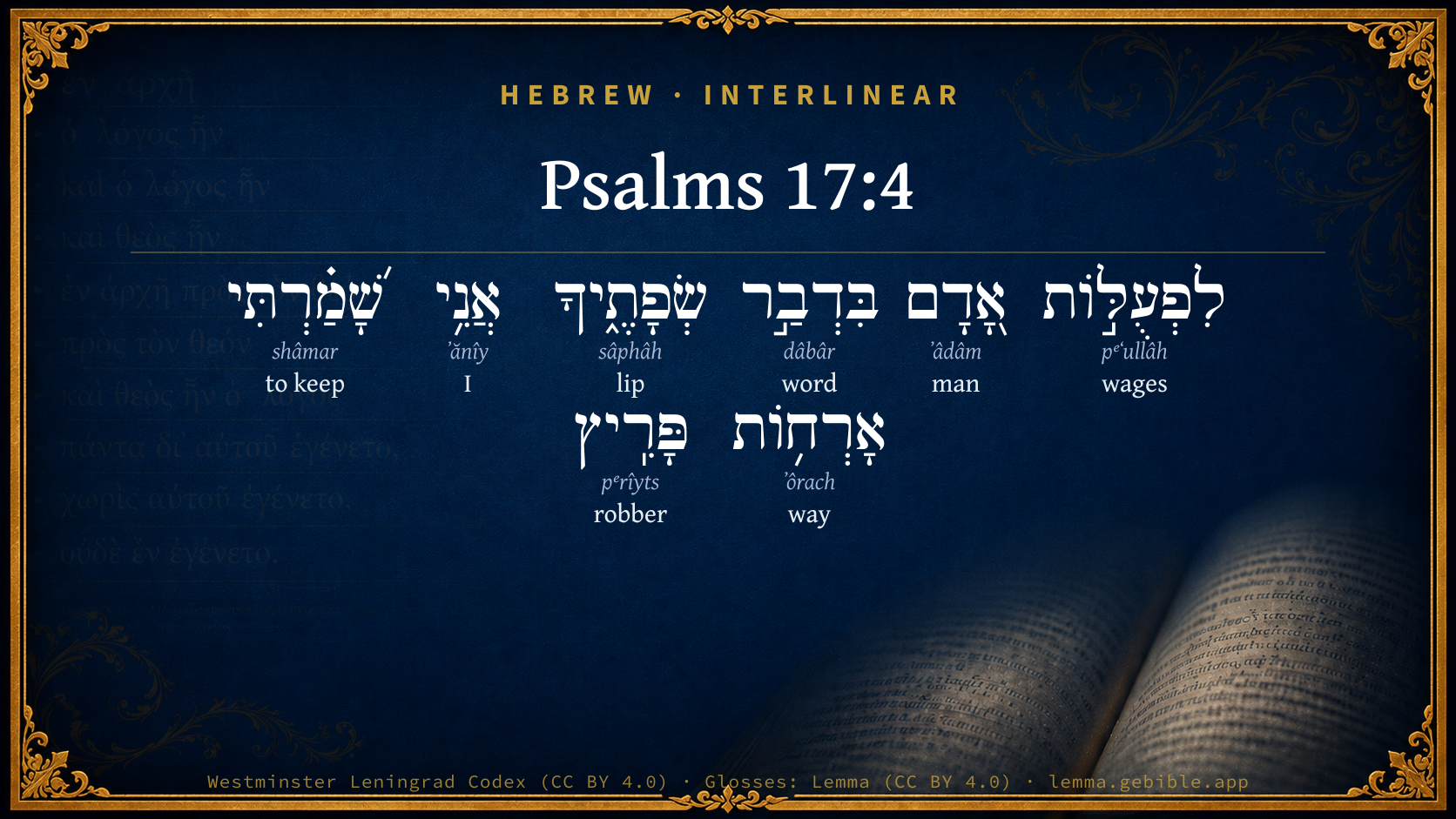
Hebrew (Westminster Leningrad Codex) Psalms 17:4 appears in the Hebrew Old Testament. The text above is from the Westminster Leningrad Codex. Each word links to its Strong’s number, a concise gloss, and parsing drawn from the Open Scriptures Hebrew Bible morphology. Click any word for its full Brown-Driver-Briggs (BDB) entry.
Download image
Cite this verse

Psalms 17:4 (World English Bible). Public Domain. Lemma interlinear Bible study tool, https://lemma.gebible.app/v/psalms/17/4.

Show BibTeX & RIS
BibTeX
RIS
English Translation
As for the works of men, by the word of your lips I have kept myself from the ways of the violent.
World English Bible · Public Domain
Highlights
  • 1 first appearance in the Hebrew Bible
Full analysis ↓
Download a study sheet

One document with this verse’s original text, its word-by-word gloss line, the meaning frame, cross-references with their text, attributed commentary, and full source and license credits — printable, and it pastes into notes with its structure intact.

This verse Autodidact and up

Study sheet (.html) Plain text (.txt)

A passage Seminary Student

Up to 50 verses in one chapter. A passage sheet keeps up to 6 commentary sources and 12 cross-references per verse, in the order this page ranks them, and says so on the sheet whenever that leaves anything out. Ask for a single verse and you get the Autodidact verse sheet above.

Everything on this page stays free to read, with no account — the sheet is a download of what is already on screen, not access to it.

Want to remove ads? Support Godless Engineer
Compare translations 3

The same verse in 3 English versions, stacked beneath the original-language interlinear above. Click any original word for its lexicon entry.

Each is an independent rendering of the whole verse — the interlinear is not word-aligned to these translations.

Highlighted words mark where these versions differ — a whole-verse word diff, not a word-by-word alignment.

  • World English Bible Public Domain
    As for the works of men, by the word of your lips I have kept myself from the ways of the violent.
  • King James Version Public Domain
    Concerning the works of men, by the word of thy lips I have kept me from the paths of the destroyer.
  • unfoldingWord Literal Text CC BY-SA 4.0
    With regard to the actions of man, by the word of your lips I have kept myself away from the paths of the violent.

unfoldingWord Literal Text — © unfoldingWord, licensed CC BY-SA 4.0. Word-aligned USFM3 via Door43 (git.door43.org/unfoldingWord/en_ult).

Versions to compare (up to 4)

3 of 4 selected

Show all 18 translations

Every available English version of this verse, each an independent rendering of the whole verse.

  • World English Bible Public Domain
    As for the works of men, by the word of your lips I have kept myself from the ways of the violent.
  • Berean Standard Bible Public Domain
    As for the deeds of men—by the word of Your lips I have avoided the ways of the violent.
  • Majority Standard Bible Public Domain
    As for the deeds of men—by the word of Your lips I have avoided the ways of the violent.
  • King James Version Public Domain
    Concerning the works of men, by the word of thy lips I have kept me from the paths of the destroyer.
  • American Standard Version (1901) Public Domain
    As for the works of men, by the word of thy lips I have kept me from the ways of the violent.
  • Revised Version (1885) Public Domain
    As for the works of men, by the word of thy lips I have kept me from the ways of the violent.
  • Geneva Bible (1599) Public Domain
    Concerning the workes of men, by the wordes of thy lips I kept mee from the paths of the cruell man.
  • Douay-Rheims (1899) Public Domain
    That my mouth may not speak the works of men: for the sake of the words of thy lips, I have kept hard ways.
  • Young's Literal Translation Public Domain
    As to doings of man, Through a word of Thy lips I have observed The paths of a destroyer;
  • Literal Standard Version CC BY-SA 4.0
    As for doings of man, || Through a word of Your lips I have observed || The paths of a destroyer;
  • Unlocked Literal Bible CC BY-SA 4.0
    As for the deeds of mankind, it is at the word of your lips that I have kept myself from the ways of the lawless.
  • unfoldingWord Literal Text CC BY-SA 4.0
    With regard to the actions of man, by the word of your lips I have kept myself away from the paths of the violent.
  • Darby Bible Public Domain
    Concerning the works of men, by the word of thy lips I have kept from the paths of the violent [man].
  • World Messianic Bible Public Domain
    As for the deeds of men, by the word of your lips, I have kept myself from the ways of the violent.
  • Webster's Bible Public Domain
    Concerning the works of men, by the word of thy lips I have kept me from the paths of the destroyer.
  • Free Bible Version CC BY-SA 4.0
    With regard to the actions of others: I have done what you told me and I have avoided what violent people do.
  • Bible in Basic English Public Domain
    As for the works of men, by the word of your lips I have kept myself from the ways of the violent.
  • JPS Tanakh (1917) Public Domain
    As for the doings of men, by the word of Thy lips I have kept me from the ways of the violent.

Literal Standard Version (2020), Covenant Press — licensed CC BY-SA 4.0. Text via the HelloAO Bible API (eBible.org). Unlocked Literal Bible (unfoldingWord) — licensed CC BY-SA 4.0. Text via the HelloAO Bible API (eBible.org). unfoldingWord Literal Text — © unfoldingWord, licensed CC BY-SA 4.0. Word-aligned USFM3 via Door43 (git.door43.org/unfoldingWord/en_ult). Free Bible Version, Dr. Jonathan Gallagher — licensed CC BY-SA 4.0. Text via the HelloAO Bible API (eBible.org).

Word by word

More ways to search: Search by grammar → Find every occurrence → Compare this word →

Practice this passage: Drill this verse → Learn its vocabulary →

About this verse

These counts appear in no published source. They are computed here, from the morphology-tagged text and Lemma’s own curated glosses. What Lemma adds →

8
words
8
distinct lemmas
Wisdom
section

Notable vocabulary

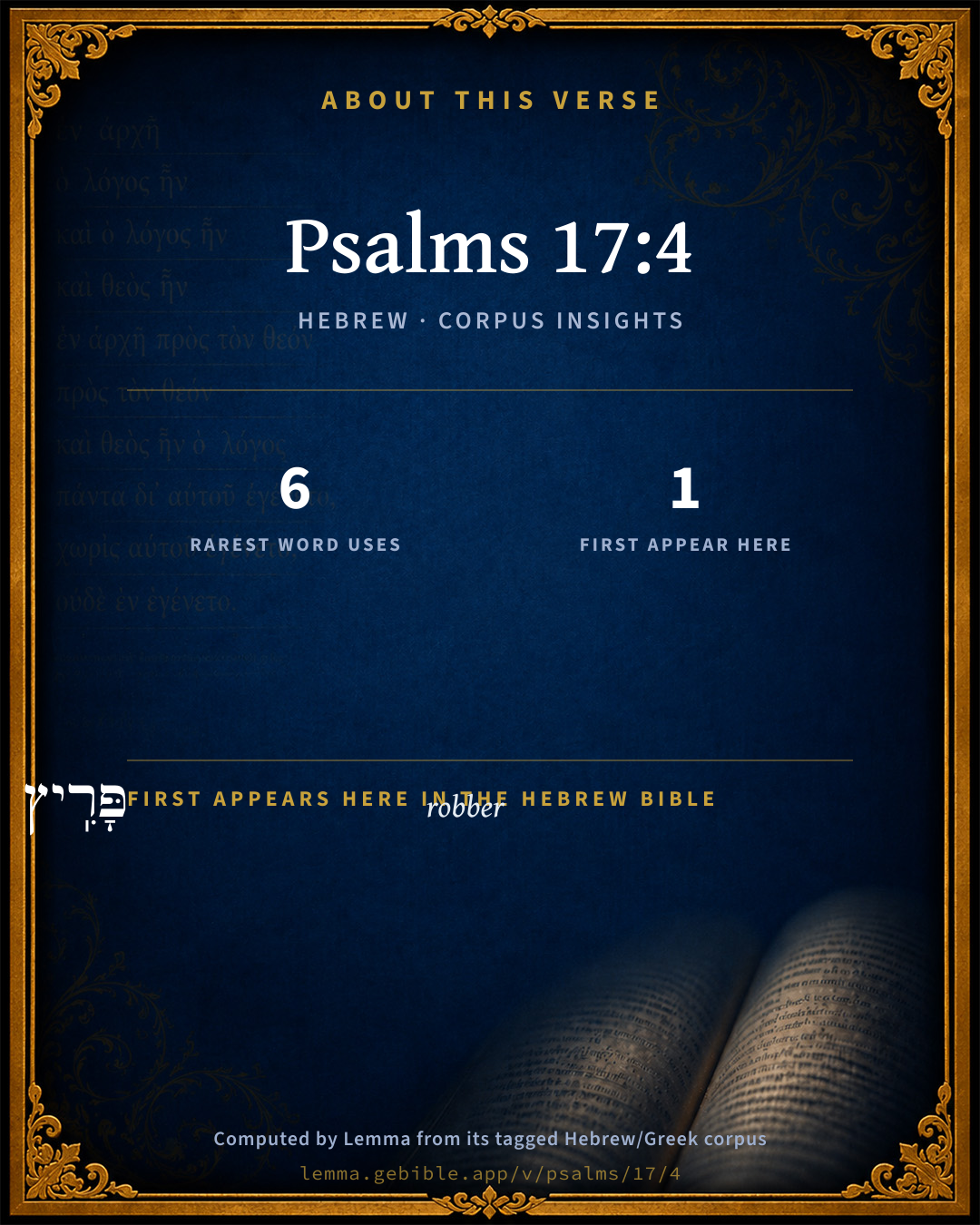
The rarest word here is פָּרִֽיץ robber H6530 — appearing just 6 times in the whole Hebrew Bible.

First appearance in Scripture

This word makes its first canonical appearance in the Hebrew Bible here:

  • פָּרִֽיץ robber H6530

Shared distinctive vocabulary

פָּרִֽיץ robber H6530 occurs in 6 verses of the Hebrew Bible. Also found in:

Grammatical profile

  • 1 verb
  • 6 nouns
  • 1 pronoun

Verb forms

  • שָׁ֝מַ֗רְתִּי Qal · Perfect

Hebrew & Septuagint length

In English translation the verse runs 22 words from the Hebrew and 19 from the Septuagint (LXX English) — closely comparable.

A rough comparison of the two English renderings, which tokenize alike — not a word-level alignment.

Word counts can differ between the Hebrew and the Greek without any difference in meaning — e.g. the Hebrew direct-object marker אֵת has no separate Greek word, and Greek often adds the article ὁ.

Cross-references

18

Topical passages linked to Psalms 17:4 in the Treasury of Scripture Knowledge — connected by theme and wording, ordered by reader-vote popularity; previews shown in the World English Bible.

  • Psalms 119:9–11 How can a young man keep his way pure? By living according to your word.
  • 1 Corinthians 3:3 for you are still fleshly. For insofar as there is jealousy, strife, and factions among you, aren't you fleshly, and don't you walk in the ways of men?
  • 1 Peter 5:8 Be sober and self-controlled. Be watchful. Your adversary the devil, walks around like a roaring lion, seeking whom he may devour.
  • Matthew 4:7 Jesus said to him, "Again, it is written, 'You shall not test the Lord, your God.'"
  • Matthew 4:10 Then Jesus said to him, "Get behind me, Satan! For it is written, 'You shall worship the Lord your God, and him only shall you serve.'"
  • Ephesians 6:17 And take the helmet of salvation, and the sword of the Spirit, which is the word of God;
  • Revelation 12:11 They overcame him because of the Lamb's blood, and because of the word of their testimony. They didn't love their life, even to death.
  • Psalms 14:1–3 The fool has said in his heart, "There is no God." They are corrupt. They have done abominable works. There is none who does good.
  • Proverbs 2:10–15 For wisdom will enter into your heart. Knowledge will be pleasant to your soul.
  • Matthew 4:4 But he answered, "It is written, 'Man shall not live by bread alone, but by every word that proceeds out of the mouth of God.'"
  • John 17:17 Sanctify them in your truth. Your word is truth.
  • James 1:18 Of his own will he brought us forth by the word of truth, that we should be a kind of first fruits of his creatures.
  • Genesis 6:11 The earth was corrupt before God, and the earth was filled with violence.
  • Job 15:16 How much less one who is abominable and corrupt, A man who drinks iniquity like water!
  • Job 31:33 If like Adam I have covered my transgressions, By hiding my iniquity in my heart,
  • 1 Peter 4:2–3 that you no longer should live the rest of your time in the flesh for the lusts of men, but for the will of God.
  • Revelation 9:11 They have over them as king the angel of the abyss. His name in Hebrew is "Abaddon," but in Greek, he has the name "Apollyon."
  • Genesis 6:5 Yahweh saw that the wickedness of man was great in the earth, and that every imagination of the thoughts of his heart was only evil continually.

Cross-references courtesy of OpenBible.info (CC BY 4.0).

Hebrew and Greek witnesses Masoretic Hebrew ↔ Greek Septuagint

The same verse in the two great witnesses to the Old Testament, shown verse-for-verse.

You’re reading Greek Psalm 16 (Hebrew Psalm 17). The Septuagint counts the superscription, so verse numbers can differ from the Hebrew — chapter-level alignment, not verse-by-verse. Numbering follows Rahlfs.

These are two independent witnesses, not word-aligned to each other, and the Septuagint is shown in lemma (dictionary) form.

Hebrew Psalms 17:4 Masoretic · Westminster Leningrad Codex

לִפְעֻלּ֣וֹת אָ֭דָם בִּדְבַ֣ר שְׂפָתֶ֑יךָ אֲנִ֥י שָׁ֝מַ֗רְתִּי אָרְח֥וֹת פָּרִֽיץ

As for the works of men, by the word of your lips I have kept myself from the ways of the violent.

World English Bible · Public Domain

Greek LXX Greek Psalm 16:4 Septuagint · lemma form

ὅπως ἄν μή λαλέω ὁ στόμα ἐγώ ὁ ἔργον ὁ ἄνθρωπος διά ὁ λόγος ὁ χεῖλος σύ ἐγώ φυλάσσω ὁδός σκληρός

As for the works of men, by the words of your lips I have guarded myself from hard ways.

LXX2012 (modern English Septuagint) · Public Domain

Hebrew: Westminster Leningrad Codex (CC BY 4.0). Greek: Septuagint (public domain); English from LXX2012 (modern English Septuagint) (Public Domain). How the Septuagint differs from the Hebrew →

Commentary

Notes on Psalms 17:4 from classic Christian and Jewish commentators (each source and its license shown beneath its notes). The classic Christian expositions comment on the surrounding passage and are grouped to its opening verse, so a note may address several verses; the Jewish commentaries on the Tanakh (Rashi and others) are per-verse, so they appear only where the commentator wrote on this verse.

Lemma curates 59 commentaries, every one of them public domain or Creative Commons licensed, each selected and text-cleaned for this edition rather than reprinted as found. About our sources →

Trapp's Complete Commentary

John Trapp

Psa 17:4 Concerning the works of men, by the word of thy lips I have kept [me from] the paths of the destroyer.

Ver. 4. Concerning the works of men] sc. Which ought to be done by them according to thy law. Or, which they are wont to do, whether right or wrong, I have not now to say, but this I can safely say by thy mercy, that

By the word of thy lips] Which I have taken for the rule and rudder of my life,

I have kept me from the paths of the destroyer] Effractoris, of the breach maker; such as is the bridge maker of Rome, at this day. David meaneth that he had shunned the society of graceless persons, Psa 26:4 Pro 24:21 Jer 15:17; and taken heed to his ways, that he offended not with his tongue, while the wicked was present, Psa 39:1-2, lest the wicked should rejoice at his misdemeanors, Psa 38:17.

John Trapp, A Commentary or Exposition upon All the Books of the Old and New Testament (1647–1656) — public domain. Text from a community e-Sword module.

The Biblical Illustrator

Joseph S. Exell

Psa_17:4

Concerning the works of men, by the word of Thy lips I have kept me from the paths of the destroyer.

Young men warned against unsound principles

Many are the nets that are spread for the souls of men, especially of young men. By means of evil associations and unsound or unscriptural principles. Of these latter we will speak now. They may be classified under three heads.

I. The principle of expediency or compromise. Things are done to serve a present purpose without regard to their being right or wrong, or whether Christian rectitude approve or condemn.

II. Self-indulgence, or animal gratification. Here he is in danger of being misled both by his equals and by himself. It is said that appetites were given, not to be crushed but gratified; that religious requirements and natural tendencies, emanating both from God, can never be incompatible with each other, and that asceticism and austerity are signs, not of a true but of a false religion. But in this case, as in every other, be who proves too much proves nothing. The natural appetites were designed not merely for gratification, but for moral discipline. They are not to be gratified alone, but subordinated, and due subordination is not asceticism, nor proper control of the affections, austerity. Religious requirements harmonise with natural tendencies, in that they impose a restriction at the very point where satisfaction terminates and excess begins: they apply reasonable and salutary restraints. Regard first the culture of the soul and you will never compromise the welfare of the body; preserve only what is due to God and you will be in little danger of withholding what is due to man.

III. The principle of false appearances or false assumptions. For it adopts a fallacious standard, superseding Gods Word by popular opinion. It is peculiarly necessary to guard against this in an age where names, self-assumed, are a prolific source of deception, and evil often puts on and parades the semblance of good. It is the way of the world, that lives without and forgets Him. It is the way of those who are often men of high honour, but of low principle; of strict uprightness, but of lax morality; men of reputable conduct, but of no religion. And especially avoid that path of the destroyer amidst the works of men, and of which Solomon says, Let not thine heart decline to her ways. The number and effrontery of those who yield to this temptation make it peculiarly subtle and fatal. The young man, new to the world, sees what others do, and that they are not the worse thought of for it, nor think at all worse of themselves; he hears some avowing it and others vindicating it--how shall he escape? Only by the word of Thy lips: that word hid in the heart, and its principles known and embraced. So shall you be enabled to stand in the evil day. (Thomas Dale, M. A.)

The Biblical Illustrator, edited by Joseph S. Exell (c. 1880s–1900s) — public domain. Text from a community e-Sword module.

Joseph Benson's Commentary

Psa 17:4. Concerning the works of men — That is, the works which men generally practise: observing how unreasonable, wicked, and pernicious they are, not only to others, but also to themselves, I have been resolved to take more care in the ordering of my actions. This he says, to show that he had been as careful to abstain from sinful actions as from sinful words, and in all respects to do his duty to God and man. By the word of thy lips — By the help of thy blessed word, and the excellent precepts, promises, and threatenings thereof, which, by deep and frequent meditation, I have hid and fixed in my heart, as the rule of my actions, the guide of my life, and the best antidote against sin and temptation, Psa 119:9; Psa 119:11. I have kept me from the paths — Hebrew, שׁמרתי ארחות, shamarti arechoth, I have watched, or observed, that is, in order to avoid, the paths, or ways of the destroyer. The ways of sin are the ways of the destroyer, that is, of the devil, whose name is Abaddon, and Apollyon, or destroyer, and who ruins souls by decoying them into these ways. Now, if we would shun them, we must attend to the word of God as our rule and guide, and in order thereto, must understand, believe, and hide it in our heart. “If the word be not in our heart at all, or if it be not there in such a manner as to be ready at all times for use and application, we shall be in danger, at every turn, of going astray.” — Horne.

Joseph Benson's Commentary on the Old and New Testaments (1811–1818) — public domain. Text from a community e-Sword module.

J. A. Alexander on Psalms

Joseph Addison Alexander

4. (Psa 17:4) (As) to the works of man, by the word of thy lips I have kept the paths of the violent (trangressor.) The works of man are the sinful courses to which man is naturally prone. The generic term man is often used in reference to the sinful infirmities of human nature. See 1Sa 24:10 (9), Hos 6:7, Job 31:33. The word of God's lips is the word uttered by him, with particular reference to his precepts or commands, but including his entire revelation. By this word, by means of it as an instrument, and in reliance on it as an authority.—The verb translated kept properly means watched, and is elsewhere applied to the observance of a rule, but in this place seems to mean watched for the purpose of avoiding, as we say in English to keep away from or keep out of danger.—From the verb which means to break forth, elsewhere applied to gross iniquities (Hos 4:2.) comes the adjective translated violent, outrageous, here used as an epithet of the flagrant sinner.

Joseph Addison Alexander, The Psalms Translated and Explained (1850) — public domain. Text from a community e-Sword module.

Geneva Bible (1599)

Geneva Bible translators

Though the wicked provoked me to do evil for evil, yet thy word kept me back.

Geneva Bible (1599) marginal notes — public domain. Text via Bolls.life.

Jamieson, Fausset & Brown

Robert Jamieson, A. R. Fausset & David Brown

works of men--sinful practices.

by the word of thy lips--as a guide (Psa 119:9, Psa 119:11, Psa 119:95).

destroyer--violent man.

Jamieson, Fausset & Brown — Commentary Critical and Explanatory on the Whole Bible (1871) — public domain (CC PDM 1.0). Text via the HelloAO Bible API.

Adam Clarke's Commentary

Verse 4. The paths of the destroyer.] Some render, hard or difficult paths, the sense of which is given above. But the passage is exceedingly obscure. My old Psalter translates and paraphrases as follows: -

Trans. That my mouthe speke noght the werkes of men, for the wordes of thi lippes I haf keped hard wayse.

Par. That es, that nothing passe of my mouthe bot at falles to the louyng of the; noght til werkes of men, that dos o gaynes thy wil; als to say, I spak noght bot gude; and for the wordes of thi lippes, that es, to ful fil the wordes that thi prophetes saide; I kepe hard waies of verteus and of tribulacioun, the qwilk men thynk hard; and for thi thai leve the hard way til heven, and takes the soft way til hel; but it es ful hard at the end.

Adam Clarke's Commentary on the Bible (1810–1826) — public domain. Text from a community e-Sword/MySword module.

John Calvin's Commentaries

4. As for the works of men, by the word of thy lips. Interpreters explain this verse in different senses. Some thinking that the letter ב, beth, which commonly signifies in or by, is taken for against, render it thus: As for the works of men which they practice against thy word. But I rather incline to the opinion of others who consider that there is here commended a right judgment of the actions of men which is formed according to the rule of the word of God. There are some shrewd and ingenious persons who carefully mark the works of men, but they do not judge of them according to the word of God. What we have as yet said does not, however, fully give us the sense of the passage. We must still consider what the Psalmist means when he speaks of the paths of the destroyer. Or, the paths of the violent. Literally of him who, by violent means, makes a breach in, or breaks down a wall or fence, the word פריף, pharits, being derived from פרף, pharats, to break down, or break through. It is referred by Calvin to the violent and wicked conduct of his enemies towards him.

“De troubler le repos et la tranquillite des autres.” — Fr.

“Afin de n’estre point corrompu par mauvals exemples.” — Fr.

“or have kept me from the paths, etc. or observed the paths, viz., so as to avoid them.” — Poole’s Annotations.

“Car mesme ceux qui sont de nature enclins a debonnairete.” — Fr.

“De real faire a nos prochains.” — Fr.

“Qu’il prendra en main la vengence contre ceux qui nous outragent.” — Fr.

John Calvin's Commentaries (1540-1563) — public domain. Text from the Calvin Translation Society English edition (1840s-50s) via the Christian Classics Ethereal Library (ccel.org). Calvin's coverage is partial (roughly two-thirds of the Bible); uncommented books and verses are honest gaps, never fabricated. The 19th-century editor's footnotes and remarks are omitted so the notes are faithfully Calvin's own voice.

Ellicott's Commentary for English Readers

(4) Concerning the works of men—i.e., as regards the actions of men, or in ordinary human actions; for the expression comp. Job_31:33; and Hos_6:7, where the margin has Adam.

By the word of thy lips.—Some take this clause closely with the foregoing, and render, “against the word,” &c. but the Authorised Version is better. The Divine standard for action, not the human or worldly, influences the writer.

I have kept me.—Literally, I for my part have observed ways of violence. But usage (Pro_2:20) almost compels us to understand by this, “I have kept ways of violence,” which is impossible here. Hence we have either to give the verb the unusual sense “guard against,” or suppose an error in the text.

A Bible Commentary for English Readers, edited by Charles John Ellicott (1878–1897) — public domain. Text from a community e-Sword module.

The Cambridge Bible for Schools and Colleges

gen. ed. J. J. S. Perowne

4. As for the works of men, by the word of thy lips

I have shunned the paths of the violent.

In regard to his behaviour as a man among men, he has obeyed the Divine precepts, and marked and shunned the ways of violent men, avoiding their example and society. God’s commandments have been his preservation, supplying the rule and the strength for his conduct. ‘The paths of the violent’ are the opposite of the ‘path of life,’ Psa_16:11. (Pro_1:19; Pro_2:11-19, &c.). Robbery with violence is mentioned as the commonest form of wrong doing to neighbours (Jer_7:11; Eze_18:10). For illustration of the verse from David’s life see 1Sa_25:32 ff; 1Sa_24:10 ff.; cp. Psa_7:3 ff.

The P.B.V., Because of men’s works, that are done against the words of thy lips, is untenable.

The Cambridge Bible for Schools and Colleges (gen. ed. J. J. S. Perowne; Cambridge University Press, 1878–1918) — public domain. Text from a community e-Sword module.

John Gill's Exposition

Concerning the works of men,.... Of wicked men, as to what respects and concerns them, or in the midst of them; in the midst of a wicked generation of men, and their filthy conversation; who appear to be so,

by the word of thy lips; the law of God, the Scriptures of truth, the rule and standard of faith and practice, which show what works are good and what are not; by the use, help, and benefit of this;

I have kept me from the paths of the destroyer; such is the devil, who was a murderer from the beginning; antichrist, whose name is Abaddon and Apollyon, both which signify a destroyer; false teachers, and all wicked men: the "paths" of such are their wicked principles and practices, their damnable errors and heresies, their sins and lusts, which make up the broad road that leads to destruction: these the psalmist "kept" or "observed" (a), for the words "me" and "from" are not in the original text; and the sense is, that he took notice of them, and avoided them, and, as a faithful prince and magistrate, forbad his subjects walking in them, and restrained them from them, making the word of God the rule of his conduct.

(a) "custodivi", Pagninus, Montanus; "observavi", Musculus, Piscator, Cocceius, Gejerus; so Ainsworth; "vel prohibui", Muis.

John Gill's Exposition of the Whole Bible (1746–1763) — public domain (CC PDM 1.0). Text via the HelloAO Bible API.

Albert Barnes' Notes on the Bible

Concerning the works of men - In respect to the works or doings of men. The reference is here probably to the ordinary or common doings of mankind, or to what generally characterizes the conduct of men. As their conduct is so commonly, and so characteristically wicked, wickedness may be spoken of as their “work,” and it is to this doubtless that the psalmist refers. In respect to the sinful courses or “paths” to which men are so prone, he says that he had kept himself from them. This is in accordance with what he says in the previous verse, that he had given no occasion by his conduct for the treatment which he had received at the hands of his enemies.

By the word of thy lips - Not by his own strength; not by any power which he himself had, but by the commands and promises of God - by what had proceeded from his mouth. The reference is doubtless to all that God had spoken: to the law which prescribed his duty, and to the promises which God had given to enable him to walk in the path of uprightness. He had relied on the word of God as inculcating duty; he had submitted to it as authority; he had found encouragement in it in endeavoring to do right.

I have kept me - I have preserved myself. I have so guarded my conduct that I have not fallen into the sins which are so common among men.

The paths of the destroyer - The paths which the “destroyer” treads; the course of life which such men lead. The idea is, not that he had been able to save himself from violence at their hands, but that he had been enabled to avoid their mode of life. The word rendered “destroyer” is from a verb which means “to break, to rend, to scatter,” and would properly refer to acts of violence and lawlessness. He had kept himself from the modes of life of the violent and the lawless; that is, he had been enabled to lead a peaceful and quiet lift. He had given no occasion to his enemies to treat him as a violent, a lawless, a wicked man.

Albert Barnes' Notes on the Bible (1834–1885) — public domain. Text from a community e-Sword/MySword module.

Matthew Poole's English Annotations

Concerning the works of men: concerning my care and caution about my words, I have now spoken, Psa 17:3, now I may say the like concerning my works. As for the works which men generally practise. Or, because of (as the prefix lamed is oft used, as Gen 2:23; Num 16:34; Jer 4:31; 22:10; 23:9)

the works of men. So the sense may be this, Observing and considering the quality of the works of the men of this age, with whom I converse, or of all mankind, some few excepted; considering, I say, how wicked, and unreasonable, and pernicious they are, not only to others, but also to themselves; I was resolved to take more care in the ordering of my own actions.

By the word of thy lips, i.e. by the help of thy blessed word, and the excellent rules, promises, and threatenings thereof, which by deep and frequent meditation I have hid and fixed in mine heart, as the best antidote against sin and temptation, Psa 119:9,11.

I have kept; so the same verb is used with the like supplement Jos 6:18, which also is in a manner included in the verb. Or, I have observed, to wit, so as to avoid them.

The paths, or ways, i.e. the customs and practices, or the imitation of them; as may be gathered from the next verse, where he prays to be kept in God’s paths, which are opposed to these paths.

Of the destroyer; or, of the violent man; such as Saul and his courtiers and soldiers have showed themselves toward me. Although their rage and violence against me might have tempted me to have repaid them in their own coin, yet I forbore it, and spared both others and Saul himself, when his life was at my mercy, 1Sa 24; 26;; and this I did in obedience to thy word, which required me to honour and preserve the Lord’s anointed.

Matthew Poole's English Annotations on the Holy Bible (1683–1685) — public domain. Text from a community e-Sword/MySword module.

The Treasury of David

Charles H. Spurgeon

Ver. 4. Concerning the works of men. While we are in the midst of men we shall have their works thrust under our notice, and we shall be compelled to keep a corner of our diary headed "concerning the works of men." To be quite clear from the dead works of carnal humanity is the devout desire of souls who are quickened by the Holy Spirit.

By the word of thy lips I have kept me from the paths of the destroyer. He had kept the highway of Scripture, and not chosen the bye paths of malice. We should soon imitate the example of the worst of men if the grace of God did not use the Word of God as the great preservative from evil. The paths of the destroyer have often tempted us; we have been prompted to become destroyers too, when we have been sorely provoked, and resentment has grown warm; but we have remembered the example of our Lord, who would not call fire from heaven upon his enemies, but meekly prayed, "Father, forgive them." All the ways of sin are the paths of Satan, the Apollyon or Abaddon, both of which words signify the destroyer. Foolish indeed are those who give their hearts to the old murderer, because for the time he panders to their evil desires. That heavenly Book which lies neglected on many a shelf is the only guide for those who would avoid the enticing and entangling mazes of sin; and it is the best means of preserving the youthful pilgrim from ever treading those dangerous ways. We must follow the one or the other; the Book of Life, or the way of death; the word of the Holy Spirit, or the suggestion of the Evil Spirit. David could urge as the proof of his sincerity that he had no part or lot with the ungodly in their ruinous ways. How can we venture to plead our cause with God, unless we also can wash our hands clean of all connection with the enemies of the Great King?

Ver. 4. Concerning the works of men, by the word of thy lips have I kept me from the paths of the destroyer: as if he had said, Would you know how is comes to pass that I escape those ungodly works and practices which men ordinarily take liberty to do? I must ascribe it to the good word of God; it is this I consult with, and by it I am kept from those foul ways whereunto others, that make no use of the word for their defence, are carried by Satan the destroyer. Can we go against sin and Satan with a better weapon than Christ used to vanquish the tempter with? And, certainly, Christ did it to set us an example how we should come armed into the field against them; for Christ could with one beam shot from his Deity (if he had pleased to exert it), have as easily laid the bold fiend at his foot, as afterward he did them that came to attack him; but he chose rather to conceal the majesty of his Divinity, and let Satan come up closer to him, that so he might confound him with the word, and thereby give him a proof of that sword of his saints, which he was to leave them for their defence against the same enemy. The devil is set out by the leviathan (Isa 27:1), him God threatens to punish with his strong sword; alluding to that great fish, the whale, which fears no fish like the swordfish, by whom this great devourer of all other fish is so often killed; for, receiving one prick from his sword, he hasteneth to the shore, and beats himself against it till he dies. Thus the devil, the great devourer of souls, who sports himself in the sea of this world, as the leviathan in the waters, and swallows the greatest part of mankind without any power to make resistance against him, is himself vanquished by the word. When he has to do with a saint armed with this sword, and instructed how to use this weapon, he then, and not till then, meets his match. William Gurnall.

Ver. 4. By the word of thy lips, etc. It is a great relief against temptations to have the word ready. The word is called, "The sword of the Spirit." Eph 6:17. In spiritual conflicts there is none like to that. Those that ride abroad in time of danger, will not be without a sword. We are in danger, and had need handle the sword of the Spirit. The more ready the Scripture is with us, the greater advantage in our conflicts and temptations. When the devil came to assault Christ, he had Scripture ready for him, whereby he overcame the tempter. The door is barred upon Satan, and he cannot find such easy entrance when the word is hid in our hearts, and made use of pertinently. "I write unto you, young men, because ye are strong." Where lies their strength? "And the word of God abideth in you, and ye have overcome the wicked one." 1Jo 2:14. Oh, it is a great advantage when we have the word, not only by us, but in us, engrafted in the heart; when it is present with us, we are more able to resist the assaults of Satan. Either a man forgets the word, or hath lost his affection to it, before he can be drawn to sin. Thomas Manton.

Ver. 4. The highway and the bypaths. The world and sin. The paths of the destroyer a significant name for transgression.

Psalms 17:5*

Charles H. Spurgeon's The Treasury of David (1869–1885) — public domain. Psalms only. Text from a community e-Sword/MySword module.

Whedon's Commentary on the Bible

Daniel D. Whedon

4. There is an historic background to the allusions of this verse. David was leading a fugitive life on the southern boundary of Judea, and in Arabia and Philistia, exiled from his country, proscribed by government, hunted by Saul, and compelled to live most of his time in the neighbourhood of robbers. It was a wild border life; but the word of God had kept him from going in their paths or adopting their habits.

Concerning the works of men—As to the doings of men; that is, the common practices of men who follow not God. Compare “course of this world.” Eph_2:2.

Kept… from the paths of the destroyer—Literally, I have watched the paths of the destroyer; that is, with a view to avoid them.

Daniel D. Whedon (gen. ed.), Commentary on the Old and New Testaments (1874–1909) — public domain. Text from a community e-Sword module.

The Pulpit Commentary

Concerning the works of man; i.e. "with respect to the actions of ordinary life here called "the works of Adami.e. of the natural man. By the word of thy lips I have kept me from the paths of the destroyer . By attending to thy Law, and following it, (see Psa_119:11) I have refrained myself from sin, and avoided the wicked courses of the violent. (comp. 1Sa_24:4-10)

The Pulpit Commentary (1880–1919), ed. H.D.M. Spence-Jones & Joseph S. Exell — public domain. Text from a community e-Sword module.

John Wesley's Explanatory Notes

Concerning - Observing the works of the men of this age, how wicked they are, I was resolved to take more care in ordering my own actions. By - By the help of thy blessed word. Paths - The customs and practices. Destroyer - Or, of the violent man: such as Saul, and his courtiers and soldiers.

John Wesley, Explanatory Notes Upon the Whole Bible (1754–1765) — public domain. Text via the GEBible commentary corpus.

unfoldingWord translationNotes

Door43 World Missions Community

it is at the word of your lips that I have kept myself from the ways of the lawless

Here "the word of your lips" is a metonym for God's instruction, and "the ways of the lawless" is a metaphor for the things that lawless people do. AT: "it is by obeying your instruction that I have kept myself from doing the things that lawless people do" or "your instruction has caused me to avoid doing wicked things" (See: Metonymy and Metaphor)

My steps have held firmly to your tracks; my feet have not slipped

Both of these clauses mean the same thing. The repetition adds emphasis. (See: Parallelism)

my feet have not slipped

The writer speaks of his obedience to God as if he were walking on a path. AT: "I am determined to follow your ways" (See: Metaphor and Litotes)

translationWords

works

word

lawful

unfoldingWord translationNotes — © Distant Shores Media and the Door43 World Missions Community, licensed CC BY-SA 4.0. Source: git.door43.org/Door43/en_tn.

Rashi

Rabbi Shlomo Yitzchaki (Rashi)

As for man’s deeds, because of the word of Your lips, etc. To support my feet, etc. From then on, for every deed of man that I came to perform, I watched myself because of the word of Your lips; [I watched] the ways of the profligate, to turn away from them, so that I should not walk in them, but [would] support my feet constantly in Your paths, that my feet should not falter from them. Another explanation: For the deeds of man according to the word of Your lips, etc. Since a person must use his deeds according to the uprightness (decree - early editions) of the word of Your lips, as You said, “You shall not commit adultery,” I kept myself from the ways of the profligate although I behaved unseemly according to the good You have done.

Rashi on the Tanakh — English translations: “The Judaica Press complete Tanach with Rashi, translated by A. J. Rosenberg” (CC BY 4.0); “Pentateuch with Rashi's commentary by M. Rosenbaum and A.M. Silbermann, 1929-1934” (public domain); “The Metsudah Tanach series, Lakewood, N.J” (CC BY 4.0); and “The Book of Joshua, Metsudah Publications, 1997” (CC BY 4.0). Text via Sefaria.

Radak

Rabbi David Kimhi (Radak)

As for the works of men, by the word of Thy lips – in what Thou hast commanded and forbidden-

I have observed the ways of the violent: – meaning, I have done according to the work of the wicked and the violent. The learned Rabbi Abraham ben Ezra expounds: “Let my sentence come forth from Thy presence so that Thou punish me if Thine eyes regard not the right!” But all this seems to me far-fetched, and to me it seems more probable that it should be taken as (ibid. 9:5) “For Thou hast maintained my right and my cause” of which the interpretation is: Thou shalt exact judgment for me from my enemies; and so, from Thy presence let my judgment come forth may mean that Thou wilt exact judgment for me from mine enemies. Thine eyes regard right: Thou seest that with me is right and with them wickedness and violence. And so the greater part of the Psalm has reference to (his) enemies, as he says (infra, 7), “From those that rise up against Thy right hand.” And he says (also) (ibid. 9): “From the wicked that spoil me.” You see that the Psalm speaks of his enemies, and it was on account of them he was seeking mercy; and he says that God will look upon the uprightness of his deeds and see that his enemies hate him without cause. He says also, Thou hast proved my heart, for Thou dost prove hearts, and knowest if my words are (those of) truth. Thou hast visited me in the night: and in the night – i.e. at a time when a man thinks of so many matters, when he is free from the business of the world and has no work to do – at night and at the time when he is awake and thinks – and Thou hast visited my heart and my thoughts, and hast tried me and found in me only good. And from my thoughts no word has proceeded save only according to the tenor of my heart, as he says: out of no feigned lips; and this is the meaning of I have resolved that my mouth shall not offend. And as I am strict with myself, so I warn others of what I see. This is the meaning of what he says: As for the works of man, by the word of Thy lips: in (the light of) what Thou hast commanded and warned, I am considering the works of man and keeping from them transgressions. And this is the meaning of: I have marked the paths of the violent: I have prevented a man from walking in the paths of the violent and wicked. And similarly, (שמר is used in the verse) “to keep (guard) the way of the tree of life” (Gen. 3:24), “so that one should not walk in it”; so also “the keeper of the park” (Neh. 2:8). After setting forth before God the uprightness of his mouth and heart and deeds, he supplicates God to support his steps lest they stumble before his enemies, and says:

Radak on the Tanakh — English translations: “Sefaria Community Translation” (CC0 1.0 (public-domain dedication)); “Eliyahu Munk, HaChut Hameshulash” (CC BY 4.0); “Rabbi Mike Feuer, Jerusalem Anthology” (CC BY 4.0); and “R. David Kimhi on the first book of Psalms, Translated by R.G. Finch, London, 1919” (public domain). Text via Sefaria.

Lesson kit

Teaching starters — assembled from the data on this page, not authored interpretation. Every prompt links to the verse data it draws on. Edit before teaching.

Psalms, in the Wisdom, opens this verse with 8 words (8 distinct Hebrew lemmas). Its most distinctive word is pᵉrîyts (“robber”). A historical commentator’s framing appears above. Read the whole chapter for the surrounding context.

Discussion questions

  1. The word pᵉrîyts carries the sense “robber.” How does it shape the verse?
  2. The word “robber” first appears here in Scripture. What is being introduced at this debut?
  3. Isaiah 35:9 shares the word «robber» with this verse. How do the two illuminate each other?
  4. The translations on this page render this verse differently — a whole-verse word diff, not a word-by-word alignment. What might account for the different wordings?
  5. The verb «שָׁ֝מַ֗רְתִּי» is Qal Perfect. How does its form color the action?
  6. Reading how Trapp's Complete Commentary and The Biblical Illustrator read this verse, where do the two commentators agree and where do they part?

Things to notice

Reading settings

Reading text

Shown beneath each verse's original-language words.

Old Testament
Old Testament edition

Read the OT as the Masoretic Hebrew (MT) or the Greek Septuagint (LXX).

English shown for the Greek Septuagint (in the Hebrew ↔ Greek comparison).

Comparing translations? Open the Compare panel on any verse page to stack up to four side by side.