1 John 5:10

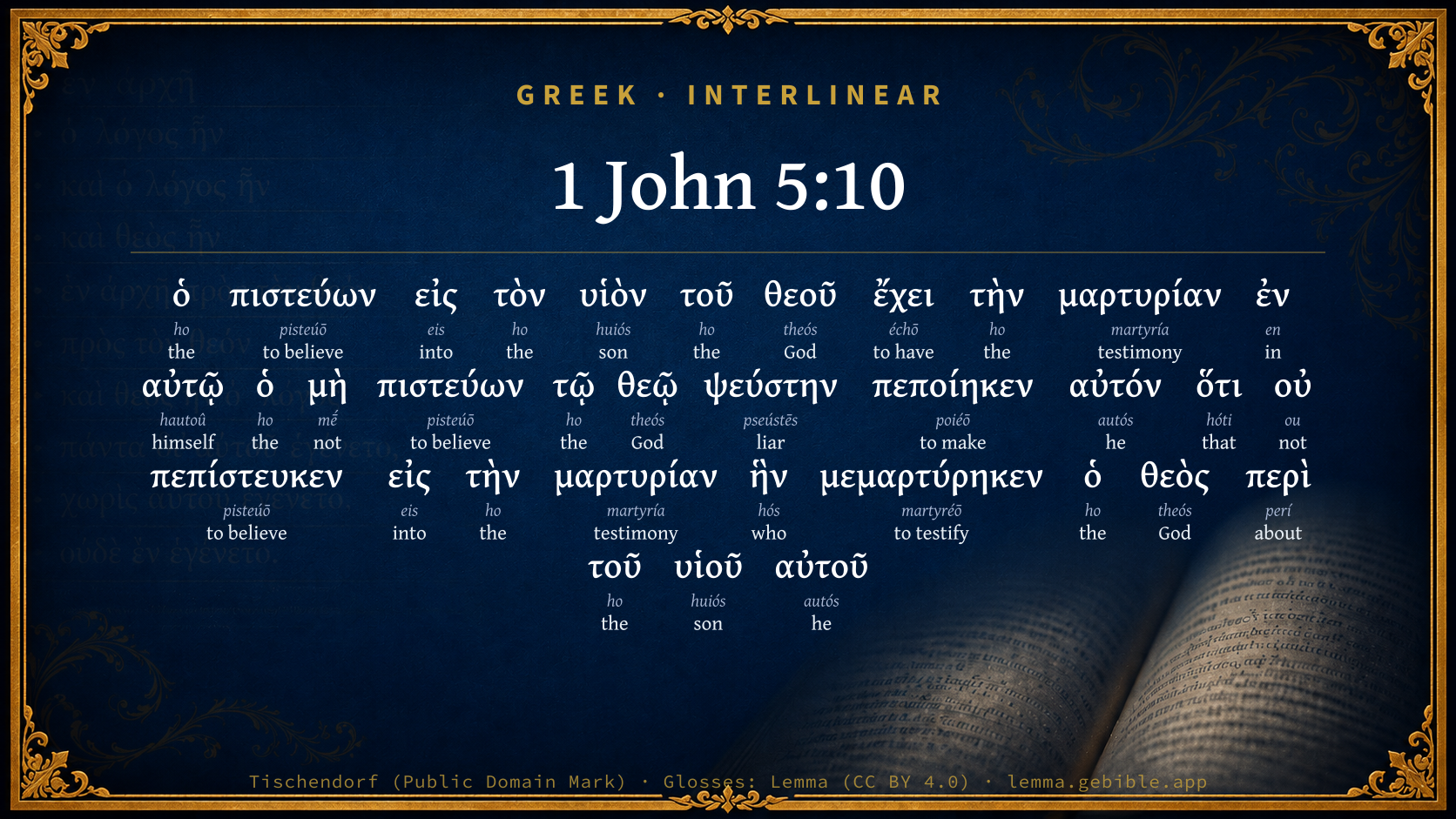
Greek (Tischendorf 8th ed.) 1 John 5:10 appears in the Greek New Testament. The text above is from the Tischendorf 8th edition. Each word links to its Strong’s number and a concise gloss. Click any word for its full Thayer’s Greek Lexicon entry.
Download image
Cite this verse

1 John 5:10 (World English Bible). Public Domain. Lemma interlinear Bible study tool, https://lemma.gebible.app/v/1-john/5/10.

Show BibTeX & RIS
BibTeX
RIS
English Translation
He who believes in the Son of God has the testimony in himself. He who doesn't believe God has made him a liar, because he has not believed in the testimony that God has given concerning his Son.
World English Bible · Public Domain
Download a study sheet

One document with this verse’s original text, its word-by-word gloss line, the meaning frame, cross-references with their text, attributed commentary, and full source and license credits — printable, and it pastes into notes with its structure intact.

This verse Autodidact and up

Study sheet (.html) Plain text (.txt)

A passage Seminary Student

Up to 50 verses in one chapter. A passage sheet keeps up to 6 commentary sources and 12 cross-references per verse, in the order this page ranks them, and says so on the sheet whenever that leaves anything out. Ask for a single verse and you get the Autodidact verse sheet above.

Everything on this page stays free to read, with no account — the sheet is a download of what is already on screen, not access to it.

Want to remove ads? Support Godless Engineer
Compare translations 3

The same verse in 3 English versions, stacked beneath the original-language interlinear above. Click any original word for its lexicon entry.

Each is an independent rendering of the whole verse — the interlinear is not word-aligned to these translations.

Highlighted words mark where these versions differ — a whole-verse word diff, not a word-by-word alignment.

  • World English Bible Public Domain
    He who believes in the Son of God has the testimony in himself. He who doesn't believe God has made him a liar, because he has not believed in the testimony that God has given concerning his Son.
  • King James Version Public Domain
    He that believeth on the Son of God hath the witness in himself: he that believeth not God hath made him a liar; because he believeth not the record that God gave of his Son.
  • unfoldingWord Literal Text CC BY-SA 4.0
    The one believing in the Son of God has the testimony in him. The one not believing God has made him a liar because he has not believed in the testimony that God has testified about his Son.

unfoldingWord Literal Text — © unfoldingWord, licensed CC BY-SA 4.0. Word-aligned USFM3 via Door43 (git.door43.org/unfoldingWord/en_ult).

Versions to compare (up to 4)

3 of 4 selected

Show all 19 translations

Every available English version of this verse, each an independent rendering of the whole verse.

  • World English Bible Public Domain
    He who believes in the Son of God has the testimony in himself. He who doesn't believe God has made him a liar, because he has not believed in the testimony that God has given concerning his Son.
  • Berean Standard Bible Public Domain
    Whoever believes in the Son of God has this testimony within him; whoever does not believe God has made Him out to be a liar, because he has not believed in the testimony that God has given about His Son.
  • Majority Standard Bible Public Domain
    Whoever believes in the Son of God has this testimony within him; whoever does not believe God has made Him out to be a liar, because he has not believed in the testimony that God has given about His Son.
  • King James Version Public Domain
    He that believeth on the Son of God hath the witness in himself: he that believeth not God hath made him a liar; because he believeth not the record that God gave of his Son.
  • American Standard Version (1901) Public Domain
    He that believeth on the Son of God hath the witness in him: he that believeth not God hath made him a liar; because he hath not believed in the witness that God hath borne concerning his Son.
  • Revised Version (1885) Public Domain
    He that believeth on the Son of God hath the witness in him: he that believeth not God hath made him a liar; because he hath not believed in the witness that God hath borne concerning his Son.
  • Geneva Bible (1599) Public Domain
    He that beleeueth in that Sonne of God, hath the witnes in himselfe: he that beleeueth not God, hath made him a lyar, because he beleeued not ye record, that God witnessed of that his Sonne.
  • Douay-Rheims (1899) Public Domain
    He that believeth in the Son of God, hath the testimony of God in himself. He that believeth not the Son, maketh him a liar: because he believeth not in the testimony which God hath testified of his Son.
  • Young's Literal Translation Public Domain
    He who is believing in the Son of God, hath the testimony in himself; he who is not believing God, a liar hath made Him, because he hath not believed in the testimony that God hath testified concerning His Son;
  • Literal Standard Version CC BY-SA 4.0
    He who is believing in the Son of God has the testimony in himself; he who is not believing God has made Him a liar, because he has not believed in the testimony that God has testified concerning His Son;
  • Unlocked Literal Bible CC BY-SA 4.0
    Anyone who believes in the Son of God has the testimony in himself. Anyone who does not believe God has made him out to be a liar, because he has not believed the witness that God has given concerning his Son.
  • unfoldingWord Literal Text CC BY-SA 4.0
    The one believing in the Son of God has the testimony in him. The one not believing God has made him a liar because he has not believed in the testimony that God has testified about his Son.
  • Darby Bible Public Domain
    He that believes on the Son of God has the witness in himself; he that does not believe God has made him a liar, because he has not believed in the witness which God has witnessed concerning his Son.
  • World Messianic Bible Public Domain
    He who believes in the Son of God has the testimony in himself. He who doesn’t believe God has made him a liar, because he has not believed in the testimony that God has given concerning his Son.
  • Webster's Bible Public Domain
    He that believeth on the Son of God hath the witness in himself: he that believeth not God, hath made him a liar, because he hath not believed the testimony that God gave of his Son.
  • Free Bible Version CC BY-SA 4.0
    Those trusting in the Son of God have accepted and hold on to this evidence. Those who don't trust God make God out to be a liar, because they don't believe the evidence God has given about his Son.
  • Bible in Basic English Public Domain
    He who has faith in the Son of God has the witness in himself: he who has not faith in God makes him false, because he has not faith in the witness which God has given about his Son.
  • Text-Critical English NT CC BY 4.0
    Whoever believes in the Son of God has the testimony in himself. Whoever does not believe God has made him a liar, because he has not believed the testimony that God has given about his Son.
  • Tyndale New Testament (1534) Public Domain
    He that beleveth on the sonne of god hath the witnes in him silfe. He that beleveth not God hath made him a lyar be cause he beleved not the recorde that god gave of his sonne.

Literal Standard Version (2020), Covenant Press — licensed CC BY-SA 4.0. Text via the HelloAO Bible API (eBible.org). Unlocked Literal Bible (unfoldingWord) — licensed CC BY-SA 4.0. Text via the HelloAO Bible API (eBible.org). unfoldingWord Literal Text — © unfoldingWord, licensed CC BY-SA 4.0. Word-aligned USFM3 via Door43 (git.door43.org/unfoldingWord/en_ult). Free Bible Version, Dr. Jonathan Gallagher — licensed CC BY-SA 4.0. Text via the HelloAO Bible API (eBible.org).

Word by word

More ways to search: Search by grammar → Find every occurrence → Compare this word →

Practice this passage: Drill this verse → Learn its vocabulary →

αὐτῷ
hautoû
G848
“himself”
Personal pronoun, Dative, Singular, Masculine
Part of Speech
Personal pronoun
Case
Dative
Number
Singular
Gender
Masculine
Full Thayer's Definition

Origin: contracted for G1438

TDNT: None

1. of himself, themself, them
  1. ὁ ho G3588 “the” Article, Nominative, Singular, Masculine
  2. πιστεύων pisteúō G4100 “to believe” Verb, Present, Active, Participle, Nominative, Singular, Masculine
  3. εἰς eis G1519 “into” Preposition
  4. τὸν ho G3588 “the” Article, Accusative, Singular, Masculine
  5. υἱὸν huiós G5207 “son” Noun, Accusative, Singular, Masculine
  6. τοῦ ho G3588 “the” Article, Genitive, Singular, Masculine
  7. θεοῦ theós G2316 “God” Noun, Genitive, Singular, Masculine
  8. ἔχει échō G2192 “to have” Verb, Present, Active, Indicative, 3rd person, Singular
  9. τὴν ho G3588 “the” Article, Accusative, Singular, Feminine
  10. μαρτυρίαν martyría G3141 “testimony” Noun, Accusative, Singular, Feminine
  11. ἐν en G1722 “in” Preposition
  12. ὁ ho G3588 “the” Article, Nominative, Singular, Masculine
  13. μὴ mḗ G3361 “not” Particle, Negative
  14. πιστεύων pisteúō G4100 “to believe” Verb, Present, Active, Participle, Nominative, Singular, Masculine
  15. τῷ ho G3588 “the” Article, Dative, Singular, Masculine
  16. θεῷ theós G2316 “God” Noun, Dative, Singular, Masculine
  17. ψεύστην pseústēs G5583 “liar” Noun, Accusative, Singular, Masculine
  18. πεποίηκεν poiéō G4160 “to make” Verb, Perfect, Active, Indicative, 3rd person, Singular
  19. αὐτόν autós G846 “he” Personal pronoun, Accusative, Singular, Masculine
  20. ὅτι hóti G3754 “that” Conjunction
  21. οὐ ou G3756 “not” Particle, Negative
  22. πεπίστευκεν pisteúō G4100 “to believe” Verb, Perfect, Active, Indicative, 3rd person, Singular
  23. εἰς eis G1519 “into” Preposition
  24. τὴν ho G3588 “the” Article, Accusative, Singular, Feminine
  25. μαρτυρίαν martyría G3141 “testimony” Noun, Accusative, Singular, Feminine
  26. ἣν hós G3739 “who” Relative pronoun, Accusative, Singular, Feminine
  27. μεμαρτύρηκεν martyréō G3140 “to testify” Verb, Perfect, Active, Indicative, 3rd person, Singular
  28. ὁ ho G3588 “the” Article, Nominative, Singular, Masculine
  29. θεὸς theós G2316 “God” Noun, Nominative, Singular, Masculine
  30. περὶ perí G4012 “about” Preposition
  31. τοῦ ho G3588 “the” Article, Genitive, Singular, Masculine
  32. υἱοῦ huiós G5207 “son” Noun, Genitive, Singular, Masculine
  33. αὐτοῦ autós G846 “he” Personal pronoun, Genitive, Singular, Masculine

About this verse

These counts appear in no published source. They are computed here, from the morphology-tagged text and Lemma’s own curated glosses. What Lemma adds →

34
words
18
distinct lemmas
General Epistles
section

Notable vocabulary

The rarest word here is αὐτῷ himself G848 — appearing just 3 times in the whole Greek New Testament.

Shared distinctive vocabulary

αὐτῷ himself G848 occurs in 3 verses of the Greek New Testament. Also found in:

Repetition

Words recur within this verse:

  • πιστεύων to believe G4100 ×3
  • θεοῦ God G2316 ×3
  • εἰς into G1519 ×2
  • υἱὸν son G5207 ×2
  • μαρτυρίαν testimony G3141 ×2
  • ὁ the G3588 ×9
  • αὐτόν he G846 ×2

Cross-references

17

Topical passages linked to 1 John 5:10 in the Treasury of Scripture Knowledge — connected by theme and wording, ordered by reader-vote popularity; previews shown in the World English Bible.

  • Romans 8:16 The Spirit himself testifies with our spirit that we are children of God;
  • Galatians 4:6 And because you are children, God sent out the Spirit of his Son into your hearts, crying, "Abba, Father!"
  • John 3:33 He who has received his witness has set his seal to this, that God is true.
  • John 5:38 You don't have his word living in you; because you don't believe him whom he sent.
  • Hebrews 3:12 Beware, brothers, lest perhaps there be in any one of you an evil heart of unbelief, in falling away from the living God;
  • Numbers 23:19 God is not a man, that he should lie, Neither the son of man, that he should repent: Has he said, and will he not do it? Or has he spoken, and will he not make it good?
  • Colossians 3:3 For you died, and your life is hidden with Christ in God.
  • 1 John 5:1 Whoever believes that Jesus is the Christ is born of God. Whoever loves the father also loves the child who is born of him.
  • Psalms 25:14 The friendship of Yahweh is with those who fear him. He will show them his covenant.
  • Proverbs 3:32 For the perverse is an abomination to Yahweh, But his friendship is with the upright.
  • 1 John 1:10 If we say that we haven't sinned, we make him a liar, and his word is not in us.
  • Revelation 2:17 He who has an ear, let him hear what the Spirit says to the assemblies. To him who overcomes, to him I will give of the hidden manna, and I will give him a white stone, and on the stone a new name written, which no one knows but he who receives it.
  • Revelation 12:17 The dragon grew angry with the woman, and went away to make war with the rest of her seed, who keep God's commandments and hold Jesus' testimony.
  • Job 24:25 If it isn't so now, who will prove me a liar, And make my speech worth nothing?"
  • Isaiah 53:1 Who has believed our message? and to whom has the arm of Yahweh been revealed?
  • John 3:16 For God so loved the world, that he gave his one and only Son, that whoever believes in him should not perish, but have eternal life.
  • 2 Peter 1:19 We have the more sure word of prophecy; whereunto you do well that you take heed, as to a lamp shining in a dark place, until the day dawns, and the day star arises in your hearts:

Cross-references courtesy of OpenBible.info (CC BY 4.0).

Commentary

Notes on 1 John 5:10 from classic Christian and Jewish commentators (each source and its license shown beneath its notes). The classic Christian expositions comment on the surrounding passage and are grouped to its opening verse, so a note may address several verses; the Jewish commentaries on the Tanakh (Rashi and others) are per-verse, so they appear only where the commentator wrote on this verse.

Lemma curates 59 commentaries, every one of them public domain or Creative Commons licensed, each selected and text-cleaned for this edition rather than reprinted as found. About our sources →

Matthew Henry's Commentary

In those words we may observe,

I. The privilege and stability of the real Christian: He that believeth on the Son of God, hath been prevailed with unfeignedly to cleave to him for salvation, hath the witness in himself, Jo1 5:10. He hath not only the outward evidence that others have, but he hath in his own heart a testimony for Jesus Christ. He can allege what Christ and the truth of Christ have done for his soul and what he has seen and found in him. As, 1. He has deeply seen his sin, and guilt, and misery, and his abundant need of such a Saviour. 2. He has seen the excellency, beauty, and office of the Son of God, and the incomparable suitableness of such a Saviour to all his spiritual wants and sorrowful circumstances. 3. He sees and admires the wisdom and love of God in preparing and sending such a Saviour to deliver him from sin and hell, and to raise him to pardon, peace, and communion with God. 4. He has found and felt the power of the word and doctrine of Christ, wounding, humbling, healing, quickening, and comforting his soul. 5. He finds that the revelation of Christ, as it is the greatest discovery and demonstration of the love of God, so it is the most apt and powerful means of kindling, fomenting, and inflaming love to the holy blessed God. 6. He is born of God by the truth of Christ, as Jo1 5:1. He has a new heart and nature, a new love, disposition, and delight, and is not the man that formerly he was. 7. He finds yet such a conflict with himself, with sin, with the flesh, the world, and invisible wicked powers, as is described and provided for in the doctrine of Christ. 8. He finds such prospects and such strength afforded him by the faith of Christ, that he can despise and overcome the world, and travel on towards a better. 9. He finds what interest the Mediator has in heaven, by the audiency and prevalency of those prayers that are sent thither in his name, according to his will, and through his intercession. 10. He is begotten again to a lively hope, to a holy confidence in God, in his good-will and love, to a pleasant victory over terrors of conscience, dread of death and hell, to a comfortable prospect of life and immortality, being enriched with the earnest of the Spirit and sealed to the day of redemption. Such assurance has the gospel believer; he has a witness in himself. Christ is formed in him, and he is growing up to the fulness and perfection, or perfect image of Christ, in heaven.

II. The aggravation of the unbeliever's sin, the sin of unbelief: He that believeth not God hath made him a liar. He does, in effect, give God the lie, because he believeth not the record that God gave of his Son, Jo1 5:10. He must believe that God did not send his Son into the world, when he has given us such manifold evidence that he did, or that Jesus Christ was not the Son of God, when all that evidence relates to and terminates upon him, or that he sent his Son to deceive the world and to lead it into error and misery, or that he permits men to devise a religion which, in all the parts of it, is a pure, holy, heavenly, undefiled institution, and so worthy to be embraced by the reason of mankind, and yet is but a delusion and a lie, and then lends them his Spirit and power to recommend and obtrude it upon the world, which is to make God the Father, the author and abettor, of the lie.

III. The matter, the substance, or contents of all this divine testimony concerning Jesus Christ: And this is the record, that God hath given to us eternal life, and this life is in his Son, Jo1 5:11. This is the sum of the gospel. This is the sum and epitome of the whole record given us by all the aforesaid six witnesses. 1. That God hath given to us eternal life. He has designed it for us in his eternal purpose. He has prepared all the means that are necessary to bring us to it. He has made it over to us by his covenant and promise. And he actually confers a right and title thereto on all who believe on and actually embrace the Son of God. Then, 2. This life is in the Son. The Son is life; eternal life in his own essence and person, Joh 1:4; Jo1 1:2. He is eternal life to us, the spring of our spiritual and glorious life, Col 3:4. From him life is communicated to us, both here in heaven. And thereupon it must follow, (1.) He that hath the Son hath life, Jo1 5:12. He that is united to the Son is united to life. He who hath a title to the Son hath a title to life, to eternal life. Such honour hath the Father put upon the Son: such honour must we put upon him too. We must come and kiss the Son, and we shall have life. (2.) He that hath not the Son of God hath not life, Jo1 5:12. He continues under the condemnation of the law (Joh 3:36); he refuses the Son, who is life itself, who is the procurer of life, and the way to it; he provokes God to deliver him over to endless death for making him a liar, since he believes not this record that God hath given concerning his Son.

IV. The end and reason of the apostle's preaching this to believers. 1. For their satisfaction and comfort: These things have I written unto you that believe on the name of the Son of God, that you may know that you have eternal life, Jo1 5:13. Upon all this evidence, and these witnesses, it is but just and meet that there should be those who believe on the name of the Son of God. God increase their number! How much testimony from heaven has the world to answer for! And to three witnesses in heaven must the world be accountable. These believers have eternal life. They have it in the covenant of the gospel, in the beginning and first-fruits of it within them, and in their Lord and head in heaven. These believers may come to know that they have eternal life, and should be quickened, encouraged, and comforted, in the prospect of it: and they should value the scriptures, which are so much written for their consolation and salvation. 2. For their confirmation and progress in their holy faith: And that you may believe on the name of the Son of God (Jo1 5:13), may go on believing. Believers must persevere, or they do nothing. To withdraw from believing on the name of the Son of God is to renounce eternal life, and draw back unto perdition. Therefore the evidences of religion and the advantage of faith are to be presented to believers, in order to hearten and encourage them to persevere to the end.

Matthew Henry's Commentary on the Whole Bible (1708–1710) — public domain (CC PDM 1.0). Text via the HelloAO Bible API.

Joseph Benson's Commentary

1Jn 5:10. He that believeth on the Son of God, with such a faith, hath the testimony in himself — Namely, knows by experience, that what God hath testified concerning his Son, and salvation in and through him, is indeed true, being already saved by him from the guilt and power of sin, into the favour and image of God, and a state of communion with him. He knows by experience, that Jesus is the Son of God in such a sense as to be an all- sufficient Saviour, and that he came by cleansing water, and by atoning blood, having received justification through the latter, and sanctification through the former. Or, which is to the same purpose, he hath received the testimony mentioned 1Jn 5:11. For, as in that verse, “the witness, by a usual metonymy, is put for the thing witnessed, and the thing witnessed being, that God hath given us eternal life through his Son, he who believeth on the Son of God, may justly be said to have eternal life, the thing witnessed, in himself; because, by his faith on the Son, being begotten of God, he hath, in the dispositions of God’s children communicated to him, eternal life begun in him; which is both a pledge and a proof that God, in due time, will completely bestow on him eternal life through his Son.” — Macknight. Add to the above, that eternal life is begun in him, and that God will, in due time, bestow on him the full enjoyment of it, he hath the testimony of the Father, Son, and Holy Ghost; the Father having lifted up the light of his countenance upon him, and thereby put joy and gladness into his heart, Psa 4:6-7; Christ dwelling in his heart by faith, and being precious to his soul, Eph 3:17; 1Pe 2:7; and the Holy Ghost, as a Spirit of adoption, witnessing with his spirit that he is a child of God, and producing in him love, joy, and peace, Rom 8:15-16; Gal 5:22. And he hath the witness of the Spirit in himself, mentioned 1Jn 5:8, or of the inspired writings, which bear witness to the genuineness of his religion, and his title to eternal life, and which are the food of his soul, the sweetness of which he tastes, and is nourished thereby; tastes the good word of God, Heb 6:5. He hath the witness of the water in himself, having been baptized with water, and had the sign, and also the thing signified thereby, the regenerating grace of God; and the witness of the blood, having received the atonement, and pardon through it, and taking all opportunities of receiving the Lord’s supper, when the bread that he breaks is to him the communion of Christ’s body; and the wine which he drinks, the communion of his blood; and he feeds on Christ in his heart by faith, with thanksgiving. On the other hand, he that believeth not God — As to his testimony concerning Christ, when at his baptism, and on the mount of transfiguration, he declared him to be his Son by a voice from heaven; and when, after his death, he demonstrated him to be his Son by raising him from the dead; hath made him a liar — That is, by refusing to believe these testimonies, he hath acted as if he judged God to be a liar, or false witness. Some MSS. and ancient versions, particularly the Vulgate, instead of He that believeth not God, have, He that believeth not the Son; which Grotius and Bengelius think the true reading. But, like most of the various readings, this makes no alteration in the sense of the passage.

Joseph Benson's Commentary on the Old and New Testaments (1811–1818) — public domain. Text from a community e-Sword module.

Bengel's Gnomon

Johann Albrecht Bengel

1Jn 5:10. Ἐν ἑαυτῷ,[23] in himself) in the inner man.

[23] The reading ἐν αὐτῷ is preferred by the decision of Ed. 1 and 2. The sense remains the same.—E. B.

B (judging from silence of collators) and Rec. Text support ἐν ἑαυτῷ: so Lachm. A and (according to Lachm.) C support αὐτῷ: so Tisch.—E.

Bengel's Gnomon of the New Testament — English translation (T&T Clark, Edinburgh, 1860) — public domain. Text from a community e-Sword module.

Meyer's Critical & Exegetical Commentary

Heinrich August Wilhelm Meyer

1Jn_5:10. Gods testimony of His Son has for its object faith in the Son of God. Hence: He that believeth on the Son hath the witness in himself.

τὴν μαρτυρίαν, i.e. the witness of God which was previously spoken of; ἔχει ἐν ἑαυτῷ, i.e. the witness is no longer merely external to him, but by virtue of his faith he has it in (not as Luther translates: with) himself; the external has become internal to him. This thought forms the transition to that contained in 1Jn_5:11. The believer, namely, has the objective witness in himself, inasmuch as he experiences in his soul the power of the truth attested by God; yet τὴν μαρτυρίαν must not here be understoodas in 1Jn_5:11of this operation itself (contrary to Düsterdieck). In the interpretation: he accepts the witness,for which, corresponding to the ἔχει, it should at least be put: he has accepted it,the preposition ἐν does not receive due justice.

In the following negative sentence, by which the thought expressed is strengthened and extended, we must supply with τῷ Θεῷ (instead of which τῷ υἱῷ is not to be read), τῷ μεμαρτυρηκότι.

ψευστὴν πεποίηκεν αὐτόν] see chap. 1Jn_1:10. In his unbelief, the witness of God is regarded by him as a lie, and God, who has given it, therefore as a liar.

This thought is confirmed by the following words: for he believeth not (has not become a believer) in the record which God has given (as a permanent record) of His Son.

With the participle πιστεύων, which describes a general class (not a single particular individual), μή is used; but with the finite verb πεπίστευκεν it is οὐ, because thereby the πιστεύειν of those that belong to that class is exactly and directly denied (comp. chap. 1Jn_2:4, 1Jn_3:10; 1Jn_3:14, 1Jn_4:8).[317]

[317] It is different in Joh_3:18, where ὅτι μὴ πεπίστευκεν follows ὁ μὴ πιστεύων, but as the reason for ἤδη κέκριται, and where, therefore, it is considered as the reason of the condemnation operating in the mind of the judge; differently Winer, p. 420 ff.; VII. p. 441 ff. The distinction lies in this, that by ψευστὴν πεποίηκεν αὐτόν it is an act of the subject, but by κέκριται the action of the judge (i.e. of God) that is indicated.

Meyer — Critical and Exegetical Commentary on the New Testament — English translation by Peter Christie, edited by Frederick Crombie (T&T Clark, 1880) — public domain. Text from a community e-Sword module.

Expositor's Greek Testament

ed. W. Robertson Nicoll

1Jn 5:10 . A subtle and profound analysis of the exercise of soul which issues in assured faith. Three stages: (1) “Believe God” ( πιστεύειν τῷ Θεῷ , credere Deo ), accept His testimony concerning His Son, i.e. , not simply His testimony at the Baptism (Mat 3:17 ) but the historic manifestation of God in Christ, the Incarnation. God speaks not by words but by acts, and to set aside His supreme act, and all the forces which it has set in operation is to “make Him a liar” by treating His historic testimony as unworthy of credit. (2) “Believe in the Son of God” ( πιστεύειν εἰς τὸν Υἱὸν τοῦ θεοῦ , credere in Filium Dei ), make the believing sell-surrender which is the reasonable and inevitable consequence of contemplating the Incarnation and recognising the wonder of it. (3) The Inward Testimony ( τὴν μαρτυρίαν ἐν αὐτῷ , testimonium in seipso ). “Fecisti nos ad te, et inquietum est cor nostrum donec requiescat in te” (Aug.). The love of Jesus satisfies the deepest need of our nature. When He is welcomed, the soul rises up and greets Him as “all its salvation and all its desire,” and the testimony is no longer external in history but an inward experience ( cf. note on 1Jn 4:9 : ἐν ἡμῖν ), and therefore indubitable. These three stages are, according to the metaphor of Rev 3:20 , (1) hearing the Saviour’s voice, (2) opening the door, (3) communion.

The Expositor's Greek Testament, edited by W. Robertson Nicoll (1897–1910) — public domain. Text from a community e-Sword module.

Geneva Bible (1599)

Geneva Bible translators

He proveth the sureness of the earthly witnesses by every man’s conscience, having that testimony in itself, which conscience he saith cannot be deceived, because it consenteth the heavenly testimony, which the Father giveth of the Son: For otherwise the Father must needs be a liar, if the conscience, which accordeth and assenteth to the Father should lie.

Geneva Bible (1599) marginal notes — public domain. Text via Bolls.life.

Jamieson, Fausset & Brown

Robert Jamieson, A. R. Fausset & David Brown

hath the witness--of God, by His Spirit (Jo1 5:8).

in himself--God's Spirit dwelling in him and witnessing that "Jesus is the Lord," "the Christ," and "the Son of God" (Jo1 5:1, Jo1 5:5). The witness of the Spirit in the believer himself to his own sonship is not here expressed, but follows as a consequence of believing the witness of God to Jesus' divine Sonship.

believeth not God--credits not His witness.

made him a liar--a consequence which many who virtually, or even avowedly, do not believe, may well startle back from as fearful blasphemy and presumption (Jo1 1:10).

believeth not the record--Greek, "believeth not IN the record, or witness." Refusal to credit God's testimony ("believeth not God") is involved in refusal to believe IN (to rest one's trust in) Jesus Christ, the object of God's record or testimony. "Divine "faith" is an assent unto something as credible upon the testimony of God. This is the highest kind of faith; because the object hath the highest credibility, because grounded upon the testimony of God, which is infallible" [PEARSON, Exposition of the Creed]. "The authority on which we believe is divine; the doctrine which we follow is divine" [LEO].

gave--Greek, "hath testified, and now testifies."

of--concerning.

Jamieson, Fausset & Brown — Commentary Critical and Explanatory on the Whole Bible (1871) — public domain (CC PDM 1.0). Text via the HelloAO Bible API.

Adam Clarke's Commentary

Verse 10. He that believeth on the Son of God] This is God's witness to a truth, the most important and interesting to mankind. God has witnessed that whosoever believeth on his Son shall be saved, and have everlasting life; and shall have the witness of it in himself, the Spirit bearing witness with his spirit that he is a child of God. To know, to feel his sin forgiven, to have the testimony of this in the heart from the Holy Spirit himself, is the privilege of every true believer in Christ.

Adam Clarke's Commentary on the Bible (1810–1826) — public domain. Text from a community e-Sword/MySword module.

John Calvin's Commentaries

9 For this is the witness, or testimony, of God The particle ὅτι does not mean here the cause, but is to be taken as explanatory; for the Apostle, after having reminded us that God deserves to be believed much more than men, now adds, that we can have no faith in God, except by believing in Christ, because God sets him alone before us and makes us to stand in him. He hence infers that we believe safely and with tranquil minds in Christ, because God by his authority warrants our faith. He does not say that God speaks outwardly, but that every one of the godly feels within that God is the author of his faith. It hence appears how different from faith is a fading opinion dependent on something else.

10. He that believeth not As the faithful possess this benefit, that they know themselves to be beyond the danger of erring, because they have God as their foundation; so he makes the ungodly to be guilty of extreme blasphemy, because they charge God with falsehood. Doubtless nothing is more valued by God than his own truth, therefore no wrong more atrocious can be done to him, than to rob him of this honor. Then in order to induce us to believe, he takes an argument from the opposite side; for if to make God a liar be a horrible and execrable impiety, because then what especially belongs to him is taken away, who would not dread to withhold faith from the gospel, in which God would have himself to be counted singularly true and faithful? This ought to be carefully observed.

Some wonder why God commends faith so much, why unbelief is so severely condemned. But the glory of God is implicated in this; for since he designed to shew a special instance of his truth in the gospel, all they who reject Christ there offered to them, leave nothing to him. Therefore, though we may grant that a man in other parts of his life is like an angel, yet his sanctity is diabolical as long as he rejects Christ. Thus we see some under the Papacy vastly pleased with the mere mask of sanctity, while they still most obstinately resist the gospel. Let us then understand, that it is the beginning of true religion, obediently to embrace this doctrine, which he has so strongly confirmed by his testimony.

John Calvin's Commentaries (1540-1563) — public domain. Text from the Calvin Translation Society English edition (1840s-50s) via the Christian Classics Ethereal Library (ccel.org). Calvin's coverage is partial (roughly two-thirds of the Bible); uncommented books and verses are honest gaps, never fabricated. The 19th-century editor's footnotes and remarks are omitted so the notes are faithfully Calvin's own voice.

The Cambridge Bible for Schools and Colleges

gen. ed. J. J. S. Perowne

10. He that believeth on the Son of God] For the first time in this Epistle we have the full phrase ‘to believe on’, of which S. John is so fond in his Gospel, where it occurs nearly 40 times. Elsewhere in N.T. it occurs only about 10 times. It expresses the strongest confidence and trust; faith moves towards and reposes on its object. Whereas ‘to believe a person’ (πιστεύειν τινί) need mean no more than to believe what he says (1Jn_4:1), ‘to believe on or in a person’ (πιστεύειν εἴς τινα) means to have full trust in his character.

hath the witness] Some authorities add ‘of God,’ which is right as an interpretation, though not as part of the text. He has it as an abiding possession (Joh_5:38; Heb_10:34): ‘hath’ does not mean merely ‘he accepts it’. Comp. ‘The Spirit Himself beareth witness with our spirit, that we are children of God’ (Rom_8:16); ‘God sent forth the Spirit of His Son into our hearts, crying, Abba, Father’ (Gal_4:6).

in himself] According to the revised reading, in him. Wiclif has ‘in him’, Luther, bei ihm: Tyndale added the ‘self’, and most English Versions have followed him. But ‘in him’ in this context cannot mean anything but ‘in himself’. The external witness faithfully accepted becomes internal certitude. Our faith in the Divinity of Christ attests its own Divine origin, for we could not have obtained it otherwise than from God. “The human mind is made for truth, and so rests in truth, as it cannot rest in falsehood. When then it once becomes possessed of a truth, what is to dispossess it? but this is to be certain; therefore once certitude, always certitude. If certitude in any matter be the termination of all doubt or fear about its truth, and an unconditional conscious adherence to it, it carries with it an inward assurance, strong though implicit, that it shall never fail” (J. H. Newman).

he that believeth not God] He that has not even enough faith to induce him to believe what God says (see first note on this verse). There are great diversities of reading here; ‘God’, ‘the Son’, ‘the Son of God’, ‘His Son’, ‘Jesus Christ’: of these ‘God’ (אBKLP) is certainly to be preferred. The others have arisen from a wish to make ‘he that believeth not’ more exactly balance ‘he that believeth’. But, as we have repeatedly seen, S. John’s antitheses seldom balance exactly. Yet it is by no means impossible that all five are wrong, and that we ought simply to read ‘He that believeth not hath made Him a liar’: comp. Joh_3:18, of which this verse seems to be an echo. In ‘he that believeth not’, the case is stated quite generally and indefinitely (ὁ μὴ πιστεύων): the Apostle is not pointing at some one person who was known as not believing (ὁ οὐ πιστεύων); comp. 1Jn_3:10; 1Jn_3:14, 1Jn_4:8; 1Jn_4:20, 1Jn_5:12.

hath made him a liar] See on 1Jn_1:10.

believeth not the record that God gave] Better, as R.V., hath not believed in the witness that God hath borne: see on 1Jn_1:2. The perfect in both cases indicates a permanent result: he has been and remains an unbeliever in the witness which God has given and continually supplies concerning His Son. ‘To believe in (on) the witness’ occurs nowhere else. See on 1Jn_3:23.

The Cambridge Bible for Schools and Colleges (gen. ed. J. J. S. Perowne; Cambridge University Press, 1878–1918) — public domain. Text from a community e-Sword module.

John Gill's Exposition

He that believeth on the Son of God,.... As a divine person who came in the flesh, and obeyed the law, and brought in everlasting righteousness, and obtained life and salvation for men: he that with the heart believes in him for righteousness, and eternal life, he being the Son of God, truly and properly God, and so able to save all that believe in him,

hath the witness in himself; of the need he stands in of Christ, and of the suitableness, fulness, and excellency of him; the Spirit of God enlightening him into the impurity of his nature, his impotence to do anything spiritually good, his incapacity to atone for sin, and the insufficiency of his righteousness to justify him before God; and convincing him that nothing but the blood of the Son of God can cleanse him from sin, and only his sacrifice can expiate it, and his righteousness justify him from it, and that without him he can do nothing; testifying also to the efficacy of his blood, the completeness of his sacrifice and satisfaction, the excellency of his righteousness, and the energy of his grace and strength: so he comes to have such a witness in himself, that if ten thousand arguments were ever so artfully formed, in favour of the purity of human nature, the power of man's free will, and the sufficiency of his righteousness, and against the sacrifice and righteousness of Christ, the dignity of his person, as the Son of God, which gives virtue to his blood, sacrifice, and righteousness, they would all signify nothing to him, he would be proof against them. And such an one very readily receives into him the testimony God gives of his Son, of the glory and excellency of his person, and retains it in him. The Alexandrian copy and the Vulgate Latin version read, "hath the witness of God in him"; to which the Ethiopic, version agrees, and confirm the last observation:

he that believeth not God; does not receive his testimony concerning his Son: the Alexandrian copy, and two of Stephens's, and the Vulgate Latin version read, "he that believeth not the Son"; and the Ethiopic version, his Son; and the Arabic version, "the Son of God"; and so is a direct antithesis to the phrase in the former clause of the verse:

hath made him a liar; not the Son, but God, as the Arabic version renders it, "hath made God himself a liar"; who is the God, of truth, and cannot lie; it is impossible he should; and as nothing can be, more contumelious and reproachful to the being and nature of God, so nothing can more fully expose and aggravate the sin of unbelief, with respect to Christ, as the Son of God:

because he believeth not the record that God gave of his Son; at the times and places before observed.

John Gill's Exposition of the Whole Bible (1746–1763) — public domain (CC PDM 1.0). Text via the HelloAO Bible API.

Trapp's Complete Commentary

John Trapp

10 He that believeth on the Son of God hath the witness in himself: he that believeth not God hath made him a liar; because he believeth not the record that God gave of his Son.

Ver. 10. Hath the witness in himself] Carries in his heart the counterpane of all the promises.

Hath made him a liar] As one may deny God in deed as well as in word, so he may give him the lie too in like manner, sc. by going away, and not heeding all the grace that he offereth by Christ; for such a one saith in effect, Tush, there is no such thing as Christ; or at least no such benefit to be reaped by his passion as they would persuade us, &c.

John Trapp, A Commentary or Exposition upon All the Books of the Old and New Testament (1647–1656) — public domain. Text from a community e-Sword module.

Albert Barnes' Notes on the Bible

He that believeth on the Son of God hath the witness in himself - The evidence that Jesus is the Son of God. Compare the notes at Rom 8:16. This cannot refer to any distinct and immediate “revelation” of that fact, that Jesus is the Christ, to the soul of the individual, and is not to be understood as independent of the external evidence of that truth, or as superseding the necessity of that evidence; but the “witness” here referred to is the fruit of all the evidence, external and internal, on the heart, producing this result; that is, there is the deepest conviction of the truth that Jesus is the Son of God. There is the evidence derived from the fact that the soul has found peace by believing on him; from the fact that the troubles and anxieties of the mind on account of sin have been removed by faith in Christ; from the new views of God and heaven which have resulted from faith in the Lord Jesus; from the effect of this in disarming death of its terrors; and from the whole influence of the gospel on the intellect and the affections - on the heart and the life. These things constitute a mass of evidence for the truth of the Christian religion, whose force the believer cannot resist, and make the sincere Christian ready to sacrifice anything rather than his religion; ready to go to the stake rather than to renounce his Saviour. Compare the notes at 1Pe 3:15.

He that believeth not God hath made him a liar - Compare the notes at 1Jo 1:10.

Because he believeth not the record ... - The idea is, that in various ways - at his baptism, at his death, by the influences of the Holy Spirit, by the miracles of Jesus, etc. - God had become a “witness” that the Lord Jesus was sent by him as a Saviour, and that to doubt or deny this partook of the same character as doubting or denying any other testimony; that is, it was practically charging him who bore the testimony with falsehood.

Albert Barnes' Notes on the Bible (1834–1885) — public domain. Text from a community e-Sword/MySword module.

Haydock's Catholic Bible Commentary

He that believeth not the Son, maketh him (God) a liar, by refusing to believe the testimonies given by the three divine Persons, that Jesus was the Messias and the true Son of God, by whom eternal life is obtained and promised to all that comply with his doctrine. In him we have also this lively confidence, that we shall obtain whatever we ask, according to his will, when we ask what is for our good with perseverance and in the manner we ought. And this we know and have experience of, by having obtained the petitions that we have made. (Witham)

George Leo Haydock (1774–1849), Haydock's Catholic Family Bible and Commentary, 1859 edition — public domain. Excludes Psalms (Douay-Rheims chapter numbering differs from Protestant) and Deuterocanonical books (Catholic canon only).

Matthew Poole's English Annotations

i.e. If he truly believe, he hath the effectual impress of this testimony on his own soul; if not, he gives God the lie, as we do to any one whose testimony we believe not. See Poole on "Joh 3:33".

Matthew Poole's English Annotations on the Holy Bible (1683–1685) — public domain. Text from a community e-Sword/MySword module.

Whedon's Commentary on the Bible

Daniel D. Whedon

10. Witness in himself—As it is the Spirit (as noted above) which gives force and life to the water and blood, by which they become witnesses, so that Spirit becomes indwelling, with its three-fold testifying power, in the believer’s soul. And as that Spirit is God and truth, so we have an inward surety of demonstration far above what men as witnesses, or narratives, can impart. The testimony, the witness, the record, is within us as a divine intuition, possessing the highest conceivable certainty.

He that believeth not God—As we believe not a perjuring human witness.

A liar—Our apostle allows not the unbeliever the chance of saying, Perhaps it is not God who testifies. It is not only a sure testimony, but it is just as sure that the testifier is God. If, therefore, the truth of the testimony is denied, the divine veracity is impeached. It is a personal issue between man and God.

Record—In all these verses the word record and witness are the same Greek word, signifying testimony, and should have been translated uniformly.

Daniel D. Whedon (gen. ed.), Commentary on the Old and New Testaments (1874–1909) — public domain. Text from a community e-Sword module.

The Pulpit Commentary

Hath the witness in him. This rendering is to be preferred to either "in Him," i.e., God, or" in himself." The former is obscure in meaning; the latter, though probably correct as an interpretation, is inaccurate as a translation, for the better reading is aujtw, not eJautw. But ejn aujtw may be reflexive. The believer in the Incarnation has the Divine testimony in his heart, and it abides with him as an additional source of evidence, supplementing and confirming the external evidence. In its daily experience, the soul finds ever fresh proof that the declaration, "This is my beloved Son," is true. But even without this internal corroboration, the external evidence suffices, and he who rejects it makes God a liar; for it is God who presents the evidence, and presents it as sufficient and true. The second half of the verse is parenthetical, to show that the unbeliever, though be has no witness in himself, is not therefore excused. In verse 11 we return to the main proposition at the beginning of verse 10.

The Pulpit Commentary (1880–1919), ed. H.D.M. Spence-Jones & Joseph S. Exell — public domain. Text from a community e-Sword module.

John Wesley's Explanatory Notes

He that believeth on the Son of God hath the testimony - The dear evidence of this, in himself: he that believeth not God, in this, hath made him a liar; because he supposes that to be false which God has expressly testified.

John Wesley, Explanatory Notes Upon the Whole Bible (1754–1765) — public domain. Text via the GEBible commentary corpus.

The People's New Testament

B. W. Johnson

10. He that believeth on the Son. He hath the witness in his changed heart and life. He that believeth not God. He makes God a liar by rejecting the witness God gives to the Son.

B. W. Johnson's The People's New Testament with Notes (1889–1891) — public domain. Electronic text from the Christian Classics Ethereal Library (CCEL) ThML edition.

Cambridge Greek Testament for Schools and Colleges

10. After τὴν μαρτυρίαν [783], Vulgate, and Memphitic insert τοῦ Θεοῦ. For ἑαυτῷ ([784]) read αυτῷ ([785][786][787][788]). But it remains doubtful whether αυτῷ represents αὐτῷ or αὐτῷ: the latter seems preferable. For τῷ Θεῷ ([789][790][791][792], Memphitic) [793] and Vulgate have τῷ υἱῷ to which others add τοῦ Θεοῦ or αὐτοῦ.

[783] 5th century. Brought by Cyril Lucar, Patriarch of Constantinople, from Alexandria, and afterwards presented by him to Charles I. in 1628. In the British Museum. All three Epistles.

[784] 4th century. Discovered by Tischendorf in 1859 at the monastery of S. Catherine on Mount Sinai, and now at Petersburg. All three Epistles.

[785] 5th century. Brought by Cyril Lucar, Patriarch of Constantinople, from Alexandria, and afterwards presented by him to Charles I. in 1628. In the British Museum. All three Epistles.

[786] 4th century. Brought to Rome about 1460. It is entered in the earliest catalogue of the Vatican Library, 1475. All three Epistles.

[787] 9th century. All three Epistles.

[788] 9th century. All three Epistles.

[789] 4th century. Discovered by Tischendorf in 1859 at the monastery of S. Catherine on Mount Sinai, and now at Petersburg. All three Epistles.

[790] 4th century. Brought to Rome about 1460. It is entered in the earliest catalogue of the Vatican Library, 1475. All three Epistles.

[791] 9th century. All three Epistles.

[792] 9th century. All three Epistles.

[793] 5th century. Brought by Cyril Lucar, Patriarch of Constantinople, from Alexandria, and afterwards presented by him to Charles I. in 1628. In the British Museum. All three Epistles.

10. ὁ πιστεύων εἰς τ. υἱὸν τ. Θ. The present participle again indicates what is habitual: not a transitory conviction (ὁ πιστεύσας), but a permanent attitude of faith (1Jn 2:10; 1Jn 2:22-23; 1Jn 3:3-4; 1Jn 3:6-8, &c.). For the first time in this Epistle we have the full phrase πιστεύειν εἰς, of which S. John is so fond in his Gospel, where it occurs nearly 40 times. Elsewhere in N.T. it occurs only about 10 times. It expresses the strongest confidence and trust; faith moves towards and reposes on its object. Whereas ‘to believe a person’ (πιστεύειν τινί) need mean no more than to believe what he says (1Jn 4:1), ‘to believe on or in a person’ (πιστεύειν εἴς τινα) means to have full trust in his character.

ἔχει τὴν μαρτυρίαν. Some authorities add τοῦ Θεοῦ, which is right as an interpretation, though not as a part of the text. He has it as an abiding possession (Joh 5:38; Heb 10:34): ἔχει does not mean merely ‘he accepts it’. Comp. ‘The Spirit Himself beareth witness with our spirit, that we are children of God’ (Rom 8:16); ‘God sent forth the Spirit of His Son into our hearts, crying, Abba, Father’ (Gal 4:6).

ἐν αὐτῷ. The differences of reading here, ἐν αὐτῷ, ἐν αὑτῷ, ἐν ἑαντῷ, are immaterial: ‘in him’ in this context cannot mean anything but ‘in himself.’ The external witness faithfully accepted becomes internal certitude. Our faith in the Divinity of Christ attests its own Divine origin, for we could not have obtained it otherwise than from God. “The human mind is made for truth, and so rests in truth, as it cannot rest in falsehood. When then it once becomes possessed of a truth, what is to dispossess it? But this is to be certain; therefore once certitude, always certitude. If certitude in any matter be the termination of all doubt or fear about its truth, and an unconditional conscious adherence to it, it carries with it an inward assurance, strong though implicit, that it shall never fail.” (J. H. Newman).

ὁ μὴ πιστεύων τῷ Θεῷ. He that has not even enough faith to induce him to believe what God says (see first note on this verse). There are great diversities of reading here; ‘God,’ ‘the Son’, ‘the Son of God’, ‘His Son’, ‘Jesus Christ’: of these ‘God’ ([845][846][847][848][849]) is certainly to be preferred. The others have arisen from a wish to make ‘he that believeth not’ more exactly balance ‘he that believeth’. But, as we have repeatedly seen, S. John’s antitheses seldom balance exactly. Yet it is by no means impossible that all five are wrong, and that we ought simply to read ‘He that believeth not hath made Him a liar’: comp. Joh 3:18, of which this verse seems to be an echo. In ‘he that believeth not’, the case is stated quite generally and indefinitely (ὁ μὴ πιστεύων): the Apostle is not pointing at some one person who was known as not believing (ὁ οὐ πιστεύων); comp. 1Jn 3:10; 1Jn 3:14; 1Jn 4:8; 1Jn 4:20; 1Jn 5:12. But in the second clause the point of view becomes one of fact and not of mere possibility; ὅτι οὐ πεπίστευκεν. Contrast ὅτι υὴ πεπίστευκεν (Joh 3:18). Winer, 594. For the antithetic parallelism comp. 1Jn 5:12; 1Jn 2:4; 1Jn 2:27.

[845] 4th century. Discovered by Tischendorf in 1859 at the monastery of S. Catherine on Mount Sinai, and now at Petersburg. All three Epistles.

[846] 4th century. Brought to Rome about 1460. It is entered in the earliest catalogue of the Vatican Library, 1475. All three Epistles.

[847] 9th century. All three Epistles.

[848] 9th century. All three Epistles.

[849] 9th century. A palimpsest. All three Epistles excepting 1Jn 3:19 to 1Jn 5:1. There is a facsimile of a portion in Hammond’s Outlines of Textual Criticism showing the late leaning uncial letters of the 9th century (Act 4:10-15), with cursives of the 13th (Heb 7:17-25) written over them.

ψεύστην πεποίηκεν αὐτόν. See on 1Jn 1:10. He has given God the lie as to His whole scheme of redemption. οὐ πεπίστευκεν … μεμαρτύρηκεν. As R.V., hath not believed in the witness that God hath borne. See on 1Jn 1:2. The perfect in both cases indicates a permanent result. He has been and remains an unbeliever in the witness which God has given and continually supplies concerning His Son. Πιστεύειν εἰς τὴν μαρτυρίαν occurs nowhere else in N.T. Usually we have πιστ. τῇ μ. See on 1Jn 3:23.

Cambridge Greek Testament for Schools and Colleges (Cambridge University Press, 1896; 21 vols, various authors incl. Carr, Maclear, Plummer, Farrar, Lumby, Moule, M. R. James, Simcox) — public domain. Text from a community e-Sword module.

Alford’s Greek Testament

Henry Alford

10-12.] The perfect μεμαρτύρηκεν, ver. 9, shewed that the testimony spoken of is not merely an historical one, such for instance as Mat 3:17, which God ἐμαρτύρησεν, but one abiding and present. And these verses explain to us what that testimony is. He that believeth in the Son of God hath the testimony (just spoken of; τοῦ θεοῦ, as the gloss adds: see var. readd.) in him (i. e. in himself. The two readings do not differ in sense. The object of the divine testimony being, to produce faith in Christ, the Apostle takes him in whom it has wrought this its effect, one who habitually believes in the Son of God, and says of such an one that he possesses the testimony in himself. What it is, he does not plainly say till below, ver. 11. But easily enough here we can synthetically put together and conjecture of what testimony it is that he is speaking: the Spirit by whom we are born again to eternal Life, the water of baptism by which the new birth is brought to pass in us by the power of the Holy Ghost (Joh 3:5, Tit 3:5), the Blood of Jesus by which we have reconciliation with God, and purification from our sins (ch. 1:7, 2:2), and eternal life (Joh 6:53 ff.),—these three all contribute to and make up our faith in Christ, and so compose that testimony, which the Apostle designates in ver. 11 by the shorter term which comprehends them all. This is rightly maintained by Düsterd. as the exegesis: identifying the μαρτυρία here with that in ver. 11, as against numerous expositors who make the one differ from the other. It is plain that all evasive senses of ἔχει ἐν αὐτῷ, such as “recipit in se” of Socinus, Grot., Rosenmüller, are inadmissible): he that believeth not God (St. John, as so frequently, proceeds to put his proposition in the strongest light by bringing out the opposite to it.

The reading τῷ θεῷ is internally as well as externally substantiated. The participle with the dative is wholly different from the same above with εἱς τὸν υἱόν. That is the resting trust of faith: this the mere first step of giving credit to a witness. Huther well fills in τῷ θεῷ by τῷ μεμαρτυρηκότι. And thus it is tacitly assumed that one who does not believe in the Son of God, gives no credit to God Himself) hath made Him a liar (perf. because the state of discredit implies a definite rejection still continuing. On the expression, see ch. 1:10), because he hath not believed in (here, not only, hath not credited, though that was the more shameful rejection of God’s word: but now the full rejection—the refusal to believe in, cast himself on God’s testimony) the testimony which God hath testified concerning His Son.

Henry Alford, The Greek Testament (1849–1861) — public domain. Text from a community e-Sword module.

International Critical Commentary

10. He who trusts himself to the guidance of the Son has in his own experience the witness which God bore to Him, it has become part of himself. He who does not accept the witness as true has not only missed the truth, but has made God a liar; for he has set aside as false the witness which God has borne concerning His own Son.

ἐν αὐτῷ] in himself, as is made clear in the paraphrase of א (ἑαυτῷ). The passage must describe the “testimonium spiritus internum.”

ὁ μὴ πιστεύων] The subjective negative is rightly used. It lays emphasis on the character rather than the fact of non-belief. A general class is described by its significant characteristic. But in N.T. οὐ with the participle is rare, in the Johannine writings only Joh 10:12. See J. H. Moulton, Gr. of N.T. Grk. 1. p. 231.

τῷ θεῷ] This construction (c. dat.) expresses, as usually, acceptance of the statement rather than surrender to the person. The variants τῷ υἱῷ, Jesu Christo, miss the point of the verse.

ψεύστην] Cf. 1:10. There is no room for ignorance or misconception. To reject the witness is to deny the truthfulness of God. He has spoken and acted deliberately, and with absolute clearness. The testimony has been borne. The things were not done in a corner. The witness must therefore either be accepted or rejected. It cannot be ignored or explained away.

πεποίηκεν] The tense suggests a definite choice of which the effects abide. The rejection has been made, and its effects are inevitable. The aorist (οὐκ ἐπίστευσεν, A, etc.) is not so forcible.

οὐ πεπίστευκεν] The negative emphasizes the actual fact rather than its character (contrast ὁ μὴ πιστεύων). The choice has been made, and its consequences are manifest.

οὐ πεπίστευκεν εἰς τὴν μαρτυρίαν] The nearest parallel to this expression is Joh 2:23 (πολλοὶ ἐπίστευσαν εἰς τὸ ὄνομα αὐτοῦ, i.e. believed on Jesus as Messiah, as being that which His name implied, and were ready to follow Him as Messiah, till they discovered how different His conception of the Messianic office was from theirs). It seems to denote devotion to a person possessed of those qualities which the witness borne to him announces, or at least to the idea which is expressed in that witness.

ἣν μεμαρτύρηκεν κ.τ.λ.] The phrases of ver. 9; are repeated for emphasis; each point is dwelt upon. The witness has been borne, once for all; it cannot be ignored or set aside. It has been borne by God Himself, in a case where His word alone can be final, as it concerns His own Son. In the writer’s view there can be no excuse for refusing to accept evidence which is so clear and satisfactory. Cf. Rothe, “If God did not will that men should believe on Jesus, He led men into a terrible temptation. So if we would keep our conception of God pure, we must ascribe this intention to Him in His ordering of the world. We generally put forward prominently whatever tells against Faith, but leave on one side what speaks for it. We ought first to answer satisfactorily the question, how it could be possible that this Faith should so widely permeate humanity before we investigate the force of our doubts, and then we should rest assured that Christianity is non sine numine”; a striking comment, even if it can hardly be said to be called out by the exact expressions of the text.

om. totum comma Ia 397ffff (96) | του θεου] om. arm-cod. | την μαρτυριαν א B K L P al. longe. plur. cat. sah. syr. arm. Cyr. Thphyl. Oec. Aug.] + του θεου A al. plus12 vg. cop. aeth.: +eius m. | αυτω A B K L P al. fere.54 cat Thphyl.] εαυτω א al. muuid Cyr. Oec. | μη] om. Ia 175 (319) | τω θεω א B K L al. longe. plur. cat. boh-codd. syr. Cyr. Thphyl. Oec. Aug. Vig.] τω υιω A 5. 27. 29. 66** al. plus12 vg. syr.: τω υιω του θῦ 56 sah. arm. boh-ed. filio eius aeth.: Iesu Christo m: om. am.* | αυτον] aeum m sah. | ου πεπιστευκεν א B K L P etc.] ουκ επιστευκεν א: ουκ επιστευσεν A 5. 33. 34 dscr | εις 2o—ην] Deo qui arm-cod. | εμαρτυρηκεν א | om. ο θεος 4 dscr jscr vg. codd. aeth. Cyr. Aug. Vig.

10. filio 2o in do

International Critical Commentary — older volumes (1896–1929), various authors — public domain. Text from a community e-Sword module.

Vincent's Word Studies in the New Testament

Marvin R. Vincent

On the Son of God. Faith in the person of Christ, not merely in the fact that Jesus is the Son of God.

God. Also personal. To believe God, is to believe the message which comes from Him. See on Joh 1:12.

Hath made - hath believed [πρποιηκεν - πεπιστευκεν] . The perfect tense marks the two results expressed by the verbs as connected with a past act. The act perpetuates itself in the present condition of the unbeliever.

Believed on the witness [πεπιστευκεν εις την μαρτυριαν] . The phrase occurs only here. See on Joh 1:12. In one other case to believe on is used with an object not directly personal, pisteuete eijv to fwv; but the reference is clearly to the personal Christ as the Light of the World (Joh 8:12).

Marvin R. Vincent, Word Studies in the New Testament (1887–1900) — public domain. Text from a community e-Sword/MySword module.

Lesson kit

Teaching starters — assembled from the data on this page, not authored interpretation. Every prompt links to the verse data it draws on. Edit before teaching.

1 John, in the General Epistles, opens this verse with 34 words (18 distinct Greek lemmas). Its most distinctive word is hautoû (“himself”). A historical commentator’s framing appears above. Read the whole chapter for the surrounding context.

Discussion questions

  1. The word hautoû carries the sense “himself.” How does it shape the verse?
  2. Luke 23:12 shares the word «himself» with this verse. How do the two illuminate each other?
  3. “to believe” occurs 3× in this one verse. What is the effect of the repetition?
  4. These translations render this verse differently. What is at stake in choosing one wording over another?
  5. Reading how Matthew Henry's Commentary and Joseph Benson's Commentary read this verse, where do the two commentators agree and where do they part?

Things to notice

  • These translations choose different wording for 18 words in this verse.
  • “to believe” occurs 3× in this single verse.
  • 18 distinct Greek lemmas span 34 words in this verse.

Reading settings

Reading text

Shown beneath each verse's original-language words.

Old Testament
Old Testament edition

Read the OT as the Masoretic Hebrew (MT) or the Greek Septuagint (LXX).

English shown for the Greek Septuagint (in the Hebrew ↔ Greek comparison).

Comparing translations? Open the Compare panel on any verse page to stack up to four side by side.