
John 7:48

Greek (Tischendorf 8th ed.) John 7:48 appears in the Greek New Testament. The text above is from the Tischendorf 8th edition. Each word links to its Strong’s number and a concise gloss. Click any word for its full Thayer’s Greek Lexicon entry.
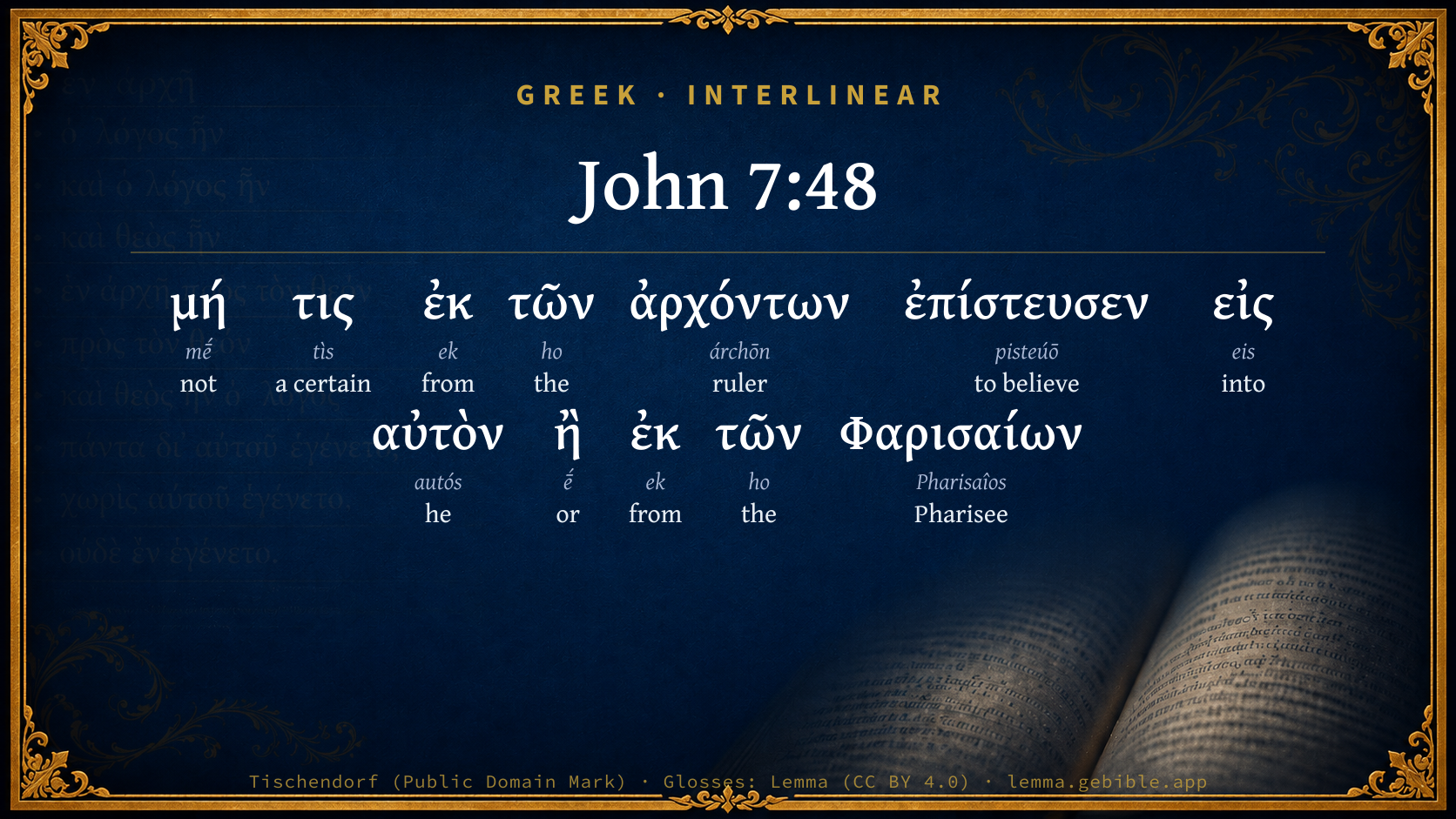
Download image
Cite this verse

John 7:48 (World English Bible). Public Domain. Lemma interlinear Bible study tool, https://lemma.gebible.app/v/john/7/48.

Show BibTeX & RIS
BibTeX
RIS
English Translation
Have any of the rulers believed in him, or of the Pharisees?
World English Bible · Public Domain
Download a study sheet

One document with this verse’s original text, its word-by-word gloss line, the meaning frame, cross-references with their text, attributed commentary, and full source and license credits — printable, and it pastes into notes with its structure intact.

This verse Autodidact and up

Study sheet (.html) Plain text (.txt)

A passage Seminary Student

Up to 50 verses in one chapter. A passage sheet keeps up to 6 commentary sources and 12 cross-references per verse, in the order this page ranks them, and says so on the sheet whenever that leaves anything out. Ask for a single verse and you get the Autodidact verse sheet above.

Everything on this page stays free to read, with no account — the sheet is a download of what is already on screen, not access to it.

Want to remove ads? Support Godless Engineer
Compare translations 3

The same verse in 3 English versions, stacked beneath the original-language interlinear above. Click any original word for its lexicon entry.

Each is an independent rendering of the whole verse — the interlinear is not word-aligned to these translations.

Highlighted words mark where these versions differ — a whole-verse word diff, not a word-by-word alignment.

  • World English Bible Public Domain
    Have any of the rulers believed in him, or of the Pharisees?
  • King James Version Public Domain
    Have any of the rulers or of the Pharisees believed on him?
  • unfoldingWord Literal Text CC BY-SA 4.0
    None from the rulers have believed in him, or from the Pharisees, have they?

unfoldingWord Literal Text — © unfoldingWord, licensed CC BY-SA 4.0. Word-aligned USFM3 via Door43 (git.door43.org/unfoldingWord/en_ult).

Versions to compare (up to 4)

3 of 4 selected

Show all 19 translations

Every available English version of this verse, each an independent rendering of the whole verse.

  • World English Bible Public Domain
    Have any of the rulers believed in him, or of the Pharisees?
  • Berean Standard Bible Public Domain
    “Have any of the rulers or Pharisees believed in Him?
  • Majority Standard Bible Public Domain
    “Have any of the rulers or Pharisees believed in Him?
  • King James Version Public Domain
    Have any of the rulers or of the Pharisees believed on him?
  • American Standard Version (1901) Public Domain
    Hath any of the rulers believed on him, or of the Pharisees?
  • Revised Version (1885) Public Domain
    Hath any of the rulers believed on him, or of the Pharisees?
  • Geneva Bible (1599) Public Domain
    Doeth any of the rulers, or of the Pharises beleeue in him?
  • Douay-Rheims (1899) Public Domain
    Hath any one of the rulers believed in him, or of the Pharisees?
  • Young's Literal Translation Public Domain
    did any one out of the rulers believe in him? or out of the Pharisees?
  • Literal Standard Version CC BY-SA 4.0
    Did anyone out of the rulers believe in Him? Or out of the Pharisees?
  • Unlocked Literal Bible CC BY-SA 4.0
    Have any of the rulers believed in him, or any of the Pharisees?
  • unfoldingWord Literal Text CC BY-SA 4.0
    None from the rulers have believed in him, or from the Pharisees, have they?
  • Darby Bible Public Domain
    Has any one of the rulers believed on him, or of the Pharisees?
  • World Messianic Bible Public Domain
    Have any of the rulers or any of the Pharisees believed in him?
  • Webster's Bible Public Domain
    Have any of the rulers, or of the Pharisees believed on him?
  • Free Bible Version CC BY-SA 4.0
    “Has a single one of the rulers or Pharisees believed in him? No!
  • Bible in Basic English Public Domain
    Have any of the rulers belief in him, or any one of the Pharisees?
  • Text-Critical English NT CC BY 4.0
    Have any of the rulers or the Pharisees believed in him?
  • Tyndale New Testament (1534) Public Domain
    Doth eny of the rulers or of the pharises beleve on him?

Literal Standard Version (2020), Covenant Press — licensed CC BY-SA 4.0. Text via the HelloAO Bible API (eBible.org). Unlocked Literal Bible (unfoldingWord) — licensed CC BY-SA 4.0. Text via the HelloAO Bible API (eBible.org). unfoldingWord Literal Text — © unfoldingWord, licensed CC BY-SA 4.0. Word-aligned USFM3 via Door43 (git.door43.org/unfoldingWord/en_ult). Free Bible Version, Dr. Jonathan Gallagher — licensed CC BY-SA 4.0. Text via the HelloAO Bible API (eBible.org).

Word by word

More ways to search: Search by grammar → Find every occurrence → Compare this word →

Practice this passage: Drill this verse → Learn its vocabulary →

About this verse

These counts appear in no published source. They are computed here, from the morphology-tagged text and Lemma’s own curated glosses. What Lemma adds →

12
words
10
distinct lemmas
Gospels
section

Shared distinctive vocabulary

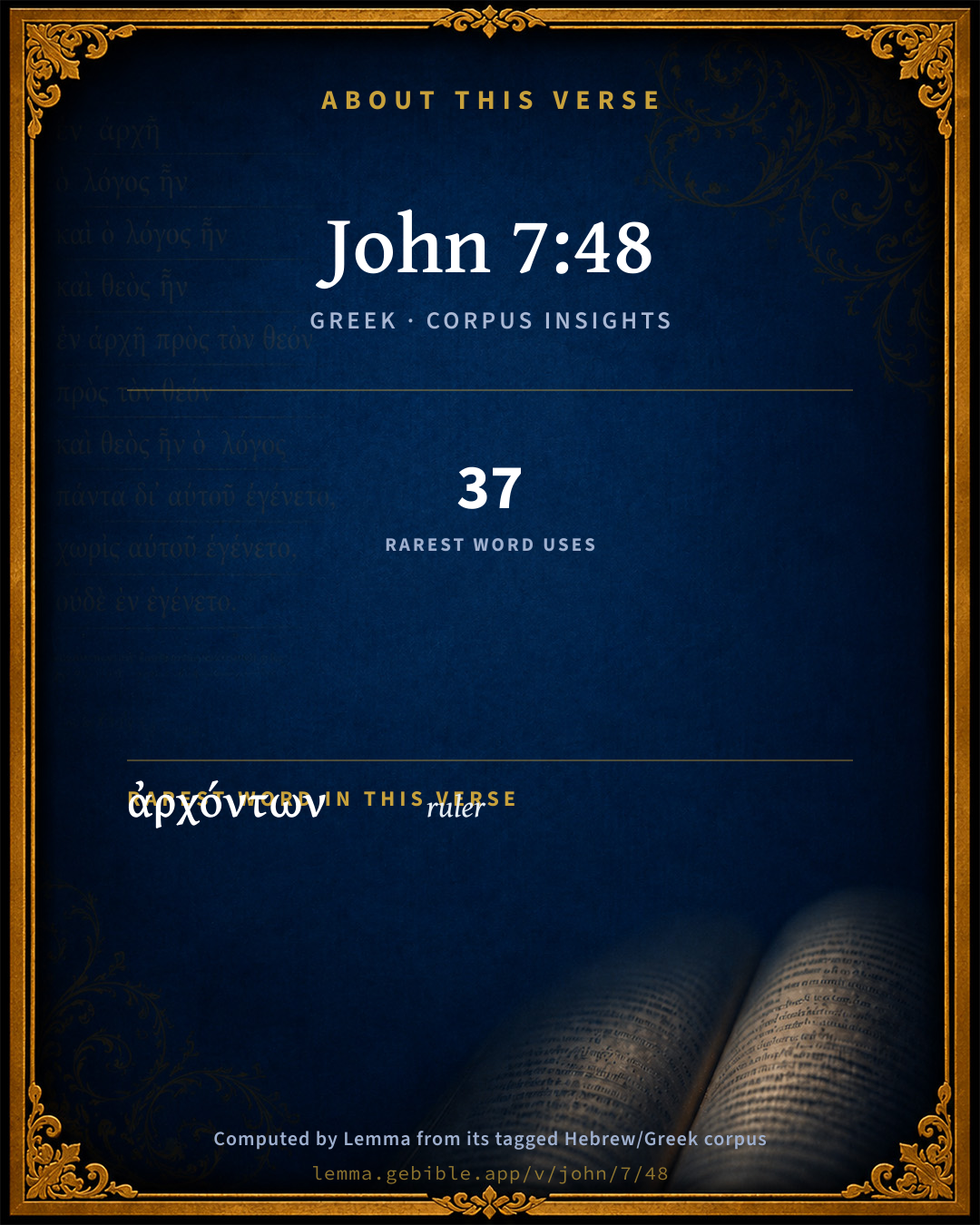
ἀρχόντων ruler G758 occurs in 36 verses of the Greek New Testament. Also found in:
Repetition

Words recur within this verse:

Cross-references

9

Topical passages linked to John 7:48 in the Treasury of Scripture Knowledge — connected by theme and wording, ordered by reader-vote popularity; previews shown in the World English Bible.

  • John 12:42 Nevertheless even of the rulers many believed in him, but because of the Pharisees they didn't confess it, so that they wouldn't be put out of the synagogue,
  • 1 Corinthians 1:20 Where is the wise? Where is the scribe? Where is the lawyer of this world? Hasn't God made foolish the wisdom of this world?
  • John 7:26 Behold, he speaks openly, and they say nothing to him. Can it be that the rulers indeed know that this is truly the Christ?
  • 1 Corinthians 2:8 which none of the rulers of this world has known. For had they known it, they wouldn't have crucified the Lord of glory.
  • Jeremiah 5:4–5 Then I said, Surely these are poor; they are foolish; for they don't know the way of Yahweh, nor the law of their God:
  • Matthew 11:25 At that time, Jesus answered, "I thank you, Father, Lord of heaven and earth, that you hid these things from the wise and understanding, and revealed them to infants.
  • John 7:50 Nicodemus (he who came to him by night, being one of them) said to them,
  • Acts 6:7 The word of God increased and the number of the disciples multiplied in Jerusalem exceedingly. A great company of the priests were obedient to the faith.

Cross-references courtesy of OpenBible.info (CC BY 4.0).

Commentary

Notes on John 7:48 from classic Christian and Jewish commentators (each source and its license shown beneath its notes). The classic Christian expositions comment on the surrounding passage and are grouped to its opening verse, so a note may address several verses; the Jewish commentaries on the Tanakh (Rashi and others) are per-verse, so they appear only where the commentator wrote on this verse.

Lemma curates 59 commentaries, every one of them public domain or Creative Commons licensed, each selected and text-cleaned for this edition rather than reprinted as found. About our sources →

Bengel's Gnomon

Johann Albrecht Bengel

Joh 7:48. Μή τις, whether has any) This is their inference: Men ought not to believe in Him, in whom the rulers do not believe. Zealots of the present day, especially the Romanists, use a similar mode of reasoning and blustering.—ἐκ τῶν Φαρισαῖων, of the Pharisees) knowing the law, they mean.[211]

[211] As opposed to this people, who knoweth not the law, ver. 49.—E. and T.

Bengel's Gnomon of the New Testament — English translation (T&T Clark, Edinburgh, 1860) — public domain. Text from a community e-Sword module.

Geneva Bible (1599)

Geneva Bible translators

False Pastors are so fond and foolish that they esteem the Church of God according to the multitude and outward show.

Geneva Bible (1599) marginal notes — public domain. Text via Bolls.life.

Jamieson, Fausset & Brown

Robert Jamieson, A. R. Fausset & David Brown

any of the rulers or . . . Pharisees believed--"Many of them" did, including Nicodemus and Joseph, but not one of these had openly "confessed Him" (Joh 12:42), and this appeal must have stung such of them as heard it to the quick.

Jamieson, Fausset & Brown — Commentary Critical and Explanatory on the Whole Bible (1871) — public domain (CC PDM 1.0). Text via the HelloAO Bible API.

Adam Clarke's Commentary

Verse 48. Have any of the rulers - believed on him?] Very few. But is this a proof that he is not of God? No, truly. If he were of the world, the world would love its own. The religion of Christ has been in general rejected by the rulers of this world. A life of mortification, self-denial, and humility, does not comport with the views of those who will have their portion in this life. It has ever been a mark of the truth of God that the great, the mighty, and the wise have in general rejected it. They are too much occupied with this world to attend to the concerns of the next.

Adam Clarke's Commentary on the Bible (1810–1826) — public domain. Text from a community e-Sword/MySword module.

John Calvin's Commentaries

48. Has any of the rulers, or of the Pharisees, believed in him? “He has none on his side,” they say, “but low and ignorant men; the rulers, and every person of distinction, are opposed to him.” They expressly name the Pharisees, because they had a reputation above others, both for knowledge and holiness, so that they might be said to be the princes of the people. This objection appears to have some plausibility; for if the rulers and governors of the Church do not retain their authority, it is impossible that any thing shall ever be properly done, or that the good order of the Church shall long continue. We know what are the fierce passions of the common people; in consequence of which the most frightful disorder must follow, when every man is allowed to do what he pleases. The authority of those who rule is therefore a necessary bridle for preserving the good order of the Church; and, accordingly, it was provided by the Law of God that, if any question or controversy should arise, it should be submitted to the decision of the High Priest, (Deuteronomy 17:8.)

But they err in this respect, that, while they claim for themselves the highest authority, they are unwilling to submit to God. It is true that God conferred the power of judgment on the high priest, but God did not intend that the high priest should decide, except according to his Law. All the authority that is possessed by pastors, therefore, is subject to the word of God, that all may be kept in their own rank, from the greatest to the smallest, and that God alone may be exalted. If pastors who honestly and sincerely discharge their duty, claim authority for themselves, this glorying will be holy and lawful; but when the mere authority of men is supported, without the authority of God’s word, it is vain and useless boasting. But it often happens that wicked men rule in the Church; and therefore we must beware of giving any authority to men, as soon as they depart from the word of God.

We see that nearly all the prophets were tormented by this kind of annoyance; for, in order to bury their doctrine, men continually brought against them the magnificent titles of Princes, of Priests, and of the Church. Provided with the same armor, Papists in the present day rage not less fiercely than did the adversaries of Christ and of the Prophets in former times. It is a horrible blindness, indeed, when a mortal man is not ashamed to oppose himself to God; but to such a pitch of madness does Satan carry those who set a higher value on their own ambition than on the truth of God. Meanwhile, it is our duty to cherish such a reverence for the word of God as shall extinguish all the splendor of the world, and scatter its vain pretensions; for miserable would be our condition, if our salvation depended on the will of princes, and far too unsteady would our faith be, if it were to stand or fall according to their pleasure.

John Calvin's Commentaries (1540-1563) — public domain. Text from the Calvin Translation Society English edition (1840s-50s) via the Christian Classics Ethereal Library (ccel.org). Calvin's coverage is partial (roughly two-thirds of the Bible); uncommented books and verses are honest gaps, never fabricated. The 19th-century editor's footnotes and remarks are omitted so the notes are faithfully Calvin's own voice.

Ellicott's Commentary for English Readers

(48) The rulers were the Sanhedrin, among whose official duties it was to prevent the introduction of false doctrines. (Comp. Note on Johnm 1:19.) “The Pharisees” were the orthodox party of the day, and they are the persons who ask the question. The matter was to be decided by authority, and not by truth. In the pride of the certainty that no one in a position of power or authority had believed on Jesus, they ask the scornful question, “Hath any one of the rulers or of the Pharisees believed? “They are stung to the very heart at seeing first the multitude, then their own officials, going after Him. They know not that there is one sitting in their midst, both ruler and Pharisee, who long before had listened to the teaching of the Galilean, and was in heart, if not in name, a disciple (John 3), and that during this very feast many of the chief Jews will believe on Him (Joh_8:30-31).

A Bible Commentary for English Readers, edited by Charles John Ellicott (1878–1897) — public domain. Text from a community e-Sword module.

The Cambridge Bible for Schools and Colleges

gen. ed. J. J. S. Perowne

48. What right have you to judge for yourselves, contrary to the declared opinion of the Sanhedrin and of the orthodox party? What right have you to wear our livery and dispute our resolutions?

The Cambridge Bible for Schools and Colleges (gen. ed. J. J. S. Perowne; Cambridge University Press, 1878–1918) — public domain. Text from a community e-Sword module.

John Gill's Exposition

Doth our law judge any man,.... Or condemn any man; or can any man be lawfully condemned:

before it hear him: what he has to say for himself; is this the usual process in our courts? or is this a legal one to condemn a man unheard?

and know what he doth? what his crimes are. This he said, having a secret respect for Christ, though he had not courage enough openly to appear for him.

John Gill's Exposition of the Whole Bible (1746–1763) — public domain (CC PDM 1.0). Text via the HelloAO Bible API.

Trapp's Complete Commentary

John Trapp

48 Have any of the rulers or of the Pharisees believed on him?

Ver. 48. Have any of the rulers, &c.] Argumentum stultum, saith Theophylact. Sapientes sapienter in infernum descendunt, saith one. And Potentes potenter torquebuntur, saith another. None so deep in hell as knowing men; they are too wise to be saved by the foolishness of preaching. But Paul, the babbler, must be heard, ere heaven can be had.

John Trapp, A Commentary or Exposition upon All the Books of the Old and New Testament (1647–1656) — public domain. Text from a community e-Sword module.

Albert Barnes' Notes on the Bible

The rulers - The members of the Sanhedrin, who were supposed to have control over the religious rites and doctrines of the nation.

The Pharisees - The sect possessing wealth, and office, and power. The name Pharisees sometimes denotes those who were high in honor and authority.

Believed on him - Is there any instance in which those who are high in rank or in office have embraced him as the Messiah? This shows the rule by which they judged of religion:

They claimed the right of regulating the doctrines and rites of religion. They repressed the liberty of private judgment, stifled investigation, assumed that a new doctrine must be heresy, and labored to keep the people within inglorious bondage. They treated the new doctrine of Jesus with contempt, and thus attempted to put it down, not by argument, but by contempt, and especially because it was embraced by the common people. This is the way in which doctrines contrary to the truth of God have been uniformly supported in the world; this is the way in which new views of truth are met; and this the way in which those in ecclesiastical power often attempt to lord it over God’s heritage, and to repress the investigation of the Bible.

Albert Barnes' Notes on the Bible (1834–1885) — public domain. Text from a community e-Sword/MySword module.

Matthew Poole's English Annotations

You ought to be ruled by us, and guided by us, who are your rulers, and your teachers: so early did the doctrine of implicit faith and obedience creep into the world; which is indeed to suppose an infallibility in teachers and rulers; to whom indeed we owe all imaginable reverence, but we must live by our own faith. And though the Jews were bound to do according to the sentence that the priests and Levites in Jerusalem should show them, Deu 17:10,11; yet it must be the sentence of the law, and it was in civil matters, as appeareth by Joh 7:8, controversies between blood and blood, plea and plea, stroke and stroke.

Matthew Poole's English Annotations on the Holy Bible (1683–1685) — public domain. Text from a community e-Sword/MySword module.

Whedon's Commentary on the Bible

Daniel D. Whedon

48. Any of the… Pharisees—The Pharisees are infallible authority for Pharisees.

Daniel D. Whedon (gen. ed.), Commentary on the Old and New Testaments (1874–1909) — public domain. Text from a community e-Sword module.

The Pulpit Commentary

Hath any one of the rulers believed on him, or of the Pharisees? They soon find they have reckoned on the emphatic negative of the query (mh tiv) too soon. There is, however, a touch of weakness in the question. They seem to say, if one of the rulers, one of the Pharisees, had taken a different course, there might be some colour for the pusillanimity of the officers. The question which they put, thus expecting a negative answer, might be answered differently. There were Pharisees who had shown some sympathy with Jesus. Certain steps, moreover, taken by him were not so hopelessly hostile to their own views. In their momentary animosity, blinded by passion, they are ready to ignore this and other facts as well. Some of the higher classes in Galilee had already admitted his claims. (see Joh_4:46 Luk_7:36, etc.) The language of the Pharisees has been a stock objection to every great spiritual movement in its beginning. The writer thus reveals a knowledge of proceedings to which he must have had some exceptional means of access. The obvious familiarity which he suggests with Nicodemus and with friends in the high priest"s palace (Joh_18:15) is the simplest explanation.

Class prejudice and Christianity.

The learned and the rich sometimes hate and despise a form of religion because it is favoured by the poor and the ignorant; and these in turn dislike and reject a different form of religion because it is adopted by their social superiors. Something similar to this antipathy seems to have been manifested among the Jews in the time of our Lord; only it was not a form of religion that was in question, it was religion itself, or rather that Being who is in his own person the sum and substance of true religion. There were undoubtedly serious reasons which led rulers and Pharisees to reject Jesus of Nazareth. That mentioned in this passage was not the most serious; but it was a real and influential reason. Jesus was reputed a Galilaean; he was heard gladly by the common people, who were ignorant of the Law. This was reason enough for his rejection by those who respected only the educated and ruling classes of society.

I THE ASSERTION IMPLIED, viz. that Jesus was not received with faith by the rulers and the Pharisees. This was not universally true. The attitude of Nicodemus on this occasion shows that, even in the council of the nation, faith in Jesus as the Christ was not unknown. Joseph of Arimathaea also was a disciple of Jesus, though secretly. Yet, broadly speaking, it was undoubtedly the case that the upper classes of his countrymen rejected Jesus, and that the more influential among them hated and dreaded him. This may be accounted for, partly upon the general principle that the wealthy and educated tend to conservatism; but mainly by considering how the teaching of Jesus was undermining the authority of the Jewish leaders, and was even threatening to cut off some of the sources of their ill-gotten riches.

II THE ARGUMENT SUGGESTED. The language suggested some such argument as this What the learned and leading classes reject is likely to be incredible and unworthy of acceptance; now, these classes altogether repudiate Jesus of Nazareth as the Messiah, or even as a prophet; there is, therefore, no room for accepting or even considering his claims. The fact of the hostility of the rulers was by this time matter of notoriety, and this had, no doubt, influence with many who were accustomed to look to their social and ecclesiastical superiors for leading. The same principle which was so influential in our Lord"s day has in subsequent periods of human history induced many to reject the Saviour. Some have attached importance to the infidelity of princes, others to that of leaders in fashion, others to that of great philosophers; and have permitted their blind reverence for authority to turn their attention away from the weighty credentials of Christianity, and from the claims of Christ himself.

III THE FALLACY LATENT. This is to be found in the assumption that learned and powerful men are likely to be right upon questions of religion. The events which followed in the history of the Son of man were enough to dispel this illusion. Not for the first or the last time, the judges in whom public confidence is chiefly placed were wrong, and the poor, illiterate, and despised were right. Against a fallacy which has led so many astray, it is well that those who desire above all things to attain the truth should be upon their guard. And the true protection is this: the habit, not of asking What is the judgment of men? but of asking What are the indications of the will of God? If the Lord Jesus Christ be in himself adapted to our needs as being the Prophet, the Priest, and the King of humanity, it is of little consequence, so far as practical guidance is concerned, to consider who rejects his claims. Let every one who is a seeker of truth turn his heart and mind to Christ. He is his own best witness, his own most convincing evidence. T.

The Pulpit Commentary (1880–1919), ed. H.D.M. Spence-Jones & Joseph S. Exell — public domain. Text from a community e-Sword module.

John Wesley's Explanatory Notes

Hath any of the rulers - Men of rank or eminence, or of the Pharisees - Men of learning or religion, believed on him?

John Wesley, Explanatory Notes Upon the Whole Bible (1754–1765) — public domain. Text via the GEBible commentary corpus.

Cambridge Greek Testament for Schools and Colleges

48. What right have you to judge for yourselves, contrary to the declared opinion of the Sanhedrin and of the orthodox party? What right have you to wear our livery and dispute our resolutions? Note the singular; Hath any one? ‘Have any’ weakens it.

Cambridge Greek Testament for Schools and Colleges (Cambridge University Press, 1896; 21 vols, various authors incl. Carr, Maclear, Plummer, Farrar, Lumby, Moule, M. R. James, Simcox) — public domain. Text from a community e-Sword module.

International Critical Commentary

48. μή τις ἐκ τῶν ἀρχόντων ἐπίστευσεν εἰς αὐτόν; “Did a single one of the rulers believe in Him?” the form of the question, μή τις, implying that a negative answer was the only possible one. Yet, a little later, this astonishing thing had come to pass, ἐκ τῶν ἀρχόντων πολλοὶ ἐπίστευσαν εἰς αὐτόν (12:42); but at this moment it seemed incredible. See on v. 32 for the ἄρχοντες, and cf. v. 50.

ἢ ἐκ τῶν Φαρισαίων; “Or a single one of the Pharisees?” Only a select few of the Pharisees were in the Sanhedrim, but the Pharisees generally were the most orthodox of all the inhabitants of Jerusalem (cf. 1:24, 7:32).

The ὑπηρέται are blamed severely because they did not do as they were told, and it is truly remarkable that they had not arrested Jesus. Subordinate officers, the Pharisees seem to say, have no right to judge of the expediency of an order which they have received.

International Critical Commentary — older volumes (1896–1929), various authors — public domain. Text from a community e-Sword module.

Vincent's Word Studies in the New Testament

Marvin R. Vincent

Of the rulers or of the Pharisees. The Greek order, as followed by Rev., is more suggestive : Hath any of the rulers believed on Him, or (to appeal to a larger circle) of the Pharisees ?

Marvin R. Vincent, Word Studies in the New Testament (1887–1900) — public domain. Text from a community e-Sword/MySword module.

Lesson kit

Teaching starters — assembled from the data on this page, not authored interpretation. Every prompt links to the verse data it draws on. Edit before teaching.

John, in the Gospels, opens this verse with 12 words (10 distinct Greek lemmas). Its most distinctive word is árchōn (“ruler”). A historical commentator’s framing appears above. Read the whole chapter for the surrounding context.

Discussion questions

  1. The word árchōn carries the sense “ruler.” How does it shape the verse?
  2. Matthew 9:18 shares the word «ruler» with this verse. How do the two illuminate each other?
  3. “from” occurs 2× in this one verse. What is the effect of the repetition?
  4. The translations on this page render this verse differently — a whole-verse word diff, not a word-by-word alignment. What might account for the different wordings?
  5. Reading how Bengel's Gnomon and Geneva Bible (1599) read this verse, where do the two commentators agree and where do they part?

Things to notice

  • These translations choose different wording for 2 words in this verse.
  • “from” occurs 2× in this single verse.
  • 10 distinct Greek lemmas span 12 words in this verse.

Reading settings

Reading text

Shown beneath each verse's original-language words.

Old Testament
Old Testament edition

Read the OT as the Masoretic Hebrew (MT) or the Greek Septuagint (LXX).

English shown for the Greek Septuagint (in the Hebrew ↔ Greek comparison).

Comparing translations? Open the Compare panel on any verse page to stack up to four side by side.