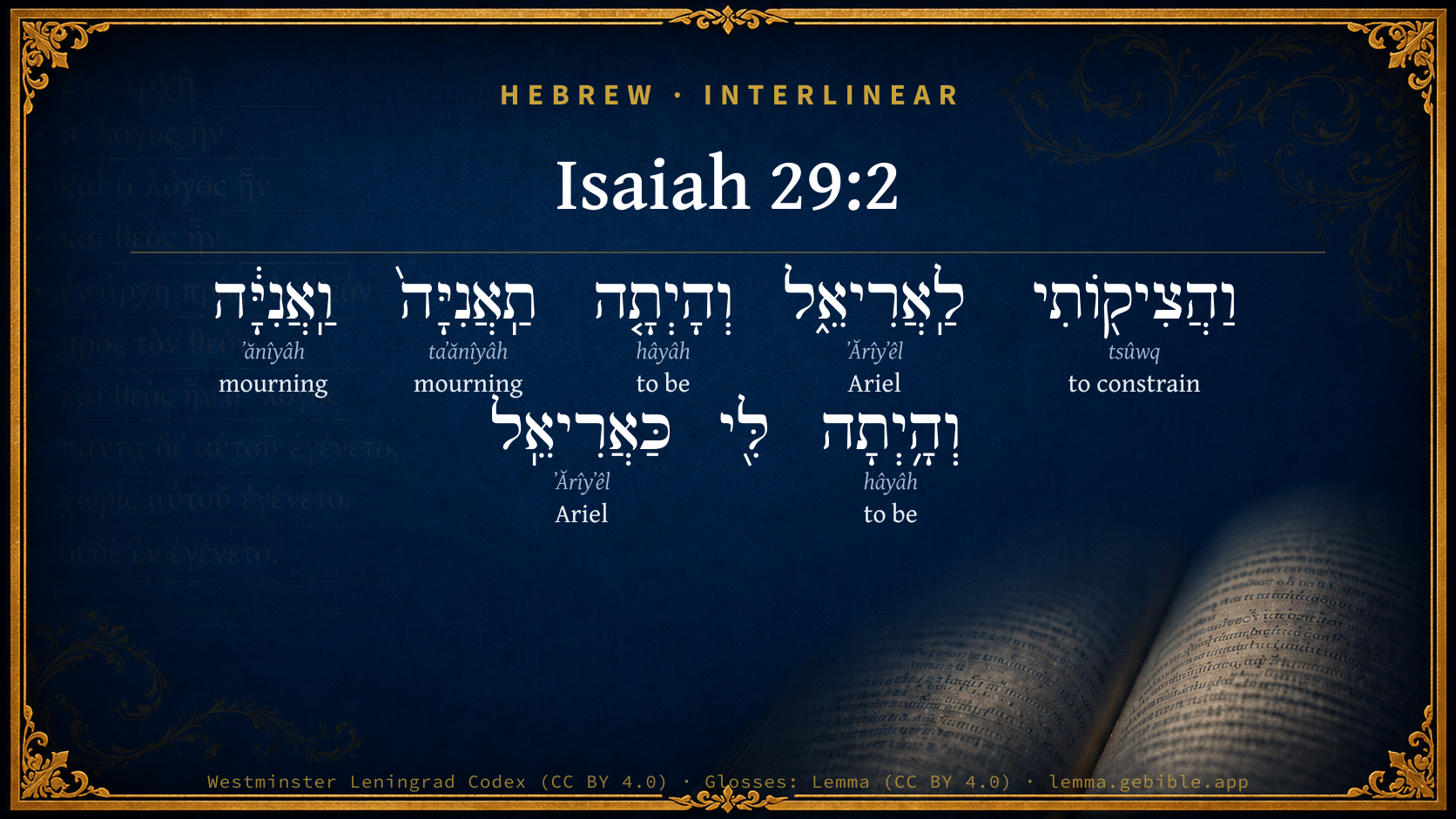
Isaiah 29:2

Hebrew (Westminster Leningrad Codex) Isaiah 29:2 appears in the Hebrew Old Testament. The text above is from the Westminster Leningrad Codex. Each word links to its Strong’s number, a concise gloss, and parsing drawn from the Open Scriptures Hebrew Bible morphology. Click any word for its full Brown-Driver-Briggs (BDB) entry.
Download image
Cite this verse

Isaiah 29:2 (World English Bible). Public Domain. Lemma interlinear Bible study tool, https://lemma.gebible.app/v/isaiah/29/2.

Show BibTeX & RIS
BibTeX
RIS
English Translation
then will I distress Ariel, and there shall be mourning and lamentation; and she shall be to me as Ariel.
World English Bible · Public Domain
Highlights
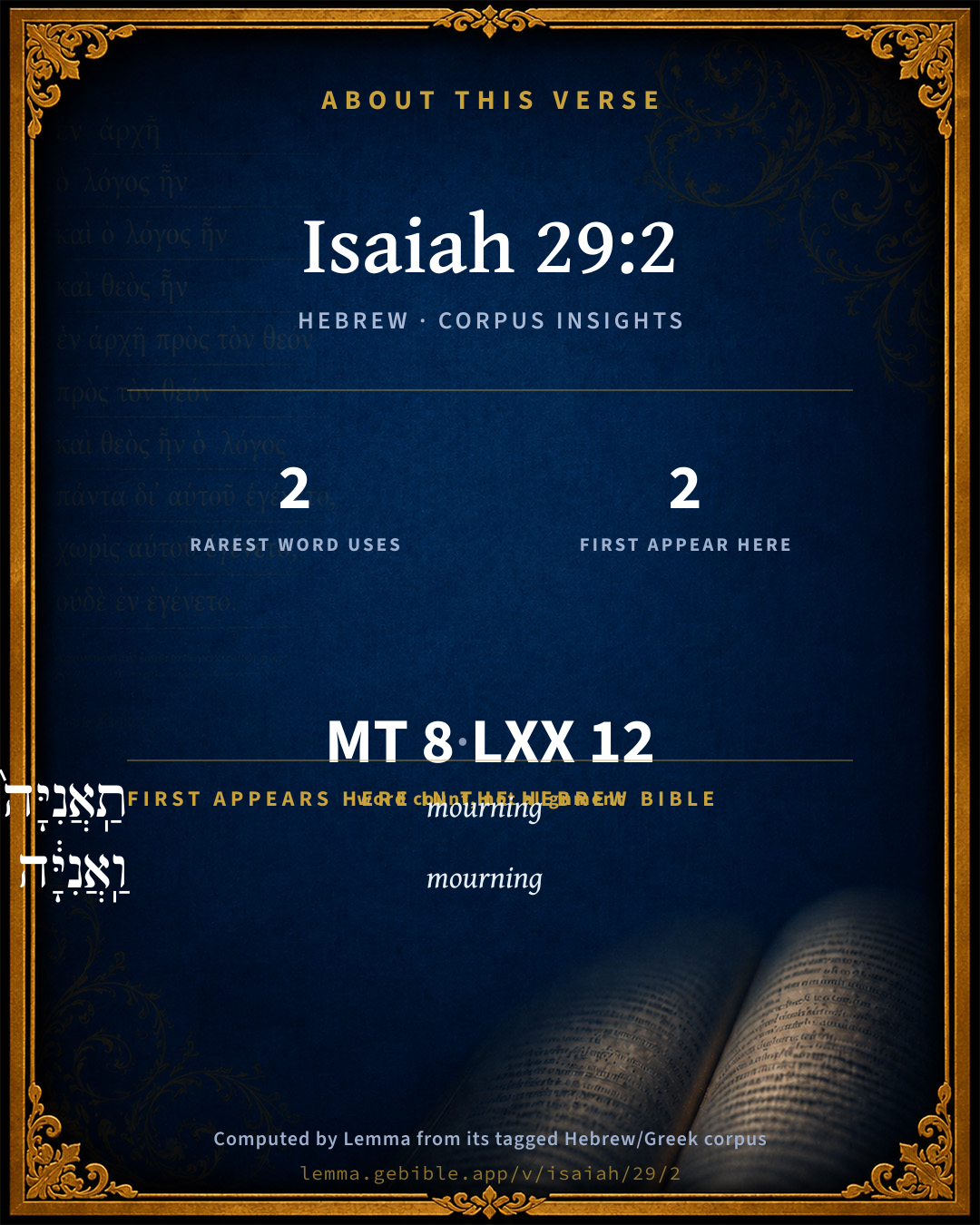
  • 2 first appearances in the Hebrew Bible
Full analysis ↓
Download a study sheet

One document with this verse’s original text, its word-by-word gloss line, the meaning frame, cross-references with their text, attributed commentary, and full source and license credits — printable, and it pastes into notes with its structure intact.

This verse Autodidact and up

Study sheet (.html) Plain text (.txt)

A passage Seminary Student

Up to 50 verses in one chapter. A passage sheet keeps up to 6 commentary sources and 12 cross-references per verse, in the order this page ranks them, and says so on the sheet whenever that leaves anything out. Ask for a single verse and you get the Autodidact verse sheet above.

Everything on this page stays free to read, with no account — the sheet is a download of what is already on screen, not access to it.

Want to remove ads? Support Godless Engineer
Compare translations 3

The same verse in 3 English versions, stacked beneath the original-language interlinear above. Click any original word for its lexicon entry.

Each is an independent rendering of the whole verse — the interlinear is not word-aligned to these translations.

Highlighted words mark where these versions differ — a whole-verse word diff, not a word-by-word alignment.

  • World English Bible Public Domain
    then will I distress Ariel, and there shall be mourning and lamentation; and she shall be to me as Ariel.
  • King James Version Public Domain
    Yet I will distress Ariel, and there shall be heaviness and sorrow: and it shall be unto me as Ariel.
  • unfoldingWord Literal Text CC BY-SA 4.0
    But I will cause distress to Ariel, and it will be mourning and lamentation, and it will be to me like an altar hearth.

unfoldingWord Literal Text — © unfoldingWord, licensed CC BY-SA 4.0. Word-aligned USFM3 via Door43 (git.door43.org/unfoldingWord/en_ult).

Versions to compare (up to 4)

3 of 4 selected

Show all 18 translations

Every available English version of this verse, each an independent rendering of the whole verse.

  • World English Bible Public Domain
    then will I distress Ariel, and there shall be mourning and lamentation; and she shall be to me as Ariel.
  • Berean Standard Bible Public Domain
    And I will constrain Ariel, and there will be mourning and lamentation; she will be like an altar hearth before Me.
  • Majority Standard Bible Public Domain
    And I will constrain Ariel, and there will be mourning and lamentation; she will be like an altar hearth before Me.
  • King James Version Public Domain
    Yet I will distress Ariel, and there shall be heaviness and sorrow: and it shall be unto me as Ariel.
  • American Standard Version (1901) Public Domain
    then will I distress Ariel, and there shall be mourning and lamentation; and she shall be unto me as Ariel.
  • Revised Version (1885) Public Domain
    then will I distress Ariel, and there shall be mourning and lamentation: and she shall be unto me as Ariel.
  • Geneva Bible (1599) Public Domain
    But I wil bring the altar into distresse, and there shalbe heauines and sorowe, and it shall be vnto me like an altar.
  • Douay-Rheims (1899) Public Domain
    And I will make a trench about Ariel, and it shall be in sorrow and mourning, and it shall be to me as Ariel.
  • Young's Literal Translation Public Domain
    And I have sent distress to Ariel, And it hath been lamentation and mourning, And it hath been to me as Ariel.
  • Literal Standard Version CC BY-SA 4.0
    And I have sent distress to Ariel, || And it has been lamentation and mourning, || And it has been to me as Ariel.
  • Unlocked Literal Bible CC BY-SA 4.0
    But I will besiege Ariel, and she will be mourning and lamenting; and she will be to me like Ariel.
  • unfoldingWord Literal Text CC BY-SA 4.0
    But I will cause distress to Ariel, and it will be mourning and lamentation, and it will be to me like an altar hearth.
  • Darby Bible Public Domain
    But I will distress Ariel, and there shall be sorrow and sadness; and it shall be unto me as an Ariel.
  • World Messianic Bible Public Domain
    then I will distress Ariel, and there will be mourning and lamentation. She shall be to me as an altar hearth.
  • Webster's Bible Public Domain
    Yet I will distress Ariel, and there shall be heaviness and sorrow; and it shall be to me as Ariel.
  • Free Bible Version CC BY-SA 4.0
    But I'm going to cause trouble for Ariel; the city will cry and mourn, it will be like an altar hearth to me.
  • Bible in Basic English Public Domain
    And I will send trouble on Ariel, and there will be weeping and cries of grief; and she will be to me as Ariel.
  • JPS Tanakh (1917) Public Domain
    Then will I distress Ariel, and there shall be mourning and moaning; and she shall be unto Me as a hearth of God.

Literal Standard Version (2020), Covenant Press — licensed CC BY-SA 4.0. Text via the HelloAO Bible API (eBible.org). Unlocked Literal Bible (unfoldingWord) — licensed CC BY-SA 4.0. Text via the HelloAO Bible API (eBible.org). unfoldingWord Literal Text — © unfoldingWord, licensed CC BY-SA 4.0. Word-aligned USFM3 via Door43 (git.door43.org/unfoldingWord/en_ult). Free Bible Version, Dr. Jonathan Gallagher — licensed CC BY-SA 4.0. Text via the HelloAO Bible API (eBible.org).

Word by word

More ways to search: Search by grammar → Find every occurrence → Compare this word →

Practice this passage: Drill this verse → Learn its vocabulary →

About this verse

These counts appear in no published source. They are computed here, from the morphology-tagged text and Lemma’s own curated glosses. What Lemma adds →

8
words
5
distinct lemmas
Prophets
section

Notable vocabulary

The rarest word here is תַֽאֲנִיָּה֙ mourning H8386 — appearing just 2 times in the whole Hebrew Bible.

First appearance in Scripture

These words make their first canonical appearance in the Hebrew Bible here:

  • תַֽאֲנִיָּה֙ mourning H8386
  • וַֽאֲנִיָּ֔ה mourning H592

Shared distinctive vocabulary

תַֽאֲנִיָּה֙ mourning H8386 occurs in 2 verses of the Hebrew Bible. Also found in:

Grammatical profile

  • 3 verbs
  • 4 nouns
  • 1 preposition

Verb forms

  • וַהֲצִיק֖וֹתִי Hiphil · Sequential Perfect
  • וְהָיְתָ֤ה Qal · Sequential Perfect
  • וְהָ֥יְתָה Qal · Sequential Perfect

Repetition

Words recur within this verse — often emphatic in Hebrew:

  • לַֽאֲרִיאֵ֑ל Ariel H740 ×2
  • וְהָיְתָ֤ה to be H1961 ×2

Hebrew & Septuagint length

In English translation the verse runs 20 words from the Hebrew and 15 from the Septuagint (LXX English) — closely comparable.

A rough comparison of the two English renderings, which tokenize alike — not a word-level alignment.

Word counts can differ between the Hebrew and the Greek without any difference in meaning — e.g. the Hebrew direct-object marker אֵת has no separate Greek word, and Greek often adds the article ὁ.

In the original languages it is 8 Hebrew tokens and 12 Greek tokens — but the two are counted differently (Hebrew bundles its prefixes and suffixes into one token; the Greek is in lemma form), so that isn’t a like-for-like length.

Cross-references

18

Topical passages linked to Isaiah 29:2 in the Treasury of Scripture Knowledge — connected by theme and wording, ordered by reader-vote popularity; previews shown in the World English Bible.

  • Isaiah 5:25–30 Therefore Yahweh's anger burns against his people, And he has stretched out his hand against them, and has struck them. The mountains tremble, And their dead bodies are as refuse in the midst of the streets. For all this, his anger is not turned away, But his hand is still stretched out.
  • Isaiah 3:26 Her gates shall lament and mourn; And she shall be desolate and sit on the ground.
  • Isaiah 10:5–6 Ho Assyrian, the rod of my anger, the staff in whose hand is my indignation!
  • Isaiah 10:32 This very day shall he halt at Nob: he shakes his hand at the mountain of the daughter of Zion, the hill of Jerusalem.
  • Isaiah 17:14 At evening, behold, terror; [and] before the morning they are no more. This is the portion of those who despoil us, and the lot of those who rob us.
  • Isaiah 24:1–12 Behold, Yahweh makes the earth empty, and makes it waste, and turns it upside down, and scatters abroad the inhabitants of it.
  • Isaiah 33:7–9 Behold, their valiant ones cry outside; the ambassadors of peace weep bitterly.
  • Isaiah 34:6 The sword of Yahweh is filled with blood, it is made fat with fatness, with the blood of lambs and goats, with the fat of the kidneys of rams; for Yahweh has a sacrifice in Bozrah, and a great slaughter in the land of Edom.
  • Isaiah 36:22 Then came Eliakim the son of Hilkiah, who was over the household, and Shebna the scribe, and Joah, the son of Asaph, the recorder, to Hezekiah with their clothes torn, and told him the words of Rabshakeh.
  • Isaiah 37:3 They said to him, Thus says Hezekiah, This day is a day of trouble, and of rebuke, and of rejection; for the children have come to the birth, and there is no strength to bring forth.
  • Jeremiah 32:28–32 Therefore thus says Yahweh: Behold, I will give this city into the hand of the Chaldeans, and into the hand of Nebuchadrezzar king of Babylon, and he shall take it:
  • Jeremiah 39:4–5 It happened that, when Zedekiah the king of Judah and all the men of war saw them, then they fled, and went forth out of the city by night, by the way of the king's garden, through the gate between the two walls; and he went out toward the Arabah.
  • Lamentations 2:5 The Lord is become as an enemy, he has swallowed up Israel; He has swallowed up all her palaces, he has destroyed his strongholds; He has multiplied in the daughter of Judah mourning and lamentation.
  • Ezekiel 22:31 Therefore have I poured out my indignation on them; I have consumed them with the fire of my wrath: their own way have I brought on their heads, says the Lord Yahweh.
  • Ezekiel 39:17 You, son of man, thus says the Lord Yahweh: Speak to the birds of every sort, and to every animal of the field, Assemble yourselves, and come; gather yourselves on every side to my sacrifice that I do sacrifice for you, even a great sacrifice on the mountains of Israel, that you may eat flesh and drink blood.
  • Zephaniah 1:7–8 Be silent at the presence of the Lord Yahweh, for the day of Yahweh is at hand. For Yahweh has prepared a sacrifice. He has consecrated his guests.
  • Revelation 19:17–18 I saw an angel standing in the sun. He cried with a loud voice, saying to all the birds that fly in the sky, "Come! Be gathered together to the great supper of God,
  • Ezekiel 24:3–13 Utter a parable to the rebellious house, and tell them, Thus says the Lord Yahweh, Set on the caldron, set it on, and also pour water into it:

Cross-references courtesy of OpenBible.info (CC BY 4.0).

Hebrew and Greek witnesses Masoretic Hebrew ↔ Greek Septuagint

The same verse in the two great witnesses to the Old Testament, shown verse-for-verse.

These are two independent witnesses, not word-aligned to each other, and the Septuagint is shown in lemma (dictionary) form.

Hebrew Isaiah 29:2 Masoretic · Westminster Leningrad Codex

וַהֲצִיק֖וֹתִי לַֽאֲרִיאֵ֑ל וְהָיְתָ֤ה תַֽאֲנִיָּה֙ וַֽאֲנִיָּ֔ה וְהָ֥יְתָה לִּ֖י כַּאֲרִיאֵֽל

then will I distress Ariel, and there shall be mourning and lamentation; and she shall be to me as Ariel.

World English Bible · Public Domain

Greek LXX Isaiah 29:2 Septuagint · lemma form

ἐκθλίβω γάρ αριηλ καί εἰμί αὐτός ὁ ἰσχύς καί ὁ πλοῦτος ἐγώ

For I will grievously afflict Ariel: and her strength and her wealth shall be mine.

LXX2012 (modern English Septuagint) · Public Domain

Hebrew: Westminster Leningrad Codex (CC BY 4.0). Greek: Septuagint (public domain); English from LXX2012 (modern English Septuagint) (Public Domain). How the Septuagint differs from the Hebrew →

Targum (Aramaic paraphrase)

1

The Targum is the ancient Jewish Aramaic paraphrase of the Hebrew Scriptures — an interpretive translation, not the Hebrew text itself. Onkelos (literal) and Pseudo-Jonathan (expansive) render the Torah, and Jonathan the Prophets. Coverage is partial: where no permissively-licensed English translation exists for a verse, only the Aramaic is shown. This is verse-level text, not a word-by-word alignment to the Hebrew.

  1. Targum Jonathan Prophets (Joshua–Malachi)
    וְעָאִיק לְקַרְתָּא דְמַדְבְּחָא בָהּ וּתְהֵי צַדְיָא וְרֵקַנְיָא וּתְהֵי מַקְפָא קֳדָמַי דַם קְטִילִין כְּאַקָפוּת מַדְבְּחָא דַם נִכְסַת קוּדְשַׁיָא בְּיוֹמָא דְחַגָא סְחוֹר סְחוֹר:

    And I will distress the city, in which the altar is, and she shall be desolate and empty; and she shall be surrounded before me with the blood of the slain, as the altar is surrounded round about with the blood of the holy sacrifices in the day of the festival.

    Targum Jonathan — Aramaic: “Mikraot Gedolot” (public domain). English: “Sefaria Community Translation” (CC0 1.0 (public-domain dedication)); “London "Chaldee Paraphrase," 1871” (public domain). Text via Sefaria.

Commentary

Notes on Isaiah 29:2 from classic Christian and Jewish commentators (each source and its license shown beneath its notes). The classic Christian expositions comment on the surrounding passage and are grouped to its opening verse, so a note may address several verses; the Jewish commentaries on the Tanakh (Rashi and others) are per-verse, so they appear only where the commentator wrote on this verse.

Lemma curates 59 commentaries, every one of them public domain or Creative Commons licensed, each selected and text-cleaned for this edition rather than reprinted as found. About our sources →

Trapp's Complete Commentary

John Trapp

Isa 29:2 Yet I will distress Ariel, and there shall be heaviness and sorrow: and it shall be unto me as Ariel.

Ver. 2. Yet I will distress Ariel.] Though a sacred place. Profligate professors are the worse for their privileges. The Jew first. {Rom 2:9}

And it shall be unto me as Ariel,] i.e., It shall be full of slain bodies, as the altar is usually full of slaughtered beasts, and swimmeth, as it were, in blood. So Jer 12:3 Isa 34:6. Arias Montanus giveth this sense: ‘Jerusalem, which once was Ariel, that is, a strong lion, shall now be Ariel, that is, a strong curse, or a rain of malediction.’

John Trapp, A Commentary or Exposition upon All the Books of the Old and New Testament (1647–1656) — public domain. Text from a community e-Sword module.

Joseph Benson's Commentary

Isa 29:2. Yet will I distress Ariel — Notwithstanding all your sacrifices, by bringing and strengthening her enemies against her. And there shall be heaviness and sorrow — Instead of your present joy and festivity. And it shall be to me as Ariel — That is, either, 1st, I will treat her like a strong and fierce lion, which the people, among whom it is, endeavour by nets and pits, and divers other ways, to take and destroy. Or, 2d, I will make Ariel the city like Ariel the altar, filling it with sacrifices, even of men, whom I will slay in my anger; which act of God is called his sacrifice, Eze 39:17-19. Agreeably to this latter interpretation, Bishop Lowth renders the clause, It shall be unto me as the hearth of the great altar: that is, as he explains it, “all on flame; as it was when taken by the Chaldeans; or covered with carcasses and blood, as when taken by the Romans: an intimation of which more distant events, though not immediate subjects of the prophecy, may perhaps be given in this obscure passage.”

Joseph Benson's Commentary on the Old and New Testaments (1811–1818) — public domain. Text from a community e-Sword module.

Geneva Bible (1599)

Geneva Bible translators

Your city shall be full of blood, as an altar whereon they sacrifice.

Geneva Bible (1599) marginal notes — public domain. Text via Bolls.life.

Jamieson, Fausset & Brown

Robert Jamieson, A. R. Fausset & David Brown

Yet--rather, "Then."

heaviness . . . sorrow--rather, preserving the Hebrew paronomasia, "groaning" and "moaning."

as Ariel--either, "the city shall be as a lion of God," that is, it shall emerge from its dangers unvanquished; or "it shall be as the altar of burnt offering," consuming with fire the besiegers (Isa 29:6; Isa 30:30; Isa 31:9; Lev 10:2); or best, as Isa 29:3 continues the threat, and the promise of deliverance does not come till Isa 29:4, "it shall be like a hearth of burning," that is, a scene of devastation by fire [G. V. SMITH]. The prophecy, probably, contemplates ultimately, besides the affliction and deliverance in Sennacherib's time, the destruction of Jerusalem by Rome, the dispersion of the Jews, their restoration, the destruction of the enemies that besiege the city (Zac 14:2), and the final glory of Israel (Isa 29:17-24).

Jamieson, Fausset & Brown — Commentary Critical and Explanatory on the Whole Bible (1871) — public domain (CC PDM 1.0). Text via the HelloAO Bible API.

Adam Clarke's Commentary

Verse 2. There shall be heaviness and sorrow - "There shall be continual mourning and sorrow"] Instead of your present joy and festivity.

And it shall be unto me as Ariel - "And it shall be unto me as the hearth of the great altar."] That is, it shall be the seat of the fire of God; which shall issue from thence to consume his enemies. See note on Isa 29:1. Or, perhaps, all on flame; as it was when taken by the Chaldeans; or covered with carcasses and blood, as when taken by the Romans: an intimation of which more distant events, though not immediate subjects of the prophecy, may perhaps be given in this obscure passage.

Adam Clarke's Commentary on the Bible (1810–1826) — public domain. Text from a community e-Sword/MySword module.

Ellicott's Commentary for English Readers

(2) And it shall be unto me as Ariel.—Better, But she (the city) shall be unto me as Ariel. That name would not falsify itself. In the midst of all her “heaviness and sorrow,” Jerusalem should still be as “the lion of God,” or, taking the other meaning, as the “altar-hearth” of God. (Comp. Eze_43:15.)

A Bible Commentary for English Readers, edited by Charles John Ellicott (1878–1897) — public domain. Text from a community e-Sword module.

The Cambridge Bible for Schools and Colleges

gen. ed. J. J. S. Perowne

2. there shall be heaviness and sorrow] Better: “mourning and lamentation” (R.V.), but still better (as reproducing the assonance of the original): moaning and bemoaning (Cheyne). The expression recurs in Lam_2:5.

it shall be unto me as Ariel] she shall be to me like a (true) altar-hearth (Kaph veritatis). If Ariel meant “Lion of God” this clause would necessarily have to be understood in a favourable sense; on the view here followed it may be either a promise or a threat; the context decides for the latter. The meaning is that Jerusalem will be either a place where the flames of war rage fiercely, or a place reeking with the blood of countless human victims. We may suppose that Isaiah addressed these words to the worshippers in the Temple, and that the great altar with its bleeding victims stood out before his mind as an emblem of Jerusalem’s fate, and suggested the name “Ariel.”

2–5. The humiliation and distress of Ariel, at the hands of the Assyrians.

The Cambridge Bible for Schools and Colleges (gen. ed. J. J. S. Perowne; Cambridge University Press, 1878–1918) — public domain. Text from a community e-Sword module.

John Gill's Exposition

Yet I will distress Ariel,.... Or "straiten" it, by causing it to be besieged; and this he would do, notwithstanding their yearly sacrifices, and their observance of their solemn feasts, and other ceremonies of the law, in which they placed their confidence, and neglected weightier matters:

and there shall be heaviness and sorrow; on account of the siege; by reason of the devastations of the enemy without, made on all the cities and towns in Judea round about; and because of the famine and bloodshed in the city:

and it shall be unto me as Ariel; the whole city shall be as the altar; as that was covered with the blood and carcasses of slain beasts, so this with the blood and carcasses of men; and so the Targum,

"and I will distress the city where the altar is, and it shall be desolate and empty; and it shall be surrounded before me with the blood of the slain, as the altar is surrounded with the blood of the holy sacrifices on a solemn feast day all around;''

so Jarchi and Kimchi.

John Gill's Exposition of the Whole Bible (1746–1763) — public domain (CC PDM 1.0). Text via the HelloAO Bible API.

Albert Barnes' Notes on the Bible

Yet I will distress Ariel - The reference here is doubtless to the siege which God says Isa 29:3 he would bring upon the guilty and formal city.

And there shall be heaviness and sorrow - This was true of the city in the siege of Sennacherib, to which this probably refers. Though the city was delivered in a sudden and remarkable manner (see the note at Isa 29:7-8), yet it was also true that it was reduced to great distress (see Isa. 36; 37)

And it shall be unto me as Ariel - This phrase shows that in Isa 29:1 Jerusalem is called ‘Ariel,’ because it contained the great altar, and was the place of sacrifice. The word “Ariel” here is to be understood in the sense “of the hearth of the great altar;” and the meaning is, ‘I will indeed make Jerusalem like the great altar; I will make it the burning place of wrath where my enemies shall be consumed as if they were on the altar of burnt sacrifice.’ Thus in Isa 30:9, it is said of Yahweh that his ‘fire is in Zion, and his furnace in Jerusalem.’ This is a strong expression, denoting the calamity that was approaching; and though the main reference in this whole passage is to the distress that would come upon them in the invasion of Sennacherib, yet there is no impropriety in supposing that there was presented to the mind of the prophet in vision the image of the total ruin that would come yet upon the city by the Chaldeans - when the temple, the palaces, and the dwellings of the magnificent city of David would be in flames, and like a vast blazing altar consuming that which was laid upon it.

Albert Barnes' Notes on the Bible (1834–1885) — public domain. Text from a community e-Sword/MySword module.

Haydock's Catholic Bible Commentary

Trench. Sennacherib did not besiege the city, chap. xxxvii. 33. But he made preparations for it, and his sentiments are expressed, (Calmet) together with the fatal consequences which he felt, when his army was offered up (Haydock) as a victim on the altar of holocausts, ver. 1.

George Leo Haydock (1774–1849), Haydock's Catholic Family Bible and Commentary, 1859 edition — public domain. Excludes Psalms (Douay-Rheims chapter numbering differs from Protestant) and Deuterocanonical books (Catholic canon only).

Matthew Poole's English Annotations

Yet, notwithstanding all your sacrifices,

I will distress Ariel, by bringing and strengthening her enemies against her.

It shall be unto me as Ariel: the sense is either,

1. I will treat her like a strong and fierce lion, which, the people among whom it is endeavour by nets, or pits, and all other ways, to take and to destroy; or,

2. I will make Ariel the city like Ariel the altar, filling it with sacrifices, even with men, whom I will slay in my anger; which act of God’s is called his sacrifice, Eze 39:17,19.

Matthew Poole's English Annotations on the Holy Bible (1683–1685) — public domain. Text from a community e-Sword/MySword module.

Whedon's Commentary on the Bible

Daniel D. Whedon

2, 3. Years may roll on, and sacrificial routine may be continued, but not long hence this shall be interrupted.

I will distress Ariel — Jerusalem shall be severely besieged.

Heaviness and sorrow — Appalling affliction shall befall her. The expression is as if the prophet had vision of all the siege troubles of Jewish history concentrated in one view, from Sennacherib to Titus, so far as the intensity of the distress is considered. The sieges, however, of which we have here a prophetic forecast, included, probably, only those experienced prior to the fall of Judea and the captivity.

I will camp — Will bring to pass that an army shall, etc.

With a mount — An elevation on which to erect battering rams, and on which to place marksmen to shoot their arrows into the city.

Raise forts — Walls, citadels, towers.

Daniel D. Whedon (gen. ed.), Commentary on the Old and New Testaments (1874–1909) — public domain. Text from a community e-Sword module.

The Pulpit Commentary

Yet will I distress Ariel; rather, and then will I distress Ariel. The sense runs on from the preceding verse. There shall be heaviness and sorrow. Mr. Cheyne"s "moaning and bemoaning" represents the Hebrew play upon words better. The natural consequence of the siege would be a constant cry of woe. And it shall be unto me as Ariel. It would be better to translate, "Yet she shall be unto me as Ariel." The meaning is that, though distressed and straitened, Jerusalem shall still through all be able by God"s help to answer to her name of "Ariel to behave as a lien when attacked by the hunters.

The Pulpit Commentary (1880–1919), ed. H.D.M. Spence-Jones & Joseph S. Exell — public domain. Text from a community e-Sword module.

J. A. Alexander on Isaiah

Joseph Addison Alexander

“And I will distress Ariel, and there shall be sadness and sorrow, and it shall be to me as Ariel. Let the years revolve and the usual routine continue, but the time is coming when it shall be interrupted.” The words translated sadness and sorrow are collateral derivatives from one root. The last clause may be either a continuation of the threatening or an added promise. If the former, the meaning probably is, it shall be indeed a furnace or an altar, (i.e., when the fire of affliction or divine wrath shall be kindled on it). If the latter, it shall still be a city of heroes, and as such withstand its enemies. Or, combining both the senses of the enigmatical name, it shall burn like a furnace, but resist like a lion.

Joseph Addison Alexander, The Prophecies of Isaiah (1846–1847; New York: Scribner, 1870–1878) — public domain. Text from a community e-Sword module.

Rashi

Rabbi Shlomo Yitzchaki (Rashi)

and it shall be to Me like Ariel It shall be surrounded by those slain by the sword, like the altar, which is surrounded by animal sacrifices.

Rashi on the Tanakh — English translations: “The Judaica Press complete Tanach with Rashi, translated by A. J. Rosenberg” (CC BY 4.0); “Pentateuch with Rashi's commentary by M. Rosenbaum and A.M. Silbermann, 1929-1934” (public domain); “The Metsudah Tanach series, Lakewood, N.J” (CC BY 4.0); and “The Book of Joshua, Metsudah Publications, 1997” (CC BY 4.0). Text via Sefaria.

Ibn Ezra

Rabbi Abraham ibn Ezra

To Ariel. To Jerusalem.

תאניה ואניה Heaviness and sorrow. Comp. ואנו and they shall mourn (19:8). According to others, A waste place, the two words being derived from אנה where; the meaning of the phrase is, that only her place will be left.

והיתה לי כאריאל And it shall be unto me as Ariel, as the altar which is desolate of sacrifices, or like an altar, because the inhabitants will be slaughtered.

Ibn Ezra on the Tanakh — English translations: “Sefaria Community Translation” (CC0 1.0 (public-domain dedication)); “Yalkut, Sifsei Chachomim Chumash, Metsudah Publications, 2009” (CC BY 4.0); and “Commentary of Ibn Ezra on Isaiah - trans. by M. Friedlander, 1873” (public domain). Text via Sefaria.

Lesson kit

Teaching starters — assembled from the data on this page, not authored interpretation. Every prompt links to the verse data it draws on. Edit before teaching.

Isaiah, in the Prophets, opens this verse with 8 words (5 distinct Hebrew lemmas). Its most distinctive word is taʼănîyâh (“mourning”). A historical commentator’s framing appears above. Read the whole chapter for the surrounding context.

Discussion questions

  1. The word taʼănîyâh carries the sense “mourning.” How does it shape the verse?
  2. 2 words here appear for the first time in Scripture. What is being introduced at this debut?
  3. Lamentations 2:5 shares the word «mourning» with this verse. How do the two illuminate each other?
  4. “Ariel” occurs 2× in this one verse. What is the effect of the repetition?
  5. These translations render this verse differently. What is at stake in choosing one wording over another?
  6. The verb «וַהֲצִיק֖וֹתִי» is Hiphil Sequential Perfect. How does its form color the action?
  7. Reading how Trapp's Complete Commentary and Joseph Benson's Commentary read this verse, where do the two commentators agree and where do they part?

Things to notice

Reading settings

Reading text

Shown beneath each verse's original-language words.

Old Testament
Old Testament edition

Read the OT as the Masoretic Hebrew (MT) or the Greek Septuagint (LXX).

English shown for the Greek Septuagint (in the Hebrew ↔ Greek comparison).

Comparing translations? Open the Compare panel on any verse page to stack up to four side by side.