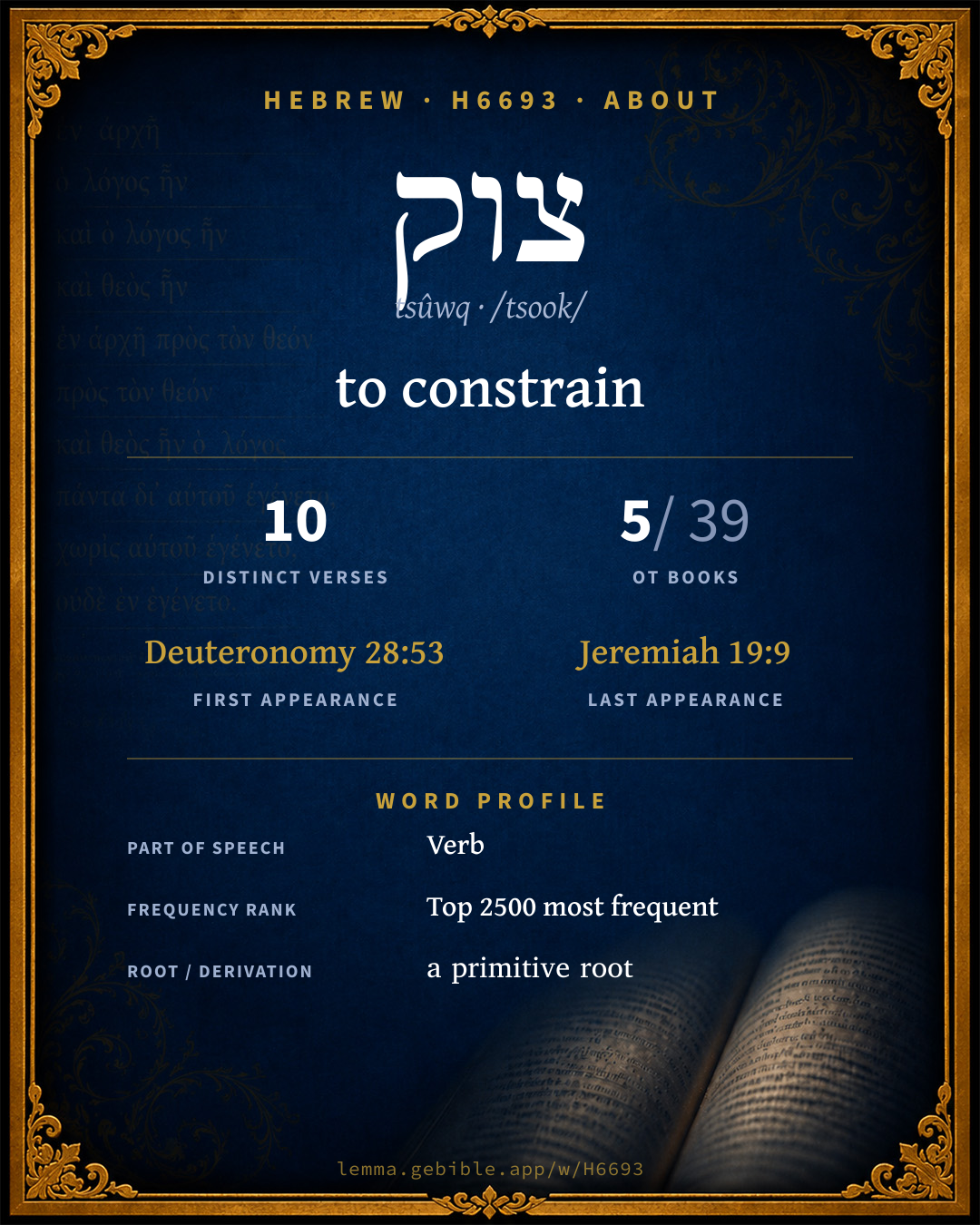
צוּק
to constrain
Full lexicon entry — Brown-Driver-Briggs (BDB)
From Brown-Driver-Briggs (BDB)
Where this word appears
Grammar key — what these labels mean
Part of speech
- Verb
- An action or state-of-being word.
Stem
- Hiphil
- The causative active stem (“he caused / brought about”).
Form
- Imperfect
- An incomplete, ongoing, or future action (“he will / would write”).
- Participle Active
- A verbal adjective expressing ongoing or characteristic action (“writing / one who writes”).
- Sequential Perfect
- A perfect with prefixed waw continuing a preceding imperfect or command (waw-consecutive perfect).
- Perfect
- A completed action or state — Hebrew marks aspect (completeness) more than strict tense (“he wrote”).
State
- Absolute
- The independent form of a noun, not bound to a following word.
Person
- 3rd Person
- The one spoken about (“he / she / it / they”).
- 1st Person
- The speaker (“I / we”).
Gender
- Masculine
- Grammatically masculine.
- Common
- Either gender — not distinguished for this form.
- Feminine
- Grammatically feminine.
Number
- Singular
- One.
- Plural
- More than one (in Hebrew, generally three or more).
Grammatical forms
- Verb, Hiphil, Imperfect, 3rd Person, Masculine, Singular 3 times (27%)
- Verb, Hiphil, Perfect, 3rd Person, Feminine, Singular 3 times (27%)
- Verb, Hiphil, Participle Active, Masculine, Singular, Absolute 2 times (18%)
- Verb, Hiphil, Participle Active, Masculine, Plural, Absolute 1 time (9%)
- Verb, Hiphil, Sequential Perfect, 1st Person, Common, Singular 1 time (9%)
- Verb, Hiphil, Imperfect, 3rd Person, Masculine, Plural 1 time (9%)
Parsed forms decoded from the imported morphology (morphhb / Westminster Leningrad Codex — WLC text public domain, morphhb tagging CC BY 4.0), counted across 11 parsed occurrences — not distinct verses.
Every verse where H6693 appears — 10 distinct verses across 5 books. Click any verse to open its interlinear word-by-word view. Verse text shown in the World English Bible for context — . Each verse’s Hebrew form is shown with its reference; the English is not keyword-highlighted, since the data carries no word-level English alignment. Use “Compare translations” on any verse to read it across multiple English versions. This concordance covers the Hebrew Bible; Septuagint (Greek Old Testament) occurrences are not indexed here.
Deuteronomy 3 verses
- Deuteronomy 28:53 יָצִ֥יק Hiphil impf 3ms You shall eat the fruit of your own body, the flesh of your sons and of your daughters, whom Yahweh your God has given you, in the siege and in the distress with which your enemies shall distress you.
- Deuteronomy 28:55 יָצִ֥יק Hiphil impf 3ms so that he will not give to any of them of the flesh of his children whom he shall eat, because he has nothing left him, in the siege and in the distress with which your enemy shall distress you in all your gates.
- Deuteronomy 28:57 יָצִ֥יק Hiphil impf 3ms and toward her young one who comes out from between her feet, and toward her children whom she shall bear; for she shall eat them for want of all things secretly, in the siege and in the distress with which your enemy shall distress you in your gates.
Judges 2 verses
- Judges 14:17 הֱצִיקַ֔תְ/הוּ Hiphil pf 3fs + sfx pers 3ms She wept before him the seven days, while their feast lasted: and it happened on the seventh day, that he told her, because she pressed him sore; and she told the riddle to the children of her people.
- Judges 16:16 הֵצִ֨יקָה Hiphil pf 3fs It happened, when she pressed him daily with her words, and urged him, that his soul was vexed to death.
Job 1 verse
Isaiah 3 verses
- Isaiah 29:2 וַ/הֲצִיק֖וֹתִי conj + Hiphil wpf 1cs then will I distress Ariel, and there shall be mourning and lamentation; and she shall be to me as Ariel.
- Isaiah 29:7 וְ/הַ/מְּצִיקִ֖ים conj + ptcl def.art + Hiphil ptcp.act mp The multitude of all the nations that fight against Ariel, even all who fight against her and her stronghold, and who distress her, shall be as a dream, a vision of the night.
- Isaiah 51:13 הַ/מֵּצִ֔יק הַ/מֵּצִֽיק ptcl def.art + Hiphil ptcp.act ms ptcl def.art + Hiphil ptcp.act ms and have forgotten Yahweh your Maker, who stretched forth the heavens, and laid the foundations of the earth; and fear continually all the day because of the fury of the oppressor, when he makes ready to destroy? and where is the fury of the oppressor?
Jeremiah 1 verse
About this entry
At a glance — auto-summarized from this page’s data, not written by a person. Every figure links to its source below. This summary describes the numbers; it doesn’t interpret them.
At its core, צוק (tsûwq) means “to constrain.” Scripture first uses it in Deuteronomy 28:53. It turns up in 10 verses across 5 books, an uncommon footprint. The word gravitates to Deuteronomy (30%), then Isaiah and Judges. It shares a root with מצוק, מצוק and צוק. Each statement above links to its evidence; the full detail follows below.
Gloss history
Strong's 1890 vs modern scholarship
About this word
Strong's H6693 catalogs a Hebrew word from the Hebrew Old Testament.
These counts are not copied from any lexicon or concordance. They are computed here, from the morphology-tagged Hebrew Old Testament. What Lemma adds →
- 10
- distinct verses
- The word appears in 10 distinct verses.
- 5 / 39
- OT books
- The word appears in 5 of 39 Old Testament books.
- #2,210
- by frequency
- Top 2500 most frequent Hebrew words (rank 2,210 of 8,640 Hebrew words by occurrence).
View all 10 occurrences in the concordance →
Most concentrated in
- Deuteronomy 3 verses 30%
- Isaiah 3 verses 30%
- Judges 2 verses 20%
By section of the Old Testament
By traditional corpus
Conventional, traditional groupings — biblical authorship is debated, so this is a traditional corpus grouping, not an authorship claim. Each share is this word’s portion of its verses in that division of the Hebrew canon. Each figure is a share of the word’s 10 distinct verses.
- Prophets (Nevi'im) 6 verses · 60%
- Torah (Pentateuch) 3 verses · 30%
- Writings (Ketuvim) 1 verse · 10%
How translations render this word
Counts come from each version’s own published word-to-Strong’s tagging or interlinear alignment — an approximate guide to how each version renders this word, not a word-level alignment the data otherwise carries. Because each total is that version’s own tagged count, the per-version totals vary from one another and need not match the appearance or distinct-verse counts above. These counts may also differ from a printed concordance because Lemma counts each distinctly tagged rendering and does not collapse phrase taggings into a single head-word total. This is a fixed set of word-tagged versions (KJV, ASV, BSB, ULT) and does not change with the reading translation you choose elsewhere. Each version’s license is shown beside its name below (and on Sources).
- King James Version: Shall distress 3×, Oppressor 2×
- American Standard Version: Distress 2×, Oppressor 2×, Shall distress 2×
- Berean Standard Bible: Will inflict 3×, Oppressor 2×
- unfoldingWord Literal Text: Oppressor 2×
King James Version Public Domain
Renders H6693 across 11 tagged occurrences — most commonly:
Plus 6 renderings that appear only once — usually multi-word phrases or single function words the recovered tagging swept in, not distinct renderings.
American Standard Version Public Domain
Renders H6693 across 12 tagged occurrences — most commonly:
Plus 6 renderings that appear only once — usually multi-word phrases or single function words the recovered tagging swept in, not distinct renderings.
Berean Standard Bible Public Domain
Renders H6693 across 11 tagged occurrences — most commonly:
Plus 6 renderings that appear only once — usually multi-word phrases or single function words the recovered tagging swept in, not distinct renderings.
unfoldingWord Literal Text CC BY-SA 4.0
Renders H6693 across 11 tagged occurrences — most commonly:
Plus 9 renderings that appear only once — usually multi-word phrases or single function words the recovered tagging swept in, not distinct renderings.
Senses in BDB
The 1 sense BDB distinguishes for this word, in lexicon order (not ranked by frequency or importance). The full entry — with sub-senses — is in the Lexicon Entry tab.
- (Hiphil) to constrain, press, bring into straits, straiten, oppress
Word origin
[ צוּק ] vb. Hiph. constrain, bring into straits, press upon
— Brown-Driver-Briggs (Oxford 1906, public domain), digitized via Sefaria, supplemented by the OpenScriptures HebrewLexicon (CC BY 4.0). See Sources.
Origin: a primitive root
Jastrow Dictionary
A second Hebrew/Aramaic lexicon for comparison, covering Aramaic and post-biblical (Talmudic, Targumic, Midrashic) usage that the biblical-Hebrew BDB does not. Matched by lemma rather than by Strong’s number, so a lemma may carry more than one Jastrow headword (shown separately below), and the entries cover usage well beyond the Bible.
צוּק I
- = יָצַק, to pour. Num. R. s. 9 (ref. to Num. V, 15) אבל צָק הוא וכ׳ but he may pour oil upon the leavings. e.g. Numbers 5:15
צוּק II
- (b. h.) [to be narrow,] to be distressed, worry, v. next w.
- to distress, afflict. Snh. 104ᵇ כל המֵצִיק לישראל וכ׳ whoever persecutes Israel, does never get tired (with ref. to Is. VIII, 23); Yalk. Is. 282. Snh. 94ᵇ, v. צָיֵף; Yalk. Kings 237. Sifré Deut. 357 מציקים המְצִיקִין לו oppressors that will oppress him; a. e.—V. מֵצִיק. e.g. Isaiah 8:23
צוּק
- Y. Sabb. I, 3ᵇ bot. לא תְצוּק רוח אנא worry not (over the temptation to sin), I am a spirit (not a real woman).
צוֹק
- (preced.) narrow point, peak, precipice, esp. Tsoḳ, the mountain from which the scapegoat was precipitated. Yoma VI, 4, sq. Ib. 67ᵇ ומניין שבצ׳ and whence is it proved that the scapegoat must be led to a precipitous place?; a. e.—Pl. צוֹקִין. B. Mets. VII, 10; ib. 36ᵇ; a. e.
A Dictionary of the Targumim, the Talmud Babli and Yerushalmi, and the Midrashic Literature (Marcus Jastrow; London, Luzac, 1903) — Public Domain. Digitized via Sefaria. Digitized via Sefaria. Full attribution on Sources.
Forms in the corpus
The 9 distinct written forms H6693 takes in the Hebrew Bible, most frequent first — each parse links to that stem’s occurrences in the concordance. Hebrew forms include their vowel points and cantillation, so a single lemma takes many written forms.
| Form | Parsing | Example | Uses |
|---|---|---|---|
| יָצִ֥יק | Verb, Hiphil, Imperfect, 3rd Person, Masculine, Singular | Deuteronomy 28:53 | 3 |
| הֱ֝צִיקַ֗תְ/נִי | Verb, Hiphil, Perfect, 3rd Person, Feminine, Singular | Job 32:18 | 1 |
| הֱצִיקַ֔תְ/הוּ | Verb, Hiphil, Perfect, 3rd Person, Feminine, Singular | Judges 14:17 | 1 |
| הֵצִ֨יקָה | Verb, Hiphil, Perfect, 3rd Person, Feminine, Singular | Judges 16:16 | 1 |
| הַ/מֵּצִ֔יק | Verb, Hiphil, Participle Active, Masculine, Singular, Absolute | Isaiah 51:13 | 1 |
| הַ/מֵּצִֽיק | Verb, Hiphil, Participle Active, Masculine, Singular, Absolute | Isaiah 51:13 | 1 |
| וְ/הַ/מְּצִיקִ֖ים | Verb, Hiphil, Participle Active, Masculine, Plural, Absolute | Isaiah 29:7 | 1 |
| וַ/הֲצִיק֖וֹתִי | Verb, Hiphil, Sequential Perfect, 1st Person, Common, Singular | Isaiah 29:2 | 1 |
| יָצִ֧יקוּ | Verb, Hiphil, Imperfect, 3rd Person, Masculine, Plural | Jeremiah 19:9 | 1 |
Same root — word family
Other BDB entries built from the same root as H6693, grouped by Strong’s listed origin. These share a root / origin per the lexicon — not necessarily a shared meaning. Each links to that word’s own entry.
Derived from this word
- מצוק mâtsôwq H4689 distress
- מצוק mâtsûwq H4690 pillar
- צוק tsûwq H6694 to pour out
- צוק tsôwq H6695 distress
Compare all same-root words → Showing 4 of 5 — not the complete family. They share a root, not necessarily a meaning.
Septuagint verse parallels
This word appears in 10 verses that also exist in the Greek Old Testament (Septuagint), out of the 10 Hebrew verses it occurs in. You can read those verses in Greek by switching the Old Testament edition to the Septuagint.
Read these verses in the Septuagint
This is a verse-level parallel only — the same verses exist in both the Hebrew and Greek Old Testaments. No word-level Hebrew↔Greek correspondence is claimed: the data carries no such alignment, so no Greek word is shown as this Hebrew word’s translation. Coverage is not total — the Septuagint omits the deuterocanon and renumbers the Psalms, so some Hebrew verses have no direct Greek parallel.