
Jeremiah 24:7

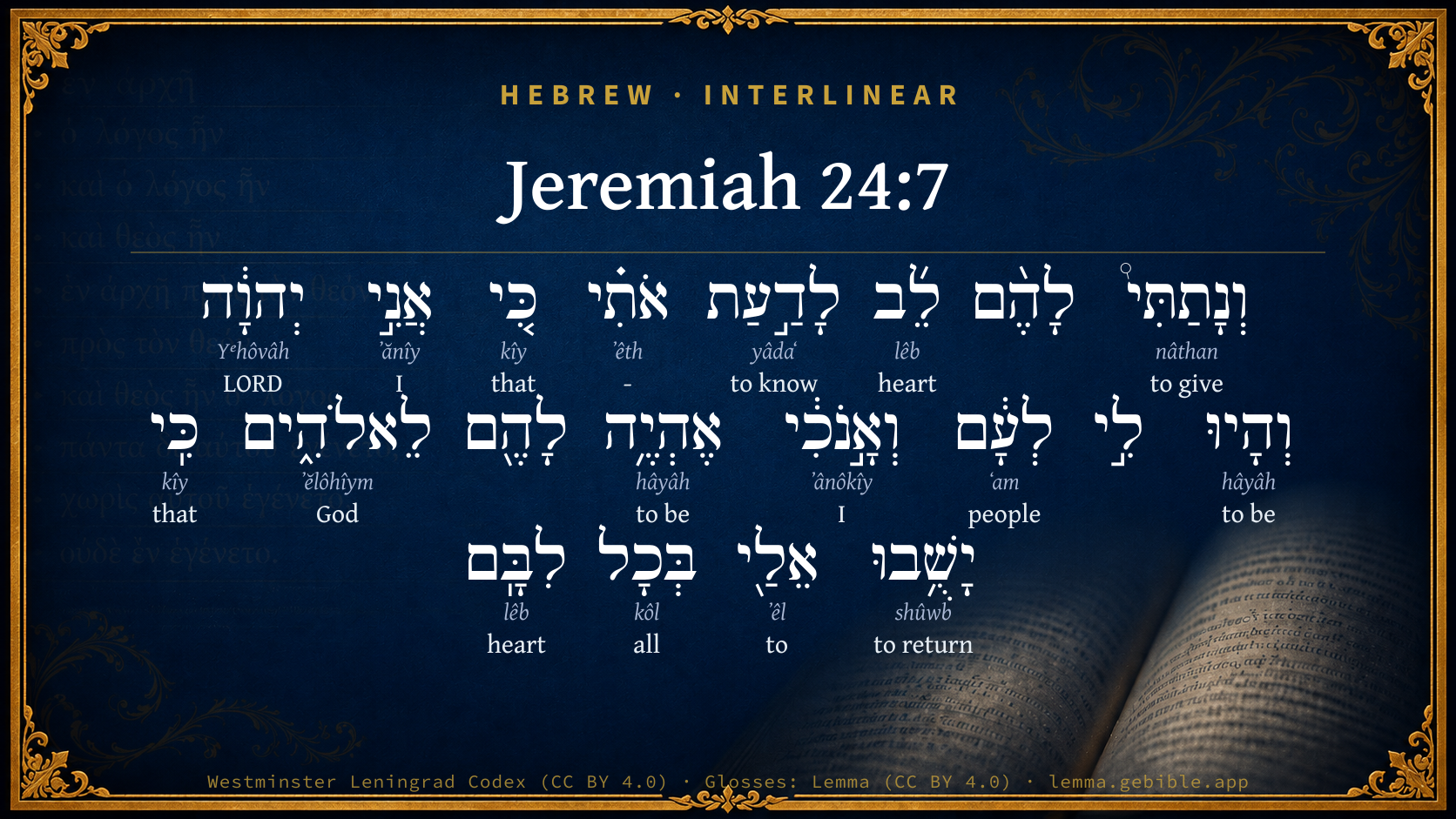
Hebrew (Westminster Leningrad Codex) Jeremiah 24:7 appears in the Hebrew Old Testament. The text above is from the Westminster Leningrad Codex. Each word links to its Strong’s number, a concise gloss, and parsing drawn from the Open Scriptures Hebrew Bible morphology. Click any word for its full Brown-Driver-Briggs (BDB) entry.
Download image
Cite this verse

Jeremiah 24:7 (World English Bible). Public Domain. Lemma interlinear Bible study tool, https://lemma.gebible.app/v/jeremiah/24/7.

Show BibTeX & RIS
BibTeX
RIS
English Translation
I will give them a heart to know me, that I am Yahweh: and they shall be my people, and I will be their God; for they shall return to me with their whole heart.
World English Bible · Public Domain
Download a study sheet

One document with this verse’s original text, its word-by-word gloss line, the meaning frame, cross-references with their text, attributed commentary, and full source and license credits — printable, and it pastes into notes with its structure intact.

This verse Autodidact and up

Study sheet (.html) Plain text (.txt)

A passage Seminary Student

Up to 50 verses in one chapter. A passage sheet keeps up to 6 commentary sources and 12 cross-references per verse, in the order this page ranks them, and says so on the sheet whenever that leaves anything out. Ask for a single verse and you get the Autodidact verse sheet above.

Everything on this page stays free to read, with no account — the sheet is a download of what is already on screen, not access to it.

Want to remove ads? Support Godless Engineer
Compare translations 3

The same verse in 3 English versions, stacked beneath the original-language interlinear above. Click any original word for its lexicon entry.

Each is an independent rendering of the whole verse — the interlinear is not word-aligned to these translations.

Highlighted words mark where these versions differ — a whole-verse word diff, not a word-by-word alignment.

  • World English Bible Public Domain
    I will give them a heart to know me, that I am Yahweh: and they shall be my people, and I will be their God; for they shall return to me with their whole heart.
  • King James Version Public Domain
    And I will give them an heart to know me, that I am the LORD: and they shall be my people, and I will be their God: for they shall return unto me with their whole heart.
  • unfoldingWord Literal Text CC BY-SA 4.0
    And I will give to them a heart to know me, that I Yahweh. And they will be to me for a people, and I, I will be to them for God, for they will return to me with all of their heart.

unfoldingWord Literal Text — © unfoldingWord, licensed CC BY-SA 4.0. Word-aligned USFM3 via Door43 (git.door43.org/unfoldingWord/en_ult).

Versions to compare (up to 4)

3 of 4 selected

Show all 18 translations

Every available English version of this verse, each an independent rendering of the whole verse.

  • World English Bible Public Domain
    I will give them a heart to know me, that I am Yahweh: and they shall be my people, and I will be their God; for they shall return to me with their whole heart.
  • Berean Standard Bible Public Domain
    I will give them a heart to know Me, that I am the LORD. They will be My people, and I will be their God, for they will return to Me with all their heart.
  • Majority Standard Bible Public Domain
    I will give them a heart to know Me, that I am the LORD. They will be My people, and I will be their God, for they will return to Me with all their heart.
  • King James Version Public Domain
    And I will give them an heart to know me, that I am the LORD: and they shall be my people, and I will be their God: for they shall return unto me with their whole heart.
  • American Standard Version (1901) Public Domain
    And I will give them a heart to know me, that I am Jehovah: and they shall be my people, and I will be their God; for they shall return unto me with their whole heart.
  • Revised Version (1885) Public Domain
    And I will give them an heart to know me, that I am the LORD: and they shall be my people, and I will be their God: for they shall return unto me with their whole heart.
  • Geneva Bible (1599) Public Domain
    And I will giue them an heart to knowe me, that I am the Lord, and they shalbe my people, and I wil be their God: for they shall returne vnto mee with their whole heart.
  • Douay-Rheims (1899) Public Domain
    And I will give them a heart to know me, that I am the Lord: and they shall be my people, and I will be their God: because they shall return to me with their whole heart.
  • Young's Literal Translation Public Domain
    And have given to them a heart to know Me, For I `am' Jehovah, And they have been to Me for a people, And I am to them for God, For they turned back unto Me with all their heart.
  • Literal Standard Version CC BY-SA 4.0
    And have given to them a heart to know Me, || For I [am] YHWH, || And they have been to Me for a people, || And I am to them for God, || For they turned back to Me with all their heart.
  • Unlocked Literal Bible CC BY-SA 4.0
    Then I will give them a heart to know me, for I am Yahweh. They will be my people and I will be their God, so they will turn to me with all their heart.
  • unfoldingWord Literal Text CC BY-SA 4.0
    And I will give to them a heart to know me, that I Yahweh. And they will be to me for a people, and I, I will be to them for God, for they will return to me with all of their heart.
  • Darby Bible Public Domain
    And I will give them a heart to know me, that I am Jehovah; and they shall be my people, and I will be their God: for they shall return unto me with their whole heart.
  • World Messianic Bible Public Domain
    I will give them a heart to know me, that I am the LORD. They will be my people, and I will be their God; for they will return to me with their whole heart.
  • Webster's Bible Public Domain
    And I will give them a heart to know me, that I am the LORD: and they shall be my people, and I will be their God: for they shall return to me with their whole heart.
  • Free Bible Version CC BY-SA 4.0
    I will give them the desire to know me, to know that I am the Lord. They will be my people, and I will be their God, for they will come back completely committed to me.
  • Bible in Basic English Public Domain
    And I will give them a heart to have knowledge of me, that I am the Lord: and they will be my people, and I will be their God: for they will come back to me with all their heart.
  • JPS Tanakh (1917) Public Domain
    And I will give them a heart to know Me, that I am the LORD; and they shall be My people, and I will be their God; for they shall return unto Me with their whole heart.

Literal Standard Version (2020), Covenant Press — licensed CC BY-SA 4.0. Text via the HelloAO Bible API (eBible.org). Unlocked Literal Bible (unfoldingWord) — licensed CC BY-SA 4.0. Text via the HelloAO Bible API (eBible.org). unfoldingWord Literal Text — © unfoldingWord, licensed CC BY-SA 4.0. Word-aligned USFM3 via Door43 (git.door43.org/unfoldingWord/en_ult). Free Bible Version, Dr. Jonathan Gallagher — licensed CC BY-SA 4.0. Text via the HelloAO Bible API (eBible.org).

Word by word

More ways to search: Search by grammar → Find every occurrence → Compare this word →

Practice this passage: Drill this verse → Learn its vocabulary →

וְאָ֣נֹכִ֔י
ʼânôkîy
H595
“and · I”
Conjunction + Pronoun, Personal, 1st Person, Common, Singular
Part of Speech
Conjunction + Pronoun
Type
Personal
Person
1st Person
Gender
Common
Number
Singular
Full BDB Definition

Origin: a primitive pronoun

TWOT: 130

I (first person singular)
  1. וְנָתַתִּי֩ nâthan H5414 “and · to give” Conjunction + Verb, Qal, Sequential Perfect, 1st Person, Common, Singular
  2. לֵ֜ב lêb H3820 “heart” Noun, Common, Masculine, Singular, Absolute
  3. לָדַ֣עַת yâdaʻ H3045 “to know” Preposition + Verb, Qal, Infinitive Construct
  4. אֹתִ֗י ʼêth H853 “- · me” Particle, Direct Object + Suffix, Personal, 1st Person, Common, Singular
  5. כִּ֚י kîy H3588 “that” Conjunction
  6. אֲנִ֣י ʼănîy H589 “I” Pronoun, Personal, 1st Person, Common, Singular
  7. יְהוָ֔ה Yᵉhôvâh H3068 “LORD” Noun, Proper
  8. וְהָיוּ hâyâh H1961 “and · to be” Conjunction + Verb, Qal, Sequential Perfect, 3rd Person, Common, Plural
  9. לְעָ֔ם ʻam H5971 “to/for · people” Preposition + Noun, Common, Masculine, Singular, Absolute
  10. אֶהְיֶ֥ה hâyâh H1961 “to be” Verb, Qal, Imperfect, 1st Person, Common, Singular
  11. לֵאלֹהִ֑ים ʼĕlôhîym H430 “to/for · God(s)” Preposition + Noun, Common, Masculine, Plural, Absolute
  12. כִּֽי kîy H3588 “that” Conjunction
  13. יָשֻׁ֥בוּ shûwb H7725 “to return” Verb, Qal, Imperfect, 3rd Person, Masculine, Plural
  14. אֵלַ֖י ʼêl H413 “to · me” Preposition + Suffix, Personal, 1st Person, Common, Singular
  15. בְּכָל kôl H3605 “in/at · all of” Preposition + Noun, Common, Masculine, Singular, Construct
  16. לִבָּֽם lêb H3820 “heart · their” Noun, Common, Masculine, Singular, Construct + Suffix, Personal, 3rd Person, Masculine, Plural

About this verse

These counts appear in no published source. They are computed here, from the morphology-tagged text and Lemma’s own curated glosses. What Lemma adds →

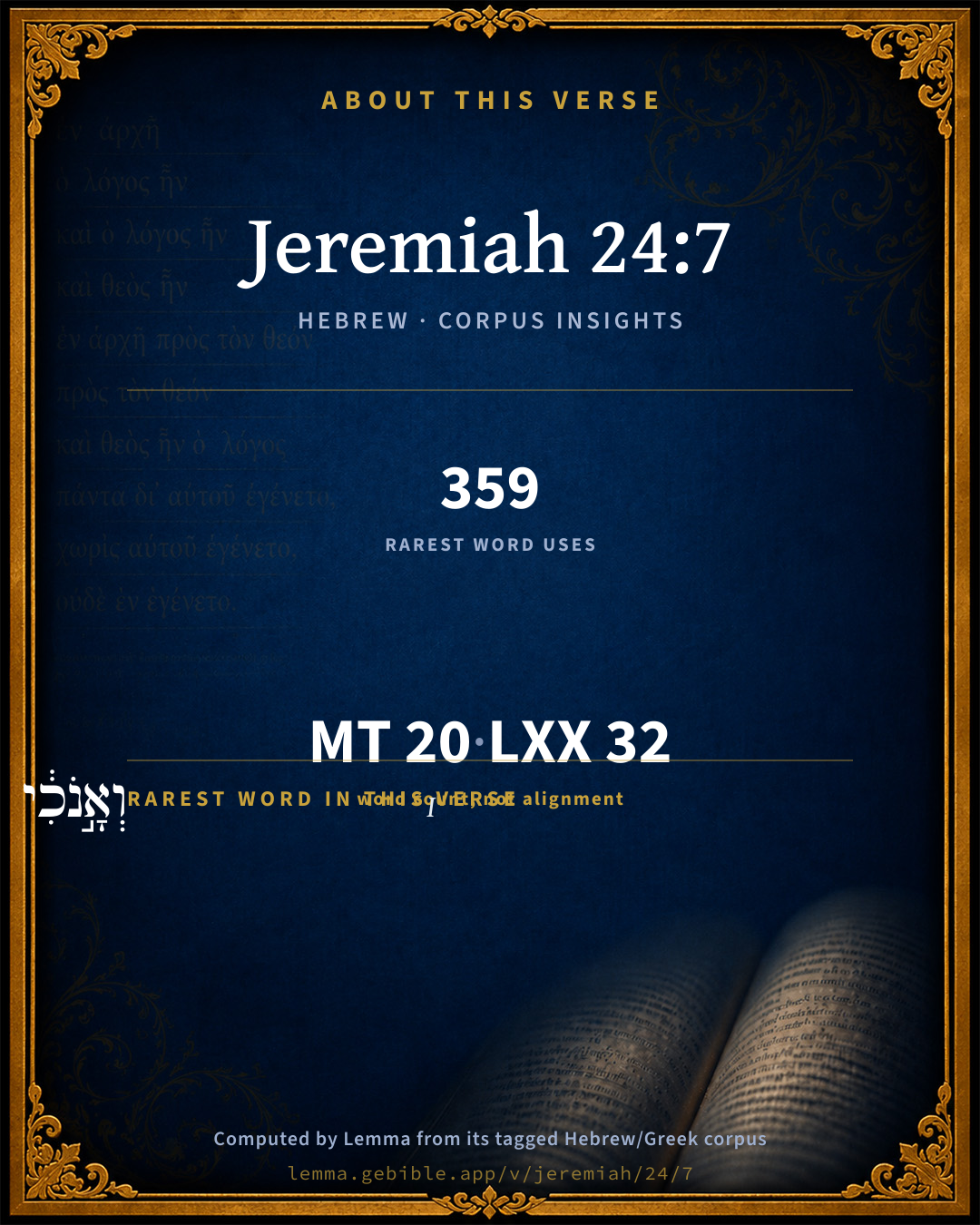
20
words
14
distinct lemmas
Prophets
section

Grammatical profile

  • 5 verbs
  • 6 nouns
  • 2 pronouns
  • 4 prepositions
  • 2 conjunctions
  • 1 particle

Verb forms

  • וְנָתַתִּי֩ Qal · Sequential Perfect
  • לָדַ֣עַת Qal · Infinitive Construct
  • וְהָיוּ Qal · Sequential Perfect
  • אֶהְיֶ֥ה Qal · Imperfect
  • יָשֻׁ֥בוּ Qal · Imperfect

Repetition

Words recur within this verse — often emphatic in Hebrew:

  • לֵ֜ב heart H3820 ×2
  • וְהָיוּ to be H1961 ×2
  • כִּ֚י that H3588 ×2

Hebrew & Septuagint length

In the original languages it is 20 Hebrew tokens and 32 Greek tokens — but the two are counted differently (Hebrew bundles its prefixes and suffixes into one token; the Greek is in lemma form), so that isn’t a like-for-like length.

Cross-references

23

Topical passages linked to Jeremiah 24:7 in the Treasury of Scripture Knowledge — connected by theme and wording, ordered by reader-vote popularity; previews shown in the World English Bible.

  • Hebrews 8:10 "For this is the covenant that I will make with the house of Israel. After those days," says the Lord; "I will put my laws into their mind, I will also write them on their heart. I will be to them a God, And they will be to me a people.
  • Jeremiah 30:22 You shall be my people, and I will be your God.
  • Ezekiel 37:23 neither shall they defile themselves any more with their idols, nor with their detestable things, nor with any of their transgressions; but I will save them out of all their dwelling-places, in which they have sinned, and will cleanse them: so shall they be my people, and I will be their God.
  • Ezekiel 36:24–28 For I will take you from among the nations, and gather you out of all the countries, and will bring you into your own land.
  • Zechariah 8:8 and I will bring them, and they will dwell in the midst of Jerusalem; and they will be my people, and I will be their God, in truth and in righteousness."
  • Deuteronomy 30:2–6 and shall return to Yahweh your God, and shall obey his voice according to all that I command you this day, you and your children, with all your heart, and with all your soul;
  • Ezekiel 11:19–20 I will give them one heart, and I will put a new spirit within you; and I will take the stony heart out of their flesh, and will give them a heart of flesh;
  • Romans 6:17 But thanks be to God, that, whereas you were bondservants of sin, you became obedient from the heart to that form of teaching whereunto you were delivered.
  • Deuteronomy 4:29–31 But from there you shall seek Yahweh your God, and you shall find him, when you search after him with all your heart and with all your soul.
  • 1 Samuel 7:3 Samuel spoke to all the house of Israel, saying, If you do return to Yahweh with all your heart, then put away the foreign gods and the Ashtaroth from among you, and direct your hearts to Yahweh, and serve him only; and he will deliver you out of the hand of the Philistines.
  • Jeremiah 31:33–34 But this is the covenant that I will make with the house of Israel after those days, says Yahweh: I will put my law in their inward parts, and in their heart will I write it; and I will be their God, and they shall be my people:
  • Jeremiah 32:38–40 and they shall be my people, and I will be their God:
  • Ezekiel 37:27 My tent also shall be with them; and I will be their God, and they shall be my people.
  • Deuteronomy 26:17–19 You have declared Yahweh this day to be your God, and that you would walk in his ways, and keep his statutes, and his commandments, and his ordinances, and listen to his voice:
  • Jeremiah 29:12–14 You shall call on me, and you shall go and pray to me, and I will listen to you.
  • 1 Kings 8:46–50 If they sin against you (for there is no man who doesn't sin), and you are angry with them, and deliver them to the enemy, so that they carry them away captive to the land of the enemy, far off or near;
  • 2 Chronicles 6:38 if they return to you with all their heart and with all their soul in the land of their captivity, where they have carried them captive, and pray toward their land, which you gave to their fathers, and the city which you have chosen, and toward the house which I have built for your name:
  • Isaiah 51:16 I have put my words in your mouth, and have covered you in the shadow of my hand, that I may plant the heavens, and lay the foundations of the earth, and tell Zion, You are my people.
  • Isaiah 55:6–7 Seek you Yahweh while he may be found; call you on him while he is near:
  • Jeremiah 3:10 Yet for all this her treacherous sister Judah has not returned to me with her whole heart, but only in pretense, says Yahweh.
  • Zechariah 13:9 I will bring the third part into the fire, And will refine them as silver is refined, And will test them like gold is tested. They will call on my name, and I will hear them. I will say, 'It is my people;' And they will say, 'Yahweh is my God.'"
  • Hosea 14:1–3 Israel, return to Yahweh your God; For you have fallen because of your sin.
  • Hebrews 11:16 But now they desire a better country, that is, a heavenly one. Therefore God is not ashamed of them, to be called their God, for he has prepared a city for them.

Cross-references courtesy of OpenBible.info (CC BY 4.0).

Hebrew and Greek witnesses Masoretic Hebrew ↔ Greek Septuagint

The same verse in the two great witnesses to the Old Testament, shown verse-for-verse.

These are two independent witnesses, not word-aligned to each other, and the Septuagint is shown in lemma (dictionary) form.

Hebrew Jeremiah 24:7 Masoretic · Westminster Leningrad Codex

וְנָתַתִּי֩ לָהֶ֨ם לֵ֜ב לָדַ֣עַת אֹתִ֗י כִּ֚י אֲנִ֣י יְהוָ֔ה וְהָיוּ לִ֣י לְעָ֔ם וְאָ֣נֹכִ֔י אֶהְיֶ֥ה לָהֶ֖ם לֵאלֹהִ֑ים כִּֽי יָשֻׁ֥בוּ אֵלַ֖י בְּכָל לִבָּֽם

I will give them a heart to know me, that I am Yahweh: and they shall be my people, and I will be their God; for they shall return to me with their whole heart.

World English Bible · Public Domain

Greek LXX Structure differs

In the Septuagint, Jeremiah is about an eighth shorter than the Hebrew and arranges its material differently — the Oracles Against the Nations (Hebrew chapters 46–51) appear in the middle of the Greek book, after 25:13. Because the chapter and verse boundaries do not line up, a verse-for-verse comparison with the Hebrew is not shown.

A verse-for-verse comparison isn’t shown here because the chapters and verses don’t line up. Switch to the LXX edition with the MT / LXX toggle above to read the Greek directly.

Hebrew: Westminster Leningrad Codex (CC BY 4.0). Greek: Septuagint (public domain); English from a public-domain English Septuagint. How the Septuagint differs from the Hebrew →

Targum (Aramaic paraphrase)

1

The Targum is the ancient Jewish Aramaic paraphrase of the Hebrew Scriptures — an interpretive translation, not the Hebrew text itself. Onkelos (literal) and Pseudo-Jonathan (expansive) render the Torah, and Jonathan the Prophets. Coverage is partial: where no permissively-licensed English translation exists for a verse, only the Aramaic is shown. This is verse-level text, not a word-by-word alignment to the Hebrew.

  1. Targum Jonathan Prophets (Joshua–Malachi)
    וְאֶתֵּן לְהוֹן לֵב לְמִידַע דְחֵלְתִּי אֲרֵי אֲנָא יְיָ וִיהוֹן קֳדָמַי לְעַם וַאֲנָא אֶהֱוֵי לְהוֹן לֶאֱלָהּ אֲרֵי יְתוּבוּן לְפוּלְחָנִי בְּכָל לִבְּהוֹן:

    (no public-domain English translation for this verse)

    Targum Jonathan — Aramaic: “Mikraot Gedolot” (public domain). English: “Sefaria Community Translation” (CC0 1.0 (public-domain dedication)); “London "Chaldee Paraphrase," 1871” (public domain). Text via Sefaria.

Commentary

Notes on Jeremiah 24:7 from classic Christian and Jewish commentators (each source and its license shown beneath its notes). The classic Christian expositions comment on the surrounding passage and are grouped to its opening verse, so a note may address several verses; the Jewish commentaries on the Tanakh (Rashi and others) are per-verse, so they appear only where the commentator wrote on this verse.

Lemma curates 59 commentaries, every one of them public domain or Creative Commons licensed, each selected and text-cleaned for this edition rather than reprinted as found. About our sources →

Trapp's Complete Commentary

John Trapp

Jer 24:7 And I will give them an heart to know me, that I [am] the LORD: and they shall be my people, and I will be their God: for they shall return unto me with their whole heart.

Ver. 7. And I will give them an heart to know me.] {a} This was better than all the rest, scil., a sanctified use of their afflictions. This we should highly prize, and pray for.

And they shall be my people.] This falling out of lovers shall but be a renewing of love between us.

For they shall return unto me.] God must sometimes whip his people to duty, and gather them from evil, as well as entice them, ut uvae dulces sint et non labruseae.

{a} Promissio Evangelica, ut infra., chap, xxxi. 33.

John Trapp, A Commentary or Exposition upon All the Books of the Old and New Testament (1647–1656) — public domain. Text from a community e-Sword module.

Tyndale Open Study Notes

Tyndale Open Resources

24:7 The Lord would do a marvelous work in the hearts of the exiles, helping them to recognize (literally know) . . . the Lord as a personal God (1 Chr 28:9; Pss 9:10; 36:10; Isa 19:21; 52:6; Dan 11:32; Hos 2:20; Titus 1:16; 1 Jn 4:6-8). • They will be my people, and I will be their God: God’s covenant with Israel would become a personal reality to them (Exod 6:7; 19:5; Deut 29:13; Rev 21:7). • wholeheartedly: The exiles would not mix religious loyalties; they would be completely committed to the one true God.

Tyndale Open Study Notes — © Tyndale Open Resources, licensed CC BY-SA 4.0. Text via the HelloAO Bible API.

Geneva Bible (1599)

Geneva Bible translators

Which declareth that man of himself can know nothing, till God give the heart and understanding.

Geneva Bible (1599) marginal notes — public domain. Text via Bolls.life.

Jamieson, Fausset & Brown

Robert Jamieson, A. R. Fausset & David Brown

(Jer 30:22; Jer 31:33; Jer 32:38). Their conversion from idolatry to the one true God, through the chastening effect of the Babylonish captivity, is here expressed in language which, in its fulness, applies to the more complete conversion hereafter of the Jews, "with their whole heart" (Jer 29:13), through the painful discipline of their present dispersion. The source of their conversion is here stated to be God's prevenient grace.

for they shall return--Repentance, though not the cause of pardon, is its invariable accompaniment: it is the effect of God's giving a heart to know Him.

Jamieson, Fausset & Brown — Commentary Critical and Explanatory on the Whole Bible (1871) — public domain (CC PDM 1.0). Text via the HelloAO Bible API.

Adam Clarke's Commentary

Verse 7. They shall be my people] I will renew my covenant with them, for they will return to me with their whole heart.

Adam Clarke's Commentary on the Bible (1810–1826) — public domain. Text from a community e-Sword/MySword module.

John Calvin's Commentaries

Here is added the main benefit, that God would not only restore the captives, that they might dwell in the land of promise, but would also change them inwardly; for except God gives us a conviction as to our own sins, and then leads us by his Spirit to repentance, whatever benefit he may bestow on us, they will only conduce to our greater ruin. The Prophet has hitherto spoken of the alleviation of punishment, as though he had said, “God will stretch forth his hand to restore his people to their own country.” Then the remission of punishment is what has been hitherto promised; but now the Prophet speaks of a much more excellent favor, that God would not only mitigate punishment, but that he would also inwardly change and reform their hearts, so that they would not only return to their own country, but would also become a true Church, a name of which they had vainly boasted. For though they had been chosen to be a peculiar people, yet, as they had departed from true religion, they were only a Church in name. But now God promises that he would bring them, not only to enjoy temporal and fading blessings, but also eternal salvation, for they would truly fear and serve him.

And this is what we ought carefully to observe, for the more bountiful God is towards men, the more is his vengeance kindled by ingratitude. What, then, would it avail us to abound in all good things, except we had evidences of God’s paternal favor towards us? But when we regard this end, that God testifies to us that he is our Father by his bounty towards us, we then make a right use of all his blessings; and God’s benefits cannot conduce to our salvation except we regard them in this light. Hence Jeremiah, after having spoken of the people’s restoration, justly exalts this favor above everything else, that the people would repent, so that they would not only fully partake of all the blessings they could expect, but would also worship God in sincerity and truth.

Now, God says that he would give them a heart to know him The word heart is to be taken here for the mind or understanding, as it means often in Hebrew. It, indeed, means frequently the seat of the affections, and also the soul of man, as including reason or understanding and will. But though the heart is taken often for the seat of the affections, it is yet applied to designate the other part of the soul, according to these words,

“Hitherto God has not given thee a heart to understand.” (Deuteronomy 29:4)

The Latins sometimes take it in this sense, according to what Cicero shews when he quotes these words of Ennius, “Catus AElius Sextus was a man remarkable in understanding.” (Egregie cordatus; Cic. 1 Tuscul.) Then, in this passage, the word heart is put for the light of the understanding. Yet another thing must be stated, that a true knowledge of God is not, as they say, imaginary, but is ever connected with a right feeling.

From the words of the Prophet we learn that repentance is the peculiar gift of God. Had Jeremiah said only that they who had been previously driven by madness into ruin, would return to a sane mind, he might have appeared as one setting up free-will and putting conversion in the power of man himself, according to what the Papists hold, who dream that we can turn to either side, to good as well as to evil; and thus they imagine that we can, after having forsaken God, of ourselves turn to him. But the Prophet clearly shews here, that it is God’s peculiar gift; for what God claims for himself, he surely does not take away from men, as though he intended to deprive them of any right which may belong to them, according to what the Pelagians hold, who seem to think that God appears almost envious when he declares that man’s conversion is in his power; but this is nothing less than a diabolical madness. It is, then, enough for us to know, that what God claims for himself is not taken away from men, for it is not in their power.

Since, then, he affirms that he would give them a heart to understand, we hence learn that men are by nature blind, and also that when they are blinded by the devil, they cannot return to the right way, and that they cannot be otherwise capable of light than by having God to illuminate them by his Spirit. We then see that man, from the time he fell, cannot rise again until God stretches forth his hand not only to help him, (as the Papists say, for they dare not claim to themselves the whole of repentance, but they halve it between themselves and God,) but even to do the whole work from the beginning to the end; for God is not called the helper in repentance, but the author of it. God, then, does not say, “I will help them, so that when they raise up their eyes to me, they shall be immediately assisted;” no, he does not say this; but what he says is, “I will give them a heart to understand.” And as understanding or knowledge is the main thing in repentance, it follows that man remains wholly under the power of the devil, and is, as it were, his slave, until God draws him forth from his miserable bondage. In short, we must maintain, that as soon as the devil draws us from the right way of salvation, nothing can come to our minds but what sinks us more and more in ruin, until God interposes, and thus restore us when thinking of no such thing.

This passage also shews, that we cannot really turn to God until we acknowledge him to be the Judge; for until the sinner sets himself before God’s tribunal, he will never be touched with the feeling of true repentance. Let us then know that the door of repentance is then opened to us, when God constrains us to look to him. At the same time there is more included in the term Jehovah than the majesty of God, for he assumes this principle, which ought to have been sufficiently known to the whole people, that he was the only true God who had chosen for himself the seed of Abraham, who had published the Law by Moses, who had made a covenant with the posterity of Abraham. There is then no doubt but that the Prophet meant that when the Jews became illuminated, they would be convinced of what they had forgotten, that is, that they had departed from the only true God. This mode of speaking then means the same as though he had said, “I will open their eyes, that they may at length acknowledge that they are apostates, and be thus humbled when made sensible how grievous was their impiety in forsaking me the fountain of living waters.”

He afterwards adds, that they should be to him a people, and that he in his turn would be to them a God; for they would return to him with the whole heart By these words the Prophet shews more clearly what he had before referred to, that God’s blessings would be then altogether salutary when they regarded their giver. As long then as we regard only the blessings of God, our insensibility produces this effect, that the more bountiful he is towards us, the more culpable we become. But when we regard God’s bounty and paternal kindness towards us, we then really enjoy his blessings. This is the meaning of the Prophet’s words when he says,

“I shall be to you a God, and ye shall be to me a people.”

What this mode of speaking means has been stated elsewhere.

Though God rules the whole world, he yet declares that he is the God of the Church; and the faithful whom he has adopted, he favors with this high distinction, that they are his people; and he does this that they may be persuaded that there is safety in him, according to what is said by Habakkuk,

“Thou art our God, we shall not die.” (Habakkuk 1:12.)

And of this sentence Christ himself is the best interpreter, when he says, that he is not the God of the dead, but of the living, (Luke 20:38;) he proves by the testimony of Moses, that Abraham, Isaac, and Jacob, though dead, were yet alive. How so; because God would not have declared that he was their God, were they not living to him. Since then he regards them as his people, he at the same time shews that there is life for them laid up in him. In short, we see that there is here promised by God not a restoration for a short time, but he adds the hope of eternal life and salvation; for the Jews were not only to return to their own country, when the time came to leave Chaldea, and a liberty granted them to build their own city; but they were also to become the true Church of God.

And the reason is also added, Because they will return to me, he says, with their whole heart He repeats what we have already observed, that they would be wise (cordatos) and intelligent, whereas they had been for a long time stupid and foolish, and the devil had so blinded them, that they were not capable of receiving sound doctrine. But these two things, the reconciliation of God with men and repentance, are necessarily connected together, yet repentance ought not to be deemed as the cause of pardon or of reconciliation, as many falsely think who imagine that men deserve pardon because they repent. It is indeed true that God is never propitious to us, except when we turn to him; but the connection, as it has been already stated, is not such that repentance is the cause of pardon, nay, this very passage clearly shews that repentance itself depends on the grace and mercy of God. Since this is true, it follows that men are anticipated by God’s gratuitous kindness.

We hence further learn, that God is not otherwise propitious to us than according to his good pleasure, so that the cause of all is only in himself. Whence is it that a sinner returns to the right way and seeks God from whom he has departed? Is it because he is moved to do so of himself? Nay, but because God illuminates his mind and touches his heart, or rather renews it. How is it that God illuminates him who has become blind? Surely for this we can find no other cause than the gratuitous mercy of God. When God then is propitious to men, so as to restore them to himself, does he not anticipate them by his grace? How then can repentance be called the cause of reconciliation, when it is its effect? It cannot be at the same time its effect and cause.

We ought therefore carefully to notice the context here, for though the Prophet says that the Jews, when they returned, would be God’s people, because they would turn to him with their whole heart, he yet had before explained whence this turning or conversion would proceed, even because God would shew them mercy. They who pervert such passages according to their own fancies, are not so acquainted with Scripture as to know that there is a twofold reconciliation of men with God: He is first reconciled to men in a hidden manner, for when they despise him, he anticipates them by his grace, and illuminates their minds and renews their hearts. This first reconciliation is what they do not understand. But there is another reconciliation, known by experience, even when we feel that the wrath of God towards us is pacified, and are indeed made sensible of this by the effects. To this the reference is made in these words,

“Turn ye to me, and I will turn to you,” (Zechariah 1:3)

that is, “I appear severe and rigid to you; but whence is this? even because ye cease not to provoke my wrath; return to me, and you shall find me ready to spare you.” God therefore did not then first begin to pardon sinners, when he does them good, but as he had been previously pacified, hence he turns them to himself, and afterwards shews that he is really reconciled to them.

By the whole heart, is intimated sincerity or integrity, as by a double heart, or a heart and a heart, is signified dissimulation. It is certain that no one turns to God in such a manner that he puts off all the affections of the flesh, that he is renewed at once in God’s image, so that he is freed from every stain. Such a conversion is never found in man. But when the Scripture speaks of the whole heart, it is in contrast with dissimulation;

“with my whole heart have I sought thee,” says David; “I have hid thy words and will keep them: I have prayed for thy favor; I will ask,” etc., (Psalm 119:10-16;)

“They will seek me,” as Moses says, “with their whole heart.” (Deuteronomy 4:29; Deuteronomy 10:12)

David did not divest himself of everything sinful, for he confesses in many places that he was laboring under many sins; but the clear meaning is, that what God requires is integrity. In short, the whole heart is integrity, that is when we deal not hypocritically with God, but desire from the heart to give up ourselves to him.

As we have before refuted the error of those who think that repentance is the cause why God becomes reconciled to us, so now we must know that God will not be propitious to us except we seek him. For there is a mutual bond of connection, so that God anticipates us by his grace, and also calls us to himself; in short, he draws us, and we feel in ourselves the working of the Holy Spirit. We do not indeed turn, unless we are turned; we do not turn through our own will or efforts, but it is the Holy Spirit’s work. Yet he who under pretext of grace indulges himself and cares not for God, and seeks not repentance, cannot flatter himself that he is one of God’s people; for as we have said, repentance is necessary. It follows, — but I cannot to-day finish this part, for he speaks of the badness of the figs, and of the remnant which still remained.

John Calvin's Commentaries (1540-1563) — public domain. Text from the Calvin Translation Society English edition (1840s-50s) via the Christian Classics Ethereal Library (ccel.org). Calvin's coverage is partial (roughly two-thirds of the Bible); uncommented books and verses are honest gaps, never fabricated. The 19th-century editor's footnotes and remarks are omitted so the notes are faithfully Calvin's own voice.

Ellicott's Commentary for English Readers

(7) I will give them an heart to know me . . .—Of this also the history of the return gives at least a partial proof. Whatever other faults might be growing up, they never again fell into the apostasy from the true faith in God, which up to the time of the exile had been their besetting sin.

They shall be my people . . .—The prophet clearly remembers and reproduces the promise of Hos_2:23.

A Bible Commentary for English Readers, edited by Charles John Ellicott (1878–1897) — public domain. Text from a community e-Sword module.

The Cambridge Bible for Schools and Colleges

gen. ed. J. J. S. Perowne

7. an heart to know me] They shall be restored in a spiritual sense also, purified in heart by their adversity.

The Cambridge Bible for Schools and Colleges (gen. ed. J. J. S. Perowne; Cambridge University Press, 1878–1918) — public domain. Text from a community e-Sword module.

John Gill's Exposition

And as the evil figs, which cannot be eaten, they are so evil,.... Here follows an explication of the evil figs, and an application of them to the wicked Jews:

surely thus saith the Lord, so will I give Zedekiah the king of Judah; who was then the reigning king of Judah, Jeconiah's father's brother; whom the king of Babylon had made king in his stead, and changed his name from Mattaniah to Zedekiah, Kg2 24:17; him the Lord threatens to give up to ruin and destruction, or to deliver into the hands of the enemy:

and his princes, and the residue of them, that remain in this land; the rest of the inhabitants of Jerusalem that continued in the land of Judea, and were not carried captive:

and them that dwell in the land of Egypt; who had fled thither for safety upon the invasion of their land, and besieging their city; all these being like to the bad figs, exceeding evil and wicked, are threatened to be delivered into the hands of their enemies, though they might think themselves safe and secure where they were.

John Gill's Exposition of the Whole Bible (1746–1763) — public domain (CC PDM 1.0). Text via the HelloAO Bible API.

Matthew Poole's English Annotations

Under the term

know me is here (as in many other texts) comprehended faith, love, obedience, all those motions of the soul which rationally should follow a right comprehending of God in men’s knowledge.

They shall be my people, and I will be their God; I will be a God in covenant with them; as I will fulfil what I have promised them, so they shall do what is their duty to me. For, or when, or after that they shall return to me; not feignedly, but with their heart; not partially, but

with their whole heart. This is promised as an effect of special grace, not of the mere good inclination of their natural wills, for so the words I will give, in the beginning of the verse, must be understood, otherwise God gives such a heart no more to one man than another.

Matthew Poole's English Annotations on the Holy Bible (1683–1685) — public domain. Text from a community e-Sword/MySword module.

The Pulpit Commentary

The conditions and relations of salvation.

I THE ABILITY TO KNOW GOD IS THE GIFT OF GOD. Not more facts, external, historical, etc., are required. Not a new Bible the letter of the Bible is probably completed already. Nor even a new mode of spiritual demonstration. But a new heart. We cannot make a new heart. God will save us by renewing:

1. The moral nature.

2. The whole life through it.

II THE BLESSINGS OF SALVATION CAN ONLY BE SECURED IN ABSOLUTE CONSECRATION. "They shall return unto me with their whole heart." Complete salvation is impossible without complete faith. To believe to believe simply, to believe wholly, this is the condition of perfect salvation.

III THE IDEAL ISRAEL MUST EVER BE A THEOCRACY. In the obedience of faith they shall be God"s people, and he will be their God. That upon which we depend in faith is that which we observe and respect in practice; it is the law and inspiration of life. Christ leads us to the Father that he and we may be one in God; not merged, confounded with Deity, but in eternal and ever-blessed subordination to him. M.

HOMILIES BY J. WAITE Ver. 7. A heart to know the Lord.

It was "for good" that God sent the captive portion of his people "into the land of the Chaldeans" (ver. 5) The germs of the better life of the future were preserved in them, and their very tribulations were the instruments of his gracious purpose and blessings in disguise. In the "evil figs the refuse left behind there was nothing worth preserving (ver. 8). Of all the beneficent Divine purposes, this had in it the promise of highest good will give them a heart to know me, that I am the Lord.

I A TRUE KNOWLEDGE OF GOD HAS ITS SEAT IN THE HEART. Intellect cannot solve the mystery of his being. Reason alone cannot even demonstrate his existence. "Who by searching can find out God?" "The world by wisdom knew not God." It is a matter of pure spiritual sensibility. Moral sympathy is the true key to this knowledge. Reverence, humility, love, trust, submission, affections of the heart, are its conditions. Even right ideas of God depend very materially on the state of the heart towards him. The exhalations of a vain, frivolous, corrupt, or carnal heart pervert the soul"s vision and obscure his glory. Only as our hearts are purged from every form of earthly defilement can we behold him as he is. "Blessed are the pure in heart: for they shall see God.

II GOD HIMSELF CAN ALONE IMPART THIS KNOWLEDGE. "I will give them," etc. It is a matter of direct Divine revelation; a Divine science in which mere human teaching is of little avail. A secret, silent, gracious power above all natural influences can alone awaken in us those moral affections which lie at the root of it. A true knowledge, like a true Christian faith, must stand "not in the wisdom of men, but in the power of God." The blindness of the man of science to the deeper meaning of nature, and of the skeptical philosopher to the manifestation of God in Christ, and of the worldling to the Divine presence in his own life, does but indicate the lack of this power. God must unveil himself to us, by drawing our hearts into lowly and loving fellowship with himself, before we can truly know him. W.

The Pulpit Commentary (1880–1919), ed. H.D.M. Spence-Jones & Joseph S. Exell — public domain. Text from a community e-Sword module.

Lesson kit

Teaching starters — assembled from the data on this page, not authored interpretation. Every prompt links to the verse data it draws on. Edit before teaching.

Jeremiah, in the Prophets, opens this verse with 20 words (14 distinct Hebrew lemmas). Its most distinctive word is ʼânôkîy (“I”). A historical commentator’s framing appears above. Read the whole chapter for the surrounding context.

Discussion questions

  1. How does “I” (ʼânôkîy) shape what this verse is saying?
  2. Hebrews 8:10 shares this passage’s theme. How do the two illuminate each other?
  3. “heart” occurs 2× in this one verse. What is the effect of the repetition?
  4. These translations render this verse differently. What is at stake in choosing one wording over another?
  5. The verb «וְנָתַתִּי֩» is Qal Sequential Perfect. How does its form color the action?
  6. Reading how Trapp's Complete Commentary and Tyndale Open Study Notes read this verse, where do the two commentators agree and where do they part?

Things to notice

Reading settings

Reading text

Shown beneath each verse's original-language words.

Old Testament
Old Testament edition

Read the OT as the Masoretic Hebrew (MT) or the Greek Septuagint (LXX).

English shown for the Greek Septuagint (in the Hebrew ↔ Greek comparison).

Comparing translations? Open the Compare panel on any verse page to stack up to four side by side.