Ezekiel 39:6

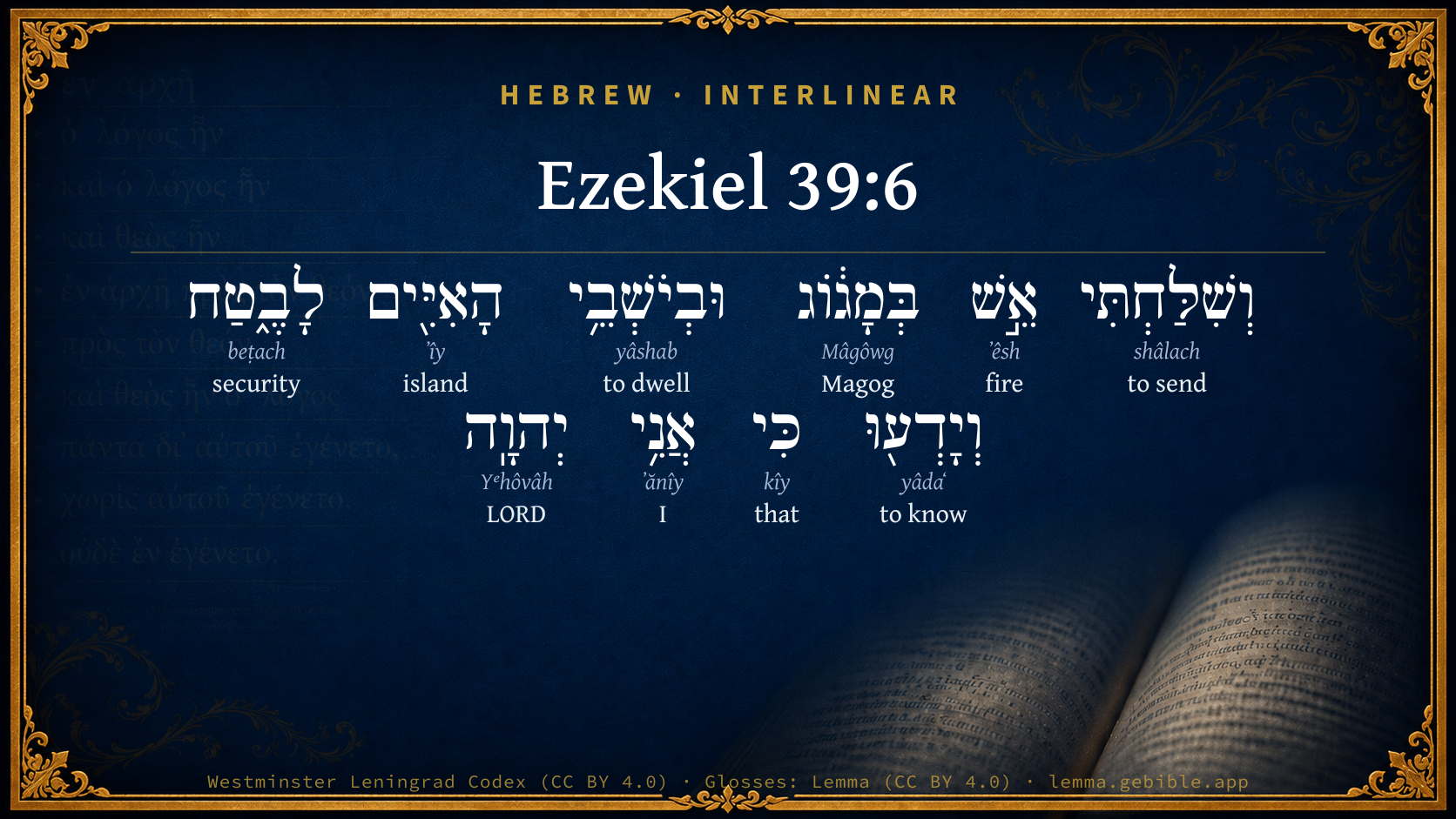
Hebrew (Westminster Leningrad Codex) Ezekiel 39:6 appears in the Hebrew Old Testament. The text above is from the Westminster Leningrad Codex. Each word links to its Strong’s number, a concise gloss, and parsing drawn from the Open Scriptures Hebrew Bible morphology. Click any word for its full Brown-Driver-Briggs (BDB) entry.
Download image
Cite this verse

Ezekiel 39:6 (World English Bible). Public Domain. Lemma interlinear Bible study tool, https://lemma.gebible.app/v/ezekiel/39/6.

Show BibTeX & RIS
BibTeX
RIS
English Translation
I will send a fire on Magog, and on those who dwell securely in the isles; and they shall know that I am Yahweh.
World English Bible · Public Domain
Download a study sheet

One document with this verse’s original text, its word-by-word gloss line, the meaning frame, cross-references with their text, attributed commentary, and full source and license credits — printable, and it pastes into notes with its structure intact.

This verse Autodidact and up

Study sheet (.html) Plain text (.txt)

A passage Seminary Student

Up to 50 verses in one chapter. A passage sheet keeps up to 6 commentary sources and 12 cross-references per verse, in the order this page ranks them, and says so on the sheet whenever that leaves anything out. Ask for a single verse and you get the Autodidact verse sheet above.

Everything on this page stays free to read, with no account — the sheet is a download of what is already on screen, not access to it.

Want to remove ads? Support Godless Engineer
Compare translations 3

The same verse in 3 English versions, stacked beneath the original-language interlinear above. Click any original word for its lexicon entry.

Each is an independent rendering of the whole verse — the interlinear is not word-aligned to these translations.

Highlighted words mark where these versions differ — a whole-verse word diff, not a word-by-word alignment.

  • World English Bible Public Domain
    I will send a fire on Magog, and on those who dwell securely in the isles; and they shall know that I am Yahweh.
  • King James Version Public Domain
    And I will send a fire on Magog, and among them that dwell carelessly in the isles: and they shall know that I am the LORD.
  • unfoldingWord Literal Text CC BY-SA 4.0
    Then I will send out fire on Magog and on those living in safety on the coasts, and they will know that I am Yahweh.

unfoldingWord Literal Text — © unfoldingWord, licensed CC BY-SA 4.0. Word-aligned USFM3 via Door43 (git.door43.org/unfoldingWord/en_ult).

Versions to compare (up to 4)

3 of 4 selected

Show all 18 translations

Every available English version of this verse, each an independent rendering of the whole verse.

  • World English Bible Public Domain
    I will send a fire on Magog, and on those who dwell securely in the isles; and they shall know that I am Yahweh.
  • Berean Standard Bible Public Domain
    I will send fire on Magog and on those who dwell securely in the coastlands, and they will know that I am the LORD.
  • Majority Standard Bible Public Domain
    I will send fire on Magog and on those who dwell securely in the coastlands, and they will know that I am the LORD.
  • King James Version Public Domain
    And I will send a fire on Magog, and among them that dwell carelessly in the isles: and they shall know that I am the LORD.
  • American Standard Version (1901) Public Domain
    And I will send a fire on Magog, and on them that dwell securely in the isles; and they shall know that I am Jehovah.
  • Revised Version (1885) Public Domain
    And I will send a fire on Magog, and on them that dwell securely in the isles: and they shall know that I am the LORD.
  • Geneva Bible (1599) Public Domain
    And I will sende a fire on Magog, and among them that dwell safely in the yles, and they shall knowe that I am the Lord.
  • Douay-Rheims (1899) Public Domain
    And I will send a fire on Magog, and on them that dwell confidently in the islands: and they shall know that I am the Lord.
  • Young's Literal Translation Public Domain
    And I have sent a fire against Magog, And against the confident inhabitants of the isles, And they have known that I `am' Jehovah.
  • Literal Standard Version CC BY-SA 4.0
    And I have sent a fire against Magog, || And against the confident inhabitants of the islands, || And they have known that I [am] YHWH.
  • Unlocked Literal Bible CC BY-SA 4.0
    Then I will send out fire on Magog and on those living in safety on the coasts, and they will know that I am Yahweh.
  • unfoldingWord Literal Text CC BY-SA 4.0
    Then I will send out fire on Magog and on those living in safety on the coasts, and they will know that I am Yahweh.
  • Darby Bible Public Domain
    And I will send a fire on Magog, and among them that dwell at ease in the isles: and they shall know that I [am] Jehovah.
  • World Messianic Bible Public Domain
    “I will send a fire on Magog and on those who dwell securely in the islands. Then they will know that I am the LORD.
  • Webster's Bible Public Domain
    And I will send a fire on Magog, and among them that dwell carelessly in the isles: and they shall know that I am the LORD.
  • Free Bible Version CC BY-SA 4.0
    I will set Magog on fire, as well as the coastlands where people think it's safe to live, and then they will acknowledge that I am the Lord.
  • Bible in Basic English Public Domain
    And I will send a fire on Magog, and on those who are living in the sea-lands without fear: and they will be certain that I am the Lord.
  • JPS Tanakh (1917) Public Domain
    And I will send a fire on Magog, and on them that dwell safely in the isles; and they shall know that I am the LORD.

Literal Standard Version (2020), Covenant Press — licensed CC BY-SA 4.0. Text via the HelloAO Bible API (eBible.org). Unlocked Literal Bible (unfoldingWord) — licensed CC BY-SA 4.0. Text via the HelloAO Bible API (eBible.org). unfoldingWord Literal Text — © unfoldingWord, licensed CC BY-SA 4.0. Word-aligned USFM3 via Door43 (git.door43.org/unfoldingWord/en_ult). Free Bible Version, Dr. Jonathan Gallagher — licensed CC BY-SA 4.0. Text via the HelloAO Bible API (eBible.org).

Word by word

More ways to search: Search by grammar → Find every occurrence → Compare this word →

Practice this passage: Drill this verse → Learn its vocabulary →

בְּמָג֔וֹג
Mâgôwg
H4031
“in/at · Magog”
Preposition + Noun, Proper
Part of Speech
Preposition + Noun
Type
Proper
Full BDB Definition

Origin: from H1463

TWOT: TWOT 324a

Magog = "land of Gog" - the 2nd son of Japheth, grandson of Noah, and progenitor of several tribes northward from Israel (noun proper masculine) - the mountainous region between Cappadocia and Media and habitation of the descendants of Magog, son of Japheth and grandson of Noah (noun proper locative)
  1. וְשִׁלַּחְתִּי shâlach H7971 “and · to send” Conjunction + Verb, Piel, Sequential Perfect, 1st Person, Common, Singular
  2. אֵ֣שׁ ʼêsh H784 “fire” Noun, Common, Both, Singular, Absolute
  3. וּבְיֹשְׁבֵ֥י yâshab H3427 “and · in/at · dwelling” Conjunction + Preposition + Verb, Qal, Participle Active, Masculine, Plural, Construct
  4. הָאִיִּ֖ים ʼîy H339 “the · islands” Particle, Definite Article + Noun, Common, Masculine, Plural, Absolute
  5. לָבֶ֑טַח beṭach H983 “to/for · security” Preposition + Noun, Common, Masculine, Singular, Absolute
  6. וְיָדְע֖וּ yâdaʻ H3045 “and · to know” Conjunction + Verb, Qal, Sequential Perfect, 3rd Person, Common, Plural
  7. כִּי kîy H3588 “that” Conjunction
  8. אֲנִ֥י ʼănîy H589 “I” Pronoun, Personal, 1st Person, Common, Singular
  9. יְהוָֽה Yᵉhôvâh H3068 “LORD” Noun, Proper

About this verse

These counts appear in no published source. They are computed here, from the morphology-tagged text and Lemma’s own curated glosses. What Lemma adds →

10
words
10
distinct lemmas
Prophets
section

Notable vocabulary

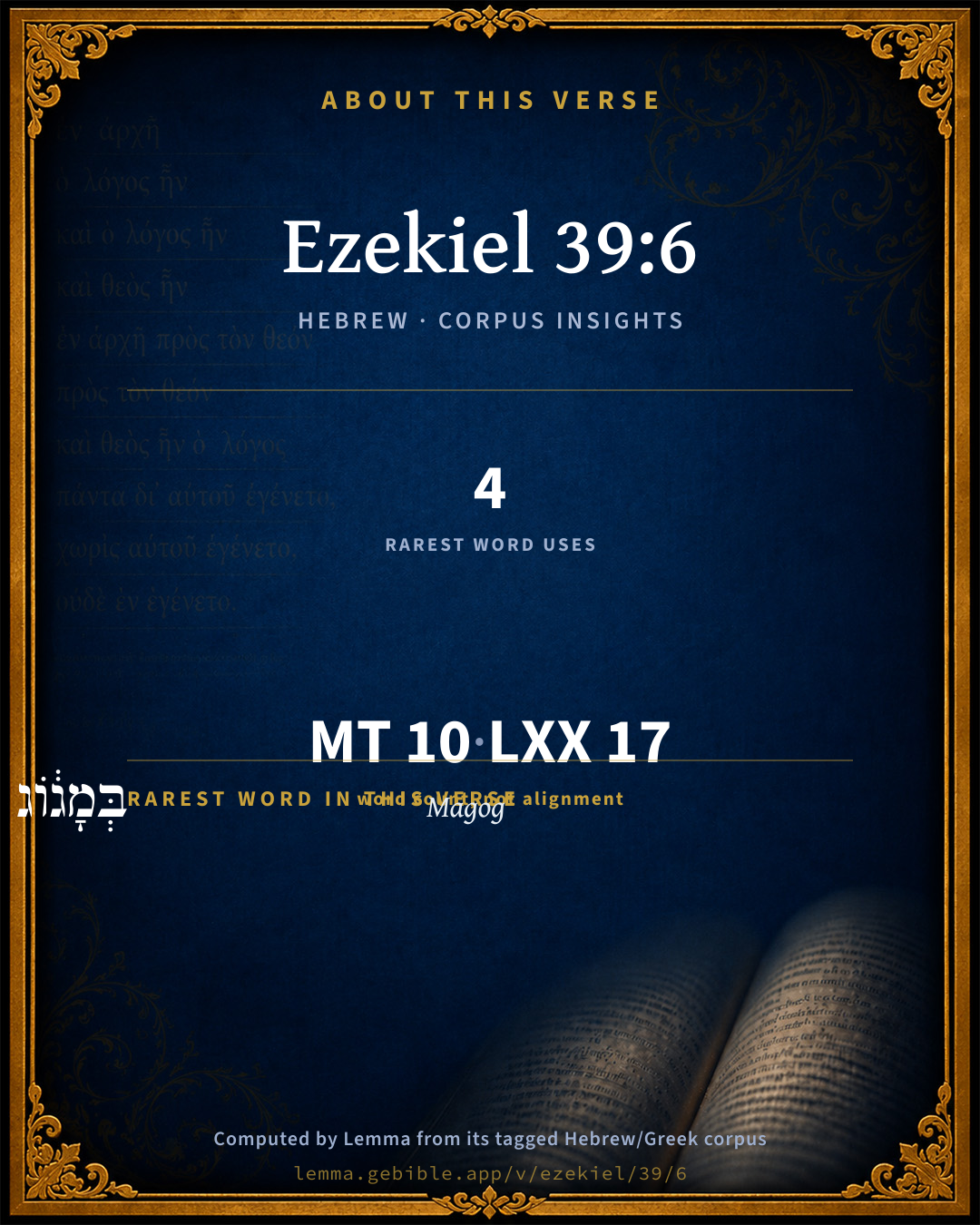
The rarest word here is בְּמָג֔וֹג Magog H4031 — appearing just 4 times in the whole Hebrew Bible.

Shared distinctive vocabulary

בְּמָג֔וֹג Magog H4031 occurs in 4 verses of the Hebrew Bible. Also found in:

Grammatical profile

  • 3 verbs
  • 5 nouns
  • 1 pronoun
  • 1 conjunction

Verb forms

  • וְשִׁלַּחְתִּי Piel · Sequential Perfect
  • וּבְיֹשְׁבֵ֥י Qal · Participle Active
  • וְיָדְע֖וּ Qal · Sequential Perfect

Hebrew & Septuagint length

In English translation the verse runs 24 words from the Hebrew and 24 from the Septuagint (LXX English) — the same length.

A rough comparison of the two English renderings, which tokenize alike — not a word-level alignment.

Word counts can differ between the Hebrew and the Greek without any difference in meaning — e.g. the Hebrew direct-object marker אֵת has no separate Greek word, and Greek often adds the article ὁ.

In the original languages it is 10 Hebrew tokens and 17 Greek tokens — but the two are counted differently (Hebrew bundles its prefixes and suffixes into one token; the Greek is in lemma form), so that isn’t a like-for-like length.

Cross-references

15

Topical passages linked to Ezekiel 39:6 in the Treasury of Scripture Knowledge — connected by theme and wording, ordered by reader-vote popularity; previews shown in the World English Bible.

  • Ezekiel 30:8 They shall know that I am Yahweh, when I have set a fire in Egypt, and all her helpers are destroyed.
  • Ezekiel 30:16 I will set a fire in Egypt: Sin shall be in great anguish, and No shall be broken up; and Memphis [shall have] adversaries in the day-time.
  • Amos 1:4 But I will send a fire into the house of Hazael, And it will devour the palaces of Ben Hadad.
  • Jeremiah 25:22 and all the kings of Tyre, and all the kings of Sidon, and the kings of the isle which is beyond the sea;
  • Psalms 72:10 The kings of Tarshish and of the isles will bring tribute. The kings of Sheba and Seba shall offer gifts.
  • Isaiah 66:19 I will set a sign among them, and I will send such as escape of them to the nations, to Tarshish, Pul, and Lud, who draw the bow, to Tubal and Javan, to the isles afar off, who have not heard my fame, neither have seen my glory; and they shall declare my glory among the nations.
  • Amos 1:10 But I will send a fire on the wall of Tyre, And it will devour its palaces."
  • Nahum 1:6 Who can stand before his indignation? Who can endure the fierceness of his anger? His wrath is poured out like fire, and the rocks are broken apart by him.
  • Judges 18:7 Then the five men departed, and came to Laish, and saw the people who were therein, how they lived in security, after the manner of the Sidonians, quiet and secure; for there was none in the land, possessing authority, that might put [them] to shame in anything, and they were far from the Sidonians, and had no dealings with any man.
  • Ezekiel 38:6 Gomer, and all his hordes; the house of Togarmah in the uttermost parts of the north, and all his hordes; even many peoples with you.
  • Ezekiel 38:11 and you shall say, I will go up to the land of unwalled villages; I will go to those who are at rest, who dwell securely, all of them dwelling without walls, and having neither bars nor gates;
  • Ezekiel 38:13 Sheba, and Dedan, and the merchants of Tarshish, with all the young lions of it, shall tell you, Are you come to take the spoil? have you assembled your company to take the prey? to carry away silver and gold, to take away cattle and goods, to take great spoil?
  • Ezekiel 38:19–22 For in my jealousy and in the fire of my wrath have I spoken, Surely in that day there shall be a great shaking in the land of Israel;
  • Amos 1:7 But I will send a fire on the wall of Gaza, And it will devour its palaces.
  • Zephaniah 2:11 Yahweh will be awesome to them, for he will famish all the gods of the land. Men will worship him, everyone from his place, even all the shores of the nations.

Cross-references courtesy of OpenBible.info (CC BY 4.0).

Hebrew and Greek witnesses Masoretic Hebrew ↔ Greek Septuagint

The same verse in the two great witnesses to the Old Testament, shown verse-for-verse.

These are two independent witnesses, not word-aligned to each other, and the Septuagint is shown in lemma (dictionary) form.

Hebrew Ezekiel 39:6 Masoretic · Westminster Leningrad Codex

וְשִׁלַּחְתִּי אֵ֣שׁ בְּמָג֔וֹג וּבְיֹשְׁבֵ֥י הָאִיִּ֖ים לָבֶ֑טַח וְיָדְע֖וּ כִּי אֲנִ֥י יְהוָֽה

I will send a fire on Magog, and on those who dwell securely in the isles; and they shall know that I am Yahweh.

World English Bible · Public Domain

Greek LXX Ezekiel 39:6 Septuagint · lemma form

καί ἀποστέλλω πῦρ ἐπί γωγ καί καταοἰκέω ὁ νήσος ἐπί εἰρήνη καί γιγνώσκω ὅτι ἐγώ εἰμί κύριος

And I will send a fire upon Gog, and the islands shall be securely inhabited: and they shall know that I am the Lord.

LXX2012 (modern English Septuagint) · Public Domain

On this verse, John Gill's Exposition discusses the Septuagint’s reading. Read the note in Commentary ↓

Hebrew: Westminster Leningrad Codex (CC BY 4.0). Greek: Septuagint (public domain); English from LXX2012 (modern English Septuagint) (Public Domain). How the Septuagint differs from the Hebrew →

Targum (Aramaic paraphrase)

1

The Targum is the ancient Jewish Aramaic paraphrase of the Hebrew Scriptures — an interpretive translation, not the Hebrew text itself. Onkelos (literal) and Pseudo-Jonathan (expansive) render the Torah, and Jonathan the Prophets. Coverage is partial: where no permissively-licensed English translation exists for a verse, only the Aramaic is shown. This is verse-level text, not a word-by-word alignment to the Hebrew.

  1. Targum Jonathan Prophets (Joshua–Malachi)
    וְאַדְלֵיק אֶשְׁתָּא בְמָגוֹג וּבְיָתְבֵי נַגְוָתָא דְשָׁרָן לְרוֹחֲצָן וְיֵדְעוּן אֲרֵי אֲנָא יְיָ:

    (no public-domain English translation for this verse)

    Targum Jonathan — Aramaic: “Mikraot Gedolot” (public domain). English: “Sefaria Community Translation” (CC0 1.0 (public-domain dedication)); “London "Chaldee Paraphrase," 1871” (public domain). Text via Sefaria.

Commentary

Notes on Ezekiel 39:6 from classic Christian and Jewish commentators (each source and its license shown beneath its notes). The classic Christian expositions comment on the surrounding passage and are grouped to its opening verse, so a note may address several verses; the Jewish commentaries on the Tanakh (Rashi and others) are per-verse, so they appear only where the commentator wrote on this verse.

Lemma curates 59 commentaries, every one of them public domain or Creative Commons licensed, each selected and text-cleaned for this edition rather than reprinted as found. About our sources →

Trapp's Complete Commentary

John Trapp

Eze 39:6 And I will send a fire on Magog, and among them that dwell carelessly in the isles: and they shall know that I [am] the LORD.

Ver. 6. And I will send a fire on Magog.] So God will one day on Rome, that Radix omnium malorum root of all evil things. {Rev 18:18-19}

And among them that dwell carelessly in the isles.] Who must not think there to moat up themselves against my fire.

John Trapp, A Commentary or Exposition upon All the Books of the Old and New Testament (1647–1656) — public domain. Text from a community e-Sword module.

Geneva Bible (1599)

Geneva Bible translators

That is, among all nations where the enemies of my people dwell, seem they never so far separated.

Geneva Bible (1599) marginal notes — public domain. Text via Bolls.life.

Jamieson, Fausset & Brown

Robert Jamieson, A. R. Fausset & David Brown

carelessly--in self-confident security.

the isles--Those dwelling in maritime regions, who had helped Gog with fleets and troops, shall be visited with the fire of God's wrath in their own lands.

Jamieson, Fausset & Brown — Commentary Critical and Explanatory on the Whole Bible (1871) — public domain (CC PDM 1.0). Text via the HelloAO Bible API.

Adam Clarke's Commentary

Verse 6. I will send a fire on Magog] On Syria. I will destroy the Syrian troops.

And among them that dwell carelessly in the isles] The auxiliary troops that came to Antiochus from the borders of the Euxine Sea.-Martin.

Adam Clarke's Commentary on the Bible (1810–1826) — public domain. Text from a community e-Sword/MySword module.

Ellicott's Commentary for English Readers

(6) A fire on Magog.—Magog is the country of Gog (Eze_38:1), and the Divine judgment is to fall therefore not only upon the army in the land of Israel, but also upon the far-distant country of Gog. In Rev_20:9 this fire is represented as coming “down from God out of heaven.”

In the isles.—This common Scriptural expression for the remoter parts of the earth is added here to show the universality of the judgment upon all that is hostile to the kingdom of God.

A Bible Commentary for English Readers, edited by Charles John Ellicott (1878–1897) — public domain. Text from a community e-Sword module.

The Cambridge Bible for Schools and Colleges

gen. ed. J. J. S. Perowne

6. Magog is the name of the country of Gog.

in the isles] the countries, i.e. the distant lands of the earth. The armies of Gog and his allies are annihilated on the mountains of Israel, but the judgment extends simultaneously to their distant abodes, that the ends of the earth may know and fear the Lord.

The Cambridge Bible for Schools and Colleges (gen. ed. J. J. S. Perowne; Cambridge University Press, 1878–1918) — public domain. Text from a community e-Sword module.

John Gill's Exposition

And I will send a fire on Magog,.... On the land of Magog; see Eze 38:2, while Gog is in the land of Israel, and he and his army perish there, his country shall be destroyed by fire, or by some judgment or judgments of God, which shall consume like fire. The Septuagint version renders it, "I will send a fire on Gog"; but he before is said to fall upon the mountains of Israel; his country is meant; it designs the destruction of the Ottoman empire:

and among them that dwell carelessly in the isles: that belong to the Turkish dominions; not only the habitants of the Continent shall be consumed, but those that dwell in islands, and think themselves safe and secure, and so live carelessly; or such who live on the sea coasts, it being usual in Scripture to call such places isles; and may intend those who dwell near the Exine and Caspian seas:

and they shall know that I am the Lord: by his judgments executed upon them.

John Gill's Exposition of the Whole Bible (1746–1763) — public domain (CC PDM 1.0). Text via the HelloAO Bible API.

Albert Barnes' Notes on the Bible

The judgment is extended to “the isles” (or, seacoast) to show that it should fall not only on Gog and his land, but on those who share Gog’s feelings of hatred and opposition to the kingdom of God.

Albert Barnes' Notes on the Bible (1834–1885) — public domain. Text from a community e-Sword/MySword module.

Haydock's Catholic Bible Commentary

Islands; in the naval forces, or in the places of his dominion where discord shall prevail. (Calmet) --- Cambyses resolved to attack Ethiopia, the people near the temple of Ammon, and the Carthaginians: but his troops refused to go against the latter, and many were smothered in the sands, or starved to death in the other expeditions. (Just. i.; Lucan x., &c.)

George Leo Haydock (1774–1849), Haydock's Catholic Family Bible and Commentary, 1859 edition — public domain. Excludes Psalms (Douay-Rheims chapter numbering differs from Protestant) and Deuterocanonical books (Catholic canon only).

Matthew Poole's English Annotations

I will send, by an unusual judgment from God, a fire; either civil dissensions, such as Egypt was consumed by, Eze 30:16; or else the destroying pestilence, which always carrieth with it a burning distemper or fever; or that fire and brimstone mentioned Eze 38:22. Or whatever this fire was, it should devour and lay desolate.

Them that dwell carelessly; who perhaps thought their situation would be their safety; though Gog fell on the land, the ships and isles might escape; not so, for the same hand will send the fire on the isles and their inhabitants which sent it on Gag. Possibly the Tyrians and Sidonians may be aimed at.

Matthew Poole's English Annotations on the Holy Bible (1683–1685) — public domain. Text from a community e-Sword/MySword module.

Whedon's Commentary on the Bible

Daniel D. Whedon

6-7. God’s wrath follows the invaders even to their own land, and the rain of fire (Eze_38:22) falls upon those who have remained at home, dwelling “securely” in their distant isles (or, coast lands), in order that they, too, may recognize Jehovah’s holiness and never “profane” his name by supposing that the people who trust in him can be defeated (Eze_39:23; see note Eze_36:20).

Daniel D. Whedon (gen. ed.), Commentary on the Old and New Testaments (1874–1909) — public domain. Text from a community e-Sword module.

Lesson kit

Teaching starters — assembled from the data on this page, not authored interpretation. Every prompt links to the verse data it draws on. Edit before teaching.

Ezekiel, in the Prophets, opens this verse with 10 words (10 distinct Hebrew lemmas). Its most distinctive word is Mâgôwg (“Magog”). A historical commentator’s framing appears above. Read the whole chapter for the surrounding context.

Discussion questions

  1. How does “Magog” (Mâgôwg) shape what this verse is saying?
  2. How does Genesis 10:2, which shares the word «Magog», read alongside this verse?
  3. These translations render this verse differently; the difference is in the English rendering, not the original. What questions does that raise?
  4. «וְשִׁלַּחְתִּי» is a Piel Sequential Perfect verb. How does that grammatical form shape the action described?
  5. Compare how Trapp's Complete Commentary and Geneva Bible (1599) read this verse. Where do they agree or differ?

Things to notice

Reading settings

Reading text

Shown beneath each verse's original-language words.

Old Testament
Old Testament edition

Read the OT as the Masoretic Hebrew (MT) or the Greek Septuagint (LXX).

English shown for the Greek Septuagint (in the Hebrew ↔ Greek comparison).

Comparing translations? Open the Compare panel on any verse page to stack up to four side by side.