
Zechariah 14:11

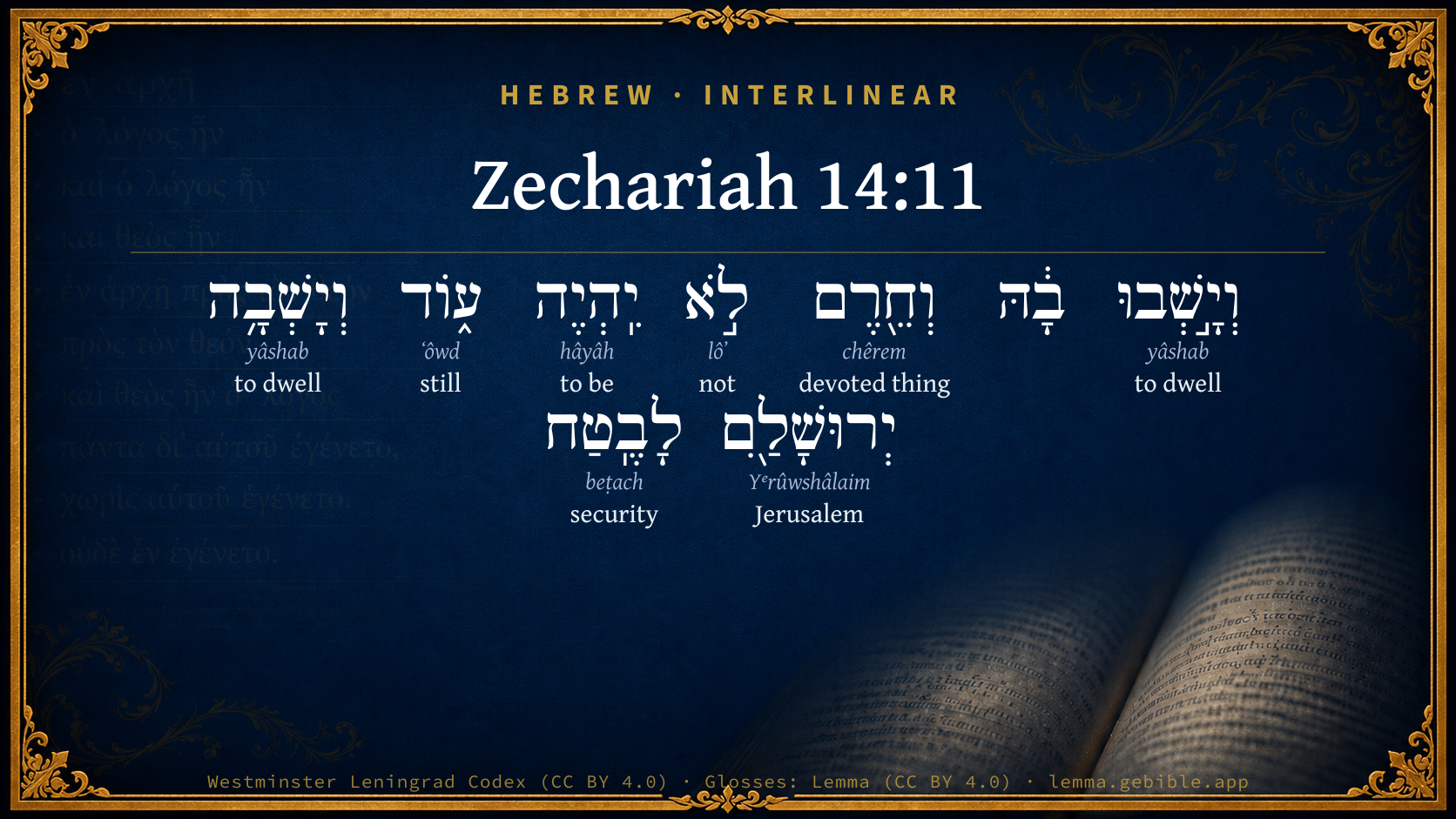
Hebrew (Westminster Leningrad Codex) Zechariah 14:11 appears in the Hebrew Old Testament. The text above is from the Westminster Leningrad Codex. Each word links to its Strong’s number, a concise gloss, and parsing drawn from the Open Scriptures Hebrew Bible morphology. Click any word for its full Brown-Driver-Briggs (BDB) entry.
Download image
Cite this verse

Zechariah 14:11 (World English Bible). Public Domain. Lemma interlinear Bible study tool, https://lemma.gebible.app/v/zechariah/14/11.

Show BibTeX & RIS
BibTeX
RIS
English Translation
Men will dwell therein, and there will be no more curse; but Jerusalem will dwell safely.
World English Bible · Public Domain
Download a study sheet

One document with this verse’s original text, its word-by-word gloss line, the meaning frame, cross-references with their text, attributed commentary, and full source and license credits — printable, and it pastes into notes with its structure intact.

This verse Autodidact and up

Study sheet (.html) Plain text (.txt)

A passage Seminary Student

Up to 50 verses in one chapter. A passage sheet keeps up to 6 commentary sources and 12 cross-references per verse, in the order this page ranks them, and says so on the sheet whenever that leaves anything out. Ask for a single verse and you get the Autodidact verse sheet above.

Everything on this page stays free to read, with no account — the sheet is a download of what is already on screen, not access to it.

Want to remove ads? Support Godless Engineer
Compare translations 3

The same verse in 3 English versions, stacked beneath the original-language interlinear above. Click any original word for its lexicon entry.

Each is an independent rendering of the whole verse — the interlinear is not word-aligned to these translations.

Highlighted words mark where these versions differ — a whole-verse word diff, not a word-by-word alignment.

  • World English Bible Public Domain
    Men will dwell therein, and there will be no more curse; but Jerusalem will dwell safely.
  • King James Version Public Domain
    And men shall dwell in it, and there shall be no more utter destruction; but Jerusalem shall be safely inhabited.
  • unfoldingWord Literal Text CC BY-SA 4.0
    will live in Jerusalem and there will be no more destruction from God against them. Jerusalem will live in safety.

unfoldingWord Literal Text — © unfoldingWord, licensed CC BY-SA 4.0. Word-aligned USFM3 via Door43 (git.door43.org/unfoldingWord/en_ult).

Versions to compare (up to 4)

3 of 4 selected

Show all 18 translations

Every available English version of this verse, each an independent rendering of the whole verse.

  • World English Bible Public Domain
    Men will dwell therein, and there will be no more curse; but Jerusalem will dwell safely.
  • Berean Standard Bible Public Domain
    People will live there, and never again will there be an utter destruction. So Jerusalem will dwell securely.
  • Majority Standard Bible Public Domain
    People will live there, and never again will there be an utter destruction. So Jerusalem will dwell securely.
  • King James Version Public Domain
    And men shall dwell in it, and there shall be no more utter destruction; but Jerusalem shall be safely inhabited.
  • American Standard Version (1901) Public Domain
    And men shall dwell therein, and there shall be no more curse; but Jerusalem shall dwell safely.
  • Revised Version (1885) Public Domain
    And men shall dwell therein, and there shall be no more curse; but Jerusalem shall dwell safely.
  • Geneva Bible (1599) Public Domain
    And men shall dwell in it, and there shall bee no more destruction, but Ierusalem shall bee safely inhabited.
  • Douay-Rheims (1899) Public Domain
    And people shall dwell in it, and there shall be no more an anathema: but Jerusalem shall sit secure.
  • Young's Literal Translation Public Domain
    And they have dwelt in her, And destruction is no more, And Jerusalem hath dwelt confidently.
  • Literal Standard Version CC BY-SA 4.0
    And they have dwelt in her, || And destruction is no more, || And Jerusalem has dwelt confidently.
  • Unlocked Literal Bible CC BY-SA 4.0
    The people will live in Jerusalem and there will be no more complete destruction from God against them. Jerusalem will live in safety.
  • unfoldingWord Literal Text CC BY-SA 4.0
    will live in Jerusalem and there will be no more destruction from God against them. Jerusalem will live in safety.
  • Darby Bible Public Domain
    And [men] shall dwell in it, and there shall be no more utter destruction; and Jerusalem shall dwell safely.
  • World Messianic Bible Public Domain
    Men will dwell therein, and there will be no more curse; but Jerusalem will dwell safely.
  • Webster's Bible Public Domain
    And men shall dwell in it, and there shall be no more utter destruction; but Jerusalem shall be safely inhabited.
  • Free Bible Version CC BY-SA 4.0
    It will be inhabited and never again condemned to destruction again—people will be able to live in safety in Jerusalem.
  • Bible in Basic English Public Domain
    And there will be no more curse; but Jerusalem will be living without fear of danger.
  • JPS Tanakh (1917) Public Domain
    And men shall dwell therein, and there shall be no more extermination; but Jerusalem shall dwell safely.

Literal Standard Version (2020), Covenant Press — licensed CC BY-SA 4.0. Text via the HelloAO Bible API (eBible.org). Unlocked Literal Bible (unfoldingWord) — licensed CC BY-SA 4.0. Text via the HelloAO Bible API (eBible.org). unfoldingWord Literal Text — © unfoldingWord, licensed CC BY-SA 4.0. Word-aligned USFM3 via Door43 (git.door43.org/unfoldingWord/en_ult). Free Bible Version, Dr. Jonathan Gallagher — licensed CC BY-SA 4.0. Text via the HelloAO Bible API (eBible.org).

Word by word

More ways to search: Search by grammar → Find every occurrence → Compare this word →

Practice this passage: Drill this verse → Learn its vocabulary →

וְחֵ֖רֶם
chêrem
H2764
“and · devoted thing”
Conjunction + Noun, Common, Masculine, Singular, Absolute
Part of Speech
Conjunction + Noun
Type
Common
Gender
Masculine
Number
Singular
State
Absolute
Full BDB Definition

Origin: from H2763

TWOT: 744a , 745a

a thing devoted, thing dedicated, ban, devotion - a net, thing perforated - have been utterly destroyed, (appointed to) utter destruction
  1. וְיָ֣שְׁבוּ yâshab H3427 “and · to dwell” Conjunction + Verb, Qal, Sequential Perfect, 3rd Person, Common, Plural
  2. לֹ֣א lôʼ H3808 “not” Particle, Negative
  3. יִֽהְיֶה hâyâh H1961 “to be” Verb, Qal, Imperfect, 3rd Person, Masculine, Singular
  4. ע֑וֹד ʻôwd H5750 “still” Adverb
  5. וְיָשְׁבָ֥ה yâshab H3427 “and · to dwell” Conjunction + Verb, Qal, Sequential Perfect, 3rd Person, Feminine, Singular
  6. יְרוּשָׁלִַ֖ם Yᵉrûwshâlaim H3389 “Jerusalem” Noun, Proper
  7. לָבֶֽטַח beṭach H983 “to/for · security” Preposition + Noun, Common, Masculine, Singular, Absolute

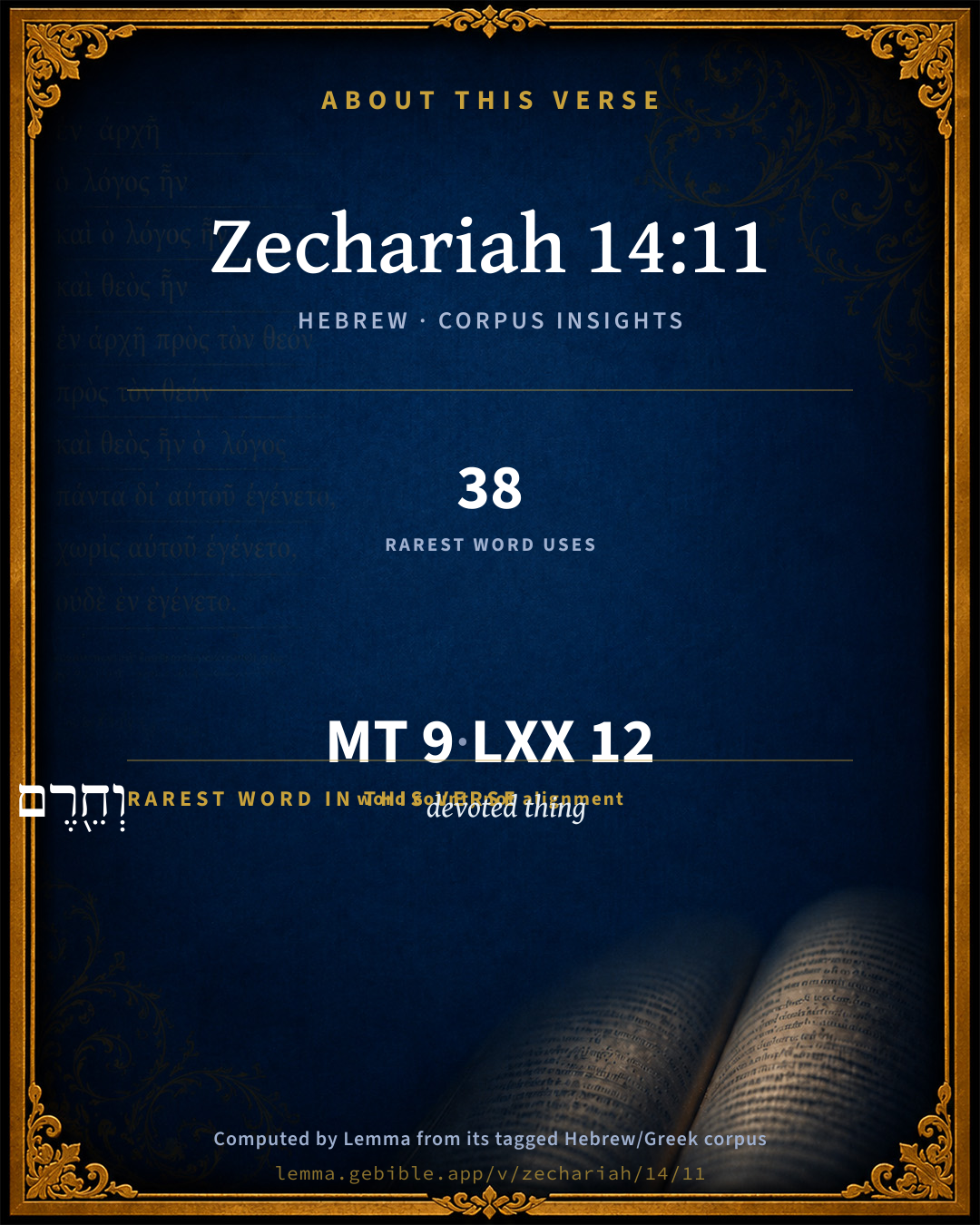
About this verse

These counts appear in no published source. They are computed here, from the morphology-tagged text and Lemma’s own curated glosses. What Lemma adds →

9
words
7
distinct lemmas
Prophets
section

Shared distinctive vocabulary

וְחֵ֖רֶם devoted thing H2764 occurs in 31 verses of the Hebrew Bible. Also found in:

Grammatical profile

  • 3 verbs
  • 3 nouns
  • 1 preposition
  • 1 adverb
  • 1 particle

Verb forms

  • וְיָ֣שְׁבוּ Qal · Sequential Perfect
  • יִֽהְיֶה Qal · Imperfect
  • וְיָשְׁבָ֥ה Qal · Sequential Perfect

Repetition

A word recurs within this verse — often emphatic in Hebrew:

  • וְיָ֣שְׁבוּ to dwell H3427 ×2

Hebrew & Septuagint length

In English translation the verse runs 16 words from the Hebrew and 19 from the Septuagint (LXX English) — closely comparable.

A rough comparison of the two English renderings, which tokenize alike — not a word-level alignment.

Word counts can differ between the Hebrew and the Greek without any difference in meaning — e.g. the Hebrew direct-object marker אֵת has no separate Greek word, and Greek often adds the article ὁ.

In the original languages it is 9 Hebrew tokens and 12 Greek tokens — but the two are counted differently (Hebrew bundles its prefixes and suffixes into one token; the Greek is in lemma form), so that isn’t a like-for-like length.

Cross-references

17

Topical passages linked to Zechariah 14:11 in the Treasury of Scripture Knowledge — connected by theme and wording, ordered by reader-vote popularity; previews shown in the World English Bible.

  • Revelation 22:3 There will be no curse any more. The throne of God and of the Lamb will be in it, and his servants serve him.
  • Jeremiah 23:5–6 Behold, the days come, says Yahweh, that I will raise to David a righteous Branch, and he shall reign as king and deal wisely, and shall execute justice and righteousness in the land.
  • Amos 9:15 I will plant them on their land, And they will no more be plucked up out of their land which I have given them," says Yahweh your God.
  • Zechariah 8:8 and I will bring them, and they will dwell in the midst of Jerusalem; and they will be my people, and I will be their God, in truth and in righteousness."
  • Revelation 21:4 He will wipe away from them every tear from their eyes. Death will be no more; neither will there be mourning, nor crying, nor pain, any more. The first things have passed away."
  • Numbers 21:3 Yahweh listened to the voice of Israel, and delivered up the Canaanites; and they utterly destroyed them and their cities: and the name of the place was called Hormah.
  • Isaiah 26:1 In that day shall this song be sung in the land of Judah: we have a strong city; salvation will he appoint for walls and bulwarks.
  • Isaiah 60:18 Violence shall no more be heard in your land, desolation nor destruction within your borders; but you shall call your walls Salvation, and your gates Praise.
  • Isaiah 66:22 For as the new heavens and the new earth, which I will make, shall remain before me, says Yahweh, so shall your seed and your name remain.
  • Jeremiah 31:40 The whole valley of the dead bodies and of the ashes, and all the fields to the brook Kidron, to the corner of the horse gate toward the east, shall be holy to Yahweh; it shall not be plucked up, nor thrown down any more forever.
  • Jeremiah 33:15–16 In those days, and at that time, will I cause a Branch of righteousness to grow up to David; and he shall execute justice and righteousness in the land.
  • Ezekiel 34:22–29 therefore will I save my flock, and they shall no more be a prey; and I will judge between sheep and sheep.
  • Ezekiel 37:26 Moreover I will make a covenant of peace with them; it shall be an everlasting covenant with them; and I will place them, and multiply them, and will set my sanctuary in the midst of them forevermore.
  • Joel 3:17 "So you will know that I am Yahweh, your God, Dwelling in Zion, my holy mountain. Then Jerusalem will be holy, And no strangers will pass through her any more.
  • Joel 3:20 But Judah will be inhabited forever, And Jerusalem from generation to generation.
  • Zechariah 2:4 and said to him, "Run, speak to this young man, saying, 'Jerusalem will be inhabited as villages without walls, because of the multitude of men and cattle in it.
  • Zechariah 8:4 Thus says Yahweh of Hosts: "Old men and old women will again dwell in the streets of Jerusalem, every man with his staff in his hand for very age.

Cross-references courtesy of OpenBible.info (CC BY 4.0).

Hebrew and Greek witnesses Masoretic Hebrew ↔ Greek Septuagint

The same verse in the two great witnesses to the Old Testament, shown verse-for-verse.

These are two independent witnesses, not word-aligned to each other, and the Septuagint is shown in lemma (dictionary) form.

Hebrew Zechariah 14:11 Masoretic · Westminster Leningrad Codex

וְיָ֣שְׁבוּ בָ֔הּ וְחֵ֖רֶם לֹ֣א יִֽהְיֶה ע֑וֹד וְיָשְׁבָ֥ה יְרוּשָׁלִַ֖ם לָבֶֽטַח

Men will dwell therein, and there will be no more curse; but Jerusalem will dwell safely.

World English Bible · Public Domain

Greek LXX Zechariah 14:11 Septuagint · lemma form

καταοἰκέω ἐν αὐτός καί οὐ εἰμί ἀνάθεμα ἔτι καί καταοἰκέω ἰερουσαλήμ πεποιθότως

they shall dwell in the city; and there shall be no more any curse, and Jerusalem shall dwell securely.

LXX2012 (modern English Septuagint) · Public Domain

On this verse, The Cambridge Bible for Schools and Colleges discusses the Septuagint’s reading. Read the note in Commentary ↓

Hebrew: Westminster Leningrad Codex (CC BY 4.0). Greek: Septuagint (public domain); English from LXX2012 (modern English Septuagint) (Public Domain). How the Septuagint differs from the Hebrew →

Targum (Aramaic paraphrase)

1

The Targum is the ancient Jewish Aramaic paraphrase of the Hebrew Scriptures — an interpretive translation, not the Hebrew text itself. Onkelos (literal) and Pseudo-Jonathan (expansive) render the Torah, and Jonathan the Prophets. Coverage is partial: where no permissively-licensed English translation exists for a verse, only the Aramaic is shown. This is verse-level text, not a word-by-word alignment to the Hebrew.

  1. Targum Jonathan Prophets (Joshua–Malachi)
    וְיֵיתְבוּן בָּהּ וּקְטָלָא לָא יְהֵי עוֹד וְתֵיתַיב יְרוּשְׁלֵם לְרוֹחֲצָן:

    (no public-domain English translation for this verse)

    Targum Jonathan — Aramaic: “Mikraot Gedolot” (public domain). English: “Sefaria Community Translation” (CC0 1.0 (public-domain dedication)); “London "Chaldee Paraphrase," 1871” (public domain). Text via Sefaria.

Commentary

Notes on Zechariah 14:11 from classic Christian and Jewish commentators (each source and its license shown beneath its notes). The classic Christian expositions comment on the surrounding passage and are grouped to its opening verse, so a note may address several verses; the Jewish commentaries on the Tanakh (Rashi and others) are per-verse, so they appear only where the commentator wrote on this verse.

Lemma curates 59 commentaries, every one of them public domain or Creative Commons licensed, each selected and text-cleaned for this edition rather than reprinted as found. About our sources →

Trapp's Complete Commentary

John Trapp

Zec 14:11 And [men] shall dwell in it, and there shall be no more utter destruction; but Jerusalem shall be safely inhabited.

Ver. 11. And men shall dwell in it] Heb. They shall dwell in it, sc. Multitudes of men. The new Jerusalem, the Church, gathered by the preaching of the gospel, shall not be thinly inhabited, as the wilderness of Judaea was; it shall not lie waste for want of people, as divers parts of Turkey do. It shall not need to call in the country, as in Nehemiah’s days, to replenish it, Neh 11:7; but it shall be fully thrust as a hive is with bees, where they hang out on heaps through want of room within; or as Jerusalem was wont to be at the three solemn feasts; or, lastly, as the temple was at those feasts where the people were so crowded that they were glad to stand and pray, for kneel or bow they could not. See Isa 51:3 Jer 31:38-40 Oba 1:19-20.

And there shall be no more utter destruction] Heb. Cherem, which the Vulgate interpreted rendereth, Anathema; There shall be no more curse, no execrable or accursed thing; no casting out by excommunication; no cause to do so. See the same Rev 22:3. No Canaanite in the Lord’s house, as Zec 14:21. Then shall Jerusalem be holy, and there shall no stranger pass through her any more, Joe 3:17, such shall be her sanctity. Others expound it of her safety and security, as in the following words, Jerusalem shall be safely inhabited. See the like Jer 23:6; Jer 33:16 "In those days shall Judah be saved, and Jerusalem shall dwell safely; and this is the name wherewith she shall be called, Jehovah Tsidkenu, The Lord our righteousness." A stately name indeed, and that which carries safety in the front of it. In Ezekiel the Church is called Jehovah Shammah The Lord is there; and the Psalmist gives the notation, and this note upon it, "God is in the midst of her, she shall not be moved: God shall help her, and that right early" (ανικητος και ακινητος). But the Lord our righteousness is a more august name. It is Christ’s own name; and imports that Christ will save his people from their sins (which would lay them naked to the wrath of God and rage of enemies), he will redeem Israel from all his iniquities, and then he need not fear what man can do unto him, Mat 1:21 Psa 130:8. It was said of Achilles, that he was Styge armatus; but every child of the Church is Coelo, Christo, Deo armatus he hath the peace of God within him and the power of God without him; and, therefore, cannot but be safe as in a tower of brass, or town of war Psa 90:1.

John Trapp, A Commentary or Exposition upon All the Books of the Old and New Testament (1647–1656) — public domain. Text from a community e-Sword module.

Jamieson, Fausset & Brown

Robert Jamieson, A. R. Fausset & David Brown

no more utter destruction-- (Jer 31:40). Literally, "no more curse" (Rev 22:3; compare Mal 4:6), for there will be no more sin. Temporal blessings and spiritual prosperity shall go together in the millennium: long life (Isa 65:20-22), peace (Isa 2:4), honor (Isa 60:14-16), righteous government (Isa 54:14; Isa 60:18). Judgment, as usual, begins at the house of God, but then falls fatally on Antichrist, whereon the Church obtains perfect liberty. The last day will end everything evil (Rom 8:21) [AUBERLEN].

Jamieson, Fausset & Brown — Commentary Critical and Explanatory on the Whole Bible (1871) — public domain (CC PDM 1.0). Text via the HelloAO Bible API.

Adam Clarke's Commentary

Verse 11. There shall be no more utter destruction] After this final restoration of Jerusalem it shall never more be destroyed; but as this was the first city of the living God upon earth, so shall it be the last; it shall be safely inhabited. It shall see war no more.

Adam Clarke's Commentary on the Bible (1810–1826) — public domain. Text from a community e-Sword/MySword module.

John Calvin's Commentaries

Zechariah concludes what he said in the last verse by saying, that Jerusalem when restored by God to its pristine state would be a populous city, for the indefinite verb here used means the same as though he had said, that the number of people would be as great as it had been before, though a small portion only had returned. We indeed know how difficult it is to fill a city with inhabitants when once deserted, especially after a long interval of time. But the Prophet here exhorts the Jews to entertain hope, for the Lord would gather again a large number of men, so as to fill the city with inhabitants.

He adds, there shall be no more utter destruction By the word חרם, cherem, I have no doubt, the Prophet means all utter ruin, such as had happened when the people were driven into exile. And for this reason and in the same sense, Isaiah says, that God had sworn that the destruction of the city would be like the deluge of Noah, (Isaiah 54:9;) for he should never again bring such a grievous and dreadful vengeance on his people. But we learn from the whole passage, that this prophecy extends to the kingdom of Christ; for though Jerusalem was destroyed by Titus, it is yet true that God bad been the perpetual guardian of that city, inasmuch as the fullness of time had come when Christ was revealed. It is then the same as though the Prophet had said, that such should be the moderation of God’s anger, that the name of the city would wholly perish, nor the whole people be forced to migrate. This then is what he understands by חרם, cherem

He now adds, that those who returned thither shall dwell safely in Jerusalem, for the Lord would protect them, and by an extended hand defend them against all enemies. We have elsewhere reminded you of the Prophet’s object; for he wished to goad the tardiness and sloth of those who made so much of their pleasures in Chaldea, that to return to the inheritance promised them from above was unpleasant and grievous to them. Hence he shows of how great a benefit of God they had deprived themselves; for being dispersed among the heathen nation they knew not that God’s aid was provided for them. They indeed deprived themselves of that promise which especially belonged to the remnant who dwelt at Jerusalem. The Prophet had also a particular regard to those miserable inhabitants of the land, who having been stimulated by God’s promises, had despised all dangers and all difficulties, and then had undergone, not grudgingly, vast troubles that they might possess their own country. The Prophet then shows that they had no reason to repent, for the Lord would bless them, and make them to dwell safely in the midst of enemies, by whom we know they were on every side surrounded, and further, that the city would become populous, though they were not then many in number. It follows —

John Calvin's Commentaries (1540-1563) — public domain. Text from the Calvin Translation Society English edition (1840s-50s) via the Christian Classics Ethereal Library (ccel.org). Calvin's coverage is partial (roughly two-thirds of the Bible); uncommented books and verses are honest gaps, never fabricated. The 19th-century editor's footnotes and remarks are omitted so the notes are faithfully Calvin's own voice.

Ellicott's Commentary for English Readers

(11) Utter destruction.—Better, ban. (Comp. Mal_4:6; Rev_22:3.)

A Bible Commentary for English Readers, edited by Charles John Ellicott (1878–1897) — public domain. Text from a community e-Sword module.

The Cambridge Bible for Schools and Colleges

gen. ed. J. J. S. Perowne

11. utter destruction] Lit. curse. ἀνάθεμα οὐκ ἔσται ἔτι. LXX. Comp. Rev_22:3.

The Cambridge Bible for Schools and Colleges (gen. ed. J. J. S. Perowne; Cambridge University Press, 1878–1918) — public domain. Text from a community e-Sword module.

John Gill's Exposition

And men shall dwell in it,.... In great numbers, in much peace and safety, and from generation to generation: Aben Ezra says, Messiah the son of David will now come:

and there shall be no more utter destruction; no wars, nor desolations by them, in a civil sense; there shall be no more killing, as the Targum, Isa 2:4 no "cherem", no anathema, in a religious sense; in the old translation it is, "and there shall be no more cursing"; there will be no curse in the Jerusalem state, Rev 22:3 which words seem to be taken from hence; no cursed thing, nor cursed person, or any curse or anathema denounced against any; no Popish bulls and anathemas, nor any other:

but Jerusalem shall be safely inhabited; the inhabitants of it shall dwell securely, without any apprehension of danger, and having no enemies to fear; though, before this safe and happy state, there will be many enemies; and what will become of them is shown in the following verses.

John Gill's Exposition of the Whole Bible (1746–1763) — public domain (CC PDM 1.0). Text via the HelloAO Bible API.

Albert Barnes' Notes on the Bible

And they shall dwell in it - In peace, going forth from it, neither into “captivity,” nor in flight Zec 14:2, Zec 14:5; for God should exempt from curse the city which He had chosen, against which the gates of hell shall not prevail, and He says of the heavenly Jerusalem, “there shall be no more curse” Rev 22:3.

Albert Barnes' Notes on the Bible (1834–1885) — public domain. Text from a community e-Sword/MySword module.

Haydock's Catholic Bible Commentary

Anathema. It shall not be sentenced to utter ruin. The Church may suffer losses, but cannot perish. (Calmet)

George Leo Haydock (1774–1849), Haydock's Catholic Family Bible and Commentary, 1859 edition — public domain. Excludes Psalms (Douay-Rheims chapter numbering differs from Protestant) and Deuterocanonical books (Catholic canon only).

Matthew Poole's English Annotations

Men, i.e. many for number, or eminent for worth,

shall dwell in it: as it was type, this was verified, say some, when in league with Bacchides and succeeding kings. But in the antitype, to which Zechariah looks, it is now, as it hath been, fulfilled, and more fully shall be, when the fulness of the Gentiles cometh in.

There shall be no more utter destruction; there may be afflictions and troubles, but no utter wasting of Jerusalem; the gates of hell shall not prevail.

But Jerusalem, the antitype, the gospel church,

shall be safely inhabited; not secure from troubles, but secure enough from total destruction.

Matthew Poole's English Annotations on the Holy Bible (1683–1685) — public domain. Text from a community e-Sword/MySword module.

Whedon's Commentary on the Bible

Daniel D. Whedon

11. The city will be inhabited.

No more utter destruction — R.V., “no more curse.” Sin has been wiped away (Zec_13:1; Zec_13:9); therefore no further judgments are needed (compare Jer_25:9; Isa_43:28; Mal_4:6).

Shall be safely inhabited — Better, R.V., “shall dwell safely.” The city need not fear any hostile attacks or calamities of any sort.

Daniel D. Whedon (gen. ed.), Commentary on the Old and New Testaments (1874–1909) — public domain. Text from a community e-Sword module.

The Pulpit Commentary

Men shall dwell in it. There shall be no tear of exile and captivity, and no necessity to fly from a victorious enemy (vers. 2, 5). Utter destruction; literally, curse, ban; LXX and Vulgate, "There shall be no more anathema." The inhabitants shall not incur the curse which is inflicted on transgressors, idolaters, and their cities by the old Law. (see Exo_22:20 Deu_7:2 Deu_13:12-15 Deu_20:17; comp. Ezr_10:8 Isa_43:28 Rev_22:3) Shall be safely inhabited; or, shall dwell safely. Sin being removed, there will be no more occasion for chastisement; and the spiritual Jerusalem shall never be destroyed.

The Pulpit Commentary (1880–1919), ed. H.D.M. Spence-Jones & Joseph S. Exell — public domain. Text from a community e-Sword module.

John Wesley's Explanatory Notes

And men - Many for number, eminent for worth. Utter destruction - There may be afflictions but no utter wasting of Jerusalem; the gates of hell shall not prevail against it.

John Wesley, Explanatory Notes Upon the Whole Bible (1754–1765) — public domain. Text via the GEBible commentary corpus.

Rashi

Rabbi Shlomo Yitzchaki (Rashi)

and there shall be no more destruction The city shall no longer be in ruins.

Rashi on the Tanakh — English translations: “The Judaica Press complete Tanach with Rashi, translated by A. J. Rosenberg” (CC BY 4.0); “Pentateuch with Rashi's commentary by M. Rosenbaum and A.M. Silbermann, 1929-1934” (public domain); “The Metsudah Tanach series, Lakewood, N.J” (CC BY 4.0); and “The Book of Joshua, Metsudah Publications, 1997” (CC BY 4.0). Text via Sefaria.

Lesson kit

Teaching starters — assembled from the data on this page, not authored interpretation. Every prompt links to the verse data it draws on. Edit before teaching.

Zechariah, in the Prophets, opens this verse with 9 words (7 distinct Hebrew lemmas). Its most distinctive word is chêrem (“devoted thing”). A historical commentator’s framing appears above. Read the whole chapter for the surrounding context.

Discussion questions

  1. How does “devoted thing” (chêrem) shape what this verse is saying?
  2. Leviticus 27:21 shares the word «devoted thing» with this verse. How do the two illuminate each other?
  3. “to dwell” occurs 2× in this one verse. What is the effect of the repetition?
  4. These translations render this verse differently. What is at stake in choosing one wording over another?
  5. The verb «וְיָ֣שְׁבוּ» is Qal Sequential Perfect. How does its form color the action?
  6. Reading how Trapp's Complete Commentary and Jamieson, Fausset & Brown read this verse, where do the two commentators agree and where do they part?

Things to notice

Reading settings

Reading text

Shown beneath each verse's original-language words.

Old Testament
Old Testament edition

Read the OT as the Masoretic Hebrew (MT) or the Greek Septuagint (LXX).

English shown for the Greek Septuagint (in the Hebrew ↔ Greek comparison).

Comparing translations? Open the Compare panel on any verse page to stack up to four side by side.