Ezekiel 34:28

Hebrew (Westminster Leningrad Codex) Ezekiel 34:28 appears in the Hebrew Old Testament. The text above is from the Westminster Leningrad Codex. Each word links to its Strong’s number, a concise gloss, and parsing drawn from the Open Scriptures Hebrew Bible morphology. Click any word for its full Brown-Driver-Briggs (BDB) entry.
Download image
Cite this verse

Ezekiel 34:28 (World English Bible). Public Domain. Lemma interlinear Bible study tool, https://lemma.gebible.app/v/ezekiel/34/28.

Show BibTeX & RIS
BibTeX
RIS
English Translation
They shall no more be a prey to the nations, neither shall the animals of the earth devour them; but they shall dwell securely, and none shall make them afraid.
World English Bible · Public Domain
Download a study sheet

One document with this verse’s original text, its word-by-word gloss line, the meaning frame, cross-references with their text, attributed commentary, and full source and license credits — printable, and it pastes into notes with its structure intact.

This verse Autodidact and up

Study sheet (.html) Plain text (.txt)

A passage Seminary Student

Up to 50 verses in one chapter. A passage sheet keeps up to 6 commentary sources and 12 cross-references per verse, in the order this page ranks them, and says so on the sheet whenever that leaves anything out. Ask for a single verse and you get the Autodidact verse sheet above.

Everything on this page stays free to read, with no account — the sheet is a download of what is already on screen, not access to it.

Want to remove ads? Support Godless Engineer
Compare translations 3

The same verse in 3 English versions, stacked beneath the original-language interlinear above. Click any original word for its lexicon entry.

Each is an independent rendering of the whole verse — the interlinear is not word-aligned to these translations.

Highlighted words mark where these versions differ — a whole-verse word diff, not a word-by-word alignment.

  • World English Bible Public Domain
    They shall no more be a prey to the nations, neither shall the animals of the earth devour them; but they shall dwell securely, and none shall make them afraid.
  • King James Version Public Domain
    And they shall no more be a prey to the heathen, neither shall the beast of the land devour them; but they shall dwell safely, and none shall make them afraid.
  • unfoldingWord Literal Text CC BY-SA 4.0
    They will no longer be plunder for the nations, and the wild animals on the earth will no longer devour them. For they will live securely, and no one will frighten them.

unfoldingWord Literal Text — © unfoldingWord, licensed CC BY-SA 4.0. Word-aligned USFM3 via Door43 (git.door43.org/unfoldingWord/en_ult).

Versions to compare (up to 4)

3 of 4 selected

Show all 18 translations

Every available English version of this verse, each an independent rendering of the whole verse.

  • World English Bible Public Domain
    They shall no more be a prey to the nations, neither shall the animals of the earth devour them; but they shall dwell securely, and none shall make them afraid.
  • Berean Standard Bible Public Domain
    They will no longer be prey for the nations, and the beasts of the earth will not consume them. They will dwell securely, and no one will frighten them.
  • Majority Standard Bible Public Domain
    They will no longer be prey for the nations, and the beasts of the earth will not consume them. They will dwell securely, and no one will frighten them.
  • King James Version Public Domain
    And they shall no more be a prey to the heathen, neither shall the beast of the land devour them; but they shall dwell safely, and none shall make them afraid.
  • American Standard Version (1901) Public Domain
    And they shall no more be a prey to the nations, neither shall the beasts of the earth devour them; but they shall dwell securely, and none shall make them afraid.
  • Revised Version (1885) Public Domain
    And they shall no more be a prey to the heathen, neither shall the beast of the earth devour them; but they shall dwell securely, and none shall make them afraid.
  • Geneva Bible (1599) Public Domain
    And they shall no more be spoyled of the heathen, neither shall the beastes of the land deuoure them, but they shall dwell safely and none shall make them afrayd.
  • Douay-Rheims (1899) Public Domain
    And they shall be no more for a spoil to the nations, neither shall the beasts of the earth devour them: but they shall dwell securely without any terror.
  • Young's Literal Translation Public Domain
    And they are no more a prey to nations, And the beast of the earth devoureth them not, And they have dwelt confidently, And there is none troubling.
  • Literal Standard Version CC BY-SA 4.0
    And they are no longer a prey to nations, || And the beast of the earth does not devour them, || And they have dwelt confidently, || And there is none troubling.
  • Unlocked Literal Bible CC BY-SA 4.0
    They will no longer be plunder for the nations, and the wild animals on the earth will no longer devour them. For they will live securely, and no one will frighten them.
  • unfoldingWord Literal Text CC BY-SA 4.0
    They will no longer be plunder for the nations, and the wild animals on the earth will no longer devour them. For they will live securely, and no one will frighten them.
  • Darby Bible Public Domain
    And they shall no more be a prey to the nations, neither shall the beast of the earth devour them; but they shall dwell in safety, and none shall make them afraid.
  • World Messianic Bible Public Domain
    They will no more be a prey to the nations, neither will the animals of the earth devour them; but they will dwell securely, and no one will make them afraid.
  • Webster's Bible Public Domain
    And they shall no more be a prey to the heathen, neither shall the beast of the land devour them; but they shall dwell safely, and none shall make them afraid.
  • Free Bible Version CC BY-SA 4.0
    They won't be the victims of other nations anymore, and wild animals won't eat them. They will live in safety, and no one will terrorize them.
  • Bible in Basic English Public Domain
    And their goods will no longer be taken by the nations, and they will not again be food for the beasts of the earth; but they will be living safely and no one will be a cause of fear to them.
  • JPS Tanakh (1917) Public Domain
    And they shall no more be a prey to the nations, neither shall the beast of the earth devour them; but they shall dwell safely, and none shall make them afraid.

Literal Standard Version (2020), Covenant Press — licensed CC BY-SA 4.0. Text via the HelloAO Bible API (eBible.org). Unlocked Literal Bible (unfoldingWord) — licensed CC BY-SA 4.0. Text via the HelloAO Bible API (eBible.org). unfoldingWord Literal Text — © unfoldingWord, licensed CC BY-SA 4.0. Word-aligned USFM3 via Door43 (git.door43.org/unfoldingWord/en_ult). Free Bible Version, Dr. Jonathan Gallagher — licensed CC BY-SA 4.0. Text via the HelloAO Bible API (eBible.org).

Word by word

More ways to search: Search by grammar → Find every occurrence → Compare this word →

Practice this passage: Drill this verse → Learn its vocabulary →

בַּז֙
baz
H957
“spoil”
Noun, Common, Masculine, Singular, Absolute
Part of Speech
Noun
Type
Common
Gender
Masculine
Number
Singular
State
Absolute
Full BDB Definition

Origin: from H962

TWOT: 225a

spoil, booty, robbery, spoiling
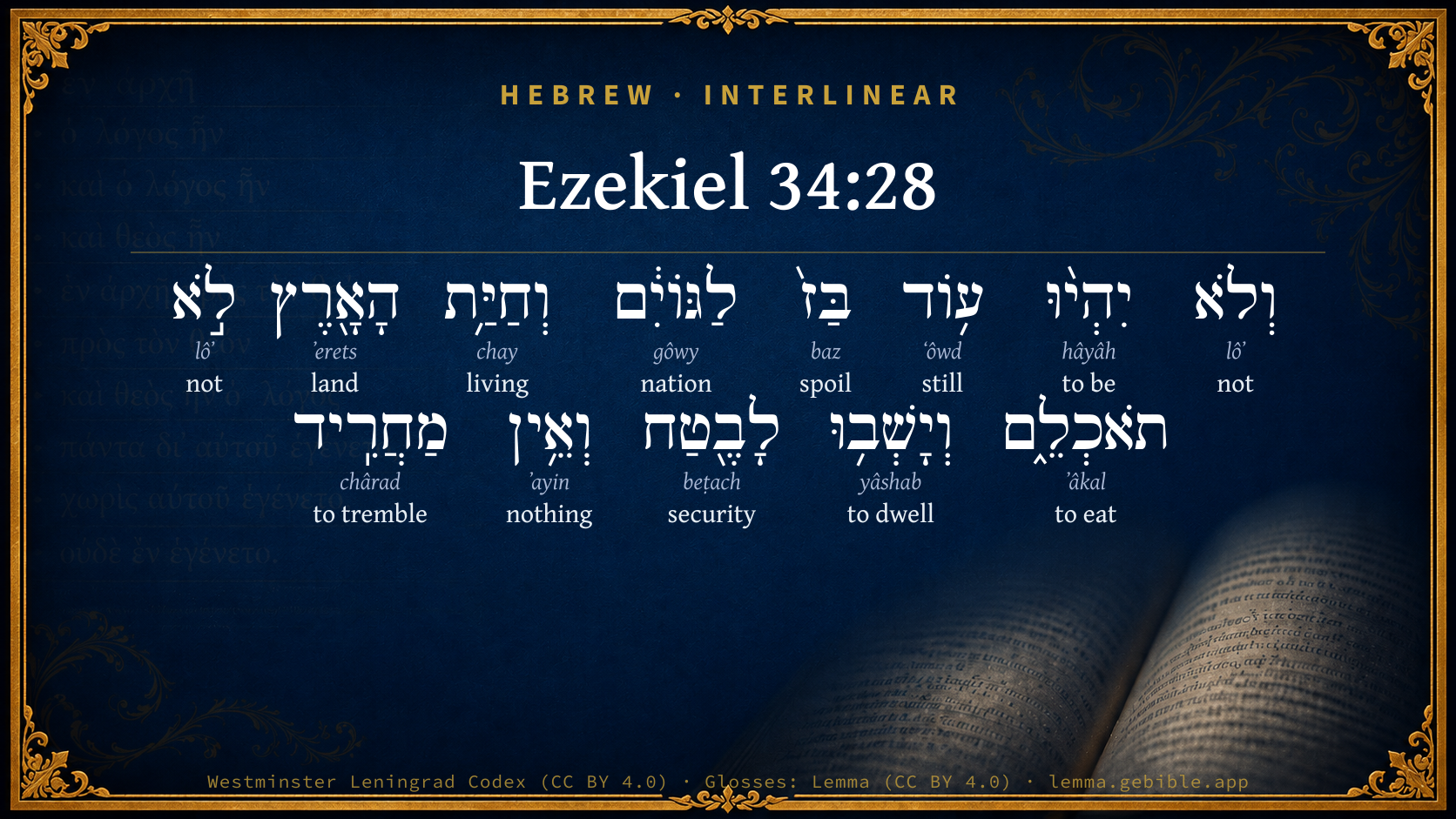
  1. וְלֹא lôʼ H3808 “and · not” Conjunction + Particle, Negative
  2. יִהְי֨וּ hâyâh H1961 “to be” Verb, Qal, Imperfect, 3rd Person, Masculine, Plural
  3. ע֥וֹד ʻôwd H5750 “still” Adverb
  4. לַגּוֹיִ֔ם gôwy H1471 “to/for the · nations” Preposition, Determined + Noun, Common, Masculine, Plural, Absolute
  5. וְחַיַּ֥ת chay H2416 “and · living of” Conjunction + Noun, Common, Feminine, Singular, Construct
  6. הָאָ֖רֶץ ʼerets H776 “the · land” Particle, Definite Article + Noun, Common, Both, Singular, Absolute
  7. לֹ֣א lôʼ H3808 “not” Particle, Negative
  8. תֹאכְלֵ֑ם ʼâkal H398 “to eat · them” Verb, Qal, Imperfect, 3rd Person, Feminine, Singular + Suffix, Personal, 3rd Person, Masculine, Plural
  9. וְיָשְׁב֥וּ yâshab H3427 “and · to dwell” Conjunction + Verb, Qal, Sequential Perfect, 3rd Person, Common, Plural
  10. לָבֶ֖טַח beṭach H983 “to/for · security” Preposition + Noun, Common, Masculine, Singular, Absolute
  11. וְאֵ֥ין ʼayin H369 “and · nothing” Conjunction + Particle, Negative
  12. מַחֲרִֽיד chârad H2729 “trembling” Verb, Hiphil, Participle Active, Masculine, Singular, Absolute

About this verse

These counts appear in no published source. They are computed here, from the morphology-tagged text and Lemma’s own curated glosses. What Lemma adds →

13
words
12
distinct lemmas
Prophets
section

Notable vocabulary

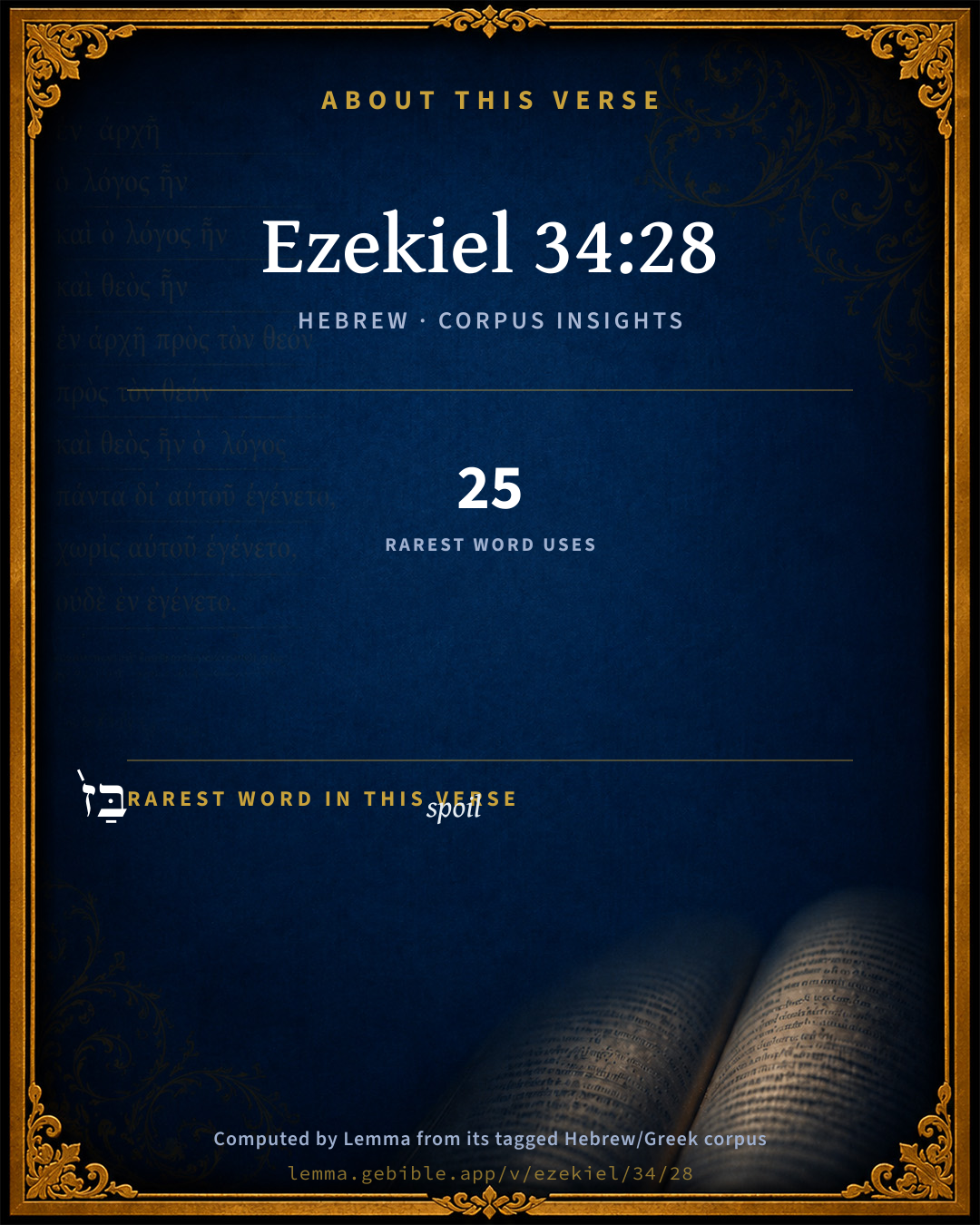
The rarest word here is בַּז֙ spoil H957 — appearing just 25 times in the whole Hebrew Bible.

Shared distinctive vocabulary

בַּז֙ spoil H957 occurs in 25 verses of the Hebrew Bible. Also found in:

Grammatical profile

  • 4 verbs
  • 5 nouns
  • 1 adverb
  • 3 particles

Verb forms

  • יִהְי֨וּ Qal · Imperfect
  • תֹאכְלֵ֑ם Qal · Imperfect
  • וְיָשְׁב֥וּ Qal · Sequential Perfect
  • מַחֲרִֽיד Hiphil · Participle Active

Repetition

A word recurs within this verse — often emphatic in Hebrew:

  • וְלֹא not H3808 ×2

Hebrew & Septuagint length

In English translation the verse runs 30 words from the Hebrew and 39 from the Septuagint (LXX English) — closely comparable.

A rough comparison of the two English renderings, which tokenize alike — not a word-level alignment.

Word counts can differ between the Hebrew and the Greek without any difference in meaning — e.g. the Hebrew direct-object marker אֵת has no separate Greek word, and Greek often adds the article ὁ.

Cross-references

8

Topical passages linked to Ezekiel 34:28 in the Treasury of Scripture Knowledge — connected by theme and wording, ordered by reader-vote popularity; previews shown in the World English Bible.

  • Jeremiah 30:10 Therefore don't you be afraid, O Jacob my servant, says Yahweh; neither be dismayed, Israel: for, behold, I will save you from afar, and your seed from the land of their captivity; and Jacob shall return, and shall be quiet and at ease, and none shall make him afraid.
  • Jeremiah 46:27 But don't be afraid you, Jacob my servant, neither be dismayed, Israel: for, behold, I will save you from afar, and your seed from the land of their captivity; and Jacob shall return, and shall be quiet and at ease, and none shall make him afraid.
  • Ezekiel 39:26 They shall bear their shame, and all their trespasses by which they have trespassed against me, when they shall dwell securely in their land, and none shall make them afraid;
  • Ezekiel 34:8 As I live, says the Lord Yahweh, surely because my sheep became a prey, and my sheep became food to all the animals of the field, because there was no shepherd, neither did my shepherds search for my sheep, but the shepherds fed themselves, and didn't feed my sheep;
  • Ezekiel 34:29 I will raise up to them a plantation for renown, and they shall be no more consumed with famine in the land, neither bear the shame of the nations any more.
  • Ezekiel 36:15 neither will I let you hear any more the shame of the nations, neither shall you bear the reproach of the peoples any more, neither shall you cause your nation to stumble any more, says the Lord Yahweh.
  • Ezekiel 34:25 I will make with them a covenant of peace, and will cause evil animals to cease out of the land; and they shall dwell securely in the wilderness, and sleep in the woods.
  • Ezekiel 36:4 therefore, you mountains of Israel, hear the word of the Lord Yahweh: Thus says the Lord Yahweh to the mountains and to the hills, to the watercourses and to the valleys, to the desolate wastes and to the cities that are forsaken, which are become a prey and derision to the residue of the nations that are round about;

Cross-references courtesy of OpenBible.info (CC BY 4.0).

Hebrew and Greek witnesses Masoretic Hebrew ↔ Greek Septuagint

The same verse in the two great witnesses to the Old Testament, shown verse-for-verse.

These are two independent witnesses, not word-aligned to each other, and the Septuagint is shown in lemma (dictionary) form.

Hebrew Ezekiel 34:28 Masoretic · Westminster Leningrad Codex

וְלֹא יִהְי֨וּ ע֥וֹד בַּז֙ לַגּוֹיִ֔ם וְחַיַּ֥ת הָאָ֖רֶץ לֹ֣א תֹאכְלֵ֑ם וְיָשְׁב֥וּ לָבֶ֖טַח וְאֵ֥ין מַחֲרִֽיד

They shall no more be a prey to the nations, neither shall the animals of the earth devour them; but they shall dwell securely, and none shall make them afraid.

World English Bible · Public Domain

Greek LXX Ezekiel 34:28 Septuagint · lemma form

καί οὐ εἰμί ἔτι ἐν προνομή ὁ ἔθνος καί ὁ θηρίον ὁ γῆ οὐκέτι μή ἐσθίω αὐτός καί καταοἰκέω ἐν ἐλπίς καί οὐ εἰμί ὁ ἐκφοβέω αὐτός

And they shall no more be a spoil to the nations, and the wild beasts of the land shall no more at all devour them; and they shall dwell safely, and there shall be none to make them afraid.

LXX2012 (modern English Septuagint) · Public Domain

Hebrew: Westminster Leningrad Codex (CC BY 4.0). Greek: Septuagint (public domain); English from LXX2012 (modern English Septuagint) (Public Domain). How the Septuagint differs from the Hebrew →

Targum (Aramaic paraphrase)

1

The Targum is the ancient Jewish Aramaic paraphrase of the Hebrew Scriptures — an interpretive translation, not the Hebrew text itself. Onkelos (literal) and Pseudo-Jonathan (expansive) render the Torah, and Jonathan the Prophets. Coverage is partial: where no permissively-licensed English translation exists for a verse, only the Aramaic is shown. This is verse-level text, not a word-by-word alignment to the Hebrew.

  1. Targum Jonathan Prophets (Joshua–Malachi)
    וְלָא יְהוֹן עוֹד בִּזָא לְעַמְמַיָא וּמַלְכְּוַת אַרְעָא לָא יְשֵׁיצִינוּן וְיַתְבוּן לְרוֹחֲצָן וְלֵית דְמָנִיד:

    (no public-domain English translation for this verse)

    Targum Jonathan — Aramaic: “Mikraot Gedolot” (public domain). English: “Sefaria Community Translation” (CC0 1.0 (public-domain dedication)); “London "Chaldee Paraphrase," 1871” (public domain). Text via Sefaria.

Commentary

Notes on Ezekiel 34:28 from classic Christian and Jewish commentators (each source and its license shown beneath its notes). The classic Christian expositions comment on the surrounding passage and are grouped to its opening verse, so a note may address several verses; the Jewish commentaries on the Tanakh (Rashi and others) are per-verse, so they appear only where the commentator wrote on this verse.

Lemma curates 59 commentaries, every one of them public domain or Creative Commons licensed, each selected and text-cleaned for this edition rather than reprinted as found. About our sources →

Trapp's Complete Commentary

John Trapp

Eze 34:28 And they shall no more be a prey to the heathen, neither shall the beast of the land devour them; but they shall dwell safely, and none shall make [them] afraid.

Ver. 28. And they shall no more be a prey to the heathen.] As the Jews then were, and are to this day, being used by the Papists as sponges. The Christian Hebrews also suffered with joy the spoiling of their goods; but then, for an allay to their grief, they knew within themselves that which did sufficiently support them, and make up their loss. {Heb 10:34}

John Trapp, A Commentary or Exposition upon All the Books of the Old and New Testament (1647–1656) — public domain. Text from a community e-Sword module.

Jamieson, Fausset & Brown

Robert Jamieson, A. R. Fausset & David Brown

dwell safely-- (Jer 23:6).

Jamieson, Fausset & Brown — Commentary Critical and Explanatory on the Whole Bible (1871) — public domain (CC PDM 1.0). Text via the HelloAO Bible API.

John Gill's Exposition

And I will raise up for them a plant of renown,.... Or, "for a name"; or, "of a name" (t); a famous one: this is to be understood, not of the Jewish nation itself, as the Targum,

"and I will raise up for them a plantation for standing;''

or which shall continue; but of the Messiah, and not of his incarnation, when he sprung up as a tender plant out of the dry ground, and as a branch out of the roots of Jesse, being on that account often spoken of as a branch; see Isa 11:1, but of him in a more raised and exalted state, as grown up to a stately tree, a goodly cedar, as in Eze 17:23 when his interest and kingdom should be great and glorious in the world, as it will be at the time of the conversion of the Jews; and it is spoken of his manifestation to them as a plant of renown, or as a renowned plant, the true vine and tree of life; or as a famous renowned person, one of name; whose glorious names and titles are Shiloh, the Messiah, Immanuel, Jehovah our righteousness, Jesus the Saviour, the Word of God, the King of kings, and Lord of lords:

and they shall be no more consumed with hunger in the land; the Targum is,

"they shall no more move from place to place through famine in the land;''

and which is to be understood, not of hunger through a famine of bread and water, but of hearing the word of the Lord; which they shall now have, and hear, and believe, and so have food for their souls, and hunger no more; as those do not who believe in Christ, Joh 6:35, for this plant raised up for them, and pointed out to them, the tree of life, Christ Jesus, bears all manner of precious fruit, sweet to the taste, and nourishing to the souls of his people; under his shadow they sit, and his fruit is sweet to them; and with him is bread enough, and to spare; so that there is no want, nor fear of consumption with hunger, where he is:

neither bear the shame of the Heathen any more; being called by them Jews, in away of taunt, a proverb, and a curse; and outcasts, whom none seek after; but now they shall no more be termed forsaken, or called desolate, but instead thereof Hephzibah and Beulah; see Jer 30:17.

(t) "plantato in nemen", Pagninus, Montanus, Cocceius, Starckius; "plantam celebri nomine", Tigurine version; "plantam in nomen", Vatablus.

John Gill's Exposition of the Whole Bible (1746–1763) — public domain (CC PDM 1.0). Text via the HelloAO Bible API.

Matthew Poole's English Annotations

See Eze 34:5,10,25, and Eze 28:26.

None shall make them afraid; neither beasts nor men, for these shall be restrained if they would, those be destroyed and cease that they cannot, endanger them.

Matthew Poole's English Annotations on the Holy Bible (1683–1685) — public domain. Text from a community e-Sword/MySword module.

Scofield Reference Notes

C. I. Scofield

prey to the heathen

The whole passage (Eze 34:23-30) speaks of a restoration yet future, for the remnant which returned after the 70 years, and their posterity, were continually under the Gentile yoke, until, in A.D. 70, they were finally driven from the land into a dispersion which still continues.

The Scofield Reference Bible (1917 edition), notes by C. I. Scofield — public domain. Text from a community e-Sword module.

unfoldingWord translationNotes

Door43 World Missions Community

General Information:

Yahweh continues giving Ezekiel his message to the people of Israel.

They will no longer be plunder for the nations

Here "nations" represents the people of the nations. AT: "The people of the nations will no longer steal from them" (See: Metonymy)

plunder

These are things that are stolen or taken by force. See how you translated "plunder" in Ezekiel 7:21.

be victims of famine

"be starved" or "be starving because of lack of food"

they will not bear the scorn of the nations

Here "nations" represents the people of the nations. The abstract noun "scorn" can be stated as a verb. AT: "they will no longer hear the people of the nations insult them" (See: Metonymy and Abstract Nouns)

translationWords

nation

devour

fear

create

peace

unfoldingWord translationNotes — © Distant Shores Media and the Door43 World Missions Community, licensed CC BY-SA 4.0. Source: git.door43.org/Door43/en_tn.

Lesson kit

Teaching starters — assembled from the data on this page, not authored interpretation. Every prompt links to the verse data it draws on. Edit before teaching.

Ezekiel, in the Prophets, opens this verse with 13 words (12 distinct Hebrew lemmas). Its most distinctive word is baz (“spoil”). A historical commentator’s framing appears above. Read the whole chapter for the surrounding context.

Discussion questions

  1. What does “spoil” (baz) contribute to the verse as a whole?
  2. Numbers 14:3 shares the word «spoil» with this verse. How do the two illuminate each other?
  3. “not” occurs 2× in this one verse. What is the effect of the repetition?
  4. The translations on this page render this verse differently — a whole-verse word diff, not a word-by-word alignment. What might account for the different wordings?
  5. The verb «יִהְי֨וּ» is Qal Imperfect. How does its form color the action?
  6. Reading how Trapp's Complete Commentary and Jamieson, Fausset & Brown read this verse, where do the two commentators agree and where do they part?

Things to notice

Reading settings

Reading text

Shown beneath each verse's original-language words.

Old Testament
Old Testament edition

Read the OT as the Masoretic Hebrew (MT) or the Greek Septuagint (LXX).

English shown for the Greek Septuagint (in the Hebrew ↔ Greek comparison).

Comparing translations? Open the Compare panel on any verse page to stack up to four side by side.