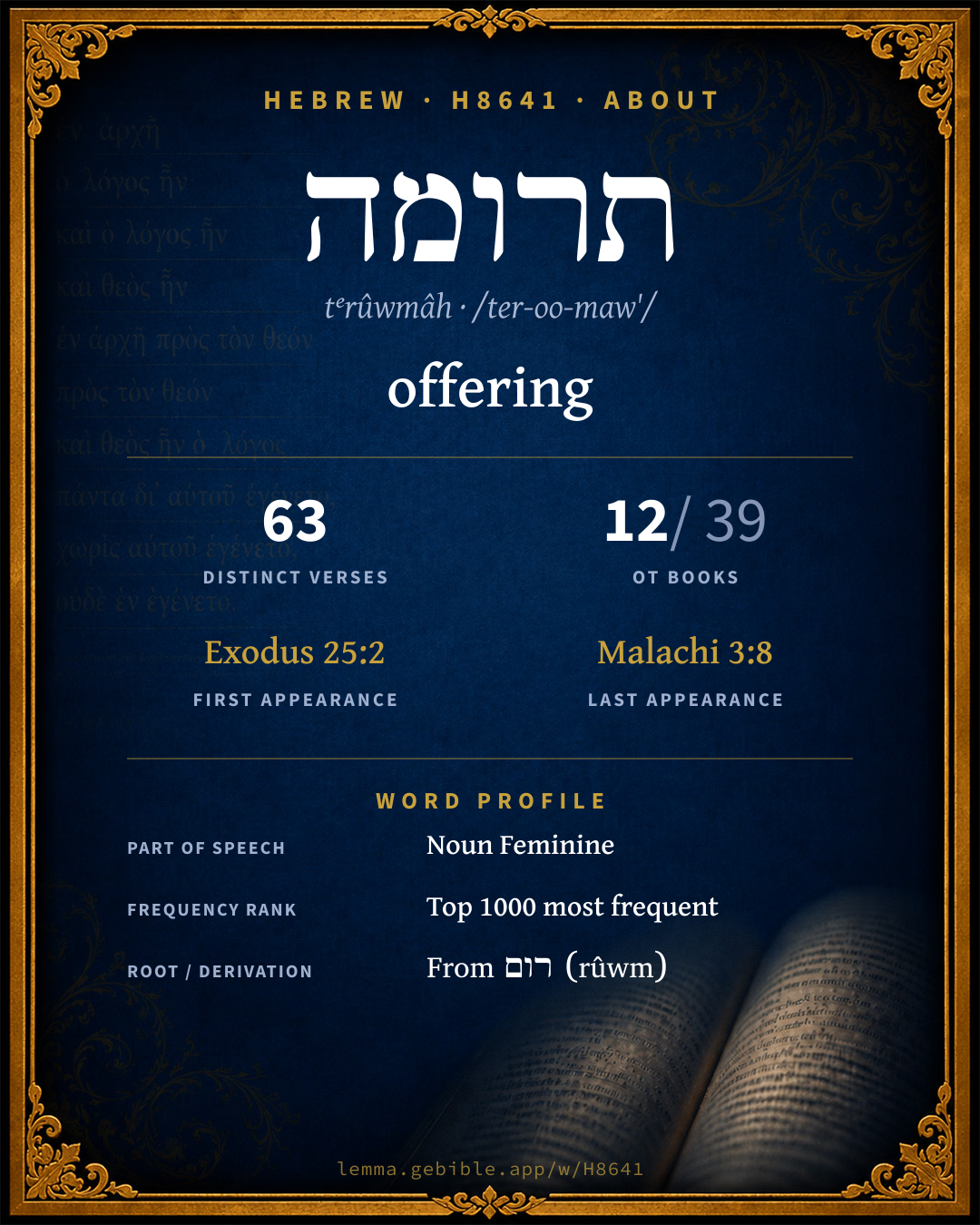
תְּרוּמָה
offering
‘offering’ is one of 6 main senses fuller range ↓
Full lexicon entry — Brown-Driver-Briggs (BDB)
From Brown-Driver-Briggs (BDB)
Where this word appears
Grammar key — what these labels mean
Part of speech
- Noun
- A naming word — a person, place, thing, or idea.
Noun type
- Common
- A common noun — a general class of person, place, or thing (“king,” “city,” “water”), not a specific name.
State
- Construct
- A noun bound to a following noun in a possessive / “of” relationship (the construct chain).
- Absolute
- The independent form of a noun, not bound to a following word.
Gender
- Feminine
- Grammatically feminine.
Number
- Singular
- One.
- Plural
- More than one (in Hebrew, generally three or more).
Every verse where H8641 appears in the Book of Ezra — 1 distinct verse. Click any verse to open its interlinear word-by-word view. Verse text shown in the World English Bible for context — . Each verse’s Hebrew form is shown with its reference; the English is not keyword-highlighted, since the data carries no word-level English alignment. Use “Compare translations” on any verse to read it across multiple English versions. This concordance covers the Hebrew Bible; Septuagint (Greek Old Testament) occurrences are not indexed here.
Ezra
About this entry
At a glance — auto-summarized from this page’s data, not written by a person. Every figure links to its source below. This summary describes the numbers; it doesn’t interpret them.
תרומה — transliterated tᵉrûwmâh — is a Hebrew noun carrying the sense “offering.” Its English rendering has broadened — “heave offering” classically, “contribution” (unfoldingWord Literal Text) in modern versions; see the renderings breakdown. The Hebrew Bible uses it across 63 verses — moderately common. More than a quarter of its appearances fall in Numbers. It is not a single-sense word — see its full sense range. Each statement above links to its evidence; the full detail follows below.
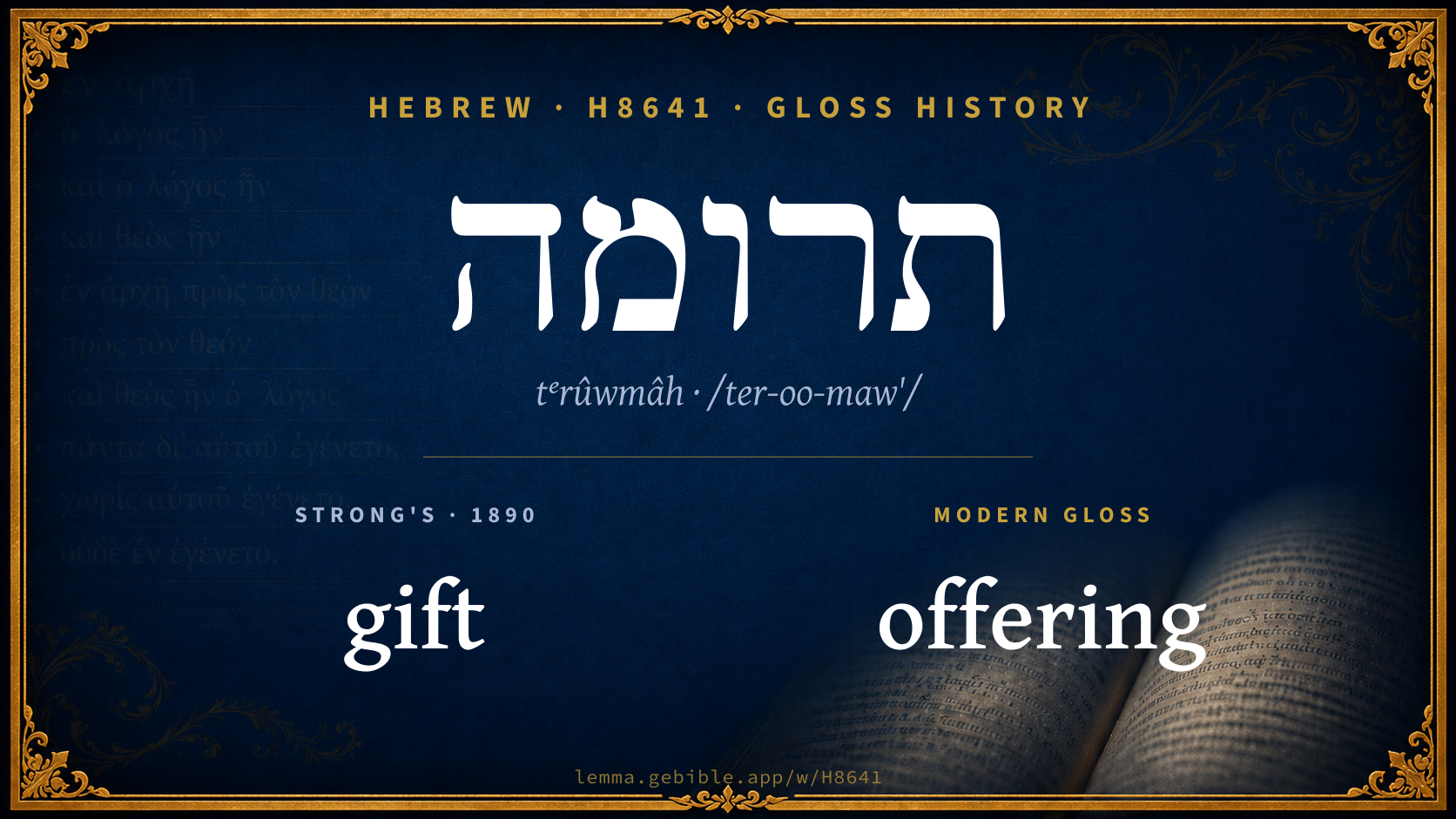
Gloss history
Strong's 1890 vs modern scholarship
About this word
Strong's H8641 catalogs a Hebrew word from the Hebrew Old Testament.
These counts are not copied from any lexicon or concordance. They are computed here, from the morphology-tagged Hebrew Old Testament. What Lemma adds →
- 63
- distinct verses
- The word appears in 63 distinct verses.
- 12 / 39
- OT books
- The word appears in 12 of 39 Old Testament books.
- #523
- by frequency
- Top 1000 most frequent Hebrew words (rank 523 of 8,640 Hebrew words by occurrence).
View all 63 occurrences in the concordance →
By section of the Old Testament
By traditional corpus
Conventional, traditional groupings — biblical authorship is debated, so this is a traditional corpus grouping, not an authorship claim. Each share is this word’s portion of its verses in that division of the Hebrew canon. Each figure is a share of the word’s 63 distinct verses.
- Torah (Pentateuch) 37 verses · 59%
- Prophets (Nevi'im) 17 verses · 27%
- Writings (Ketuvim) 9 verses · 14%
How translations render this word
Counts come from each version’s own published word-to-Strong’s tagging or interlinear alignment — an approximate guide to how each version renders this word, not a word-level alignment the data otherwise carries. Because each total is that version’s own tagged count, the per-version totals vary from one another and need not match the appearance or distinct-verse counts above. These counts may also differ from a printed concordance because Lemma counts each distinctly tagged rendering and does not collapse phrase taggings into a single head-word total. This is a fixed set of word-tagged versions (KJV, ASV, BSB, ULT) and does not change with the reading translation you choose elsewhere. Each version’s license is shown beside its name below (and on Sources).
- King James Version: Heave offering 14×, Offering 13×, Oblation 11×
- American Standard Version: Heave-offering 17×, Oblation 14×, Offering 7×
- Berean Standard Bible: Offering 21×, Contribution 12×, Portion 8×
- unfoldingWord Literal Text: Contribution 25×, Contribution of 18×, Offering 6×
King James Version Public Domain
Renders H8641 across 76 tagged occurrences — most commonly:
Plus 22 renderings that appear only once — usually multi-word phrases or single function words the recovered tagging swept in, not distinct renderings.
American Standard Version Public Domain
Renders H8641 across 76 tagged occurrences — most commonly:
Plus 22 renderings that appear only once — usually multi-word phrases or single function words the recovered tagging swept in, not distinct renderings.
Berean Standard Bible Public Domain
Renders H8641 across 73 tagged occurrences — most commonly:
Plus 16 renderings that appear only once — usually multi-word phrases or single function words the recovered tagging swept in, not distinct renderings. Not rendered by a distinct English word in 3 further occurrences.
unfoldingWord Literal Text CC BY-SA 4.0
Renders H8641 across 78 tagged occurrences — most commonly:
Plus 10 renderings that appear only once — usually multi-word phrases or single function words the recovered tagging swept in, not distinct renderings.
12 senses and sub-senses in the full BDB
What do BDB’s symbols mean?
BDB uses these scholarly abbreviations:
| Symbol | Meaning |
|---|---|
| 𝔊 | the Septuagint (the ancient Greek translation, LXX) |
| 𝔙 | the Vulgate (the Latin translation) |
| 𝔖 | the Syriac version (the Peshitta) |
| 𝔗 | the Targum (the Aramaic translation) |
| ψ | the Psalms |
| √ | root (the underlying root or stem) |
| ‖ | parallel passage (a synonymous or contrasted parallel) |
| † | the dagger: every passage where the word occurs is cited |
The 12 senses and sub-senses the full Brown-Driver-Briggs lexicon distinguishes for this word, in lexicon order (not ranked by frequency), with BDB’s own verbatim wording and sub-sense lettering. Shown in Hebrew script with BDB’s own scholarly abbreviations. The condensed entry is in the Lexicon Entry tab. See also the Forms in the corpus table below.
- 1. earliest use: contrib. of products of soil for י׳, תְּרוּמַת יֶדְכֶם Dt 12:6, 11, cf. v 17; also Ez 20:40 Nu 15:19, 20(×2), 21. e.g. Deuteronomy 12:6
- 2. contrib. for prince, in Ezekiel’s scheme: Ez 45:13, 16 e.g. Ezekiel 45:13
- 3. tract of land to be set apart for temple, and for use of priests and Levites, in Ezek.’s scheme: Ez 45:1; 48:8, 9, 20a, 21b; called ת׳ הַקֹּדֶשׂ 45:6, 7(×2); 48:10, 18(×2), 20b, 21a, 21c; ת׳ הָאָרְץ קֹדֶשׁ קָֽדָשִׁים v 12. e.g. Ezekiel 45:1
- 4. contrib. to י׳, set apart for priests, Ez 44:30(×2); Lv 22:12; Nu 5:9; 18:8, 11, 19; 2 Ch 31:10, 12, 14; specif.: e.g. Ezekiel 44:30
- a. of cakes and cereals Lv 7:14; Ne 10:38, 40 (also for Levites), 12:44 (id.), 13:5; cf. וּשְׂדֵי תְרוּמוֹת 2 S 1:21, i.e. (si vera l.) fields yielding sacred imposts, but very dub.; 𝔊L ὄρη θανάτου, cf. We; JPPet JBL xii (1893), 54 proposes מָוֶת (הָרֵי) שׂ׳, ה׳ as gloss; HPS שְׂדוֹת הַמָּוֶת; > Sta וּשְׂדֵי עֲרֵמוֹת; v. also Dr. e.g. Leviticus 7:14
- b. of animal sacrif., the thigh, שׁוֹק הַתּ׳ Ex 29:27, 28; Lv 7:34; 10:14, 15; Nu 6:20. e.g. Exodus 29:27
- c. priests’ share of Levites’tithe, Nu 18:26, 27, 28(×2), 29. e.g. Numbers 18:26
- d. of booty Nu 31:29, 41, 52. e.g. Numbers 31:29
- e. tithe for Levites 18:24. e.g. Numbers 18:24
- 5. materials for tabern., sacred garments, etc., Ex 25:2(×2), 3; 35:5(×2), 21, 24(×2); 36:3, 6; for temple Ezr 8:25. e.g. Exodus 25:2
- 6. half-shekel for maintaining service of sanctuary Ex 30:13, 14, 15. e.g. Exodus 30:13
- 7. late, contribution, in gen., אִישׁ תְּרוּמוֹת Pr 29:4 a man of contributions, i.e. demanding them, = man of exactions.—תּ׳ Is 40:20 of idol-image (si vera l.), so still Di-Kit; read perhaps תְּמוּנָה 𝔊 (ὁμοίωμα v 19) Du; other conj. in Che Hpt., v. also iii. [סָכַן].—Vbs. c. ת׳ are: הֵרִים Ez 45:1 + 14 times, הֵבִיא Dt 12:6 + 9 times, נָתַן Ez 44:30 + 9 times, לָקַח Ex 25:2(×2) + times, חִקְרִיב Lv 7:14; Nu 5:9.—Vid. Dr Dt 12:6;Hast. DB iii. 588. e.g. Proverbs 29:4
Senses from the full Brown-Driver-Briggs lexicon (Brown, Driver, Briggs; Oxford 1906 — public domain), digitized via Sefaria, supplemented by the OpenScriptures HebrewLexicon (CC BY 4.0). Full attribution on Sources.
Word origin
n.f. contribution, offering, for sacred uses (not certain before Dt.; chiefly Ez P and late) (proposes something lifted off, separated);—abs. ת׳ Ez 45:13 +; cstr. תְּרוּמַת Ex 30:14 +; sf. תְּרוּמָתִי 25:2, מַתְכֶם- Nu 18:27, מָתָם- Ex 29:28; pl. תְּרוּמוֹת Na 12:44 Pr 29:4, מֹת- 2 S 1:21 Nu 18:19; sf. תְּרוּמֹתָ֑י v 8, etc.;—
— Brown-Driver-Briggs (Oxford 1906, public domain), digitized via Sefaria, supplemented by the OpenScriptures HebrewLexicon (CC BY 4.0). See Sources.
Derived from רום (rûwm) (H7311) — to rise.
Jastrow Dictionary
A second Hebrew/Aramaic lexicon for comparison, covering Aramaic and post-biblical (Talmudic, Targumic, Midrashic) usage that the biblical-Hebrew BDB does not. Matched by lemma rather than by Strong’s number, so a lemma may carry more than one Jastrow headword (shown separately below), and the entries cover usage well beyond the Bible.
תְּרוּמָה
- 1. removal. Yoma 22ᵃ, a. fr. תְּרוּמַת הדשן the removal of the ashes from the altar (v. Lev. VI, 3). e.g. Leviticus 6:3
- 2. [lifting,] heave-offering, dedicated object; contribution for the sanctuary; sacred treasure. Shek. III, 2; IV, 1 תרומת הלשכה, v. לִשְׁכָּה. Ib. הת׳ מה היו עושין בה what did they do with the treasure (of the half-Shekel contributions)? Y. ib. I, 45ᵈ bot. שלש תרומות … תרומת אדנים ות׳ שקלים ות׳ המשכן three kinds of contributions are spoken of in this section (Ex. XXV, 2 sq.): the contribution for the sockets (ib. XXXVIII, 26 sq.), the contribution of the head-tax (ib. XXX, 12 sq.), and the free-will contributions for the Tabernacle; a. fr.—Esp. T’rumah, the priest’s share of the crop, of dough &c. Ter. I, 1 אין תְּרוּמָתָן ת׳ what they set aside for the priest’s gift is not legal T’rumah. Ib. 3 תְּרוּמָתוֹ ת׳ what he set aside is T’rumah. Ib. IV, 3 שיעור ת׳ עין יפה וכ׳ the proportion of the priest’s gift is, in case of liberality, one-fortieth &c. Ib. 5 אחד מעשרה כת׳ מעשר one-tenth, which is as much as the gift of tithes; יתר ממנה יעשנה ת׳ מעשר וכ׳ if he took out more than that, let him make it a contribution of tithes (for another pile). Ib. VII, 5 שתי … של ת׳ וכ׳ two piles, one containing T’rumah, and the other secular fruit (חוּלִּין); a. v. fr.—Pl. תְּרוּמוֹת. Y. Shek. l. c. Taan. 7ᵇ ביטול ת׳ ומעשרות neglect of the laws concerning T’rumah and tithes; a. fr.—Trnsf. choice. Gitt. 67ᵃ מידותי ת׳ מת׳ וכ׳, v. מִדָּה.—T’rumoth name of a treatise, of the Order of Z’raʿim, of Mishnah, Tosefta, and Talmud Y’rushalmi. e.g. Exodus 25:2
A Dictionary of the Targumim, the Talmud Babli and Yerushalmi, and the Midrashic Literature (Marcus Jastrow; London, Luzac, 1903) — Public Domain. Digitized via Sefaria. Digitized via Sefaria. Full attribution on Sources.
Forms in the corpus
The 47 distinct written forms H8641 takes in the Hebrew Bible, most frequent first — each parse links to that state’s occurrences in the concordance. Hebrew forms include their vowel points and cantillation, so a single lemma takes many written forms.
Same root — word family
Other BDB entries built from the same root as H8641, grouped by Strong’s listed origin. These share a root / origin per the lexicon — not necessarily a shared meaning. Each links to that word’s own entry.
Derives from
Shares the same root
- מרום mârôwm H4791 height
- רום rûwm H7312 haughtiness
- רום rûwm H7313 to rise
- רום rôwm H7315 on high
- רמה râmâh H7413 high place
- רמות râmûwth H7419 height
Derived from this word
Proper names from this root
People and places named from this root — a name, not an additional meaning of the word.
- ירימות Yᵉrîymôwth H3406 Jerimoth
- ירמות Yarmûwth H3412 Jarmuth
- ירמי Yᵉrêmay H3413 Jeremai
- ירמיה Yirmᵉyâh H3414 Jeremiah
- מרמות Mᵉrêmôwth H4822 Meremoth
- רומה Rûwmâh H7316 height
- רוממתי עזר Rôwmamtîy ʻEzer H7320 Romamti-ezer
- רם Râm H7410 Ram
- רמיה Ramyâh H7422 Ramiah
Compare all same-root words → Showing 4 of 18 — not the complete family. 9 of the same-root words are proper names (people or places). They share a root, not necessarily a meaning.
Septuagint verse parallels
This word appears in 59 verses that also exist in the Greek Old Testament (Septuagint), out of the 63 Hebrew verses it occurs in. You can read those verses in Greek by switching the Old Testament edition to the Septuagint.
Read these verses in the Septuagint
- Exodus 25:2
- Leviticus 7:14
- Numbers 5:9
- Deuteronomy 12:6
- 2 Samuel 1:21
- 2 Chronicles 31:10
- Ezra 8:25
- Proverbs 29:4
- Isaiah 40:20
- Ezekiel 20:40
- Malachi 3:8
This is a verse-level parallel only — the same verses exist in both the Hebrew and Greek Old Testaments. No word-level Hebrew↔Greek correspondence is claimed: the data carries no such alignment, so no Greek word is shown as this Hebrew word’s translation. Coverage is not total — the Septuagint omits the deuterocanon and renumbers the Psalms, so some Hebrew verses have no direct Greek parallel.