
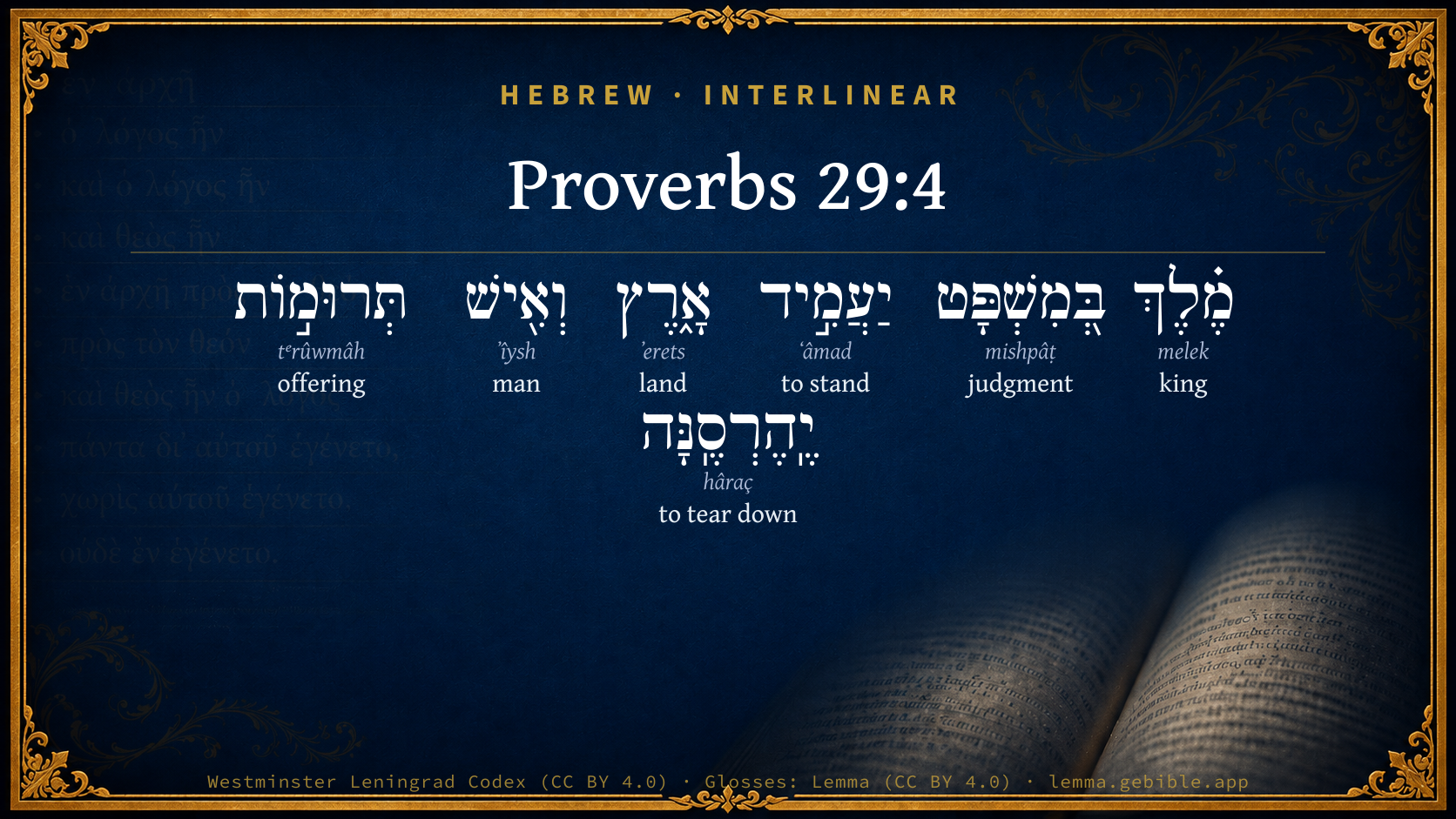
Proverbs 29:4

Hebrew (Westminster Leningrad Codex) Proverbs 29:4 appears in the Hebrew Old Testament. The text above is from the Westminster Leningrad Codex. Each word links to its Strong’s number, a concise gloss, and parsing drawn from the Open Scriptures Hebrew Bible morphology. Click any word for its full Brown-Driver-Briggs (BDB) entry.
Download image
Cite this verse

Proverbs 29:4 (World English Bible). Public Domain. Lemma interlinear Bible study tool, https://lemma.gebible.app/v/proverbs/29/4.

Show BibTeX & RIS
BibTeX
RIS
English Translation
The king by justice makes the land stable, But he who takes bribes tears it down.
World English Bible · Public Domain
Download a study sheet

One document with this verse’s original text, its word-by-word gloss line, the meaning frame, cross-references with their text, attributed commentary, and full source and license credits — printable, and it pastes into notes with its structure intact.

This verse Autodidact and up

Study sheet (.html) Plain text (.txt)

A passage Seminary Student

Up to 50 verses in one chapter. A passage sheet keeps up to 6 commentary sources and 12 cross-references per verse, in the order this page ranks them, and says so on the sheet whenever that leaves anything out. Ask for a single verse and you get the Autodidact verse sheet above.

Everything on this page stays free to read, with no account — the sheet is a download of what is already on screen, not access to it.

Want to remove ads? Support Godless Engineer
Compare translations 3

The same verse in 3 English versions, stacked beneath the original-language interlinear above. Click any original word for its lexicon entry.

Each is an independent rendering of the whole verse — the interlinear is not word-aligned to these translations.

Highlighted words mark where these versions differ — a whole-verse word diff, not a word-by-word alignment.

  • World English Bible Public Domain
    The king by justice makes the land stable, But he who takes bribes tears it down.
  • King James Version Public Domain
    The king by judgment establisheth the land: but he that receiveth gifts overthroweth it.
  • unfoldingWord Literal Text CC BY-SA 4.0
    A king by justice causes the land to stand, but a man of contributions tears it down.

unfoldingWord Literal Text — © unfoldingWord, licensed CC BY-SA 4.0. Word-aligned USFM3 via Door43 (git.door43.org/unfoldingWord/en_ult).

Versions to compare (up to 4)

3 of 4 selected

Show all 18 translations

Every available English version of this verse, each an independent rendering of the whole verse.

  • World English Bible Public Domain
    The king by justice makes the land stable, But he who takes bribes tears it down.
  • Berean Standard Bible Public Domain
    By justice a king brings stability to the land, but a man who exacts tribute demolishes it.
  • Majority Standard Bible Public Domain
    By justice a king brings stability to the land, but a man who exacts tribute demolishes it.
  • King James Version Public Domain
    The king by judgment establisheth the land: but he that receiveth gifts overthroweth it.
  • American Standard Version (1901) Public Domain
    The king by justice establisheth the land; But he that exacteth gifts overthroweth it.
  • Revised Version (1885) Public Domain
    The king by judgment establisheth the land: but he that exacteth gifts overthroweth it.
  • Geneva Bible (1599) Public Domain
    A King by iudgement mainteineth ye countrey: but a man receiuing giftes, destroyeth it.
  • Douay-Rheims (1899) Public Domain
    A just king setteth up the land: a covetous man shall destroy it.
  • Young's Literal Translation Public Domain
    A king by judgment establisheth a land, And one receiving gifts throweth it down.
  • Literal Standard Version CC BY-SA 4.0
    A king establishes a land by judgment, || And one receiving gifts throws it down.
  • Unlocked Literal Bible CC BY-SA 4.0
    The king establishes the land by justice, but the one who demands bribes tears it down.
  • unfoldingWord Literal Text CC BY-SA 4.0
    A king by justice causes the land to stand, but a man of contributions tears it down.
  • Darby Bible Public Domain
    A king by just judgment establisheth the land; but he that taketh gifts overthroweth it.
  • World Messianic Bible Public Domain
    The king by justice makes the land stable, but he who takes bribes tears it down.
  • Webster's Bible Public Domain
    The king by judgment establisheth the land: but he that receiveth gifts overthroweth it.
  • Free Bible Version CC BY-SA 4.0
    A king who rules justly makes the country secure, but one who asks for bribes will destroy it.
  • Bible in Basic English Public Domain
    A king, by right rule, makes the land safe; but one full of desires makes it a waste.
  • JPS Tanakh (1917) Public Domain
    The king by justice establisheth the land; but he that exacteth gifts overthroweth it.

Literal Standard Version (2020), Covenant Press — licensed CC BY-SA 4.0. Text via the HelloAO Bible API (eBible.org). Unlocked Literal Bible (unfoldingWord) — licensed CC BY-SA 4.0. Text via the HelloAO Bible API (eBible.org). unfoldingWord Literal Text — © unfoldingWord, licensed CC BY-SA 4.0. Word-aligned USFM3 via Door43 (git.door43.org/unfoldingWord/en_ult). Free Bible Version, Dr. Jonathan Gallagher — licensed CC BY-SA 4.0. Text via the HelloAO Bible API (eBible.org).

Word by word

More ways to search: Search by grammar → Find every occurrence → Compare this word →

Practice this passage: Drill this verse → Learn its vocabulary →

יֶֽהֶרְסֶֽנָּה
hâraç
H2040
“to tear down · her”
Verb, Qal, Imperfect, 3rd Person, Masculine, Singular + Suffix, Personal, 3rd Person, Feminine, Singular
Part of Speech
Verb
Stem
Qal
Form
Imperfect
Person
3rd Person
Gender
Masculine
Number
Singular
Full BDB Definition

Origin: a primitive root

TWOT: 516

to tear down, break down, overthrow, beat down, break, break through, destroy, pluck down, pull down, throw down, ruined, destroyer, utterly - (Qal) - to throw down, tear down - to break through - to break down, break away - (Niphal) to be torn down, be thrown down - (Piel) - to overthrow, tear down - destroyer (participle)
  1. מֶ֗לֶךְ melek H4428 “king” Noun, Common, Masculine, Singular, Absolute
  2. בְּ֭מִשְׁפָּט mishpâṭ H4941 “in/at · judgment” Preposition + Noun, Common, Masculine, Singular, Absolute
  3. יַעֲמִ֣יד ʻâmad H5975 “to stand” Verb, Hiphil, Imperfect, 3rd Person, Masculine, Singular
  4. אָ֑רֶץ ʼerets H776 “land” Noun, Common, Both, Singular, Absolute
  5. וְאִ֖ישׁ ʼîysh H376 “and · man of” Conjunction + Noun, Common, Masculine, Singular, Construct
  6. תְּרוּמ֣וֹת tᵉrûwmâh H8641 “offerings” Noun, Common, Feminine, Plural, Absolute

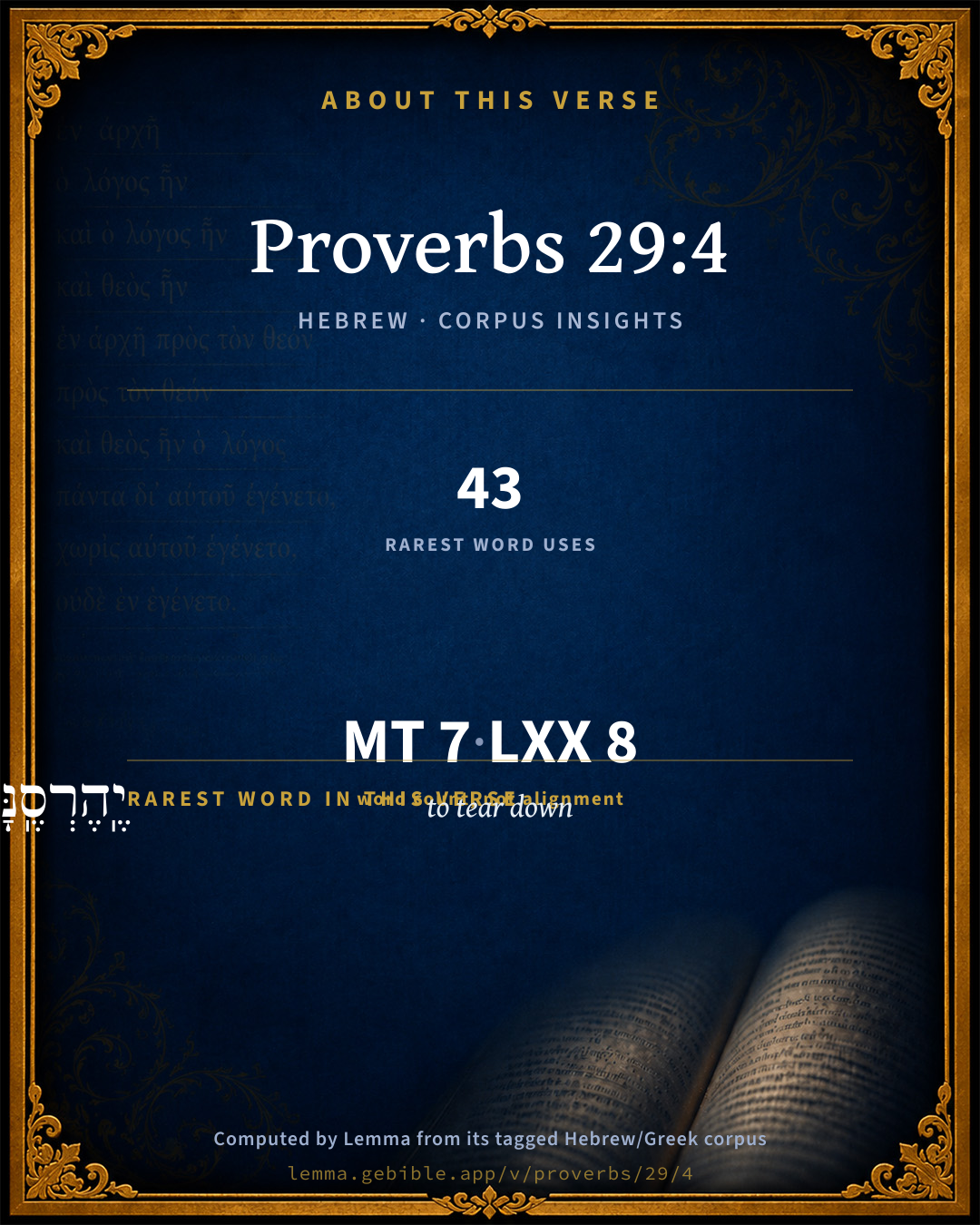
About this verse

These counts appear in no published source. They are computed here, from the morphology-tagged text and Lemma’s own curated glosses. What Lemma adds →

7
words
7
distinct lemmas
Wisdom
section

Shared distinctive vocabulary

יֶֽהֶרְסֶֽנָּה to tear down H2040 occurs in 42 verses of the Hebrew Bible. Also found in:

Grammatical profile

  • 2 verbs
  • 5 nouns

Verb forms

  • יַעֲמִ֣יד Hiphil · Imperfect
  • יֶֽהֶרְסֶֽנָּה Qal · Imperfect

Hebrew & Septuagint length

In English translation the verse runs 16 words from the Hebrew and 11 from the Septuagint (LXX English) — the Septuagint runs noticeably shorter here. See the side-by-side →

A rough comparison of the two English renderings, which tokenize alike — not a word-level alignment.

Word counts can differ between the Hebrew and the Greek without any difference in meaning — e.g. the Hebrew direct-object marker אֵת has no separate Greek word, and Greek often adds the article ὁ.

In the original languages it is 7 Hebrew tokens and 8 Greek tokens — but the two are counted differently (Hebrew bundles its prefixes and suffixes into one token; the Greek is in lemma form), so that isn’t a like-for-like length.

Cross-references

16

Topical passages linked to Proverbs 29:4 in the Treasury of Scripture Knowledge — connected by theme and wording, ordered by reader-vote popularity; previews shown in the World English Bible.

  • Proverbs 29:14 The king who fairly judges the poor, His throne shall be established forever.
  • Proverbs 20:8 A king who sits on the throne of judgment Scatters away all evil with his eyes.
  • Daniel 11:20 Then shall stand up in his place one who shall cause a tax collector to pass through the kingdom to maintain its glory; but within few days he shall be destroyed, neither in anger, nor in battle.
  • Micah 7:3 Their hands are on that which is evil to do it diligently. The ruler and judge ask for a bribe; And the powerful man dictates the evil desire of his soul. Thus they conspire together.
  • 1 Samuel 13:13 Samuel said to Saul, You have done foolishly; you have not kept the commandment of Yahweh your God, which he commanded you: for now would Yahweh have established your kingdom on Israel forever.
  • 2 Samuel 8:15 David reigned over all Israel; and David executed justice and righteousness to all his people.
  • 1 Kings 2:12 Solomon sat on the throne of David his father; and his kingdom was established greatly.
  • 2 Kings 15:18–20 He did that which was evil in the sight of Yahweh: he didn't depart all his days from the sins of Jeroboam the son of Nebat, with which he made Israel to sin.
  • 2 Chronicles 9:8 Blessed be Yahweh your God, who delighted in you, to set you on his throne, to be king for Yahweh your God: because your God loved Israel, to establish them forever, therefore made he you king over them, to do justice and righteousness.
  • Psalms 89:14 Righteousness and justice are the foundation of your throne. Loving kindness and truth go before your face.
  • Psalms 99:4 The King's strength also loves justice. You do establish equity. You execute justice and righteousness in Jacob.
  • Proverbs 8:15 By me kings reign, And princes decree justice.
  • Proverbs 16:12 It is an abomination for kings to do wrong, For the throne is established by righteousness.
  • Isaiah 9:7 Of the increase of his government and of peace there shall be no end, on the throne of David, and on his kingdom, to establish it, and to uphold it with justice and with righteousness from henceforth even forever. The zeal of Yahweh of Hosts will perform this.
  • Isaiah 49:8 Thus says Yahweh, In an acceptable time have I answered you, and in a day of salvation have I helped you; and I will preserve you, and give you for a covenant of the people, to raise up the land, to make them inherit the desolate heritage:
  • Jeremiah 22:13–17 Woe to him who builds his house by unrighteousness, and his chambers by injustice; who uses his neighbor's service without wages, and doesn't give him his hire;

Cross-references courtesy of OpenBible.info (CC BY 4.0).

Hebrew and Greek witnesses Masoretic Hebrew ↔ Greek Septuagint

The same verse in the two great witnesses to the Old Testament, shown verse-for-verse.

Here the Septuagint runs noticeably shorter than the Hebrew — LXX2012 (modern English Septuagint) 11 words vs World English Bible 16. A rough length comparison of the two English translations, not a word-level alignment — read both below.

These are two independent witnesses, not word-aligned to each other, and the Septuagint is shown in lemma (dictionary) form.

Hebrew Proverbs 29:4 Masoretic · Westminster Leningrad Codex

מֶ֗לֶךְ בְּ֭מִשְׁפָּט יַעֲמִ֣יד אָ֑רֶץ וְאִ֖ישׁ תְּרוּמ֣וֹת יֶֽהֶרְסֶֽנָּה

The king by justice makes the land stable, But he who takes bribes tears it down.

World English Bible · Public Domain

Greek LXX Proverbs 29:4 Septuagint · lemma form

βασιλεύς δίκαιος ἀναἵστημι χώρα ἀνήρ δέ παράνομος κατασκάπτω

A righteous king establishes a country: but a transgressor destroys it.

LXX2012 (modern English Septuagint) · Public Domain

On this verse, John Gill's Exposition discusses the Septuagint’s reading. Read the note in Commentary ↓

Hebrew: Westminster Leningrad Codex (CC BY 4.0). Greek: Septuagint (public domain); English from LXX2012 (modern English Septuagint) (Public Domain). How the Septuagint differs from the Hebrew →

Commentary

Notes on Proverbs 29:4 from classic Christian and Jewish commentators (each source and its license shown beneath its notes). The classic Christian expositions comment on the surrounding passage and are grouped to its opening verse, so a note may address several verses; the Jewish commentaries on the Tanakh (Rashi and others) are per-verse, so they appear only where the commentator wrote on this verse.

Lemma curates 59 commentaries, every one of them public domain or Creative Commons licensed, each selected and text-cleaned for this edition rather than reprinted as found. About our sources →

Trapp's Complete Commentary

John Trapp

Pro 29:4 The king by judgment establisheth the land: but he that receiveth gifts overthroweth it.

Ver. 4. The king by judgment stablisheth the land.] This one piece of Solomon’s politics hath much more good advice in it than all Lypsius’s Beehive, or Machiavel’s Spider web.

But he that receiveth gifts.] Heb., A man of oblations; that is, as some interpret it, a man that sacreligiously meddleth with things dedicated to pious uses, and makes a gain of them to himself. See Pro 20:25.

John Trapp, A Commentary or Exposition upon All the Books of the Old and New Testament (1647–1656) — public domain. Text from a community e-Sword module.

Joseph Benson's Commentary

Pro 29:4. The king by judgment — By the free and impartial exercise of justice; establisheth the land — Restores his kingdom to a firm and good state, though it might before be in great disorder; but he that receiveth gifts — Hebrew, אישׁ תרומות, a man of oblations, or gifts, whose delight and common practice it is to take bribes and sell justice; overthroweth it —

Subverts it utterly, though it might before be never so well settled.

Joseph Benson's Commentary on the Old and New Testaments (1811–1818) — public domain. Text from a community e-Sword module.

Tyndale Open Study Notes

Tyndale Open Resources

29:4 A just king looks out for the rights of others; a ruler who accepts bribes uses his office for personal gain (see also 17:23; 22:16; 28:21).

Tyndale Open Study Notes — © Tyndale Open Resources, licensed CC BY-SA 4.0. Text via the HelloAO Bible API.

Matthew Henry's Commentary

Here is, 1. The happiness of a people under a good government. The care and business of a prince should be to establish the land, to maintain its fundamental laws, to settle the minds of his subjects and make them easy, to secure their liberties and properties from hostilities and for posterity, and to set in order the things that are wanting; this he must do by judgment, by wise counsels, and by the steady administration of justice, without respect of persons, which will have these good effects. 2. The misery of a people under a bad government: A man of oblations (so it is in the margin) overthrows the land; a man that is either sacrilegious or superstitious, or that invades the priest's office, as Saul and Uzziah - or a man that aims at nothing but getting money, and will, for a good bribe, connive at the most guilty, and, in hope of one, persecute the innocent - such governors as these will ruin a country.

Matthew Henry's Commentary on the Whole Bible (1708–1710) — public domain (CC PDM 1.0). Text via the HelloAO Bible API.

Jamieson, Fausset & Brown

Robert Jamieson, A. R. Fausset & David Brown

by judgment--that is, righteous decisions, opposed to those procured by gifts (compare Pro 28:21), by which good government is perverted.

land--for nation.

Jamieson, Fausset & Brown — Commentary Critical and Explanatory on the Whole Bible (1871) — public domain (CC PDM 1.0). Text via the HelloAO Bible API.

Adam Clarke's Commentary

Verse 4. He that receiveth gifts] This was notoriously the case in this kingdom, before the passing of the Magna Charta, or great charter of liberties. Hence that article in it, Nulli vendemus justitiam; "We will not sell justice to any." I have met with cases in our ancient records where, in order to get his right, a man was obliged almost to ruin himself in presents to the king, queen, and their favourites, to get the case decided in his favour.

Adam Clarke's Commentary on the Bible (1810–1826) — public domain. Text from a community e-Sword/MySword module.

Ellicott's Commentary for English Readers

(4) By judgment.—Upright decisions.

He that receiveth gifts.—To pervert justice (Pro_15:27).

A Bible Commentary for English Readers, edited by Charles John Ellicott (1878–1897) — public domain. Text from a community e-Sword module.

The Cambridge Bible for Schools and Colleges

gen. ed. J. J. S. Perowne

4. receiveth] The R.V., exacteth, is scarcely an improvement, for it is enough to “overthrow the land” that the king be open to receive gifts. The Heb., a man of offerings, will bear either sense. The rendering of R.V. marg., that imposeth tribute, sacrifices the contrast in the two members of the proverb, between the impartial administration of justice and the venality and corruption which are the curse of Oriental courts.

The Cambridge Bible for Schools and Colleges (gen. ed. J. J. S. Perowne; Cambridge University Press, 1878–1918) — public domain. Text from a community e-Sword module.

John Gill's Exposition

The king by judgment establisheth the land,.... By executing, judgment and justice among his subjects, he establishes the laws of the land, and the government of it; he secures its peace and prosperity, and preserves his people in the possession at their properties and privileges; and makes them rich and powerful, and the state stable and flourishing, so that it continues firm to posterity; such a king was Solomon, Ch2 9:8;

but he that receiveth gifts overthroweth it; that, is, a king that does so; Gersom observes that he is not called a king, because such a man is not worthy of the name, who takes gifts and is bribed by them to pervert judgment and justice; whereby the laws of the nation are violated, and the persons and properties of his subjects become the prey of wicked men; and so the state is subverted and falls to ruin: it is in the original text, "a man of oblations" (k); the word is generally used of the sacred oblations or offerings under the law; hence some understand it of a sacrilegious prince who of his own arbitrary power converts sacred things to civil uses. The Targum, Septuagint, Syriac and Arabic versions render it, a wicked and ungodly man; and the Vulgate Latin version, a covetous man; as such a prince must be in whatsoever light he is seen, whether as a perverter of justice through bribes, or as a sacrilegious man; though it may be rendered, "a man of exactions" (l), for it is used of the oblation of a prince which he receives from his people, Eze 45:9; as Aben Ezra observes; and so it may be interpreted of a king that lays heavy taxes upon his people, and thereby brings them to distress and poverty, and the state to ruin.

(k) "vir oblationam", Montanus, Baynus, Grotius, Gejerus, Schultens. (l) "Vir exactionum", Mercerus; "qui levat exactiones", Munster; "qui tributa imponit", so some in Vatablus; "qui tribbuta extorquet", Tigurine version.

John Gill's Exposition of the Whole Bible (1746–1763) — public domain (CC PDM 1.0). Text via the HelloAO Bible API.

Matthew Poole's English Annotations

By judgment; by the free and impartial exercise of justice.

He that receiveth gifts, Heb. a man (for he would not vouchsafe to call him a king, as being unworthy of that name and office) of oblations or gifts, i.e. whose delight and common practice it is to take bribes, and sell justice.

Matthew Poole's English Annotations on the Holy Bible (1683–1685) — public domain. Text from a community e-Sword/MySword module.

Whedon's Commentary on the Bible

Daniel D. Whedon

4. By judgment — Administrative justice.

He that receiveth gifts — “A man of exactions, or of oblations, exacts tribute.” — Conant. “Is fond of bribes.” — Zockler. The idea seems to be, that such a man sits upon the throne to receive oblations rather than to dispense justice — that he makes himself a god to be appeased by offerings, and sells favours to the highest bidder. Such, indeed, was and is the character of many of the eastern despots. Nor has this form of iniquity been confined to the East. Dr. Clarke says: “I have met with cases in our ancient records where, in order to get his right, a man was obliged almost to ruin himself in presents to the king, queen, and their favourites.” One of the articles of the Magna Charta is:

Nulli vendemus justitiam; “We will sell justice to no one.” Under our system of government, and in our times, perhaps the most likely place to find the development of this evil is in the legislative department — national and local. Legislators who receive, directly or indirectly, a compensation for their votes, are acting on the principle condemned in this proverb, and are contributing their share to the ruin of their country. Compare Eze_45:9.

Daniel D. Whedon (gen. ed.), Commentary on the Old and New Testaments (1874–1909) — public domain. Text from a community e-Sword module.

The Pulpit Commentary

Many of the proverbs in this chapter seem to suit the time of Jeroboam II. (see on Pro_28:3) The king by judgment establisheth the land. The king, the fountain of justice, by his equitable government brings his country into a healthy and settled condition. (1Ki_15:4; comp. Ver. 14; Pro_16:12 Pro_25:5) In the security of the throne the land and people participate. He that receiveth gifts overthroweth it. The expression, twOmWrT vyai (ish terumoth), "man of offerings," "man of gifts," is ambiguous: it may mean "the taker of bribes," the unrighteous ruler who sells justice, (Pro_15:27) or it may signify "the imposer of taxes" (Eze_45:13, etc.) or forced benevolences. Aquila and Theodotion have anhtwn , "man of heave offerings," and Wordsworth regards him as a man who claims and receives gifts, as if he were a deity on earth. Whichever sense we give to the phrase, the contrast lies between the inflexibly upright ruler and the iniquitous or extortionate prince. The Septuagint gives paranomov , "a transgressor;" Vulgate, vir avarus.

The Pulpit Commentary (1880–1919), ed. H.D.M. Spence-Jones & Joseph S. Exell — public domain. Text from a community e-Sword module.

John Wesley's Explanatory Notes

Judgment - By the free and impartial exercise of justice. Gifts - Bribes.

John Wesley, Explanatory Notes Upon the Whole Bible (1754–1765) — public domain. Text via the GEBible commentary corpus.

Keil & Delitzsch

C. F. Keil & F. Delitzsch

A series of six proverb follows, beginning with a proverb of the king:

4 A king by righteousness bringeth the land to a good condition;

But a man of taxes bringeth it down.

The Hiph. חעמיד signifies to make it so that a person or matter comes to stand erect and stand fast (e.g., Kg1 15:4); הרס, to tear down, is the contrary of building up and extending (Psa 28:5), cf. נהרס, opp. רוּם, of the state, Pro 11:11. By 'אישׁ תּר is meant the king, or a man of this kind; but it is questionable whether as a man of gifts, i.e., one who lets gifts be made to him (Grotius, Fleischer, Ewald, Bertheau, Zckler), or as a man of taxes, i.e., who imposes them (Midrash, Aben Ezra, Ralbag, Rosenmller, Hitzig). Both interpretations are possible, for 'תר means tax (lifting, raising = dedicating), free-will offerings, as well as gifts that are obligatory and required by the laws of nature. Since the word, in the only other place where it occurs, Eze 45:13-16, is used of the relation of the people to the prince, and denotes a legally-imposed tax, so it appears also here, in passing over from the religious sphere to the secular, to be meant of taxes, and that according to its fundamental conception of gifts, i.e., such taxes as are given on account of anything, such as the produce of the soil, manufactures, heritages. Thus also is to be understood Aquila's and Theodotion's ἀνὴρ ἀφαιρεμάτων, and the rendering also of the Venet. ἐράνων. A man on the throne, covetous of such gifts, brings the land to ruin by exacting contributions; on the contrary, a king helps the land to a good position, and an enduring prosperity, by the exercise of right, and that in appointing a well-proportioned and fit measure of taxation.

Keil & Delitzsch — Biblical Commentary on the Old Testament (1861–1891) — public domain (CC PDM 1.0). Text via the HelloAO Bible API. (Old Testament only.)

Bridges on Proverbs

Charles Bridges

Of what avail are the best laws, if they be badly administered? Partiality and injustice absolutely make them null and void. And yet it requires great integrity and moral courage to withstand the temptations of worldly policy and self-interest. God’s own throne is built and established by judgment.†1 This then can be the only establishment of the land.†2 The compromise of it to some private ends provokes the anger of God to the chastisement, if not the overthrow, of the land. The article in our Magna Charta — ’We will sell justice to none’ — is but too plain evidence of the recklessness of all social principles, ere the great standard was erected among us.

Under the godly government of Samuel the land was established by judgment.†3 "But his sons walked not in his ways." They were men of oblations. They received gifts; and the Theocracy — the great palladium of the land — was overthrown.†4 The righteous administration of David "bore up the pillars" of the land, at a time of great national weakness.†5 The same principles in the godly successors were the source of strength and prosperity.†6 The want of uprightness in Saul shook the kingdom from his grasp;†7 and the covetousness of Johoiakim†8 destroyed its foundations, and buried him in its ruins. Let the same consistency pervade every grade of official responsibility. No respect will be paid to dignity, temporal or spiritual, except it be established with judgment. Let men of God be in our high places; and "righteousness will exalt a nation," and our Church will be "the joy and praise of the whole earth." (Pro 14:34 .)

Footnotes:

†1 Psa 89:14; Psa 97:2 . Isa 9:7 .

†2 Pro 29:14; Pro 16:10-12 ; Pro 20:8, Pro 20:26 ; Pro 25:5 . 2Ch 9:8 .

†3 1Sa 7:3-12, 1Sa 7:15-17 .

†4 1Sa 8:2-7 .

†5 Psa 75:2-6, Psa 75:10 . 2Sa 8:15 .

†6 2Ch 1:1 ; 2Ch 14:2-7 ; 2Ch 19:6-7, with 2Ch 20:27-30 ; 2Ch 31:20-21 . Isa 32:1-2 .

†7 1Sa 13:13 .

†8 Jer 22:13-19.

Charles Bridges, An Exposition of the Book of Proverbs (1846) — public domain. Text from a community e-Sword module.

Rashi

Rabbi Shlomo Yitzchaki (Rashi)

establishes the country If he is an honest judge, he establishes the country.

but a haughty man Heb. תרומות, a haughty man, who does not care to take time in judgment. Our Rabbis (Keth. 105b) stated: “If the judge is like a king, who does not have to acquire friends and accept bribes, he establishes the country. But if he is like a priest, who asks for terumoth in the threshing floors, he tears it down.”

Rashi on the Tanakh — English translations: “The Judaica Press complete Tanach with Rashi, translated by A. J. Rosenberg” (CC BY 4.0); “Pentateuch with Rashi's commentary by M. Rosenbaum and A.M. Silbermann, 1929-1934” (public domain); “The Metsudah Tanach series, Lakewood, N.J” (CC BY 4.0); and “The Book of Joshua, Metsudah Publications, 1997” (CC BY 4.0). Text via Sefaria.

Lesson kit

Teaching starters — assembled from the data on this page, not authored interpretation. Every prompt links to the verse data it draws on. Edit before teaching.

Proverbs, in the Wisdom, opens this verse with 7 words (7 distinct Hebrew lemmas). Its most distinctive word is hâraç (“to tear down”). The Greek Septuagint runs shorter here. A historical commentator’s framing appears above. Read the whole chapter for the surrounding context.

Discussion questions

  1. The word hâraç carries the sense “to tear down.” How does it shape the verse?
  2. Exodus 15:7 shares the word «to tear down» with this verse. How do the two illuminate each other?
  3. Compared with the Hebrew, the Septuagint runs shorter here. What questions does that raise?
  4. These translations render this verse differently; the difference is in the English rendering, not the original. What questions does that raise?
  5. The verb «יַעֲמִ֣יד» is Hiphil Imperfect. How does its form color the action?
  6. Reading how Trapp's Complete Commentary and Joseph Benson's Commentary read this verse, where do the two commentators agree and where do they part?

Things to notice

Reading settings

Reading text

Shown beneath each verse's original-language words.

Old Testament
Old Testament edition

Read the OT as the Masoretic Hebrew (MT) or the Greek Septuagint (LXX).

English shown for the Greek Septuagint (in the Hebrew ↔ Greek comparison).

Comparing translations? Open the Compare panel on any verse page to stack up to four side by side.