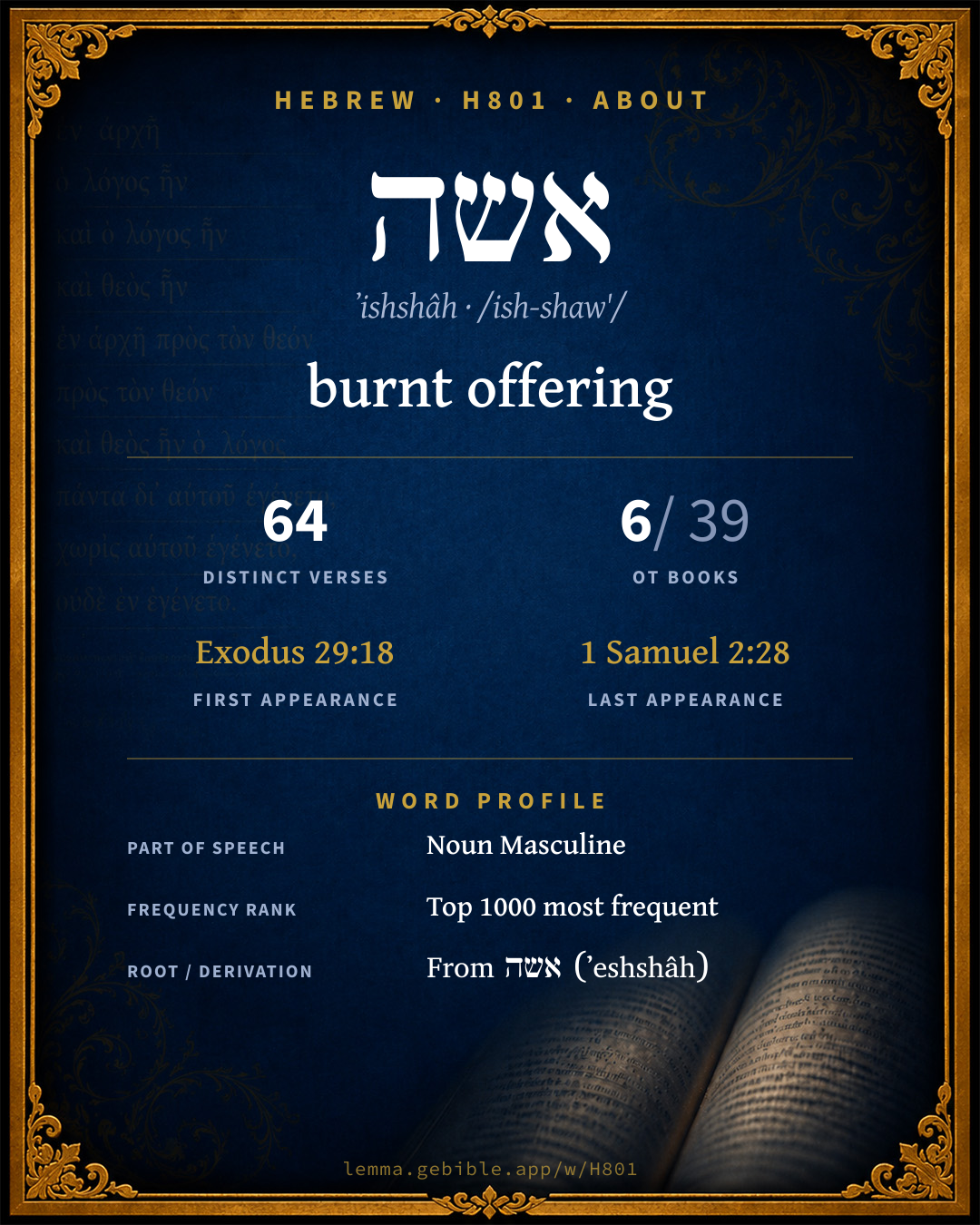
אִשֶּׁה
burnt offering
Full lexicon entry — Brown-Driver-Briggs (BDB)
From Brown-Driver-Briggs (BDB)
Where this word appears
See every Absolute-state word in the Hebrew Bible →
Grammar key — what these labels mean
Part of speech
- Noun
- A naming word — a person, place, thing, or idea.
Noun type
- Common
- A common noun — a general class of person, place, or thing (“king,” “city,” “water”), not a specific name.
State
- Absolute
- The independent form of a noun, not bound to a following word.
- Construct
- A noun bound to a following noun in a possessive / “of” relationship (the construct chain).
Gender
- Masculine
- Grammatically masculine.
Number
- Singular
- One.
- Plural
- More than one (in Hebrew, generally three or more).
Grammatical forms
- Noun, Common, Masculine, Singular, Absolute 33 times (51%)
- Noun, Common, Masculine, Plural, Construct 18 times (28%)
- Noun, Common, Masculine, Singular, Construct 14 times (22%)
Parsed forms decoded from the imported morphology (morphhb / Westminster Leningrad Codex — WLC text public domain, morphhb tagging CC BY 4.0), counted across 65 parsed occurrences — not distinct verses.
Every verse where H801 appears — 64 distinct verses across 6 books. Click any verse to open its interlinear word-by-word view. Verse text shown in the World English Bible for context — . Each verse’s Hebrew form is shown with its reference; the English is not keyword-highlighted, since the data carries no word-level English alignment. Use “Compare translations” on any verse to read it across multiple English versions. This concordance covers the Hebrew Bible; Septuagint (Greek Old Testament) occurrences are not indexed here.
Exodus 4 verses
- Exodus 29:18 אִשֶּׁ֥ה n c ms You shall burn the whole ram on the altar: it is a burnt offering to Yahweh; it is a sweet savor, an offering made by fire to Yahweh.
- Exodus 29:25 אִשֶּׁ֥ה n c ms You shall take them from their hands, and burn them on the altar on the burnt offering, for a sweet savor before Yahweh: it is an offering made by fire to Yahweh.
- Exodus 29:41 אִשֶּׁ֖ה n c ms The other lamb you shall offer at evening, and shall do to it according to the meal-offering of the morning, and according to its drink-offering, for a sweet savor, an offering made by fire to Yahweh.
- Exodus 30:20 אִשֶּׁ֖ה n c ms When they go into the tent of meeting, they shall wash with water, that they not die; or when they come near to the altar to minister, to burn an offering made by fire to Yahweh.
Leviticus 41 verses
- Leviticus 1:9 אִשֵּׁ֥ה n c ms cs but its innards and its legs he shall wash with water. The priest shall burn the whole on the altar, for a burnt offering, an offering made by fire, of a sweet savor to Yahweh.
- Leviticus 1:13 אִשֵּׁ֛ה n c ms cs but the innards and the legs he shall wash with water. The priest shall offer the whole, and burn it on the altar. It is a burnt offering, an offering made by fire, of a sweet savor to Yahweh.
- Leviticus 1:17 אִשֵּׁ֛ה n c ms cs He shall tear it by its wings, but shall not divide it apart. The priest shall burn it on the altar, on the wood that is on the fire. It is a burnt offering, an offering made by fire, of a sweet savor to Yahweh.
- Leviticus 2:2 אִשֵּׁ֛ה n c ms cs He shall bring it to Aaron's sons the priests; and he shall take his handful of its fine flour, and of its oil, with all its frankincense; and the priest shall burn the memorial of it on the altar, an offering made by fire, of a sweet savor to Yahweh.
- Leviticus 2:3 מֵ/אִשֵּׁ֥י prep + n c mp cs That which is left of the meal offering shall be Aaron's and his sons'. It is a most holy thing of the offerings of Yahweh made by fire.
- Leviticus 2:9 אִשֵּׁ֛ה n c ms cs The priest shall take from the meal offering its memorial, and shall burn it on the altar, an offering made by fire, of a sweet savor to Yahweh.
- Leviticus 2:10 מֵ/אִשֵּׁ֥י prep + n c mp cs That which is left of the meal offering shall be Aaron's and his sons'. It is a thing most holy of the offerings of Yahweh made by fire.
- Leviticus 2:11 אִשֶּׁ֖ה n c ms "'No meal offering, which you shall offer to Yahweh, shall be made with yeast; for you shall burn no yeast, nor any honey, as an offering made by fire to Yahweh.
- Leviticus 2:16 אִשֶּׁ֖ה n c ms The priest shall burn as its memorial, part of its bruised grain, and part of its oil, along with all its frankincense: it is an offering made by fire to Yahweh.
- Leviticus 3:3 אִשֶּׁ֖ה n c ms He shall offer of the sacrifice of peace offerings an offering made by fire to Yahweh; the fat that covers the innards, and all the fat that is on the innards,
- Leviticus 3:5 אִשֵּׁ֛ה n c ms cs Aaron's sons shall burn it on the altar on the burnt offering, which is on the wood that is on the fire: it is an offering made by fire, of a sweet savor to Yahweh.
- Leviticus 3:9 אִשֶּׁ֣ה n c ms He shall offer from the sacrifice of peace offerings an offering made by fire to Yahweh; its fat, the entire tail fat, he shall take away close to the backbone; and the fat that covers the inwards, and all the fat that is on the inwards,
- Leviticus 3:11 אִשֶּׁ֖ה n c ms The priest shall burn it on the altar: it is the food of the offering made by fire to Yahweh.
- Leviticus 3:14 אִשֶּׁ֖ה n c ms He shall offer from it as his offering, an offering made by fire to Yahweh; the fat that covers the innards, and all the fat that is on the innards,
- Leviticus 3:16 אִשֶּׁה֙ n c ms The priest shall burn them on the altar: it is the food of the offering made by fire, for a sweet savor; all the fat is Yahweh's.
- Leviticus 4:35 אִשֵּׁ֣י n c mp cs All its fat he shall take away, like the fat of the lamb is taken away from the sacrifice of peace offerings; and the priest shall burn them on the altar, on the offerings of Yahweh made by fire; and the priest shall make atonement for him concerning his sin that he has sinned, and he will be forgiven.
- Leviticus 5:12 אִשֵּׁ֣י n c mp cs He shall bring it to the priest, and the priest shall take his handful of it as the memorial portion, and burn it on the altar, on the offerings of Yahweh made by fire. It is a sin offering.
- Leviticus 6:17 מֵ/אִשָּׁ֑/י prep + n c mp cs + sfx pers 1cs It shall not be baked with yeast. I have given it as their portion of my offerings made by fire. It is most holy, as the sin offering, and as the trespass offering.
- Leviticus 6:18 מֵ/אִשֵּׁ֖י prep + n c mp cs Every male among the children of Aaron shall eat of it, as their portion forever throughout your generations, from the offerings of Yahweh made by fire. Whoever touches them shall be holy.'"
- Leviticus 7:5 אִשֶּׁ֖ה n c ms and the priest shall burn them on the altar for an offering made by fire to Yahweh: it is a trespass offering.
- Leviticus 7:25 אִשֶּׁ֖ה n c ms For whoever eats the fat of the animal, of which men offer an offering made by fire to Yahweh, even the soul who eats it shall be cut off from his people.
- Leviticus 7:30 אִשֵּׁ֣י n c mp cs With his own hands he shall bring the offerings of Yahweh made by fire. He shall bring the fat with the breast, that the breast may be waved for a wave offering before Yahweh.
- Leviticus 7:35 מֵ/אִשֵּׁ֖י prep + n c mp cs This is the anointing portion of Aaron, and the anointing portion of his sons, out of the offerings of Yahweh made by fire, in the day when he presented them to minister to Yahweh in the priest's office;
- Leviticus 8:21 אִשֶּׁ֥ה n c ms He washed the innards and the legs with water; and Moses burned the whole ram on the altar. It was a burnt offering for a sweet savor. It was an offering made by fire to Yahweh; as Yahweh commanded Moses.
- Leviticus 8:28 אִשֶּׁ֥ה n c ms Moses took them from their hands, and burned them on the altar on the burnt offering. They were a consecration for a sweet savor. It was an offering made by fire to Yahweh.
- Leviticus 10:12 מֵ/אִשֵּׁ֣י prep + n c mp cs Moses spoke to Aaron, and to Eleazar and to Ithamar, his sons who were left, "Take the meal offering that remains of the offerings of Yahweh made by fire, and eat it without yeast beside the altar; for it is most holy;
- Leviticus 10:13 מֵ/אִשֵּׁ֖י prep + n c mp cs and you shall eat it in a holy place, because it is your portion, and your sons' portion, of the offerings of Yahweh made by fire: for so I am commanded.
- Leviticus 10:15 אִשֵּׁ֤י n c mp cs The heaved thigh and the waved breast they shall bring with the offerings made by fire of the fat, to wave it for a wave offering before Yahweh: and it shall be yours, and your sons' with you, as a portion forever; as Yahweh has commanded."
- Leviticus 21:6 אִשֵּׁ֨י n c mp cs They shall be holy to their God, and not profane the name of their God; for they offer the offerings of Yahweh made by fire, the bread of their God; therefore they shall be holy.
- Leviticus 21:21 אִשֵּׁ֣י n c mp cs no man of the seed of Aaron the priest, who has a blemish, shall come near to offer the offerings of Yahweh made by fire. Since has a blemish, he shall not come near to offer the bread of his God.
- Leviticus 22:22 וְ/אִשֶּׁ֗ה conj + n c ms Blind, injured, maimed, having a wart, festering, or having a running sore, you shall not offer these to Yahweh, nor make an offering by fire of them on the altar to Yahweh.
- Leviticus 22:27 אִשֶּׁ֖ה n c ms "When a bull, or a sheep, or a goat, is born, then it shall remain seven days with its mother; and from the eighth day and thenceforth it shall be accepted for the offering of an offering made by fire to Yahweh.
- Leviticus 23:8 אִשֶּׁ֛ה n c ms But you shall offer an offering made by fire to Yahweh seven days. In the seventh day is a holy convocation: you shall do no regular work.'"
- Leviticus 23:13 אִשֶּׁ֥ה n c ms The meal offering with it shall be two tenth parts of an ephah of fine flour mingled with oil, an offering made by fire to Yahweh for a sweet savor; and the drink offering with it shall be of wine, the fourth part of a hin.
- Leviticus 23:18 אִשֵּׁ֥ה n c ms cs You shall present with the bread seven lambs without blemish a year old, one young bull, and two rams. Yhey shall be a burnt offering to Yahweh, with their meal offering, and their drink offerings, even an offering made by fire, of a sweet aroma to Yahweh.
- Leviticus 23:25 אִשֶּׁ֖ה n c ms You shall do no regular work; and you shall offer an offering made by fire to Yahweh.'"
- Leviticus 23:27 אִשֶּׁ֖ה n c ms "However on the tenth day of this seventh month is the day of atonement: it shall be a holy convocation to you, and you shall afflict yourselves; and you shall offer an offering made by fire to Yahweh.
- Leviticus 23:36 אִשֶּׁ֖ה אִשֶּׁ֤ה n c ms n c ms Seven days you shall offer an offering made by fire to Yahweh. On the eighth day shall be a holy convocation to you; and you shall offer an offering made by fire to Yahweh. It is a solemn assembly; you shall do no regular work.
- Leviticus 23:37 אִשֶּׁ֜ה n c ms "'These are the appointed feasts of Yahweh, which you shall proclaim to be holy convocations, to offer an offering made by fire to Yahweh, a burnt offering, and a meal offering, a sacrifice, and drink offerings, each on its own day;
- Leviticus 24:7 אִשֶּׁ֖ה n c ms You shall put pure frankincense on each row, that it may be to the bread for a memorial, even an offering made by fire to Yahweh.
- Leviticus 24:9 מֵ/אִשֵּׁ֥י prep + n c mp cs It shall be for Aaron and his sons; and they shall eat it in a holy place: for it is most holy to him of the offerings of Yahweh made by fire by a perpetual statute."
Numbers 16 verses
- Numbers 15:3 אִשֶּׁ֤ה n c ms and will make an offering by fire to Yahweh, a burnt offering, or a sacrifice, to accomplish a vow, or as a freewill-offering, or in your set feasts, to make a sweet savor to Yahweh, of the herd, or of the flock;
- Numbers 15:10 אִשֵּׁ֥ה n c ms cs and you shall offer for the drink-offering half a hin of wine, for an offering made by fire, of a sweet savor to Yahweh.
- Numbers 15:13 אִשֵּׁ֥ה n c ms cs All who are home-born shall do these things after this manner, in offering an offering made by fire, of a sweet savor to Yahweh.
- Numbers 15:14 אִשֵּׁ֥ה n c ms cs If a stranger lives as a foreigner with you, or whoever may be among you throughout your generations, and will offer an offering made by fire, of a sweet savor to Yahweh; as you do, so he shall do.
- Numbers 15:25 אִשֶּׁ֣ה n c ms The priest shall make atonement for all the congregation of the children of Israel, and they shall be forgiven; for it was an error, and they have brought their offering, an offering made by fire to Yahweh, and their sin-offering before Yahweh, for their error:
- Numbers 18:17 אִשֶּׁ֛ה n c ms But the firstborn of a cow, or the firstborn of a sheep, or the firstborn of a goat, you shall not redeem; they are holy: you shall sprinkle their blood on the altar, and shall burn their fat for an offering made by fire, for a sweet savor to Yahweh.
- Numbers 28:2 לְ/אִשַּׁ֗/י prep + n c mp cs + sfx pers 1cs Command the children of Israel, and tell them, My offering, my food for my offerings made by fire, of a sweet savor to me, shall you observe to offer to me in their due season.
- Numbers 28:3 הָֽ/אִשֶּׁ֔ה ptcl def.art + n c ms You shall tell them, This is the offering made by fire which you shall offer to Yahweh: he-lambs a year old without blemish, two day by day, for a continual burnt offering.
- Numbers 28:6 אִשֶּׁ֖ה n c ms It is a continual burnt offering, which was ordained in Mount Sinai for a sweet savor, an offering made by fire to Yahweh.
- Numbers 28:8 אִשֵּׁ֛ה n c ms cs The other lamb shall you offer at even: as the meal-offering of the morning, and as the drink-offering of it, you shall offer it, an offering made by fire, of a sweet savor to Yahweh.
- Numbers 28:13 אִשֶּׁ֖ה n c ms and a tenth part of fine flour mixed with oil for a meal-offering to every lamb; for a burnt offering of a sweet savor, an offering made by fire to Yahweh.
- Numbers 28:19 אִשֶּׁ֤ה n c ms but you shall offer an offering made by fire, a burnt offering to Yahweh: two young bulls, and one ram, and seven he-lambs a year old; they shall be to you without blemish;
- Numbers 28:24 אִשֵּׁ֥ה n c ms cs After this manner you shall offer daily, for seven days, the food of the offering made by fire, of a sweet savor to Yahweh: it shall be offered besides the continual burnt offering, and the drink-offering of it.
- Numbers 29:6 אִשֶּׁ֖ה n c ms besides the burnt offering of the new moon, and the meal-offering of it, and the continual burnt offering and the meal-offering of it, and their drink-offerings, according to their ordinance, for a sweet savor, an offering made by fire to Yahweh.
- Numbers 29:13 אִשֵּׁ֨ה n c ms cs and you shall offer a burnt offering, an offering made by fire, of a sweet savor to Yahweh; thirteen young bulls, two rams, fourteen he-lambs a year old; they shall be without blemish;
- Numbers 29:36 אִשֵּׁ֨ה n c ms cs but you shall offer a burnt offering, an offering made by fire, of a sweet savor to Yahweh: one bull, one ram, seven he-lambs a year old without blemish;
Deuteronomy 1 verse
Joshua 1 verse
1 Samuel 1 verse
About this entry
At a glance — auto-summarized from this page’s data, not written by a person. Every figure links to its source below. This summary describes the numbers; it doesn’t interpret them.
At its core, אשה (ʼishshâh) means “burnt offering.” Its uses cluster heavily in Leviticus (64% of all occurrences). With 64 verses in 6 books, it is a moderately common word in the Hebrew Bible. First canonically at Exodus 29:18, it enters the text early. Translators differ — “offering made by fire” in the King James Version, then “food offering” (Berean Standard Bible) and “gift” (unfoldingWord Literal Text), as the renderings breakdown shows. Each statement above links to its evidence; the full detail follows below.
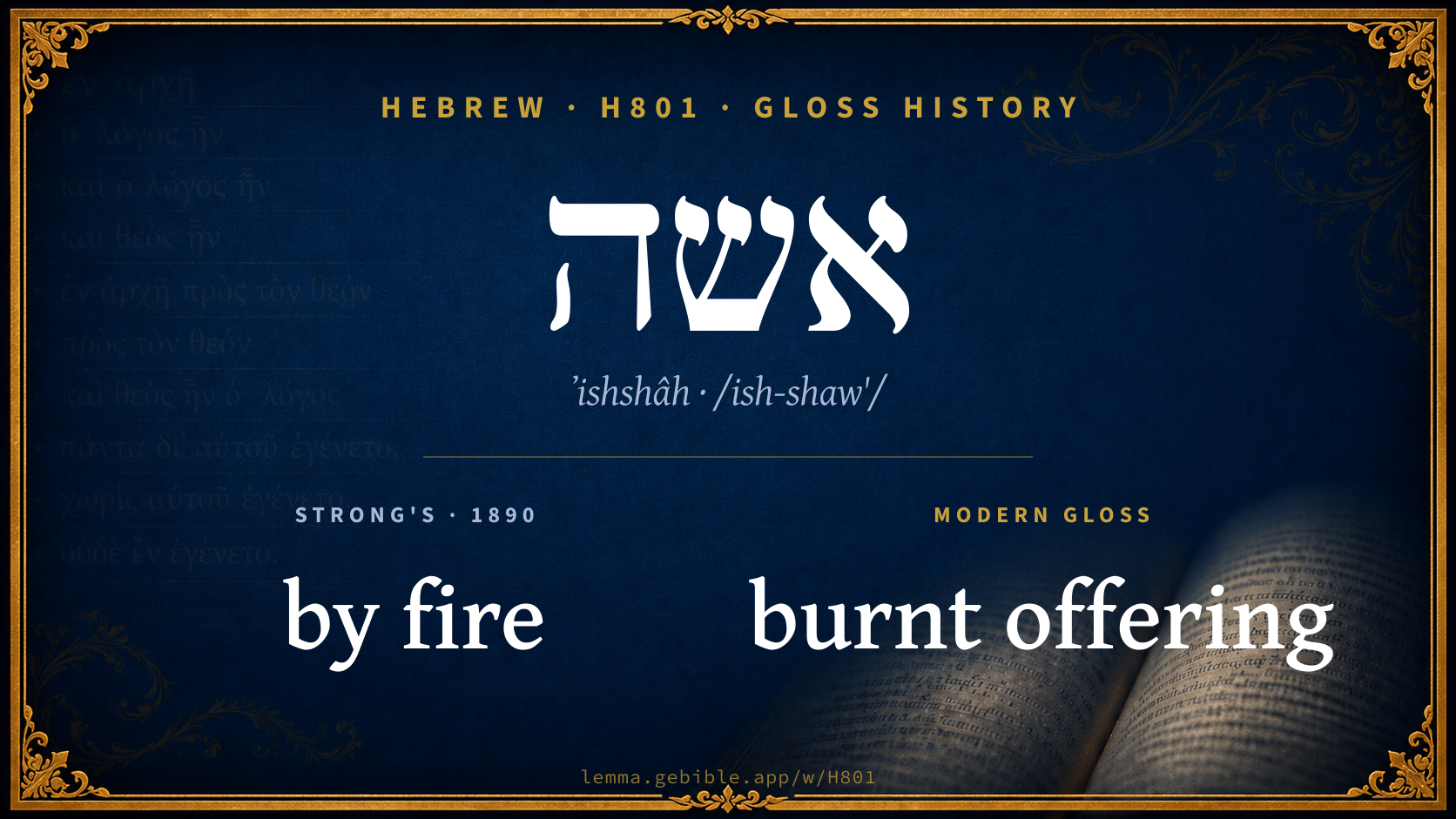
Gloss history
Strong's 1890 vs modern scholarship
About this word
Strong's H801 catalogs a Hebrew word from the Hebrew Old Testament.
These counts are not copied from any lexicon or concordance. They are computed here, from the morphology-tagged Hebrew Old Testament. What Lemma adds →
- 64
- distinct verses
- The word appears in 64 distinct verses.
- 6 / 39
- OT books
- The word appears in 6 of 39 Old Testament books.
- #597
- by frequency
- Top 1000 most frequent Hebrew words (rank 597 of 8,640 Hebrew words by occurrence).
View all 64 occurrences in the concordance →
By section of the Old Testament
By traditional corpus
Conventional, traditional groupings — biblical authorship is debated, so this is a traditional corpus grouping, not an authorship claim. Each share is this word’s portion of its verses in that division of the Hebrew canon. Each figure is a share of the word’s 64 distinct verses.
- Torah (Pentateuch) 62 verses · 97%
- Prophets (Nevi'im) 2 verses · 3%
How translations render this word
Counts come from each version’s own published word-to-Strong’s tagging or interlinear alignment — an approximate guide to how each version renders this word, not a word-level alignment the data otherwise carries. Because each total is that version’s own tagged count, the per-version totals vary from one another and need not match the appearance or distinct-verse counts above. These counts may also differ from a printed concordance because Lemma counts each distinctly tagged rendering and does not collapse phrase taggings into a single head-word total. This is a fixed set of word-tagged versions (KJV, ASV, BSB, ULT) and does not change with the reading translation you choose elsewhere. Each version’s license is shown beside its name below (and on Sources).
- King James Version: Offering made by fire 26×, Made by fire 15×, Offerings 9×
- American Standard Version: Offering made by fire 32×, Made by fire 20×, Offerings 11×
- Berean Standard Bible: Food offering 43×, Food offerings 18×, Is a food offering 3×
- unfoldingWord Literal Text: Gift 29×, Gifts of 12×, Offering made by fire 7×
King James Version Public Domain
Renders H801 across 78 tagged occurrences — most commonly:
Plus 7 renderings that appear only once — usually multi-word phrases or single function words the recovered tagging swept in, not distinct renderings.
American Standard Version Public Domain
Renders H801 across 76 tagged occurrences — most commonly:
Plus 7 renderings that appear only once — usually multi-word phrases or single function words the recovered tagging swept in, not distinct renderings.
Berean Standard Bible Public Domain
Renders H801 across 65 tagged occurrences — most commonly:
Plus 1 rendering that appears only once — usually multi-word phrases or single function words the recovered tagging swept in, not distinct renderings.
unfoldingWord Literal Text CC BY-SA 4.0
Renders H801 across 67 tagged occurrences — most commonly:
Plus 8 renderings that appear only once — usually multi-word phrases or single function words the recovered tagging swept in, not distinct renderings.
Senses in BDB
The 1 sense BDB distinguishes for this word, in lexicon order (not ranked by frequency or importance). The full entry — with sub-senses — is in the Lexicon Entry tab.
- burnt-offering, offering made by fire, fire offering
Word origin
n.m. Jos 13, 14 an offering made by fire (> Wetzst in DePsalmen., ed. 4, 889 der. from √ ii. אנשׁ, means to friendly relations betw. God & man; cf. LagBN 190) Ex 29:18 + 32 times; cstr. אִשֵּׁה Lv 1:9 + 14 times pl. cstr. אִשֵּׁי Lv 4:35; 24:9 + 15 times; sf. אִשַּׁי Nu 28:2, אִשָּׁ֑י Lv 6:10; used chiefly of offerings of animals, but also of the מִנְחָה Lv 2:11, and of the sacred bread and frankincense Lv 24:7 which was placed on the table as a memorial, and finally went to the priests. The word is used in Dt 18:1 Jos 13:14 (D) 1 S 2:28; elsewhere in P Lv 6:10; 10:15; 22:22 Nu 28:2, 3, especially in phrases אִשֵּׁי יהוה Lv 2:3 + 11 times אִשֶּׂה רֵיחַ נִיחֹחַ ליהוה Lv 1:9 + 14 times, ריח ניחח אשׁה ליהוה Ex 29:18 + 6 times, אשׁה ליהוה ריח ניחח Lv 23:13, אשׁה לריח ניחח Lv 3:16 Nu 18:17, אשׁה (הוא) ליהוה Ex 29:25 Lv 2:16; אִשֶּׁה ליהוה acc. after verbs of offering Ex 30:20 + 14 times, אִשֶּׁה עֹלָה ליהוה Nu 28:19, קָרְבָּן אִשֶּׁה ליהוה Lv 22:27 Nu 15:25.
— Brown-Driver-Briggs (Oxford 1906, public domain), digitized via Sefaria, supplemented by the OpenScriptures HebrewLexicon (CC BY 4.0). See Sources.
Derived from אשה (ʼeshshâh) (H800) — fire.
Jastrow Dictionary
A second Hebrew/Aramaic lexicon for comparison, covering Aramaic and post-biblical (Talmudic, Targumic, Midrashic) usage that the biblical-Hebrew BDB does not. Matched by lemma rather than by Strong’s number, so a lemma may carry more than one Jastrow headword (shown separately below), and the entries cover usage well beyond the Bible.
אִשָּׁה
- v. איש,, const. אֵשֶׁת, woman, wife. Pes. VIII, 1. Ab. Zar. 25ᵇ א׳ כלי זיינה עליה woman carries her weapon with her, is protected against murder by gentiles (who would rather assault her innocence). Ib. א׳ חשובה a woman of high rank (influential). Ib. אִשְתּוֹ משמרתו his wife’s presence guards him from wrong-doing; a. fr.—Pl. (נָשׁוֹת) נָשִׁים q. v.
אִשֶּׁה
- burnt-offering, v. אִישֶּׁה.
A Dictionary of the Targumim, the Talmud Babli and Yerushalmi, and the Midrashic Literature (Marcus Jastrow; London, Luzac, 1903) — Public Domain. Digitized via Sefaria. Digitized via Sefaria. Full attribution on Sources.
Forms in the corpus
The 22 distinct written forms H801 takes in the Hebrew Bible, most frequent first — each parse links to that state’s occurrences in the concordance. Hebrew forms include their vowel points and cantillation, so a single lemma takes many written forms.
Septuagint verse parallels
This word appears in 64 verses that also exist in the Greek Old Testament (Septuagint), out of the 64 Hebrew verses it occurs in. You can read those verses in Greek by switching the Old Testament edition to the Septuagint.
Read these verses in the Septuagint
This is a verse-level parallel only — the same verses exist in both the Hebrew and Greek Old Testaments. No word-level Hebrew↔Greek correspondence is claimed: the data carries no such alignment, so no Greek word is shown as this Hebrew word’s translation. Coverage is not total — the Septuagint omits the deuterocanon and renumbers the Psalms, so some Hebrew verses have no direct Greek parallel.