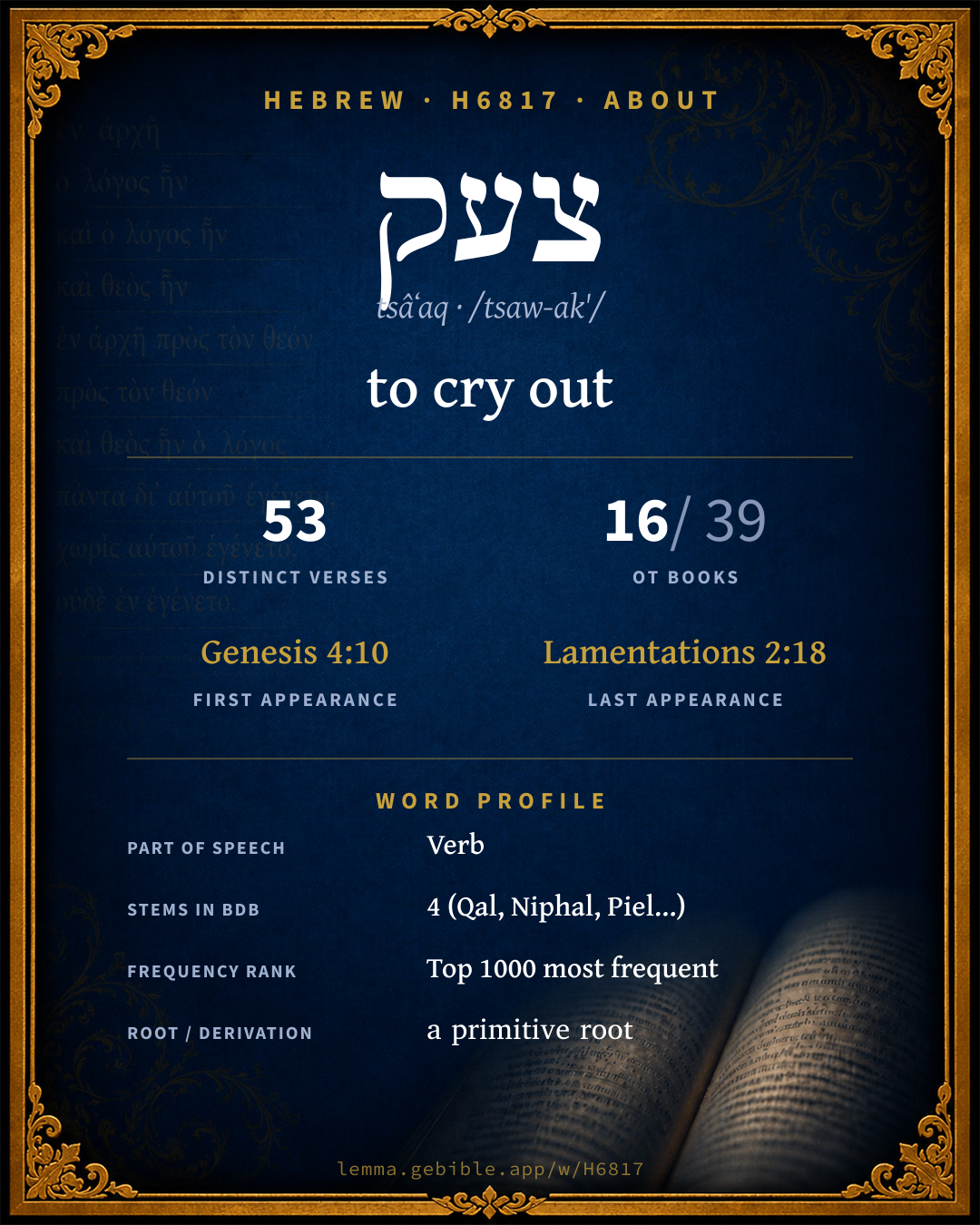
צָעַק
to cry out
‘to cry out’ is one of 4 main senses fuller range ↓
Full lexicon entry — Brown-Driver-Briggs (BDB)
From Brown-Driver-Briggs (BDB)
Where this word appears
See every Qal verb in the Hebrew Bible →
Grammar key — what these labels mean
Part of speech
- Verb
- An action or state-of-being word.
Stem
- Qal
- The basic, simple active stem — the plain form of the verb (“he wrote”). Here: ‘cry’
- Niphal
- Usually the simple passive or reflexive of the Qal (“he was written”). Here: ‘be summoned’
- Hiphil
- The causative active stem (“he caused / brought about”). Here: ‘call together’
- Piel
- An intensive or resultative active stem.
Form
- Sequential Imperfect
- An imperfect with prefixed waw — the standard past-narrative form (waw-consecutive imperfect).
- Imperfect
- An incomplete, ongoing, or future action (“he will / would write”).
- Perfect
- A completed action or state — Hebrew marks aspect (completeness) more than strict tense (“he wrote”).
- Imperative
- A direct command (“write!”).
- Participle Active
- A verbal adjective expressing ongoing or characteristic action (“writing / one who writes”).
- Cohortative
- A first-person volitional form expressing wish or resolve (“let me / let us write”).
- Infinitive Construct
- A bound verbal noun, frequently with prepositions (“to write / in writing”).
- Infinitive Absolute
- An unbound verbal noun, often intensifying or standing in for a finite verb.
State
- Absolute
- The independent form of a noun, not bound to a following word.
Person
- 3rd Person
- The one spoken about (“he / she / it / they”).
- 2nd Person
- The one addressed (“you”).
- 1st Person
- The speaker (“I / we”).
Gender
- Masculine
- Grammatically masculine.
- Feminine
- Grammatically feminine.
- Common
- Either gender — not distinguished for this form.
Number
- Singular
- One.
- Plural
- More than one (in Hebrew, generally three or more).
Grammatical forms 24 distinct
- Verb, Qal, Sequential Imperfect, 3rd Person, Masculine, Singular 8 times (15%)
- Verb, Qal, Sequential Imperfect, 3rd Person, Masculine, Plural 7 times (13%)
- Verb, Qal, Imperfect, 3rd Person, Masculine, Singular 4 times (7%)
- Verb, Qal, Perfect, 3rd Person, Feminine, Singular 4 times (7%)
- Verb, Niphal, Sequential Imperfect, 3rd Person, Masculine, Plural 3 times (5%)
- Verb, Niphal, Sequential Imperfect, 3rd Person, Masculine, Singular 3 times (5%)
- Verb, Qal, Imperfect, 3rd Person, Masculine, Plural 3 times (5%)
- Verb, Qal, Perfect, 3rd Person, Common, Plural 3 times (5%)
+16 more forms (20 occurrences)
Parsed forms decoded from the imported morphology (morphhb / Westminster Leningrad Codex — WLC text public domain, morphhb tagging CC BY 4.0), counted across 55 parsed occurrences — not distinct verses.
Every verse where H6817 appears — 53 distinct verses across 16 books. Click any verse to open its interlinear word-by-word view. Verse text shown in the World English Bible for context — . Each verse’s Hebrew form is shown with its reference; the English is not keyword-highlighted, since the data carries no word-level English alignment. Use “Compare translations” on any verse to read it across multiple English versions. This concordance covers the Hebrew Bible; Septuagint (Greek Old Testament) occurrences are not indexed here.
Genesis 3 verses
- Genesis 4:10 צֹעֲקִ֥ים Qal ptcp.act mp Yahweh said, "What have you done? The voice of your brother's blood cries to me from the ground.
- Genesis 27:34 וַ/יִּצְעַ֣ק conj + Qal wimpf 3ms When Esau heard the words of his father, he cried with an exceeding great and bitter cry, and said to his father, "Bless me, even me also, my father."
- Genesis 41:55 וַ/יִּצְעַ֥ק conj + Qal wimpf 3ms When all the land of Egypt was famished, the people cried to Pharaoh for bread, and Pharaoh said to all the Egyptians, "Go to Joseph. What he says to you, do."
Exodus 9 verses
- Exodus 5:8 צֹֽעֲקִים֙ Qal ptcp.act mp The number of the bricks, which they made before, you require from them. You shall not diminish anything of it, for they are idle; therefore they cry, saying, 'Let us go and sacrifice to our God.'
- Exodus 5:15 וַ/יִּצְעֲק֥וּ conj + Qal wimpf 3mp Then the officers of the children of Israel came and cried to Pharaoh, saying, "Why do you deal this way with your servants?
- Exodus 8:12 וַ/יִּצְעַ֤ק conj + Qal wimpf 3ms Moses and Aaron went out from Pharaoh, and Moses cried to Yahweh concerning the frogs which he had brought on Pharaoh.
- Exodus 14:10 וַ/יִּצְעֲק֥וּ conj + Qal wimpf 3mp When Pharaoh drew near, the children of Israel lifted up their eyes, and behold, the Egyptians were marching after them; and they were very afraid. The children of Israel cried out to Yahweh.
- Exodus 14:15 תִּצְעַ֖ק Qal impf 2ms Yahweh said to Moses, "Why do you cry to me? Speak to the children of Israel, that they go forward.
- Exodus 15:25 וַ/יִּצְעַ֣ק conj + Qal wimpf 3ms Then he cried to Yahweh. Yahweh shown him a tree, and he threw it into the waters, and the waters were made sweet. There he made a statute and an ordinance for them, and there he tested them;
- Exodus 17:4 וַ/יִּצְעַ֤ק conj + Qal wimpf 3ms Moses cried to Yahweh, saying, "What shall I do with these people? They are almost ready to stone me."
- Exodus 22:23 צָעֹ֤ק יִצְעַק֙ Qal inf.abs Qal impf 3ms If you take advantage of them at all, and they cry at all to me, I will surely hear their cry;
- Exodus 22:27 יִצְעַ֣ק Qal impf 3ms for that is his only covering, it is his garment for his skin. What would he sleep in? It will happen, when he cries to me, that I will hear, for I am gracious.
Numbers 3 verses
- Numbers 11:2 וַ/יִּצְעַ֥ק conj + Qal wimpf 3ms The people cried to Moses; and Moses prayed to Yahweh, and the fire abated.
- Numbers 12:13 וַ/יִּצְעַ֣ק conj + Qal wimpf 3ms Moses cried to Yahweh, saying, Heal her, God, I beg you.
- Numbers 20:16 וַ/נִּצְעַ֤ק conj + Qal wimpf 1cp and when we cried to Yahweh, he heard our voice, and sent an angel, and brought us forth out of Egypt: and, behold, we are in Kadesh, a city in the uttermost of your border.
Deuteronomy 3 verses
- Deuteronomy 22:24 צָעֲקָ֣ה Qal pf 3fs then you shall bring them both out to the gate of that city, and you shall stone them to death with stones; the lady, because she didn't cry, being in the city; and the man, because he has humbled his neighbor's wife: so you shall put away the evil from the midst of you.
- Deuteronomy 22:27 צָעֲקָ֗ה Qal pf 3fs for he found her in the field, the pledged to be married lady cried, and there was none to save her.
- Deuteronomy 26:7 וַ/נִּצְעַ֕ק conj + Qal wimpf 1cp and we cried to Yahweh, the God of our fathers, and Yahweh heard our voice, and saw our affliction, and our toil, and our oppression;
Joshua 1 verse
Judges 6 verses
- Judges 4:3 וַ/יִּצְעֲק֥וּ conj + Qal wimpf 3mp The children of Israel cried to Yahweh: for he had nine hundred chariots of iron; and twenty years he mightily oppressed the children of Israel.
- Judges 7:23 וַ/יִּצָּעֵ֧ק conj + Niphal wimpf 3ms The men of Israel were gathered together out of Naphtali, and out of Asher, and out of all Manasseh, and pursued after Midian.
- Judges 7:24 וַ/יִּצָּעֵ֞ק conj + Niphal wimpf 3ms Gideon sent messengers throughout all the hill-country of Ephraim, saying, Come down against Midian, and take before them the waters, as far as Beth Barah, even the Jordan. So all the men of Ephraim were gathered together, and took the waters as far as Beth Barah, even the Jordan.
- Judges 10:12 וַ/תִּצְעֲק֣וּ conj + Qal wimpf 2mp The Sidonians also, and the Amalekites, and the Maonites, did oppress you; and you cried to me, and I saved you out of their hand.
- Judges 10:17 וַ/יִּצָּֽעֲקוּ֙ conj + Niphal wimpf 3mp Then the children of Ammon were gathered together, and encamped in Gilead. The children of Israel assembled themselves together, and encamped in Mizpah.
- Judges 12:1 וַ/יִּצָּעֵק֙ conj + Niphal wimpf 3ms The men of Ephraim were gathered together, and passed northward; and they said to Jephthah, Why did you pass over to fight against the children of Ammon, and didn't call us to go with you? we will burn your house on you with fire.
1 Samuel 2 verses
- 1 Samuel 10:17 וַ/יַּצְעֵ֤ק conj + Hiphil wimpf 3ms Samuel called the people together to Yahweh to Mizpah;
- 1 Samuel 13:4 וַ/יִּצָּעֲק֥וּ conj + Niphal wimpf 3mp All Israel heard say that Saul had struck the garrison of the Philistines, and also that Israel was had in abomination with the Philistines. The people were gathered together after Saul to Gilgal.
1 Kings 1 verse
2 Kings 8 verses
- 2 Kings 2:12 מְצַעֵק֙ Piel ptcp.act ms Elisha saw it, and he cried, My father, my father, the chariots of Israel and the horsemen of it! He saw him no more: and he took hold of his own clothes, and tore them in two pieces.
- 2 Kings 3:21 וַ/יִּצָּעֲק֗וּ conj + Niphal wimpf 3mp Now when all the Moabites heard that the kings had come up to fight against them, they gathered themselves together, all who were able to put on armor, and upward, and stood on the border.
- 2 Kings 4:1 צָעֲקָ֨ה Qal pf 3fs Now there cried a certain woman of the wives of the sons of the prophets to Elisha, saying, Your servant my husband is dead; and you know that your servant did fear Yahweh: and the creditor is come to take to him my two children to be bondservants.
- 2 Kings 4:40 צָעָ֗קוּ Qal pf 3cp So they poured out for the men to eat. It happened, as they were eating of the stew, that they cried out, and said, man of God, there is death in the pot. They could not eat of it.
- 2 Kings 6:5 וַ/יִּצְעַ֥ק conj + Qal wimpf 3ms But as one was felling a beam, the axe head fell into the water; and he cried, and said, Alas, my master! for it was borrowed.
- 2 Kings 6:26 צָעֲקָ֤ה Qal pf 3fs As the king of Israel was passing by on the wall, there cried a woman to him, saying, Help, my lord, O king.
- 2 Kings 8:3 לִ/צְעֹ֣ק prep + Qal inf.cs It happened at the seven years' end, that the woman returned out of the land of the Philistines: and she went forth to cry to the king for her house and for her land.
- 2 Kings 8:5 צֹעֶ֣קֶת Qal ptcp.act fs It happened, as he was telling the king how he had restored to life him who was dead, that behold, the woman, whose son he had restored to life, cried to the king for her house and for her land. Gehazi said, My lord, O king, this is the woman, and this is her son, whom Elisha restored to life.
2 Chronicles 1 verse
Nehemiah 1 verse
Job 2 verses
Psalms 5 verses
- Psalms 34:17 צָעֲק֣וּ Qal pf 3cp The righteous cry, and Yahweh hears, And delivers them out of all their troubles.
- Psalms 77:1 וְ/אֶצְעָ֑קָה conj + Qal coh 1cs My cry goes to God! Indeed, I cry to God for help, And for him to listen to me.
- Psalms 88:1 צָעַ֖קְתִּי Qal pf 1cs Yahweh, the God of my salvation, I have cried day and night before you.
- Psalms 107:6 וַ/יִּצְעֲק֣וּ conj + Qal wimpf 3mp Then they cried to Yahweh in their trouble, And he delivered them out of their distresses,
- Psalms 107:28 וַ/יִּצְעֲק֣וּ conj + Qal wimpf 3mp Then they cry to Yahweh in their trouble, And he brings them out of their distress.
Isaiah 5 verses
- Isaiah 19:20 יִצְעֲק֤וּ Qal impf 3mp It shall be for a sign and for a witness to Yahweh of Hosts in the land of Egypt; for they shall cry to Yahweh because of oppressors, and he will send them a savior, and a defender, and he will deliver them.
- Isaiah 33:7 צָעֲק֖וּ Qal pf 3cp Behold, their valiant ones cry outside; the ambassadors of peace weep bitterly.
- Isaiah 42:2 יִצְעַ֖ק Qal impf 3ms He will not cry, nor lift up his voice, nor cause it to be heard in the street.
- Isaiah 46:7 יִצְעַ֤ק Qal impf 3ms They bear it on the shoulder, they carry it, and set it in its place, and it stands, from its place it shall not move: yes, one may cry to it, yet it can not answer, nor save him out of his trouble.
- Isaiah 65:14 תִּצְעֲקוּ֙ Qal impf 2mp behold, my servants shall sing for joy of heart, but you shall cry for sorrow of heart, and shall wail for vexation of spirit.
Jeremiah 2 verses
- Jeremiah 22:20 וּֽ/צְעָ֔קִי וְ/צַֽעֲקִי֙ conj + Qal impv 2fs conj + Qal impv 2fs Go up to Lebanon, and cry; and lift up your voice in Bashan, and cry from Abarim; for all your lovers are destroyed.
- Jeremiah 49:3 צְעַקְנָה֮ Qal impv 2fp Wail, Heshbon, for Ai is laid waste; cry, you daughters of Rabbah, gird you with sackcloth: lament, and run back and forth among the fences; for Malcam shall go into captivity, his priests and his princes together.
Lamentations 1 verse
About this entry
At a glance — auto-summarized from this page’s data, not written by a person. Every figure links to its source below. This summary describes the numbers; it doesn’t interpret them.
“to cry out” is the headline sense of the Hebrew verb צעק (tsâʻaq). The King James Version usually renders it “cried,” while modern versions prefer “cried out” (Berean Standard Bible) and “and” (unfoldingWord Literal Text) — see the renderings breakdown. With 53 verses in 16 books, it is a moderately common word in the Hebrew Bible. Scripture first uses it in Genesis 4:10. As a verb its force shifts by stem, across 4 stems (Qal, Niphal, and more). The sections below give every sense, occurrence, and version rendering.
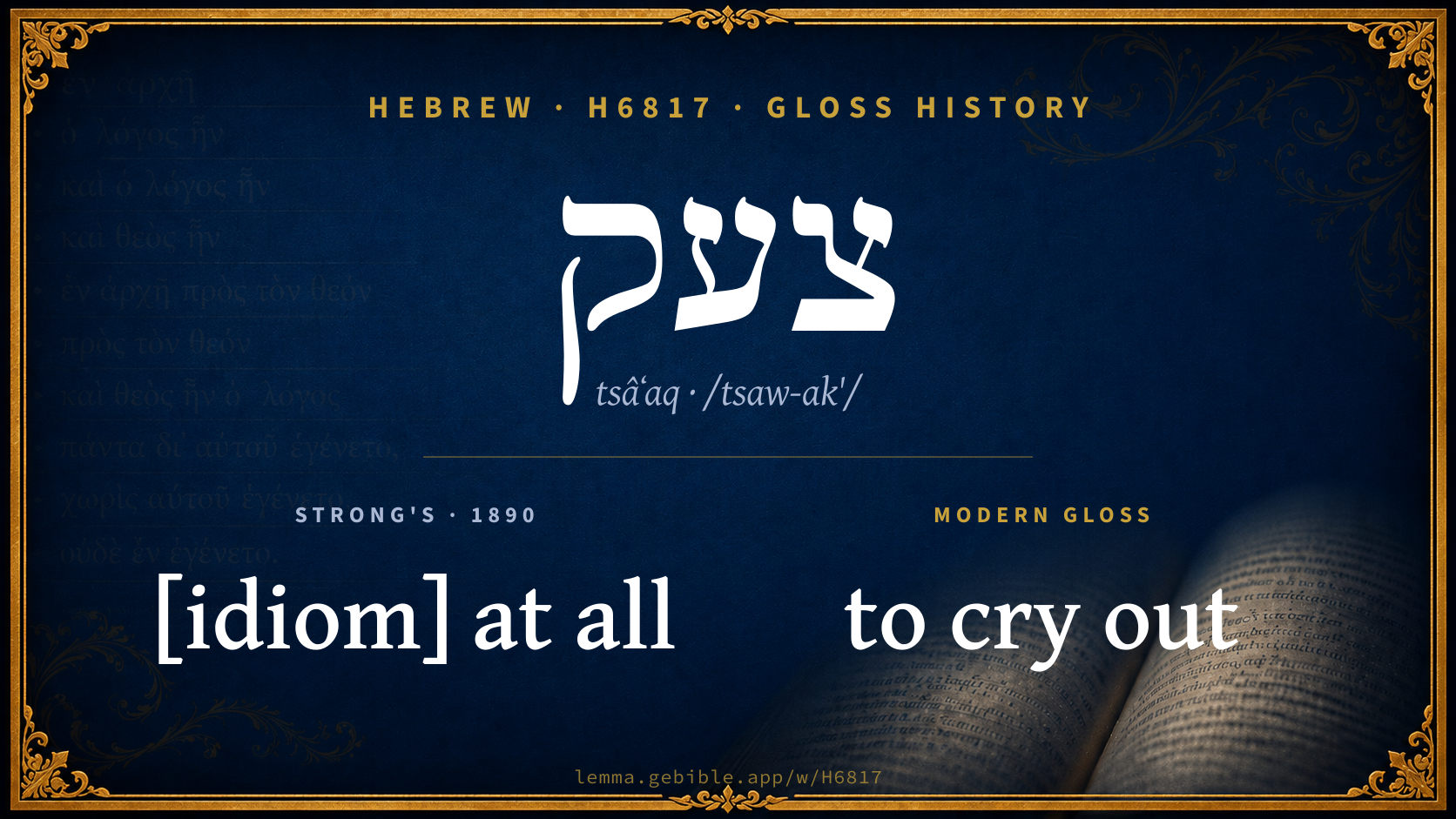
Gloss history
Strong's 1890 vs modern scholarship
About this word
Strong's H6817 catalogs a Hebrew word from the Hebrew Old Testament.
These counts are not copied from any lexicon or concordance. They are computed here, from the morphology-tagged Hebrew Old Testament. What Lemma adds →
- 53
- distinct verses
- The word appears in 53 distinct verses.
- 16 / 39
- OT books
- The word appears in 16 of 39 Old Testament books.
- #686
- by frequency
- Top 1000 most frequent Hebrew words (rank 686 of 8,640 Hebrew words by occurrence).
View all 53 occurrences in the concordance →
By section of the Old Testament
By traditional corpus
Conventional, traditional groupings — biblical authorship is debated, so this is a traditional corpus grouping, not an authorship claim. Each share is this word’s portion of its verses in that division of the Hebrew canon. Each figure is a share of the word’s 53 distinct verses.
- Prophets (Nevi'im) 25 verses · 47%
- Torah (Pentateuch) 18 verses · 34%
- Writings (Ketuvim) 10 verses · 19%
How translations render this word
Counts come from each version’s own published word-to-Strong’s tagging or interlinear alignment — an approximate guide to how each version renders this word, not a word-level alignment the data otherwise carries. Because each total is that version’s own tagged count, the per-version totals vary from one another and need not match the appearance or distinct-verse counts above. These counts may also differ from a printed concordance because Lemma counts each distinctly tagged rendering and does not collapse phrase taggings into a single head-word total. This is a fixed set of word-tagged versions (KJV, ASV, BSB, ULT) and does not change with the reading translation you choose elsewhere. Each version’s license is shown beside its name below (and on Sources).
- King James Version: Cried 11×, He cried 5×, Cry 4×
- American Standard Version: Cried 11×, Were gathered together 5×, Cry 4×
- Berean Standard Bible: Cried out 14×, Cry out 6×, They cried out 4×
- unfoldingWord Literal Text: And 9×, Cried out 9×, Cry out 6×
King James Version Public Domain
Renders H6817 across 55 tagged occurrences — most commonly:
Plus 23 renderings that appear only once — usually multi-word phrases or single function words the recovered tagging swept in, not distinct renderings.
American Standard Version Public Domain
Renders H6817 across 56 tagged occurrences — most commonly:
Plus 22 renderings that appear only once — usually multi-word phrases or single function words the recovered tagging swept in, not distinct renderings.
Berean Standard Bible Public Domain
Renders H6817 across 55 tagged occurrences — most commonly:
Plus 21 renderings that appear only once — usually multi-word phrases or single function words the recovered tagging swept in, not distinct renderings.
unfoldingWord Literal Text CC BY-SA 4.0
Renders H6817 across 70 tagged occurrences — most commonly:
Plus other, less common renderings. Plus 18 renderings that appear only once — usually multi-word phrases or single function words the recovered tagging swept in, not distinct renderings.
10 senses and sub-senses in the full BDB
Hebrew verbs can shift meaning by stem (binyan): Qal is the basic action, Niphal is often passive or reflexive, Piel often intensifies or makes it factitive, and Hiphil is typically causative. The senses below are grouped under the stem BDB assigns to each.
What do BDB’s symbols mean?
BDB uses these scholarly abbreviations:
| Symbol | Meaning |
|---|---|
| 𝔊 | the Septuagint (the ancient Greek translation, LXX) |
| 𝔙 | the Vulgate (the Latin translation) |
| 𝔖 | the Syriac version (the Peshitta) |
| 𝔗 | the Targum (the Aramaic translation) |
| ψ | the Psalms |
| √ | root (the underlying root or stem) |
| ‖ | parallel passage (a synonymous or contrasted parallel) |
| † | the dagger: every passage where the word occurs is cited |
The 10 senses and sub-senses the full Brown-Driver-Briggs lexicon distinguishes for this word, in lexicon order (not ranked by frequency), with BDB’s own verbatim wording and sub-sense lettering. Shown in Hebrew script with BDB’s own scholarly abbreviations. The condensed entry is in the Lexicon Entry tab. See also the Forms in the corpus table below.
Qal
- Pf. 3 ms. צ׳ 1 K 20:39 La 2:18, 3 fs. צָֽעֲקָה Dt 22:24 +, etc.; Impf. יִצְעַק Ex 23:22 +, etc.; Imv. fs. וְצַעֲקִי Je 22:20, וּצֳעָ֑קִי v 20; fpl. צְעַקְנָה 49:3; Inf. abs. צָעֹק Ex 22:22; cstr. לִצְעֹק 2 K 8:3; Pt. fs. abs. צֹעֶ֫קֶת 2 K 8:5; mpl. צֹעֲקִים Gn 4:10; Ex 5:8;— e.g. 1 Kings 20:39
- 1. cry, cry out, for help, usually c. אֶל pers.;—
- a. unto man Gn 41:55 (E; + ל rei), Nu 11:3 (JE), 1 K 20:39 2 K 6:26; 8:3 (+ אֶל rei), v 5 (+ עַל rei); sq. אמר Ex 5:15 (J), 2 K 4:1 and (אֶל pers. om.) Ex 5:8 (J), 2 K 4:40; 6:5. e.g. Genesis 41:55
- b. especially unto י׳: Gn 4:10; Ex 8:3 (+ עַל־דְּבַר rei), 14:10, 15; 15:25; 17:4; 22:22 (צָעֹק יִצְעַק), v 26 Nu 12:13; 20:16 Jos 24:7 (all JE), Ju 4:3; 10:12; Dt 26:7; Is 19:20 (+ מִפְּנֵי rei), La 2:18; Ne 9:27 ψ 107:6, 28; קוֹלִי אֶל־א׳ וְאֶצְעָ֑קָה 77:2, cf. 34:18; c. לי׳ 2 Ch 13:14, נֶגְדֶּ֑ךָ ψ 88:2. e.g. Genesis 4:10
- c. cry unto (אֶל) idol Is 46:7. e.g. Isaiah 46:7
- 2. abs. cry, cry out, in distress, need;—Gn 27:34 (J; c. acc. cogn.), Dt 22:24, 27; Is 33:7 (‖ בָּכָה), 65:14 (‖ הֵילִיל, opp. רָנַן; c. מִן rei), Je 22:20(×2) (‖ נָתַן קוֹל), 49:3 (‖ הֵילִיל), Jb 35:12; c. obj. חָמָס Jb 19:7 (‖ אֲשַׁוַּע). e.g. Genesis 27:34
- 3. make outcry, clamour, Is 42:2 (+ יִשָּׂא, יַשְׁמִיעַ קוֹלוֹ). e.g. Isaiah 42:2
Niphal
- be summoned (i.e. to arms), abs.; Impf. 3 ms. וַיִּצָּעֵק Ju 7:23, 24; 12:1, so 3 mpl. וַיִּצֶּעֲקוּ 10:17; 2 K 3:21, sq. אַחֲרֵי שָׁאוּל + acc. loc. 1 S 13:4. e.g. Judges 7:23
Piel
- Pt. מְצַעֵק cry aloud, in grief, 2 K 2:12. e.g. 2 Kings 2:12
Hiphil
- call together וַיַּצְעֵק אֶת־הָעָם אֶל־י׳ הַמִּצְפָּה 1 S 10:17. e.g. 1 Samuel 10:17
Senses from the full Brown-Driver-Briggs lexicon (Brown, Driver, Briggs; Oxford 1906 — public domain), digitized via Sefaria, supplemented by the OpenScriptures HebrewLexicon (CC BY 4.0). Full attribution on Sources.
Word origin
vb. cry, cry out, call (‖זָעַק; NH id.; Arabic صَعَقَ, perhaps orig. sound as thunder, cf. صَاعِقَةٌ thunderbolt, صَعِقَ bellow (of bull));—
— Brown-Driver-Briggs (Oxford 1906, public domain), digitized via Sefaria, supplemented by the OpenScriptures HebrewLexicon (CC BY 4.0). See Sources.
Origin: a primitive root
Jastrow Dictionary
A second Hebrew/Aramaic lexicon for comparison, covering Aramaic and post-biblical (Talmudic, Targumic, Midrashic) usage that the biblical-Hebrew BDB does not. Matched by lemma rather than by Strong’s number, so a lemma may carry more than one Jastrow headword (shown separately below), and the entries cover usage well beyond the Bible.
צָעַק
- to cry; (cmp. צָוַוח) to complain. Mekh. Mishp. s. 18 (ref. to Ex. XXII, 22) יכול כל זמן שהוא צוֹעֵק וכ׳ lest you may think, when he cries, I hear him (take up his cause), and when he does not cry, I do not &c. B. Kam. 93ᵃ אוי לו לצוֹעֵק … הנִצְעָק woe to him who cries (prays for divine judgment to come down upon his neighbor) more than to him who is cried against. Ib. אחד לצועק ואחד לנצעק וכ׳ Ms. M. both are included (in Ex. l. c.) as deserving divine punishment, the crier and he who is cried against, only that they (in heaven) hasten to attend to the crier first &c. (differ. vers. quoted in Tosaf.). B. Mets. 75ᵇ שלשה צוֹעֲקִין ואינן נענין three persons cry in distress, and are not answered (because they are themselves to blame for their sufferings). Midr. Till. to Ps. XXXIV והיו צוֹצֲקוֹת שתיהן וכ׳ and both of them screamed and raged within &c. Men. 53ᵇ; a. fr. e.g. Exodus 22:22
- to be complained of, v. supra.
צְעֵק
- Targ. Josh. XXIV, 7. Targ. Jud. IV, 3.
A Dictionary of the Targumim, the Talmud Babli and Yerushalmi, and the Midrashic Literature (Marcus Jastrow; London, Luzac, 1903) — Public Domain. Digitized via Sefaria. Digitized via Sefaria. Full attribution on Sources.
Forms in the corpus
The 46 distinct written forms H6817 takes in the Hebrew Bible, most frequent first — each parse links to that stem’s occurrences in the concordance. Hebrew forms include their vowel points and cantillation, so a single lemma takes many written forms.
Same root — word family
Other BDB entries built from the same root as H6817, grouped by Strong’s listed origin. These share a root / origin per the lexicon — not necessarily a shared meaning. Each links to that word’s own entry.
Derived from this word
Compare all same-root words → They share a root, not necessarily a meaning.
Septuagint verse parallels
This word appears in 50 verses that also exist in the Greek Old Testament (Septuagint), out of the 53 Hebrew verses it occurs in. You can read those verses in Greek by switching the Old Testament edition to the Septuagint.
Read these verses in the Septuagint
- Genesis 4:10
- Exodus 5:8
- Numbers 11:2
- Deuteronomy 22:24
- Joshua 24:7
- Judges 4:3
- 1 Samuel 10:17
- 2 Kings 2:12
- 2 Chronicles 13:14
- Job 19:7
- Psalms 34:17
- Isaiah 19:20
This is a verse-level parallel only — the same verses exist in both the Hebrew and Greek Old Testaments. No word-level Hebrew↔Greek correspondence is claimed: the data carries no such alignment, so no Greek word is shown as this Hebrew word’s translation. Coverage is not total — the Septuagint omits the deuterocanon and renumbers the Psalms, so some Hebrew verses have no direct Greek parallel.