Isaiah 65:14

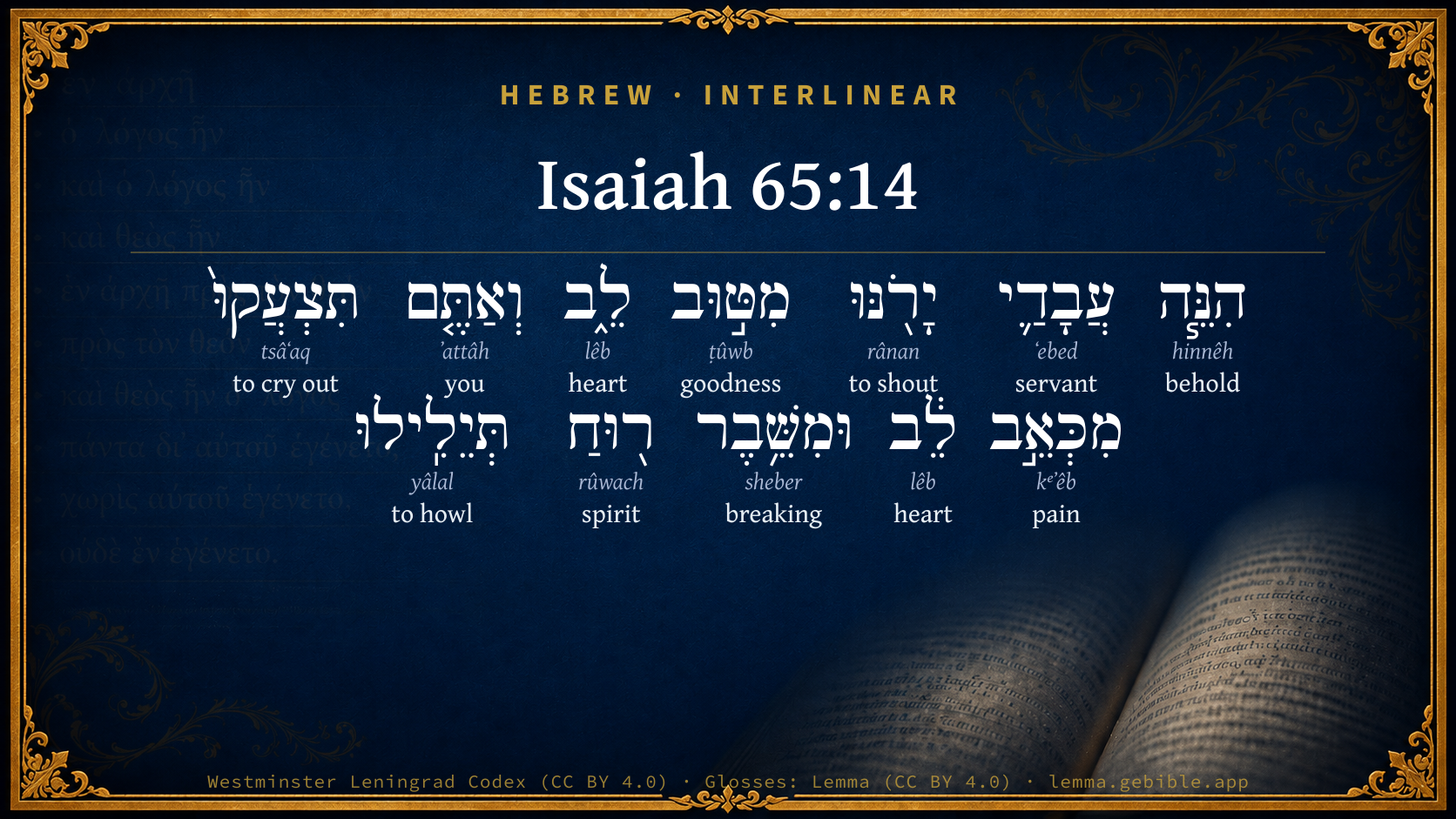
Hebrew (Westminster Leningrad Codex) Isaiah 65:14 appears in the Hebrew Old Testament. The text above is from the Westminster Leningrad Codex. Each word links to its Strong’s number, a concise gloss, and parsing drawn from the Open Scriptures Hebrew Bible morphology. Click any word for its full Brown-Driver-Briggs (BDB) entry.
Download image
Cite this verse

Isaiah 65:14 (World English Bible). Public Domain. Lemma interlinear Bible study tool, https://lemma.gebible.app/v/isaiah/65/14.

Show BibTeX & RIS
BibTeX
RIS
English Translation
behold, my servants shall sing for joy of heart, but you shall cry for sorrow of heart, and shall wail for vexation of spirit.
World English Bible · Public Domain
Download a study sheet

One document with this verse’s original text, its word-by-word gloss line, the meaning frame, cross-references with their text, attributed commentary, and full source and license credits — printable, and it pastes into notes with its structure intact.

This verse Autodidact and up

Study sheet (.html) Plain text (.txt)

A passage Seminary Student

Up to 50 verses in one chapter. A passage sheet keeps up to 6 commentary sources and 12 cross-references per verse, in the order this page ranks them, and says so on the sheet whenever that leaves anything out. Ask for a single verse and you get the Autodidact verse sheet above.

Everything on this page stays free to read, with no account — the sheet is a download of what is already on screen, not access to it.

Want to remove ads? Support Godless Engineer
Compare translations 3

The same verse in 3 English versions, stacked beneath the original-language interlinear above. Click any original word for its lexicon entry.

Each is an independent rendering of the whole verse — the interlinear is not word-aligned to these translations.

Highlighted words mark where these versions differ — a whole-verse word diff, not a word-by-word alignment.

  • World English Bible Public Domain
    behold, my servants shall sing for joy of heart, but you shall cry for sorrow of heart, and shall wail for vexation of spirit.
  • King James Version Public Domain
    Behold, my servants shall sing for joy of heart, but ye shall cry for sorrow of heart, and shall howl for vexation of spirit.
  • unfoldingWord Literal Text CC BY-SA 4.0
    Behold, my servants will shout joyfully from goodness of heart, but you, you will cry out from pain of heart, and from breaking of spirit you will wail.

unfoldingWord Literal Text — © unfoldingWord, licensed CC BY-SA 4.0. Word-aligned USFM3 via Door43 (git.door43.org/unfoldingWord/en_ult).

Versions to compare (up to 4)

3 of 4 selected

Show all 18 translations

Every available English version of this verse, each an independent rendering of the whole verse.

  • World English Bible Public Domain
    behold, my servants shall sing for joy of heart, but you shall cry for sorrow of heart, and shall wail for vexation of spirit.
  • Berean Standard Bible Public Domain
    My servants will shout for joy with a glad heart, but you will cry out with a heavy heart and wail with a broken spirit.
  • Majority Standard Bible Public Domain
    My servants will shout for joy with a glad heart, but you will cry out with a heavy heart and wail with a broken spirit.
  • King James Version Public Domain
    Behold, my servants shall sing for joy of heart, but ye shall cry for sorrow of heart, and shall howl for vexation of spirit.
  • American Standard Version (1901) Public Domain
    behold, my servants shall sing for joy of heart, but ye shall cry for sorrow of heart, and shall wail for vexation of spirit.
  • Revised Version (1885) Public Domain
    behold, my servants shall sing for joy of heart, but ye shall cry for sorrow of heart, and shall howl for vexation of spirit.
  • Geneva Bible (1599) Public Domain
    Beholde, my seruants shall sing for ioye of heart, and ye shall crye for sorow of heart, and shall howle for vexation of minde.
  • Douay-Rheims (1899) Public Domain
    Behold my servants shall rejoice, and you shall be confounded: behold my servants shall praise for joyfulness of heart, and you shall cry for sorrow of heart, and shall howl for grief of spirit.
  • Young's Literal Translation Public Domain
    Lo, My servants sing from joy of heart, And ye cry from pain of heart, And from breaking of spirit ye do howl.
  • Literal Standard Version CC BY-SA 4.0
    Behold, My servants sing from joy of heart, || And you cry from pain of heart, || And you howl from breaking of spirit.
  • Unlocked Literal Bible CC BY-SA 4.0
    Look, my servants will shout with joy because of gladness of heart, but you will cry because of the pain of the heart, and will wail because of the crushing of the spirit.
  • unfoldingWord Literal Text CC BY-SA 4.0
    Behold, my servants will shout joyfully from goodness of heart, but you, you will cry out from pain of heart, and from breaking of spirit you will wail.
  • Darby Bible Public Domain
    behold, my servants shall sing aloud for gladness of heart, and *ye* shall cry out for sorrow of heart, and shall howl for vexation of spirit.
  • World Messianic Bible Public Domain
    Behold, my servants will sing for joy of heart, but you will cry for sorrow of heart, and will wail for anguish of spirit.
  • Webster's Bible Public Domain
    Behold, my servants shall sing for joy of heart, but ye shall cry for sorrow of heart, and shall howl for vexation of spirit.
  • Free Bible Version CC BY-SA 4.0
    Listen! My servants will shout because they're so happy inside, but you will cry out in deepest pain, howling because your spirit is broken.
  • Bible in Basic English Public Domain
    My servants will make songs in the joy of their hearts, but you will be crying for sorrow, and making sounds of grief from a broken spirit.
  • JPS Tanakh (1917) Public Domain
    Behold, My servants shall sing for joy of heart, but ye shall cry for sorrow of heart, and shall wail for vexation of spirit.

Literal Standard Version (2020), Covenant Press — licensed CC BY-SA 4.0. Text via the HelloAO Bible API (eBible.org). Unlocked Literal Bible (unfoldingWord) — licensed CC BY-SA 4.0. Text via the HelloAO Bible API (eBible.org). unfoldingWord Literal Text — © unfoldingWord, licensed CC BY-SA 4.0. Word-aligned USFM3 via Door43 (git.door43.org/unfoldingWord/en_ult). Free Bible Version, Dr. Jonathan Gallagher — licensed CC BY-SA 4.0. Text via the HelloAO Bible API (eBible.org).

Word by word

More ways to search: Search by grammar → Find every occurrence → Compare this word →

Practice this passage: Drill this verse → Learn its vocabulary →

מִכְּאֵ֣ב
kᵉʼêb
H3511
“from · pain of”
Preposition + Noun, Common, Masculine, Singular, Construct
Part of Speech
Preposition + Noun
Type
Common
Gender
Masculine
Number
Singular
State
Construct
Full BDB Definition

Origin: from H3510

TWOT: 940a

pain (mental and physical), sorrow
  1. הִנֵּ֧ה hinnêh H2009 “behold” Particle, Demonstrative
  2. עֲבָדַ֛י ʻebed H5650 “servants · my” Noun, Common, Masculine, Plural, Construct + Suffix, Personal, 1st Person, Common, Singular
  3. יָרֹ֖נּוּ rânan H7442 “to shout” Verb, Qal, Imperfect, 3rd Person, Masculine, Plural
  4. מִטּ֣וּב ṭûwb H2898 “from · goodness of” Preposition + Noun, Common, Masculine, Singular, Construct
  5. לֵ֑ב lêb H3820 “heart” Noun, Common, Masculine, Singular, Absolute
  6. וְאַתֶּ֤ם ʼattâh H859 “and · you” Conjunction + Pronoun, Personal, 2nd Person, Masculine, Plural
  7. תִּצְעֲקוּ֙ tsâʻaq H6817 “to cry out” Verb, Qal, Imperfect, 2nd Person, Masculine, Plural
  8. לֵ֔ב lêb H3820 “heart” Noun, Common, Masculine, Singular, Absolute
  9. וּמִשֵּׁ֥בֶר sheber H7667 “and · from · breaking of” Conjunction + Preposition + Noun, Common, Masculine, Singular, Construct
  10. ר֖וּחַ rûwach H7307 “spirit” Noun, Common, Both, Singular, Absolute
  11. תְּיֵלִֽילוּ yâlal H3213 “to howl” Verb, Hiphil, Imperfect, 2nd Person, Masculine, Plural

About this verse

These counts appear in no published source. They are computed here, from the morphology-tagged text and Lemma’s own curated glosses. What Lemma adds →

12
words
11
distinct lemmas
Prophets
section

Notable vocabulary

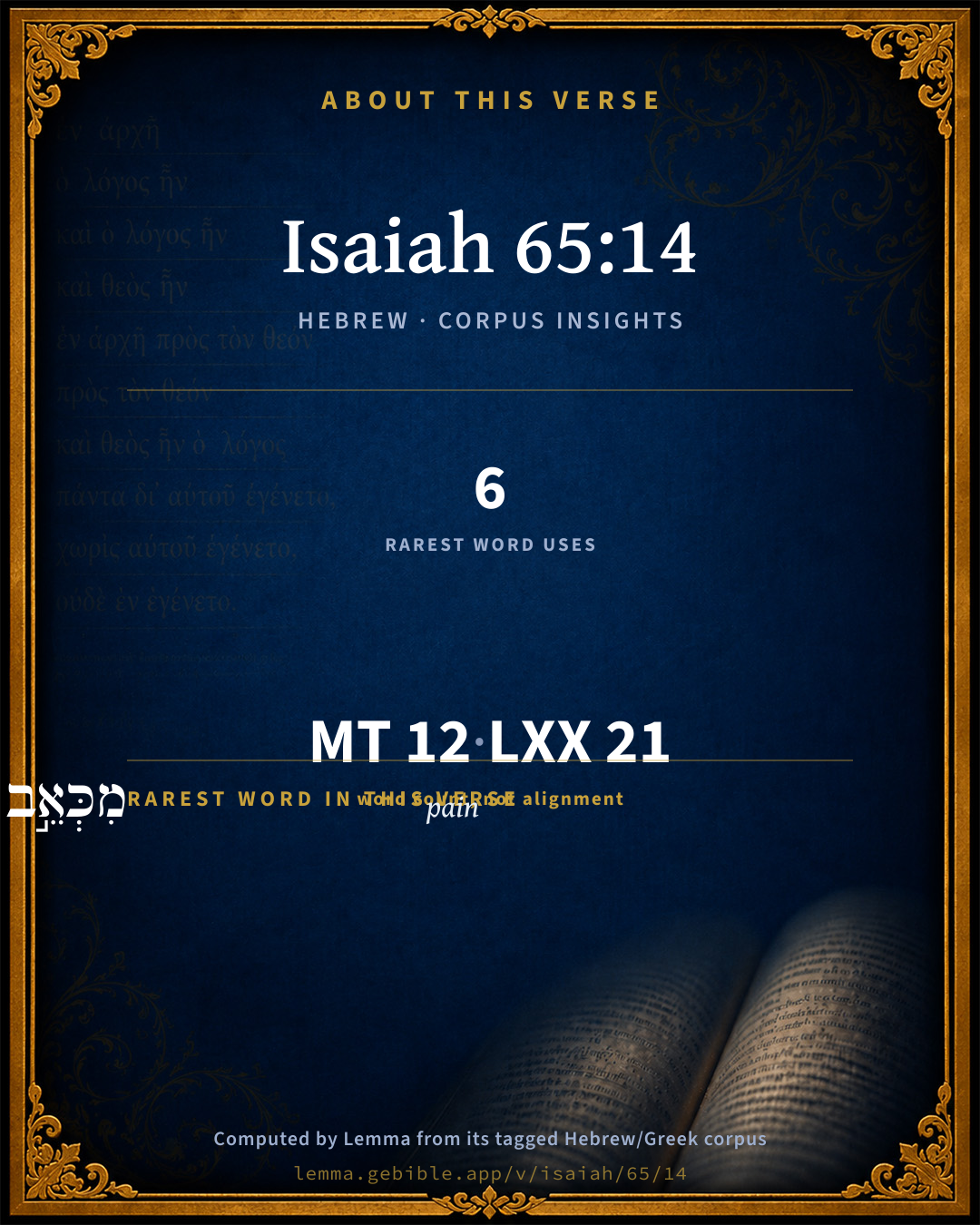
The rarest word here is מִכְּאֵ֣ב pain H3511 — appearing just 6 times in the whole Hebrew Bible.

Shared distinctive vocabulary

מִכְּאֵ֣ב pain H3511 occurs in 6 verses of the Hebrew Bible. Also found in:

Grammatical profile

  • 3 verbs
  • 7 nouns
  • 1 pronoun
  • 1 particle

Verb forms

  • יָרֹ֖נּוּ Qal · Imperfect
  • תִּצְעֲקוּ֙ Qal · Imperfect
  • תְּיֵלִֽילוּ Hiphil · Imperfect

Repetition

A word recurs within this verse — often emphatic in Hebrew:

  • לֵ֑ב heart H3820 ×2

Hebrew & Septuagint length

In English translation the verse runs 24 words from the Hebrew and 26 from the Septuagint (LXX English) — closely comparable.

A rough comparison of the two English renderings, which tokenize alike — not a word-level alignment.

Word counts can differ between the Hebrew and the Greek without any difference in meaning — e.g. the Hebrew direct-object marker אֵת has no separate Greek word, and Greek often adds the article ὁ.

In the original languages it is 12 Hebrew tokens and 21 Greek tokens — but the two are counted differently (Hebrew bundles its prefixes and suffixes into one token; the Greek is in lemma form), so that isn’t a like-for-like length.

Cross-references

11

Topical passages linked to Isaiah 65:14 in the Treasury of Scripture Knowledge — connected by theme and wording, ordered by reader-vote popularity; previews shown in the World English Bible.

  • Psalms 66:4 All the earth will worship you, And will sing to you; They will sing to your name." Selah.
  • Matthew 8:12 but the children of the Kingdom will be thrown out into the outer darkness. There will be weeping and the gnashing of teeth."
  • Isaiah 24:14 These shall lift up their voice, they shall shout; for the majesty of Yahweh they cry aloud from the sea.
  • Isaiah 52:8–9 The voice of your watchmen! they lift up the voice, together do they sing; for they shall see eye to eye, when Yahweh returns to Zion.
  • Jeremiah 31:7 For thus says Yahweh, Sing with gladness for Jacob, and shout for the chief of the nations: publish you, praise you, and say, Yahweh, save your people, the remnant of Israel.
  • Matthew 13:42 and will cast them into the furnace of fire. There will be weeping and the gnashing of teeth.
  • Matthew 22:13 Then the king said to the servants, 'Bind him hand and foot, take him away, and throw him into the outer darkness; there is where the weeping and grinding of teeth will be.'
  • Luke 13:28 There will be weeping and gnashing of teeth, when you see Abraham, Isaac, Jacob, and all the prophets, in the Kingdom of God, and yourselves being thrown outside.
  • James 5:1 Come now, you rich, weep and howl for your miseries that are coming on you.
  • James 5:13 Is any among you suffering? Let him pray. Is any cheerful? Let him sing praises.
  • Job 29:13 The blessing of him who was ready to perish came on me, And I caused the widow's heart to sing for joy.

Cross-references courtesy of OpenBible.info (CC BY 4.0).

Hebrew and Greek witnesses Masoretic Hebrew ↔ Greek Septuagint

The same verse in the two great witnesses to the Old Testament, shown verse-for-verse.

These are two independent witnesses, not word-aligned to each other, and the Septuagint is shown in lemma (dictionary) form.

Hebrew Isaiah 65:14 Masoretic · Westminster Leningrad Codex

הִנֵּ֧ה עֲבָדַ֛י יָרֹ֖נּוּ מִטּ֣וּב לֵ֑ב וְאַתֶּ֤ם תִּצְעֲקוּ֙ מִכְּאֵ֣ב לֵ֔ב וּמִשֵּׁ֥בֶר ר֖וּחַ תְּיֵלִֽילוּ

behold, my servants shall sing for joy of heart, but you shall cry for sorrow of heart, and shall wail for vexation of spirit.

World English Bible · Public Domain

Greek LXX Isaiah 65:14 Septuagint · lemma form

ἰδού ὁ δουλεύω ἐγώ ἀγαλλιάομαι ἐν εὐφροσύνη σύ δέ κράζω διά ὁ πόνος ὁ καρδία σύ καί ἀπό συντριβή πνεῦμα ὀλολύζω

behold, my servants shall exult with joy, but you⌃ shall cry for the sorrow of your heart, and shall howl for the vexation of your spirit.

LXX2012 (modern English Septuagint) · Public Domain

Hebrew: Westminster Leningrad Codex (CC BY 4.0). Greek: Septuagint (public domain); English from LXX2012 (modern English Septuagint) (Public Domain). How the Septuagint differs from the Hebrew →

Targum (Aramaic paraphrase)

1

The Targum is the ancient Jewish Aramaic paraphrase of the Hebrew Scriptures — an interpretive translation, not the Hebrew text itself. Onkelos (literal) and Pseudo-Jonathan (expansive) render the Torah, and Jonathan the Prophets. Coverage is partial: where no permissively-licensed English translation exists for a verse, only the Aramaic is shown. This is verse-level text, not a word-by-word alignment to the Hebrew.

  1. Targum Jonathan Prophets (Joshua–Malachi)
    הָא עַבְדֵי צַדִיקַיָא יְשַׁבְּחוּן מִטוּב לֵב וְאַתּוּן תִּצַוְחוּן מִכְּאֵב לֵב וּמִתְּבַר רוּחַ תְּיַלְלוּן:

    Behold, my righteous servants shall sing for joy of heart, but ye shall cry for sorrow of heart, and ye shall howl for vexation of spirit.

    Targum Jonathan — Aramaic: “Mikraot Gedolot” (public domain). English: “Sefaria Community Translation” (CC0 1.0 (public-domain dedication)); “London "Chaldee Paraphrase," 1871” (public domain). Text via Sefaria.

Commentary

Notes on Isaiah 65:14 from classic Christian and Jewish commentators (each source and its license shown beneath its notes). The classic Christian expositions comment on the surrounding passage and are grouped to its opening verse, so a note may address several verses; the Jewish commentaries on the Tanakh (Rashi and others) are per-verse, so they appear only where the commentator wrote on this verse.

Lemma curates 59 commentaries, every one of them public domain or Creative Commons licensed, each selected and text-cleaned for this edition rather than reprinted as found. About our sources →

Trapp's Complete Commentary

John Trapp

Isa 65:14 Behold, my servants shall sing for joy of heart, but ye shall cry for sorrow of heart, and shall howl for vexation of spirit.

Ver. 14. Behold, my servants shall sing.] "In the transgression of an evil man there is a snare," or a cord to strangle his joys with; "but the righteous doth sing and rejoice." {Pro 29:6} {See Trapp on "Pro 29:6"}

And shall howl.] When ye come to hell especially, where is wailing, and yelling, and gnashing of teeth.

John Trapp, A Commentary or Exposition upon All the Books of the Old and New Testament (1647–1656) — public domain. Text from a community e-Sword module.

The Biblical Illustrator

Joseph S. Exell

Isa_65:14

Behold, My servants shall sing

Joys

Heathenism knows nothing of the gladness described in oar text, But in this life every man may sing for joy of heart.

1. God makes His servants sing for joy of heart. There was once a famous musician who could bring out the most charming music from one string of a violin. Like that violin, many of us have only one string, and that a cracked one; but our God can make it sound forth perfect praise.

2. You may recognize a servant of God by his joyous face. We do not see many joyous faces, except in little children; and only then at odd times. The human race is born to trouble; but God can turn our sorrow into joy. How pleasant to look on a glad and joyous face I Nightingales do not often come so far north as Manchester; but last year one of those birds built its nest outside our city, and dozens of people went out to hear the sweet singer of the night. Letters were written to the newspapers about it, and everybody thought it a remarkable thing. How sweet it was to hear the warble of that bird in the darkness of the night! If the nightingale sang in the day-time, we might not notice it any more than the melody of the lark or the music of the wren; it is delightsome to us because it is a song in the night. Likewise, a joyous face and joyous words are equally remarkable. In this world of dark doubts and fears, let the singing of the joy in your heart be seen in your face and heard in your words.

3. The servants of God are also known by their joyous disposition. Live temperately, be home in good time every evening, rise early; and the joyousness of life shall enter your heart.

4. The servants of God have the joy of knowing Him.

5. There is the joy of pardon.

6. There is the joy of salvation.

7. We have also the joy of faith. How blessed to be able to trust Gods care! In the long roads of the East, where people have to travel wearily on foot for many miles, it is the custom of kindly-hearted people to put on the road-side a pitcher of water, so that the thirsty traveller may freely drink. Likewise, God puts blessings and comforts for us on our pathway; and such tokens of His goodness cause us to sing for joy.

8. We have the joy of His presence. One day, when the Grecian army was near the enemys camp, Alexander the Great slept very peacefully; and when he awoke, one of his friends said--Alexander, how is it you slept so well? The king replied, Slept so well? Of course I can sleep well. Does not Parmenio watch? Does not God watch over you?

9. There is the joy of His promises. Lord Chatham one day promised his son that when the garden wall was pulled down, he should be present to see it fall. But forgetting has promise, he gave orders for the wall to be taken down in the absence of his son. He remembered it the next day, and at once ordered it to be rebuilt, in order that the promise might be kept. But God never forgets His promise.

10. There is the joy of the future. You may ask, Is there any joy in death? Yes! One day, a sculptor was near death; pain shot through his frame; and when his wifes tears dropped on his face, he said, My dear, have patience; this pain is only the chiselling! So, when death comes to you, you shall have the joy of knowing that your pain is Gods kindly hand dealing very gently with you. (W. Birch.)

The Biblical Illustrator, edited by Joseph S. Exell (c. 1880s–1900s) — public domain. Text from a community e-Sword module.

Jamieson, Fausset & Brown

Robert Jamieson, A. R. Fausset & David Brown

howl-- (Isa 15:2; Mat 8:12).

Jamieson, Fausset & Brown — Commentary Critical and Explanatory on the Whole Bible (1871) — public domain (CC PDM 1.0). Text via the HelloAO Bible API.

The Cambridge Bible for Schools and Colleges

gen. ed. J. J. S. Perowne

14. joy of heart] Cf. Deu_28:47.

vexation of spirit] lit. breaking of spirit; contrast the different sense of “broken of heart” (ch. Isa_61:1).

The Cambridge Bible for Schools and Colleges (gen. ed. J. J. S. Perowne; Cambridge University Press, 1878–1918) — public domain. Text from a community e-Sword module.

John Gill's Exposition

Behold, my servants shall sing for joy of heart,.... The songs of electing, redeeming, and calling grace, with which they come to Zion now, and will hereafter; having their hearts filled with joy unutterable, and full of glory, under a sense of the great things which God has done for them:

but ye shall cry for sorrow of heart, and shall howl for vexation of spirit; under the sore judgments of God upon them, the sword and famine; more especially during the siege of Jerusalem, and when wrath came upon them to the uttermost, in the destruction of their city, temple, and nation, and they fell into the hands of the Romans, who carried them captive, and dispersed them in various places; and as the wicked will in hell to all eternity, where is nothing but weeping, wailing, and gnashing of teeth.

John Gill's Exposition of the Whole Bible (1746–1763) — public domain (CC PDM 1.0). Text via the HelloAO Bible API.

Albert Barnes' Notes on the Bible

Shall sing for joy of heart - They who serve me shall have abundant occasion of rejoicing. But ye - shall howl. You shall shriek under the anguish and distress that shall come upon you.

For vexation of spirit - Margin, as in Hebrew, ‘Breaking.’ That is, your spirit shall be broken and crushed under the weight of the calamities that shall come upon you.

Albert Barnes' Notes on the Bible (1834–1885) — public domain. Text from a community e-Sword/MySword module.

Ibn Ezra

Rabbi Abraham ibn Ezra

תְּיֵילִילוּ Ye shall howl. The regular form of the word would be תַּיְלִילוּ; comp., יַיְשִׁירוּ they look straight (Prov. 4:25). It is similar in form to יְיֵדָע he knoweth; (Ps. 138:6), and יְיֵטִיב he doth good (Job 24:21)

Ibn Ezra on the Tanakh — English translations: “Sefaria Community Translation” (CC0 1.0 (public-domain dedication)); “Yalkut, Sifsei Chachomim Chumash, Metsudah Publications, 2009” (CC BY 4.0); and “Commentary of Ibn Ezra on Isaiah - trans. by M. Friedlander, 1873” (public domain). Text via Sefaria.

Lesson kit

Teaching starters — assembled from the data on this page, not authored interpretation. Every prompt links to the verse data it draws on. Edit before teaching.

Isaiah, in the Prophets, opens this verse with 12 words (11 distinct Hebrew lemmas). Its most distinctive word is kᵉʼêb (“pain”). A historical commentator’s framing appears above. Read the whole chapter for the surrounding context.

Discussion questions

  1. The word kᵉʼêb carries the sense “pain.” How does it shape the verse?
  2. How does Job 2:13, which shares the word «pain», read alongside this verse?
  3. What does the repetition of “heart” (2× in this one verse) do in this verse?
  4. These translations render this verse differently. What is at stake in choosing one wording over another?
  5. «יָרֹ֖נּוּ» is a Qal Imperfect verb. How does that grammatical form shape the action described?
  6. Compare how Trapp's Complete Commentary and The Biblical Illustrator read this verse. Where do they agree or differ?

Things to notice

Reading settings

Reading text

Shown beneath each verse's original-language words.

Old Testament
Old Testament edition

Read the OT as the Masoretic Hebrew (MT) or the Greek Septuagint (LXX).

English shown for the Greek Septuagint (in the Hebrew ↔ Greek comparison).

Comparing translations? Open the Compare panel on any verse page to stack up to four side by side.