
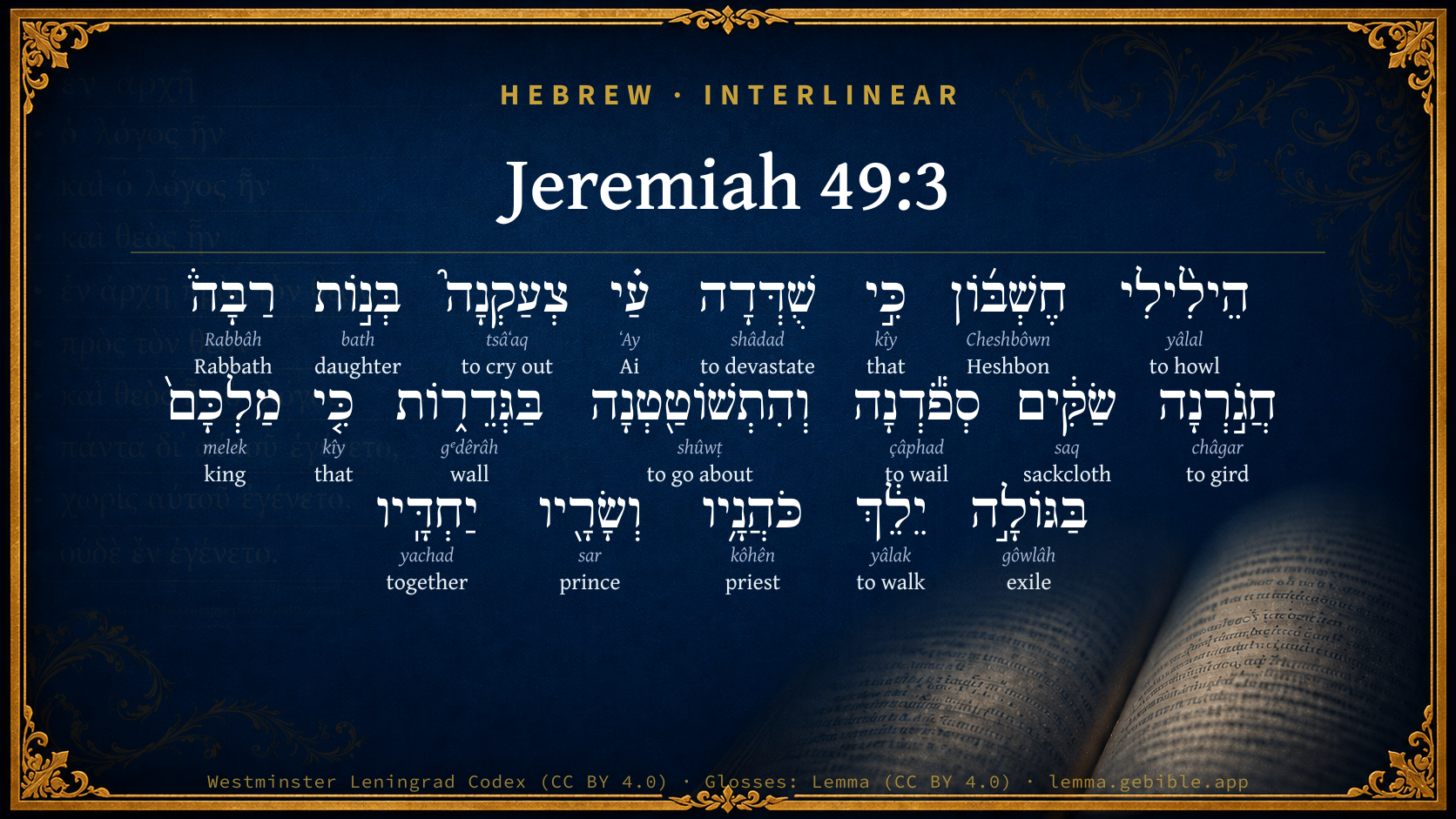
Jeremiah 49:3

Hebrew (Westminster Leningrad Codex) Jeremiah 49:3 appears in the Hebrew Old Testament. The text above is from the Westminster Leningrad Codex. Each word links to its Strong’s number, a concise gloss, and parsing drawn from the Open Scriptures Hebrew Bible morphology. Click any word for its full Brown-Driver-Briggs (BDB) entry.
Download image
Cite this verse

Jeremiah 49:3 (World English Bible). Public Domain. Lemma interlinear Bible study tool, https://lemma.gebible.app/v/jeremiah/49/3.

Show BibTeX & RIS
BibTeX
RIS
English Translation
Wail, Heshbon, for Ai is laid waste; cry, you daughters of Rabbah, gird you with sackcloth: lament, and run back and forth among the fences; for Malcam shall go into captivity, his priests and his princes together.
World English Bible · Public Domain
Download a study sheet

One document with this verse’s original text, its word-by-word gloss line, the meaning frame, cross-references with their text, attributed commentary, and full source and license credits — printable, and it pastes into notes with its structure intact.

This verse Autodidact and up

Study sheet (.html) Plain text (.txt)

A passage Seminary Student

Up to 50 verses in one chapter. A passage sheet keeps up to 6 commentary sources and 12 cross-references per verse, in the order this page ranks them, and says so on the sheet whenever that leaves anything out. Ask for a single verse and you get the Autodidact verse sheet above.

Everything on this page stays free to read, with no account — the sheet is a download of what is already on screen, not access to it.

Want to remove ads? Support Godless Engineer
Compare translations 3

The same verse in 3 English versions, stacked beneath the original-language interlinear above. Click any original word for its lexicon entry.

Each is an independent rendering of the whole verse — the interlinear is not word-aligned to these translations.

Highlighted words mark where these versions differ — a whole-verse word diff, not a word-by-word alignment.

  • World English Bible Public Domain
    Wail, Heshbon, for Ai is laid waste; cry, you daughters of Rabbah, gird you with sackcloth: lament, and run back and forth among the fences; for Malcam shall go into captivity, his priests and his princes together.
  • King James Version Public Domain
    Howl, O Heshbon, for Ai is spoiled: cry, ye daughters of Rabbah, gird you with sackcloth; lament, and run to and fro by the hedges; for their king shall go into captivity, and his priests and his princes together.
  • unfoldingWord Literal Text CC BY-SA 4.0
    “Howl in lament, Heshbon, for Ai will be devastated! Shout out, daughters of Rabbah! Put on sackcloth. Lament and run about in futility, for Molech is going into captivity, together with his priests and leaders.

unfoldingWord Literal Text — © unfoldingWord, licensed CC BY-SA 4.0. Word-aligned USFM3 via Door43 (git.door43.org/unfoldingWord/en_ult).

Versions to compare (up to 4)

3 of 4 selected

Show all 18 translations

Every available English version of this verse, each an independent rendering of the whole verse.

  • World English Bible Public Domain
    Wail, Heshbon, for Ai is laid waste; cry, you daughters of Rabbah, gird you with sackcloth: lament, and run back and forth among the fences; for Malcam shall go into captivity, his priests and his princes together.
  • Berean Standard Bible Public Domain
    Wail, O Heshbon, for Ai has been destroyed; cry out, O daughters of Rabbah! Put on sackcloth and mourn; run back and forth within your walls, for Milcom will go into exile together with his priests and officials.
  • Majority Standard Bible Public Domain
    Wail, O Heshbon, for Ai has been destroyed; cry out, O daughters of Rabbah! Put on sackcloth and mourn; run back and forth within your walls, for Milcom will go into exile together with his priests and officials.
  • King James Version Public Domain
    Howl, O Heshbon, for Ai is spoiled: cry, ye daughters of Rabbah, gird you with sackcloth; lament, and run to and fro by the hedges; for their king shall go into captivity, and his priests and his princes together.
  • American Standard Version (1901) Public Domain
    Wail, O Heshbon, for Ai is laid waste; cry, ye daughters of Rabbah, gird you with sackcloth: lament, and run to and fro among the fences; for Malcam shall go into captivity, his priests and his princes together.
  • Revised Version (1885) Public Domain
    Howl, O Heshbon, for Ai is spoiled; cry, ye daughters of Rabbah, gird you with sackcloth: lament, and run to and fro among the fences; for Malcam shall go into captivity, his priests and his princes together.
  • Geneva Bible (1599) Public Domain
    Howle, O Heshbon, for Ai is wasted: crie ye daughters of Rabbah: girde you with sackecloth: mourne and runne to and from by the hedges: for their King shall goe into captiuitie; and his Priestes, and his princes likewise.
  • Douay-Rheims (1899) Public Domain
    Howl, O Hesebon, for Hai is wasted. Cry, ye daughters of Rabbath, gird yourselves with haircloth: mourn and go about by the hedges: for Melchom shall be carried into captivity, his priests, and his princes together.
  • Young's Literal Translation Public Domain
    Howl, Heshbon, for spoiled is Ai, Cry, daughters of Rabbah, gird on sackcloth, Lament, and go to and fro by the hedges, For Malcam into captivity doth go, His priests and his princes together.
  • Literal Standard Version CC BY-SA 4.0
    Howl, Heshbon, for Ai is spoiled, || Cry, daughters of Rabbah, gird on sackcloth, || Lament, and go to and fro by the hedges, || For Malcam goes into captivity, || His priests and his princes together.
  • Unlocked Literal Bible CC BY-SA 4.0
    “Howl in lament, Heshbon, for Ai will be devastated! Shout out, daughters of Rabbah! Put on sackcloth. Lament and run about in futility, for Molech is going into captivity, together with his priests and leaders.
  • unfoldingWord Literal Text CC BY-SA 4.0
    “Howl in lament, Heshbon, for Ai will be devastated! Shout out, daughters of Rabbah! Put on sackcloth. Lament and run about in futility, for Molech is going into captivity, together with his priests and leaders.
  • Darby Bible Public Domain
    Howl, Heshbon! for Ai is laid waste; cry, daughters of Rabbah, gird you with sackcloth, lament and run to and fro within the enclosures: for Malcam shall go into captivity, his priests and his princes together.
  • World Messianic Bible Public Domain
    “Wail, Heshbon, for Ai is laid waste! Cry, you daughters of Rabbah! Clothe yourself in sackcloth. Lament, and run back and forth among the fences; for Malcam will go into captivity, his priests and his princes together.
  • Webster's Bible Public Domain
    Howl, O Heshbon, for Ai is laid waste: cry, ye daughters of Rabbah, gird you with sackcloth; lament, and run to and fro by the hedges; for their king shall go into captivity, and his priests and his princes together.
  • Free Bible Version CC BY-SA 4.0
    Weep, people of Heshbon, for the town of Ai has been destroyed. Cry for help, people of Rabbah! Put on clothes made of sackcloth and start mourning; run to and fro inside your city walls, because your god Milcom will go into exile along with his priests and leaders.
  • Bible in Basic English Public Domain
    Make sounds of grief, O Heshbon, for Ai is wasted; give loud cries, O daughters of Rabbah, and put haircloth round you: give yourselves to weeping, running here and there and wounding yourselves; for Milcom will be taken prisoner together with his rulers and his priests.
  • JPS Tanakh (1917) Public Domain
    Wail, O Heshbon, for Ai is undone; cry, ye daughters of Rabbah, gird you with sackcloth; lament, and run to and fro among the folds; for Malcam shall go into captivity, his priests and his princes together.

Literal Standard Version (2020), Covenant Press — licensed CC BY-SA 4.0. Text via the HelloAO Bible API (eBible.org). Unlocked Literal Bible (unfoldingWord) — licensed CC BY-SA 4.0. Text via the HelloAO Bible API (eBible.org). unfoldingWord Literal Text — © unfoldingWord, licensed CC BY-SA 4.0. Word-aligned USFM3 via Door43 (git.door43.org/unfoldingWord/en_ult). Free Bible Version, Dr. Jonathan Gallagher — licensed CC BY-SA 4.0. Text via the HelloAO Bible API (eBible.org).

Word by word

More ways to search: Search by grammar → Find every occurrence → Compare this word →

Practice this passage: Drill this verse → Learn its vocabulary →

בַּגְּדֵר֑וֹת
gᵉdêrâh
H1448
“in/at the · walls”
Preposition, Determined + Noun, Common, Feminine, Plural, Absolute
Part of Speech
Preposition + Noun
Type
Common
Gender
Feminine
Number
Plural
State
Absolute
Full BDB Definition

Origin: from H1447

TWOT: 318b

wall, hedge - sheepfold (construct with 'sheep')
  1. הֵילִ֨ילִי yâlal H3213 “howl” Verb, Hiphil, Imperative, 2nd Person, Feminine, Singular
  2. חֶשְׁבּ֜וֹן Cheshbôwn H2809 “Heshbon” Noun, Proper
  3. כִּ֣י kîy H3588 “that” Conjunction
  4. שֻׁדְּדָה shâdad H7703 “to devastate” Verb, Pual, Perfect, 3rd Person, Feminine, Singular
  5. עַ֗י ʻAy H5857 “Ai” Noun, Proper
  6. צְעַקְנָה֮ tsâʻaq H6817 “cry out” Verb, Qal, Imperative, 2nd Person, Feminine, Plural
  7. בְּנ֣וֹת bath H1323 “daughters of” Noun, Common, Feminine, Plural, Construct
  8. רַבָּה֒ Rabbâh H7237 “Rabbath” Noun, Proper
  9. חֲגֹ֣רְנָה châgar H2296 “gird” Verb, Qal, Imperative, 2nd Person, Feminine, Plural
  10. שַׂקִּ֔ים saq H8242 “sacks” Noun, Common, Masculine, Plural, Absolute
  11. סְפֹ֕דְנָה çâphad H5594 “wail” Verb, Qal, Imperative, 2nd Person, Feminine, Plural
  12. וְהִתְשׁוֹטַ֖טְנָה shûwṭ H7751 “and · go about” Conjunction + Verb, Hithpolel, Imperative, 2nd Person, Feminine, Plural
  13. כִּ֤י kîy H3588 “that” Conjunction
  14. מַלְכָּם֙ melek H4428 “king · their” Noun, Common, Masculine, Singular, Construct + Suffix, Personal, 3rd Person, Masculine, Plural
  15. בַּגּוֹלָ֣ה gôwlâh H1473 “in/at the · exile” Preposition, Determined + Noun, Common, Feminine, Singular, Absolute
  16. יֵלֵ֔ךְ yâlak H3212 “to walk” Verb, Qal, Imperfect, 3rd Person, Masculine, Singular
  17. כֹּהֲנָ֥יו kôhên H3548 “priests · his” Noun, Common, Masculine, Plural, Construct + Suffix, Personal, 3rd Person, Masculine, Singular
  18. וְשָׂרָ֖יו sar H8269 “and · princes · his” Conjunction + Noun, Common, Masculine, Plural, Construct + Suffix, Personal, 3rd Person, Masculine, Singular
  19. יַחְדָּֽיו yachad H3162 “together” Adverb

About this verse

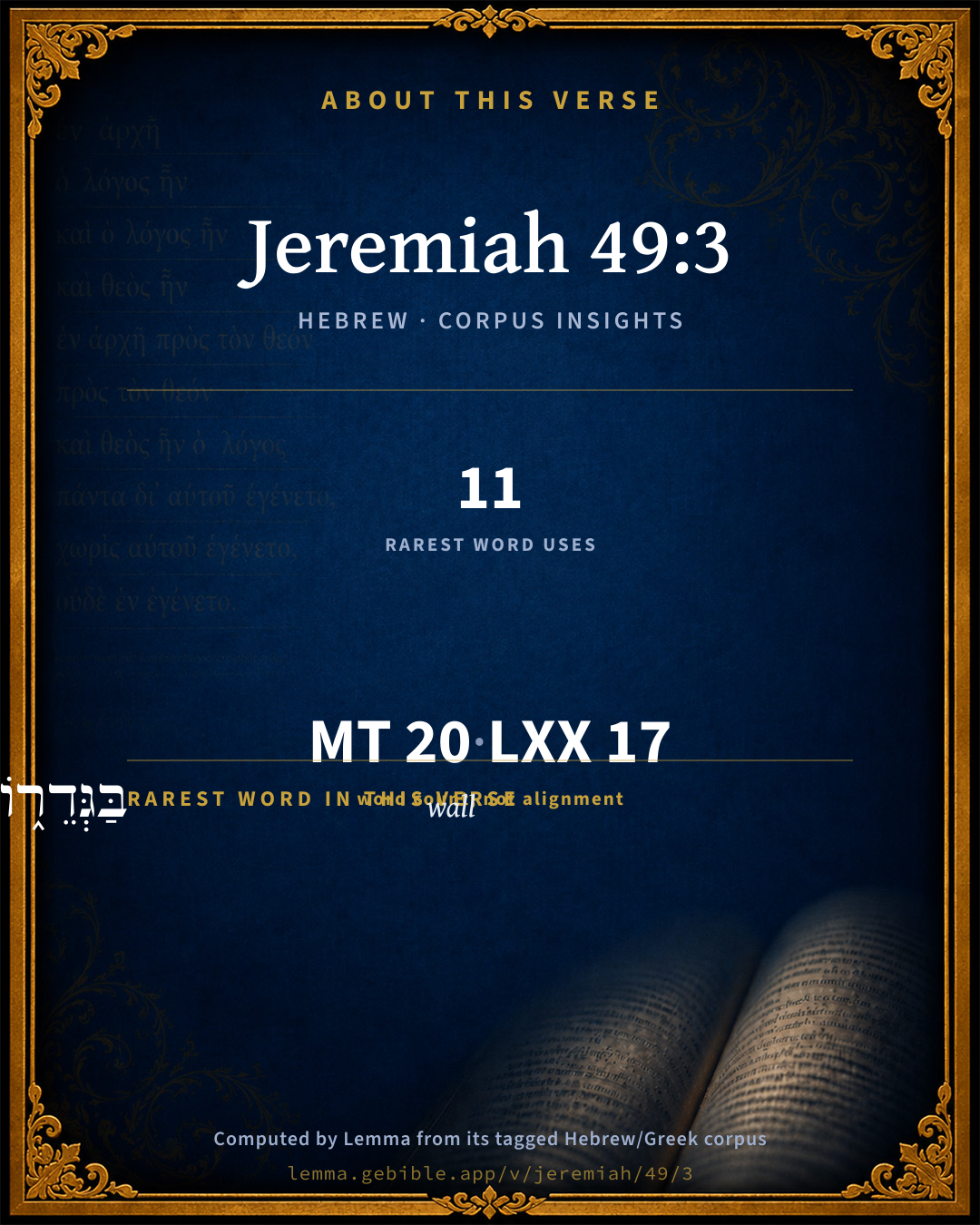
These counts appear in no published source. They are computed here, from the morphology-tagged text and Lemma’s own curated glosses. What Lemma adds →

20
words
19
distinct lemmas
Prophets
section

Notable vocabulary

The rarest word here is בַּגְּדֵר֑וֹת wall H1448 — appearing just 11 times in the whole Hebrew Bible.

Shared distinctive vocabulary

בַּגְּדֵר֑וֹת wall H1448 occurs in 11 verses of the Hebrew Bible. Also found in:

Grammatical profile

  • 7 verbs
  • 10 nouns
  • 2 conjunctions
  • 1 adverb

Verb forms

  • הֵילִ֨ילִי Hiphil · Imperative
  • שֻׁדְּדָה Pual · Perfect
  • צְעַקְנָה֮ Qal · Imperative
  • חֲגֹ֣רְנָה Qal · Imperative
  • סְפֹ֕דְנָה Qal · Imperative
  • וְהִתְשׁוֹטַ֖טְנָה Hithpolel · Imperative
  • יֵלֵ֔ךְ Qal · Imperfect

Repetition

A word recurs within this verse — often emphatic in Hebrew:

  • כִּ֣י that H3588 ×2

Hebrew & Septuagint length

In the original languages it is 20 Hebrew tokens and 17 Greek tokens — but the two are counted differently (Hebrew bundles its prefixes and suffixes into one token; the Greek is in lemma form), so that isn’t a like-for-like length.

Cross-references

24

Topical passages linked to Jeremiah 49:3 in the Treasury of Scripture Knowledge — connected by theme and wording, ordered by reader-vote popularity; previews shown in the World English Bible.

  • Jeremiah 48:7 For, because you have trusted in your works and in your treasures, you also shall be taken: and Chemosh shall go forth into captivity, his priests and his princes together.
  • Isaiah 15:2 They are gone up to Bayith, and to Dibon, to the high places, to weep: Moab wails over Nebo, and over Medeba; on all their heads is baldness, every beard is cut off.
  • Jeremiah 48:37 For every head is bald, and every beard clipped: on all the hands are cuttings, and on the loins sackcloth.
  • 1 Kings 11:5 For Solomon went after Ashtoreth the goddess of the Sidonians, and after Milcom the abomination of the Ammonites.
  • 1 Kings 11:33 because that they have forsaken me, and have worshiped Ashtoreth the goddess of the Sidonians, Chemosh the god of Moab, and Milcom the god of the children of Ammon; and they have not walked in my ways, to do that which is right in my eyes, and [to keep] my statutes and my ordinances, as did David his father.
  • 2 Kings 23:13 The high places that were before Jerusalem, which were on the right hand of the mountain of corruption, which Solomon the king of Israel had built for Ashtoreth the abomination of the Sidonians, and for Chemosh the abomination of Moab, and for Milcom the abomination of the children of Ammon, did the king defile.
  • Jeremiah 4:8 For this gird you with sackcloth, lament and wail; for the fierce anger of Yahweh hasn't turned back from us.
  • Jeremiah 46:25 Yahweh of Hosts, the God of Israel, says: Behold, I will punish Amon of No, and Pharaoh, and Egypt, with her gods, and her kings; even Pharaoh, and those who trust in him:
  • Joshua 8:28 So Joshua burnt Ai, and made it a heap forever, even a desolation, to this day.
  • Job 30:3–7 They are gaunt from lack and famine. They gnaw the dry ground, in the gloom of waste and desolation.
  • Isaiah 13:6 Wail; for the day of Yahweh is at hand; as destruction from the Almighty shall it come.
  • Isaiah 14:31 Howl, gate; cry, city; you are melted away, Philistia, all of you; for there comes a smoke out of the north, and there is no straggler in his ranks.
  • Isaiah 16:7 Therefore shall Moab wail for Moab, everyone shall wail: for the raisin-cakes of Kir Hareseth shall you mourn, utterly stricken.
  • Isaiah 23:1 The burden of Tyre. Howl, you ships of Tarshish; for it is laid waste, so that there is no house, no entering in: from the land of Kittim it is revealed to them.
  • Isaiah 23:6 Pass over to Tarshish; wail, you inhabitants of the coast.
  • Isaiah 32:11–12 Tremble, you women who are at ease; be troubled, you careless ones; strip yourselves, and make yourselves naked, and gird [sackcloth] on your loins.
  • Jeremiah 6:26 Daughter of my people, gird you with sackcloth, and wallow yourself in ashes: make you mourning, as for an only son, most bitter lamentation; for the destroyer shall suddenly come on us.
  • Jeremiah 48:2 The praise of Moab is no more; in Heshbon they have devised evil against her: Come, and let us cut her off from being a nation. You also, Madmen, shall be brought to silence: the sword shall pursue you.
  • Jeremiah 48:20 Moab is disappointed; for it is broken down: wail and cry; tell you it by the Arnon, that Moab is laid waste.
  • Jeremiah 49:1 Of the children of Ammon. Thus says Yahweh: Has Israel no sons? has he no heir? why then does Malcam possess Gad, and his people well in the cities of it?
  • Jeremiah 51:8 Babylon is suddenly fallen and destroyed: wail for her; take balm for her pain, if so be she may be healed.
  • Amos 1:15 And their king will go into captivity, He and his princes together," says Yahweh.
  • Zephaniah 1:5 those who worship the host of the sky on the housetops, those who worship and swear by Yahweh and also swear by Malcam,
  • James 5:1 Come now, you rich, weep and howl for your miseries that are coming on you.

Cross-references courtesy of OpenBible.info (CC BY 4.0).

Hebrew and Greek witnesses Masoretic Hebrew ↔ Greek Septuagint

The same verse in the two great witnesses to the Old Testament, shown verse-for-verse.

These are two independent witnesses, not word-aligned to each other, and the Septuagint is shown in lemma (dictionary) form.

Hebrew Jeremiah 49:3 Masoretic · Westminster Leningrad Codex

הֵילִ֨ילִי חֶשְׁבּ֜וֹן כִּ֣י שֻׁדְּדָה עַ֗י צְעַקְנָה֮ בְּנ֣וֹת רַבָּה֒ חֲגֹ֣רְנָה שַׂקִּ֔ים סְפֹ֕דְנָה וְהִתְשׁוֹטַ֖טְנָה בַּגְּדֵר֑וֹת כִּ֤י מַלְכָּם֙ בַּגּוֹלָ֣ה יֵלֵ֔ךְ כֹּהֲנָ֥יו וְשָׂרָ֖יו יַחְדָּֽיו

Wail, Heshbon, for Ai is laid waste; cry, you daughters of Rabbah, gird you with sackcloth: lament, and run back and forth among the fences; for Malcam shall go into captivity, his priests and his princes together.

World English Bible · Public Domain

Greek LXX Structure differs

In the Septuagint, Jeremiah is about an eighth shorter than the Hebrew and arranges its material differently — the Oracles Against the Nations (Hebrew chapters 46–51) appear in the middle of the Greek book, after 25:13. Because the chapter and verse boundaries do not line up, a verse-for-verse comparison with the Hebrew is not shown.

A verse-for-verse comparison isn’t shown here because the chapters and verses don’t line up. Switch to the LXX edition with the MT / LXX toggle above to read the Greek directly.

Hebrew: Westminster Leningrad Codex (CC BY 4.0). Greek: Septuagint (public domain); English from a public-domain English Septuagint. How the Septuagint differs from the Hebrew →

Targum (Aramaic paraphrase)

1

The Targum is the ancient Jewish Aramaic paraphrase of the Hebrew Scriptures — an interpretive translation, not the Hebrew text itself. Onkelos (literal) and Pseudo-Jonathan (expansive) render the Torah, and Jonathan the Prophets. Coverage is partial: where no permissively-licensed English translation exists for a verse, only the Aramaic is shown. This is verse-level text, not a word-by-word alignment to the Hebrew.

  1. Targum Jonathan Prophets (Joshua–Malachi)
    אַיְלִילוּ יַתְבֵי חֶשְׁבּוֹן אֲרֵי אִתְבְּזִיזַת עֵי צְוָוחוּ יַתְבֵי כַפְרָנֵי רַבָּא אֶסָרוּ סַקִין סְפוּדוּ וְאִתְהַמְמוּן בְּסִיָען אֲרֵי מַלְכְּהוֹן בְּגָלוּתָא יְהַךְ פַּלְחוֹהִי וְרַבְרְבוֹהִי כַּחֲדָא:

    (no public-domain English translation for this verse)

    Targum Jonathan — Aramaic: “Mikraot Gedolot” (public domain). English: “Sefaria Community Translation” (CC0 1.0 (public-domain dedication)); “London "Chaldee Paraphrase," 1871” (public domain). Text via Sefaria.

Commentary

Notes on Jeremiah 49:3 from classic Christian and Jewish commentators (each source and its license shown beneath its notes). The classic Christian expositions comment on the surrounding passage and are grouped to its opening verse, so a note may address several verses; the Jewish commentaries on the Tanakh (Rashi and others) are per-verse, so they appear only where the commentator wrote on this verse.

Lemma curates 59 commentaries, every one of them public domain or Creative Commons licensed, each selected and text-cleaned for this edition rather than reprinted as found. About our sources →

Trapp's Complete Commentary

John Trapp

Jer 49:3 Howl, O Heshbon, for Ai is spoiled: cry, ye daughters of Rabbah, gird you with sackcloth; lament, and run to and fro by the hedges; for their king shall go into captivity, [and] his priests and his princes together.

Ver. 3. Howl, O Heshbon.] A city of the Gadites, but seized upon, it seemeth, first by the Ammonites, and then by the Moabites. {Jer 48:2; Jer 48:24-25}

For Ai is spoiled.] Not that Ai, Jos 7:1, but another of that name beyond Jordan - Gaja, Ptolemy calleth it.

And run to and fro by the hedges.] Hide you behind the hedges.

For their king.] Or, Malcham their idol - as Chemosh. {Jer 48:7}

John Trapp, A Commentary or Exposition upon All the Books of the Old and New Testament (1647–1656) — public domain. Text from a community e-Sword module.

Joseph Benson's Commentary

Jer 49:3. Howl, O Heshbon, for Ai is spoiled — This “Ai must be a different city from that taken by Joshua, chap. 8., which lay on the west side of Jordan. Grotius mentions another city, called Gaia by Ptolemy; which, being near Heshbon, the destruction of it was matter of concern to the neighbouring city.” Lament, and run to and fro by the hedges — Try to hide yourselves in the thickets, and remove from one place to another, for fear of being discovered. But by גדרות, here rendered hedges, Blaney thinks, are meant, “those fences or enclosures round the lesser towns, which served to secure them against thieves and robbers, but were not dignified with the name of walls, capable of resisting the attack of a regular enemy.” The psalmist, he supposes, distinguishes these from the fortifications of cities, Psa 89:40, terming the former גדרתיו, his fences, and the latter מבצריו, his strong holds, or walled fortresses. According to this interpretation, therefore, the prophet here foretels that “the inhabitants of the lesser towns should run to and fro, like persons distracted with fear, within their enclosures, not daring to step beyond them, lest they should fall in with the enemy, whose approach they dreaded.” For their king — Or, Milcom, their idol; shall go into captivity, and his priests and princes together — “Here the same is said of Milcom,” says Blaney, “as was of Chemosh, chap. Jer 48:7, which shows that the word is properly used as the name of the Ammonitish idol.”

Joseph Benson's Commentary on the Old and New Testaments (1811–1818) — public domain. Text from a community e-Sword module.

Tyndale Open Study Notes

Tyndale Open Resources

49:3 The Ammonites might have thought that their deity, Molech, was powerful. However, the coming invader would take this idol into exile with his priests and officials; their ritual magic would be exposed as a fraud.

Tyndale Open Study Notes — © Tyndale Open Resources, licensed CC BY-SA 4.0. Text via the HelloAO Bible API.

Jamieson, Fausset & Brown

Robert Jamieson, A. R. Fausset & David Brown

Heshbon . . . Ai--Nebuchadnezzar, coming from the north, first attacked Ammon, then its brother and neighbor, Moab. As Ai of Ammon had already suffered destruction, Heshbon of Moab being near it might well fear the same fate.

hedges--Their cities being destroyed, the outcasts have no place of shelter save behind the "hedges" of vineyards and gardens; or else the enclosures of their villages.

their king--Melchom, the idol, as the mention of "his priests" shows (compare Jer 48:7).

Jamieson, Fausset & Brown — Commentary Critical and Explanatory on the Whole Bible (1871) — public domain (CC PDM 1.0). Text via the HelloAO Bible API.

Adam Clarke's Commentary

Verse 3. Run to and fro by the hedges] It is supposed that this may refer to the women making lamentations for the dead, that were in general buried by the walls of their gardens; but others think that it refers to the smaller cities or villages, called here the daughters of Rabbah, the metropolis; the inhabitants of which are exhorted to seek safety somewhere else, as none can be expected from them, now that the enemy is at hand.

Adam Clarke's Commentary on the Bible (1810–1826) — public domain. Text from a community e-Sword/MySword module.

John Calvin's Commentaries

The Prophet now triumphs, as it were, over the land of Ammon, and, according to his accustomed manner, as we have before seen; for had the prophets spoken without metaphors, and simply narrated the things treated of by them, their words would have been frigid and inefficient, and would not have penetrated into the hearts of men. This, then, is the reason why the prophets adopted an elevated style, and adorned with grandeur their prophecies; for they never, like rhetoricians, affected eloquence, but necessity so urged them, that they represented to the eyes those things which they could not otherwise form a conception of in their minds. On this subject we have spoken often already; but I am again constrained briefly to touch on it, because those who are not well acquainted with Scripture, and do not understand the design of the Holy Spirit, may think that words only are here poured forth. But when we duly weigh what I have said, then we shall readily acknowledge that the Prophet did not, without reason, enlarge on what he had previously said.

Howl, thou Heshbon, he says, for Ai is laid waste These were two neighboring cities: hence he exhorts Heshbon to howl on seeing the overthrow of another city. He then adds, Cry, or cry aloud, ye daughters of Rabbah He again repeats what he had before touched upon as to the city Rabbah. Gird yourselves, he says, with sackcloth, or put on sackcloth. He does not here exhort the citizens of Rabbah to repentance, but he speaks according to the customs of the people, as it has been stated elsewhere. Sackcloth was, indeed, a symbol of penitence; when the miserable wished humbly to flee to God’s mercy, and to confess their sins, they put on sackcloth. But the unbelieving imitated the faithful without discretion or judgment. Hence it was, that they scattered ashes on their heads, that without any reason they put on sackcloth. What was then commonly done is now mentioned by Jeremiah; Put on sackcloth, he says, lament and run here and there by the fences

He afterwards adds in the third person, for gone is their king into captivity. He expressed this, that the Israelites might know, that though that kingdom flourished for a time, yet the day of which the Prophet had spoken would come, when the condition of the Ammonites would be nothing better than that of the Israelites; whose king, as it was known, had been driven into exile, together with the priests and princes. The Prophet now denounces the same punishment on the Ammonites, that not only their king would be driven into another land, as a captive, but also their princes and their priests. It follows —

John Calvin's Commentaries (1540-1563) — public domain. Text from the Calvin Translation Society English edition (1840s-50s) via the Christian Classics Ethereal Library (ccel.org). Calvin's coverage is partial (roughly two-thirds of the Bible); uncommented books and verses are honest gaps, never fabricated. The 19th-century editor's footnotes and remarks are omitted so the notes are faithfully Calvin's own voice.

Ellicott's Commentary for English Readers

(3) Howl, O Heshbon, for Ai is spoiled.—Heshbon has appeared in Jer_48:2; Jer_48:45, as connected with the fortunes of Moab, but it was strictly an Ammonite city. The “Ai” here is obviously not the city near Jericho of Jos_8:28, and unless we assume an error in the text (“Ai” for “Ar”= city), we must infer the existence of a Trans-jordanic city of the same name.

Run to and fro by the hedges.—Hedges, in the English sense of the word, have never been common in the East, and the word here denotes either the palings round the sheep-folds, or the walls round the vineyards of the villages that are described as the “daughters of Rabbah.” The word is never used for the walls of a city, but appears in Num_22:24; Num_32:16; Num_32:24; Num_32:36 in the sense of “sheep-folds.”

Their king shall go into captivity.—Better, as before, Melcom. As in Jer_48:7, the captivity of the national deity with his priests (the fact that they are named is decisive as to the meaning) involves the captivity of the people.

A Bible Commentary for English Readers, edited by Charles John Ellicott (1878–1897) — public domain. Text from a community e-Sword module.

The Cambridge Bible for Schools and Colleges

gen. ed. J. J. S. Perowne

3. Howl, O Heshbon] Heshbon was a Moabite city (Jer_48:2; Jer_48:34; Jer_48:45), and an Ammonite Ai is otherwise unknown. Hence conjectural emendations are (a) to read (with Co.) for “Heshbon” Ammon (i.e. its inhabitants), and for “Ai” the city, or (b) emending “Ai” as in (a), to read for “Heshbon” (with a considerable change of the word in MT.) the palace (Du.). Neither (a) nor (b) however is quite satisfactory.

among the fences] The Heb. means walls, such as enclose sheepfolds. Probably it needs emendation, and Gi., Du. and Co. all recognise that what we expect is something indicative of mourning. Co.’s conjecture makes the least change in MT., viz. in mourning attire.

Malcam shall go, etc.] See Jer_48:7 and cp. Amo_1:15.

The Cambridge Bible for Schools and Colleges (gen. ed. J. J. S. Perowne; Cambridge University Press, 1878–1918) — public domain. Text from a community e-Sword module.

John Gill's Exposition

Howl, O Heshbon,.... Which was a city of Moab, though it formerly belonged to the Amorites; see Jer 48:2; it was upon the border of Ammon, and near to Ai, now destroyed; and therefore is called upon to howl and lament, because its destruction also was near at hand, and might be expected; hence Kimchi gathers, that the Ammonites were destroyed before the Moabites: but some have thought that Heshbon was a double city, divided by a river, which ran through it; and that that city which was on one side of the river belonged to Moab, and that on the other side to Ammon:

for Ai is spoiled; not that which was near Jericho in the land of Canaan, but a city in the land of Ammon, thought to be the Gaia of Ptolemy; this seems to be the first city in the country of Ammon that Nebuchadnezzar would lay waste:

cry, ye daughters of Rabbah; the royal city before mentioned; See Gill on Jer 49:2; either the inhabitants of it, particularly the women, especially the younger women, who would be in the utmost distress on hearing the enemy was so near them, and what had befallen Ai; or the villages about Rabbah, as Kimchi interprets it; that is, as the Targum,

"the inhabitants of the villages of Rabbah:''

gird ye with sackcloth; as a token of calamity and mourning for it, as was usual:

lament, and run to and fro by the hedges; which Jarchi, Kimchi, and Ben Melech, understand of the enclosures or fences of villages, like those of gardens, fields, and folds, in distinction from walls of cities, and fortified places; but rather it signifies the hedges in the fields, whither, being drove from their habitations, they would seek unto for shelter, and run about among them for safety, lamenting their unhappy case:

for their king shall go into captivity; be taken and carried captive; either their principal governor; or rather Milcom their god, since it follows:

and his priests and his princes together; both such as offered sacrifices to him, and attended on and supported his worship: the same is said of Chemosh, the god of the Moabites, Jer 48:7.

John Gill's Exposition of the Whole Bible (1746–1763) — public domain (CC PDM 1.0). Text via the HelloAO Bible API.

Albert Barnes' Notes on the Bible

Ai - Not the town on the west of the Jordan Jos 7:2; a place not mentioned elsewhere. For Ai some read Ar.

Hedges - Fields were not divided by hedges until recent times; the term probably means the walls which enclose the vineyards Num 22:24.

Albert Barnes' Notes on the Bible (1834–1885) — public domain. Text from a community e-Sword/MySword module.

Haydock's Catholic Bible Commentary

Hai, or Je-abarim. Both these cities pertained also to Moab. --- Hedges. Hebrew Gederoth, may be the city Gadara. --- Melchom, or Moloc, who claimed dominion over this people. If they had used their reason, they must have seen that he was no god, since the Lord disposed of him as he pleased so long before.

George Leo Haydock (1774–1849), Haydock's Catholic Family Bible and Commentary, 1859 edition — public domain. Excludes Psalms (Douay-Rheims chapter numbering differs from Protestant) and Deuterocanonical books (Catholic canon only).

Matthew Poole's English Annotations

Heshbon was formerly a city of the Amorites, of whom Sihon was king, who resided here (but it appears by Jer 49:26 that it was taken from Moab); it is probable that it was at this time a city of Moab: the prophet calls to them to howl

for Ai a city of the Ammonites, not the same mentioned Jos 7:2, for that was on the other side of Jordan. It is uncertain whether by the

daughters of Rabbah be to be understood other lesser cities, or the younger women that inhabited Rabbah: he calls to them all to mourn; and for all the indications or signs of mourning, such as girding with sackcloth, running up and down, like persons distracted, by the hedges, where they might be hidden, and not so easily seen. For they shall all go together into captivity; their Melcom, which may signify their idol to whom they gave that name, or their

king, or else their supreme magistrate, with their

priests and nobles, all orders of persons.

Matthew Poole's English Annotations on the Holy Bible (1683–1685) — public domain. Text from a community e-Sword/MySword module.

Whedon's Commentary on the Bible

Daniel D. Whedon

3. Heshbon was formerly the residence of Sihon, king of the Amorites, but it seems at this time to have been in possession of the Ammonites. No city Ai is known to have been in this region, and there is serious, but certainly no insuperable, difficulty in this fact. Some conjectures of change in the text have been made, but they should not be entertained. We have no list of Ammonite cities, and so no presumption against the existence of such a city arises from our ignorance.

Hedges — Some understand sheep-folds, but this is an undue limitation of the original word. Enclosures, embracing sheep-folds, vineyards, etc., are meant.

Their king — Margin. Melcom, the name of their tutelar divinity. That this is right the mention of his priests almost demonstrates.

Daniel D. Whedon (gen. ed.), Commentary on the Old and New Testaments (1874–1909) — public domain. Text from a community e-Sword module.

The Pulpit Commentary

Heshbon. Here mentioned as de jure a Gadite, but de facto an Ammonitish, town; in Num_21:26 it appears as "the city of Sihon" the Amorite. In Isa_15:4 and Isa_16:9 it is reckoned to the Moabites. There was a continual warfare between the neighbouring tribes of Reuben and Gad on the one hand, and the Moabites and Ammonites on the other. Let Heshbon lament, because Ai is spoiled. The introduction of At, which is only known to us as a Canaanitish town, near Bethel, on the wrong side of the Jordan for Moab, is startling. It is replied that we have no list of the Ammonitish cities, and that there may have been another town named At. The reply is valid; but loaves a second difficulty untouched, viz. that the mention of a third place destroys the continuity of thought. First, we are made acquainted with the fall of Rabbah; then Heshbon (probably the second place in the country) is called upon to wail because x has been taken by storm; then the populations of the "daughter" cities are summoned to join in the lamentation over Rabbah; is it not reasonable to conclude that the subject of the mourning is one and the same? Now, it is well known that the received text abounds in small errors arising from the confusion of similar Hebrew letters, and that among the letters most easily confounded are yod and resh. Is it not an obvious conclusion that for Ai we should rather read Ar ("the city"), a name as suitable for the capital of Ammon as for that of Moab? It is true that we have no example elsewhere of Rabbah being called by the name of Ar; but in 2Sa_10:3, 14 it is described as "the city," and we have to be on our guard against the argument a silentio that favourite weapon of destructive criticism! Since a conjecture must be made, it is more respectful to the prophet to choose the one which is most suitable to the context. Daughters of Rabbah; i.e. unwalled towns (as in ver. 2). Run to and fro by the hedges; rather, by the enclosures; i.e. wander about in the open country, seeking a lodging place in the enclosures of the sheepfolds (so Num_32:24, Hebrew) or the vineyards. (so Num_22:24, Hebrew) Their king; or, Milcom (see on ver. 1).

The Pulpit Commentary (1880–1919), ed. H.D.M. Spence-Jones & Joseph S. Exell — public domain. Text from a community e-Sword module.

John Wesley's Explanatory Notes

Ai - A city of the Ammonites, not the same mentioned, Josh. vii, 2, for that was on the other side Jordan. By the hedges - Where they might be hidden, and not so easily seen.

John Wesley, Explanatory Notes Upon the Whole Bible (1754–1765) — public domain. Text via the GEBible commentary corpus.

unfoldingWord translationNotes

Door43 World Missions Community

Howl in lament

"Cry loudly and weep"

Heshbon

Translate the name of this city as you did in Jeremiah 48:2. Here "Heshbon" represents the people. AT: "people of Heshbon" (See: How to Translate Names and Metonymy)

for Ai will be devastated

This can be stated in active form. AT: "for your enemies will devastate Ai" (See: Active or Passive)

daughters of Rabbah

Possible meanings are 1) "daughters" represent the women who live in Rabbah. AT: "women of Rabbah" or 2) all the people in general are spoken of as if they are the daughters of Rabbah. AT: "people of Rabbah" (See: Metaphor)

for Molech is going into captivity

"for your enemies will take your god Molech captive." This means the enemies will take the idol that represents Molech back to their land.

Why do you brag about your valleys ... daughter?

Yahweh uses a question to scold the people for bragging about the large amount of fruit that grows in their valleys. This rhetorical question can be translated as a statement. AT: "Do not be proud of your valleys ... daughter." (See: Rhetorical Question)

Why do you brag about your valleys, your valleys that are so fruitful

Some versions of the Bible read, "Why do you brag about your strength, your strength which is ebbing away"

faithless daughter

Here, the people of Ammon are spoken of as if they were a daughter. AT: "faithless people" or "rebellious people" (See: Metaphor)

say, 'Who will come against me?'

The Ammonites use this question to state that they do not believe anyone can defeat them. It can be reworded as an indirect statement. AT: "falsely think that no one can defeat you." (See: Rhetorical Question and Direct and Indirect Quotations)

translationWords

lament

Ai

devastate

sackcloth

captive

priest

faithless

trust

unfoldingWord translationNotes — © Distant Shores Media and the Door43 World Missions Community, licensed CC BY-SA 4.0. Source: git.door43.org/Door43/en_tn.

Rashi

Rabbi Shlomo Yitzchaki (Rashi)

for Ai has been spoiled Ai, that is near it, [has been spoiled,] and it is of the land of Ammon.

O villages of Rabbah Rabbah of the children of Ammon.

and mobilize in companies Heb. והתשוטטנה בגדרות. Jonathan renders: ואתהמכוּן בסיעָן, mobilize in companies. He interprets והתשוטטנה as an expression of armies that run to and fro (משוטטים); and גדרות is an expression of sheepcotes full of flocks, and can be interpreted as “and roll in the dung of the sheepcotes,” an expression of contempt. [Onkelos translates:] “And Esau despised” (Gen. 25:34), ושט עשו.

Rashi on the Tanakh — English translations: “The Judaica Press complete Tanach with Rashi, translated by A. J. Rosenberg” (CC BY 4.0); “Pentateuch with Rashi's commentary by M. Rosenbaum and A.M. Silbermann, 1929-1934” (public domain); “The Metsudah Tanach series, Lakewood, N.J” (CC BY 4.0); and “The Book of Joshua, Metsudah Publications, 1997” (CC BY 4.0). Text via Sefaria.

Lesson kit

Teaching starters — assembled from the data on this page, not authored interpretation. Every prompt links to the verse data it draws on. Edit before teaching.

Jeremiah, in the Prophets, opens this verse with 20 words (19 distinct Hebrew lemmas). Its most distinctive word is gᵉdêrâh (“wall”). A historical commentator’s framing appears above. Read the whole chapter for the surrounding context.

Discussion questions

  1. How does “wall” (gᵉdêrâh) shape what this verse is saying?
  2. How does Numbers 32:16, which shares the word «wall», read alongside this verse?
  3. What does the repetition of “that” (2× in this one verse) do in this verse?
  4. The translations on this page render this verse differently — a whole-verse word diff, not a word-by-word alignment. What might account for the different wordings?
  5. «הֵילִ֨ילִי» is a Hiphil Imperative verb. How does that grammatical form shape the action described?
  6. Compare how Trapp's Complete Commentary and Joseph Benson's Commentary read this verse. Where do they agree or differ?

Things to notice

Reading settings

Reading text

Shown beneath each verse's original-language words.

Old Testament
Old Testament edition

Read the OT as the Masoretic Hebrew (MT) or the Greek Septuagint (LXX).

English shown for the Greek Septuagint (in the Hebrew ↔ Greek comparison).

Comparing translations? Open the Compare panel on any verse page to stack up to four side by side.