Psalms 92:9

Hebrew (Westminster Leningrad Codex) Psalms 92:9 appears in the Hebrew Old Testament. The text above is from the Westminster Leningrad Codex. Each word links to its Strong’s number, a concise gloss, and parsing drawn from the Open Scriptures Hebrew Bible morphology. Click any word for its full Brown-Driver-Briggs (BDB) entry.
Download image
Cite this verse

Psalms 92:9 (World English Bible). Public Domain. Lemma interlinear Bible study tool, https://lemma.gebible.app/v/psalms/92/9.

Show BibTeX & RIS
BibTeX
RIS
English Translation
For, behold, your enemies, Yahweh, For, behold, your enemies shall perish. All the evil-doers will be scattered.
World English Bible · Public Domain
Download a study sheet

One document with this verse’s original text, its word-by-word gloss line, the meaning frame, cross-references with their text, attributed commentary, and full source and license credits — printable, and it pastes into notes with its structure intact.

This verse Autodidact and up

Study sheet (.html) Plain text (.txt)

A passage Seminary Student

Up to 50 verses in one chapter. A passage sheet keeps up to 6 commentary sources and 12 cross-references per verse, in the order this page ranks them, and says so on the sheet whenever that leaves anything out. Ask for a single verse and you get the Autodidact verse sheet above.

Everything on this page stays free to read, with no account — the sheet is a download of what is already on screen, not access to it.

Want to remove ads? Support Godless Engineer
Compare translations 3

The same verse in 3 English versions, stacked beneath the original-language interlinear above. Click any original word for its lexicon entry.

Each is an independent rendering of the whole verse — the interlinear is not word-aligned to these translations.

Highlighted words mark where these versions differ — a whole-verse word diff, not a word-by-word alignment.

  • World English Bible Public Domain
    For, behold, your enemies, Yahweh, For, behold, your enemies shall perish. All the evil-doers will be scattered.
  • King James Version Public Domain
    For, lo, thine enemies, O LORD, for, lo, thine enemies shall perish; all the workers of iniquity shall be scattered.
  • unfoldingWord Literal Text CC BY-SA 4.0
    For behold your enemies, Yahweh! For behold your enemies—they will perish! All those who do evil will be scattered.

unfoldingWord Literal Text — © unfoldingWord, licensed CC BY-SA 4.0. Word-aligned USFM3 via Door43 (git.door43.org/unfoldingWord/en_ult).

Versions to compare (up to 4)

3 of 4 selected

Show all 18 translations

Every available English version of this verse, each an independent rendering of the whole verse.

  • World English Bible Public Domain
    For, behold, your enemies, Yahweh, For, behold, your enemies shall perish. All the evil-doers will be scattered.
  • Berean Standard Bible Public Domain
    For surely Your enemies, O LORD, surely Your enemies will perish; all evildoers will be scattered.
  • Majority Standard Bible Public Domain
    For surely Your enemies, O LORD, surely Your enemies will perish; all evildoers will be scattered.
  • King James Version Public Domain
    For, lo, thine enemies, O LORD, for, lo, thine enemies shall perish; all the workers of iniquity shall be scattered.
  • American Standard Version (1901) Public Domain
    For, lo, thine enemies, O Jehovah, For, lo, thine enemies shall perish; All the workers of iniquity shall be scattered.
  • Revised Version (1885) Public Domain
    For, lo, thine enemies, O LORD, for, lo, thine enemies shall perish; all the workers of iniquity shall be scattered.
  • Geneva Bible (1599) Public Domain
    For loe, thine enemies, O Lord: for loe, thine enemies shall perish: all the workers of iniquitie shall be destroyed.
  • Douay-Rheims (1899) Public Domain
    but thou, O Lord, art most high for evermore.
  • Young's Literal Translation Public Domain
    For, lo, Thine enemies, O Jehovah, For, lo, Thine enemies, do perish, Separate themselves do all workers of iniquity.
  • Literal Standard Version CC BY-SA 4.0
    For behold, Your enemies, O YHWH, || For behold, Your enemies perish, || All workers of iniquity separate themselves.
  • Unlocked Literal Bible CC BY-SA 4.0
    Indeed, look at your enemies, Yahweh! Indeed, look at your enemies. They will perish! All those who do evil will be scattered.
  • unfoldingWord Literal Text CC BY-SA 4.0
    For behold your enemies, Yahweh! For behold your enemies—they will perish! All those who do evil will be scattered.
  • Darby Bible Public Domain
    For lo, thine enemies, O Jehovah, for lo, thine enemies shall perish; all the workers of iniquity shall be scattered.
  • World Messianic Bible Public Domain
    For behold, your enemies, LORD, for behold, your enemies shall perish. All the evildoers will be scattered.
  • Webster's Bible Public Domain
    \\92:8\\But thou, LORD, art most high for evermore.
  • Free Bible Version CC BY-SA 4.0
    Your enemies, Lord, your enemies will die; everyone who does evil will be destroyed!
  • Bible in Basic English Public Domain
    For see! your haters, O Lord, will be put to death; all the workers of evil will be put to flight;
  • JPS Tanakh (1917) Public Domain
    (92-10) For, lo, Thine enemies, O LORD, for, lo, Thine enemies shall perish: all the workers of iniquity shall be scattered.

Literal Standard Version (2020), Covenant Press — licensed CC BY-SA 4.0. Text via the HelloAO Bible API (eBible.org). Unlocked Literal Bible (unfoldingWord) — licensed CC BY-SA 4.0. Text via the HelloAO Bible API (eBible.org). unfoldingWord Literal Text — © unfoldingWord, licensed CC BY-SA 4.0. Word-aligned USFM3 via Door43 (git.door43.org/unfoldingWord/en_ult). Free Bible Version, Dr. Jonathan Gallagher — licensed CC BY-SA 4.0. Text via the HelloAO Bible API (eBible.org).

Word by word

More ways to search: Search by grammar → Find every occurrence → Compare this word →

Practice this passage: Drill this verse → Learn its vocabulary →

יִ֝תְפָּרְד֗וּ
pârad
H6504
“to divide”
Verb, Hithpael, Imperfect, 3rd Person, Masculine, Plural
Part of Speech
Verb
Stem
Hithpael
Form
Imperfect
Person
3rd Person
Gender
Masculine
Number
Plural
Full BDB Definition

Origin: a primitive root

TWOT: 1806

to separate, divide - (Qal) to divide - (Niphal) - to divide, separate - to be divided, be separated - (Piel) to be separated - (Pual) to be divided - (Hiphil) - to divide, separate - to make a division, make a separation - (Hithpael) to be divided, be separated, get separated
  1. כִּ֤י kîy H3588 “that” Conjunction
  2. הִנֵּ֪ה hinnêh H2009 “behold” Particle, Demonstrative
  3. אֹיְבֶ֡יךָ ʼôyêb H341 “enemy · you” Verb, Qal, Participle Active, Masculine, Plural, Construct + Suffix, Personal, 2nd Person, Masculine, Singular
  4. יְֽהוָ֗ה Yᵉhôvâh H3068 “LORD” Noun, Proper
  5. כִּֽי kîy H3588 “that” Conjunction
  6. הִנֵּ֣ה hinnêh H2009 “behold” Particle, Demonstrative
  7. אֹיְבֶ֣יךָ ʼôyêb H341 “enemy · you” Verb, Qal, Participle Active, Masculine, Plural, Construct + Suffix, Personal, 2nd Person, Masculine, Singular
  8. יֹאבֵ֑דוּ ʼâbad H6 “to perish” Verb, Qal, Imperfect, 3rd Person, Masculine, Plural
  9. כָּל kôl H3605 “all of” Noun, Common, Masculine, Singular, Construct
  10. פֹּ֥עֲלֵי pâʻal H6466 “doing” Verb, Qal, Participle Active, Masculine, Plural, Construct
  11. אָֽוֶן ʼâven H205 “trouble” Noun, Common, Masculine, Singular, Absolute

About this verse

These counts appear in no published source. They are computed here, from the morphology-tagged text and Lemma’s own curated glosses. What Lemma adds →

12
words
9
distinct lemmas
Wisdom
section

Shared distinctive vocabulary

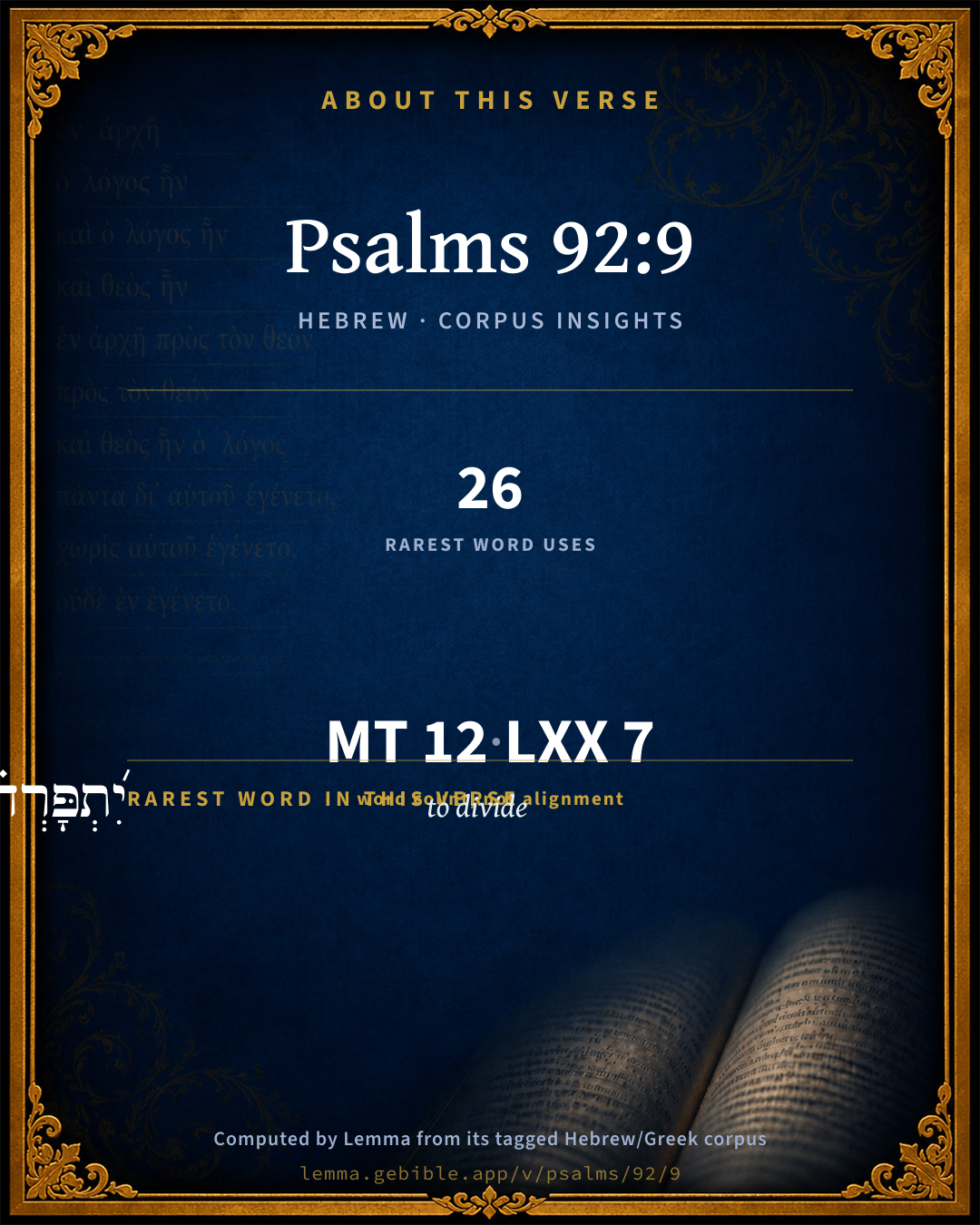
יִ֝תְפָּרְד֗וּ to divide H6504 occurs in 26 verses of the Hebrew Bible. Also found in:

Grammatical profile

  • 5 verbs
  • 3 nouns
  • 2 conjunctions
  • 2 particles

Verb forms

  • אֹיְבֶ֡יךָ Qal · Participle Active
  • אֹיְבֶ֣יךָ Qal · Participle Active
  • יֹאבֵ֑דוּ Qal · Imperfect
  • יִ֝תְפָּרְד֗וּ Hithpael · Imperfect
  • פֹּ֥עֲלֵי Qal · Participle Active

Repetition

Words recur within this verse — often emphatic in Hebrew:

  • הִנֵּ֪ה behold H2009 ×2
  • אֹיְבֶ֡יךָ enemy H341 ×2
  • כִּ֤י that H3588 ×2

Hebrew & Septuagint length

In English translation the verse runs 17 words from the Hebrew and 15 from the Septuagint (LXX English) — closely comparable.

A rough comparison of the two English renderings, which tokenize alike — not a word-level alignment.

Word counts can differ between the Hebrew and the Greek without any difference in meaning — e.g. the Hebrew direct-object marker אֵת has no separate Greek word, and Greek often adds the article ὁ.

In the original languages it is 12 Hebrew tokens and 7 Greek tokens — but the two are counted differently (Hebrew bundles its prefixes and suffixes into one token; the Greek is in lemma form), so that isn’t a like-for-like length.

Cross-references

18

Topical passages linked to Psalms 92:9 in the Treasury of Scripture Knowledge — connected by theme and wording, ordered by reader-vote popularity; previews shown in the World English Bible.

  • Psalms 37:20 But the wicked shall perish. The enemies of Yahweh shall be like the beauty of the fields. They will vanish-- Vanish like smoke.
  • Psalms 89:10 You have broken Rahab in pieces, like one of the slain. You have scattered your enemies with your mighty arm.
  • Psalms 21:8–9 Your hand will find out all of your enemies. Your right hand will find out those who hate you.
  • Psalms 68:1–2 Let God arise! Let his enemies be scattered! Let them who hate him also flee before him.
  • Matthew 7:23 Then I will tell them, 'I never knew you. Depart from me, you who work iniquity.'
  • 2 Thessalonians 1:7–9 and to give relief to you that are afflicted with us, when the Lord Jesus is revealed from heaven with his mighty angels in flaming fire,
  • Leviticus 26:33 I will scatter you among the nations, and I will draw out the sword after you: and your land will be a desolation, and your cities shall be a waste.
  • Numbers 10:35 It happened, when the ark set forward, that Moses said, Rise up, Yahweh, and let your enemies be scattered; and let those who hate you flee before you.
  • Deuteronomy 28:64 Yahweh will scatter you among all peoples, from the one end of the earth even to the other end of the earth; and there you shall serve other gods, which you have not known, you nor your fathers, even wood and stone.
  • Judges 5:31 So let all your enemies perish, Yahweh: But let those who love him be as the sun when he goes forth in his might. The land had rest forty years.
  • Psalms 1:4 The wicked are not so, But are like the chaff which the wind drives away.
  • Psalms 59:11 Don't kill them, or my people may forget. Scatter them by your power, and bring them down, Lord our shield.
  • Psalms 68:30 Rebuke the wild animal of the reeds, The multitude of the bulls, with the calves of the peoples. Being humbled, may it bring bars of silver. Scatter the nations that delight in war.
  • Psalms 73:27 For, behold, those who are far from you shall perish. You have destroyed all those who are unfaithful to you.
  • Isaiah 17:13 The nations shall rush like the rushing of many waters: but he shall rebuke them, and they shall flee far off, and shall be chased as the chaff of the mountains before the wind, and like the whirling dust before the storm.
  • Ezekiel 5:12 A third part of you shall die with the pestilence, and with famine shall they be consumed in the midst of you; and a third part shall fall by the sword round about you; and a third part I will scatter to all the winds, and will draw out a sword after them.
  • Luke 19:27 But bring those enemies of mine who didn't want me to reign over them here, and kill them before me.'"
  • Luke 21:24 They will fall by the edge of the sword, and will be led captive into all the nations. Jerusalem will be trampled down by the Gentiles, until the times of the Gentiles are fulfilled.

Cross-references courtesy of OpenBible.info (CC BY 4.0).

Hebrew and Greek witnesses Masoretic Hebrew ↔ Greek Septuagint

The same verse in the two great witnesses to the Old Testament, shown verse-for-verse.

You’re reading Greek Psalm 91 (Hebrew Psalm 92). The Septuagint counts the superscription, so verse numbers can differ from the Hebrew — chapter-level alignment, not verse-by-verse. Numbering follows Rahlfs.

These are two independent witnesses, not word-aligned to each other, and the Septuagint is shown in lemma (dictionary) form.

Hebrew Psalms 92:9 Masoretic · Westminster Leningrad Codex

כִּ֤י הִנֵּ֪ה אֹיְבֶ֡יךָ יְֽהוָ֗ה כִּֽי הִנֵּ֣ה אֹיְבֶ֣יךָ יֹאבֵ֑דוּ יִ֝תְפָּרְד֗וּ כָּל פֹּ֥עֲלֵי אָֽוֶן

For, behold, your enemies, Yahweh, For, behold, your enemies shall perish. All the evil-doers will be scattered.

World English Bible · Public Domain

Greek LXX Greek Psalm 91:9 Septuagint · lemma form

σύ δέ ὕψιστος εἰς ὁ αἰών κύριος

For, behold, your enemies shall perish; and all the workers of iniquity shall be scattered.

LXX2012 (modern English Septuagint) · Public Domain

Hebrew: Westminster Leningrad Codex (CC BY 4.0). Greek: Septuagint (public domain); English from LXX2012 (modern English Septuagint) (Public Domain). How the Septuagint differs from the Hebrew →

Commentary

Notes on Psalms 92:9 from classic Christian and Jewish commentators (each source and its license shown beneath its notes). The classic Christian expositions comment on the surrounding passage and are grouped to its opening verse, so a note may address several verses; the Jewish commentaries on the Tanakh (Rashi and others) are per-verse, so they appear only where the commentator wrote on this verse.

Lemma curates 59 commentaries, every one of them public domain or Creative Commons licensed, each selected and text-cleaned for this edition rather than reprinted as found. About our sources →

Trapp's Complete Commentary

John Trapp

Psa 92:9 For, lo, thine enemies, O LORD, for, lo, thine enemies shall perish; all the workers of iniquity shall be scattered.

Ver. 9. For, lo, thine enemies, &c.] The psalmist, by this demonstrative particle "lo," points to it as it were with the finger, as a thing most evident and undoubted.

Shall be scattered] Disparant se, dissiliunt, dispart themselves.

John Trapp, A Commentary or Exposition upon All the Books of the Old and New Testament (1647–1656) — public domain. Text from a community e-Sword module.

Joseph Benson's Commentary

Psa 92:9-10. For lo, thine enemies, &c., shall perish — He represents their destruction as certain, and as present, which the repetition of the words implies. But my horn shalt thou exalt, &c. — But, as for me and other righteous persons, (of whom he says the same thing, Psa 92:12,) we shall be advanced to true and everlasting honour and felicity: I shall be anointed with fresh oil — Oil, sweet and uncorrupted; that is, I shall have great cause of rejoicing, and testifying my joy, by anointing myself; as the manner was in feasts, and all joyful solemnities.

Joseph Benson's Commentary on the Old and New Testaments (1811–1818) — public domain. Text from a community e-Sword module.

J. A. Alexander on Psalms

Joseph Addison Alexander

10. (Psa 92:9) For lo, thine enemies, Jehovah—for lo, thine enemies shall perish; dispersed shall be all the doers of iniquity. Jehovah must be the Most High, because his enemies not only yield to him, but perish in his presence. Here, as in Psa 89:10; Psa 89:51, the enemies of God and of his people are identified. The last verb is properly a reflective, and may be translated, they shall scatter (or disperse) themselves, implying more activity and eagerness than the simple passive, shall be scattered. Compare Job 4:11.

Joseph Addison Alexander, The Psalms Translated and Explained (1850) — public domain. Text from a community e-Sword module.

John Calvin's Commentaries

9 For, lo! thine enemies, O Jehovah! From what was already said in the verse preceding, the Psalmist concludes it to be impossible that God should not overthrow his enemies. This, as I have already observed, clearly shows that it was his design to establish our faith under the strong temptations to which it is subjected, and, more especially, to remove that offense out of the way, which has disturbed the minds of many, and led them astray; — we refer to the prosperity of the wicked, and its effect in attaching a certain perplexity to the judgments of God. As our faith is never called to a more sharp and arduous trial than upon this point, the Psalmist delivers the truth, which he announces with much force of expression, using both exclamations and repetition. First, he declares the destruction of God’s enemies to be as certain as if it had already taken place, and he had witnessed it with his own eyes; then he repeats his assertion: and from all this we may see how much he had benefited by glancing with the eye of faith beyond this world to the throne of God in the heavens. When staggered in our own faith at any time by the prosperity of the wicked, we should learn by his example to rise in our contemplations to a God in heaven, and the conviction will immediately follow in our minds that his enemies cannot long continue to triumph. The Psalmist tells us who they are that are God’s enemies. God hates none without a cause; nay, so far as men are the workmanship of his hand, he embraces them in his fatherly love. But as nothing is more opposed to his nature than sin, he proclaims irreconcilable war with the wicked. It contributes in no small degree to the comfort of the Lord’s people, to know that the reason why the wicked are destroyed is, their being necessarily the objects of God’s hatred, so that he can no more fail to punish them than deny himself.

The Psalmist, shortly afterwards, shows that he intended this to be a ground of comfort and hope under all cares, griefs, anxieties, and embarrassments. He speaks under the figure of oil of enjoying Divine blessings, and by green or fresh oil is meant, such as has not become corrupted, or unfit for use by age. It is noticeable that he appropriates, and improves for his own individual comfort, that grace of God which is extended to all the Lord’s people without exception; and would teach us by this that mere general doctrine is a cold and unsatisfactory thing, and that each of us should improve it particularly for himself, in the persuasion of our belonging to the number of God’s children. In one word, the Psalmist promises himself the protection of God, under whatever persecutions he should endure from his enemies, whether they were secret, or more open and violent, that he may encourage himself to persevere with indefatigable spirit in the world’s conflict. We may judge from this how absurd is the opinion of the Rabbin, who conjectured that Adam was the author of this psalm — as if it were credible that his posterity should have set themselves up in rebellion against him.

John Calvin's Commentaries (1540-1563) — public domain. Text from the Calvin Translation Society English edition (1840s-50s) via the Christian Classics Ethereal Library (ccel.org). Calvin's coverage is partial (roughly two-thirds of the Bible); uncommented books and verses are honest gaps, never fabricated. The 19th-century editor's footnotes and remarks are omitted so the notes are faithfully Calvin's own voice.

The Cambridge Bible for Schools and Colleges

gen. ed. J. J. S. Perowne

9. For lo] Pointing apparently to some recent actual example. ‘Anadiplosis’ or rhetorical repetition is a favourite figure in this group of Psalms. Cp. Psa_90:17; Psa_93:1; Psa_93:3; Psa_94:1; Psa_94:3; Psa_94:23; Psa_96:13. The first two lines are a reminiscence of Jdg_5:31.

shall be scattered] Lit. shall scatter themselves. The seemingly solid phalanx of antagonism breaks up and disperses, disintegrated from within.

9–15. Further confirmation of the sovereignty of Jehovah: the wicked who are His foes perish, the righteous who are His friends flourish.

The Cambridge Bible for Schools and Colleges (gen. ed. J. J. S. Perowne; Cambridge University Press, 1878–1918) — public domain. Text from a community e-Sword module.

John Gill's Exposition

But my horn shall thou exalt like the horn of an unicorn,.... Which is said to be very high and strong, see Deu 33:17 this may be understood of the establishment of David's kingdom, of his royal authority, power, and the glory of it, signified by his horn; which was fulfilled when he had subdued the neighbouring nations, and the kings of them, and was exalted above them, and had rest from all his enemies: and may be applied unto the Messiah, the horn of David, the horn of salvation raised up in his house, Psa 132:17 and so may refer to exaltation at the right hand of God, and the strength and glory of his kingdom; see Sa1 2:10, and also may be interpreted of every good man, in opposition to the wicked; who, though low and abased, God will exalt and set them among princes, and cause them to inherit the throne of glory, and even to sit down on the same throne with Christ; see Sa1 2:8.

I shall be anointed with fresh oil; oil of olive, as the Targum; oil of myrrh, as Aben Ezra; it may respect David's unction to office, as king of Israel; for not only after he had been anointed by Samuel, but even after he was anointed by the men of Judah as king over them, he was afresh anointed by all the tribes of Israel as their king, Sa2 2:4, "oil" often signifies the Spirit of God, his gifts and graces; and "fresh" oil may intend new supplies of his grace out of the fulness of it, which is in Christ; and also the renewed joys and comforts of the Holy Spirit, who is the oil of gladness Christ was anointed with above his fellows, and is given to his people in measure.

John Gill's Exposition of the Whole Bible (1746–1763) — public domain (CC PDM 1.0). Text via the HelloAO Bible API.

Albert Barnes' Notes on the Bible

For, lo, thine enemies, O Lord, for, lo, thine enemies shall perish - The repetition of the word “lo” here - “behold!” - is emphatic. The attention of the psalmist was fixed on this as an event which would be sure to occur. It was certain that God would be exalted; it followed from this, that all his enemies would be subdued in order that he might be thus exalted.

All the workers of iniquity shall be scattered - More literally, “shall scatter or disperse themselves;” implying eagerness and activity, as if they were in haste to flee away. The allusion is to an army that is discomfited, disorganized, “demoralized,” and scattered; or to chaff that is dispersed by the wind. See Job 21:18; Isa 17:13; Isa 29:5; Hos 13:3.

Albert Barnes' Notes on the Bible (1834–1885) — public domain. Text from a community e-Sword/MySword module.

Matthew Poole's English Annotations

He represents their destruction as present, and as certain, which the repetition of the words implies.

Matthew Poole's English Annotations on the Holy Bible (1683–1685) — public domain. Text from a community e-Sword/MySword module.

The Treasury of David

Charles H. Spurgeon

Ver. 9. For, lo, thine enemies, O Lord. It is a wonder full of instruction and warning, observe it, O ye sons of men;

for, lo, thine enemies shall parish; they shall cease from among men, they shall be known no more. In that the thing is spoken twice it is confirmed by the Lord, it shall surely be, and that speedily.

All the workers of iniquity shall be scattered; their forces shall be dispersed, their hopes broken, and themselves driven hither and thither like chaff before the tempest. They shall scatter like timid sheep pursued by the lion, they will not have the courage to remain in arms, nor the unity to abide in confederacy. The grass cannot resist the scythe, but falls in withering ranks, even so are the ungodly cut down and swept away in process of time, while the Lord whom they despised sits unmoved upon the throne of his infinite dominion. Terrible as this fact is, no true hearted heart would wish to have it otherwise. Treason against the great Monarch of the universe ought not to go unpunished; such wanton wickedness richly merits the severest doom.

Ver. 9. "Lo thine enemies"; "lo thine enemies." He represents their destruction as present, and as certain, which the repetition of the words implies. Matthew Pool.

Ver. 9. Thine enemies shall perish. This is the only Psalm in the Psalter which is designated a Sabbath song. The older Sabbath was a type of our rest in Christ from sin; and therefore the final extirpation of sin forms one of the leading subjects of the psalm. Joseph Francis Thrupp.

Ver. 9. All the workers of iniquity shall be scattered. The wicked may unite and confederate together, but the bands of their society are feeble. It is seldom that they long agree together; at least as to the particular object of their pursuit. Though they certainly harmonize in the general one, that of working iniquity. But God will soon by his power, and in his wrath, confound and scatter them even to destruction. Samuel Burder.

Psalms 92:10*

Charles H. Spurgeon's The Treasury of David (1869–1885) — public domain. Psalms only. Text from a community e-Sword/MySword module.

Whedon's Commentary on the Bible

Daniel D. Whedon

9. For, lo… for, lo—This repetition of the interjective particle is intensive, as if the speaker was seized with sudden amazement and horror at the spectacle of such an unlooked for destruction of his enemies, who were also God’s enemies. If we apply this, historically, to Sennacherib, compare this vision of his catastrophe with the proud beginnings of the war, when he first marched to Jerusalem by the way of Michmash, (described Isa_10:28-32,) and Isaiah’s prediction of his overthrow, Isa_10:33-34; compare, also, 2Ki_19:35-37.

Scattered—Broken to pieces, that is, with violence and without order.

Daniel D. Whedon (gen. ed.), Commentary on the Old and New Testaments (1874–1909) — public domain. Text from a community e-Sword module.

The Pulpit Commentary

For, lo, thine enemies, O Lord, for, lo, thine enemies shall perish. Whatever else is uncertain, this at least is sure, that ultimately God"s enemies will perish. The repetition adds the greatest force to the passage. All the workers of iniquity (comp. ver. 7) shall be scattered. All of themevery one. (comp. Mat_7:23, "Depart from me, ye that work iniquity

The Pulpit Commentary (1880–1919), ed. H.D.M. Spence-Jones & Joseph S. Exell — public domain. Text from a community e-Sword module.

Rashi

Rabbi Shlomo Yitzchaki (Rashi)

But You remain on high In all Your judgments, You have the upper hand, for all justify Your judgments.

Rashi on the Tanakh — English translations: “The Judaica Press complete Tanach with Rashi, translated by A. J. Rosenberg” (CC BY 4.0); “Pentateuch with Rashi's commentary by M. Rosenbaum and A.M. Silbermann, 1929-1934” (public domain); “The Metsudah Tanach series, Lakewood, N.J” (CC BY 4.0); and “The Book of Joshua, Metsudah Publications, 1997” (CC BY 4.0). Text via Sefaria.

Lesson kit

Teaching starters — assembled from the data on this page, not authored interpretation. Every prompt links to the verse data it draws on. Edit before teaching.

Psalms, in the Wisdom, opens this verse with 12 words (9 distinct Hebrew lemmas). Its most distinctive word is pârad (“to divide”). A historical commentator’s framing appears above. Read the whole chapter for the surrounding context.

Discussion questions

  1. The word pârad carries the sense “to divide.” How does it shape the verse?
  2. Genesis 2:10 shares the word «to divide» with this verse. How do the two illuminate each other?
  3. “behold” occurs 2× in this one verse. What is the effect of the repetition?
  4. These translations render this verse differently. What is at stake in choosing one wording over another?
  5. The verb «אֹיְבֶ֡יךָ» is Qal Participle Active. How does its form color the action?
  6. Reading how Trapp's Complete Commentary and Joseph Benson's Commentary read this verse, where do the two commentators agree and where do they part?

Things to notice

Reading settings

Reading text

Shown beneath each verse's original-language words.

Old Testament
Old Testament edition

Read the OT as the Masoretic Hebrew (MT) or the Greek Septuagint (LXX).

English shown for the Greek Septuagint (in the Hebrew ↔ Greek comparison).

Comparing translations? Open the Compare panel on any verse page to stack up to four side by side.