
Psalms 94:16

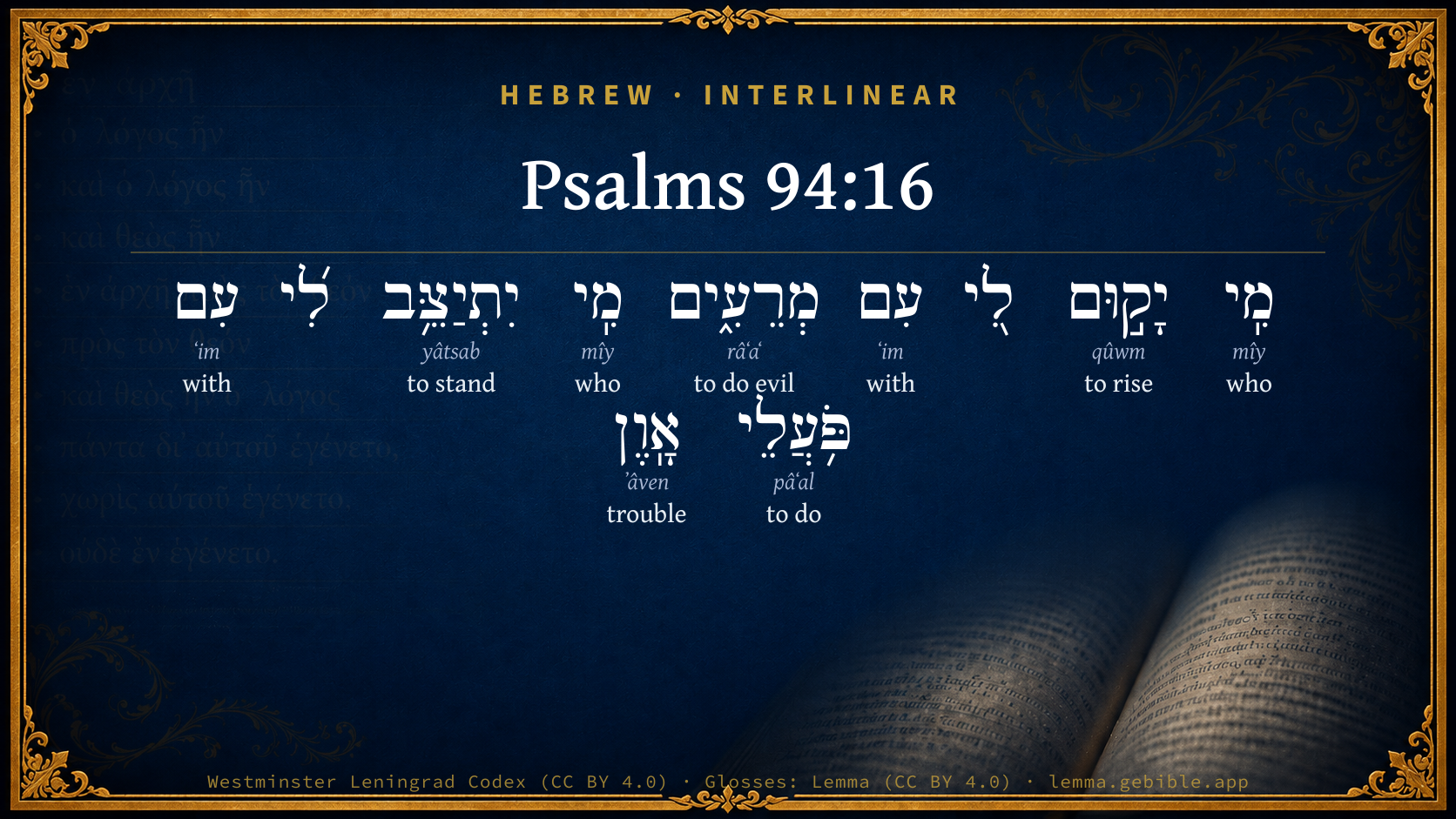
Hebrew (Westminster Leningrad Codex) Psalms 94:16 appears in the Hebrew Old Testament. The text above is from the Westminster Leningrad Codex. Each word links to its Strong’s number, a concise gloss, and parsing drawn from the Open Scriptures Hebrew Bible morphology. Click any word for its full Brown-Driver-Briggs (BDB) entry.
Download image
Cite this verse

Psalms 94:16 (World English Bible). Public Domain. Lemma interlinear Bible study tool, https://lemma.gebible.app/v/psalms/94/16.

Show BibTeX & RIS
BibTeX
RIS
English Translation
Who will rise up for me against the wicked? Who will stand up for me against the evil-doers?
World English Bible · Public Domain
Download a study sheet

One document with this verse’s original text, its word-by-word gloss line, the meaning frame, cross-references with their text, attributed commentary, and full source and license credits — printable, and it pastes into notes with its structure intact.

This verse Autodidact and up

Study sheet (.html) Plain text (.txt)

A passage Seminary Student

Up to 50 verses in one chapter. A passage sheet keeps up to 6 commentary sources and 12 cross-references per verse, in the order this page ranks them, and says so on the sheet whenever that leaves anything out. Ask for a single verse and you get the Autodidact verse sheet above.

Everything on this page stays free to read, with no account — the sheet is a download of what is already on screen, not access to it.

Want to remove ads? Support Godless Engineer
Compare translations 3

The same verse in 3 English versions, stacked beneath the original-language interlinear above. Click any original word for its lexicon entry.

Each is an independent rendering of the whole verse — the interlinear is not word-aligned to these translations.

Highlighted words mark where these versions differ — a whole-verse word diff, not a word-by-word alignment.

  • World English Bible Public Domain
    Who will rise up for me against the wicked? Who will stand up for me against the evil-doers?
  • King James Version Public Domain
    Who will rise up for me against the evildoers? or who will stand up for me against the workers of iniquity?
  • unfoldingWord Literal Text CC BY-SA 4.0
    Who will rise up for me against the evildoers? Who will stand up for me against the workers of wickedness?

unfoldingWord Literal Text — © unfoldingWord, licensed CC BY-SA 4.0. Word-aligned USFM3 via Door43 (git.door43.org/unfoldingWord/en_ult).

Versions to compare (up to 4)

3 of 4 selected

Show all 18 translations

Every available English version of this verse, each an independent rendering of the whole verse.

  • World English Bible Public Domain
    Who will rise up for me against the wicked? Who will stand up for me against the evil-doers?
  • Berean Standard Bible Public Domain
    Who will rise up for me against the wicked? Who will stand for me against the workers of iniquity?
  • Majority Standard Bible Public Domain
    Who will rise up for me against the wicked? Who will stand for me against the workers of iniquity?
  • King James Version Public Domain
    Who will rise up for me against the evildoers? or who will stand up for me against the workers of iniquity?
  • American Standard Version (1901) Public Domain
    Who will rise up for me against the evil-doers? Who will stand up for me against the workers of iniquity?
  • Revised Version (1885) Public Domain
    Who will rise up for me against the evil-doers? who will stand up for me against the workers of iniquity?
  • Geneva Bible (1599) Public Domain
    Who will rise vp with me against the wicked? or who will take my part against the workers of iniquitie?
  • Douay-Rheims (1899) Public Domain
    Who shall rise up for me against the evildoers? or who shall stand with me against the workers of iniquity?
  • Young's Literal Translation Public Domain
    Who riseth up for me with evil doers? Who stationeth himself for me with workers of iniquity?
  • Literal Standard Version CC BY-SA 4.0
    Who rises up for me with evildoers? Who stations himself for me with workers of iniquity?
  • Unlocked Literal Bible CC BY-SA 4.0
    Who will rise up to defend me against the evildoers? Who will stand up for me against the wicked?
  • unfoldingWord Literal Text CC BY-SA 4.0
    Who will rise up for me against the evildoers? Who will stand up for me against the workers of wickedness?
  • Darby Bible Public Domain
    Who will rise up for me against the evil-doers? who will stand for me against the workers of iniquity?
  • World Messianic Bible Public Domain
    Who will rise up for me against the wicked? Who will stand up for me against the evildoers?
  • Webster's Bible Public Domain
    Who will rise up for me against the evil-doers? or who will stand up for me against the workers of iniquity?
  • Free Bible Version CC BY-SA 4.0
    Who came to my defense against the wicked; who stood up for me against those who do evil?
  • Bible in Basic English Public Domain
    Who will give me help against the sinners? and who will be my support against the workers of evil?
  • JPS Tanakh (1917) Public Domain
    Who will rise up for me against the evil-doers? Who will stand up for me against the workers of iniquity?

Literal Standard Version (2020), Covenant Press — licensed CC BY-SA 4.0. Text via the HelloAO Bible API (eBible.org). Unlocked Literal Bible (unfoldingWord) — licensed CC BY-SA 4.0. Text via the HelloAO Bible API (eBible.org). unfoldingWord Literal Text — © unfoldingWord, licensed CC BY-SA 4.0. Word-aligned USFM3 via Door43 (git.door43.org/unfoldingWord/en_ult). Free Bible Version, Dr. Jonathan Gallagher — licensed CC BY-SA 4.0. Text via the HelloAO Bible API (eBible.org).

Word by word

More ways to search: Search by grammar → Find every occurrence → Compare this word →

Practice this passage: Drill this verse → Learn its vocabulary →

יִתְיַצֵּ֥ב
yâtsab
H3320
“to stand”
Verb, Hithpael, Imperfect, 3rd Person, Masculine, Singular
Part of Speech
Verb
Stem
Hithpael
Form
Imperfect
Person
3rd Person
Gender
Masculine
Number
Singular
Full BDB Definition

Origin: a primitive root

TWOT: 894

to place, set, stand, set or station oneself, present oneself - (Hithpael) to station oneself, take one's stand, stand, present oneself, stand with someone
  1. מִֽי mîy H4310 “who” Particle, Interrogative
  2. יָק֣וּם qûwm H6965 “to rise” Verb, Qal, Imperfect, 3rd Person, Masculine, Singular
  3. עִם ʻim H5973 “with” Preposition
  4. מְרֵעִ֑ים râʻaʻ H7489 “doing evil” Verb, Hiphil, Participle Active, Masculine, Plural, Absolute
  5. מִֽי mîy H4310 “who” Particle, Interrogative
  6. עִם ʻim H5973 “with” Preposition
  7. פֹּ֥עֲלֵי pâʻal H6466 “doing” Verb, Qal, Participle Active, Masculine, Plural, Construct
  8. אָֽוֶן ʼâven H205 “trouble” Noun, Common, Masculine, Singular, Absolute

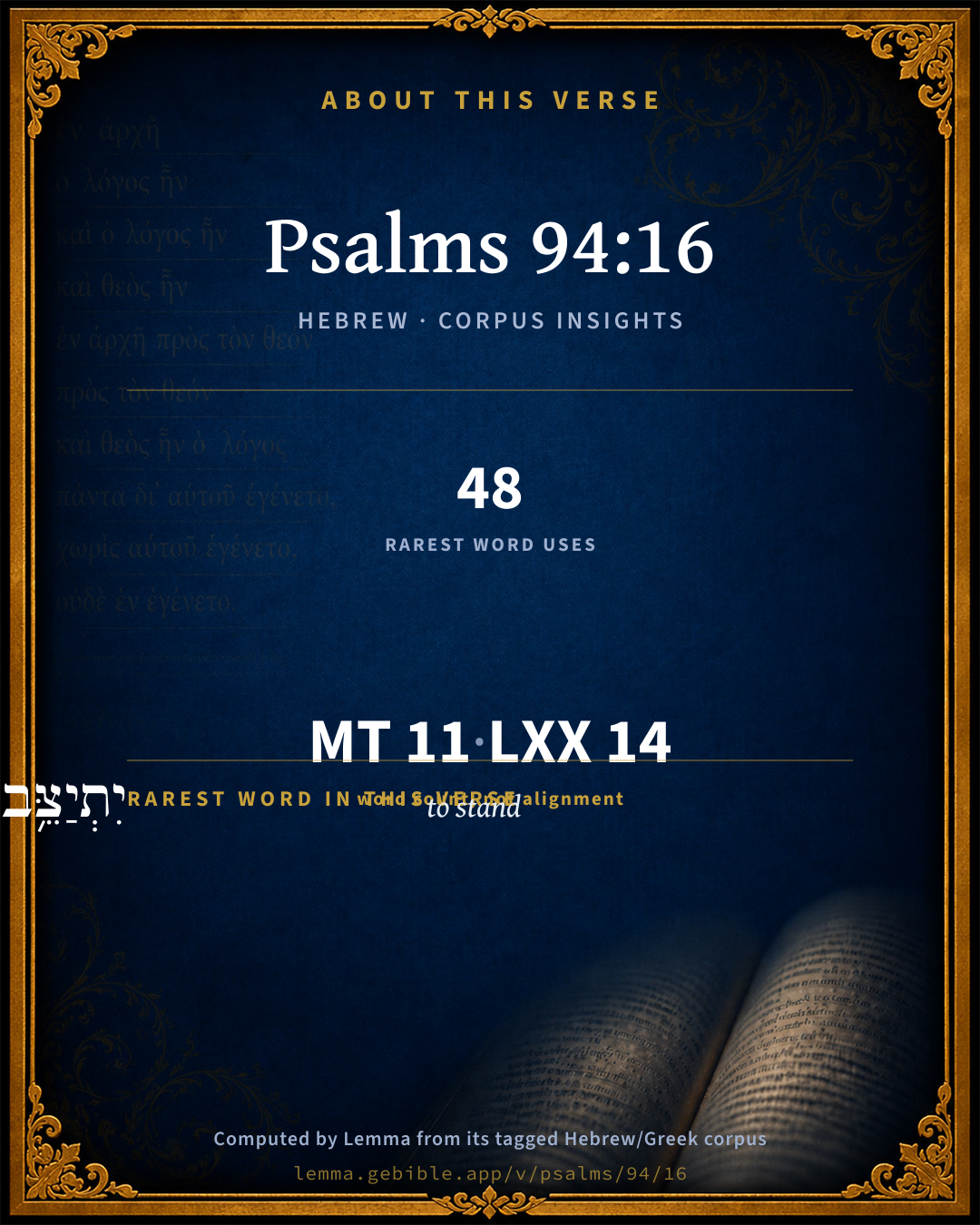
About this verse

These counts appear in no published source. They are computed here, from the morphology-tagged text and Lemma’s own curated glosses. What Lemma adds →

11
words
7
distinct lemmas
Wisdom
section

Shared distinctive vocabulary

יִתְיַצֵּ֥ב to stand H3320 occurs in 45 verses of the Hebrew Bible. Also found in:

Grammatical profile

  • 4 verbs
  • 1 noun
  • 4 prepositions
  • 2 particles

Verb forms

  • יָק֣וּם Qal · Imperfect
  • מְרֵעִ֑ים Hiphil · Participle Active
  • יִתְיַצֵּ֥ב Hithpael · Imperfect
  • פֹּ֥עֲלֵי Qal · Participle Active

Repetition

Words recur within this verse — often emphatic in Hebrew:

Hebrew & Septuagint length

In English translation the verse runs 18 words from the Hebrew and 21 from the Septuagint (LXX English) — closely comparable.

A rough comparison of the two English renderings, which tokenize alike — not a word-level alignment.

Word counts can differ between the Hebrew and the Greek without any difference in meaning — e.g. the Hebrew direct-object marker אֵת has no separate Greek word, and Greek often adds the article ὁ.

In the original languages it is 11 Hebrew tokens and 14 Greek tokens — but the two are counted differently (Hebrew bundles its prefixes and suffixes into one token; the Greek is in lemma form), so that isn’t a like-for-like length.

Cross-references

18

Topical passages linked to Psalms 94:16 in the Treasury of Scripture Knowledge — connected by theme and wording, ordered by reader-vote popularity; previews shown in the World English Bible.

  • Judges 5:23 Curse you Meroz, said the angel of Yahweh. Curse you bitterly the inhabitants of it, Because they didn't come to the help of Yahweh, To the help of Yahweh against the mighty.
  • Numbers 25:6–13 Behold, one of the children of Israel came and brought to his brothers a Midianite woman in the sight of Moses, and in the sight of all the congregation of the children of Israel, while they were weeping at the door of the tent of meeting.
  • Psalms 59:2 Deliver me from the workers of iniquity. Save me from the bloodthirsty men.
  • John 7:50–51 Nicodemus (he who came to him by night, being one of them) said to them,
  • 3 John 1:8 We therefore ought to receive such, that we may be fellow workers for the truth.
  • Exodus 32:26–29 then Moses stood in the gate of the camp, and said, "Whoever is on Yahweh's side, come to me!" All the sons of Levi gathered themselves together to him.
  • Numbers 10:35 It happened, when the ark set forward, that Moses said, Rise up, Yahweh, and let your enemies be scattered; and let those who hate you flee before you.
  • 1 Kings 18:39–40 When all the people saw it, they fell on their faces: and they said, Yahweh, he is God; Yahweh, he is God.
  • 2 Kings 9:32 He lifted up his face to the window, and said, Who is on my side? who? There looked out to him two or three eunuchs.
  • 2 Kings 10:15 When he was departed there, he lighted on Jehonadab the son of Rechab coming to meet him; and he greeted him, and said to him, Is your heart right, as my heart is with your heart? Jehonadab answered, It is. If it be, give me your hand. He gave him his hand; and he took him up to him into the chariot.
  • Nehemiah 5:7 Then I consulted with myself, and contended with the nobles and the rulers, and said to them, You exact usury, everyone of his brother. I held a great assembly against them.
  • Psalms 17:13 Arise, Yahweh, Confront him, cast him down. Deliver my soul from the wicked by your sword;
  • Isaiah 59:16 He saw that there was no man, and wondered that there was no intercessor: therefore his own arm brought salvation to him; and his righteousness, it upheld him.
  • Isaiah 63:5 I looked, and there was none to help; and I wondered that there was none to uphold: therefore my own arm brought salvation to me; and my wrath, it upheld me.
  • Jeremiah 5:1 Run you back and forth through the streets of Jerusalem, and see now, and know, and seek in the broad places of it, if you can find a man, if there are any who does justly, who seeks truth; and I will pardon her.
  • Jeremiah 26:16–19 Then said the princes and all the people to the priests and to the prophets: This man is not worthy of death; for he has spoken to us in the name of Yahweh our God.
  • Ezekiel 22:30 I sought for a man among them, who should build up the wall, and stand in the gap before me for the land, that I should not destroy it; but I found none.
  • Matthew 12:30 "He who is not with me is against me, and he who doesn't gather with me, scatters.

Cross-references courtesy of OpenBible.info (CC BY 4.0).

Hebrew and Greek witnesses Masoretic Hebrew ↔ Greek Septuagint

The same verse in the two great witnesses to the Old Testament, shown verse-for-verse.

You’re reading Greek Psalm 93 (Hebrew Psalm 94). The Septuagint counts the superscription, so verse numbers can differ from the Hebrew — chapter-level alignment, not verse-by-verse. Numbering follows Rahlfs.

These are two independent witnesses, not word-aligned to each other, and the Septuagint is shown in lemma (dictionary) form.

Hebrew Psalms 94:16 Masoretic · Westminster Leningrad Codex

מִֽי יָק֣וּם לִ֭י עִם מְרֵעִ֑ים מִֽי יִתְיַצֵּ֥ב לִ֝י עִם פֹּ֥עֲלֵי אָֽוֶן

Who will rise up for me against the wicked? Who will stand up for me against the evil-doers?

World English Bible · Public Domain

Greek LXX Greek Psalm 93:16 Septuagint · lemma form

τίς ἀναἵστημι ἐγώ ἐπί πονηρεύομαι ἤ τίς συν παραἵστημι ἐγώ ἐπί ἐργάζομαι ὁ ἀνομία

Who will rise up for me against the transgressors? or who will stand up with me against the workers of iniquity?

LXX2012 (modern English Septuagint) · Public Domain

On this verse, The Treasury of David discusses the Septuagint’s reading. Read the note in Commentary ↓

Hebrew: Westminster Leningrad Codex (CC BY 4.0). Greek: Septuagint (public domain); English from LXX2012 (modern English Septuagint) (Public Domain). How the Septuagint differs from the Hebrew →

Commentary

Notes on Psalms 94:16 from classic Christian and Jewish commentators (each source and its license shown beneath its notes). The classic Christian expositions comment on the surrounding passage and are grouped to its opening verse, so a note may address several verses; the Jewish commentaries on the Tanakh (Rashi and others) are per-verse, so they appear only where the commentator wrote on this verse.

Lemma curates 59 commentaries, every one of them public domain or Creative Commons licensed, each selected and text-cleaned for this edition rather than reprinted as found. About our sources →

The Cambridge Bible for Schools and Colleges

gen. ed. J. J. S. Perowne

16. Who will rise up &c.] Who will stand up as my champion? It is not a question of doubt or unbelief, but an emphatic form of assertion that Israel has no helper but Jehovah.

16–19. Israel has no champion but Jehovah. Experience has proved His goodness. The Psalmist is partly speaking in the name of the people even when he uses the singular (Psa_94:16-18; Psa_94:23, our God), partly expressing his own personal feelings (Psa_94:19).

The Cambridge Bible for Schools and Colleges (gen. ed. J. J. S. Perowne; Cambridge University Press, 1878–1918) — public domain. Text from a community e-Sword module.

Trapp's Complete Commentary

John Trapp

Psa 94:16 Who will rise up for me against the evildoers? [or] who will stand up for me against the workers of iniquity?

Ver. 16. Who will rise up for me] q.d. But a very few fast friends find I at court, Jonathan excepted. Some there are that will sprinkle me with court holy water, as they say, give glossing speeches; but it is little that they will do, and yet less that they will suffer for me. Faithful friends, saith one, are gone on pilgrimage, and their return is uncertain.

John Trapp, A Commentary or Exposition upon All the Books of the Old and New Testament (1647–1656) — public domain. Text from a community e-Sword module.

The Biblical Illustrator

Joseph S. Exell

Psa_94:16

Who will rise up for Me against the evil-doers?

or who will stand up for Me against the workers of iniquity?

The summons to holy work

It is hardly possible to read this psalm through without feeling that the inspired voice in it denounces the unbelief of the heathen world. When a man has come to a deep conviction of the Oneness of Jehovah every other worship is to him an abomination, for such worship must either be an awful rivalry to Him whose glory cannot be given to another, or must involve a total misconception of His nature and a blasphemous corruption of His name.

I. Characteristics of these evil-doers.

1. Not more than one-seventh of the human race is even nominally Christian; and among these Christians are reckoned all the populations of Austria, France, Russia, America, and Spain; the Greeks, the Copts, and the Armenians; the priest-ridden inhabitants of Brazil and Mexico, and all the crowds of our English cities; the Sabbath-breakers, the despisers of Gods love, the haters of Gods law, the drunkard, the harlot, the miser, the dotard, and the fool. Verily, an accumulation of sin, a multitude of evil-doers, are to be found in so-called Christendom! But let us turn from the one-seventh to the six-sevenths of this worlds population. Here, notwithstanding all our grievous imperfections, we are passing out of Goshen into Egyptian darkness.

2. Their variety. In one place there is subtle speculation, in another gross vice; here utter indifference, there wild fanaticism; in one tribe crushing ignorance, in another daring philosophy and luxuriant imagination. Some there are who, under the stimulus of history and myth, are virtual adorers of humanity, as the Confucianist and the Northern Buddhist; others, without traditions, or love, or duty, cherish no reverence, and fear no evil. The regiments of the prince of this world wear various uniforms; the mutineers in Gods army are widespread and bear divers colours: they speak a hundred dialects or tongues, and are scattered over the whole world. Amid the varieties that we have to contend against, and the sins that we know to be grieving the heart of Immanuel, let us not omit to notice the men who find in the variety of the mutineers some arguments against the legitimacy of the Great King, who give to these forms of evil-doing gentle names, who are hopeless about the work of their reduction, and give it up in despair.

3. Their organization. The differences of which we have spoken in race, position, language, religion, philosophical character, take great leading types, and have prominent characteristics. Take away caste from the Brahmin, and you deprive him of his birthright. Take away caste from the mind of the Hindu, and you take away his living God. The most acute minds, and the best educated of the native populations, fight against all that we can believe to be sacred and holy, with the desperation of men who are contending for the altar, the homesteads, the graves of their fathers.

4. Their depravity. We would not blacken our poor humanity beyond its deserts, but nowhere, not even amid the most polished provinces of India and China, can we find a righteous class, or discover anything approximating a moral elevation--a standard of excellence which can excite the faintest hope that heathenism has within itself the elements of improvement or the seeds of life. Even the few exceptions of men whose virtues have been notorious, whose temptations have been overcome, whose philosophy, whose affections, or whose patriotism have triumphed over their lust, and been mighty enough to redeem them by Gods grace from the universal pollution, do after all shed the most terrible light over the corruption that is untouched, and reveal throughout the wide extent of man the presence of a power and of possibilities, of a conscience, a freedom, and a spirit in man which leave him, as the apostle says, without excuse.

II. The course which God has taken with these evil-doers, and also what is involved in the appeal here uttered. Who will rise up for Me against the evil-doers? Who is on the Lords side? Whom shall we send, and who will go for us? By these appeals to the heart of His people, God seems to tell us that He is not going to crush, or destroy, or convert, or save these evil-doers by any fiat of omnipotence, by any touch of His imperial sceptre, His method has always been to teach men by men; to uproot error by truth; to overturn and undermine evil influence by good influence; to conquer darkness by light; to drive out hatred by love. He took up the manhood of Jesus into His own Godhead, and made that great light henceforth to rule the day, and He made the reflections of His glory--as all lesser lights really are--to rule the night; and ever since the exaltation of Jesus, when He intends to reach the hearts and conquer the wills of men by His love, He calls the sons of men, the brethren of Jesus, to His help against the mighty.

III. The response which is made to this appeal. Science, commerce, luxury, a polished language and unlimited resources, have had their day and utterly failed, having miserably succumbed in revelry, suicide and hell. Never let us hope that we can save Africa with cotton, or India with railways; the Moslem is not softened by a telegraph, nor the Dyak of Borneo purified by geometry. God calls for other helpers; and lo! by the side of all these shadowy forms, an angel of light (Rev_10:1-2). The thunders utter their voices, and another angel appears, having the everlasting Gospel, etc. Wheresoever this power has gone it has gained victories. Every sanctuary, every log-cabin where the name of Jesus has been breathed, is a scene where a battle has been fought against evil-doers, and a victory has been won. With whatsoever individual, class, or nation it comes fairly into contact, the evil is driven out, the tendencies to good sublimed and purified. It is the Gospel which shows the only way of meeting the clamour of insulted conscience, and supplies motives strong enough to lift the soul into harmony with its own moral law. (H. Reynolds, B.A.)

Zeal for Christian enterprise

When Dr. Beecher, the father of Mr. Beecher-Stowe, lay dying, his sons said to him, Would you rather go to heaven, or begin the battle on earth again? The eyes of the old warrior in the cause of Christ sparkeled as he replied, Boys, if I had the choice I would choose the battle. If all professing Christians were as eager to fight for their King against the forces of darkness, the world would soon be won to the Saviour. Alas! too many seem to think more about going to heaven than seeking to lead others there. (The Quiver.)

Help anywhere

During one of the great battles of the American Civil War a recruit who had lost his company in the tumult of strife approached General Sheridan and timidly asked where he would step in, Step in? thundered Sheridan, in a voice that frightened the already terrified recruit almost as much as the roar of cannonading and musketry. Step in anywhere; theres fighting all along the line. An accident occurred recently that very forcibly brought Sheridans words to mind. A heavy piece of machinery was being moved into a building by means of a block and tackle. Suddenly one of the ropes parted and the machine began to slide backward. The two men who had charge of the work sprang to stay its progress, but it was more than they were capable of doing. Give us a lift, one of them shouted to a bystander. Where shall I take hold? asked the man thus addressed, unmindful of the fact that both men were exerting every muscle to control the machine and that there was not a second to lose. Grab hold anywhere! yelled the mover. But another had already seen the necessity for instant action, and rendered the necessary assistance. It may be that we are in a field of Christian enterprise where we are unaccustomed to work, and are timidly asking where we shall Step in. We may find our answer in the words of Sheridan, Step in anywhere; theres fighting all along the line. (Christian World.)

The Biblical Illustrator, edited by Joseph S. Exell (c. 1880s–1900s) — public domain. Text from a community e-Sword module.

Joseph Benson's Commentary

Psa 94:16. Who will rise up for me against the evil-doers? — Have I any friend that, in love to me, will appear for me? Hath justice any friend that, in a pious indignation at unrighteousness, will plead my injured cause? He looked, but there was none to save, there was none to uphold. On the side of the oppressor there was power, and therefore the oppressed had no comforter. God alone helped him, as he says in the next verse.

Joseph Benson's Commentary on the Old and New Testaments (1811–1818) — public domain. Text from a community e-Sword module.

Keil & Delitzsch

C. F. Keil & F. Delitzsch

In the fifth strophe the poet celebrates the praise of the Lord as his sole, but also trusty and most consolatory help. The meaning of the question in Psa 94:16 is, that there is no man who would rise and succour him in the conflict with the evil-doers; ל as in Exo 14:25; Jdg 6:31, and עם (without נלחם or the like) in the sense of contra, as in Psa 55:19, cf. Ch2 20:6. God alone is his help. He alone has rescued him from death. היה is to be supplied to לוּלי: if He had not been, or: if He were not; and the apodosis is: then very little would have been wanting, then it would soon have come to this, that his soul would have taken up its abode, etc.; cf. on the construction Psa 119:92; Psa 124:1-5; Isa 1:9, and on כּמעט with the praet. Psa 73:2; Psa 119:87; Gen 26:10 (on the other hand with the fut. Psa 81:15). דּוּמה is, as in Psa 115:17, the silence of the grave and of Hades; here it is the object to שׁכנה, as in Psa 37:3, Pro 8:12, and frequently. When he appears to himself already as one that has fallen, God's mercy holds him up. And when thoughts, viz., sad and fearful thoughts, are multiplied within him, God's comforts delight him, viz., the encouragement of His word and the inward utterances of His Spirit. שׁרעפּים, as in Psa 139:23, is equivalent to שעפּים, from שׂעף, סעף, Arab. š‛b, to split, branch off (Psychology, S. 181; tr. p. 214). The plural form ישׁעשׁעוּ, like the plural of the imperative in Isa 29:9, has two Pathachs, the second of which is the "independentification" of the Chateph of ישׁעשׁע.

Keil & Delitzsch — Biblical Commentary on the Old Testament (1861–1891) — public domain (CC PDM 1.0). Text via the HelloAO Bible API. (Old Testament only.)

J. A. Alexander on Psalms

Joseph Addison Alexander

16. (Psa 94:16) Who will arise for me with evil doers? Who will stand up for me with workers of iniquity? Arise, address himself to action. See above, on Psa 3:7. For me, for my support in my defence. With, in conflict or contention with. Stand up, take a stand, assume a position. See above, on Psa 2:2. Evil-doers, as in Psa 92:11. Workers of Iniquity, as in Psa 94:4 above. The interrogation in this verse prepares the way for the expression of confidence in that which follows.

Joseph Addison Alexander, The Psalms Translated and Explained (1850) — public domain. Text from a community e-Sword module.

Tyndale Open Study Notes

Tyndale Open Resources

94:16-23 The psalmist’s prayer resumes (see 94:1-7) with a desperate cry for the Lord’s justice; it concludes with the hopeful expectation that evil will end.

94:16 Only God has the power to stand up to the wicked (see 2:2).

Tyndale Open Study Notes — © Tyndale Open Resources, licensed CC BY-SA 4.0. Text via the HelloAO Bible API.

Adam Clarke's Commentary

Verse 16. Who will rise up for me] Who is he that shall be the deliverer of thy people? Who will come to our assistance against these wicked Babylonians?

Adam Clarke's Commentary on the Bible (1810–1826) — public domain. Text from a community e-Sword/MySword module.

John Calvin's Commentaries

16. Who will rise up for me against my adversaries? Here the Psalmist points out, in a lively and graphic manner, how destitute he was of all human aid. As if at the moment in danger, he cries out — Who will stand up for me? Who will oppose himself to my enemies? And immediately afterwards he replies, that had not God helped him, he must have despaired of safety. In declaring that he had been thus miraculously rescued from death, when deserted by all the world, he commends the more God’s kindness and grace. When men aid us, they are only instruments by which the grace of God works; but we are apt not to recognize God’s hand when we see any subordinate agency in the deliverance. He speaks of his life dwelling in silence, (verse 17) for the dead lie in the grave without feeling or strength. Thus the Psalmist owns that there was no means by which his life could have been preserved, had not God interposed without delay.

John Calvin's Commentaries (1540-1563) — public domain. Text from the Calvin Translation Society English edition (1840s-50s) via the Christian Classics Ethereal Library (ccel.org). Calvin's coverage is partial (roughly two-thirds of the Bible); uncommented books and verses are honest gaps, never fabricated. The 19th-century editor's footnotes and remarks are omitted so the notes are faithfully Calvin's own voice.

Ellicott's Commentary for English Readers

(16) Rise up.—Stand up—i.e., as champion. (Comp. 2Sa_23:11, of the exploit of Shammah, the son of Agee the Hararite; comp. Psa_2:2.)

A Bible Commentary for English Readers, edited by Charles John Ellicott (1878–1897) — public domain. Text from a community e-Sword module.

John Gill's Exposition

Who will rise up for me against the evildoers?.... These are the words of the psalmist, representing the church of God, under sore persecutions from the antichristian party; called "evildoers", because of their thefts, murders, idolatries, sorceries, and all manner of wickedness committed by them, Rev 9:21, intimating that she had looked all around her, and could not observe any that she could hope for assistance from, to fight her battles for her with the enemy, and deliver her out of his hands: the Targum is,

"who will rise up, for me, to make war with the evildoers?''

what the church here seems to say in a despairing way, the followers of antichrist say in a triumphant and insulting manner; "who is like unto the beast who is able to make war with him?" Rev 13:4, or "who will stand up for me against the workers of iniquity?" to contend or strive with them, as the Targum; suggesting, that she had no friends to appear for her, that had either courage or strength to engage in such a warfare; her case was like that of the oppressed, Solomon speaks of, Ecc 4:1, or the Apostle Paul's, when none stood with him; but all forsook him, excepting the Lord, Ti2 4:16 and so here the church had none to rise up, and stand by her, but the Lord; Michael, the great Prince that stands for the children and people of God, and who is a match for all the enemies of his church; and he will rise and stand up for them, and fight their battles; and overcome the beast and false prophet, with the kings of the earth, Dan 12:1.

John Gill's Exposition of the Whole Bible (1746–1763) — public domain (CC PDM 1.0). Text via the HelloAO Bible API.

Albert Barnes' Notes on the Bible

Who will rise up for me against the evil-doers?... - This is the language of the psalmist. It is what he had said in the circumstances referred to in the first part of the psalm, when the wicked seemed to triumph; when they had come in upon the land, and laid waste the heritage of God, Psa 94:3-6. At that time, full of anxiety and trouble, and deeply impressed with a sense of danger, he had anxiously looked around for help, and had asked with deep concern who would stand up for him and defend him. The following verses Psa 94:17-18 show what was then his reliance, and in what way confidence in God had kept him from falling into despair.

Albert Barnes' Notes on the Bible (1834–1885) — public domain. Text from a community e-Sword/MySword module.

Matthew Poole's English Annotations

To defend and help me. I looked hither and thither, and called to my friends for their help, saying,

Who will, & c.? but none of them appeared, but God alone helped me, as he saith in the next verse.

Matthew Poole's English Annotations on the Holy Bible (1683–1685) — public domain. Text from a community e-Sword/MySword module.

The Treasury of David

Charles H. Spurgeon

Ver. 16. Notwithstanding the psalmist's persuasion that all would be well eventually, he could not at the time perceive any one who would stand side by side with him in opposing evil; no champion of the right was forthcoming, the faithful failed from among men. This also is a bitter trial, and a sore evil under the sun; yet it has its purpose, for it drives the heart still more completely to the Lord, compelling it to rest alone in him. If we could find friends elsewhere, it may be our God would not be so dear to us; but when, after calling upon heaven and earth to help, we meet with no succour but such as comes from the eternal arm, we are led to prize our God, and rest upon him with undivided trust. Never is the soul safer or more at rest than when, all other helpers failing, she leans upon the Lord alone. The verse before us is an appropriate cry, now that the church sees error invading her on all sides, while faithful ministers are few, and fewer still are bold enough to "stand up" and defy the enemies of truth. Where are our Luthers and our Calvins? A false charity has enfeebled the most of the valiant men of Israel. Our John Knox would be worth a mint at this hour, but where is he? Our grand consolation is that the God of Knox and Luther is yet with us, and in due time will call out his chosen champions.

Ver. 16. Who will rise up, etc. I think we ought to look upon David here in a public capacity, as a prince or magistrate; and then as such he deplores the increase and confidence of the wicked; and having fortified himself in God by prayer, he resolves, in the words of the text, to do the duty of his station, to employ all the power God had given him for the extirpation of wickedness, and the reformation of an impious people; and earnestly invites and calls in to his assistance all that had either heart or ability for such a work, as being well aware of the great difficulty of it. This is the sense I prefer, because it best becomes the zeal and faith of David, best suits the spirit and genius of several other parallel psalms, and seems plainly to me, to have the countenance of the Targum and the Septuagint.

In the words thus explained we have these three things: 1. The deplorable state of Israel. This is easily to be collected from the form and manner of David's expressing himself here, Who will stand up for me? or who will take my part? As if he should have said, Such is the number and power of the wicked, that how much soever my heart is set upon a reformation, I can hardly hope to effect it, without the concurrence and joint endeavours of good men. And yet, alas! how little is the assistance I can reasonably expect of this kind? How few are the sincere friends of goodness? How great and how general is the coldness and indifference which possesses men in the things of God? 2. The duty of the magistrate. This is plainly implied here, and is, to curb and restrain wickedness, and to promote a general reformation. 3. The duty of all good people. Which is, as far as in them lies, to assist and encourage the magistrate in this good work. Richard Lucas, 1697.

Ver. 16. Who will rise up for me against the wicked? In all ages, men who neither feared God nor regarded man have combined together and formed confederacies, to carry on the works of darkness. And herein they have shown themselves wise in their generation, for by this means they more effectually promoted the kingdom of their father the devil, than otherwise they could have done. On the other hand, men who did fear God, and desire the happiness of their fellow creatures, have in every age found it needful to join together in order to oppose the works of darkness, to spread the knowledge of God their Saviour, and to promote his kingdom upon earth. Indeed he himself instructed them so to do. From the time that men were upon the earth, he hath taught them to join together in his service, and has united them in one body by one Spirit. And for this very end he has joined them together, "that he might destroy the works of the devil; "first in them that are already united, and by them that are round about them. John Wesley, in a Sermon on these words, preached before the Society for Reformation of Manners, Jan. 30, 1763.

Ver. 16.

1. The question asked by the church of her champions.

2. The answer of every true hearted man.

3. The yet more encouraging answer of her Lord.

Ver. 16-17. The sole source of succour.

1. A loud cry for help. As from a champion, or advocate.

2. Earth's answer. A dead silence, disturbed only by echo (Ps 94:17).

3. The succouring voice that breaks the silencethe Lord's (Ps 94:17). C.A.D.

Psalms 94:17*

Charles H. Spurgeon's The Treasury of David (1869–1885) — public domain. Psalms only. Text from a community e-Sword/MySword module.

Whedon's Commentary on the Bible

Daniel D. Whedon

16. Who will rise up for me—Who is able to rise up for our help against these evil doers? That is, there is no human power to do it. God alone can do it. The inference, then, is, that our continued existence is itself proof that God is still our helper.

Daniel D. Whedon (gen. ed.), Commentary on the Old and New Testaments (1874–1909) — public domain. Text from a community e-Sword module.

The Pulpit Commentary

Who will rise up for me against the evil doers? or, who will stand up for me against the workers of iniquity? But meanwhile, until this happy time come, what is the condition of the godly? Are they not left a prey to the evil doers, at their mercy, without a champion? The answer is given in the next verse.

The Pulpit Commentary (1880–1919), ed. H.D.M. Spence-Jones & Joseph S. Exell — public domain. Text from a community e-Sword module.

John Wesley's Explanatory Notes

Rise - To defend and help me. I looked hither and thither, but none appeared; God alone helped me.

John Wesley, Explanatory Notes Upon the Whole Bible (1754–1765) — public domain. Text via the GEBible commentary corpus.

Rashi

Rabbi Shlomo Yitzchaki (Rashi)

Who will rise up for me Whose merit will stand up for us among these evildoers?

Rashi on the Tanakh — English translations: “The Judaica Press complete Tanach with Rashi, translated by A. J. Rosenberg” (CC BY 4.0); “Pentateuch with Rashi's commentary by M. Rosenbaum and A.M. Silbermann, 1929-1934” (public domain); “The Metsudah Tanach series, Lakewood, N.J” (CC BY 4.0); and “The Book of Joshua, Metsudah Publications, 1997” (CC BY 4.0). Text via Sefaria.

Lesson kit

Teaching starters — assembled from the data on this page, not authored interpretation. Every prompt links to the verse data it draws on. Edit before teaching.

Psalms, in the Wisdom, opens this verse with 11 words (7 distinct Hebrew lemmas). Its most distinctive word is yâtsab (“to stand”). A historical commentator’s framing appears above. Read the whole chapter for the surrounding context.

Discussion questions

  1. The word yâtsab carries the sense “to stand.” How does it shape the verse?
  2. Exodus 2:4 shares the word «to stand» with this verse. How do the two illuminate each other?
  3. “who” occurs 2× in this one verse. What is the effect of the repetition?
  4. These translations render this verse differently. What is at stake in choosing one wording over another?
  5. The verb «יָק֣וּם» is Qal Imperfect. How does its form color the action?
  6. Reading how The Cambridge Bible for Schools and Colleges and Trapp's Complete Commentary read this verse, where do the two commentators agree and where do they part?

Things to notice

Reading settings

Reading text

Shown beneath each verse's original-language words.

Old Testament
Old Testament edition

Read the OT as the Masoretic Hebrew (MT) or the Greek Septuagint (LXX).

English shown for the Greek Septuagint (in the Hebrew ↔ Greek comparison).

Comparing translations? Open the Compare panel on any verse page to stack up to four side by side.