
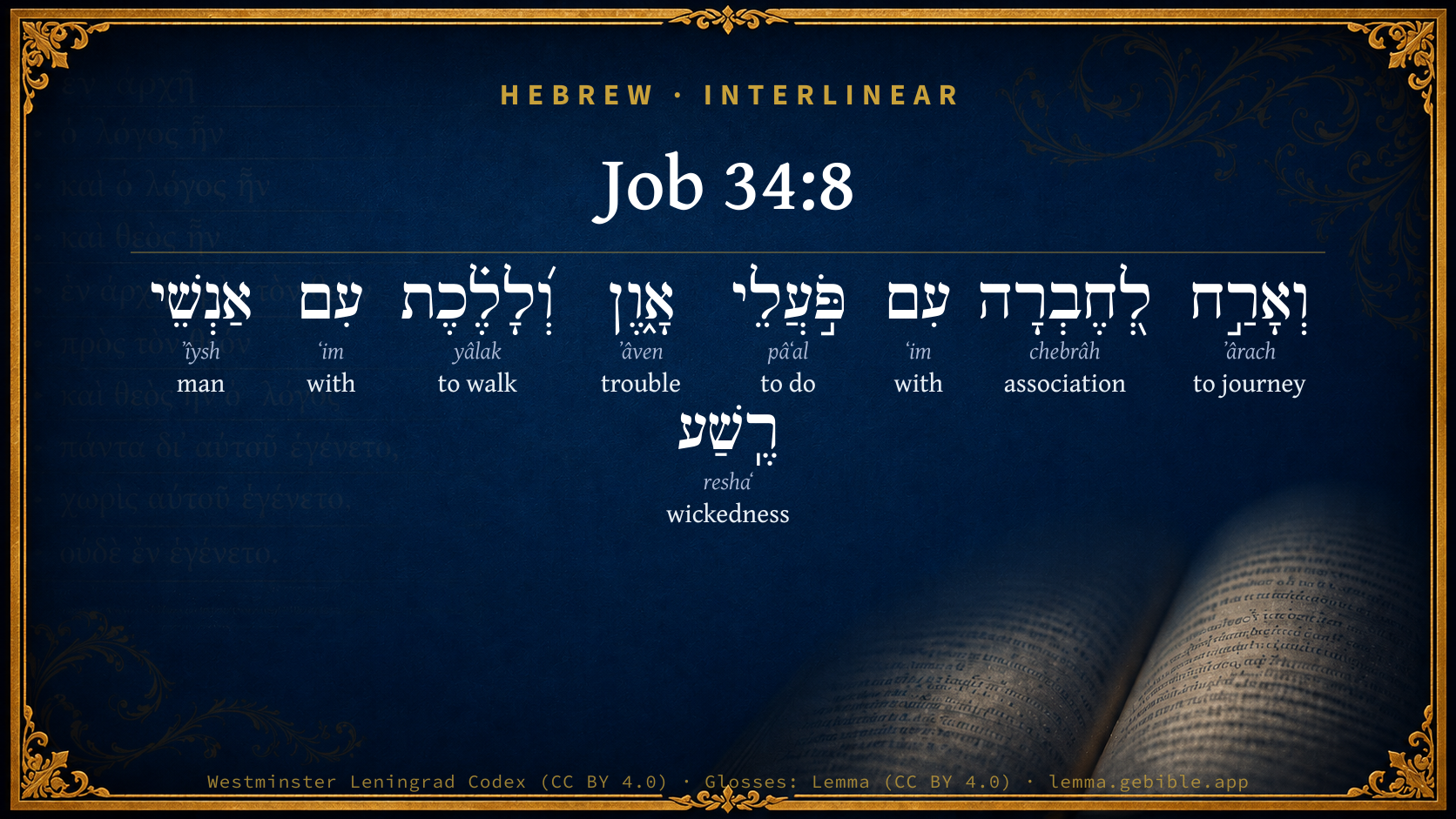
Job 34:8

Hebrew (Westminster Leningrad Codex) Job 34:8 appears in the Hebrew Old Testament. The text above is from the Westminster Leningrad Codex. Each word links to its Strong’s number, a concise gloss, and parsing drawn from the Open Scriptures Hebrew Bible morphology. Click any word for its full Brown-Driver-Briggs (BDB) entry.
Download image
Cite this verse

Job 34:8 (World English Bible). Public Domain. Lemma interlinear Bible study tool, https://lemma.gebible.app/v/job/34/8.

Show BibTeX & RIS
BibTeX
RIS
English Translation
Who goes in company with the workers of iniquity, And walks with wicked men?
World English Bible · Public Domain
Highlights Full analysis ↓
Download a study sheet

One document with this verse’s original text, its word-by-word gloss line, the meaning frame, cross-references with their text, attributed commentary, and full source and license credits — printable, and it pastes into notes with its structure intact.

This verse Autodidact and up

Study sheet (.html) Plain text (.txt)

A passage Seminary Student

Up to 50 verses in one chapter. A passage sheet keeps up to 6 commentary sources and 12 cross-references per verse, in the order this page ranks them, and says so on the sheet whenever that leaves anything out. Ask for a single verse and you get the Autodidact verse sheet above.

Everything on this page stays free to read, with no account — the sheet is a download of what is already on screen, not access to it.

Want to remove ads? Support Godless Engineer
Compare translations 3

The same verse in 3 English versions, stacked beneath the original-language interlinear above. Click any original word for its lexicon entry.

Each is an independent rendering of the whole verse — the interlinear is not word-aligned to these translations.

Highlighted words mark where these versions differ — a whole-verse word diff, not a word-by-word alignment.

  • World English Bible Public Domain
    Who goes in company with the workers of iniquity, And walks with wicked men?
  • King James Version Public Domain
    Which goeth in company with the workers of iniquity, and walketh with wicked men.
  • unfoldingWord Literal Text CC BY-SA 4.0
    and he travels in company with doers of iniquity and walks with men of wickedness!

unfoldingWord Literal Text — © unfoldingWord, licensed CC BY-SA 4.0. Word-aligned USFM3 via Door43 (git.door43.org/unfoldingWord/en_ult).

Versions to compare (up to 4)

3 of 4 selected

Show all 18 translations

Every available English version of this verse, each an independent rendering of the whole verse.

  • World English Bible Public Domain
    Who goes in company with the workers of iniquity, And walks with wicked men?
  • Berean Standard Bible Public Domain
    He keeps company with evildoers and walks with wicked men.
  • Majority Standard Bible Public Domain
    He keeps company with evildoers and walks with wicked men.
  • King James Version Public Domain
    Which goeth in company with the workers of iniquity, and walketh with wicked men.
  • American Standard Version (1901) Public Domain
    Who goeth in company with the workers of iniquity, And walketh with wicked men?
  • Revised Version (1885) Public Domain
    Which goeth in company with the workers of iniquity, and walketh with wicked men.
  • Geneva Bible (1599) Public Domain
    Which goeth in the companie of them that worke iniquitie, and walketh with wicked men?
  • Douay-Rheims (1899) Public Domain
    Who goeth in company with them that work iniquity, and walketh with wicked men?
  • Young's Literal Translation Public Domain
    And he hath travelled for company With workers of iniquity, So as to go with men of wickedness.
  • Literal Standard Version CC BY-SA 4.0
    And he has traveled for company || With workers of iniquity, || So as to go with men of wickedness.
  • Unlocked Literal Bible CC BY-SA 4.0
    who goes around in the company of those who do evil, and who walks with wicked men?
  • unfoldingWord Literal Text CC BY-SA 4.0
    and he travels in company with doers of iniquity and walks with men of wickedness!
  • Darby Bible Public Domain
    And goeth in company with workers of iniquity, and walketh with wicked men.
  • World Messianic Bible Public Domain
    who goes in company with the workers of iniquity, and walks with wicked men?
  • Webster's Bible Public Domain
    Who goeth in company with the workers of iniquity, and walketh with wicked men.
  • Free Bible Version CC BY-SA 4.0
    He keeps company with wicked people; he associates with those who do evil.
  • Bible in Basic English Public Domain
    And goes in the company of evil-doers, walking in the way of sinners?
  • JPS Tanakh (1917) Public Domain
    Who goeth in company with the workers of iniquity, and walketh with wicked men.

Literal Standard Version (2020), Covenant Press — licensed CC BY-SA 4.0. Text via the HelloAO Bible API (eBible.org). Unlocked Literal Bible (unfoldingWord) — licensed CC BY-SA 4.0. Text via the HelloAO Bible API (eBible.org). unfoldingWord Literal Text — © unfoldingWord, licensed CC BY-SA 4.0. Word-aligned USFM3 via Door43 (git.door43.org/unfoldingWord/en_ult). Free Bible Version, Dr. Jonathan Gallagher — licensed CC BY-SA 4.0. Text via the HelloAO Bible API (eBible.org).

Word by word

More ways to search: Search by grammar → Find every occurrence → Compare this word →

Practice this passage: Drill this verse → Learn its vocabulary →

About this verse

These counts appear in no published source. They are computed here, from the morphology-tagged text and Lemma’s own curated glosses. What Lemma adds →

9
words
8
distinct lemmas
Wisdom
section

Notable vocabulary

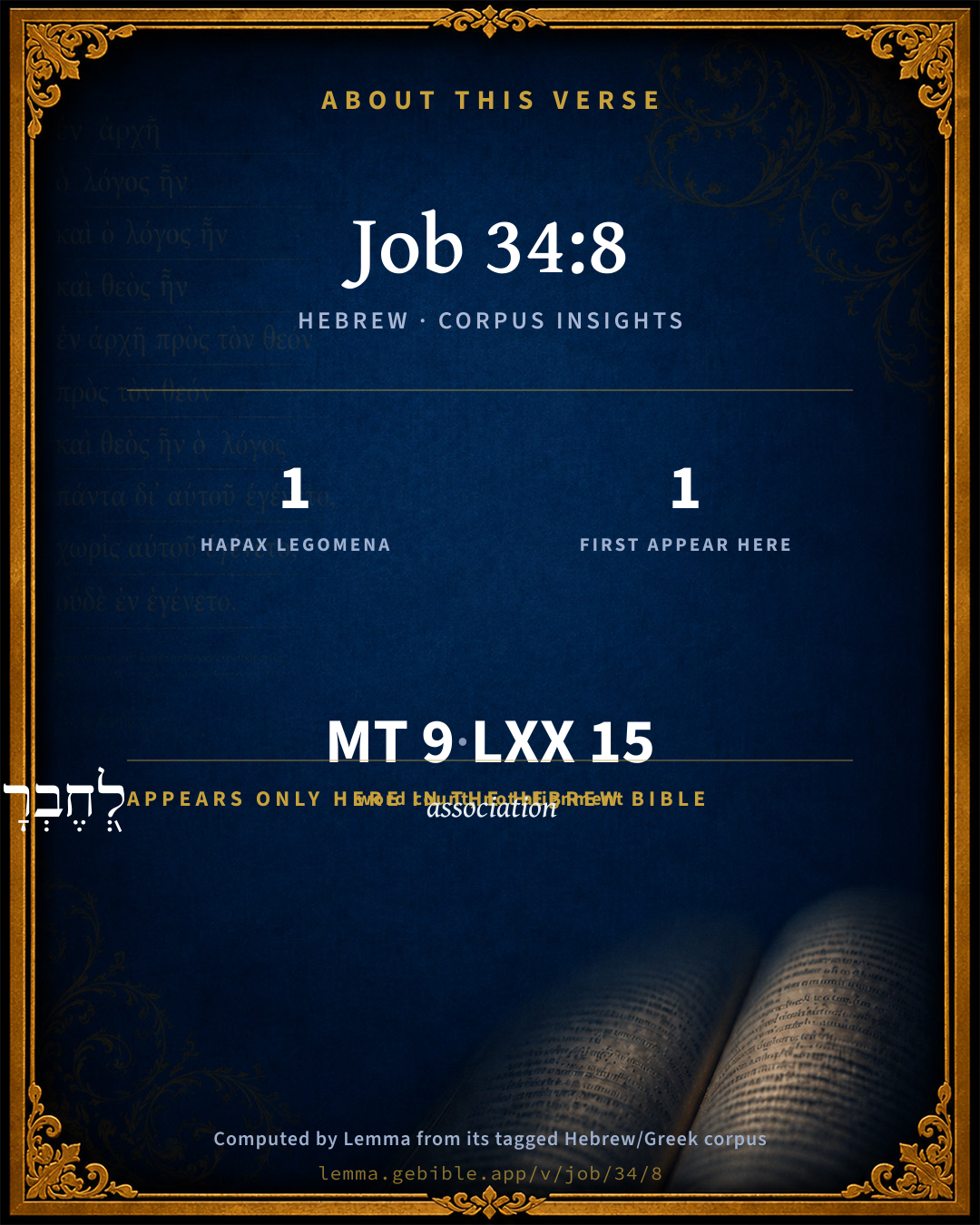
1 hapax legomenon — a word that appears only here in the entire Hebrew Bible:

  • לְ֭חֶבְרָה association H2274

First appearance in Scripture

This word makes its first canonical appearance in the Hebrew Bible here:

  • לְ֭חֶבְרָה association H2274

Shared distinctive vocabulary

וְאָרַ֣ח to journey H732 occurs in 5 verses of the Hebrew Bible. Also found in:

Grammatical profile

  • 3 verbs
  • 4 nouns
  • 2 prepositions

Verb forms

  • וְאָרַ֣ח Qal · Perfect
  • פֹּ֣עֲלֵי Qal · Participle Active
  • וְ֝לָלֶ֗כֶת Qal · Infinitive Construct

Repetition

A word recurs within this verse — often emphatic in Hebrew:

Hebrew & Septuagint length

In English translation the verse runs 14 words from the Hebrew and 20 from the Septuagint (LXX English) — the Septuagint runs noticeably longer here. See the side-by-side →

A rough comparison of the two English renderings, which tokenize alike — not a word-level alignment.

Word counts can differ between the Hebrew and the Greek without any difference in meaning — e.g. the Hebrew direct-object marker אֵת has no separate Greek word, and Greek often adds the article ὁ.

In the original languages it is 9 Hebrew tokens and 15 Greek tokens — but the two are counted differently (Hebrew bundles its prefixes and suffixes into one token; the Greek is in lemma form), so that isn’t a like-for-like length.

Cross-references

13

Topical passages linked to Job 34:8 in the Treasury of Scripture Knowledge — connected by theme and wording, ordered by reader-vote popularity; previews shown in the World English Bible.

  • Psalms 1:1 Blessed is the man who doesn't walk in the counsel of the wicked, Nor stand in the way of sinners, Nor sit in the seat of scoffers;
  • Proverbs 13:20 One who walks with wise men grows wise, But a companion of fools suffers harm.
  • 1 Corinthians 15:33 Don't be deceived! "Evil companionships corrupt good morals."
  • Psalms 26:4 I have not sat with deceitful men, Neither will I go in with hypocrites.
  • Psalms 50:18 When you saw a thief, you consented with him, And have participated with adulterers.
  • Psalms 73:12–15 Behold, these are the wicked. Being always at ease, they increase in riches.
  • Proverbs 1:15 My son, don't walk in the way with them. Keep your foot from their path,
  • Proverbs 2:12 To deliver you from the way of evil, From the men who speak perverse things;
  • Job 2:10 But he said to her, "You speak as one of the foolish women would speak. What? Shall we receive good at the hand of God, and shall we not receive evil?" In all this Job didn't sin with his lips.
  • Job 11:3 Should your boastings make men hold their peace? When you mock, shall no man make you ashamed?
  • Job 15:5 For your iniquity teaches your mouth, And you choose the language of the crafty.
  • Job 22:15 Will you keep the old way Which wicked men have trodden,
  • Proverbs 4:14 Don't enter into the path of the wicked. Don't walk in the way of evil men.

Cross-references courtesy of OpenBible.info (CC BY 4.0).

Hebrew and Greek witnesses Masoretic Hebrew ↔ Greek Septuagint

The same verse in the two great witnesses to the Old Testament, shown verse-for-verse.

Here the Septuagint runs noticeably longer than the Hebrew — LXX2012 (modern English Septuagint) 20 words vs World English Bible 14. A rough length comparison of the two English translations, not a word-level alignment — read both below.

These are two independent witnesses, not word-aligned to each other, and the Septuagint is shown in lemma (dictionary) form.

Hebrew Job 34:8 Masoretic · Westminster Leningrad Codex

וְאָרַ֣ח לְ֭חֶבְרָה עִם פֹּ֣עֲלֵי אָ֑וֶן וְ֝לָלֶ֗כֶת עִם אַנְשֵׁי רֶֽשַׁע

Who goes in company with the workers of iniquity, And walks with wicked men?

World English Bible · Public Domain

Greek LXX Job 34:8 Septuagint · lemma form

οὐ ἁμαρτάνω οὐδέ ἀσεβέω ἤ ὁδός κοινωνέω μετά ποιέω ὁ ἄνομος ὁ πορεύομαι μετά ἀσεβής

saying, I have not sinned, nor committed ungodliness, nor had fellowship with workers of iniquity, to go with the ungodly.

LXX2012 (modern English Septuagint) · Public Domain

On this verse, Haydock's Catholic Bible Commentary discusses the Septuagint’s reading. Read the note in Commentary ↓

Hebrew: Westminster Leningrad Codex (CC BY 4.0). Greek: Septuagint (public domain); English from LXX2012 (modern English Septuagint) (Public Domain). How the Septuagint differs from the Hebrew →

Commentary

Notes on Job 34:8 from classic Christian and Jewish commentators (each source and its license shown beneath its notes). The classic Christian expositions comment on the surrounding passage and are grouped to its opening verse, so a note may address several verses; the Jewish commentaries on the Tanakh (Rashi and others) are per-verse, so they appear only where the commentator wrote on this verse.

Lemma curates 59 commentaries, every one of them public domain or Creative Commons licensed, each selected and text-cleaned for this edition rather than reprinted as found. About our sources →

Trapp's Complete Commentary

John Trapp

Job 34:8 Which goeth in company with the workers of iniquity, and walketh with wicked men.

Ver. 8. Which goeth in company with the workers of iniquity] Strange if he should; for the wicked is abomination to the righteous, Pro 29:27. "Lord, gather not my soul with sinners, nor my life with bloody men," saith David, Psa 26:9. Lord, send me not to hell among the wicked (said a certain good woman upon her death bed), for thou knowest I never liked their company here on earth. But how proveth Elihu this charge against Job, who was ever a terror to graceless Belialists? Forsooth he gathereth it from a certain speech of his, if he could tell what, or when it was uttered.

John Trapp, A Commentary or Exposition upon All the Books of the Old and New Testament (1647–1656) — public domain. Text from a community e-Sword module.

Geneva Bible (1599)

Geneva Bible translators

Meaning, that Job was like to the wicked, because he seemed not to glorify God and submit himself to his judgments.

Geneva Bible (1599) marginal notes — public domain. Text via Bolls.life.

Jamieson, Fausset & Brown

Robert Jamieson, A. R. Fausset & David Brown

Job virtually goes in company (makes common cause) with the wicked, by taking up their sentiments (Job 9:22-23, Job 9:30; Job 21:7-15), or at least by saying, that those who act on such sentiments are unpunished (Mal 3:14). To deny God's righteous government because we do not see the reasons of His acts, is virtually to take part with the ungodly.

Jamieson, Fausset & Brown — Commentary Critical and Explanatory on the Whole Bible (1871) — public domain (CC PDM 1.0). Text via the HelloAO Bible API.

Adam Clarke's Commentary

Verse 8. Which goeth in company with the workers of iniquity] This is an allusion to a caravan: all kinds of persons are found there; but yet a holy and respectable man might be found in that part of the company where profligates assembled. But surely this assertion of Elihu was not strictly true; and the words literally translated, will bear a less evil meaning: "Job makes a track ארח arach, to join fellowship, לחברה lechebrah, with the workers of iniquity;" i.e., Job's present mode of reasoning, when he says, "I am righteous, yet God hath taken away my judgment," is according to the assertion of sinners, who say, "There is no profit in serving God; for, if a man be righteous, he is not benefited by it, for God does not vindicate a just man's cause against his oppressors." By adopting so much of their creed, he intimates that Job is taking the steps that lead to fellowship with them. See Job 34:9.

Adam Clarke's Commentary on the Bible (1810–1826) — public domain. Text from a community e-Sword/MySword module.

Ellicott's Commentary for English Readers

(8) And walketh with wicked men.—This was the charge that was brought against Job by Eliphaz (Job_15:4-5; Job_22:15).

A Bible Commentary for English Readers, edited by Charles John Ellicott (1878–1897) — public domain. Text from a community e-Sword module.

The Cambridge Bible for Schools and Colleges

gen. ed. J. J. S. Perowne

8. In expressing such opinions Job goes over to the camp of the professed ungodly; comp. Job_22:15; Psa_1:1.

The Cambridge Bible for Schools and Colleges (gen. ed. J. J. S. Perowne; Cambridge University Press, 1878–1918) — public domain. Text from a community e-Sword module.

John Gill's Exposition

For he hath said,.... Not plainly and expressly, but consequentially; what it was thought might be inferred from what he had said, particularly in Job 9:22;

it profiteth a man nothing that he should delight himself with God; in his house and ordinances, ways and worship; he may as well indulge himself in the pleasures of sin, and in the delights of the world, if God destroys the perfect and the wicked, as Job had said in the place referred to; if this be the case, it is in vain to serve God, and pray unto him, or keep his ordinances; which are the language and sentiments of wicked men, and according to which they act, see Job 21:14, Mal 3:14. Mr. Broughton renders it,

"when he would walk with God;''

and so the Targum,

"in his walking with God;''

and another Targum,

"in his running with God:''

though he walks and even runs in the way of his commandments, yet it is of no advantage to him; or he does the will of God, as Aben Ezra; or seeks to please him or be acceptable to him, and to find grace in his sight. Whereas though love and hatred are not known by prosperity and adversity, but both come to good and bad men, which seems to be Job's meaning in the above place, from whence this inference is deduced; yet it is certain that godliness is profitable to all, Ti1 4:8.

John Gill's Exposition of the Whole Bible (1746–1763) — public domain (CC PDM 1.0). Text via the HelloAO Bible API.

Albert Barnes' Notes on the Bible

Which goeth in company with the workers of iniquity - That is, in his sentiments. The idea is, that he advocated the same opinions which they did, and entertained the same views of God and of his government. The same charge had been before brought against him by his friends; see the notes at Job 21.

Albert Barnes' Notes on the Bible (1834–1885) — public domain. Text from a community e-Sword/MySword module.

Haydock's Catholic Bible Commentary

Goeth in. Septuagint insert a negation, which is not found in Hebrew, Chaldean, &c. They may be understood to speak ironically. (Calmet) --- "Who committeth no sin, nor iniquity, nor has had any society with lawless people, so as to walk with wicked men." (Haydock)

George Leo Haydock (1774–1849), Haydock's Catholic Family Bible and Commentary, 1859 edition — public domain. Excludes Psalms (Douay-Rheims chapter numbering differs from Protestant) and Deuterocanonical books (Catholic canon only).

Matthew Poole's English Annotations

Although I dare not say, as his three friends do, that he is a wicked man, yet in this matter he speaks and acts like one of them.

Matthew Poole's English Annotations on the Holy Bible (1683–1685) — public domain. Text from a community e-Sword/MySword module.

Whedon's Commentary on the Bible

Daniel D. Whedon

8. In company — Literally, To the company. That Job should have uttered such words (Job_34:5-6) stirs the indignation of Elihu. His zeal for God and the truth leads him, like the friends, into embittered language and unjustifiable assault. His view is in general just, that the language a man speaks betokens the company he keeps. He intimates that the complaints Job makes are merely the sentiments of the utterly godless, though in another guise. Like sentiments lead to like company, and, vice versa, as we see in the following verse, low associations give rise to low ideas. Dr. Clarke thinks there is an allusion here to a caravan, in which all kinds of persons were found.

Daniel D. Whedon (gen. ed.), Commentary on the Old and New Testaments (1874–1909) — public domain. Text from a community e-Sword module.

The Pulpit Commentary

Which goeth in company with the workers of iniquity. It is impossible to supply any other antecedent to "which" than Job himself. Elihu therefore accuses Job of having turned aside from righteousness, and betaken himself to the "counsel of the ungodly, the way of sinners, and the seat of the scornful". (Psa_1:1) This is grossly to exaggerate Job"s faults of temper, and puts Elihu very nearly on a level with Eliphaz, Bildad, and Zophar in respect of misconception and rudeness. And walketh with wicked men. If no more is meant than that Job has adopted principles and arguments commonly used by wicked men (Canon Cook), the language employed is unfortunate.

The Pulpit Commentary (1880–1919), ed. H.D.M. Spence-Jones & Joseph S. Exell — public domain. Text from a community e-Sword module.

John Wesley's Explanatory Notes

Who goeth - Although I dare not say, that he is a wicked man, yet in this matter he speaks and acts like one of them.

John Wesley, Explanatory Notes Upon the Whole Bible (1754–1765) — public domain. Text via the GEBible commentary corpus.

Lesson kit

Teaching starters — assembled from the data on this page, not authored interpretation. Every prompt links to the verse data it draws on. Edit before teaching.

Job, in the Wisdom, opens this verse with 9 words (8 distinct Hebrew lemmas). Its most distinctive word is chebrâh (“association”). The Greek Septuagint runs longer here. A historical commentator’s framing appears above. Read the whole chapter for the surrounding context.

Discussion questions

  1. What does “association” (chebrâh) contribute to the verse as a whole?
  2. This verse holds 1 word here found nowhere else in the Hebrew Bible. What might the rare word draw attention to?
  3. The word “association” first appears here in Scripture. What is being introduced at this debut?
  4. Judges 19:17 shares the word «to journey» with this verse. How do the two illuminate each other?
  5. “with” occurs 2× in this one verse. What is the effect of the repetition?
  6. Compared with the Hebrew, the Septuagint runs longer here. What questions does that raise?
  7. These translations render this verse differently; the difference is in the English rendering, not the original. What questions does that raise?
  8. The verb «וְאָרַ֣ח» is Qal Perfect. How does its form color the action?

Things to notice

  • 1 word in this verse appears nowhere else in the Hebrew Bible.
  • 1 word makes its first canonical appearance in Scripture here.
  • This verse counts 9 Hebrew ↔ 15 Greek words.
  • These translations choose different wording for 11 words in this verse.
  • “with” occurs 2× in this single verse.

Reading settings

Reading text

Shown beneath each verse's original-language words.

Old Testament
Old Testament edition

Read the OT as the Masoretic Hebrew (MT) or the Greek Septuagint (LXX).

English shown for the Greek Septuagint (in the Hebrew ↔ Greek comparison).

Comparing translations? Open the Compare panel on any verse page to stack up to four side by side.