
Psalms 141:9

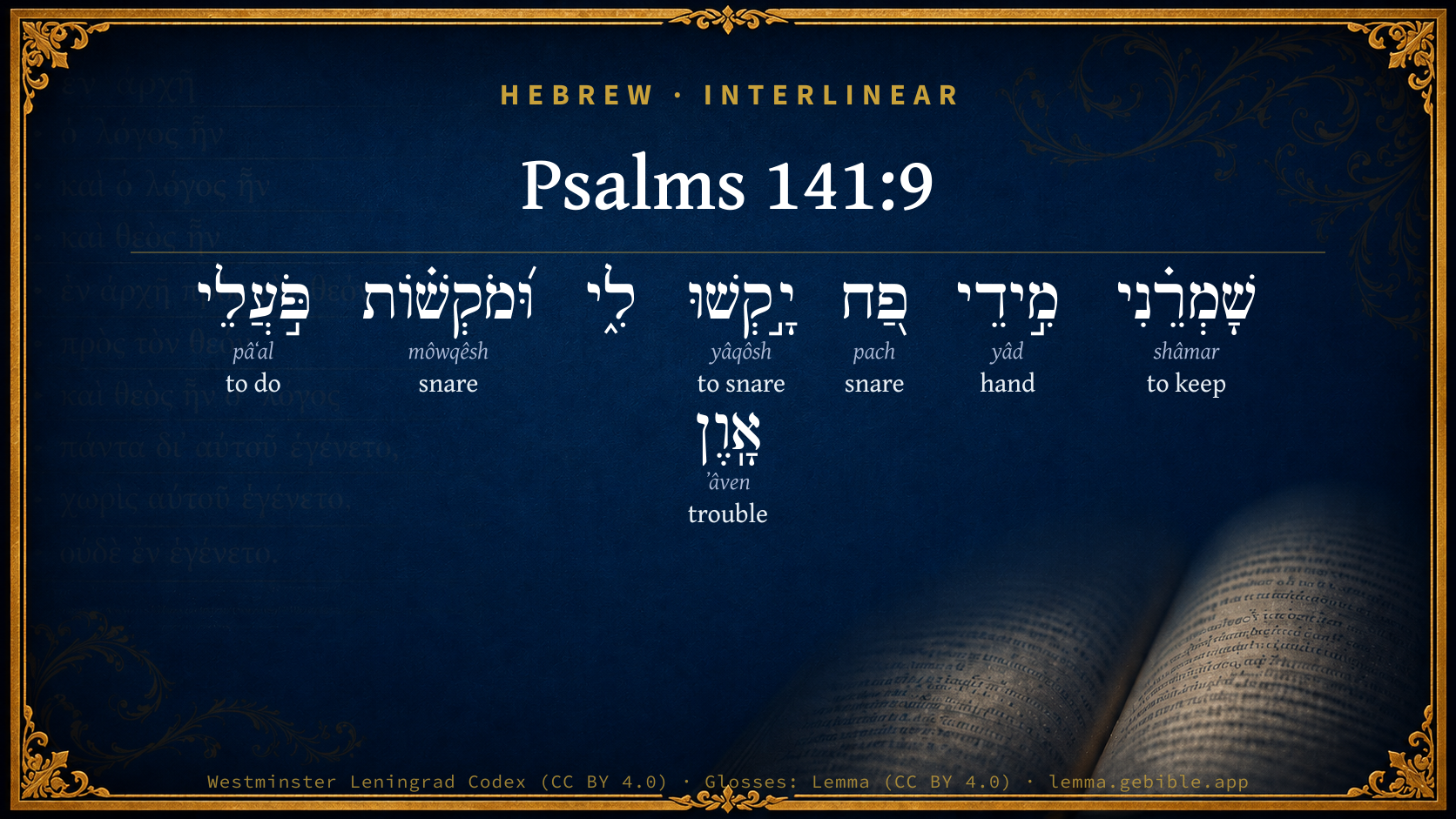
Hebrew (Westminster Leningrad Codex) Psalms 141:9 appears in the Hebrew Old Testament. The text above is from the Westminster Leningrad Codex. Each word links to its Strong’s number, a concise gloss, and parsing drawn from the Open Scriptures Hebrew Bible morphology. Click any word for its full Brown-Driver-Briggs (BDB) entry.
Download image
Cite this verse

Psalms 141:9 (World English Bible). Public Domain. Lemma interlinear Bible study tool, https://lemma.gebible.app/v/psalms/141/9.

Show BibTeX & RIS
BibTeX
RIS
English Translation
Keep me from the snare which they have laid for me, From the traps of the workers of iniquity.
World English Bible · Public Domain
Download a study sheet

One document with this verse’s original text, its word-by-word gloss line, the meaning frame, cross-references with their text, attributed commentary, and full source and license credits — printable, and it pastes into notes with its structure intact.

This verse Autodidact and up

Study sheet (.html) Plain text (.txt)

A passage Seminary Student

Up to 50 verses in one chapter. A passage sheet keeps up to 6 commentary sources and 12 cross-references per verse, in the order this page ranks them, and says so on the sheet whenever that leaves anything out. Ask for a single verse and you get the Autodidact verse sheet above.

Everything on this page stays free to read, with no account — the sheet is a download of what is already on screen, not access to it.

Want to remove ads? Support Godless Engineer
Compare translations 3

The same verse in 3 English versions, stacked beneath the original-language interlinear above. Click any original word for its lexicon entry.

Each is an independent rendering of the whole verse — the interlinear is not word-aligned to these translations.

Highlighted words mark where these versions differ — a whole-verse word diff, not a word-by-word alignment.

  • World English Bible Public Domain
    Keep me from the snare which they have laid for me, From the traps of the workers of iniquity.
  • King James Version Public Domain
    Keep me from the snares which they have laid for me, and the gins of the workers of iniquity.
  • unfoldingWord Literal Text CC BY-SA 4.0
    Keep me from the hands of the snare they have laid for me, and the traps of the workers of evil.

unfoldingWord Literal Text — © unfoldingWord, licensed CC BY-SA 4.0. Word-aligned USFM3 via Door43 (git.door43.org/unfoldingWord/en_ult).

Versions to compare (up to 4)

3 of 4 selected

Show all 18 translations

Every available English version of this verse, each an independent rendering of the whole verse.

  • World English Bible Public Domain
    Keep me from the snare which they have laid for me, From the traps of the workers of iniquity.
  • Berean Standard Bible Public Domain
    Keep me from the snares they have laid for me, and from the lures of evildoers.
  • Majority Standard Bible Public Domain
    Keep me from the snares they have laid for me, and from the lures of evildoers.
  • King James Version Public Domain
    Keep me from the snares which they have laid for me, and the gins of the workers of iniquity.
  • American Standard Version (1901) Public Domain
    Keep me from the snare which they have laid for me, And from the gins of the workers of iniquity.
  • Revised Version (1885) Public Domain
    Keep me from the snare which they have laid for me, and from the gins of the workers of iniquity.
  • Geneva Bible (1599) Public Domain
    Keepe me from the snare, which they haue layde for me, and from the grennes of the workers of iniquitie.
  • Douay-Rheims (1899) Public Domain
    Give me not up, O Lord, from my desire to the wicked: they have plotted against me; do not thou forsake me, lest they should triumph.
  • Young's Literal Translation Public Domain
    Keep me from the gin they laid for me, Even snares of workers of iniquity.
  • Literal Standard Version CC BY-SA 4.0
    Keep me from the trap they laid for me, || Even snares of workers of iniquity.
  • Unlocked Literal Bible CC BY-SA 4.0
    Protect me from the snares that they have laid for me, from the traps of evildoers.
  • unfoldingWord Literal Text CC BY-SA 4.0
    Keep me from the hands of the snare they have laid for me, and the traps of the workers of evil.
  • Darby Bible Public Domain
    Keep me from the snare which they have laid for me, and from the traps of the workers of iniquity.
  • World Messianic Bible Public Domain
    Keep me from the snare which they have laid for me, from the traps of the workers of iniquity.
  • Webster's Bible Public Domain
    Keep me from the snare which they have laid for me, and the gins of the workers of iniquity.
  • Free Bible Version CC BY-SA 4.0
    Keep me safe from the traps they have set to catch me, from the snares of evil people.
  • Bible in Basic English Public Domain
    Keep me from the net which they have put down for me, and from the designs of the workers of evil.
  • JPS Tanakh (1917) Public Domain
    Keep me from the snare which they have laid for me, and from the gins of the workers of iniquity.

Literal Standard Version (2020), Covenant Press — licensed CC BY-SA 4.0. Text via the HelloAO Bible API (eBible.org). Unlocked Literal Bible (unfoldingWord) — licensed CC BY-SA 4.0. Text via the HelloAO Bible API (eBible.org). unfoldingWord Literal Text — © unfoldingWord, licensed CC BY-SA 4.0. Word-aligned USFM3 via Door43 (git.door43.org/unfoldingWord/en_ult). Free Bible Version, Dr. Jonathan Gallagher — licensed CC BY-SA 4.0. Text via the HelloAO Bible API (eBible.org).

Word by word

More ways to search: Search by grammar → Find every occurrence → Compare this word →

Practice this passage: Drill this verse → Learn its vocabulary →

About this verse

These counts appear in no published source. They are computed here, from the morphology-tagged text and Lemma’s own curated glosses. What Lemma adds →

8
words
7
distinct lemmas
Wisdom
section

Notable vocabulary

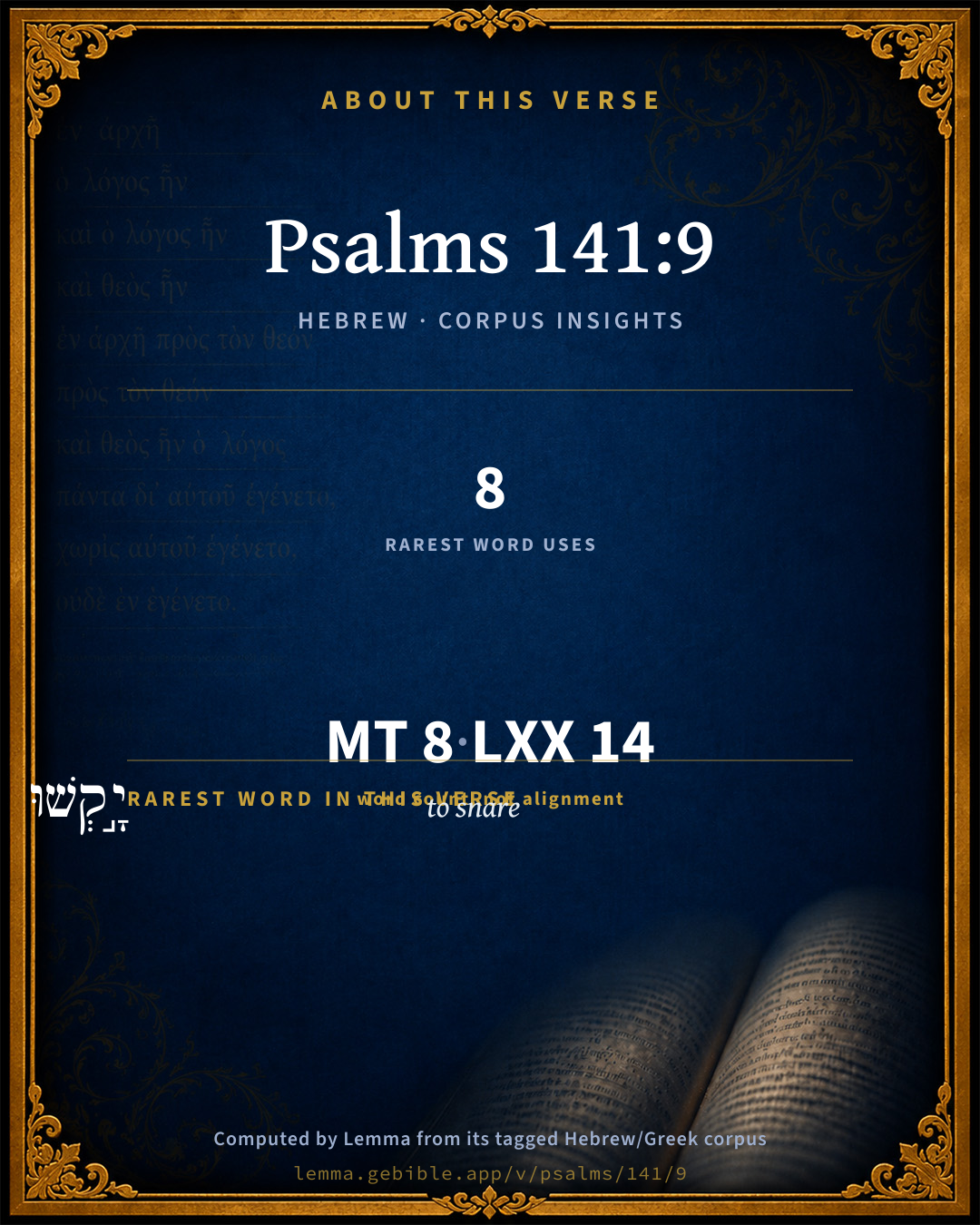
The rarest word here is יָ֣קְשׁוּ to snare H3369 — appearing just 8 times in the whole Hebrew Bible.

Shared distinctive vocabulary

יָ֣קְשׁוּ to snare H3369 occurs in 8 verses of the Hebrew Bible. Also found in:

Grammatical profile

  • 3 verbs
  • 4 nouns
  • 1 preposition

Verb forms

  • שָׁמְרֵ֗נִי Qal · Imperative
  • יָ֣קְשׁוּ Qal · Perfect
  • פֹּ֣עֲלֵי Qal · Participle Active

Hebrew & Septuagint length

In English translation the verse runs 19 words from the Hebrew and 21 from the Septuagint (LXX English) — closely comparable.

A rough comparison of the two English renderings, which tokenize alike — not a word-level alignment.

Word counts can differ between the Hebrew and the Greek without any difference in meaning — e.g. the Hebrew direct-object marker אֵת has no separate Greek word, and Greek often adds the article ὁ.

In the original languages it is 8 Hebrew tokens and 14 Greek tokens — but the two are counted differently (Hebrew bundles its prefixes and suffixes into one token; the Greek is in lemma form), so that isn’t a like-for-like length.

Cross-references

7

Topical passages linked to Psalms 141:9 in the Treasury of Scripture Knowledge — connected by theme and wording, ordered by reader-vote popularity; previews shown in the World English Bible.

  • Psalms 119:110 The wicked have laid a snare for me, Yet I haven't gone astray from your precepts.
  • Psalms 140:5 The proud have hidden a snare for me, They have spread the cords of a net by the path. They have set traps for me. Selah.
  • Luke 20:20 They watched him, and sent out spies, who pretended to be righteous, that they might trap him in something he said, so as to deliver him up to the power and authority of the governor.
  • Proverbs 13:14 The teaching of the wise is a spring of life, To turn from the snares of death.
  • Psalms 38:12 They also who seek after my life lay snares. Those who seek my hurt speak mischievous things, And meditate deceits all day long.
  • Psalms 142:3 When my spirit was overwhelmed within me, You knew my path. In the way in which I walk, They have hidden a snare for me.
  • Jeremiah 18:22 Let a cry be heard from their houses, when you shall bring a troop suddenly on them; for they have dug a pit to take me, and hid snares for my feet.

Cross-references courtesy of OpenBible.info (CC BY 4.0).

Hebrew and Greek witnesses Masoretic Hebrew ↔ Greek Septuagint

The same verse in the two great witnesses to the Old Testament, shown verse-for-verse.

You’re reading Greek Psalm 140 (Hebrew Psalm 141). The Septuagint counts the superscription, so verse numbers can differ from the Hebrew — chapter-level alignment, not verse-by-verse. Numbering follows Rahlfs.

These are two independent witnesses, not word-aligned to each other, and the Septuagint is shown in lemma (dictionary) form.

Hebrew Psalms 141:9 Masoretic · Westminster Leningrad Codex

שָׁמְרֵ֗נִי מִ֣ידֵי פַ֭ח יָ֣קְשׁוּ לִ֑י וּ֝מֹקְשׁ֗וֹת פֹּ֣עֲלֵי אָֽוֶן

Keep me from the snare which they have laid for me, From the traps of the workers of iniquity.

World English Bible · Public Domain

Greek LXX Greek Psalm 140:9 Septuagint · lemma form

φυλάσσω ἐγώ ἀπό παγίς ὅς συνἵστημι ἐγώ καί ἀπό σκάνδαλον ὁ ἐργάζομαι ὁ ἀνομία

Keep me from the snare which they have set for me, and from the stumbling blocks of them that work iniquity.

LXX2012 (modern English Septuagint) · Public Domain

Hebrew: Westminster Leningrad Codex (CC BY 4.0). Greek: Septuagint (public domain); English from LXX2012 (modern English Septuagint) (Public Domain). How the Septuagint differs from the Hebrew →

Commentary

Notes on Psalms 141:9 from classic Christian and Jewish commentators (each source and its license shown beneath its notes). The classic Christian expositions comment on the surrounding passage and are grouped to its opening verse, so a note may address several verses; the Jewish commentaries on the Tanakh (Rashi and others) are per-verse, so they appear only where the commentator wrote on this verse.

Lemma curates 59 commentaries, every one of them public domain or Creative Commons licensed, each selected and text-cleaned for this edition rather than reprinted as found. About our sources →

Trapp's Complete Commentary

John Trapp

Psa 141:9 Keep me from the snares [which] they have laid for me, and the gins of the workers of iniquity.

Ver. 9. Keep me from the snare, &c.] See Psa 145:5.

John Trapp, A Commentary or Exposition upon All the Books of the Old and New Testament (1647–1656) — public domain. Text from a community e-Sword module.

Joseph Benson's Commentary

Psa 141:9-10. Keep me from the snare which they have laid for me — Keep me from being taken in it: give me to discover and evade it. If Saul and his evil counsellors be intended in this clause, probably the heathen, to whom David was now driven for refuge, were meant in the next. They were workers of iniquity in the worst sense, being worshippers of idols, and their idols were always snares to the Israelites, as their history informs us, and as they were forewarned by God himself, Jdg 2:3. Their gods will be a snare unto you, Hebrew, מוקשׁ, the same word with that translated, in the plural number, gins, in this verse. Let the wicked fall — Hebrew, יפלו, they shall fall; into their own nets — Into the snares, dangers, and mischiefs which they design for me. While that I withal escape — Namely, together with my followers, or, in like manner, as I have formerly done. But many translators, both ancient and modern, join the word יחד, here rendered withal, or together, to the preceding clause to which it is placed next in the Hebrew, and then the meaning is, the wicked shall fall into their own nets together, or alike, one as well as another, Saul himself not excepted, (whom, though I dare not destroy him, God will judge,) while that I escape, am preserved from that common calamity in which mine enemies perish. Which was verified by the event. For David escaped all the snares which were laid for him on every side; and was strangely kept out of harm’s way, when Saul and other of David’s enemies were cut off by the Philistines, 1 Samuel 31. So will the devices of the enemies of God’s people be in the end turned against themselves. They shall fall and perish, but the saved of the Lord shall triumph with their Redeemer to eternity. Reader, see that thou be one of these!

Joseph Benson's Commentary on the Old and New Testaments (1811–1818) — public domain. Text from a community e-Sword module.

J. A. Alexander on Psalms

Joseph Addison Alexander

9. (Psa 141:9) Keep me from the hands of the snare which they have netted for me, and the nets of the doers of iniquity. The word hands is entirely omitted both in the English Bible and the Prayer Book version. It is put, by a favourite personification, for power or possession. The use of the expression here was probably occasioned by its previous use in Psa 140:4. The verb netted is here employed to represent the cognate verb and noun in Hebrew.

Joseph Addison Alexander, The Psalms Translated and Explained (1850) — public domain. Text from a community e-Sword module.

John Calvin's Commentaries

9. Keep me, etc. He owns himself to be shut up in the snares of his enemies, unless set free by a higher hand. In praying to God under the straits to which he was reduced, he proves what a high estimate he formed of what his mercy could effect, as elsewhere he says, that the issues from death belong to him. (Psalm 68:20.) God often delays interposing, that the deliverance may be the more signal; and afterwards he makes the devices of the wicked to recoil upon their own heads. It seems absurd to refer the pronoun his to Saul, as if the sense were that Doeg and others of that character would fall into the snares of Saul. It would seem to be God who is intended. First, he had spoken of being preserved by God from the toils of the wicked, and now to these snares which the wicked spread for the upright he opposes the snares with which God catches the crafty in their own devices. And as the number of his enemies was great, he uses the expression, let them fall together, for escape would have been impossible, had he not been persuaded that it was easy for God to overthrow any combined force and array of men. What follows admits of two meanings. Many read, I shall always pass. But we may suppose order of the words changed and read, until I pass. It prays that his enemies should be held in the snare till he got off safe,

John Calvin's Commentaries (1540-1563) — public domain. Text from the Calvin Translation Society English edition (1840s-50s) via the Christian Classics Ethereal Library (ccel.org). Calvin's coverage is partial (roughly two-thirds of the Bible); uncommented books and verses are honest gaps, never fabricated. The 19th-century editor's footnotes and remarks are omitted so the notes are faithfully Calvin's own voice.

Ellicott's Commentary for English Readers

(9) From the snare.—The original idiom is far more forcible: “from the hands (or, ‘clutches’) of the snare.” (See above, Psa_141:6, “in the hands of the cliff.”)

A Bible Commentary for English Readers, edited by Charles John Ellicott (1878–1897) — public domain. Text from a community e-Sword module.

The Cambridge Bible for Schools and Colleges

gen. ed. J. J. S. Perowne

9. Cp. Psa_140:4-5.

grins] Rather, baits or lures, the sensual temptations by which they are endeavouring to entice him (Psa_141:4). For grins see on Psa_140:5.

The Cambridge Bible for Schools and Colleges (gen. ed. J. J. S. Perowne; Cambridge University Press, 1878–1918) — public domain. Text from a community e-Sword module.

John Gill's Exposition

Keep me from the snare which they have laid for me,.... Either Saul, who gave him a wife to be a snare to him, and set men to watch his house and take him; or the Ziphites, who proposed to Saul to deliver him into his hands; see Sa1 18:21.

and the gins of the workers of iniquity; the transgressions of wicked men are snares to others, by way of example; and so are the doctrines of false teachers, and the temptations of Satan, from all which good men desire to be kept, Pro 29:6; and it is the Lord alone that keeps and preserves from them, or breaks the snare and delivers them, Psa 124:7.

John Gill's Exposition of the Whole Bible (1746–1763) — public domain (CC PDM 1.0). Text via the HelloAO Bible API.

Albert Barnes' Notes on the Bible

Keep me from the snares ... - See the notes at Psa 11:6. Compare Psa 38:12; Psa 69:22; Psa 91:3. The secret plans which they have laid against me.

And the gins of the workers of iniquity - Wicked men; men who seek my destruction. On the word gins, see the notes at Isa 8:14. The gin is a trap or snare to catch birds or wild animals. The word used here is the same which occurs in Psa 18:5, and which is there rendered “snare.” See the notes at that passage. Compare also Psa 64:5; Psa 69:22; Psa 106:36; Psa 140:5, where the same word occurs.

Albert Barnes' Notes on the Bible (1834–1885) — public domain. Text from a community e-Sword/MySword module.

The Treasury of David

Charles H. Spurgeon

Ver. 9. Keep me from, the snares which they have laid for me. He had before asked, in Ps 141:3, that the door of his mouth might be kept; but his prayer now grows into "Keep me." He seems more in trouble about covert temptation than concerning open attacks. Brave men do not dread battle, but they hate secret plots. We cannot endure to be entrapped like unsuspecting animals; therefore we cry to the God of wisdom for protection. And the gins of the workers of iniquity. These evil workers sought to catch David in his speech or acts. This was in itself a piece of in equity, and so of a piece with the rest of their conduct. They were bad themselves, and they wished either to make him like themselves, or to cause him to seem so. If they could not catch the good man in one way, they would try another; snares and gins should be multiplied, for anyhow they were determined to work his ruin. Nobody could preserve David but the Omniscient and Omnipotent One: he also will preserve us. It is hard to keep out of snares which you cannot see, and to escape gins which you cannot discover. Well might the much hunted Psalmist cry, "Keep me."

Ver. 9-10. Snares, Gins, Nets. The usual method of capturing or killing the lion in Palestine was by pitfalls or nets, to both of which there are many references in the Scriptures. The mode of hunting the lion with nets was identical with that which is practised in India at the present time. The precise locality of the lion's dwelling place having been discovered, a circular wall of net is arranged round it, or if only a few nets can be obtained, they are set in a curved form, the concave side being towards the lion. They then send dogs into the thicket, hurl stones and sticks at the den, shoot arrows into it, fling burning torches at it, and so irritate and alarm the animal that it rushes against the net, which is so made that it falls down and envelops the animal in its folds. If the nets be few, the drivers go to the opposite side of the den, and induce the lion to escape in the direction where he sees no foes, but where he is sure to run against the treacherous net. Other large and dangerous animals were also captured by the same means. Another and more common, because an easier and a cheaper method, was, by digging a deep pit, covering the mouth with a slight covering of sticks and earth, and driving the animal upon the treacherous covering. It is an easier method than the net, because after the pit is once dug, the only trouble lies in throwing the covering over its mouth. But it is not so well adapted for taking beasts alive, as they are likely to be damaged, either by the fall into the pit, or by the means used in getting them out again. Animals, therefore, that are caught in pits are generally, though not always, killed before they are taken out. The net, however, envelops the animal so perfectly, and renders it so helpless, that it can be easily bound and taken away. The hunting net is very expensive, and requires a large staff of men to work it, so that none but a rich man could use the net in hunting.

Besides the net, several other modes of bird catching were used by the ancient Jews, just as is the case at the present day. Boys, for example, who catch birds for their own consumption, and not for the market, can do so by means of various traps, most of which are made on the principle of the noose, or snare. Sometimes a great number of hair nooses are set in places to which the birds are decoyed, so that in hopping about, many of them are sure to be entangled in the snares. Sometimes the noose is ingeniously suspended in a narrow passage which the birds are likely to traverse, and sometimes a simple fall trap is employed. J. G. Wood.

Psalms 141:10*

Charles H. Spurgeon's The Treasury of David (1869–1885) — public domain. Psalms only. Text from a community e-Sword/MySword module.

The Pulpit Commentary

Keep me from the snares which they have laid for me, and the gins of the workers of iniquity. (comp. Psa_40:4, Psa_40:5)

The Pulpit Commentary (1880–1919), ed. H.D.M. Spence-Jones & Joseph S. Exell — public domain. Text from a community e-Sword module.

Lesson kit

Teaching starters — assembled from the data on this page, not authored interpretation. Every prompt links to the verse data it draws on. Edit before teaching.

Psalms, in the Wisdom, opens this verse with 8 words (7 distinct Hebrew lemmas). Its most distinctive word is yâqôsh (“to snare”). A historical commentator’s framing appears above. Read the whole chapter for the surrounding context.

Discussion questions

  1. The word yâqôsh carries the sense “to snare.” How does it shape the verse?
  2. How does Deuteronomy 7:25, which shares the word «to snare», read alongside this verse?
  3. These translations render this verse differently. What is at stake in choosing one wording over another?
  4. «שָׁמְרֵ֗נִי» is a Qal Imperative verb. How does that grammatical form shape the action described?
  5. Compare how Trapp's Complete Commentary and Joseph Benson's Commentary read this verse. Where do they agree or differ?

Things to notice

Reading settings

Reading text

Shown beneath each verse's original-language words.

Old Testament
Old Testament edition

Read the OT as the Masoretic Hebrew (MT) or the Greek Septuagint (LXX).

English shown for the Greek Septuagint (in the Hebrew ↔ Greek comparison).

Comparing translations? Open the Compare panel on any verse page to stack up to four side by side.