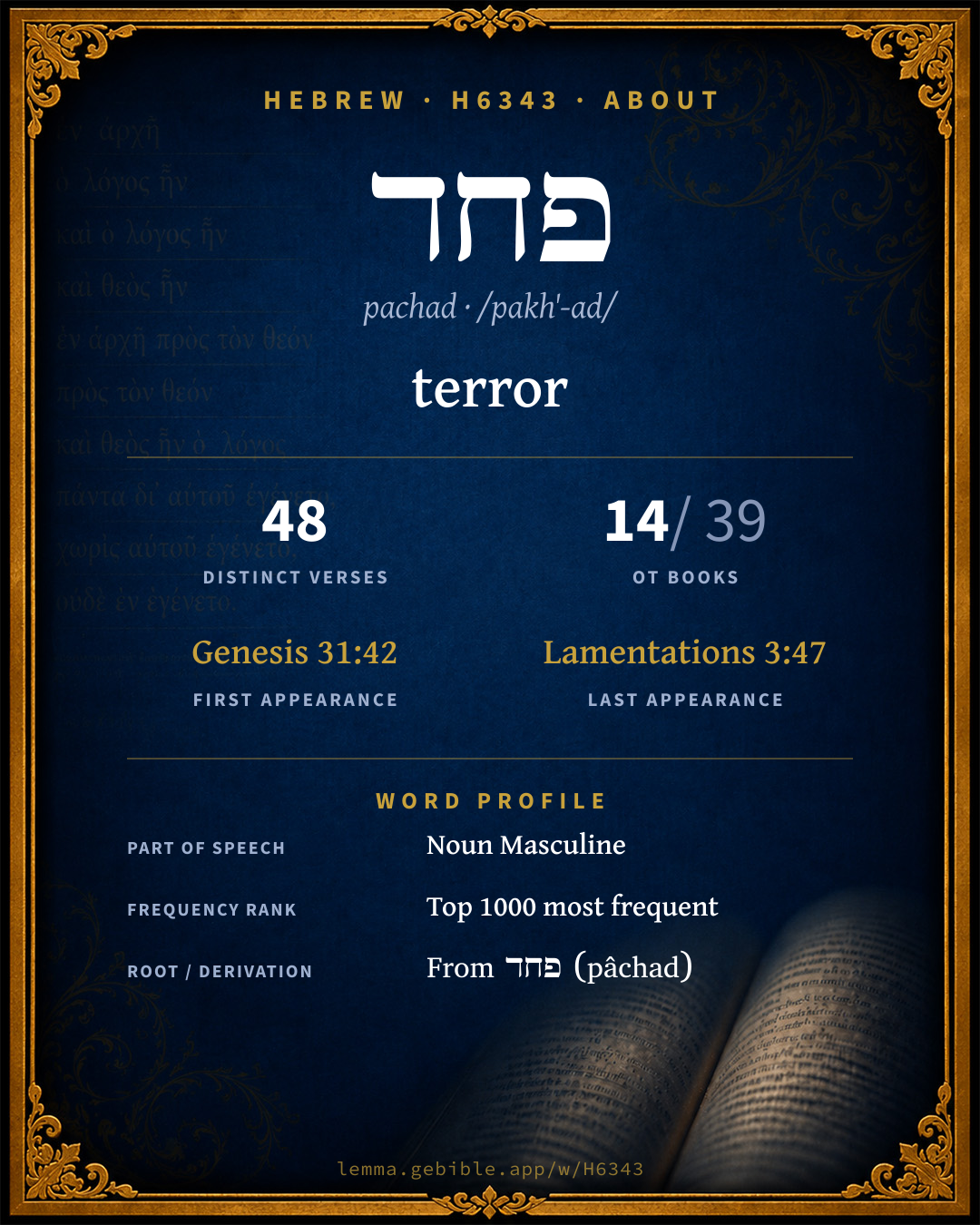
פַּ֫חַד
terror
‘terror’ is one of 3 main senses fuller range ↓
Full lexicon entry — Brown-Driver-Briggs (BDB)
From Brown-Driver-Briggs (BDB)
Where this word appears
See every Construct-state word in the Hebrew Bible →
Grammar key — what these labels mean
Part of speech
- Noun
- A naming word — a person, place, thing, or idea.
Noun type
- Common
- A common noun — a general class of person, place, or thing (“king,” “city,” “water”), not a specific name.
State
- Absolute
- The independent form of a noun, not bound to a following word.
- Construct
- A noun bound to a following noun in a possessive / “of” relationship (the construct chain).
Gender
- Masculine
- Grammatically masculine.
Number
- Singular
- One.
- Plural
- More than one (in Hebrew, generally three or more).
26 distinct verses where H6343 appears in the Construct state, across 10 books. Filtered view — show all forms. Click any verse to open its interlinear word-by-word view. Verse text shown in the World English Bible for context — . Each verse’s Hebrew form is shown with its reference; the English is not keyword-highlighted, since the data carries no word-level English alignment. Use “Compare translations” on any verse to read it across multiple English versions. This concordance covers the Hebrew Bible; Septuagint (Greek Old Testament) occurrences are not indexed here.
Genesis 2 verses
- Genesis 31:42 וּ/פַ֤חַד conj + n c ms cs Unless the God of my father, the God of Abraham, and the fear of Isaac, had been with me, surely now you would have sent me away empty. God has seen my affliction and the labor of my hands, and rebuked you last night."
- Genesis 31:53 בְּ/פַ֖חַד prep + n c ms cs The God of Abraham, and the God of Nahor, the God of their father, judge between us." Then Jacob swore by the fear of his father, Isaac.
Deuteronomy 3 verses
- Deuteronomy 2:25 פַּחְדְּ/ךָ֙ n c ms cs + sfx pers 2ms This day will I begin to put the dread of you and the fear of you on the peoples who are under the whole sky, who shall hear the report of you, and shall tremble, and be in anguish because of you.
- Deuteronomy 11:25 פַּחְדְּ/כֶ֨ם n c ms cs + sfx pers 2mp There shall no man be able to stand before you: Yahweh your God shall lay the fear of you and the dread of you on all the land that you shall tread on, as he has spoken to you.
- Deuteronomy 28:67 מִ/פַּ֤חַד prep + n c ms cs In the morning you shall say, Would it were even! and at even you shall say, Would it were morning! for the fear of your heart which you shall fear, and for the sight of your eyes which you shall see.
1 Samuel 1 verse
1 Chronicles 1 verse
2 Chronicles 4 verses
- 2 Chronicles 14:14 פַֽחַד n c ms cs They struck all the cities round about Gerar; for the fear of Yahweh came on them: and they despoiled all the cities; for there was much spoil in them.
- 2 Chronicles 17:10 פַּ֣חַד n c ms cs The fear of Yahweh fell on all the kingdoms of the lands that were round about Judah, so that they made no war against Jehoshaphat.
- 2 Chronicles 19:7 פַֽחַד n c ms cs Now therefore let the fear of Yahweh be on you; take heed and do it: for there is no iniquity with Yahweh our God, nor respect of persons, nor taking of bribes.
- 2 Chronicles 20:29 פַּ֣חַד n c ms cs The fear of God was on all the kingdoms of the countries, when they heard that Yahweh fought against the enemies of Israel.
Esther 3 verses
- Esther 8:17 פַּֽחַד n c ms cs In every province, and in every city, wherever the king's commandment and his decree came, the Jews had gladness and joy, a feast and a good day. Many from among the peoples of the land became Jews; for the fear of the Jews was fallen on them.
- Esther 9:2 פַּחְדָּ֖/ם n c ms cs + sfx pers 3mp the Jews gathered themselves together in their cities throughout all the provinces of the king Ahasuerus, to lay hand on such as sought their hurt: and no man could withstand them; for the fear of them was fallen on all the peoples.
- Esther 9:3 פַּֽחַד n c ms cs All the princes of the provinces, and the satraps, and the governors, and those who did the king's business, helped the Jews; because the fear of Mordecai was fallen on them.
Job 1 verse
Psalms 5 verses
- Psalms 36:1 פַּ֥חַד n c ms cs An oracle is within my heart about the disobedience of the wicked: "There is no fear of God before his eyes."
- Psalms 64:1 מִ/פַּ֥חַד prep + n c ms cs Hear my voice, God, in my complaint. Preserve my life from fear of the enemy.
- Psalms 91:5 מִ/פַּ֣חַד prep + n c ms cs You shall not be afraid of the terror by night, Nor of the arrow that flies by day;
- Psalms 105:38 פַּחְדָּ֣/ם n c ms cs + sfx pers 3mp Egypt was glad when they departed, For the fear of them had fallen on them.
- Psalms 119:120 מִ/פַּחְדְּ/ךָ֣ prep + n c ms cs + sfx pers 2ms My flesh trembles for fear of you. I am afraid of your judgments.
Proverbs 3 verses
- Proverbs 1:26 פַחְדְּ/כֶֽם n c ms cs + sfx pers 2mp I also will laugh at your disaster. I will mock when calamity overtakes you;
- Proverbs 1:27 פַּחְדְּ/כֶ֗ם n c ms cs + sfx pers 2mp When calamity overtakes you like a storm, When your disaster comes on like a whirlwind; When distress and anguish come on you.
- Proverbs 1:33 מִ/פַּ֥חַד prep + n c ms cs But whoever listens to me will dwell securely, And will be at ease, without fear of harm."
Isaiah 3 verses
- Isaiah 2:10 פַּ֣חַד n c ms cs Enter into the rock, And hide in the dust, From before the terror of Yahweh, And from the glory of his majesty.
- Isaiah 2:19 פַּ֤חַד n c ms cs Men shall go into the caves of the rocks, And into the holes of the earth, From before the terror of Yahweh, And from the glory of his majesty, When he arises to shake the earth mightily.
- Isaiah 2:21 פַּ֤חַד n c ms cs To go into the caverns of the rocks, And into the clefts of the ragged rocks, From before the terror of Yahweh, And from the glory of his majesty, When he arises to shake the earth mightily.
About this entry
At a glance — auto-summarized from this page’s data, not written by a person. Every figure links to its source below. This summary describes the numbers; it doesn’t interpret them.
פחד (pachad) is a Hebrew noun most often rendered “terror.” Debuting at Genesis 31:42, it then recurs through the corpus. The Hebrew Bible uses it across 48 verses — moderately common. It is not a single-sense word — see its full sense range. Related forms include פחד, פחד and פחדה. The sections below give every sense, occurrence, and version rendering.
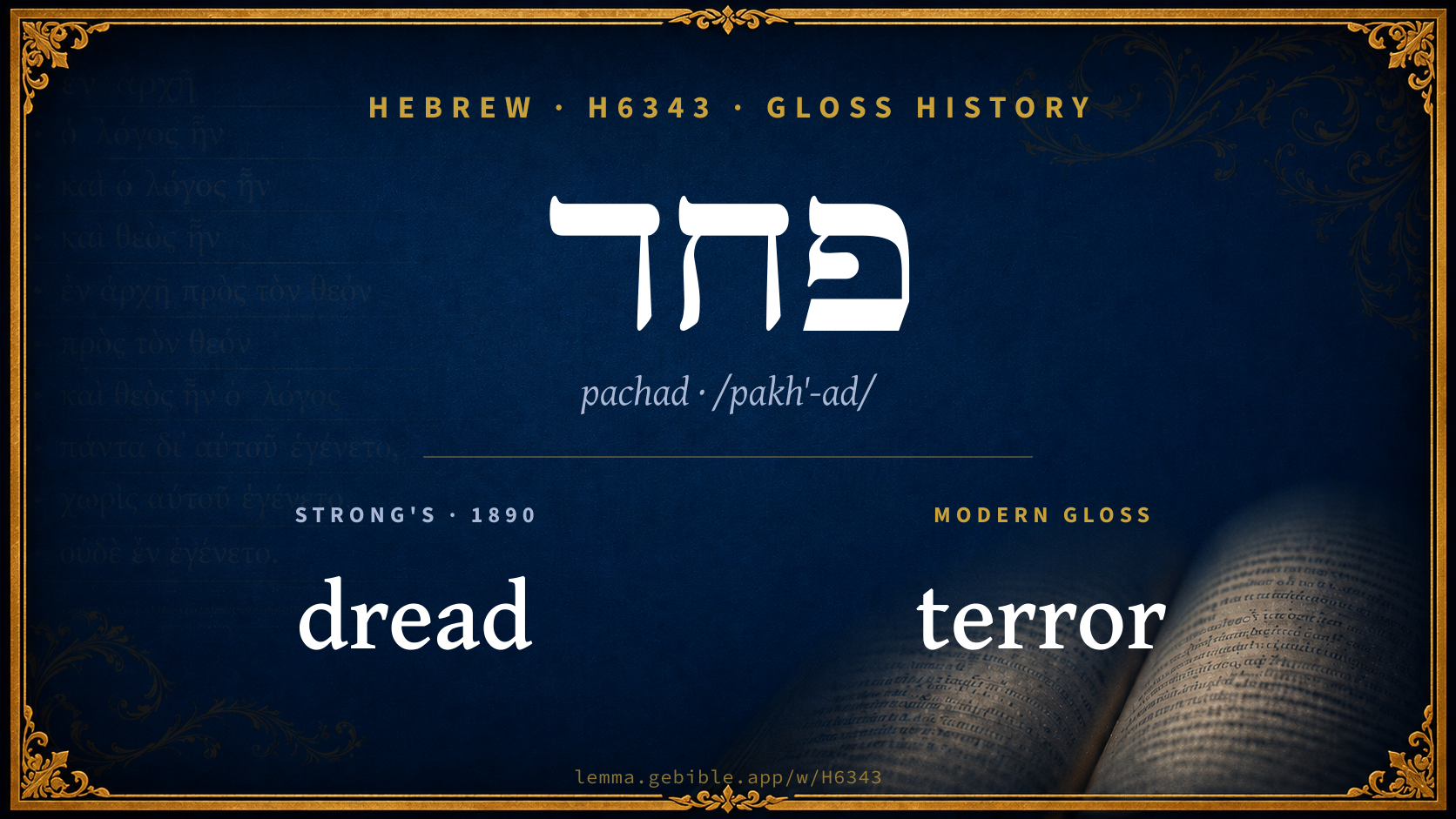
Gloss history
Strong's 1890 vs modern scholarship
About this word
Strong's H6343 catalogs a Hebrew word from the Hebrew Old Testament.
These counts are not copied from any lexicon or concordance. They are computed here, from the morphology-tagged Hebrew Old Testament. What Lemma adds →
- 48
- distinct verses
- The word appears in 48 distinct verses.
- 14 / 39
- OT books
- The word appears in 14 of 39 Old Testament books.
- #752
- by frequency
- Top 1000 most frequent Hebrew words (rank 752 of 8,640 Hebrew words by occurrence).
View all 48 occurrences in the concordance →
By section of the Old Testament
By traditional corpus
Conventional, traditional groupings — biblical authorship is debated, so this is a traditional corpus grouping, not an authorship claim. Each share is this word’s portion of its verses in that division of the Hebrew canon. Each figure is a share of the word’s 48 distinct verses.
- Writings (Ketuvim) 32 verses · 67%
- Prophets (Nevi'im) 10 verses · 21%
- Torah (Pentateuch) 6 verses · 13%
How translations render this word
Counts come from each version’s own published word-to-Strong’s tagging or interlinear alignment — an approximate guide to how each version renders this word, not a word-level alignment the data otherwise carries. Because each total is that version’s own tagged count, the per-version totals vary from one another and need not match the appearance or distinct-verse counts above. These counts may also differ from a printed concordance because Lemma counts each distinctly tagged rendering and does not collapse phrase taggings into a single head-word total. This is a fixed set of word-tagged versions (KJV, ASV, BSB, ULT) and does not change with the reading translation you choose elsewhere. Each version’s license is shown beside its name below (and on Sources).
BDB lists this Strong’s number as 2 distinct words (homographs). Each count above pools all of them and is not split by sense — see the Senses section below. A low-frequency rendering may belong to a different one of those words, not the primary meaning.
- King James Version†: Fear 37×, Dread 3×, Were they in great 2×
- American Standard Version†: Fear 30×, Dread 4×, Terror 4×
- Berean Standard Bible†: Fear 12×, Terror 12×, Dread 9×
- unfoldingWord Literal Text†: Fear 10×, Dread of 8×, Dread 5×
King James Version Public Domain
Renders H6343 across 49† tagged occurrences — most commonly:
Plus 7 renderings that appear only once — usually multi-word phrases or single function words the recovered tagging swept in, not distinct renderings.
American Standard Version Public Domain
Renders H6343 across 49† tagged occurrences — most commonly:
Plus 9 renderings that appear only once — usually multi-word phrases or single function words the recovered tagging swept in, not distinct renderings.
Berean Standard Bible Public Domain
Renders H6343 across 49† tagged occurrences — most commonly:
Plus 13 renderings that appear only once — usually multi-word phrases or single function words the recovered tagging swept in, not distinct renderings.
unfoldingWord Literal Text CC BY-SA 4.0
Renders H6343 across 46† tagged occurrences — most commonly:
Plus 10 renderings that appear only once — usually multi-word phrases or single function words the recovered tagging swept in, not distinct renderings.
Senses in the full BDB
What do BDB’s symbols mean?
BDB uses these scholarly abbreviations:
| Symbol | Meaning |
|---|---|
| 𝔊 | the Septuagint (the ancient Greek translation, LXX) |
| 𝔙 | the Vulgate (the Latin translation) |
| 𝔖 | the Syriac version (the Peshitta) |
| 𝔗 | the Targum (the Aramaic translation) |
| ψ | the Psalms |
| √ | root (the underlying root or stem) |
| ‖ | parallel passage (a synonymous or contrasted parallel) |
| † | the dagger: every passage where the word occurs is cited |
The 3 senses and sub-senses the full Brown-Driver-Briggs lexicon distinguishes for this word, in lexicon order (not ranked by frequency), with BDB’s own verbatim wording and sub-sense lettering. Shown in Hebrew script with BDB’s own scholarly abbreviations. The condensed entry is in the Lexicon Entry tab. See also the Forms in the corpus table below.
- 1. dread, פ׳ י׳, i.e. before י׳, often (not always) terrifying, unfitting for action, †Is 2:10, 19, 21; 1 S 11:7; 2 Ch 14:13; 17:10, so פ׳ אֱלֹהִים †20:29, c. sf. Jb 13:11 ψ 119:120 trembleth for dread of thee; c. genit. obj. Isr., †Dt 2:25 (‖ יִרְאָה), 11:25 (‖ מוֹרָא), ψ 105:38 Est 8:17; 9:2, פ׳ אוֹיֵב †ψ 64:2, of individual †1 Ch 14:17; Est 9:3; c. genit. obj. rei Pr 1:33; abs., in gen., Ex 15:16 (song; ‖ אֵימָ֫תָה), Jb 4:14 (‖ רְעָדָה), Je 30:5 (‖ קוֹל חֲרָדָה) +; as acc. cogn. c. פָּחַד ψ 14:5 + (v. פָּחַד); c. genit. subj. †Pr 1:26, 27 (both ‖ אֵיד) Dt 28:67. e.g. Isaiah 2:10
- 2. = object of dread †ψ 31:12; 36:2, פ׳ אֵלַי Jb 31:23; פַּחַד פָּחַדְתִּי †Jb 3:25; מִקּוֹל הַפַּחַד †Is 24:18 sound of the disaster, for מִפְּנֵי הַפּ׳ of orig. Je 48:44, but קוֹל פְּחָדִים †Jb 15:21 = a sound of terrors; פ׳ פִּתְאֹם 22:10; Pr 3:25. e.g. Psalms 31:12
- 3. as design. dei †פ׳ יִצְחָק Gn 31:42 (‖ אֱלֹהֵי אַבְרָהָם), so v 53 (‖ id.; both E). e.g. Genesis 31:42
Senses from the full Brown-Driver-Briggs lexicon (Brown, Driver, Briggs; Oxford 1906 — public domain), digitized via Sefaria, supplemented by the OpenScriptures HebrewLexicon (CC BY 4.0). Full attribution on Sources.
Word origin
I. n.m. 1 S 11:7 dread;—פ׳ abs. Gn 31:42 +, cstr. 1 S 11:7 +, sf. פַּחְדְּךָ Dt 2:25 ψ 119:120, פַּחְדּוֹ Jb 13:11 1 Ch 14:17, etc.; pl. פְּחָדִים Jb 15:21:—
II. n.[m.] thigh (prob. loan-word (through Aramaic, otherwise ذ = ז) from Arabic فَخِذٌ thigh and (cf. WeGGN, 1893, 479) sub-tribe, Palm. פחד tribe);—גִּידֵי פַחְדּוֹ Jb 40:17 Kt the sinews of his thigh (Qr du. פַחֲדָיו), of hippopotamus.
— Brown-Driver-Briggs (Oxford 1906, public domain), digitized via Sefaria, supplemented by the OpenScriptures HebrewLexicon (CC BY 4.0). See Sources.
Derived from פחד (pâchad) (H6342) — to fear.
Jastrow Dictionary
A second Hebrew/Aramaic lexicon for comparison, covering Aramaic and post-biblical (Talmudic, Targumic, Midrashic) usage that the biblical-Hebrew BDB does not. Matched by lemma rather than by Strong’s number, so a lemma may carry more than one Jastrow headword (shown separately below), and the entries cover usage well beyond the Bible.
פָּחַד
- (b. h.) [to breathe, pant,] to fear; to be anxious. Esth. R. to V, 1 למה תִפְחְדִי why art thou afraid? Midr. Till. to Ps. XIV שלא פָחֲדוּ מן וכ׳ that they were not afraid of the Lord; a. e.
- to be frightened, excited. Esth. R. to IV, 15 היתה אסתר נִפְחֶדֶת מאוד וכ׳ Esther was greatly excited on account of the evil &c. Cant. R. to III, 8 מתיראין ומזדעזעין ונִפְחָדִין afraid, trembling, and excited; a. e.
- to frighten. Num. R. s. 16 כשמבקשין להַפְחִידוֹ when they want to frighten the child, v. רְצוּעָה; a. e.
- same. Part. pass. מְפוּחָד; pl. מְפוּחָדִים. Sifra B’har, Par. 3, ch. IV (ref. to Lev. XXV, 19) לא מפוזרים ולא מפ׳ neither scattered, nor frightened. e.g. Leviticus 25:19
- to be afraid; to be joyously excited; to await with anxiety. Pesik. R. s. 15 ולא היו מתיראים ולא מִתְפַּחֲדִים and they were neither afraid, nor excited; Yalk. Ps. 795. Deut. R. s. 1, end מתייראין ומִתְפַּחֲדִין מכם trembled and were afraid of you. Ab. d’R. N. ch. IX שיהא לבו של־אדם מִתְפַּחֵד וכ׳ that a man’s heart should be afraid (of an evil occurrence) every day. Gen. R. s. 48 זה מִתְפַּחֵד לומר איזו פרוקופי וכ׳ the one is excited thinking what the distinction will be which the king is to confer upon me; וזה מתפ׳ ואומר איזה דין וכ׳ and the other is excited thinking what the judgment will be &c.; Yalk. Is. 304. Tanḥ. Lekh 15 אתם מתפחדין על הטוב וכ׳ you will be excited with joy over the good which is reserved for you (ref. to ופחדו, Hos. III, 5). Cant. R. l. c.; a. fr. e.g. Hosea 3:5
פְּחַד
- Part. pass. פָּחִיד. Targ. O. Deut. XXVIII, 66 (ed. Berl. a. oth. תוה).
- same. Ber. 60ᵃ חזייה דקא מְפַחֵיד (Ms. F. פָּחִיד) he saw that he was in fear; ib. מ"ט קא מְפַחְדַּת Ms. M. (differ. in ed.) why art thou afraid?; Yalk. Job 897; Yalk. Is. l. c. מְפַחַד (Part. pass.). Pes. 111ᵇ, sq. מפחיד will be in fear (without knowing why); a. e.
פַּחַד
- preced.) fear. Esth. R. to IV, 6 פ׳ ורעד fear and trembling. Yalk. Ex. 181 נפל פַּחְדָּם עליהם the dread of them fell upon them. Gitt. 70ᵃ שלשה דברים … פ׳ דרך ועון three things break a man’s energies, they are, fear, travel, and sin. B. Bath. 10ᵃ גוף קשה פ׳ שוברו a body is strong, fear breaks it; פ׳ קשה יין מפיגו fear is strong, wine drives it out; a. e.
פַּחַד ²
- Targ. Esth. VIII, 17; a. fr.—[Targ. Y. Lev. XIV, 50 דפחד ed. Amst., v. פְּחַר.]—Sot. 20ᵇ, v. בִּיעֲתוּתָא. Snh. 95ᵇ bot. ההוא גברא בההוא פ׳ נמי יתיב this man, too, lives in that fear, i.e. that is the very thing that troubles me. B. Mets. 66ᵇ דילמא לפכוחי פַחְדֵּיה קא שתי perhaps he drinks to break his fear (to get courage)?; Taan. 13ᵇ פחודיה some ed. (corr. acc.).—[V. פַּחְדִּין.]
A Dictionary of the Targumim, the Talmud Babli and Yerushalmi, and the Midrashic Literature (Marcus Jastrow; London, Luzac, 1903) — Public Domain. Digitized via Sefaria. Digitized via Sefaria. Full attribution on Sources.
Forms in the corpus
The 35 distinct written forms H6343 takes in the Hebrew Bible, most frequent first — each parse links to that state’s occurrences in the concordance. Hebrew forms include their vowel points and cantillation, so a single lemma takes many written forms.
Same root — word family
Other BDB entries built from the same root as H6343, grouped by Strong’s listed origin. These share a root / origin per the lexicon — not necessarily a shared meaning. Each links to that word’s own entry.
Derives from
Derived from this word
Compare all same-root words → They share a root, not necessarily a meaning.
Septuagint verse parallels
This word appears in 45 verses that also exist in the Greek Old Testament (Septuagint), out of the 48 Hebrew verses it occurs in. You can read those verses in Greek by switching the Old Testament edition to the Septuagint.
Read these verses in the Septuagint
- Genesis 31:42
- Exodus 15:16
- Deuteronomy 2:25
- 1 Samuel 11:7
- 1 Chronicles 14:17
- 2 Chronicles 14:14
- Esther 8:17
- Job 3:25
- Psalms 14:5
- Proverbs 1:26
- Song of Solomon 3:8
- Isaiah 2:10
This is a verse-level parallel only — the same verses exist in both the Hebrew and Greek Old Testaments. No word-level Hebrew↔Greek correspondence is claimed: the data carries no such alignment, so no Greek word is shown as this Hebrew word’s translation. Coverage is not total — the Septuagint omits the deuterocanon and renumbers the Psalms, so some Hebrew verses have no direct Greek parallel.