
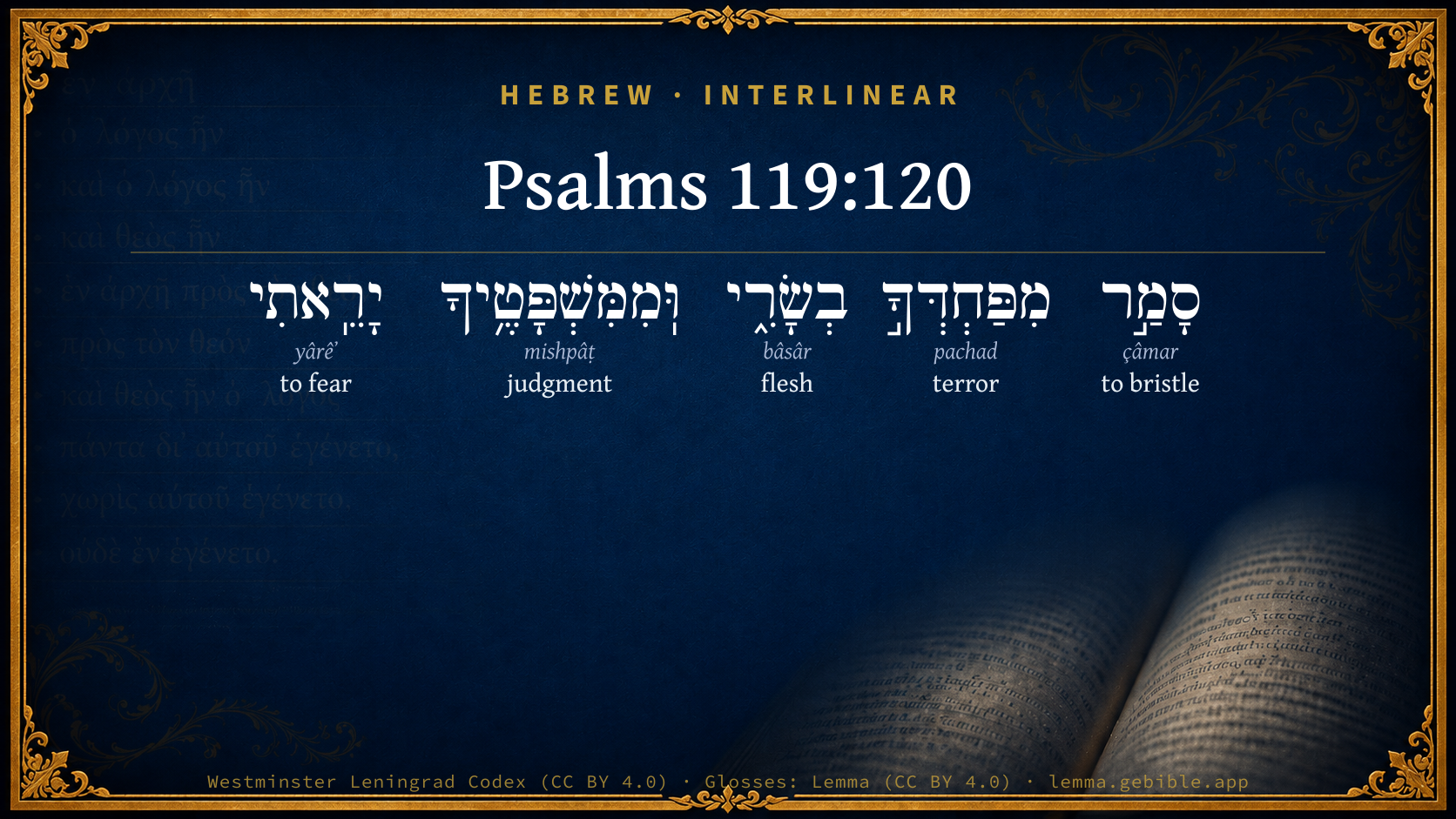
Psalms 119:120

Hebrew (Westminster Leningrad Codex) Psalms 119:120 appears in the Hebrew Old Testament. The text above is from the Westminster Leningrad Codex. Each word links to its Strong’s number, a concise gloss, and parsing drawn from the Open Scriptures Hebrew Bible morphology. Click any word for its full Brown-Driver-Briggs (BDB) entry.
Download image
Cite this verse

Psalms 119:120 (World English Bible). Public Domain. Lemma interlinear Bible study tool, https://lemma.gebible.app/v/psalms/119/120.

Show BibTeX & RIS
BibTeX
RIS
English Translation
My flesh trembles for fear of you. I am afraid of your judgments.
World English Bible · Public Domain
Download a study sheet

One document with this verse’s original text, its word-by-word gloss line, the meaning frame, cross-references with their text, attributed commentary, and full source and license credits — printable, and it pastes into notes with its structure intact.

This verse Autodidact and up

Study sheet (.html) Plain text (.txt)

A passage Seminary Student

Up to 50 verses in one chapter. A passage sheet keeps up to 6 commentary sources and 12 cross-references per verse, in the order this page ranks them, and says so on the sheet whenever that leaves anything out. Ask for a single verse and you get the Autodidact verse sheet above.

Everything on this page stays free to read, with no account — the sheet is a download of what is already on screen, not access to it.

Want to remove ads? Support Godless Engineer
Compare translations 3

The same verse in 3 English versions, stacked beneath the original-language interlinear above. Click any original word for its lexicon entry.

Each is an independent rendering of the whole verse — the interlinear is not word-aligned to these translations.

Highlighted words mark where these versions differ — a whole-verse word diff, not a word-by-word alignment.

  • World English Bible Public Domain
    My flesh trembles for fear of you. I am afraid of your judgments.
  • King James Version Public Domain
    My flesh trembleth for fear of thee; and I am afraid of thy judgments.
  • unfoldingWord Literal Text CC BY-SA 4.0
    My flesh shudders from dread of you, and I fear your judgments. AYIN

unfoldingWord Literal Text — © unfoldingWord, licensed CC BY-SA 4.0. Word-aligned USFM3 via Door43 (git.door43.org/unfoldingWord/en_ult).

Versions to compare (up to 4)

3 of 4 selected

Show all 17 translations

Every available English version of this verse, each an independent rendering of the whole verse.

  • World English Bible Public Domain
    My flesh trembles for fear of you. I am afraid of your judgments.
  • Berean Standard Bible Public Domain
    My flesh trembles in awe of You; I stand in fear of Your judgments.
  • Majority Standard Bible Public Domain
    My flesh trembles in awe of You; I stand in fear of Your judgments.
  • King James Version Public Domain
    My flesh trembleth for fear of thee; and I am afraid of thy judgments.
  • American Standard Version (1901) Public Domain
    My flesh trembleth for fear of thee; And I am afraid of thy judgments.
  • Revised Version (1885) Public Domain
    My flesh trembleth for fear of thee; and I am afraid of thy judgments.
  • Geneva Bible (1599) Public Domain
    My flesh trembleth for feare of thee, and I am afraide of thy iudgements.
  • Young's Literal Translation Public Domain
    Trembled from Thy fear hath my flesh, And from Thy judgments I have been afraid!
  • Literal Standard Version CC BY-SA 4.0
    My flesh has trembled from Your fear, || And I have been afraid from Your judgments!
  • Unlocked Literal Bible CC BY-SA 4.0
    My body trembles in fear of you, and I am afraid of your righteous decrees.
  • unfoldingWord Literal Text CC BY-SA 4.0
    My flesh shudders from dread of you, and I fear your judgments. AYIN
  • Darby Bible Public Domain
    My flesh shuddereth for fear of thee; and I am afraid of thy judgments.
  • World Messianic Bible Public Domain
    My flesh trembles for fear of you. I am afraid of your judgments. AYIN
  • Webster's Bible Public Domain
    My flesh trembleth for fear of thee; and I am afraid of thy judgments.
  • Free Bible Version CC BY-SA 4.0
    I have goose bumps thinking of you—I'm in awe! I'm scared of your judgments! Ayin
  • Bible in Basic English Public Domain
    My flesh is moved for fear of you; I give honour to your decisions.
  • JPS Tanakh (1917) Public Domain
    My flesh shuddereth for fear of Thee; and I am afraid of Thy judgments.

Literal Standard Version (2020), Covenant Press — licensed CC BY-SA 4.0. Text via the HelloAO Bible API (eBible.org). Unlocked Literal Bible (unfoldingWord) — licensed CC BY-SA 4.0. Text via the HelloAO Bible API (eBible.org). unfoldingWord Literal Text — © unfoldingWord, licensed CC BY-SA 4.0. Word-aligned USFM3 via Door43 (git.door43.org/unfoldingWord/en_ult). Free Bible Version, Dr. Jonathan Gallagher — licensed CC BY-SA 4.0. Text via the HelloAO Bible API (eBible.org).

Word by word

More ways to search: Search by grammar → Find every occurrence → Compare this word →

Practice this passage: Drill this verse → Learn its vocabulary →

About this verse

These counts appear in no published source. They are computed here, from the morphology-tagged text and Lemma’s own curated glosses. What Lemma adds →

5
words
5
distinct lemmas
Wisdom
section

Notable vocabulary

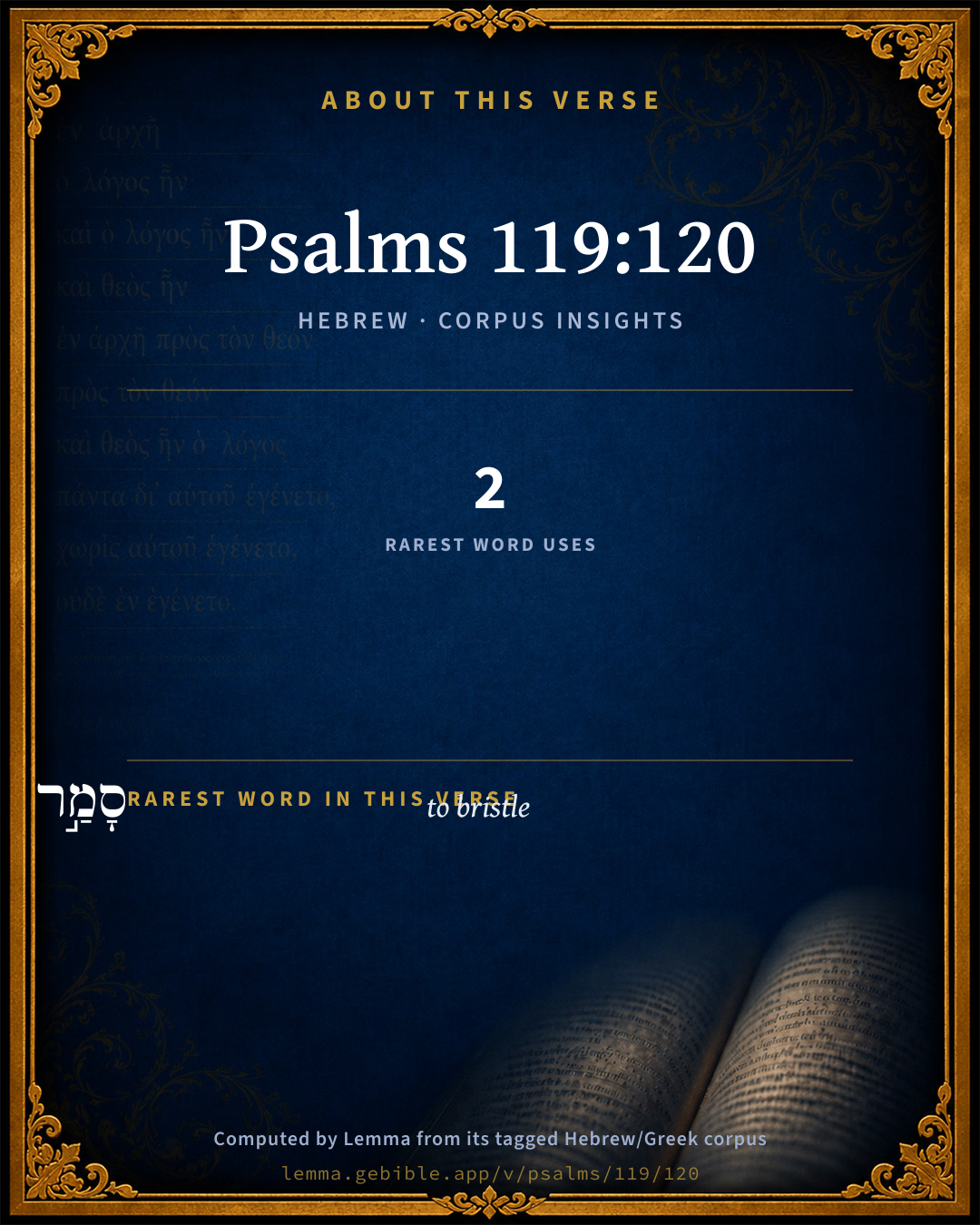
The rarest word here is סָמַ֣ר to bristle H5568 — appearing just 2 times in the whole Hebrew Bible.

Shared distinctive vocabulary

סָמַ֣ר to bristle H5568 occurs in 2 verses of the Hebrew Bible. Also found in:

Grammatical profile

  • 2 verbs
  • 3 nouns

Verb forms

  • סָמַ֣ר Qal · Perfect
  • יָרֵֽאתִי Qal · Perfect

Hebrew & Septuagint length

In English translation the verse runs 13 words from the Hebrew and 13 from the Septuagint (LXX English) — the same length.

A rough comparison of the two English renderings, which tokenize alike — not a word-level alignment.

Word counts can differ between the Hebrew and the Greek without any difference in meaning — e.g. the Hebrew direct-object marker אֵת has no separate Greek word, and Greek often adds the article ὁ.

Cross-references

15

Topical passages linked to Psalms 119:120 in the Treasury of Scripture Knowledge — connected by theme and wording, ordered by reader-vote popularity; previews shown in the World English Bible.

  • Daniel 10:8–11 So I was left alone, and saw this great vision, and there remained no strength in me; for my comeliness was turned in me into corruption, and I retained no strength.
  • Habakkuk 3:16 I heard, and my body trembled. My lips quivered at the voice. Rottenness enters into my bones, and I tremble in my place, Because I must wait quietly for the day of trouble, For the coming up of the people who invade us.
  • Hebrews 12:21 and so fearful was the appearance, that Moses said, "I am terrified and trembling."
  • Hebrews 12:28–29 Therefore, receiving a Kingdom that can't be shaken, let us have grace, through which we serve God acceptably, with reverence and awe,
  • Isaiah 66:2 For all these things has my hand made, and [so] all these things came to be, says Yahweh: but to this man will I look, even to him who is poor and of a contrite spirit, and who trembles at my word.
  • Philippians 2:12 So then, my beloved, even as you have always obeyed, not only in my presence, but now much more in my absence, work out your own salvation with fear and trembling.
  • Leviticus 10:1–3 Nadab and Abihu, the sons of Aaron, each took his censer, and put fire in it, and laid incense on it, and offered strange fire before Yahweh, which he had not commanded them.
  • 2 Chronicles 34:21 Go you, inquire of Yahweh for me, and for those who are left in Israel and in Judah, concerning the words of the book that is found; for great is the wrath of Yahweh that is poured out on us, because our fathers have not kept the word of Yahweh, to do according to all that is written in this book.
  • 2 Samuel 6:8–9 David was displeased, because Yahweh had broken forth on Uzzah; and he called that place Perez Uzzah, to this day.
  • 2 Chronicles 34:27 because your heart was tender, and you did humble yourself before God, when you heard his words against this place, and against the inhabitants of it, and have humbled yourself before me, and have torn your clothes, and wept before me; I also have heard you, says Yahweh.
  • Psalms 119:53 Indignation has taken hold on me, Because of the wicked who forsake your law.
  • 1 Samuel 6:20 The men of Beth-shemesh said, Who is able to stand before Yahweh, this holy God? and to whom shall he go up from us?
  • Revelation 1:17–18 When I saw him, I fell at his feet like a dead man. He laid his right hand on me, saying, "Don't be afraid. I am the first and the last,
  • 1 Chronicles 24:16–17 the nineteenth to Pethahiah, the twentieth to Jehezkel,
  • 1 Chronicles 24:30 The sons of Mushi: Mahli, and Eder, and Jerimoth. These were the sons of the Levites after their fathers' houses.

Cross-references courtesy of OpenBible.info (CC BY 4.0).

Hebrew and Greek witnesses Masoretic Hebrew ↔ Greek Septuagint

The same verse in the two great witnesses to the Old Testament, shown verse-for-verse.

You’re reading Greek Psalm 118 (Hebrew Psalm 119). The Septuagint counts the superscription, so verse numbers can differ from the Hebrew — chapter-level alignment, not verse-by-verse. Numbering follows Rahlfs.

These are two independent witnesses, not word-aligned to each other, and the Septuagint is shown in lemma (dictionary) form.

Hebrew Psalms 119:120 Masoretic · Westminster Leningrad Codex

סָמַ֣ר מִפַּחְדְּךָ֣ בְשָׂרִ֑י וּֽמִמִּשְׁפָּטֶ֥יךָ יָרֵֽאתִי

My flesh trembles for fear of you. I am afraid of your judgments.

World English Bible · Public Domain

Greek LXX Greek Psalm 118:120 Septuagint · lemma form

καθηλόω ἐκ ὁ φόβος σύ ὁ σάρξ ἐγώ ἀπό γάρ ὁ κρίμα σύ φοβέω

Penetrate my flesh with your fear; for I am afraid of your judgments.

LXX2012 (modern English Septuagint) · Public Domain

Hebrew: Westminster Leningrad Codex (CC BY 4.0). Greek: Septuagint (public domain); English from LXX2012 (modern English Septuagint) (Public Domain). How the Septuagint differs from the Hebrew →

Commentary

Notes on Psalms 119:120 from classic Christian and Jewish commentators (each source and its license shown beneath its notes). The classic Christian expositions comment on the surrounding passage and are grouped to its opening verse, so a note may address several verses; the Jewish commentaries on the Tanakh (Rashi and others) are per-verse, so they appear only where the commentator wrote on this verse.

Lemma curates 59 commentaries, every one of them public domain or Creative Commons licensed, each selected and text-cleaned for this edition rather than reprinted as found. About our sources →

Trapp's Complete Commentary

John Trapp

Psa 119:120 My flesh trembleth for fear of thee; and I am afraid of thy judgments.

Ver. 120. My flesh trembleth] Horripilatur, Job 4:15. In the saints is a mixture of contrary passions, fear and great joy, as was in those holy women, Mat 28:8, and the one makes way for the other.

John Trapp, A Commentary or Exposition upon All the Books of the Old and New Testament (1647–1656) — public domain. Text from a community e-Sword module.

The Biblical Illustrator

Joseph S. Exell

Psa_119:120

My flesh trembleth for fear of Thee; and I am afraid of Thy judgments.

The trembling flesh

I. The psalmist, in this section, contemplates Gods wrath against sinners (verses 118, 119). Then apparently his thought goes on to his own case, and what is likely to be his own sentence. He is disturbed by the contemplation of that sharp judgment which he must undergo in the day when his soul shall go forth from the body.

II. The expression which he uses is a very remarkable one. My flesh trembleth for fear of Thee. When a mans body reveals his fright it has quite mastered him.

III. Is not this a servile fear, unbecoming the Christian who has given himself up to be our Lords disciple?

1. There are, however, among professing Christians those who, by weakly continuing in some evil habit, have reduced themselves to the condition of servility.

2. There are professing Christians who have no very especial besetting sin of the mortal type, who yet go on without fervour and without making any progress in the spiritual life. They know that they have many faults, small faults in the worlds eyes, yet which, when tolerated, make the life thoroughly un-Christlike. They acquiesce in these. It does not make much difference what the defect of character may be, the grievous thing about it is that there is no faithful persistent effort to conquer it. Wherever there is found a soul like that it may well be permeated with servile fear as it contemplates the judgment, for that sort of offenders will not find mercy in the day of their sentence.

3. There are many more who ought to feel a servile fear of the wrath of God when they contemplate their lives seriously because they are not doing all that they can to put away their sins.

IV. Those who are most in earnest in seeking to prepare themselves for the judgment of the last day are the ones who tremble most at the thought of that judgment. And with very earnest souls it ceases to be a servile fear because they trust themselves more and more unreservedly to the Divine mercy. The secret of perfect trust is perfect self-distrust. And there is nothing which helps more to a realization of ones unworthiness than the contemplation of the just judgment of God as He reveals it in Holy Writ. (Arthur Ritchie.)

The Biblical Illustrator, edited by Joseph S. Exell (c. 1880s–1900s) — public domain. Text from a community e-Sword module.

J. A. Alexander on Psalms

Joseph Addison Alexander

120. (Psa 119:120) My flesh shudders from dread of thee, and of thy judgments I am afraid. The first verb in Hebrew occurs only here, but is universally admitted to denote some bodily effect of fear, such as trembling, shuddering, or the instinctive creeping of the flesh. Afraid of, in the last clause, does not fully represent the Hebrew phrase, which denotes not mere apprehension of something still future or absent, but terror in view of something actually present. Judgments has its usual wide sense, but with special reference, in this case, to God's penal visitations. Here ends the fifteenth stanza, in which, as in the one before it, every verse has a distinct initial word.

Joseph Addison Alexander, The Psalms Translated and Explained (1850) — public domain. Text from a community e-Sword module.

Geneva Bible (1599)

Geneva Bible translators

Thy judgments do not only teach me obedience, but cause me to fear, considering mine own weakness, which fear causeth repentance.

Geneva Bible (1599) marginal notes — public domain. Text via Bolls.life.

Adam Clarke's Commentary

Verse 120. My flesh trembleth for fear of thee] I know thou art a just and holy God: I know thou requirest truth in the inner parts. I know that thou art a Spirit, and that they who worship thee must worship thee in spirit and in truth; and I am often alarmed lest I fall short. It is only an assurance of my interest in thy mercy that can save me from distressing fears and harassing doubts. It is our privilege to know we are in God's favour; and it is not less so to maintain a continual filial fear of offending him. A true conception of God's justice and mercy begets reverence.

ANALYSIS OF LETTER SAMECH. - Fifteenth Division

In this section the psalmist -

I. Declares his hatred to wickedness, and his detestation of wicked men.

II. Expresses his love to God's law.

III. Prays for grace to sustain him in the observance of it.

IV. Foretells the destruction of the wicked.

I. "I hate vain thoughts;" not only evil itself, but the thought that leads to it.

II. 1. "Thy law do I love:" I strive to keep every affection exercised on its proper object.

2. This is my privilege: for thou art, 1. "My hiding-place," that public evils may not reach me; and 2. "My shield," to ward off the fiery darts of the wicked one.

3. To God, therefore, and his word, he would adhere in all extremities; and would have no communion with the wicked. 1. These he would drive away as the pests of piety: "Depart from me." 2. Because he would "keep the commandments of God," while the others were bent on breaking them.

III. He prays for the grace of God to sustain him.

1. "Uphold me:" if thou do not, I fall.

2. "Hold thou me up:" for I am falling. One part of this prayer is against the occurrence of evil; the other, against evil as actually taking place.

IV. He foretells the destruction of wicked men.

1. "Thou hast trodden down:" they who tread thy commandments under their feet shall be trodden down under thy feet. The first treading shall bring on the second.

2. They deceive themselves in supposing thou wilt not resent this. This is a deception, and a dangerous one too, for it is against the most positive declarations of thy truth, therefore it is falsehood.

3. This is most certain, for "thou puttest away all the wicked of the earth like dross;" they are utterly vile, and of no account in thy sight.

4. "Therefore I love thy testimonies." And for this, among others reasons, that I may avoid their judgments.

5. Foreseeing the judgments to fall on the wicked, it was necessary that he should be filled with a salutary fear. 1. "My flesh trembleth." Happy is he who by other men's harms learns to be wise. 2. We should work out our salvation with fear and trembling. God is holy and just as well as merciful; therefore we should fear before him. 3. Because he saw those judgments coming on the wicked, he desired to be established in God's holy fear. In all cases the old proverb is true: "Too much familiarity breeds contempt."

Adam Clarke's Commentary on the Bible (1810–1826) — public domain. Text from a community e-Sword/MySword module.

John Calvin's Commentaries

120. My flesh hath trembled for fear of thee. At first sight the prophet seems to contradict himself. He had just now said, that, by God’s severity, he was gently drawn to love his testimonies; now he declares, that he was seized with terror. But although these two effects differ widely from each other, yet, if we consider by what kind of discipline God forms us to reverence his law, we will perceive that they entirely harmonize. We require to be subdued by fear that we may desire and seek after the favor of God. Since fear, then, is the beginning of love, the prophet testifies, that he was awakened by a heart-felt fear of God to look well to himself. Nor is the mortification of the flesh so easy a matter, as that every one should consent to enter upon it, without the constraint of violent means; and, therefore, it is not wonderful if God struck his servant with terror, that, in this way, he might bend his mind to a holy fear of him. It is an evidence of no common wisdom to tremble before God when he executes his judgments, of which the majority of mankind take no notice. We are then taught by these words of the prophet, that we ought to consider attentively the judgments of God, that they may not only gently instruct us, but that they may also strike us with such terror as will lead us to true repentance.

John Calvin's Commentaries (1540-1563) — public domain. Text from the Calvin Translation Society English edition (1840s-50s) via the Christian Classics Ethereal Library (ccel.org). Calvin's coverage is partial (roughly two-thirds of the Bible); uncommented books and verses are honest gaps, never fabricated. The 19th-century editor's footnotes and remarks are omitted so the notes are faithfully Calvin's own voice.

Ellicott's Commentary for English Readers

(120) Trembleth.—The original is far stronger. Better, as in Job_4:15, the hair of my flesh stands up. So Symmachus.

A Bible Commentary for English Readers, edited by Charles John Ellicott (1878–1897) — public domain. Text from a community e-Sword module.

The Cambridge Bible for Schools and Colleges

gen. ed. J. J. S. Perowne

120. trembleth for fear of thee] Shudders for awe of thee, lit. of the hair standing on end with fright: horrescit.

thy judgments] Either acts of judgement, punishments inflicted upon the wicked, or the laws and ordinances in accordance with which they are punished. Reverent fear is the right complement of holy love. “The flesh is to be awed by Divine judgements, though the higher and surer part of the soul is strongly and freely tied with the cords of love” (Leighton).

The Cambridge Bible for Schools and Colleges (gen. ed. J. J. S. Perowne; Cambridge University Press, 1878–1918) — public domain. Text from a community e-Sword module.

John Gill's Exposition

Deal with thy servant according unto thy mercy,.... Which is either general and providential, and reaches to all his creatures; and according to which David had been dealt with all his days, and which he desires a continuance of: or special; and which is in Christ, and communicated through him; and in whom he deals with his people, not according to their merits, but his own mercy; by receiving and accepting them, and admitting them into his presence, and to partake of his favours, and by pardoning their sins and saving their souls; which is not by works of righteousness they have done but according to his abundant mercy; and by giving them eternal life and happiness at the great day;

and teach me thy statutes; which is often requested; and which not only shows the need of divine teachings, and the psalmist's earnest and importunate desire to have them; but also that the mercy, grace, and kindness of God, have an influence on the holy life and conversation of the saints, and do not at all encourage licentiousness.

John Gill's Exposition of the Whole Bible (1746–1763) — public domain (CC PDM 1.0). Text via the HelloAO Bible API.

Albert Barnes' Notes on the Bible

My flesh trembleth for fear of thee - I stand in awe of thee. I shudder at the consciousness of thy presence. See Hab 3:16; Heb 12:21; Joe 2:10; Nah 1:5. There is nothing unaccountable in this. Any man would tremble, should God manifest himself to him as he might do; and it is possible that the mind may have such an overpowering sense of the presence and majesty of God, that the body shall be agitated, lose its strength, and with the deepest alarm fall to the earth. Compare Dan 10:8; Rev 1:17. No man could meet one of the departed dead, or a good angel, without this fear; how much less could he meet God!

And I am afraid of thy judgments - Of thy laws or commands. My mind is filled with awe at the strictness, the spirituality, the severity of thy law. Reverence - awe - is one of the essential elements of all true religion.

Albert Barnes' Notes on the Bible (1834–1885) — public domain. Text from a community e-Sword/MySword module.

Matthew Poole's English Annotations

The observation of thy terrible judgments against ungodly men, and the conscience of my own infirmity and manifold sins, makes me fear lest thou shouldst punish me also, as thou mightest justly do, if thou shouldst be strict to mark what is amiss in me; or lest I should partake with them in their sins, and consequently in their plagues.

Matthew Poole's English Annotations on the Holy Bible (1683–1685) — public domain. Text from a community e-Sword/MySword module.

The Treasury of David

Charles H. Spurgeon

Ver. 120. My flesh trembleth for fear of thee. Such was his awe in the presence of the Judge of all the earth, whose judgment he had just now been considering, that he did exceedingly fear and quake. Even the grosser part of his being, his flesh, felt a solemn dread at the thought of offending one so good and great, who would so effectually sever the wicked from among the just. Alas, poor flesh, this is the highest thing to which thou canst attain!

And I am afraid of thy judgments. God's words of judgment are solemn, and his deeds of judgment are terrible; they may well make us afraid. At the thought of the Judge of all, his piercing eye, his books of record, his day of assize, and the operations of his justice, we may well cry for cleansed thoughts, and hearts, and ways, lest his judgments should light on us. When we see the great Refiner separating the precious from the vile, we may well feel a godly fear, lest we should be put away by him, and left to be trodden under his feet.

Love in the previous verse is quite consistent with fear in this verse: the fear which hath torment is cast out, but not the filial fear which leads to reverence and obedience.

The fifteenth letter, SAMECH, denotes a prop or pillar, and this agrees well with the subject matter of the strophe, in which God is twice implored to uphold his servant (Ps 119:16-17), while the utter destruction of those who make light of his law, or encourage scepticism regarding it, may be compared to the fate of the Philistine lords, on whom Samson brought down the roof of the house where they were making merry, by overthrowing the pillars which supported it. Neale and Littledale.

Ver. 120. My flesh trembleth for fear of thee. Instead of exulting over those who fell under God's displeasure he humbleth himself. What we read and hear of the judgments of God upon wicked people should make us (1) To reverence his terrible majesty, and to stand in awe of him. Who is able to stand before this holy Lord God? 1Sa 6:20. (2) To fear lest we offend him, and become obnoxious to his wrath. Good men have need to be restrained from sin by the terrors of the Lord; especially when judgment begins at the house of God, and hypocrites are discovered, and put away as dross. Matthew Henry.

Ver 120. My flesh trembleth for fear of thee, etc. At the presence of Jehovah, when he appeareth in judgment, the earth trembleth and is still. His best servants are not exempted from an awful dread, upon such occasions; scenes of this kind, shown in vision to the prophets, cause their flesh to quiver, and all their bones to shake. Encompassed with a frail body, and a sinful world, we stand in need of every possible tie; and the affections both of fear and love must be employed, to restrain us from transgression; we must, at the same time, "love God's testimonies, and fear his Judgments." George Horne.

Ver. 120 My flesh trembleth for fear of thee, etc. In prayer, in the evening I had such near and terrific views of God's judgments upon sinners in hell, that my flesh trembled for fear of them...I flew trembling to Jesus Christ as if the flames were taking hold of me: Oh! Christ will indeed save me or else I perish. Henry Martyn, 1781-1812.

Ver. 120. My flesh trembleth for fear of thee. Familiarity with men breeds contempt; familiarity with God, not so: none reverence the Lord more than they who know him best and are most familiar with him. William Cowper.

Ver. 120,116. My flesh trembleth for fear of thee; I am Afraid....let me not be ashamed of my hope. True religion consists in a proper mixture of fear of God, and of hope in his mercy; and wherever either of these is entirely wanting, there can be no true religion. God has joined these things, and we ought by no means to put them asunder. He cannot take pleasure in those who fear him with a slavish fear, without hoping in his mercy, because they seem to consider him as a cruel and tyrannical being, who has no mercy or goodness in his nature; and, besides, they implicitly charge him with falsehood, by refusing to believe and hope in his invitations and offers of mercy. On the other hand, he cannot be pleased with those who pretend to hope in his mercy without fearing him; for they insult him by supposing that there is nothing in him which ought to be feared; and, in addition to this, they make him a liar, by disbelieving his awful threatenings denounced against sinners, and call in question his authority, by refusing to obey him. Those only who both fear him and hope in his mercy, give him the honour that is due to his name. Edward Payson.

Ver. 120. Trembles or shudders, strictly used of the hair as standing erect in terror (comp. Job 4:15). J.J. Stewart Perowne.

Ver. 120. The judgments of God on the wicked cause in the righteous,

1. Love.

2. Awe.

3. Fear.

Ver. 120.

1. Describe the true character of the fear.

(a) It is the fear of reverence for God's authority and

power.

(b) It is the fear of horror against sin as meriting

judgment.

2. Show its compatibility with filial love.

(a) The more we love God the more firmly we believe in the

certainty and awfulness of his judgments.

(b) The more we love God the more will we

fear to arouse his chastising rod against ourselves.

(a) In fact, if we love not God, we shall have no fear lest

sin should involve us in judgment.

3. Commend it.

(a) As it proves a just sense of sin's desert.

(b) As it shows a true appreciation of God's righteousness.

(c) As it is not a fear that hath torment, but a fear which

increases watchfulness, and walks hand in hand with

perfect confidence in saying grace. J.F.

Psalms 119:121*

Charles H. Spurgeon's The Treasury of David (1869–1885) — public domain. Psalms only. Text from a community e-Sword/MySword module.

The Pulpit Commentary

My flesh trembleth for fear of thee, (comp. Isa_6:5 Jer_23:9 Hab_3:16) And I am afraid of thy judgments. Thy "judgments" upon the wicked cause me to shudder with fear.

The Pulpit Commentary (1880–1919), ed. H.D.M. Spence-Jones & Joseph S. Exell — public domain. Text from a community e-Sword module.

Rashi

Rabbi Shlomo Yitzchaki (Rashi)

bristles Heb. סמר, like (Job 4:15): “it made the hair of my flesh stand on end (מסמר),” as a person whose hair stands on end, harizer in Old French, se herisser in modern French, to bristle.

and I dread Your judgments The retribution for Your decrees.

Rashi on the Tanakh — English translations: “The Judaica Press complete Tanach with Rashi, translated by A. J. Rosenberg” (CC BY 4.0); “Pentateuch with Rashi's commentary by M. Rosenbaum and A.M. Silbermann, 1929-1934” (public domain); “The Metsudah Tanach series, Lakewood, N.J” (CC BY 4.0); and “The Book of Joshua, Metsudah Publications, 1997” (CC BY 4.0). Text via Sefaria.

Lesson kit

Teaching starters — assembled from the data on this page, not authored interpretation. Every prompt links to the verse data it draws on. Edit before teaching.

Psalms, in the Wisdom, opens this verse with 5 words (5 distinct Hebrew lemmas). Its most distinctive word is çâmar (“to bristle”). A historical commentator’s framing appears above. Read the whole chapter for the surrounding context.

Discussion questions

  1. The word çâmar carries the sense “to bristle.” How does it shape the verse?
  2. Job 4:15 shares the word «to bristle» with this verse. How do the two illuminate each other?
  3. These translations render this verse differently. What is at stake in choosing one wording over another?
  4. The verb «סָמַ֣ר» is Qal Perfect. How does its form color the action?
  5. Reading how Trapp's Complete Commentary and The Biblical Illustrator read this verse, where do the two commentators agree and where do they part?

Things to notice

Reading settings

Reading text

Shown beneath each verse's original-language words.

Old Testament
Old Testament edition

Read the OT as the Masoretic Hebrew (MT) or the Greek Septuagint (LXX).

English shown for the Greek Septuagint (in the Hebrew ↔ Greek comparison).

Comparing translations? Open the Compare panel on any verse page to stack up to four side by side.