
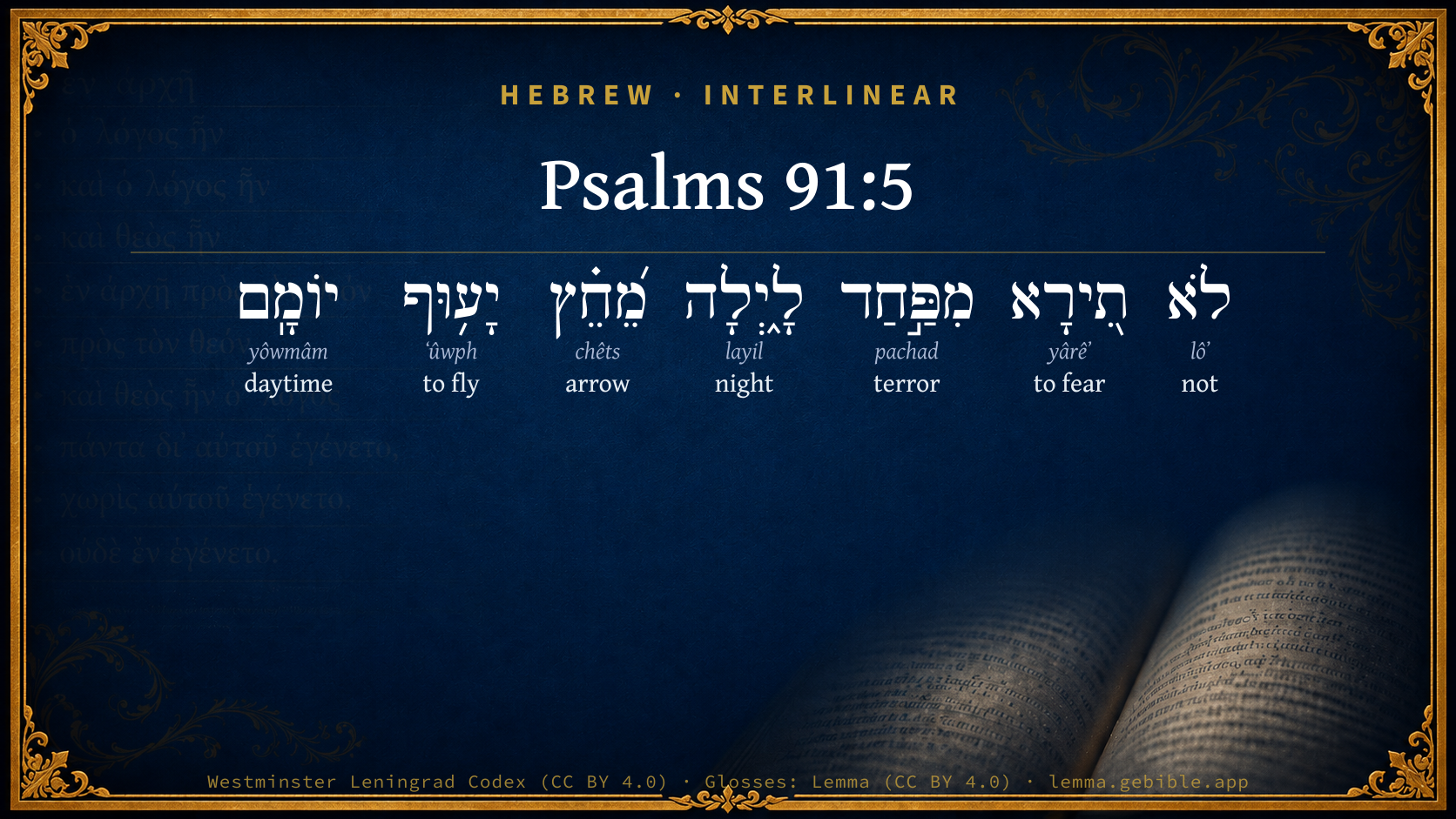
Psalms 91:5

Hebrew (Westminster Leningrad Codex) Psalms 91:5 appears in the Hebrew Old Testament. The text above is from the Westminster Leningrad Codex. Each word links to its Strong’s number, a concise gloss, and parsing drawn from the Open Scriptures Hebrew Bible morphology. Click any word for its full Brown-Driver-Briggs (BDB) entry.
Download image
Cite this verse

Psalms 91:5 (World English Bible). Public Domain. Lemma interlinear Bible study tool, https://lemma.gebible.app/v/psalms/91/5.

Show BibTeX & RIS
BibTeX
RIS
English Translation
You shall not be afraid of the terror by night, Nor of the arrow that flies by day;
World English Bible · Public Domain
Download a study sheet

One document with this verse’s original text, its word-by-word gloss line, the meaning frame, cross-references with their text, attributed commentary, and full source and license credits — printable, and it pastes into notes with its structure intact.

This verse Autodidact and up

Study sheet (.html) Plain text (.txt)

A passage Seminary Student

Up to 50 verses in one chapter. A passage sheet keeps up to 6 commentary sources and 12 cross-references per verse, in the order this page ranks them, and says so on the sheet whenever that leaves anything out. Ask for a single verse and you get the Autodidact verse sheet above.

Everything on this page stays free to read, with no account — the sheet is a download of what is already on screen, not access to it.

Want to remove ads? Support Godless Engineer
Compare translations 3

The same verse in 3 English versions, stacked beneath the original-language interlinear above. Click any original word for its lexicon entry.

Each is an independent rendering of the whole verse — the interlinear is not word-aligned to these translations.

Highlighted words mark where these versions differ — a whole-verse word diff, not a word-by-word alignment.

  • World English Bible Public Domain
    You shall not be afraid of the terror by night, Nor of the arrow that flies by day;
  • King James Version Public Domain
    Thou shalt not be afraid for the terror by night; nor for the arrow that flieth by day;
  • unfoldingWord Literal Text CC BY-SA 4.0
    You will not be afraid of the terror of the night, of the arrow flies by day,

unfoldingWord Literal Text — © unfoldingWord, licensed CC BY-SA 4.0. Word-aligned USFM3 via Door43 (git.door43.org/unfoldingWord/en_ult).

Versions to compare (up to 4)

3 of 4 selected

Show all 18 translations

Every available English version of this verse, each an independent rendering of the whole verse.

  • World English Bible Public Domain
    You shall not be afraid of the terror by night, Nor of the arrow that flies by day;
  • Berean Standard Bible Public Domain
    You will not fear the terror of the night, nor the arrow that flies by day,
  • Majority Standard Bible Public Domain
    You will not fear the terror of the night, nor the arrow that flies by day,
  • King James Version Public Domain
    Thou shalt not be afraid for the terror by night; nor for the arrow that flieth by day;
  • American Standard Version (1901) Public Domain
    Thou shalt not be afraid for the terror by night, Nor for the arrow that flieth by day;
  • Revised Version (1885) Public Domain
    Thou shalt not be afraid for the terror by night, nor for the arrow that flieth by day;
  • Geneva Bible (1599) Public Domain
    Thou shalt not be afraide of the feare of the night, nor of the arrowe that flyeth by day:
  • Douay-Rheims (1899) Public Domain
    His truth shall compass thee with a shield: thou shalt not be afraid of the terror of the night.
  • Young's Literal Translation Public Domain
    Thou art not afraid of fear by night, Of arrow that flieth by day,
  • Literal Standard Version CC BY-SA 4.0
    You are not afraid of fear by night, || Of arrow that flies by day,
  • Unlocked Literal Bible CC BY-SA 4.0
    You will not be afraid of terror in the night, or of the arrow that flies by day,
  • unfoldingWord Literal Text CC BY-SA 4.0
    You will not be afraid of the terror of the night, of the arrow flies by day,
  • Darby Bible Public Domain
    Thou shalt not be afraid for the terror by night, for the arrow that flieth by day,
  • World Messianic Bible Public Domain
    You shall not be afraid of the terror by night, nor of the arrow that flies by day,
  • Webster's Bible Public Domain
    Thou shalt not be afraid for the terror by night; nor for the arrow that flieth by day;
  • Free Bible Version CC BY-SA 4.0
    You will not be afraid of terror at night or an arrow that flies in the day,
  • Bible in Basic English Public Domain
    You will have no fear of the evil things of the night, or of the arrow in flight by day,
  • JPS Tanakh (1917) Public Domain
    Thou shalt not be afraid of the terror by night, nor of the arrow that flieth by day;

Literal Standard Version (2020), Covenant Press — licensed CC BY-SA 4.0. Text via the HelloAO Bible API (eBible.org). Unlocked Literal Bible (unfoldingWord) — licensed CC BY-SA 4.0. Text via the HelloAO Bible API (eBible.org). unfoldingWord Literal Text — © unfoldingWord, licensed CC BY-SA 4.0. Word-aligned USFM3 via Door43 (git.door43.org/unfoldingWord/en_ult). Free Bible Version, Dr. Jonathan Gallagher — licensed CC BY-SA 4.0. Text via the HelloAO Bible API (eBible.org).

Word by word

More ways to search: Search by grammar → Find every occurrence → Compare this word →

Practice this passage: Drill this verse → Learn its vocabulary →

About this verse

These counts appear in no published source. They are computed here, from the morphology-tagged text and Lemma’s own curated glosses. What Lemma adds →

7
words
7
distinct lemmas
Wisdom
section

Shared distinctive vocabulary

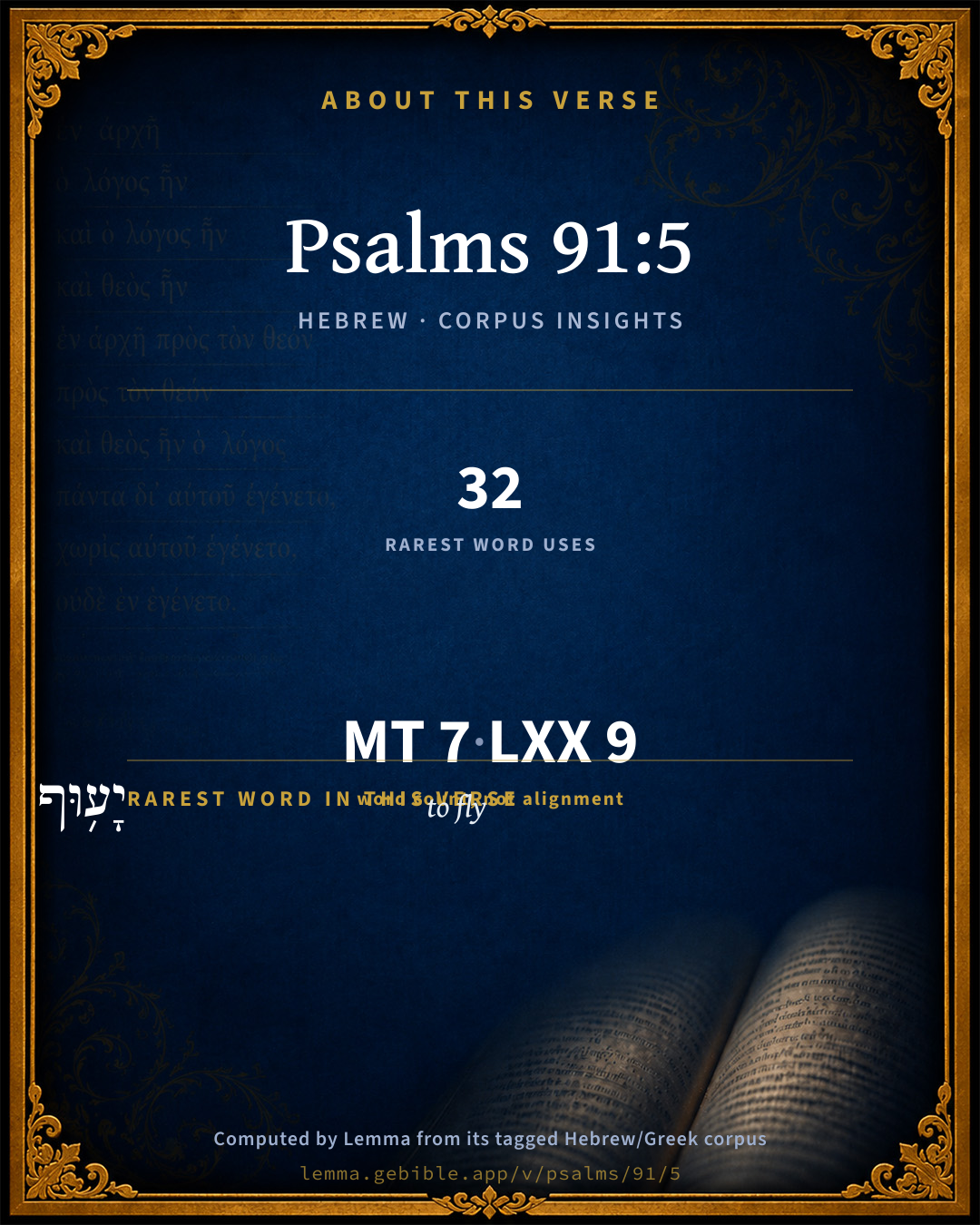
יָע֥וּף to fly H5774 occurs in 29 verses of the Hebrew Bible. Also found in:

Grammatical profile

  • 2 verbs
  • 3 nouns
  • 1 adverb
  • 1 particle

Verb forms

  • תִ֭ירָא Qal · Imperfect
  • יָע֥וּף Qal · Imperfect

Hebrew & Septuagint length

In English translation the verse runs 18 words from the Hebrew and 16 from the Septuagint (LXX English) — closely comparable.

A rough comparison of the two English renderings, which tokenize alike — not a word-level alignment.

Word counts can differ between the Hebrew and the Greek without any difference in meaning — e.g. the Hebrew direct-object marker אֵת has no separate Greek word, and Greek often adds the article ὁ.

In the original languages it is 7 Hebrew tokens and 9 Greek tokens — but the two are counted differently (Hebrew bundles its prefixes and suffixes into one token; the Greek is in lemma form), so that isn’t a like-for-like length.

Cross-references

19

Topical passages linked to Psalms 91:5 in the Treasury of Scripture Knowledge — connected by theme and wording, ordered by reader-vote popularity; previews shown in the World English Bible.

  • Isaiah 43:2 When you pass through the waters, I will be with you; and through the rivers, they shall not overflow you: when you walk through the fire, you shall not be burned, neither shall the flame kindle on you.
  • Job 5:19–27 He will deliver you in six troubles; Yes, in seven there shall no evil touch you.
  • Proverbs 3:23–25 Then you shall walk in your way securely. Your foot won't stumble.
  • Psalms 3:5–6 I laid myself down and slept. I awakened; for Yahweh sustains me.
  • Psalms 112:7 He will not be afraid of evil news. His heart is steadfast, trusting in Yahweh.
  • Hebrews 13:6 So that with good courage we say, "The Lord is my helper. I will not fear. What can man do to me?"
  • Psalms 27:1–3 Yahweh is my light and my salvation. Whom shall I fear? Yahweh is the strength of my life. Of whom shall I be afraid?
  • Proverbs 28:1 The wicked flee when no one pursues; But the righteous are as bold as a lion.
  • Isaiah 21:4 My heart flutters, horror has frightened me; the twilight that I desired has been turned into trembling to me.
  • Job 4:13–15 In thoughts from the visions of the night, When deep sleep falls on men,
  • Job 24:14–16 The murderer rises with the light. He kills the poor and needy. In the night he is like a thief.
  • Psalms 46:2 Therefore we won't be afraid, though the earth changes, Though the mountains are shaken into the heart of the seas;
  • Song of Solomon 3:8 They all handle the sword, and are expert in war. Every man has his sword on his thigh, Because of fear in the night.
  • Luke 12:20 "But God said to him, 'You foolish one, tonight your soul is required of you. The things which you have prepared--whose will they be?'
  • Luke 12:39 But know this, that if the master of the house had known in what hour the thief was coming, he would have watched, and not allowed his house to be broken into.
  • 2 Kings 7:6 For the Lord had made the host of the Syrians to hear a noise of chariots, and a noise of horses, even the noise of a great host: and they said one to another, Behold, the king of Israel has hired against us the kings of the Hittites, and the kings of the Egyptians, to come on us.
  • Lamentations 3:12–13 He has bent his bow, and set me as a mark for the arrow.
  • Matthew 8:26 He said to them, "Why are you fearful, oh you of little faith?" Then he got up, rebuked the wind and the sea, and there was a great calm.
  • Job 6:4 For the arrows of the Almighty are within me, My spirit drinks up their poison. The terrors of God set themselves in array against me.

Cross-references courtesy of OpenBible.info (CC BY 4.0).

Hebrew and Greek witnesses Masoretic Hebrew ↔ Greek Septuagint

The same verse in the two great witnesses to the Old Testament, shown verse-for-verse.

You’re reading Greek Psalm 90 (Hebrew Psalm 91). The Septuagint counts the superscription, so verse numbers can differ from the Hebrew — chapter-level alignment, not verse-by-verse. Numbering follows Rahlfs.

These are two independent witnesses, not word-aligned to each other, and the Septuagint is shown in lemma (dictionary) form.

Hebrew Psalms 91:5 Masoretic · Westminster Leningrad Codex

לֹא תִ֭ירָא מִפַּ֣חַד לָ֑יְלָה מֵ֝חֵ֗ץ יָע֥וּף יוֹמָֽם

You shall not be afraid of the terror by night, Nor of the arrow that flies by day;

World English Bible · Public Domain

Greek LXX Greek Psalm 90:5 Septuagint · lemma form

οὐ φοβέω ἀπό φόβος νυκτερινός ἀπό βέλος πέτομαι ἡμέρα

You shall not be afraid of terror by night; nor of the arrow flying by day;

LXX2012 (modern English Septuagint) · Public Domain

Hebrew: Westminster Leningrad Codex (CC BY 4.0). Greek: Septuagint (public domain); English from LXX2012 (modern English Septuagint) (Public Domain). How the Septuagint differs from the Hebrew →

Commentary

Notes on Psalms 91:5 from classic Christian and Jewish commentators (each source and its license shown beneath its notes). The classic Christian expositions comment on the surrounding passage and are grouped to its opening verse, so a note may address several verses; the Jewish commentaries on the Tanakh (Rashi and others) are per-verse, so they appear only where the commentator wrote on this verse.

Lemma curates 59 commentaries, every one of them public domain or Creative Commons licensed, each selected and text-cleaned for this edition rather than reprinted as found. About our sources →

Trapp's Complete Commentary

John Trapp

Psa 91:5 Thou shalt not be afraid for the terror by night; [nor] for the arrow [that] flieth by day;

Ver. 5. Thou shalt not be afraid for the terror by night] Thou shalt be freed, if not from the common destruction, yet from the common distraction.

Impavidum ferient ruinae.

Nor for the arrow that flieth by day] Sudden ill occurrences quae nec praevident nec praecavent fideles, the arrows of death shall come whisking by thine ears, and not hit. (Hor. lib 2, Od. 13.)

Quid quisque vitet nunquam homini saris

Cautum est in horas - Improvisa lethi

Vis rapuit, rapietque gentes.

True faith is a target, and sayeth a man if not from the smart, yet from the hurt of evil accidents.

John Trapp, A Commentary or Exposition upon All the Books of the Old and New Testament (1647–1656) — public domain. Text from a community e-Sword module.

Joseph Benson's Commentary

Psa 91:5-6. Thou shalt not be afraid for the terror by night — When evil accidents are most terrible and least avoidable; nor for the arrow — Any common and destructive calamity; (for such are commonly called God’s arrows;) that flieth by day — Which is the time for shooting arrows. The sense of the verse is, Thou shalt be kept from secret and open mischiefs at all times. Nor for the pestilence, &c. — This verse explains the former, and shows what that terror and arrow signify; that walketh in darkness — That makes progress and spreads death and desolation in an invisible manner, such as can neither be foreseen nor prevented; nor for the destruction at noon-day — That, like a bold enemy, assaults us openly, and though discovered cannot be resisted.

Joseph Benson's Commentary on the Old and New Testaments (1811–1818) — public domain. Text from a community e-Sword module.

J. A. Alexander on Psalms

Joseph Addison Alexander

5. (Psa 91:5) Thou shalt not be afraid for the terror by night, for the arrow (that) flies by day. Shalt not fear, i.e. shalt have no reason for alarm. Terror by night, literally of night, i.e. nightly or nocturnal tenor. There is no need of restricting this expression to any particular form of danger or distress, since all are usually aggravated by their occurrence in the night. Should any specific sense be put upon the figure of an arrow, from analogy and usage, it would be that of human enmity. See above, on Psa 58:7. The Hebrew preposition, in both clauses, properly means from, i.e. arising or proceeding from, occasioned by, in consequence of, something else.

Joseph Addison Alexander, The Psalms Translated and Explained (1850) — public domain. Text from a community e-Sword module.

Tyndale Open Study Notes

Tyndale Open Resources

91:5-8 The godly should not be afraid, because the Lord watches over them. These promises do not guarantee an escape from trouble, but they create an expectation of the Lord’s goodness.

Tyndale Open Study Notes — © Tyndale Open Resources, licensed CC BY-SA 4.0. Text via the HelloAO Bible API.

Geneva Bible (1599)

Geneva Bible translators

The care that God hath over his, is most sufficient to defend them from all dangers.

Geneva Bible (1599) marginal notes — public domain. Text via Bolls.life.

Adam Clarke's Commentary

Verse 5. The terror by night] Night is a time of terrors, because it is a time of treasons, plunder, robbery, and murder. The godly man lies down in peace, and sleeps quietly, for he trusts his body, soul, and substance, in the hand of God; and he knows that he who keepeth Israel neither slumbers nor sleeps. It may also mean all spiritual foes, - the rulers of the darkness of this world. I have heard the following petition in an evening family prayer: "Blessed Lord, take us into thy protection this night; and preserve us from disease, from sudden death, from the violence of fire, from the edge of the sword, from the designs of wicked men, and from the influence of malicious spirits!"

Nor for the arrow] The Chaldee translates this verse, "Thou shalt not fear the demons that walk by night; nor the arrow of the angel of death which is shot in the day time." Thou needest not to fear a sudden and unprovided - for death.

Adam Clarke's Commentary on the Bible (1810–1826) — public domain. Text from a community e-Sword/MySword module.

John Calvin's Commentaries

5 Thou shalt not fear for the terror of the night. The Psalmist continues to insist upon the truth which I have just adverted to, that, if we confide with implicit reliance upon the protection of God, we will be secure from every temptation and assault of Satan. It is of importance to remember, that those whom God has taken under his care are in a state of the most absolute safety. Even those who have reached the most advanced experience find nothing more difficult than to rely upon Divine deliverance; and more especially when, overtaken by some of the many forms in which danger and death await us in this world, doubts will insinuate themselves into our hearts, giving rise to fear and disquietude. There was reason, therefore, why the Psalmist should enter upon a specification of different evils, encouraging the Lord’s people to look for more than one mode of deliverance, and to bear up under various and accumulated calamities. Mention is made of the fear of the night, because men are naturally apprehensive in the dark, or because the night exposes us to dangers of different kinds, and our fears are apt at such a season to magnify any sound or disturbance. The arrow, rather than another weapon, is instanced as flying by day, for the reason apparently that it shoots to a greater distance, and with such swiftness, that we can with difficulty escape it. The verse which follows states, though in different words, the same truth, that there is no kind of calamity which the shield of the Almighty cannot ward off and repel.

John Calvin's Commentaries (1540-1563) — public domain. Text from the Calvin Translation Society English edition (1840s-50s) via the Christian Classics Ethereal Library (ccel.org). Calvin's coverage is partial (roughly two-thirds of the Bible); uncommented books and verses are honest gaps, never fabricated. The 19th-century editor's footnotes and remarks are omitted so the notes are faithfully Calvin's own voice.

Ellicott's Commentary for English Readers

(5) Terror by night.—Possibly a night attack by an enemy. (Comp. Son_3:8; Pro_3:23-26.) Comp. Milton:

“To bless the doors from nightly harm.”

In this case the arrow flying by day would refer to dangers of actual battle. But it is quite possible that the latter may be merely the Oriental expression for the pestilence, since it is still so called by Arabians. “I desired to remove to a less contagious air. I received from Solyman the emperor this message: that the emperor wondered what I meant in desiring to remove my habitation. Is not the pestilence God’s arrow, which will always hit his mark?”—Quoted in Spurgeon’s Treasury of David, from Busbequin’s Travels.

A Bible Commentary for English Readers, edited by Charles John Ellicott (1878–1897) — public domain. Text from a community e-Sword module.

The Cambridge Bible for Schools and Colleges

gen. ed. J. J. S. Perowne

5. Neither sudden assaults of enemies by night, nor open attacks by day (Son_3:8; Jer_6:4-5; Pro_3:24-25) shall have power to harm thee. The language is figurative: all hostility, whether secret or avowed, is meant.

The Cambridge Bible for Schools and Colleges (gen. ed. J. J. S. Perowne; Cambridge University Press, 1878–1918) — public domain. Text from a community e-Sword module.

John Gill's Exposition

Thou shalt not be afraid for the terror by night,.... The terrible things that happen in the night; as fire, storms and tempests, invasion of enemies, murders, thefts, and, robberies: a good man, when he has committed himself and his family to the care and protection of God by prayer, has no reason to be anxiously careful of these things, or to indulge a slavish fear about them; see Psa 3:5, the Targum is,

"thou shall not be afraid for the fear of devils that walk in the night:''

so Jarchi interprets this, and the next verse, of such; as do others of the Jewish writers: a man that trusts in the Lord need not be afraid of men or devils: a fear of evil spirits is natural to men, and very early appeared; perhaps it took its rise from the fatal affair of the fall of our first parents, through an intercourse with an evil spirit; and ever since has been imprinted on human nature an aversion to evil spirits, and a dread of them, and even of all spirits in general; see Job 4:13,

nor for the arrow that flieth by day; the judgments of God, such as the sword, famine, and pestilence; these are called the arrows of God, Deu 32:23 (q), because they move swiftly, come suddenly, and strike surely, and are open and visible; they are sent by the Lord, and are ordered and directed by him, and hit and hurt whom he pleases, and none else; and therefore such who dwell in the secret of the Lord, and under his shadow, need not be distressed about them: the Targum interprets it of the arrow of the angel of death, which he sends out in the day; see Heb 2:14, so Jarchi understands it of a demon that flies like an arrow.

(q) ---- , Homer. Iliad. 1. v. 51, 53.

John Gill's Exposition of the Whole Bible (1746–1763) — public domain (CC PDM 1.0). Text via the HelloAO Bible API.

Albert Barnes' Notes on the Bible

Thou shalt not be afraid for the terror by night - That which usually causes alarm at night - a sudden attack; an unexpected incursion of enemies; sudden disease coming on by night; or the pestilence which seems to love night, and to “walk in darkness.” Any one of these things seems to be aggravated by night and darkness; and hence, we most dread them then. We cannot see their approach; we cannot measure their outlines; we know not the extent of the danger, or what may be the calamity.

Nor for the arrow that flieth by day - Whether shot from the bow of God - as pestilence and disease; or from the hand of man in battle. The idea is, that he that trusts in God will be calm. Compare the notes at Psa 56:3.

Albert Barnes' Notes on the Bible (1834–1885) — public domain. Text from a community e-Sword/MySword module.

Matthew Poole's English Annotations

By night, when evil accidents are most terrible and least avoidable.

The arrow; the pestilence, or any such common and destructive calamity; for such are frequently called God’s arrows, as Dent. Deu 32:23,42; La 3:12,13, &c.

By day, which is the time for shooting of arrows. The sense of the verse is, He shall be kept from secret and open mischiefs at all times.

Matthew Poole's English Annotations on the Holy Bible (1683–1685) — public domain. Text from a community e-Sword/MySword module.

The Treasury of David

Charles H. Spurgeon

Ver. 5. Thou shalt not be afraid for the terror by night. Such frail creatures are we that both by night and by day we are in danger, and so sinful are we that in either season we may be readily carried away by fear; the promise before us secures the favourite of heaven both from danger and from the fear of it. Night is the congenial hour of horrors, when alarms walk abroad like beasts of prey, or ghouls from among the tombs; our fears turn the sweet season of repose into one of dread, and though angels are abroad and fill our chambers, we dream of demons and dire visitants from hell. Blessed is that communion with God which renders us impervious to midnight frights, and horrors born of darkness. Not to be afraid is in itself an unspeakable blessing, since for every suffering which we endure from real injury we are tormented by a thousand griefs which arise from fear only. The shadow of the Almighty removes all gloom from the shadow of night: once covered by the divine wing, we care not what winged terrors may fly abroad in the earth.

Nor for the arrow that flieth by day. Cunning foes lie in ambuscade, and aim the deadly shaft at our hearts, but we do not fear them, and have no cause to do so. That arrow is not made which can destroy the righteous, for the Lord hath said, "No weapon that is formed against thee shall prosper." In times of great danger those who have made the Lord their refuge, and therefore have refused to use the carnal weapon, have been singularly preserved; the annals of the Quakers bear good evidence to this; yet probably the main thought is, that from the cowardly attacks of crafty malice those who walk by faith shall be protected, from cunning heresies they shall be preserved, and in sudden temptations they shall be secured from harm. Day has its perils as well as night, arrows more deadly than those poisoned by the Indian are flying noiselessly through the air, and we shall be their victims unless we find both shield and buckler in our God. 0 believer, dwell under the shadow of the Lord, and none of the archers shall destroy thee, they may shoot at thee and wound thee grievously, but thy bow shall abide in strength. When Satan's quiver shall be empty thou shalt remain uninjured by his craft and cruelty, yea, his broken darts shall be to thee as trophies of the truth and power of the Lord thy God.

Ver. 5. The true remedy against tormenting fear is faith in God; for many terrible things may befall men when they are most secure, like unto those which befall men in the night: but for any harm which may befall the believer this way, the Lord here willeth him to be nothing afraid: Thou shalt not be afraid for the terror by night. Many sadder accidents may befall men when they are most watching and upon their guard, but the Lord willeth the believer to be confident that he shall not be harmed this way: Thou shalt not be afraid for the arrow that flieth by day. Many evils are men subject unto, which come upon them men cannot tell how, but from such evils the Lord assures the believer he shall have no harm: Thou shalt not be afraid of the pestilence which walketh in darkness. Men are subject to many evils which come upon them openly, and not unawares, such as are calamities from enemies and oppressors; the Lord willeth the believer to be confident that he shall not be harmed this way: Thou shalt not be afraid for the destruction that wasteth at noonday. David Dickson.

Ver. 5. Thou shalt not be afraid. Not only do the pious stand safe, they are not even touched with fear. For the prophet does not say, Thou shalt not be seized; but, Thou shalt not be afraid. Certainly such a confidence of mind could not be attributed to natural powers, in so menacing and so overwhelming a destruction. For it is natural to mortals, it is implanted in them by God the author and maker of nature, to fear whatever is hurtful and deadly, especially what visibly smites and suddenly destroys. Therefore does he beautifully join together these two things: the first, in saying, Thou shalt not be afraid;the second, by adding, For the terror. He acknowledges that this plague is terrible to nature; and then by his trust in divine protection he promises himself this security, that he shall not fear the evil, which would otherwise make human nature quail. Wherefore, in my judgment, those persons are neither kind (humani) nor pious who are of opinion that so great a calamity is not to be dreaded by mortals. They neither observe the condition of our nature, nor honour the blessing of divine protection; both of which we see here done by the prophet. Musculus.

Ver. 5. Not that we are always actually delivered out of every particular danger or grievance, but because all will turn (such is our confidence in God) to our greater good; and the more we suffer the greater shall our reward and our glory be. To the same purpose is the expression of Isaiah: "When thou passest through the waters, I will be with thee; and through the rivers, they shall not overflow thee; when thou walkest through the fire, thou shalt not be burned; neither shall the flame kindle upon thee." Isa 43:2. So also Hab 3:17-18, "Although the fig tree shall not blossom, "&c.; and Job 5:19-20, etc. And therefore here is no ground, if the words be rightly understood, for any man absolutely to presume or conclude that he shall actually be delivered out of any particular danger; much less upon such a presumption wilfully to run into dangers. If such figures, the ornament of all language; such rhetorical, emphatic amplifications be allowed to human writers, and well enough understood in ordinary language; why not to holy writers as well, who had to do with men, as well as others; whose end also was to use such expressions as might affect and move? That human writers have said as much of the security of good and godly men, I shall need to go no further than Horace his Ode, Integer vitae scelerisque purus, &c. Most dangerous then and erroneous is the inference of some men, yea, of some expositors, here, upon these words of the psalmist, that no godly man can suffer by the plague, or pestilence: nor is old Lactantius his assertion much sounder, Non potest ergo fieri, quin hominem justum inter descrimina tempestatum, &c., that no just man can perish by war, or by tempest. (Instit. 1. v, c. 18). Most interpreters conclude here, that the godly are preserved in time of public calamities; which, in a right sense, may be true; but withal they should have added, that all godly men are not exempted at such times; to prevent rash judgments. Westminster Assembly's Annotations.

Ver. 5. The arrow. The arrow in this passage probably means the pestilence. The Arabs denote the pestilence by an allusion to this flying weapon. "I desired to remove to a less contagious air. I received from Solyman, the emperor, this message; that the emperor wondered what I meant, in desiring to remove my habitation; is not the pestilence God's arrow, which will always hit his mark? If God would visit me here with, how could I avoid it? is not the plague, said he, in my own palace, and yet I do not think of removing." Busbequiu's Travels. "What, say they, is not the plague the dart of Almighty God, and can we escape the blow that he levels at us? is not his hand steady to hit the persons he aims at? can we run out of his sight, and beyond his power?" Smith's Remarks on the Turks, 1673. Herbert also, speaking of Curroon, says, "That year his empire was so wounded with God's arrows of plague, pestilence, and famine, as this thousand years before was never so terrible." See Eze 5:16. S. Burder's Scripture Expositor.

Ver. 5-6. Joseph Scaliger explains, in Epis. 9, these two verses thus, thou shalt not fear, dxkm, from consternation by night, Uxm, from the arrow flying by day, rgdm, from pestilence walking at evening, kymqm, from devastation at noon. Under these four he comprehends all the evils and dangers to which man is liable. And as the Hebrews divide the twenty-four hours of day and night into four parts, namely, evening, midnight, morning, and midday, so he understands the hours of danger to be divided accordingly: in a word, "that the man who has made God his refuge, "is always safe, day and night, at every hour, from every danger. Bythner.

Ver. 5-6.

1. The exposure of all men to fear. (a) Continually, day and night. (b) Deservedly: "conscience doth make cowards of us all."

2. The exemption of some men from fear. (a) Because of their trust. (b) Because of the divine protection.

Psalms 91:6*

Charles H. Spurgeon's The Treasury of David (1869–1885) — public domain. Psalms only. Text from a community e-Sword/MySword module.

Whedon's Commentary on the Bible

Daniel D. Whedon

5. Terror by night… arrow… by day—A time of war is here supposed, when the night is filled with apprehensions and the day with battles.

Daniel D. Whedon (gen. ed.), Commentary on the Old and New Testaments (1874–1909) — public domain. Text from a community e-Sword module.

The Pulpit Commentary

Thou shalt not be afraid for the terror by night. Robbers constituted the chief "terror by night"; (see Job_24:14-16 Jer_49:9 Oba_1:5) but night attacks on the part of a foreign enemy were not uncommon. (Son_3:8 Isa_15:1) Nor for the arrow that fleth by day. Open war is probably intended, not sirocco, or pestilence, or "the arrows of the Almighty". (Job_6:4) The man who trusts in God will be specially protected in the peril of battle.

The Pulpit Commentary (1880–1919), ed. H.D.M. Spence-Jones & Joseph S. Exell — public domain. Text from a community e-Sword module.

John Wesley's Explanatory Notes

By night - When evil accidents are most terrible and least avoidable. Arrow - The pestilence, or any such destructive calamity; such are frequently called God's arrows. By day - Thou shalt be kept from secret and open mischiefs.

John Wesley, Explanatory Notes Upon the Whole Bible (1754–1765) — public domain. Text via the GEBible commentary corpus.

unfoldingWord translationNotes

Door43 World Missions Community

terror in the night

The psalmist speaks of "terror" as if it were a spirit or fierce animal that could attack at night and so terrify people. AT: "things attacking you at night" (See: Metonymy)

in the night ... by day

These two phrases taken together refer to all possible times of night and day. (See: Merism)

the arrow that flies by day

"Arrow" here is a metonym for the people who shoot the arrows. AT: "people attacking you with arrows during the day" (See: Metonymy)

or of the plague that roams

The psalmist speaks of illness as if it were a person who went about at night killing other people. AT: "You will not be afraid of dying from illness" (See: Personification)

roams

goes wherever he wants to go at any time

in the darkness ... at noontime

These two phrases taken together refer to all possible times of night and day. (See: Merism)

disease

an illness that makes many people ill at the same time

A thousand may fall at your side and ten thousand at your right hand

"Many people may fall all around you." If translating the exact numbers confuses the readers, you may omit them.

it will not reach you

"the evil will not harm you"

translationWords

fear

terror

bow and arrow

plague

darkness

right hand

unfoldingWord translationNotes — © Distant Shores Media and the Door43 World Missions Community, licensed CC BY-SA 4.0. Source: git.door43.org/Door43/en_tn.

Rashi

Rabbi Shlomo Yitzchaki (Rashi)

You will not fear if you trust in Him.

the arrow that flies by day the demon that flies like an arrow.

Rashi on the Tanakh — English translations: “The Judaica Press complete Tanach with Rashi, translated by A. J. Rosenberg” (CC BY 4.0); “Pentateuch with Rashi's commentary by M. Rosenbaum and A.M. Silbermann, 1929-1934” (public domain); “The Metsudah Tanach series, Lakewood, N.J” (CC BY 4.0); and “The Book of Joshua, Metsudah Publications, 1997” (CC BY 4.0). Text via Sefaria.

Lesson kit

Teaching starters — assembled from the data on this page, not authored interpretation. Every prompt links to the verse data it draws on. Edit before teaching.

Psalms, in the Wisdom, opens this verse with 7 words (7 distinct Hebrew lemmas). Its most distinctive word is ʻûwph (“to fly”). A historical commentator’s framing appears above. Read the whole chapter for the surrounding context.

Discussion questions

  1. The word ʻûwph carries the sense “to fly.” How does it shape the verse?
  2. How does Genesis 1:20, which shares the word «to fly», read alongside this verse?
  3. These translations render this verse differently. What is at stake in choosing one wording over another?
  4. «תִ֭ירָא» is a Qal Imperfect verb. How does that grammatical form shape the action described?
  5. Compare how Trapp's Complete Commentary and Joseph Benson's Commentary read this verse. Where do they agree or differ?

Things to notice

Reading settings

Reading text

Shown beneath each verse's original-language words.

Old Testament
Old Testament edition

Read the OT as the Masoretic Hebrew (MT) or the Greek Septuagint (LXX).

English shown for the Greek Septuagint (in the Hebrew ↔ Greek comparison).

Comparing translations? Open the Compare panel on any verse page to stack up to four side by side.