
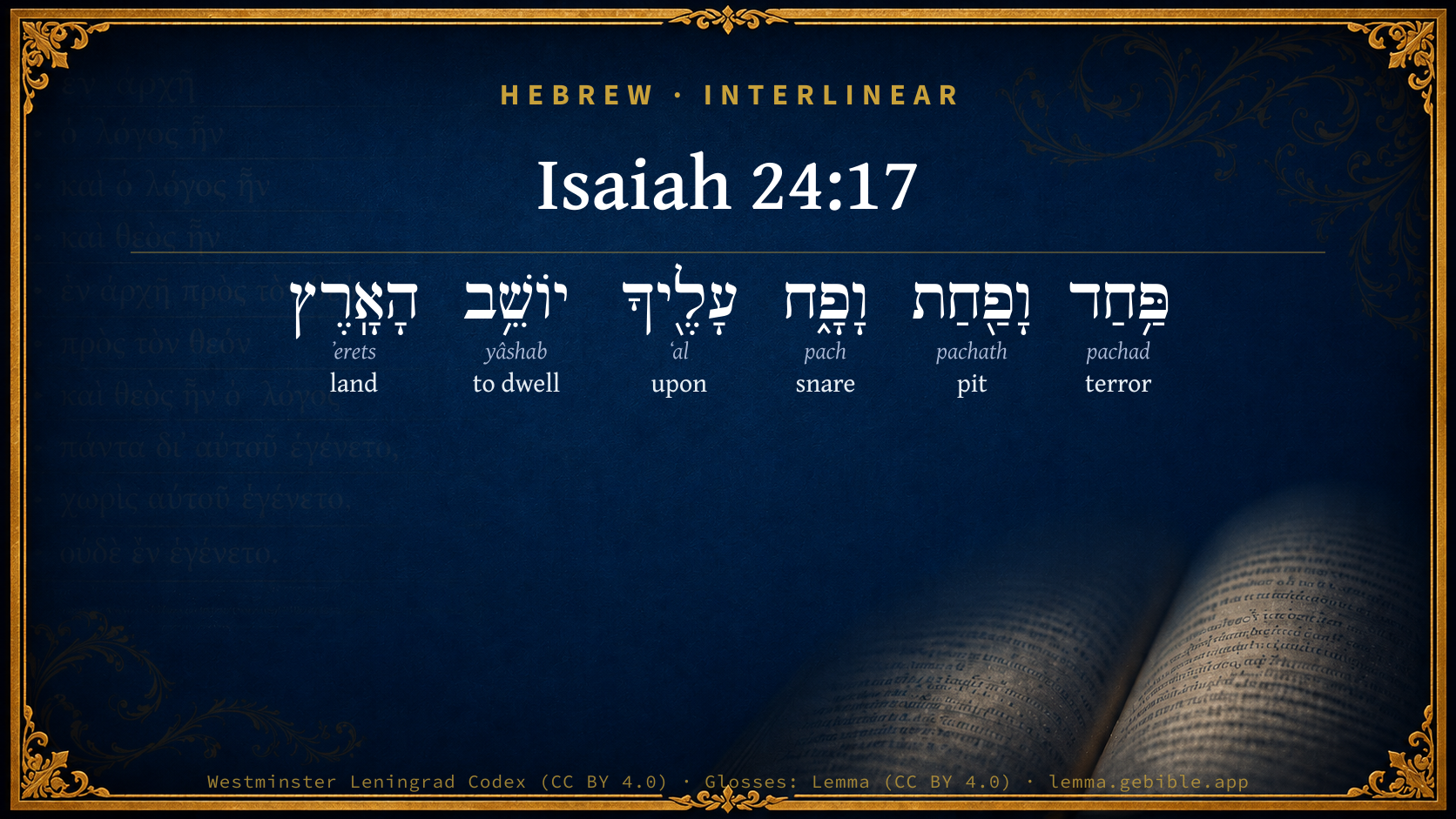
Isaiah 24:17

Hebrew (Westminster Leningrad Codex) Isaiah 24:17 appears in the Hebrew Old Testament. The text above is from the Westminster Leningrad Codex. Each word links to its Strong’s number, a concise gloss, and parsing drawn from the Open Scriptures Hebrew Bible morphology. Click any word for its full Brown-Driver-Briggs (BDB) entry.
Download image
Cite this verse

Isaiah 24:17 (World English Bible). Public Domain. Lemma interlinear Bible study tool, https://lemma.gebible.app/v/isaiah/24/17.

Show BibTeX & RIS
BibTeX
RIS
English Translation
Fear, and the pit, and the snare, are on you, O inhabitant of the earth.
World English Bible · Public Domain
Download a study sheet

One document with this verse’s original text, its word-by-word gloss line, the meaning frame, cross-references with their text, attributed commentary, and full source and license credits — printable, and it pastes into notes with its structure intact.

This verse Autodidact and up

Study sheet (.html) Plain text (.txt)

A passage Seminary Student

Up to 50 verses in one chapter. A passage sheet keeps up to 6 commentary sources and 12 cross-references per verse, in the order this page ranks them, and says so on the sheet whenever that leaves anything out. Ask for a single verse and you get the Autodidact verse sheet above.

Everything on this page stays free to read, with no account — the sheet is a download of what is already on screen, not access to it.

Want to remove ads? Support Godless Engineer
Compare translations 3

The same verse in 3 English versions, stacked beneath the original-language interlinear above. Click any original word for its lexicon entry.

Each is an independent rendering of the whole verse — the interlinear is not word-aligned to these translations.

Highlighted words mark where these versions differ — a whole-verse word diff, not a word-by-word alignment.

  • World English Bible Public Domain
    Fear, and the pit, and the snare, are on you, O inhabitant of the earth.
  • King James Version Public Domain
    Fear, and the pit, and the snare, are upon thee, O inhabitant of the earth.
  • unfoldingWord Literal Text CC BY-SA 4.0
    Terror and pit and snare upon you, dweller of the earth!

unfoldingWord Literal Text — © unfoldingWord, licensed CC BY-SA 4.0. Word-aligned USFM3 via Door43 (git.door43.org/unfoldingWord/en_ult).

Versions to compare (up to 4)

3 of 4 selected

Show all 18 translations

Every available English version of this verse, each an independent rendering of the whole verse.

  • World English Bible Public Domain
    Fear, and the pit, and the snare, are on you, O inhabitant of the earth.
  • Berean Standard Bible Public Domain
    Terror and pit and snare await you, O dweller of the earth.
  • Majority Standard Bible Public Domain
    Terror and pit and snare await you, O dweller of the earth.
  • King James Version Public Domain
    Fear, and the pit, and the snare, are upon thee, O inhabitant of the earth.
  • American Standard Version (1901) Public Domain
    Fear, and the pit, and the snare, are upon thee, O inhabitant of the earth.
  • Revised Version (1885) Public Domain
    Fear, and the pit, and the snare, are upon thee, O inhabitant of the earth.
  • Geneva Bible (1599) Public Domain
    Feare, and the pitte, and the snare are vpon thee, O inhabitant of the earth.
  • Douay-Rheims (1899) Public Domain
    Fear, and the pit, and the snare are upon thee, O thou inhabitant of the earth.
  • Young's Literal Translation Public Domain
    Fear, and a snare, and a gin, `Are' on thee, O inhabitant of the land.
  • Literal Standard Version CC BY-SA 4.0
    Fear, and a snare, and a trap, || [Are] on you, O inhabitant of the earth.
  • Unlocked Literal Bible CC BY-SA 4.0
    Terror, the pit, and the snare are upon you, inhabitants of the earth.
  • unfoldingWord Literal Text CC BY-SA 4.0
    Terror and pit and snare upon you, dweller of the earth!
  • Darby Bible Public Domain
    Fear, and the pit, and the snare are upon thee, inhabitant of the land.
  • World Messianic Bible Public Domain
    Fear, the pit, and the snare are on you who inhabit the earth.
  • Webster's Bible Public Domain
    Fear, and the pit, and the snare, are upon thee, O inhabitant of the earth.
  • Free Bible Version CC BY-SA 4.0
    Terrors and pit-traps and snares are waiting for you, people of the earth.
  • Bible in Basic English Public Domain
    Fear, and death, and the net, are come on you, O people of the earth.
  • JPS Tanakh (1917) Public Domain
    Terror, and the pit, and the trap, are upon thee, O inhabitant of the earth.

Literal Standard Version (2020), Covenant Press — licensed CC BY-SA 4.0. Text via the HelloAO Bible API (eBible.org). Unlocked Literal Bible (unfoldingWord) — licensed CC BY-SA 4.0. Text via the HelloAO Bible API (eBible.org). unfoldingWord Literal Text — © unfoldingWord, licensed CC BY-SA 4.0. Word-aligned USFM3 via Door43 (git.door43.org/unfoldingWord/en_ult). Free Bible Version, Dr. Jonathan Gallagher — licensed CC BY-SA 4.0. Text via the HelloAO Bible API (eBible.org).

Word by word

More ways to search: Search by grammar → Find every occurrence → Compare this word →

Practice this passage: Drill this verse → Learn its vocabulary →

About this verse

These counts appear in no published source. They are computed here, from the morphology-tagged text and Lemma’s own curated glosses. What Lemma adds →

6
words
6
distinct lemmas
Prophets
section

Notable vocabulary

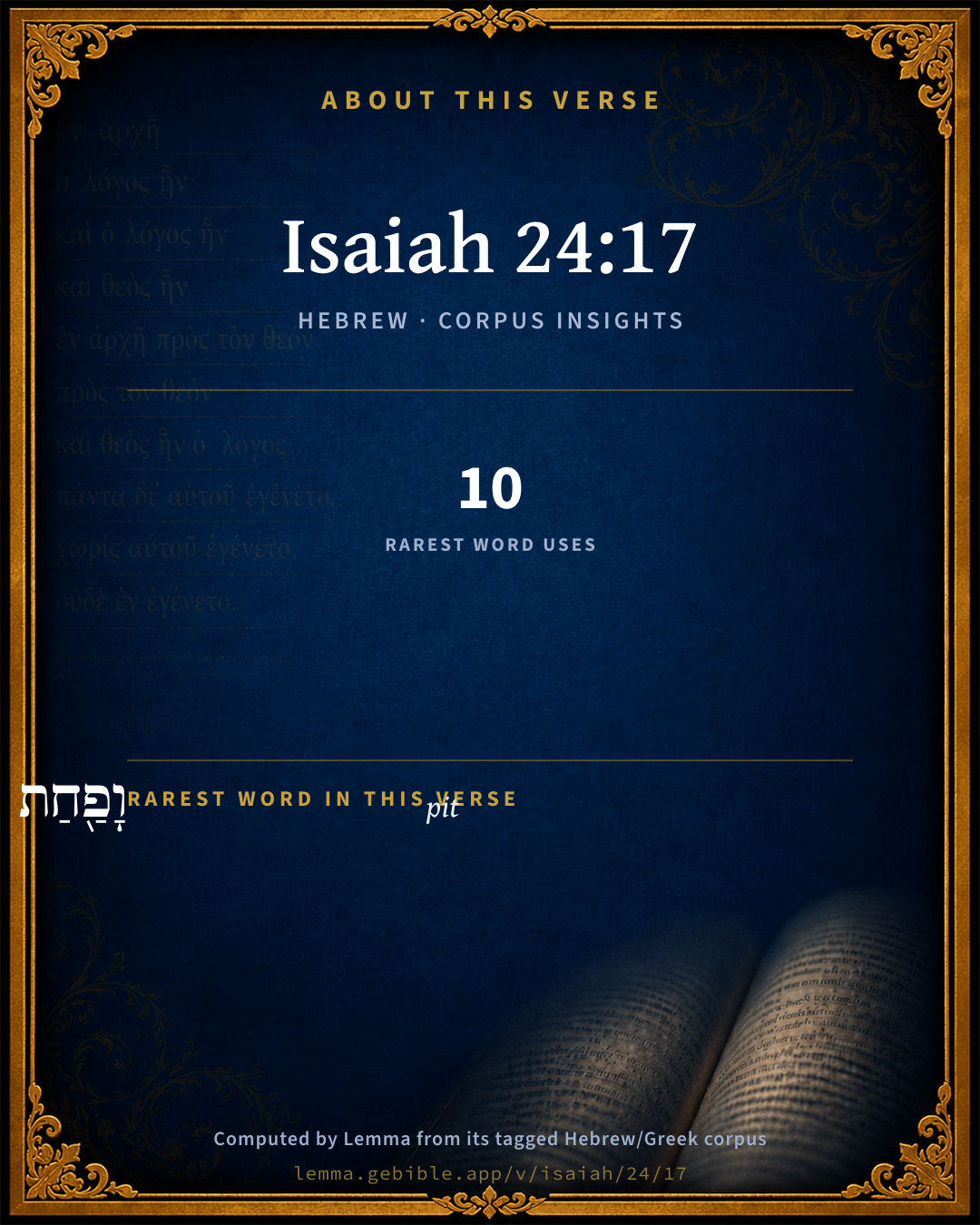
The rarest word here is וָפַ֖חַת pit H6354 — appearing just 10 times in the whole Hebrew Bible.

Shared distinctive vocabulary

וָפַ֖חַת pit H6354 occurs in 8 verses of the Hebrew Bible. Also found in:

Grammatical profile

  • 1 verb
  • 4 nouns
  • 1 preposition

Verb forms

  • יוֹשֵׁ֥ב Qal · Participle Active

Hebrew & Septuagint length

In English translation the verse runs 15 words from the Hebrew and 15 from the Septuagint (LXX English) — the same length.

A rough comparison of the two English renderings, which tokenize alike — not a word-level alignment.

Word counts can differ between the Hebrew and the Greek without any difference in meaning — e.g. the Hebrew direct-object marker אֵת has no separate Greek word, and Greek often adds the article ὁ.

Cross-references

6

Topical passages linked to Isaiah 24:17 in the Treasury of Scripture Knowledge — connected by theme and wording, ordered by reader-vote popularity; previews shown in the World English Bible.

  • Jeremiah 48:43–44 Fear, and the pit, and the snare, are on you, inhabitant of Moab, says Yahweh.
  • Leviticus 26:21–22 "'If you walk contrary to me, and won't listen to me, then I will bring seven times more plagues on you according to your sins.
  • 1 Kings 19:17 It shall happen, that he who escapes from the sword of Hazael shall Jehu kill; and he who escapes from the sword of Jehu shall Elisha kill.
  • Jeremiah 8:3 Death shall be chosen rather than life by all the residue that remain of this evil family, that remain in all the places where I have driven them, says Yahweh of Hosts.
  • Ezekiel 14:21 For thus says the Lord Yahweh: How much more when I send my four sore judgments on Jerusalem, the sword, and the famine, and the evil animals, and the pestilence, to cut off from it man and animal!
  • Amos 5:19 As if a man fled from a lion, And a bear met him; Or he went into the house and leaned his hand on the wall, And a snake bit him.

Cross-references courtesy of OpenBible.info (CC BY 4.0).

Hebrew and Greek witnesses Masoretic Hebrew ↔ Greek Septuagint

The same verse in the two great witnesses to the Old Testament, shown verse-for-verse.

These are two independent witnesses, not word-aligned to each other, and the Septuagint is shown in lemma (dictionary) form.

Hebrew Isaiah 24:17 Masoretic · Westminster Leningrad Codex

פַּ֥חַד וָפַ֖חַת וָפָ֑ח עָלֶ֖יךָ יוֹשֵׁ֥ב הָאָֽרֶץ

Fear, and the pit, and the snare, are on you, O inhabitant of the earth.

World English Bible · Public Domain

Greek LXX Isaiah 24:17 Septuagint · lemma form

φόβος καί βόθυνος καί παγίς ἐπί σύ ὁ ἐνοἰκέω ἐπί ὁ γῆ

Fear, and a pit, and a snare, are upon you that dwell on the earth.

LXX2012 (modern English Septuagint) · Public Domain

Hebrew: Westminster Leningrad Codex (CC BY 4.0). Greek: Septuagint (public domain); English from LXX2012 (modern English Septuagint) (Public Domain). How the Septuagint differs from the Hebrew →

Targum (Aramaic paraphrase)

1

The Targum is the ancient Jewish Aramaic paraphrase of the Hebrew Scriptures — an interpretive translation, not the Hebrew text itself. Onkelos (literal) and Pseudo-Jonathan (expansive) render the Torah, and Jonathan the Prophets. Coverage is partial: where no permissively-licensed English translation exists for a verse, only the Aramaic is shown. This is verse-level text, not a word-by-word alignment to the Hebrew.

  1. Targum Jonathan Prophets (Joshua–Malachi)
    דַחֲלָא וְכוּמְצָא וּמְצָדָא עֲלָךְ יָתֵיב אַרְעָא:

    The terror, the pit, and the snare, are upon thee, O inhabitant of the land.

    Targum Jonathan — Aramaic: “Mikraot Gedolot” (public domain). English: “Sefaria Community Translation” (CC0 1.0 (public-domain dedication)); “London "Chaldee Paraphrase," 1871” (public domain). Text via Sefaria.

Commentary

Notes on Isaiah 24:17 from classic Christian and Jewish commentators (each source and its license shown beneath its notes). The classic Christian expositions comment on the surrounding passage and are grouped to its opening verse, so a note may address several verses; the Jewish commentaries on the Tanakh (Rashi and others) are per-verse, so they appear only where the commentator wrote on this verse.

Lemma curates 59 commentaries, every one of them public domain or Creative Commons licensed, each selected and text-cleaned for this edition rather than reprinted as found. About our sources →

Trapp's Complete Commentary

John Trapp

Isa 24:17 Fear, and the pit, and the snare, [are] upon thee, O inhabitant of the earth.

Ver. 17. Fear, and the pit, and the snare, are upon thee.] Metaphora a venatoribus, a metaphor from hunters, elegantly expressed in the original by words of a like sound. God hath variety of plagues at command; his quiver is full of shafts, neither can he possibly want a weapon to beat his rebels with. If the Amorites escape the sword, yet they are brained with hailstones {Jos 10:11} If the Syrians get into a walled town, yet they are baned by the fall of a wall upon them. {1Ki 20:30}

John Trapp, A Commentary or Exposition upon All the Books of the Old and New Testament (1647–1656) — public domain. Text from a community e-Sword module.

The Biblical Illustrator

Joseph S. Exell

Isa_24:17

Fear and the pit, and the snare, are upon thee

Fear, and the pit, and the snare

The expressions here used seem to have formed a proverbial saying, as appears from their being repeated by the prophet Jeremiah (Jer_48:43-44).

They allude to the different methods of taking wild beasts that were anciently in use. The fear, or terror, was a line strung with feathers of different colours, which was so constructed as to flutter in the air and to make a terrifying noise, that frightened the beasts into the pit, or the snare, that was prepared for them. The pit was digged deep in the ground, and covered over with boughs or turf, in order to deceive them, that they might fall into it unawares. The snare was composed of nets, enclosing a large space of ground that the wild beasts were known to haunt, which was drawn gradually narrower, until they were at last entangled and shut up. Our prophet, addressing himself to the inhabitants of the earth, declares, that calamities corresponding to each of these ways of destroying wild beasts, were to seize upon them, and that they should be so ordered, that those who escaped one sort would be arrested by another. (R. Macculloch.)

The Biblical Illustrator, edited by Joseph S. Exell (c. 1880s–1900s) — public domain. Text from a community e-Sword module.

Joseph Benson's Commentary

Isa 24:17-18. Fear, and the pit, and the snare, &c. — Great and various judgments, some actually inflicted, and others justly feared, as the punishment of the last-mentioned perfidiousness of the Jews toward God and their own Messiah. He that fleeth from the fear, &c. — Upon the report of some terrible evil coming toward him; shall fall into the pit — When he designs to avoid one danger, by so doing he shall plunge himself into another and greater mischief. For the windows from on high are opened, &c. — Both heaven and earth conspire against him. He alludes to the deluge of waters which God poured down from heaven, and to the earthquake which he often causes below. There is a remarkable elegance in the original of the 17th verse. The three Hebrew words, פחד, pachad, פחת, pachath, and פח, pach, being a paronomasia, or having an affinity in sound with each other, which cannot be translated into another language. And there is also great sublimity in the latter clause of the 18th verse, in which the ideas and expressions, taken from the deluge, are strongly expressive of that deluge of divine wrath which should fall upon, and totally overwhelm, the apostate Jews for rejecting and crucifying their own Messiah.

Joseph Benson's Commentary on the Old and New Testaments (1811–1818) — public domain. Text from a community e-Sword module.

Jamieson, Fausset & Brown

Robert Jamieson, A. R. Fausset & David Brown

This verse explains the wretchedness spoken of in Isa 24:16. Jeremiah (Jer 48:43-44) uses the same words. They are proverbial; Isa 24:18 expressing that the inhabitants were nowhere safe; if they escaped one danger, they fell into another, and worse, on the opposite side (Amo 5:19). "Fear" is the term applied to the cords with feathers of all colors which, when fluttered in the air, scare beasts into the pitfall, or birds into the snare. HORSLEY makes the connection. Indignant at the treatment which the Just One received, the prophet threatens the guilty land with instant vengeance.

Jamieson, Fausset & Brown — Commentary Critical and Explanatory on the Whole Bible (1871) — public domain (CC PDM 1.0). Text via the HelloAO Bible API.

Adam Clarke's Commentary

Verse 17. Fear, and the pit - "The terror, the pit"] If they escape one calamity, another shall overtake them.

"As if a man should flee from a lion, and a bear should

overtake him:

Or should betake himself to his house, and lean his hand

on the wall,

And a serpent should bite him."

Am 5:19.

"For," as our Saviour expressed it in a like parabolical manner, "wheresoever the carcass is there shall the eagles be gathered together," Mt 24:28. The images are taken from the different methods of hunting and taking wild beasts, which were anciently in use. The terror was a line strung with feathers of all colours, which fluttering in the air scared and frightened the beasts into the toils, or into the pit which was prepared for them. Nec est mirum, cum maximos ferarum greges linea pennis distincta contineat, et in insidias agat, ab ipso effectu dicta formido. Seneca de Ira, ii. 12. The pit or pitfall, fovea; digged deep in the ground, and covered over with green boughs, turf, c., in order to deceive them, that they might fall into it unawares. The snare, or toils, indago a series of nets, inclosing at first a great space of ground, in which the wild beasts were known to be; and then drawn in by degrees into a narrower compass, till they were at last closely shut up, and entangled in them. - L.

For מכול mikkol, a MS. reads מפני mippeney, as it is in Jer 48:44, and so the Vulgate and Chaldee. But perhaps it is only, like the latter, a Hebraism, and means no more than the simple preposition מ mem. See Ps 102:6. For it does not appear that the terror was intended to scare the wild beasts by its noise. The paronomasia is very remarkable; פחד pachad, פחת pachath, פך pach: and that it was a common proverbial form, appears from Jeremiah's repeating it in the same words, Jer 48:43-44.

Adam Clarke's Commentary on the Bible (1810–1826) — public domain. Text from a community e-Sword/MySword module.

Ellicott's Commentary for English Readers

(17) Fear, and the pit, and the snare . . .—The words paint the rapid succession of inevitable calamities, in imagery drawn from the several forms of the hunter’s work. There is first the terror of the startled beast; then the pit dug that he might fall into it; then the snare, if he struggled out of the pit, out of which there was no escape (Isa_8:15). The passage is noticeable as having been reproduced by Jeremiah in his prophecy against Moab (Jer_48:43-44).

A Bible Commentary for English Readers, edited by Charles John Ellicott (1878–1897) — public domain. Text from a community e-Sword module.

The Cambridge Bible for Schools and Colleges

gen. ed. J. J. S. Perowne

17–20. This description of the judgment on the earth and its inhabitants seems to connect immediately with Isa_24:13.

17, 18a recur almost verbatim in Jer_48:43 f. (cf. also Amo_5:19).

18b—20 describe the physical convulsions which accompany the day of Jehovah.

the windows from on high are opened] An allusion to the story of the Deluge (Gen_7:11; Gen_8:2). The rest of the imagery is based on the phenomena of the earthquake.

The Cambridge Bible for Schools and Colleges (gen. ed. J. J. S. Perowne; Cambridge University Press, 1878–1918) — public domain. Text from a community e-Sword module.

John Gill's Exposition

Fear, and the pit, and the snare, are upon thee, O inhabitant of the earth. This is to be understood not of the land of Judea only, and the inhabitants of it, but of all the earth; Kimchi interprets it of the nations of the world, particularly the Greeks and Turks; but the whole world, and the inhabitants of it, are meant, as the following verses show. There is an elegant play on words in the Hebrew, which cannot well be expressed in English, in the words "pachad, pachath, pach", fear, pit, and a snare; which are expressive of a variety of dangers, difficulties, and distresses; there seems to be an allusion to creatures that are hunted, who flee through fear, and fleeing fall into pits, or are entangled in snares, and so taken. Before the last day, or second coming of Christ to judge the world, there will be great perplexity in men's minds, great dread and fear upon their hearts, and much distress of nations; and the coming of the Son of Man will be as a snare upon the earth; see Luk 21:25.

.

Isaiah 24:18

isa 24:18

isa 24:18

isa 24:18And it shall come to pass, that he who fleeth from the noise of the fear,.... From the fearful noise that will be made, the voices and thunderings heard in the heavens above, the sea and waves roaring below; or from wars, and rumours of wars, and terrible armies approaching and pursuing, Luk 21:25 or rather at the report of an object to be feared and dreaded by wicked men, even the Son of Man coming in the clouds of heaven, Rev 1:7,

shall fall into the pit; of ruin and destruction, dug for the wicked, Psa 94:13 just as the kings of Sodom and Gomorrah fell into the slime pits, when they fled from their conquerors, Gen 14:10,

and he that comes up out of the midst of the pit shall be taken in the snare; the meaning is, that he that escapes one trouble should fall into another, so that there will be no safety anywhere. Jarchi's note is,

"he that escapes the sword of Messiah ben Joseph, shall fall upon the sword of Messiah ben David; and he that escapes from thence shall be taken in a snare in the war of Gog:''

for the windows from on high are open; not hereby signifying, as Jerom thinks, that the Lord would now see all the sins of men, which, because he did not punish before, he seemed by sinners to be ignorant of; but the allusion is to the opening of the windows of heaven at the time of the deluge, Gen 7:11 and intimates, that the wrath of God should be revealed from heaven, and the severest judgments be denounced, made manifest, and come down from thence in a very visible, public, and terrible manner, like an overflowing tempest of rain:

and the foundations of the earth do shake: very probably the dissolution of the world may be attended with a general earthquake; or this may denote the dread and terror that will seize the inhabitants of it.

John Gill's Exposition of the Whole Bible (1746–1763) — public domain (CC PDM 1.0). Text via the HelloAO Bible API.

Albert Barnes' Notes on the Bible

Fear, and the pit - This verse is an explanation of the cause of the wretchedness referred to in the previous verse. The same expression is found in Jer 48:43, in his account of the destruction that would come upon Moab, a description which Jeremiah probably copied from Isaiah - There is also here in the original a “paronomasia” that cannot be retained in a translation - פחד ופחת ופח pachad vâpachath vâpach - where the form פח pach occurs in each word. The sense is, that they were nowhere safe; that if they escaped one danger, they immediately fell into another. The expression is equivalent to that which occurs in the writings of the Latin classics:

Incidit in Scyllam cupiens vitare Charybdin.

The same idea, that if a man should escape from one calamity he would fall into another, is expressed in another form in Amo 5:19 :

As if a man did flee from a lion, and a bear met him;

Or went into a house, and leaned his hand on the wall,

And a serpent bit him.

In the passage before us, there is an advance from one danger to another, or the subsequent one is more to be dreaded than the preceding. The figure is taken from the mode of taking wild beasts, where various nets, toils, or pitfalls were employed to secure them. The word ‘fear’ (פחד pachad), denotes anything that was used to frighten or arouse the wild beasts in hunting, or to drive them into the pitfall that was prepared for them. Among the Romans the name ‘fears’ (“formidines”) was given to lines or cords strung with feathers of all colors, which, when they fluttered in the air or were shaken, frightened the beasts into the pits, or the birds into the snares which were prepared to take them (Seneca, De Ira, ii. 122; virg. AE. xii. 7499; Geor. iii. 372). It is possible that this may be referred to here under the name of ‘fear.’ The word ‘pit’ (פחת pachat) denotes the pitfall; a hole dug in the ground, and covered over with bushes, leaves, etc., into which they might fall unawares. The word ‘snare’ (פח pach) denotes a net, or gin, and perhaps refers to a series of nets enclosing at first a large space of ground, in which the wild beasts were, and then drawn by degrees into a narrow compass, so that they could not escape.

Albert Barnes' Notes on the Bible (1834–1885) — public domain. Text from a community e-Sword/MySword module.

Haydock's Catholic Bible Commentary

Snare. He alludes to the methods of taking wild beasts, Job xviii. 11. --- Opened, as they were in the days of Noe[Noah]. (Calmet) --- All sorts of misery hang over us.

George Leo Haydock (1774–1849), Haydock's Catholic Family Bible and Commentary, 1859 edition — public domain. Excludes Psalms (Douay-Rheims chapter numbering differs from Protestant) and Deuterocanonical books (Catholic canon only).

Matthew Poole's English Annotations

Great and various judgments, some actually inflicted, and others expected and justly feared, as the punishment of their last-mentioned treachery.

Matthew Poole's English Annotations on the Holy Bible (1683–1685) — public domain. Text from a community e-Sword/MySword module.

Whedon's Commentary on the Bible

Daniel D. Whedon

17-20. The foundations… do shake — From the statement of these verses it would look as if the new view of the prophet was but a sudden shift in an ecstatic scene. The rush of invaders and the fleeing of the pursued are represented by images taken from the deluge and geologic earthquakes. The final scene is apocalyptic, and the earth is removed from existence.

Daniel D. Whedon (gen. ed.), Commentary on the Old and New Testaments (1874–1909) — public domain. Text from a community e-Sword module.

The Pulpit Commentary

Fear, and the pit, and the snare, are upon thee. Man will be like a hunted animal, flying from pursuit, and in danger at each step of falling into a pit or being caught in a snare. (comp. Jer_48:43, Jer_48:44, where the idea is borrowed from this place, and applied to a particular nation)

The Pulpit Commentary (1880–1919), ed. H.D.M. Spence-Jones & Joseph S. Exell — public domain. Text from a community e-Sword module.

John Wesley's Explanatory Notes

The snare - Great and various judgments, some actually inflicted, and others justly feared.

John Wesley, Explanatory Notes Upon the Whole Bible (1754–1765) — public domain. Text via the GEBible commentary corpus.

J. A. Alexander on Isaiah

Joseph Addison Alexander

“Fear and pit and snare upon thee, oh inhabitant of the land!” This may be either a warning (are upon the) or the expression of a wish (be upon thee). It is a probable though not a necessary supposition, that the terms here used are borrowed from the ancient art of hunting.

Joseph Addison Alexander, The Prophecies of Isaiah (1846–1847; New York: Scribner, 1870–1878) — public domain. Text from a community e-Sword module.

unfoldingWord translationNotes

Door43 World Missions Community

Terror, the pit, and the snare are upon you, inhabitants of the earth

"You people of the earth will experience terror, the pit, and the snare"

the pit, and the snare ... caught in the snare

Here "pit" and "snare" represent all the different bad things that will happen to people. People will run away to escape one bad thing but they will just experience another bad thing. (See: Synecdoche)

the sound of terror

"the terrifying sound"

will be caught in the snare

This can be stated in active form. AT: "the snare will catch him" (See: Active or Passive)

The windows of the heavens will be opened

This speaks of large amounts of rain falling from the sky as if Yahweh opened a window in the sky and let the water pour through. AT: "The sky will split open and torrents of rain will fall" (See: Metaphor)

the foundations of the earth will shake

The word "foundation" normally refers to a stone structure that gives support to a building from underneath. Here it describes a similar structure that was thought to support and hold the earth in place. Isaiah says even the structure that holds the earth will shake. AT: "the earth will shake terribly" or "there will be a terrible earthquake"

translationWords

terror

pit

snare

heaven

found

unfoldingWord translationNotes — © Distant Shores Media and the Door43 World Missions Community, licensed CC BY-SA 4.0. Source: git.door43.org/Door43/en_tn.

Rashi

Rabbi Shlomo Yitzchaki (Rashi)

Fright and a pit and a trap [shall come] upon you upon the peoples dwelling in the land.

a pit a hole in which to fall, as he goes on to state.

Rashi on the Tanakh — English translations: “The Judaica Press complete Tanach with Rashi, translated by A. J. Rosenberg” (CC BY 4.0); “Pentateuch with Rashi's commentary by M. Rosenbaum and A.M. Silbermann, 1929-1934” (public domain); “The Metsudah Tanach series, Lakewood, N.J” (CC BY 4.0); and “The Book of Joshua, Metsudah Publications, 1997” (CC BY 4.0). Text via Sefaria.

Ibn Ezra

Rabbi Abraham ibn Ezra

Fear and the pit, etc. And therefore the evil is come to all people; for when any person is in fear, and a kind of pit is near him, and his foot is besides caught in a snare, he must instantly fall.

Ibn Ezra on the Tanakh — English translations: “Sefaria Community Translation” (CC0 1.0 (public-domain dedication)); “Yalkut, Sifsei Chachomim Chumash, Metsudah Publications, 2009” (CC BY 4.0); and “Commentary of Ibn Ezra on Isaiah - trans. by M. Friedlander, 1873” (public domain). Text via Sefaria.

Lesson kit

Teaching starters — assembled from the data on this page, not authored interpretation. Every prompt links to the verse data it draws on. Edit before teaching.

Isaiah, in the Prophets, opens this verse with 6 words (6 distinct Hebrew lemmas). Its most distinctive word is pachath (“pit”). A historical commentator’s framing appears above. Read the whole chapter for the surrounding context.

Discussion questions

  1. What does “pit” (pachath) contribute to the verse as a whole?
  2. How does 2 Samuel 17:9, which shares the word «pit», read alongside this verse?
  3. These translations render this verse differently. What is at stake in choosing one wording over another?
  4. «יוֹשֵׁ֥ב» is a Qal Participle Active verb. How does that grammatical form shape the action described?
  5. Compare how Trapp's Complete Commentary and The Biblical Illustrator read this verse. Where do they agree or differ?

Things to notice

Reading settings

Reading text

Shown beneath each verse's original-language words.

Old Testament
Old Testament edition

Read the OT as the Masoretic Hebrew (MT) or the Greek Septuagint (LXX).

English shown for the Greek Septuagint (in the Hebrew ↔ Greek comparison).

Comparing translations? Open the Compare panel on any verse page to stack up to four side by side.