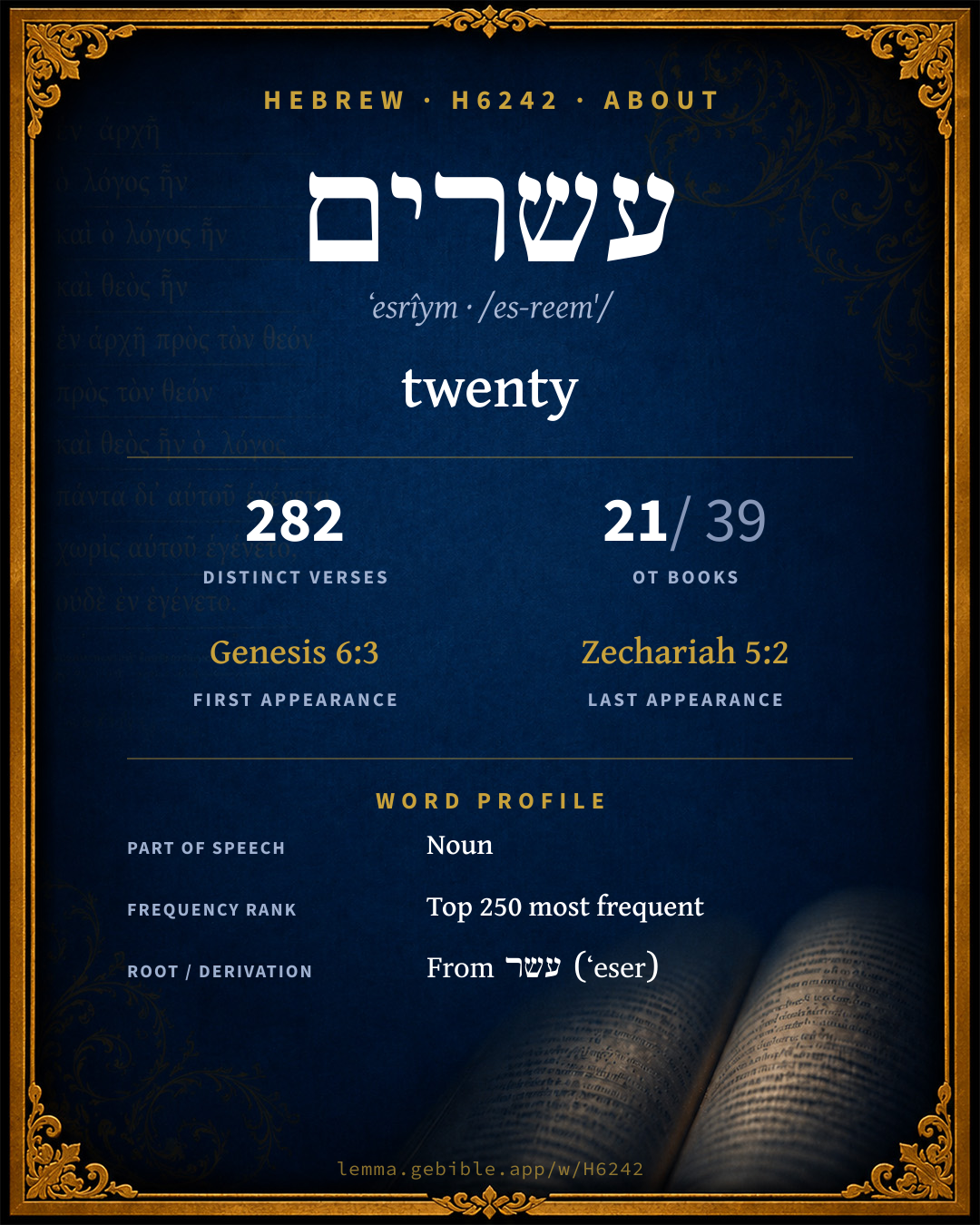
עֶשְׂרִים
twenty
Full lexicon entry — Brown-Driver-Briggs (BDB)
From Brown-Driver-Briggs (BDB)
Where this word appears
Grammar key — what these labels mean
Part of speech
- Adjective
- A word that describes or qualifies a noun.
State
- Absolute
- The independent form of a noun, not bound to a following word.
Gender
- Both
- Attested as both masculine and feminine.
Number
- Plural
- More than one (in Hebrew, generally three or more).
Every verse where H6242 appears in the Book of 2 Samuel — 9 distinct verses. Click any verse to open its interlinear word-by-word view. Verse text shown in the World English Bible for context — . Each verse’s Hebrew form is shown with its reference; the English is not keyword-highlighted, since the data carries no word-level English alignment. Use “Compare translations” on any verse to read it across multiple English versions. This concordance covers the Hebrew Bible; Septuagint (Greek Old Testament) occurrences are not indexed here.
2 Samuel
- 2 Samuel 3:20 עֶשְׂרִ֣ים adj Cardinal number bp So Abner came to David to Hebron, and twenty men with him. David made Abner and the men who were with him a feast.
- 2 Samuel 8:4 וְ/עֶשְׂרִ֥ים conj + Adjective Cardinal number bp David took from him one thousand seven hundred horsemen, and twenty thousand footmen: and David hamstrung all the chariot horses, but reserved of them for one hundred chariots.
- 2 Samuel 8:5 עֶשְׂרִֽים adj Cardinal number bp When the Syrians of Damascus came to help Hadadezer king of Zobah, David struck of the Syrians two and twenty thousand men.
- 2 Samuel 9:10 וְ/עֶשְׂרִ֥ים conj + Adjective Cardinal number bp You shall till the land for him, you, and your sons, and your servants; and you shall bring in [the fruits], that your master's son may have bread to eat: but Mephibosheth your master's son shall eat bread always at my table." Now Ziba had fifteen sons and twenty servants.
- 2 Samuel 10:6 עֶשְׂרִ֥ים adj Cardinal number bp When the children of Ammon saw that they were become odious to David, the children of Ammon sent and hired the Syrians of Beth Rehob, and the Syrians of Zobah, twenty thousand footmen, and the king of Maacah with one thousand men, and the men of Tob twelve thousand men.
- 2 Samuel 18:7 עֶשְׂרִ֥ים adj Cardinal number bp The people of Israel were struck there before the servants of David, and there was a great slaughter there that day of twenty thousand men.
- 2 Samuel 19:17 וְ/עֶשְׂרִ֥ים conj + Adjective Cardinal number bp There were a thousand men of Benjamin with him, and Ziba the servant of the house of Saul, and his fifteen sons and his twenty servants with him; and they went through the Jordan in the presence of the king.
- 2 Samuel 21:20 עֶשְׂרִ֤ים adj Cardinal number bp There was again war at Gath, where was a man of great stature, who had on every hand six fingers, and on every foot six toes, four and twenty in number; and he also was born to the giant.
- 2 Samuel 24:8 וְ/עֶשְׂרִ֥ים conj + Adjective Cardinal number bp So when they had gone back and forth through all the land, they came to Jerusalem at the end of nine months and twenty days.
About this entry
At a glance — auto-summarized from this page’s data, not written by a person. Every figure links to its source below. This summary describes the numbers; it doesn’t interpret them.
עשרים (ʻesrîym) is a Hebrew noun most often rendered “twenty.” Where the King James Version says “twenty,” newer translations reach for “were” (unfoldingWord Literal Text); the renderings breakdown has the detail. The Hebrew Bible uses it across 282 verses — common. Debuting at Genesis 6:3, it then recurs through the corpus. Related forms include עשר, עשור and עשירי. For the data behind this summary, explore the sense tree and the renderings breakdown below.
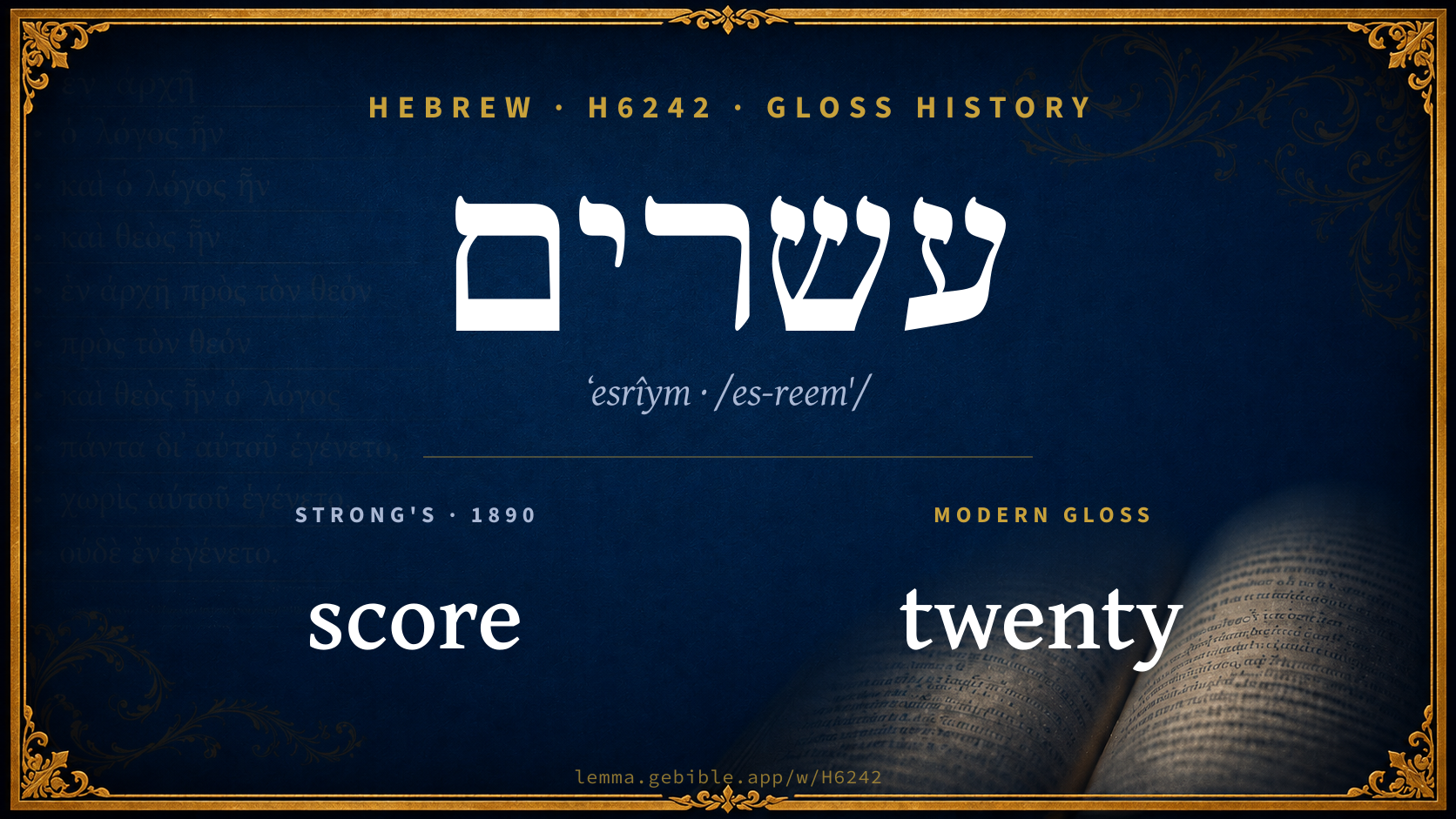
Gloss history
Strong's 1890 vs modern scholarship
About this word
Strong's H6242 catalogs a Hebrew word from the Hebrew Old Testament.
These counts are not copied from any lexicon or concordance. They are computed here, from the morphology-tagged Hebrew Old Testament. What Lemma adds →
- 282
- distinct verses
- The word appears in 282 distinct verses.
- 21 / 39
- OT books
- The word appears in 21 of 39 Old Testament books.
- #159
- by frequency
- Top 250 most frequent Hebrew words (rank 159 of 8,640 Hebrew words by occurrence).
View all 282 occurrences in the concordance →
Most concentrated in
- 1 Chronicles 39 verses 14%
- Numbers 32 verses 11%
- Ezekiel 29 verses 10%
By section of the Old Testament
By traditional corpus
Conventional, traditional groupings — biblical authorship is debated, so this is a traditional corpus grouping, not an authorship claim. Each share is this word’s portion of its verses in that division of the Hebrew canon. Each figure is a share of the word’s 282 distinct verses.
- Writings (Ketuvim) 111 verses · 39%
- Prophets (Nevi'im) 105 verses · 37%
- Torah (Pentateuch) 66 verses · 23%
How translations render this word
Counts come from each version’s own published word-to-Strong’s tagging or interlinear alignment — an approximate guide to how each version renders this word, not a word-level alignment the data otherwise carries. Because each total is that version’s own tagged count, the per-version totals vary from one another and need not match the appearance or distinct-verse counts above. These counts may also differ from a printed concordance because Lemma counts each distinctly tagged rendering and does not collapse phrase taggings into a single head-word total. This is a fixed set of word-tagged versions (KJV, ASV, BSB, ULT) and does not change with the reading translation you choose elsewhere. Each version’s license is shown beside its name below (and on Sources).
- King James Version: Twenty 215×, Twentieth 34×, Were twenty 21×
- American Standard Version: Twenty 210×, Twentieth 32×, Was twenty 18×
- Berean Standard Bible: Twenty 100×, Twenty-five 15×, Twenty-two 9×
- unfoldingWord Literal Text: Were 46×, Twenty 43×, And 17×
King James Version Public Domain
Renders H6242 across 314 tagged occurrences — most commonly:
Plus 17 renderings that appear only once — usually multi-word phrases or single function words the recovered tagging swept in, not distinct renderings. Not rendered by a distinct English word in 1 further occurrence.
American Standard Version Public Domain
Renders H6242 across 312 tagged occurrences — most commonly:
Plus 26 renderings that appear only once — usually multi-word phrases or single function words the recovered tagging swept in, not distinct renderings.
Berean Standard Bible Public Domain
Renders H6242 across 199 tagged occurrences — most commonly:
Plus other, less common renderings. Plus 26 renderings that appear only once — usually multi-word phrases or single function words the recovered tagging swept in, not distinct renderings. Not rendered by a distinct English word in 116 further occurrences.
unfoldingWord Literal Text CC BY-SA 4.0
Renders H6242 across 158 tagged occurrences — most commonly:
Plus other, less common renderings. Plus 14 renderings that appear only once — usually multi-word phrases or single function words the recovered tagging swept in, not distinct renderings. Not rendered by a distinct English word in 164 further occurrences.
18 senses and sub-senses in the full BDB
What do BDB’s symbols mean?
BDB uses these scholarly abbreviations:
| Symbol | Meaning |
|---|---|
| 𝔊 | the Septuagint (the ancient Greek translation, LXX) |
| 𝔙 | the Vulgate (the Latin translation) |
| 𝔖 | the Syriac version (the Peshitta) |
| 𝔗 | the Targum (the Aramaic translation) |
| ψ | the Psalms |
| √ | root (the underlying root or stem) |
| ‖ | parallel passage (a synonymous or contrasted parallel) |
| † | the dagger: every passage where the word occurs is cited |
The 18 senses and sub-senses the full Brown-Driver-Briggs lexicon distinguishes for this word, in lexicon order (not ranked by frequency), with BDB’s own verbatim wording and sub-sense lettering. Shown in Hebrew script with BDB’s own scholarly abbreviations. The condensed entry is in the Lexicon Entry tab. See also the Forms in the corpus table below.
- I. as cardinal:
- 1. without other num.:
- a. usually sq. n.s. (especially שָׁנָה, אִישׁ, אַמָּה, etc.) Gn 31:38 1 S 14:14 Ex 38:18 + 64 times, + עֶשְׂרִים אֶלֶף 20,000 1 Ch 18:4 + 7 times + Ez 45:1 (reading עֶשְׂרִים אָ֑לֶף, v. עֶשֶׂר 2 b). e.g. Genesis 31:38
- b. sq. n.pl. 2 S 3:20; Ex 36:23, 24, 25 + 4 times. e.g. 2 Samuel 3:20
- c. sq. n.s. coll. 1 K 5:3. e.g. 1 Kings 5:3
- d. n.pl. precedes Gn 32:15(×2), 16; 2 Ch 3:3 + 6 times e.g. Genesis 32:15
- e. n. om. Gn 18:31(×2) (הָע׳), 1 K 6:2 + 6 times, as pred. Ex 27:10(×2), 11(×2) + 4 times. e.g. Genesis 18:31
- f. + בָּאַמָּה Zc 5:2. e.g. Zechariah 5:2
- 2. + other num.:
- a. c. units, usually 20 + (c. וְ) unit + n.s. Ju 10:2, 3 1 K 14:20 + 58 times (incl. 20 + 1 × 1000, etc., 27 times); n. om. Jos 15:32 + 2 times pred.; less often unit + 20 + n.s. Gn 11:24 Ex 38:24 Nu 8:24 (all P) + 27 times; unit + 20 + בָּאַמָּה Ez 40:21 Ex 26:2; 36:9 (both P). e.g. Judges 10:2
- b. 20 + unit + n.pl. Nu 7:8(×2) (P), 1 Ch 2:22 + 3 times Chr. e.g. Numbers 7:8
- c. n.pl. + 20 + unit Jos 19:30 1 Ch 12:29 (van d. H. v 28). e.g. Joshua 19:30
- d. c. hundreds, 20 usually foll.; sq. n.s. 1 K 9:14 Gn 6:3 Dt 31:2 + 7 times; n. om. 2 Ch 3:4 Ezr 2:32 = Ne 7:35; 20 + 100 (n. om.) Nu 7:86. e.g. 1 Kings 9:14
- e. n.pl. + 100 + 20 1 Ch 15:5, 6;—cf. further מֵאָה. e.g. 1 Chronicles 15:5
- 1. without other num.:
- II. as ordinal:
- 1. 20 alone, בִּשְׁנַת ע׳ in the twentieth year 1 K 15:9 + 4 times; n. om. Nu 10:11 + 3 times. e.g. 1 Kings 15:9
- 2.
- a. 20 + unit + ns. Ez 29:17; 40:1. e.g. Ezekiel 29:17
- b. ns. + 20 + unit Hg 1:15; 2 Ch 7:10 +; ns. + unit + 20 Ex 12:8; בִּשְׁנַת + 20 + unit 1 K 16:10, etc.—Vid. reff. sub עֶשֶׂר. e.g. Haggai 1:15
Senses from the full Brown-Driver-Briggs lexicon (Brown, Driver, Briggs; Oxford 1906 — public domain), digitized via Sefaria, supplemented by the OpenScriptures HebrewLexicon (CC BY 4.0). Full attribution on Sources.
Word origin
n.pl.indecl. (a) twenty (ancient pl. of עֶשֶׂר Prä BAS i. 376; NH = BH; Arabic عِشْرُونَ; Assyrian ešrâ; Sab. עשרי HomChrest. 48; Ethiopic ዕሥራ: Aramaic עשרין, ܥܶܣܪܝܺܢ; Nab. עשרין);—
— Brown-Driver-Briggs (Oxford 1906, public domain), digitized via Sefaria, supplemented by the OpenScriptures HebrewLexicon (CC BY 4.0). See Sources.
Derived from עשר (ʻeser) (H6235) — ten.
Jastrow Dictionary
A second Hebrew/Aramaic lexicon for comparison, covering Aramaic and post-biblical (Talmudic, Targumic, Midrashic) usage that the biblical-Hebrew BDB does not. Matched by lemma rather than by Strong’s number, so a lemma may carry more than one Jastrow headword (shown separately below), and the entries cover usage well beyond the Bible.
עֶשֶׂר
- (b. h.) ten. Ab. V, 1, v. מַאֲמָר. Ex. R. s. 15, a. fr. עשר מכות (not עשרה) the ten Egyptian plagues. Ib. ע׳ אנשים ten men; a. v. fr.—In compounds עָשָׂר, עֶשְׂרֵה, as אַחַד ע׳ eleven, שְׁנֵים ע׳ twelve &c. R. Hash. I, 1 בחמשה ע׳ בו on the fifteenth day of it (the month of Shebat). Pes. I, 1 אור לארבעה ע׳, v. אוֹר II; a. v. fr.—Pl. עֶשְׂרִים twenty. B. Bath. 107ᵃ ואחד אומר בע׳ and one of the experts says, it is worth twenty (Selaim). Ab. V, 21 בן ע׳ לרריף at the age of twenty years it is time to hunt (for a living); a. v. fr.
A Dictionary of the Targumim, the Talmud Babli and Yerushalmi, and the Midrashic Literature (Marcus Jastrow; London, Luzac, 1903) — Public Domain. Digitized via Sefaria. Digitized via Sefaria. Full attribution on Sources.
Forms in the corpus
The 36 distinct written forms H6242 takes in the Hebrew Bible, most frequent first — each parse links to that state’s occurrences in the concordance. Hebrew forms include their vowel points and cantillation, so a single lemma takes many written forms.
| Form | Parsing | Example | Uses |
|---|---|---|---|
| עֶשְׂרִ֥ים | Adjective, Cardinal number, Both, Plural, Absolute | Daniel 10:4 | 77 |
| עֶשְׂרִ֤ים | Adjective, Cardinal number, Both, Plural, Absolute | Exodus 30:13 | 34 |
| עֶשְׂרִ֣ים | Adjective, Cardinal number, Both, Plural, Absolute | Daniel 10:13 | 29 |
| עֶשְׂרִ֨ים | Adjective, Cardinal number, Both, Plural, Absolute | Ezekiel 45:12 | 22 |
| וְ/עֶשְׂרִ֥ים | Adjective, Cardinal number, Both, Plural, Absolute | Esther 1:1 | 20 |
| וְ/עֶשְׂרִים֙ | Adjective, Cardinal number, Both, Plural, Absolute | Exodus 26:2 | 17 |
| וְ/עֶשְׂרִ֖ים | Adjective, Cardinal number, Both, Plural, Absolute | Ezekiel 40:21 | 15 |
| עֶשְׂרִ֔ים | Adjective, Cardinal number, Both, Plural, Absolute | Exodus 27:10 | 11 |
| וְ/עֶשְׂרִ֤ים | Adjective, Cardinal number, Both, Plural, Absolute | Esther 8:9 | 10 |
| וְ/עֶשְׂרִֽים | Adjective, Cardinal number, Both, Plural, Absolute | Ezra 1:9 | 9 |
| עֶשְׂרִֽים | Adjective, Cardinal number, Both, Plural, Absolute | Ezra 8:19 | 9 |
| וְ/עֶשְׂרִ֛ים | Adjective, Cardinal number, Both, Plural, Absolute | Deuteronomy 34:7 | 6 |
| עֶשְׂרִ֧ים | Adjective, Cardinal number, Both, Plural, Absolute | Haggai 1:15 | 6 |
| וְ/עֶשְׂרִ֣ים | Adjective, Cardinal number, Both, Plural, Absolute | Ezekiel 45:12 | 5 |
| עֶשְׂרִ֑ים | Adjective, Cardinal number, Both, Plural, Absolute | Genesis 18:31 | 5 |
| בְּ/עֶשְׂרִ֣ים | Adjective, Cardinal number, Both, Plural, Absolute | Ezekiel 40:1 | 4 |
| בְּ/עֶשְׂרִ֥ים | Adjective, Cardinal number, Both, Plural, Absolute | Haggai 2:1 | 4 |
| וְ/עֶשְׂרִ֨ים | Adjective, Cardinal number, Both, Plural, Absolute | Deuteronomy 31:2 | 4 |
| עֶשְׂרִ֖ים | Adjective, Cardinal number, Both, Plural, Absolute | Exodus 26:20 | 4 |
| וְ/עֶשְׂרִ֔ים | Adjective, Cardinal number, Both, Plural, Absolute | 1 Chronicles 24:17 | 3 |
| עֶשְׂרִים֩ | Adjective, Cardinal number, Both, Plural, Absolute | 1 Kings 5:11 | 3 |
| בְּ/עֶשְׂרִ֤ים | Adjective, Cardinal number, Both, Plural, Absolute | Ezekiel 29:17 | 2 |
| וְ/עֶשְׂרִ֑ים | Adjective, Cardinal number, Both, Plural, Absolute | Ezra 8:20 | 2 |
| וְ/עֶשְׂרִים֮ | Adjective, Cardinal number, Both, Plural, Absolute | Esther 8:9 | 2 |
| עֶשְׂרִ֗ים | Adjective, Cardinal number, Both, Plural, Absolute | Exodus 27:11 | 2 |
| בְּ/עֶשְׂרִ֧ים | Adjective, Cardinal number, Both, Plural, Absolute | Haggai 2:20 | 1 |
| הָ/עֶשְׂרִֽים | Adjective, Cardinal number, Both, Plural, Absolute | 1 Chronicles 24:16 | 1 |
| הָֽ/עֶשְׂרִ֗ים | Adjective, Cardinal number, Both, Plural, Absolute | Ezekiel 42:3 | 1 |
| הָֽ/עֶשְׂרִֽים | Adjective, Cardinal number, Both, Plural, Absolute | Genesis 18:31 | 1 |
| ו/עשרים | Adjective, Cardinal number, Both, Plural, Absolute | Nehemiah 7:69 | 1 |
| וְ/עֶשְׂרִ֧ים | Adjective, Cardinal number, Both, Plural, Absolute | 1 Kings 6:20 | 1 |
| כְּ/עֶשְׂרִ֣ים | Adjective, Cardinal number, Both, Plural, Absolute | 1 Samuel 14:14 | 1 |
| כְּ/עֶשְׂרִ֥ים | Adjective, Cardinal number, Both, Plural, Absolute | Ezekiel 8:16 | 1 |
| לְ/עֶשְׂרִים֙ | Adjective, Cardinal number, Both, Plural, Absolute | 1 Chronicles 25:27 | 1 |
| עֶשְׂרִ֛ים | Adjective, Cardinal number, Both, Plural, Absolute | Nehemiah 2:1 | 1 |
| עֶשְׂרִים֙ | Adjective, Cardinal number, Both, Plural, Absolute | Exodus 27:11 | 1 |
Same root — word family
Other BDB entries built from the same root as H6242, grouped by Strong’s listed origin. These share a root / origin per the lexicon — not necessarily a shared meaning. Each links to that word’s own entry.
Derives from
Shares the same root
- עשור ʻâsôwr H6218 ten
- עשירי ʻăsîyrîy H6224 tenth
- עשר ʻăsar H6236 ten
- עשר ʻâsâr H6240 teen
- עשרון ʻissârôwn H6241 tithe
Derived from this word
Compare all same-root words → Showing 4 of 8 — not the complete family. They share a root, not necessarily a meaning.
Septuagint verse parallels
This word appears in 254 verses that also exist in the Greek Old Testament (Septuagint), out of the 282 Hebrew verses it occurs in. You can read those verses in Greek by switching the Old Testament edition to the Septuagint.
Read these verses in the Septuagint
- Genesis 6:3
- Exodus 12:18
- Leviticus 27:3
- Numbers 1:3
- Deuteronomy 31:2
- Joshua 15:32
- Judges 4:3
- 1 Samuel 7:2
- 2 Samuel 3:20
- 1 Kings 5:11
- 2 Kings 4:42
- 1 Chronicles 2:22
This is a verse-level parallel only — the same verses exist in both the Hebrew and Greek Old Testaments. No word-level Hebrew↔Greek correspondence is claimed: the data carries no such alignment, so no Greek word is shown as this Hebrew word’s translation. Coverage is not total — the Septuagint omits the deuterocanon and renumbers the Psalms, so some Hebrew verses have no direct Greek parallel.