
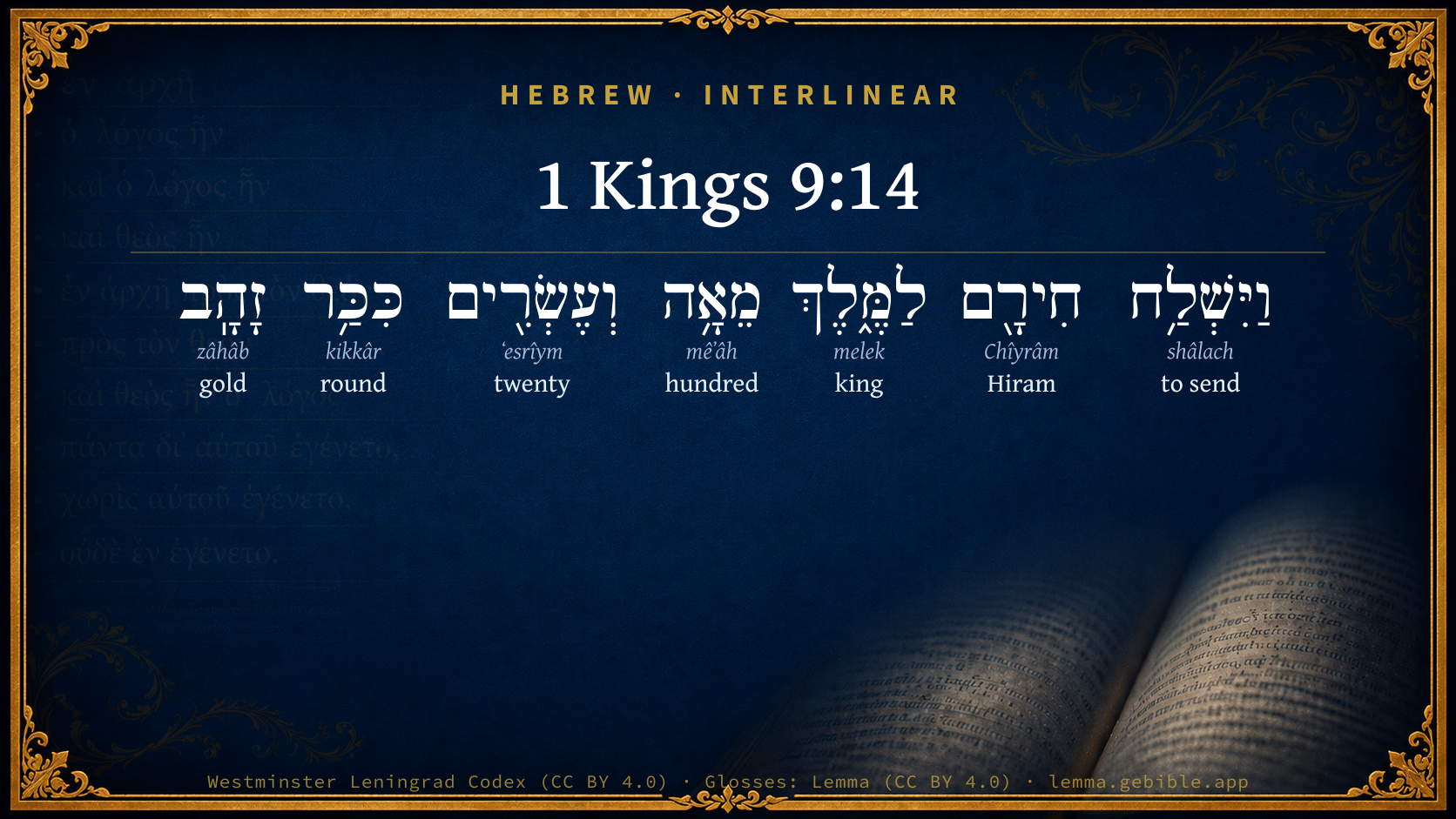
1 Kings 9:14

Hebrew (Westminster Leningrad Codex) 1 Kings 9:14 appears in the Hebrew Old Testament. The text above is from the Westminster Leningrad Codex. Each word links to its Strong’s number, a concise gloss, and parsing drawn from the Open Scriptures Hebrew Bible morphology. Click any word for its full Brown-Driver-Briggs (BDB) entry.
Download image
Cite this verse

1 Kings 9:14 (World English Bible). Public Domain. Lemma interlinear Bible study tool, https://lemma.gebible.app/v/1-kings/9/14.

Show BibTeX & RIS
BibTeX
RIS
English Translation
Hiram sent to the king one hundred twenty talents of gold.
World English Bible · Public Domain
Download a study sheet

One document with this verse’s original text, its word-by-word gloss line, the meaning frame, cross-references with their text, attributed commentary, and full source and license credits — printable, and it pastes into notes with its structure intact.

This verse Autodidact and up

Study sheet (.html) Plain text (.txt)

A passage Seminary Student

Up to 50 verses in one chapter. A passage sheet keeps up to 6 commentary sources and 12 cross-references per verse, in the order this page ranks them, and says so on the sheet whenever that leaves anything out. Ask for a single verse and you get the Autodidact verse sheet above.

Everything on this page stays free to read, with no account — the sheet is a download of what is already on screen, not access to it.

Want to remove ads? Support Godless Engineer
Compare translations 3

The same verse in 3 English versions, stacked beneath the original-language interlinear above. Click any original word for its lexicon entry.

Each is an independent rendering of the whole verse — the interlinear is not word-aligned to these translations.

Highlighted words mark where these versions differ — a whole-verse word diff, not a word-by-word alignment.

  • World English Bible Public Domain
    Hiram sent to the king one hundred twenty talents of gold.
  • King James Version Public Domain
    And Hiram sent to the king sixscore talents of gold.
  • unfoldingWord Literal Text CC BY-SA 4.0
    Now Hiram had sent to the king 120 kikkars of gold.

unfoldingWord Literal Text — © unfoldingWord, licensed CC BY-SA 4.0. Word-aligned USFM3 via Door43 (git.door43.org/unfoldingWord/en_ult).

Versions to compare (up to 4)

3 of 4 selected

Show all 18 translations

Every available English version of this verse, each an independent rendering of the whole verse.

  • World English Bible Public Domain
    Hiram sent to the king one hundred twenty talents of gold.
  • Berean Standard Bible Public Domain
    And Hiram had sent the king 120 talents of gold.
  • Majority Standard Bible Public Domain
    And Hiram had sent the king 120 talents of gold.
  • King James Version Public Domain
    And Hiram sent to the king sixscore talents of gold.
  • American Standard Version (1901) Public Domain
    And Hiram sent to the king sixscore talents of gold.
  • Revised Version (1885) Public Domain
    And Hiram sent to the king sixscore talents of gold.
  • Geneva Bible (1599) Public Domain
    And Hiram had sent the King sixe score talents of gold.
  • Douay-Rheims (1899) Public Domain
    And Hiram sent to king Solomon a hundred and twenty talents of gold.
  • Young's Literal Translation Public Domain
    And Hiram sendeth to the king a hundred and twenty talents of gold.
  • Literal Standard Version CC BY-SA 4.0
    And Hiram sends one hundred and twenty talents of gold to the king.
  • Unlocked Literal Bible CC BY-SA 4.0
    Hiram had sent to the king 120 talents of gold.
  • unfoldingWord Literal Text CC BY-SA 4.0
    Now Hiram had sent to the king 120 kikkars of gold.
  • Darby Bible Public Domain
    And Hiram had sent to the king one hundred and twenty talents of gold.
  • World Messianic Bible Public Domain
    Hiram sent to the king one hundred twenty talents of gold.
  • Webster's Bible Public Domain
    And Hiram sent to the king one hundred and twenty talents of gold.
  • Free Bible Version CC BY-SA 4.0
    Even so, Hiram sent the king 120 talents of gold in payment.
  • Bible in Basic English Public Domain
    And Hiram sent the king a hundred and twenty talents of gold.
  • JPS Tanakh (1917) Public Domain
    And Hiram sent to the king sixscore talents of gold.

Literal Standard Version (2020), Covenant Press — licensed CC BY-SA 4.0. Text via the HelloAO Bible API (eBible.org). Unlocked Literal Bible (unfoldingWord) — licensed CC BY-SA 4.0. Text via the HelloAO Bible API (eBible.org). unfoldingWord Literal Text — © unfoldingWord, licensed CC BY-SA 4.0. Word-aligned USFM3 via Door43 (git.door43.org/unfoldingWord/en_ult). Free Bible Version, Dr. Jonathan Gallagher — licensed CC BY-SA 4.0. Text via the HelloAO Bible API (eBible.org).

Word by word

More ways to search: Search by grammar → Find every occurrence → Compare this word →

Practice this passage: Drill this verse → Learn its vocabulary →

About this verse

These counts appear in no published source. They are computed here, from the morphology-tagged text and Lemma’s own curated glosses. What Lemma adds →

7
words
7
distinct lemmas
Historical
section

Shared distinctive vocabulary

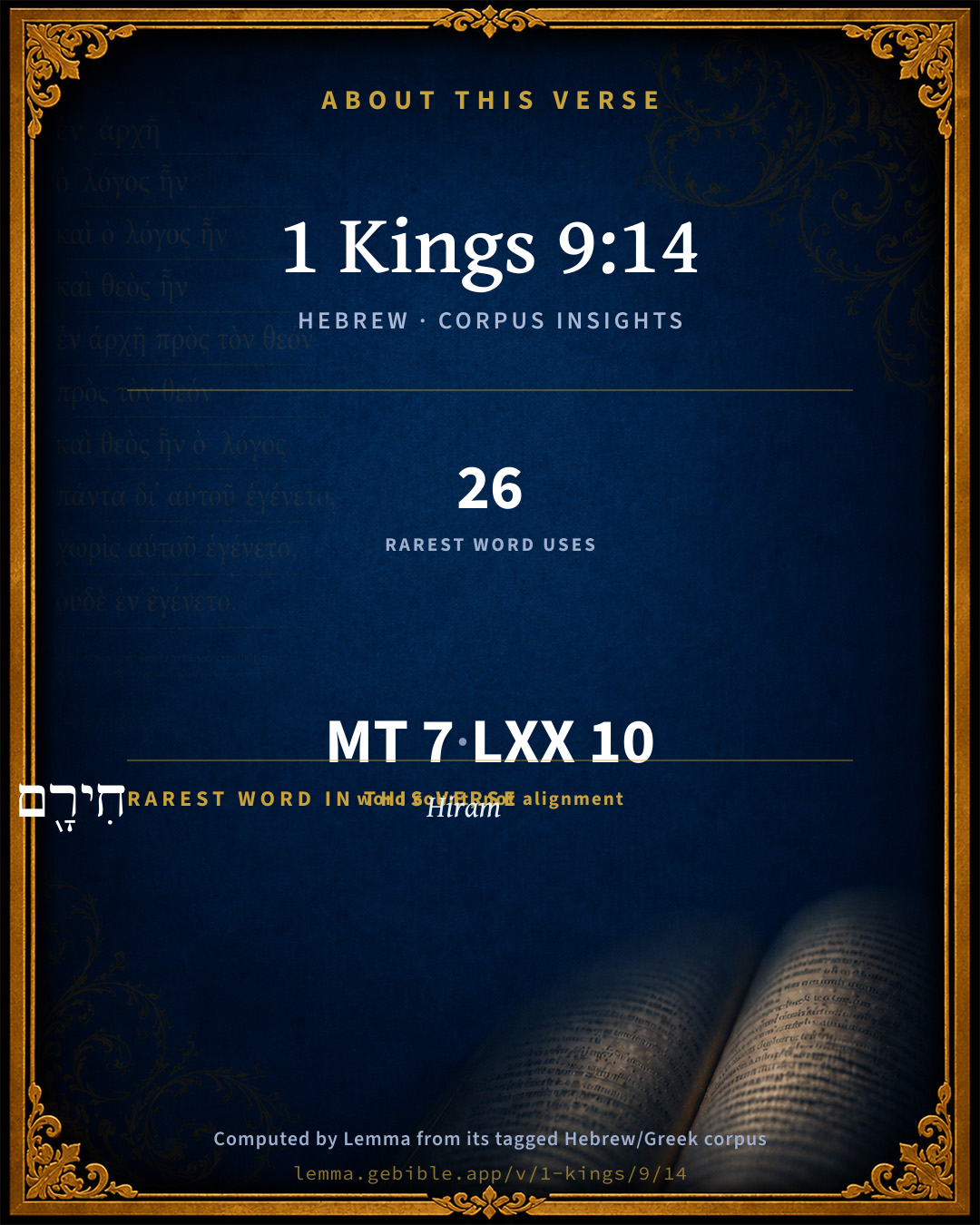
חִירָ֖ם Hiram H2438 occurs in 21 verses of the Hebrew Bible. Also found in:

Grammatical profile

  • 1 verb
  • 4 nouns
  • 2 adjectives

Verb forms

  • וַיִּשְׁלַ֥ח Qal · Sequential Imperfect

Hebrew & Septuagint length

In English translation the verse runs 11 words from the Hebrew and 12 from the Septuagint (LXX English) — closely comparable.

A rough comparison of the two English renderings, which tokenize alike — not a word-level alignment.

Word counts can differ between the Hebrew and the Greek without any difference in meaning — e.g. the Hebrew direct-object marker אֵת has no separate Greek word, and Greek often adds the article ὁ.

In the original languages it is 7 Hebrew tokens and 10 Greek tokens — but the two are counted differently (Hebrew bundles its prefixes and suffixes into one token; the Greek is in lemma form), so that isn’t a like-for-like length.

Cross-references

5

Topical passages linked to 1 Kings 9:14 in the Treasury of Scripture Knowledge — connected by theme and wording, ordered by reader-vote popularity; previews shown in the World English Bible.

  • 1 Kings 9:11 (now Hiram the king of Tyre had furnished Solomon with cedar trees and fir trees, and with gold, according to all his desire), that then king Solomon gave Hiram twenty cities in the land of Galilee.
  • 1 Kings 9:28 They came to Ophir, and fetched from there gold, four hundred and twenty talents, and brought it to king Solomon.
  • 1 Kings 10:10 She gave the king one hundred twenty talents of gold, and of spices very great store, and precious stones: there came no more such abundance of spices as these which the queen of Sheba gave to king Solomon.
  • 1 Kings 10:14 Now the weight of gold that came to Solomon in one year was six hundred sixty-six talents of gold,
  • 1 Kings 10:21 All king Solomon's drinking vessels were of gold, and all the vessels of the house of the forest of Lebanon were of pure gold: none were of silver; it was nothing accounted of in the days of Solomon.

Cross-references courtesy of OpenBible.info (CC BY 4.0).

Hebrew and Greek witnesses Masoretic Hebrew ↔ Greek Septuagint

The same verse in the two great witnesses to the Old Testament, shown verse-for-verse.

These are two independent witnesses, not word-aligned to each other, and the Septuagint is shown in lemma (dictionary) form.

Hebrew 1 Kings 9:14 Masoretic · Westminster Leningrad Codex

וַיִּשְׁלַ֥ח חִירָ֖ם לַמֶּ֑לֶךְ מֵאָ֥ה וְעֶשְׂרִ֖ים כִּכַּ֥ר זָהָֽב

Hiram sent to the king one hundred twenty talents of gold.

World English Bible · Public Domain

Greek LXX 1 Kings 9:14 Septuagint · lemma form

καί φέρω χιραμ ὁ σαλωμών ἑκατόν καί εἴκοσι τάλαντον χρυσίον

And Chiram brought to Solomon one hundred and twenty talents of gold,

LXX2012 (modern English Septuagint) · Public Domain

Hebrew: Westminster Leningrad Codex (CC BY 4.0). Greek: Septuagint (public domain); English from LXX2012 (modern English Septuagint) (Public Domain). How the Septuagint differs from the Hebrew →

Targum (Aramaic paraphrase)

1

The Targum is the ancient Jewish Aramaic paraphrase of the Hebrew Scriptures — an interpretive translation, not the Hebrew text itself. Onkelos (literal) and Pseudo-Jonathan (expansive) render the Torah, and Jonathan the Prophets. Coverage is partial: where no permissively-licensed English translation exists for a verse, only the Aramaic is shown. This is verse-level text, not a word-by-word alignment to the Hebrew.

  1. Targum Jonathan Prophets (Joshua–Malachi)
    וּשְׁדַר חִירָם לְמַלְכָּא מְאָה וְעַשְׂרִין כִּכָּרֵי דַהֲבָא:

    (no public-domain English translation for this verse)

    Targum Jonathan — Aramaic: “Mikraot Gedolot” (public domain). English: “Sefaria Community Translation” (CC0 1.0 (public-domain dedication)); “London "Chaldee Paraphrase," 1871” (public domain). Text via Sefaria.

Commentary

Notes on 1 Kings 9:14 from classic Christian and Jewish commentators (each source and its license shown beneath its notes). The classic Christian expositions comment on the surrounding passage and are grouped to its opening verse, so a note may address several verses; the Jewish commentaries on the Tanakh (Rashi and others) are per-verse, so they appear only where the commentator wrote on this verse.

Lemma curates 59 commentaries, every one of them public domain or Creative Commons licensed, each selected and text-cleaned for this edition rather than reprinted as found. About our sources →

Trapp's Complete Commentary

John Trapp

1Ki 9:14 And Hiram sent to the king sixscore talents of gold.

Ver. 14. And Hiram sent to the king.] Miserat autem, so Vatablus rendereth it, And Hiram had sent. &c., sc., before the offer of those twenty cities.

John Trapp, A Commentary or Exposition upon All the Books of the Old and New Testament (1647–1656) — public domain. Text from a community e-Sword module.

Geneva Bible (1599)

Geneva Bible translators

For his tribute toward the building.

The common talent was about threescore pounds weight.

Geneva Bible (1599) marginal notes — public domain. Text via Bolls.life.

Adam Clarke's Commentary

Verse 14. Sixscore talents of gold.] This was the sum which Hiram had lent, and in order to pay this Solomon had laid a tax upon his people, as we afterward learn. The whole is very darkly expressed.

Adam Clarke's Commentary on the Bible (1810–1826) — public domain. Text from a community e-Sword/MySword module.

Ellicott's Commentary for English Readers

(14) Hiram sent to the king sixscore talents of gold.—The payment, on any calculation, was a large one, though little more than a sixth of Solomon’s yearly revenue. (See 1Ki_10:14.) How it is connected with the previous verses is matter of conjecture. It may possibly be a note referring back to 1Ki_9:11, and explaining the amount of gold which Hiram had sent. If this is not so, it would then seem to be a payment in acknowledgment of the cession of the cities, as being of greater value than the debt which it was meant to discharge. Hiram’s depreciation of the cities need not imply that he did not care to keep them. “It is naught, it is naught, saith the buyer: but when he is gone his way, then he boasteth.” (Pro_20:14). Josephus (Ant. viii. 5, 3), has a quaint story in connection with this intercourse between Hiram and Solomon (quoted from Dios), declaring that a contest in riddles took place between these kings, and that, when Hiram could not solve the riddles of Solomon, he “paid a large sum of money for his fine,” but adds that he afterwards retaliated on Solomon, by aid of Abdemon of Tyre. It appears by 2Ch_7:2, that the cities were afterwards restored to Israel—how, and why, we know not.

(15 28) The rest of the chapter consists of brief historical notes, partly referring back to the previous records. Thus, 1Ki_9:15 refers back to 1Ki_5:13; 1Ki_9:20-22 to 1Ki_5:15; 1Ki_9:24 to 1Ki_7:8; 1Ki_9:25 is a note connected with the history of the dedication of the Temple. The style is markedly different from the graphic and picturesque style of the passages preceding and following it.

A Bible Commentary for English Readers, edited by Charles John Ellicott (1878–1897) — public domain. Text from a community e-Sword module.

John Gill's Exposition

And this is the reason of the levy which King Solomon raised,.... Both of men to work, Kg1 5:13, and of money to defray the expense:

it was for to build the house of the Lord; the temple:

and his own house; or palace:

and Millo; which he repaired: See Gill on Sa1 5:9.

and the wall of Jerusalem; which, as Abarbinel says, was a large building, there being three walls one within another:

and Hazor; a city in the tribe of Naphtali, and which had been a royal city with the Canaanites; see Jos 11:1.

and Megiddo; which was in the tribe of Manasseh, Jos 17:11.

and Gezer; which was in the tribe of Ephraim, and formerly a royal city of the Canaanites, Jos 10:33.

John Gill's Exposition of the Whole Bible (1746–1763) — public domain (CC PDM 1.0). Text via the HelloAO Bible API.

Albert Barnes' Notes on the Bible

Hiram sent sixscore talents of gold - Apparently, to show that, although disappointed, he was not offended. The sum sent was very large - above a million and a quarter of our money, according to one estimate of the weight of the Hebrew gold talent; or about 720,000 according to the estimate adopted in Exo 38:24-29 note. At any rate, it was more than equal to a sixth part of Solomon’s regular revenue 1Ki 10:14.

Albert Barnes' Notes on the Bible (1834–1885) — public domain. Text from a community e-Sword/MySword module.

Matthew Poole's English Annotations

Or rather, for Hiram had sent. And this seems to be here added, both to declare the quantity of the gold sent, which had been only named before, 1Ki 9:11, and as the reason why he resented Solomon’s action so ill, because so great a sum required a better recompence.

Matthew Poole's English Annotations on the Holy Bible (1683–1685) — public domain. Text from a community e-Sword/MySword module.

Whedon's Commentary on the Bible

Daniel D. Whedon

14. Hiram sent… gold — Probably not as a present, but as a loan; and the verse may be regarded as a fuller statement of his furnishing Solomon with gold, which is more briefly noticed in 1Ki_9:11. In view of the vast profusion of gold with which Solomon adorned the temple and the palace, and other works throughout his whole kingdom, we need not wonder that he gathered gold from all possible quarters.

Daniel D. Whedon (gen. ed.), Commentary on the Old and New Testaments (1874–1909) — public domain. Text from a community e-Sword module.

The Pulpit Commentary

And Hiram sent jl must be understood as pluperfect, Now Hiram had sent," referring to verse 11. This fact is mentioned to explain the gift of the cities, viz., that they were in payment for the gold he had furnished. The timber and stone and labour had been paid for in corn and wine and oil (See on 1Ki_5:11) to the king sixscore talents of gold.

This sum is variously estimated at from half a million to a million and a quarter of our money. (Keil, in loc., and Dict. Bib. 3:1734. It equalled 3000 shekels of the sanctuary. (Exo_38:24-26) Keil, who, as we have seen, interprets Cabul to mean pledged, says somewhat positively that these 120 talents were merely lent to Solomon to enable him to prosecute his undertakings, and that the twenty cities were Hiram"s security for its repayment. He further sees in the restoration of these cities (2Ch_8:2, where see note) a proof that Solomon must have repaid the amount lent him. The "sixscore talents "should be compared with the 120 talents of ch. 10:10, and the 666 talents of 1Ki_10:14.

The Pulpit Commentary (1880–1919), ed. H.D.M. Spence-Jones & Joseph S. Exell — public domain. Text from a community e-Sword module.

John Wesley's Explanatory Notes

Sent - And this seems to be here added, both to declare the quantity of the gold sent, which had been only named before, ver. 11, and as the reason why he resented Solomon's action, because so great a sum required a better recompense.

John Wesley, Explanatory Notes Upon the Whole Bible (1754–1765) — public domain. Text via the GEBible commentary corpus.

Lesson kit

Teaching starters — assembled from the data on this page, not authored interpretation. Every prompt links to the verse data it draws on. Edit before teaching.

1 Kings, in the Historical, opens this verse with 7 words (7 distinct Hebrew lemmas). Its most distinctive word is Chîyrâm (“Hiram”). A historical commentator’s framing appears above. Read the whole chapter for the surrounding context.

Discussion questions

  1. What does “Hiram” (Chîyrâm) contribute to the verse as a whole?
  2. How does 2 Samuel 5:11, which shares the word «Hiram», read alongside this verse?
  3. The translations on this page render this verse differently — a whole-verse word diff, not a word-by-word alignment. What might account for the different wordings?
  4. «וַיִּשְׁלַ֥ח» is a Qal Sequential Imperfect verb. How does that grammatical form shape the action described?
  5. Compare how Trapp's Complete Commentary and Geneva Bible (1599) read this verse. Where do they agree or differ?

Things to notice

Reading settings

Reading text

Shown beneath each verse's original-language words.

Old Testament
Old Testament edition

Read the OT as the Masoretic Hebrew (MT) or the Greek Septuagint (LXX).

English shown for the Greek Septuagint (in the Hebrew ↔ Greek comparison).

Comparing translations? Open the Compare panel on any verse page to stack up to four side by side.