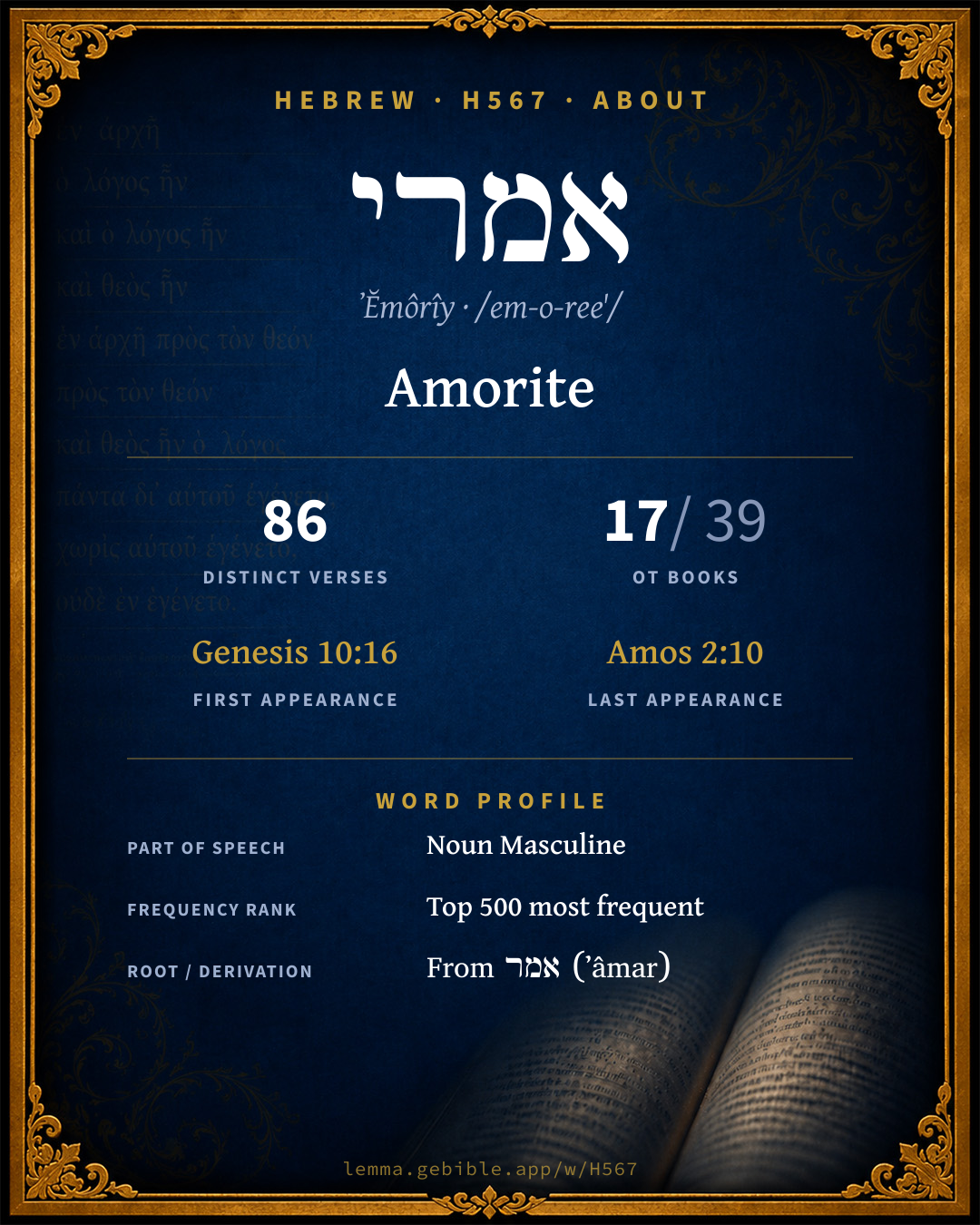
אֱמֹרִי
Amorite
BDB lists 2 entries for ‘Amorite’ fuller range ↓
Full lexicon entry — Brown-Driver-Briggs (BDB)
From Brown-Driver-Briggs (BDB)
Where this word appears
Grammar key — what these labels mean
Part of speech
- Noun
- A naming word — a person, place, thing, or idea.
Noun type
- Gentilic
- A noun naming a member of a people, tribe, or region of origin (e.g. an Israelite, a Moabite).
State
- Absolute
- The independent form of a noun, not bound to a following word.
Gender
- Masculine
- Grammatically masculine.
Number
- Singular
- One.
Every verse where H567 appears in the Book of Joshua — 20 distinct verses. Click any verse to open its interlinear word-by-word view. Verse text shown in the World English Bible for context — . Each verse’s Hebrew form is shown with its reference; the English is not keyword-highlighted, since the data carries no word-level English alignment. Use “Compare translations” on any verse to read it across multiple English versions. This concordance covers the Hebrew Bible; Septuagint (Greek Old Testament) occurrences are not indexed here.
Joshua
- Joshua 2:10 הָ/אֱמֹרִ֜י ptcl def.art + n Gentilic ms For we have heard how Yahweh dried up the water of the Red Sea before you, when you came out of Egypt; and what you did to the two kings of the Amorites, who were beyond the Jordan, to Sihon and to Og, whom you utterly destroyed.
- Joshua 3:10 וְ/הָ/אֱמֹרִ֖י conj + ptcl def.art + n Gentilic ms Joshua said, Hereby you shall know that the living God is among you, and that he will without fail drive out from before you the Canaanite, and the Hittite, and the Hivite, and the Perizzite, and the Girgashite, and the Amorite, and the Jebusite.
- Joshua 5:1 הָ/אֱמֹרִ֡י ptcl def.art + n Gentilic ms It happened, when all the kings of the Amorites, who were beyond the Jordan westward, and all the kings of the Canaanites, who were by the sea, heard how that Yahweh had dried up the waters of the Jordan from before the children of Israel, until we were passed over, that their heart melted, neither was there spirit in them any more, because of the children of Israel.
- Joshua 7:7 הָ/אֱמֹרִ֖י ptcl def.art + n Gentilic ms Joshua said, Alas, Lord Yahweh, why have you at all brought this people over the Jordan, to deliver us into the hand of the Amorites, to cause us to perish? would that we had been content and lived beyond the Jordan!
- Joshua 9:1 וְ/הָ֣/אֱמֹרִ֔י conj + ptcl def.art + n Gentilic ms It happened, when all the kings who were beyond the Jordan, in the hill-country, and in the lowland, and on all the shore of the great sea in front of Lebanon, the Hittite, and the Amorite, the Canaanite, the Perizzite, the Hivite, and the Jebusite, heard of it;
- Joshua 9:10 הָ/אֱמֹרִ֔י ptcl def.art + n Gentilic ms and all that he did to the two kings of the Amorites, who were beyond the Jordan, to Sihon king of Heshbon, and to Og king of Bashan, who was at Ashtaroth.
- Joshua 10:5 הָ/אֱמֹרִ֗י ptcl def.art + n Gentilic ms Therefore the five kings of the Amorites, the king of Jerusalem, the king of Hebron, the king of Jarmuth, the king of Lachish, the king of Eglon, gathered themselves together, and went up, they and all their hosts, and encamped against Gibeon, and made war against it.
- Joshua 10:6 הָ/אֱמֹרִ֖י ptcl def.art + n Gentilic ms The men of Gibeon sent to Joshua to the camp to Gilgal, saying, Don't slack your hand from your servants; come up to us quickly, and save us, and help us: for all the kings of the Amorites that dwell in the hill-country are gathered together against us.
- Joshua 10:12 הָ֣/אֱמֹרִ֔י ptcl def.art + n Gentilic ms Then spoke Joshua to Yahweh in the day when Yahweh delivered up the Amorites before the children of Israel; and he said in the sight of Israel, Sun, stand you still on Gibeon; You, Moon, in the valley of Aijalon.
- Joshua 11:3 וְ/הָ/אֱמֹרִ֧י conj + ptcl def.art + n Gentilic ms to the Canaanite on the east and on the west, and the Amorite, and the Hittite, and the Perizzite, and the Jebusite in the hill-country, and the Hivite under Hermon in the land of Mizpah.
- Joshua 12:2 הָ/אֱמֹרִ֔י ptcl def.art + n Gentilic ms Sihon king of the Amorites, who lived in Heshbon, and ruled from Aroer, which is on the edge of the valley of the Arnon, and [the city that is in] the middle of the valley, and half Gilead, even to the river Jabbok, the border of the children of Ammon;
- Joshua 12:8 הָֽ/אֱמֹרִ֔י ptcl def.art + n Gentilic ms in the hill-country, and in the lowland, and in the Arabah, and in the slopes, and in the wilderness, and in the South; the Hittite, the Amorite, and the Canaanite, the Perizzite, the Hivite, and the Jebusite:
- Joshua 13:4 הָ/אֱמֹרִֽי ptcl def.art + n Gentilic ms on the south; all the land of the Canaanites, and Mearah that belongs to the Sidonians, to Aphek, to the border of the Amorites;
- Joshua 13:10 הָ/אֱמֹרִ֔י ptcl def.art + n Gentilic ms and all the cities of Sihon king of the Amorites, who reigned in Heshbon, to the border of the children of Ammon;
- Joshua 13:21 הָ/אֱמֹרִ֔י ptcl def.art + n Gentilic ms and all the cities of the plain, and all the kingdom of Sihon king of the Amorites, who reigned in Heshbon, whom Moses struck with the chiefs of Midian, Evi, and Rekem, and Zur, and Hur, and Reba, the princes of Sihon, who lived in the land.
- Joshua 24:8 הָ/אֱמֹרִי֙ ptcl def.art + n Gentilic ms I brought you into the land of the Amorites, that lived beyond the Jordan: and they fought with you; and I gave them into your hand, and you possessed their land; and I destroyed them from before you.
- Joshua 24:11 הָֽ/אֱמֹרִ֨י ptcl def.art + n Gentilic ms You went over the Jordan, and came to Jericho: and the men of Jericho fought against you, the Amorite, and the Perizzite, and the Canaanite, and the Hittite, and the Girgashite, the Hivite, and the Jebusite; and I delivered them into your hand.
- Joshua 24:12 הָ/אֱמֹרִ֑י ptcl def.art + n Gentilic ms I sent the hornet before you, which drove them out from before you, even the two kings of the Amorites; not with your sword, nor with your bow.
- Joshua 24:15 הָ/אֱמֹרִ֔י ptcl def.art + n Gentilic ms If it seem evil to you to serve Yahweh, choose you this day whom you will serve; whether the gods which your fathers served that were beyond the River, or the gods of the Amorites, in whose land you dwell: but as for me and my house, we will serve Yahweh.
- Joshua 24:18 הָ/אֱמֹרִ֛י ptcl def.art + n Gentilic ms and Yahweh drove out from before us all the peoples, even the Amorites who lived in the land: therefore we also will serve Yahweh; for he is our God.
About this entry
At a glance — auto-summarized from this page’s data, not written by a person. Every figure links to its source below. This summary describes the numbers; it doesn’t interpret them.
The Hebrew name אמרי centers on the idea of “Amorite.” First canonically at Genesis 10:16, it enters the text early. It turns up in 86 verses across 17 books, a moderately common footprint. Dig into 86-verse concordance and the renderings breakdown below.
Gloss history
Strong's 1890 vs modern scholarship
About this word
Strong's H567 catalogs a Hebrew word from the Hebrew Old Testament.
These counts are not copied from any lexicon or concordance. They are computed here, from the morphology-tagged Hebrew Old Testament. What Lemma adds →
- 86
- distinct verses
- The word appears in 86 distinct verses.
- 17 / 39
- OT books
- The word appears in 17 of 39 Old Testament books.
- #470
- by frequency
- Top 500 most frequent Hebrew words (rank 470 of 8,640 Hebrew words by occurrence).
View all 86 occurrences in the concordance →
Most concentrated in
- Joshua 20 verses 23%
- Deuteronomy 15 verses 17%
- Numbers 12 verses 14%
By section of the Old Testament
By traditional corpus
Conventional, traditional groupings — biblical authorship is debated, so this is a traditional corpus grouping, not an authorship claim. Each share is this word’s portion of its verses in that division of the Hebrew canon. Each figure is a share of the word’s 86 distinct verses.
- Prophets (Nevi'im) 41 verses · 48%
- Torah (Pentateuch) 39 verses · 45%
- Writings (Ketuvim) 6 verses · 7%
How translations render this word
Counts come from each version’s own published word-to-Strong’s tagging or interlinear alignment — an approximate guide to how each version renders this word, not a word-level alignment the data otherwise carries. Because each total is that version’s own tagged count, the per-version totals vary from one another and need not match the appearance or distinct-verse counts above. These counts may also differ from a printed concordance because Lemma counts each distinctly tagged rendering and does not collapse phrase taggings into a single head-word total. This is a fixed set of word-tagged versions (KJV, ASV, BSB, ULT) and does not change with the reading translation you choose elsewhere. Each version’s license is shown beside its name below (and on Sources).
- King James Version: Amorites 70×, Amorite 11×
- American Standard Version: Amorites 55×, Amorite 21×, All the kings of the amorites 2×
- Berean Standard Bible: Amorites 70×, Amorite 9×
- unfoldingWord Literal Text: Amorite 54×, Amorites 30×, Was an amorite 2×
King James Version Public Domain
Renders H567 across 87 tagged occurrences — most commonly:
Plus 6 renderings that appear only once — usually multi-word phrases or single function words the recovered tagging swept in, not distinct renderings.
American Standard Version Public Domain
Renders H567 across 87 tagged occurrences — most commonly:
Plus 9 renderings that appear only once — usually multi-word phrases or single function words the recovered tagging swept in, not distinct renderings.
Berean Standard Bible Public Domain
Renders H567 across 86 tagged occurrences — most commonly:
Plus 7 renderings that appear only once — usually multi-word phrases or single function words the recovered tagging swept in, not distinct renderings. Not rendered by a distinct English word in 1 further occurrence.
unfoldingWord Literal Text CC BY-SA 4.0
Renders H567 across 87 tagged occurrences — most commonly:
Plus 1 rendering that appears only once — usually multi-word phrases or single function words the recovered tagging swept in, not distinct renderings.
Senses in the full BDB
What do BDB’s symbols mean?
BDB uses these scholarly abbreviations:
| Symbol | Meaning |
|---|---|
| 𝔊 | the Septuagint (the ancient Greek translation, LXX) |
| 𝔙 | the Vulgate (the Latin translation) |
| 𝔖 | the Syriac version (the Peshitta) |
| 𝔗 | the Targum (the Aramaic translation) |
| ψ | the Psalms |
| √ | root (the underlying root or stem) |
| ‖ | parallel passage (a synonymous or contrasted parallel) |
| † | the dagger: every passage where the word occurs is cited |
The 3 senses and sub-senses the full Brown-Driver-Briggs lexicon distinguishes for this word, in lexicon order (not ranked by frequency), with BDB’s own verbatim wording and sub-sense lettering. Shown in Hebrew script with BDB’s own scholarly abbreviations. The condensed entry is in the Lexicon Entry tab. See also the Forms in the corpus table below.
- 1. called son of Canaan Gn 10:16 (J) 1 Ch 1:14 = e.g. Genesis 10:16
- 2. a chief people dispossessed by Hebrews; (a) living E. of Jordan Nu 21:13,(×2), 25 + 9 times Nu + Jos 24:8 (all E), cf. Jos 2:10; 9:10 (JE) Dt 1:4; 3:2, 9 + 7 times D; also Ju 10:8, 11; 11:19, 21, 22, 23; 1 K 4:19 ψ 135:11; 136:19 (Sihon their king Nu 21:21 +; Sihon & Og Dt 3:8 +); (b) living W. of Jordan Jos 10:5, 6; 24:12, 15, 18 (all E), cf. 7:7 (JE); 5:1; 10:12 (both D; cf. also 13:4, q. del. Di) Ju 1:34, 35, 36; 6:10; 1 K 21:26; 2 K 21:11 cf. 1 S 7:14; 2 S 21:2; (c) living in south Dt 1:7, 19, 20, 27, 44; cf. Gn 14:7 (W. of Dead Sea); (d) in gen. = ancient inhabitants of Canaan Gn 15:16 (J or R) 48:22 (E) Am 2:9, 10; (e) named in list of Canaanitish peoples, to be dispossessed by Isr. Ex 3:8, 17; 13:5; 33:2; 34:11; Jos 3:10; 9:1 (all J); Dt 7:1; 20:17 Jos 11:3; 12:8 (all D); Ex 23:23; Nu 13:29; Jos 24:11 (all E); Ju 3:5; 1 K 9:20; 2 Ch 8:7; Ezr 9:1; Ne 9:8; cf. Ez 16:3, 45; (on these lists cf. BuUrgesch 344 ff. & WeJBTh xxi. 602.) e.g. Numbers 21:13
- 3. adj.gent. sg. Gn 14:13; Dt 2:24. e.g. Genesis 14:13
Senses from the full Brown-Driver-Briggs lexicon (Brown, Driver, Briggs; Oxford 1906 — public domain), digitized via Sefaria, supplemented by the OpenScriptures HebrewLexicon (CC BY 4.0). Full attribution on Sources.
Word origin
n.pr.m.coll. (construed as pl. Dt 3:9 + 5 times) Amorites (perhaps = mountain-dwellers, cf. Nu 13:29; Dt 1:7, 19 f. etc. & Di Gn 10:16 al.)—always c. art., except Nu 21:29; Ez 16:45. Meaning mountain-dwellers very dub.; on א׳ = Egyptian ʾA-ma-ra v. WMMAs. u. Eur. 229 ff., = TelAm. and Assyrian Amurru, v. WklTelAm. 36 JastrEB Canaan, § 10 SayHastDB Amorites al.; cf. also GFM; Ju 4,5 Dr Dt 1:7 Gray Nu 13:29.
— Brown-Driver-Briggs (Oxford 1906, public domain), digitized via Sefaria, supplemented by the OpenScriptures HebrewLexicon (CC BY 4.0). See Sources.
Derived from אמר (ʼâmar) (H559) — to say.
Jastrow Dictionary
A second Hebrew/Aramaic lexicon for comparison, covering Aramaic and post-biblical (Talmudic, Targumic, Midrashic) usage that the biblical-Hebrew BDB does not. Matched by lemma rather than by Strong’s number, so a lemma may carry more than one Jastrow headword (shown separately below), and the entries cover usage well beyond the Bible.
אֲמַר
- 1) as preced. 1). Targ. Gen. I, 3; a. v. fr.—א׳ מר above you quoted an authority, or, it has been stated. Ber. 2ᵃ; a. fr.—א׳ קרא the Scripture says. Ib. 13ᵃ; a. fr.—Y. Orl. III, end, 63ᵇ, a. fr. אמרונה בשם … (in Bab. heb. אֲמָרוּהָ) they said it in behalf of … i.e. as a tradition.—Y. Ber. I, 2ᵈ מילתיה אמרה his word (statement, opinion &c.) proves.—הדא אמרה = זאת אומרת; v. preced.—אַמְרֵי (h. אָמְרוּ) they say, it is said. Sabb. 19ᵃ אמרו עליו על … ואמרי לה וכ׳ it is told about R. …, and another relation refers this to R.—; a. fr.—קאמר, קאמרי &c. = קא אמר &c. Ḥull. 85ᵃ; a. fr.—מנא תימרא whence dost thou prove? Sabb. 23ᵃ; a. fr.—Inf. מֵימַר, מֵימְרָא. סבר מ׳, סבר למ׳ originally he was of the opinion. Y. Sabb. VI, 8ᶜ top; Keth. 87ᵇ; a. v. fr.—לְמֵימְרָא does this mean to say? Sabb. 15ᵇ; a. fr. לא אמרן אלא … אבל … this has been said, i.e. this applies only to a case … but if … Ber. 43ᵇ; a. fr.—כְּלוֹמַר as if saying, meaning to say, viz; v. כִּילּוּ.—Y. Kil. IV, 32ᶜ bot. אימורין לבני וכ׳ say ye to &c.—מאי איכא למימר, v. אִיכָּא; Answ. אֵימוּר say … Sabb. 6ᵃ; a. fr.—Hor. 13ᵃ א׳ כולה who orders every thing (as an etymol. of אֲמַרְכָּל).—2) to praise, proclaim. Targ. Is. VIII, 13; a. fr.—Part. pass. אָמִיר q. v.
- , contr. אִתְּמַר, אִיתְּ׳ it is said, taught. Targ. Job XXXIV, 31.—Y. Yoma V, end, 43ᵃ אתאמרת, contr. אִתַּמְרַת it has been said with refer. to the opinion of …—אִתְּ׳, אִיתְּ׳ it has been said (above);we have been taught. Succ. 15ᵃ; a. fr.
- same. Targ. Gen. XXII, 14; a. e.
אַמְרִי
- Af. of מרי.
A Dictionary of the Targumim, the Talmud Babli and Yerushalmi, and the Midrashic Literature (Marcus Jastrow; London, Luzac, 1903) — Public Domain. Digitized via Sefaria. Digitized via Sefaria. Full attribution on Sources.
Forms in the corpus
The 31 distinct written forms H567 takes in the Hebrew Bible, most frequent first — each parse links to that state’s occurrences in the concordance. Hebrew forms include their vowel points and cantillation, so a single lemma takes many written forms.
| Form | Parsing | Example | Uses |
|---|---|---|---|
| הָ/אֱמֹרִ֔י | Noun, Gentilic, Masculine, Singular, Absolute | Deuteronomy 1:20 | 12 |
| הָ/אֱמֹרִ֖י | Noun, Gentilic, Masculine, Singular, Absolute | Deuteronomy 1:27 | 11 |
| הָֽ/אֱמֹרִ֔י | Noun, Gentilic, Masculine, Singular, Absolute | Deuteronomy 1:4 | 10 |
| הָ֣/אֱמֹרִ֔י | Noun, Gentilic, Masculine, Singular, Absolute | Genesis 10:16 | 6 |
| הָ/אֱמֹרִֽי | Noun, Gentilic, Masculine, Singular, Absolute | Amos 2:10 | 5 |
| הָ/אֱמֹרִ֗י | Noun, Gentilic, Masculine, Singular, Absolute | Genesis 14:13 | 4 |
| וְ/הָֽ/אֱמֹרִי֙ | Noun, Gentilic, Masculine, Singular, Absolute | Exodus 3:8 | 4 |
| הָ/אֱמֹרִ֑י | Noun, Gentilic, Masculine, Singular, Absolute | Joshua 24:12 | 3 |
| הָ/אֱמֹרִ֜י | Noun, Gentilic, Masculine, Singular, Absolute | Deuteronomy 1:44 | 3 |
| הָֽ/אֱמֹרִי֙ | Noun, Gentilic, Masculine, Singular, Absolute | Amos 2:9 | 3 |
| הָ/אֱמֹרִ֛י | Noun, Gentilic, Masculine, Singular, Absolute | Joshua 24:18 | 2 |
| הָ/אֱמֹרִ֥י | Noun, Gentilic, Masculine, Singular, Absolute | Numbers 21:32 | 2 |
| הָ/אֱמֹרִי֙ | Noun, Gentilic, Masculine, Singular, Absolute | Exodus 34:11 | 2 |
| וְ/הָ/אֱמֹרִ֜י | Noun, Gentilic, Masculine, Singular, Absolute | Deuteronomy 7:1 | 2 |
| וְ/הָ֣/אֱמֹרִ֔י | Noun, Gentilic, Masculine, Singular, Absolute | Deuteronomy 3:9 | 2 |
| אֱמֹרִ֖י | Noun, Gentilic, Masculine, Singular, Absolute | Numbers 21:29 | 1 |
| אֱמֹרִֽי | Noun, Gentilic, Masculine, Singular, Absolute | Ezekiel 16:45 | 1 |
| הָ/אֱמֹרִ֡י | Noun, Gentilic, Masculine, Singular, Absolute | Joshua 5:1 | 1 |
| הָ/אֱמֹרִ֧י | Noun, Gentilic, Masculine, Singular, Absolute | Nehemiah 9:8 | 1 |
| הָֽ/אֱמֹרִ֑י | Noun, Gentilic, Masculine, Singular, Absolute | Numbers 21:13 | 1 |
| הָֽ/אֱמֹרִ֨י | Noun, Gentilic, Masculine, Singular, Absolute | Joshua 24:11 | 1 |
| הָֽ/אֱמֹרִי֮ | Noun, Gentilic, Masculine, Singular, Absolute | Deuteronomy 1:7 | 1 |
| הָֽ/אֱמֹרִ֔י | Noun, Gentilic, Masculine, Singular, Absolute | Deuteronomy 1:19 | 1 |
| הָֽ/אֱמֹרִ֛י | Noun, Gentilic, Masculine, Singular, Absolute | Deuteronomy 2:24 | 1 |
| הָֽ/אֱמֹרִי֙ | Noun, Gentilic, Masculine, Singular, Absolute | Genesis 15:21 | 1 |
| וְ/הָ/אֱמֹרִ֖י | Noun, Gentilic, Masculine, Singular, Absolute | Joshua 3:10 | 1 |
| וְ/הָ/אֱמֹרִ֤י | Noun, Gentilic, Masculine, Singular, Absolute | 2 Chronicles 8:7 | 1 |
| וְ/הָ/אֱמֹרִ֧י | Noun, Gentilic, Masculine, Singular, Absolute | Joshua 11:3 | 1 |
| וְ/הָ/אֱמֹרִֽי | Noun, Gentilic, Masculine, Singular, Absolute | Ezra 9:1 | 1 |
| וְ/הָ/אֱמֹרִי֙ | Noun, Gentilic, Masculine, Singular, Absolute | Deuteronomy 20:17 | 1 |
| לָֽ/אֱמֹרִֽי | Noun, Gentilic, Masculine, Singular, Absolute | Numbers 22:2 | 1 |
Same root — word family
Other BDB entries built from the same root as H567, grouped by Strong’s listed origin. These share a root / origin per the lexicon — not necessarily a shared meaning. Each links to that word’s own entry.
Derives from
Shares the same root
Proper names from this root
People and places named from this root — a name, not an additional meaning of the word.
Compare all same-root words → Showing 4 of 9 — not the complete family. 3 of the same-root words are proper names (people or places). They share a root, not necessarily a meaning.
Bible dictionary
Public-domain dictionary articles matched to this entry by name (Amorite). A biblical name can be shared by more than one person or place, so an article may treat several.
Hitchcock's Bible Names Dictionary · Roswell D. Hitchcock, 1869
bitter; a rebel; a babbler
Classic public-domain reference works; full attribution on Sources.
Septuagint verse parallels
This word appears in 83 verses that also exist in the Greek Old Testament (Septuagint), out of the 86 Hebrew verses it occurs in. You can read those verses in Greek by switching the Old Testament edition to the Septuagint.
Read these verses in the Septuagint
- Genesis 10:16
- Exodus 3:8
- Numbers 13:29
- Deuteronomy 1:4
- Joshua 2:10
- Judges 1:34
- 1 Samuel 7:14
- 2 Samuel 21:2
- 1 Kings 4:19
- 2 Kings 21:11
- 1 Chronicles 1:14
- 2 Chronicles 8:7
This is a verse-level parallel only — the same verses exist in both the Hebrew and Greek Old Testaments. No word-level Hebrew↔Greek correspondence is claimed: the data carries no such alignment, so no Greek word is shown as this Hebrew word’s translation. Coverage is not total — the Septuagint omits the deuterocanon and renumbers the Psalms, so some Hebrew verses have no direct Greek parallel.