
Joshua 9:10

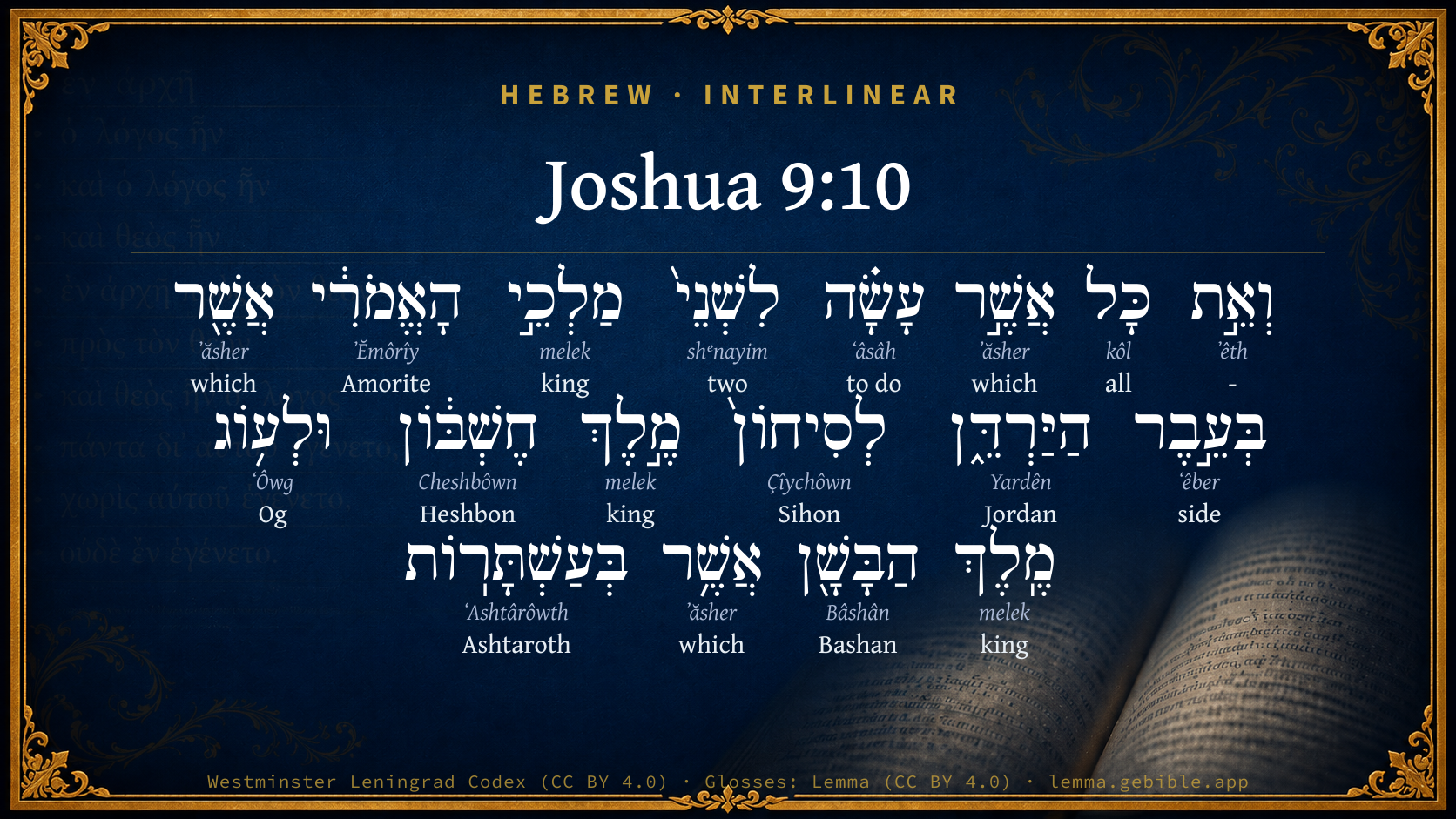
Hebrew (Westminster Leningrad Codex) Joshua 9:10 appears in the Hebrew Old Testament. The text above is from the Westminster Leningrad Codex. Each word links to its Strong’s number, a concise gloss, and parsing drawn from the Open Scriptures Hebrew Bible morphology. Click any word for its full Brown-Driver-Briggs (BDB) entry.
Download image
Cite this verse

Joshua 9:10 (World English Bible). Public Domain. Lemma interlinear Bible study tool, https://lemma.gebible.app/v/joshua/9/10.

Show BibTeX & RIS
BibTeX
RIS
English Translation
and all that he did to the two kings of the Amorites, who were beyond the Jordan, to Sihon king of Heshbon, and to Og king of Bashan, who was at Ashtaroth.
World English Bible · Public Domain
Download a study sheet

One document with this verse’s original text, its word-by-word gloss line, the meaning frame, cross-references with their text, attributed commentary, and full source and license credits — printable, and it pastes into notes with its structure intact.

This verse Autodidact and up

Study sheet (.html) Plain text (.txt)

A passage Seminary Student

Up to 50 verses in one chapter. A passage sheet keeps up to 6 commentary sources and 12 cross-references per verse, in the order this page ranks them, and says so on the sheet whenever that leaves anything out. Ask for a single verse and you get the Autodidact verse sheet above.

Everything on this page stays free to read, with no account — the sheet is a download of what is already on screen, not access to it.

Want to remove ads? Support Godless Engineer
Compare translations 3

The same verse in 3 English versions, stacked beneath the original-language interlinear above. Click any original word for its lexicon entry.

Each is an independent rendering of the whole verse — the interlinear is not word-aligned to these translations.

Highlighted words mark where these versions differ — a whole-verse word diff, not a word-by-word alignment.

  • World English Bible Public Domain
    and all that he did to the two kings of the Amorites, who were beyond the Jordan, to Sihon king of Heshbon, and to Og king of Bashan, who was at Ashtaroth.
  • King James Version Public Domain
    And all that he did to the two kings of the Amorites, that were beyond Jordan, to Sihon king of Heshbon, and to Og king of Bashan, which was at Ashtaroth.
  • unfoldingWord Literal Text CC BY-SA 4.0
    and all that he did to the two kings of the Amorite who were on the other side of the Jordan, to Sihon the king of Heshbon and to Og the king of Bashan who in Ashtaroth.

unfoldingWord Literal Text — © unfoldingWord, licensed CC BY-SA 4.0. Word-aligned USFM3 via Door43 (git.door43.org/unfoldingWord/en_ult).

Versions to compare (up to 4)

3 of 4 selected

Show all 18 translations

Every available English version of this verse, each an independent rendering of the whole verse.

  • World English Bible Public Domain
    and all that he did to the two kings of the Amorites, who were beyond the Jordan, to Sihon king of Heshbon, and to Og king of Bashan, who was at Ashtaroth.
  • Berean Standard Bible Public Domain
    and all that He did to the two kings of the Amorites beyond the Jordan—Sihon king of Heshbon and Og king of Bashan, who reigned in Ashtaroth.
  • Majority Standard Bible Public Domain
    and all that He did to the two kings of the Amorites beyond the Jordan—Sihon king of Heshbon and Og king of Bashan, who reigned in Ashtaroth.
  • King James Version Public Domain
    And all that he did to the two kings of the Amorites, that were beyond Jordan, to Sihon king of Heshbon, and to Og king of Bashan, which was at Ashtaroth.
  • American Standard Version (1901) Public Domain
    and all that he did to the two kings of the Amorites, that were beyond the Jordan, to Sihon king of Heshbon, and to Og king of Bashan, who was at Ashtaroth.
  • Revised Version (1885) Public Domain
    and all that he did to the two kings of the Amorites, that were beyond Jordan, to Sihon king of Heshbon, and to Og king of Bashan, which was at Ashtaroth.
  • Geneva Bible (1599) Public Domain
    And all that he hath done to the two Kings of the Amorites that were beyonde Iorden, to Sihon King of Heshbon, and to Og King of Bashan, which were at Ashtaroth.
  • Douay-Rheims (1899) Public Domain
    And to the two kings of the Amorrhites that were beyond the Jordan, Sehon king of Hesebon, and Og king of Basan, that was in Astaroth:
  • Young's Literal Translation Public Domain
    and all that He hath done to the two kings of the Amorite who `are' beyond the Jordan, to Sihon king of Heshbon, and to Og king of Bashan, who `is' in Ashtaroth.
  • Literal Standard Version CC BY-SA 4.0
    and all that He has done to the two kings of the Amorite who [are] beyond the Jordan, to Sihon king of Heshbon, and to Og king of Bashan, who [is] in Ashtaroth.
  • Unlocked Literal Bible CC BY-SA 4.0
    and everything that he did to the two kings of the Amorites on the other side of the Jordan—to Sihon king of Heshbon, and to Og king of Bashan who was at Ashtaroth.
  • unfoldingWord Literal Text CC BY-SA 4.0
    and all that he did to the two kings of the Amorite who were on the other side of the Jordan, to Sihon the king of Heshbon and to Og the king of Bashan who in Ashtaroth.
  • Darby Bible Public Domain
    and all that he did to the two kings of the Amorites that were beyond Jordan, to Sihon the king of Heshbon, and to Og the king of Bashan, who was at Ashtaroth.
  • World Messianic Bible Public Domain
    and all that he did to the two kings of the Amorites who were beyond the Jordan, to Sihon king of Heshbon and to Og king of Bashan, who was at Ashtaroth.
  • Webster's Bible Public Domain
    And all that he did to the two kings of the Amorites, that were beyond Jordan, to Sihon king of Heshbon, and to Og king of Bashan, who was at Ashtaroth.
  • Free Bible Version CC BY-SA 4.0
    and what he did to the two Amorite kings east of the Jordan—to Sihon, king of Heshbon, and Og, king of Bashan, who ruled in Ashtaroth.
  • Bible in Basic English Public Domain
    And what he did to the two kings of the Amorites east of Jordan, to Sihon, king of Heshbon, and to Og, king of Bashan, at Ashtaroth.
  • JPS Tanakh (1917) Public Domain
    and all that He did to the two kings of the Amorites, that were beyond the Jordan, to Sihon king of Heshbon, and to Og king of Bashan, who was at Ashtaroth.

Literal Standard Version (2020), Covenant Press — licensed CC BY-SA 4.0. Text via the HelloAO Bible API (eBible.org). Unlocked Literal Bible (unfoldingWord) — licensed CC BY-SA 4.0. Text via the HelloAO Bible API (eBible.org). unfoldingWord Literal Text — © unfoldingWord, licensed CC BY-SA 4.0. Word-aligned USFM3 via Door43 (git.door43.org/unfoldingWord/en_ult). Free Bible Version, Dr. Jonathan Gallagher — licensed CC BY-SA 4.0. Text via the HelloAO Bible API (eBible.org).

Word by word

More ways to search: Search by grammar → Find every occurrence → Compare this word →

Practice this passage: Drill this verse → Learn its vocabulary →

בְּעַשְׁתָּרֽוֹת
ʻAshtârôwth
H6252
“in/at · Ashtaroth”
Preposition + Noun, Proper
Part of Speech
Preposition + Noun
Type
Proper
Full BDB Definition

Origin: pl. of H6251

TWOT: 1718b

Ashtaroth or Astaroth = "star" - false goddesses in the Canaanite religion, usually related to fertility cult (noun proper feminine deity) - a city in Bashan east of the Jordan given to Manasseh (noun proper locative)
  1. וְאֵ֣ת ʼêth H853 “and · -” Conjunction + Particle, Direct Object
  2. כָּל kôl H3605 “all of” Noun, Common, Masculine, Singular, Construct
  3. אֲשֶׁ֣ר ʼăsher H834 “which” Particle, Relative
  4. עָשָׂ֗ה ʻâsâh H6213 “to do” Verb, Qal, Perfect, 3rd Person, Masculine, Singular
  5. לִשְׁנֵי֙ shᵉnayim H8147 “to/for · two” Preposition + Adjective, Cardinal number, Masculine, Dual, Construct
  6. מַלְכֵ֣י melek H4428 “kings of” Noun, Common, Masculine, Plural, Construct
  7. הָאֱמֹרִ֔י ʼĔmôrîy H567 “the · Amorite” Particle, Definite Article + Noun, Gentilic, Masculine, Singular, Absolute
  8. אֲשֶׁ֖ר ʼăsher H834 “which” Particle, Relative
  9. בְּעֵ֣בֶר ʻêber H5676 “in/at · side of” Preposition + Noun, Common, Masculine, Singular, Construct
  10. הַיַּרְדֵּ֑ן Yardên H3383 “the · Jordan” Particle, Definite Article + Noun, Proper
  11. לְסִיחוֹן֙ Çîychôwn H5511 “to/for · Sihon” Preposition + Noun, Proper
  12. מֶ֣לֶךְ melek H4428 “king of” Noun, Common, Masculine, Singular, Construct
  13. חֶשְׁבּ֔וֹן Cheshbôwn H2809 “Heshbon” Noun, Proper
  14. וּלְע֥וֹג ʻÔwg H5747 “and · to/for · Og” Conjunction + Preposition + Noun, Proper
  15. מֶֽלֶךְ melek H4428 “king of” Noun, Common, Masculine, Singular, Construct
  16. הַבָּשָׁ֖ן Bâshân H1316 “the · Bashan” Particle, Definite Article + Noun, Proper
  17. אֲשֶׁ֥ר ʼăsher H834 “which” Particle, Relative

About this verse

These counts appear in no published source. They are computed here, from the morphology-tagged text and Lemma’s own curated glosses. What Lemma adds →

18
words
14
distinct lemmas
Historical
section

Notable vocabulary

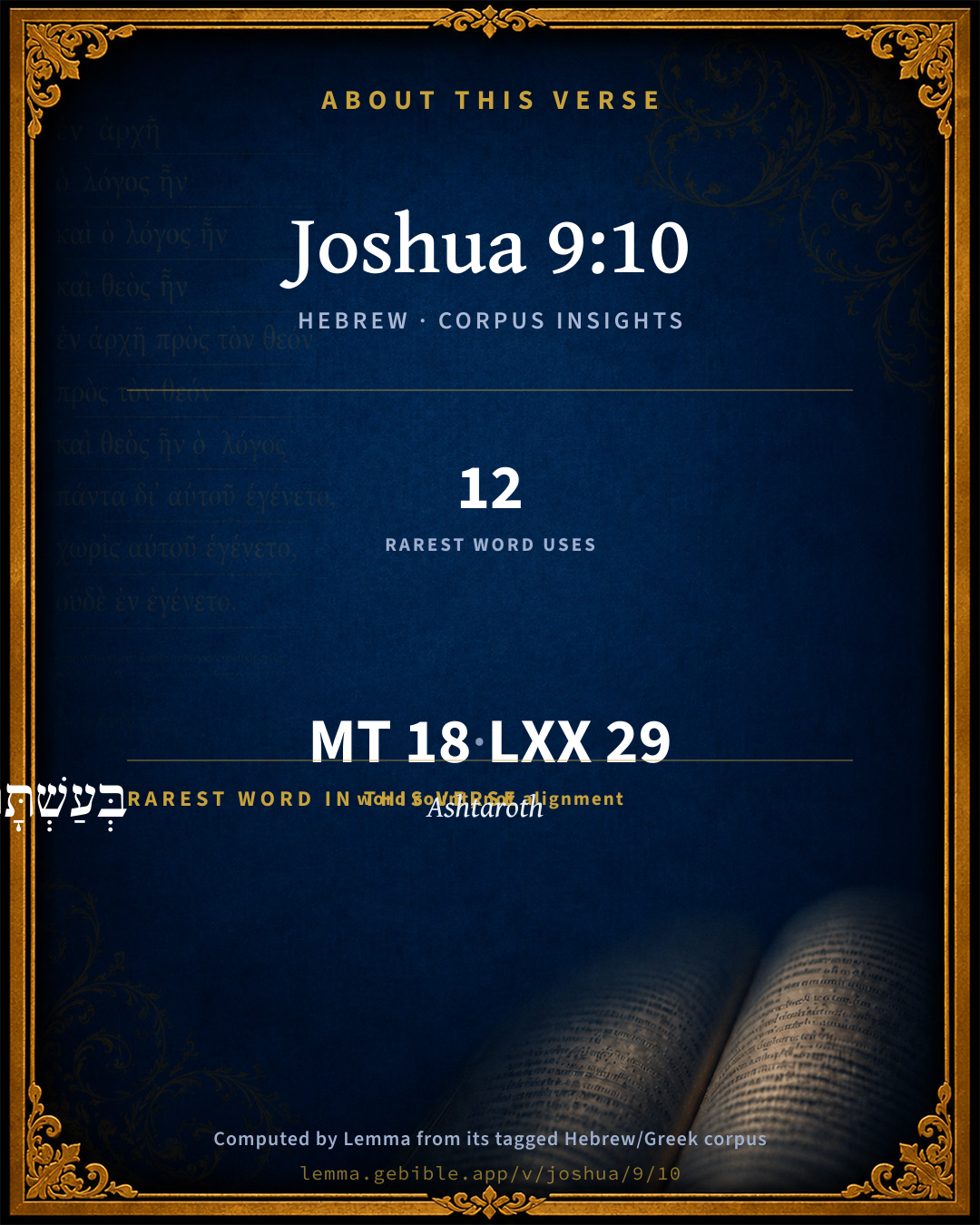
The rarest word here is בְּעַשְׁתָּרֽוֹת Ashtaroth H6252 — appearing just 12 times in the whole Hebrew Bible.

Shared distinctive vocabulary

בְּעַשְׁתָּרֽוֹת Ashtaroth H6252 occurs in 12 verses of the Hebrew Bible. Also found in:

Grammatical profile

  • 1 verb
  • 12 nouns
  • 1 adjective
  • 4 particles

Verb forms

  • עָשָׂ֗ה Qal · Perfect

Repetition

Words recur within this verse — often emphatic in Hebrew:

  • מַלְכֵ֣י king H4428 ×3
  • אֲשֶׁ֣ר which H834 ×3

Hebrew & Septuagint length

In English translation the verse runs 32 words from the Hebrew and 33 from the Septuagint (LXX English) — closely comparable.

A rough comparison of the two English renderings, which tokenize alike — not a word-level alignment.

Word counts can differ between the Hebrew and the Greek without any difference in meaning — e.g. the Hebrew direct-object marker אֵת has no separate Greek word, and Greek often adds the article ὁ.

In the original languages it is 18 Hebrew tokens and 29 Greek tokens — but the two are counted differently (Hebrew bundles its prefixes and suffixes into one token; the Greek is in lemma form), so that isn’t a like-for-like length.

Cross-references

5

Topical passages linked to Joshua 9:10 in the Treasury of Scripture Knowledge — connected by theme and wording, ordered by reader-vote popularity; previews shown in the World English Bible.

  • Numbers 21:24–35 Israel struck him with the edge of the sword, and possessed his land from the Arnon to the Jabbok, even to the children of Ammon; for the border of the children of Ammon was strong.
  • Deuteronomy 1:4 after he had struck Sihon the king of the Amorites, who lived in Heshbon, and Og the king of Bashan, who lived in Ashtaroth, at Edrei.
  • Deuteronomy 2:30–3:7 But Sihon king of Heshbon would not let us pass by him; for Yahweh your God hardened his spirit, and made his heart obstinate, that he might deliver him into your hand, as at this day.
  • Joshua 12:4 and the border of Og king of Bashan, of the remnant of the Rephaim, who lived at Ashtaroth and at Edrei,
  • 1 Chronicles 6:71 To the sons of Gershom [were given], out of the family of the half-tribe of Manasseh, Golan in Bashan with its suburbs, and Ashtaroth with its suburbs;

Cross-references courtesy of OpenBible.info (CC BY 4.0).

Hebrew and Greek witnesses Masoretic Hebrew ↔ Greek Septuagint

The same verse in the two great witnesses to the Old Testament, shown verse-for-verse.

These are two independent witnesses, not word-aligned to each other, and the Septuagint is shown in lemma (dictionary) form.

Hebrew Joshua 9:10 Masoretic · Westminster Leningrad Codex

וְאֵ֣ת כָּל אֲשֶׁ֣ר עָשָׂ֗ה לִשְׁנֵי֙ מַלְכֵ֣י הָאֱמֹרִ֔י אֲשֶׁ֖ר בְּעֵ֣בֶר הַיַּרְדֵּ֑ן לְסִיחוֹן֙ מֶ֣לֶךְ חֶשְׁבּ֔וֹן וּלְע֥וֹג מֶֽלֶךְ הַבָּשָׁ֖ן אֲשֶׁ֥ר בְּעַשְׁתָּרֽוֹת

and all that he did to the two kings of the Amorites, who were beyond the Jordan, to Sihon king of Heshbon, and to Og king of Bashan, who was at Ashtaroth.

World English Bible · Public Domain

Greek LXX Joshua 9:10 Septuagint · lemma form

καί ὅσος ποιέω ὁ βασιλεύς ὁ ἀμορραῖος ὅς εἰμί πέραν ὁ ἰορδάνης ὁ σηων βασιλεύς εσεβων καί ὁ ωγ βασιλεύς ὁ βασαν ὅς καταοἰκέω ἐν ασταρωθ καί ἐν εδραϊν

and all that he did to the kings of the Amorites, who were beyond Jordan, to Seon king of the Amorites, and Og king of Basan, who lived in Astaroth and in Edrain.

LXX2012 (modern English Septuagint) · Public Domain

Hebrew: Westminster Leningrad Codex (CC BY 4.0). Greek: Septuagint (public domain); English from LXX2012 (modern English Septuagint) (Public Domain). How the Septuagint differs from the Hebrew →

Targum (Aramaic paraphrase)

1

The Targum is the ancient Jewish Aramaic paraphrase of the Hebrew Scriptures — an interpretive translation, not the Hebrew text itself. Onkelos (literal) and Pseudo-Jonathan (expansive) render the Torah, and Jonathan the Prophets. Coverage is partial: where no permissively-licensed English translation exists for a verse, only the Aramaic is shown. This is verse-level text, not a word-by-word alignment to the Hebrew.

  1. Targum Jonathan Prophets (Joshua–Malachi)
    וְיַת כָּל דַעֲבַד לִתְרֵין מַלְכֵי אֱמוֹרָאֵי דִי בְּעִבְרָא דְיַרְדְנָא לְסִיחוֹן מַלְכָּא דְחֶשְׁבּוֹן וּלְעוֹג מַלְכָּא דְמַתְנַן דִבְעַשְׁתָּרוֹת:

    (no public-domain English translation for this verse)

    Targum Jonathan — Aramaic: “Mikraot Gedolot” (public domain). English: “Sefaria Community Translation” (CC0 1.0 (public-domain dedication)); “London "Chaldee Paraphrase," 1871” (public domain). Text via Sefaria.

Commentary

Notes on Joshua 9:10 from classic Christian and Jewish commentators (each source and its license shown beneath its notes). The classic Christian expositions comment on the surrounding passage and are grouped to its opening verse, so a note may address several verses; the Jewish commentaries on the Tanakh (Rashi and others) are per-verse, so they appear only where the commentator wrote on this verse.

Lemma curates 59 commentaries, every one of them public domain or Creative Commons licensed, each selected and text-cleaned for this edition rather than reprinted as found. About our sources →

Trapp's Complete Commentary

John Trapp

Jos 9:10 And all that he did to the two kings of the Amorites, that [were] beyond Jordan, to Sihon king of Heshbon, and to Og king of Bashan, which [was] at Ashtaroth.

Ver. 10. And all that he did to the two kings.] Not of Jericho and Ai, but of Heshbon and Pashan, things long since done, and far and near talked of.

John Trapp, A Commentary or Exposition upon All the Books of the Old and New Testament (1647–1656) — public domain. Text from a community e-Sword module.

The Cambridge Bible for Schools and Colleges

gen. ed. J. J. S. Perowne

10. to Og, king of Bashan] They prudently omit all mention of the late capture of Jericho and Ai, lest the revelation of what had recently occurred should betray them.

The Cambridge Bible for Schools and Colleges (gen. ed. J. J. S. Perowne; Cambridge University Press, 1878–1918) — public domain. Text from a community e-Sword module.

John Gill's Exposition

And all that he did to the two kings of the Amorites, that were beyond Jordan,.... On the other side of Jordan from Gilgal:

to Sihon king of Heshbon, and to Og king of Bashan in Ashtaroth; the history of which see in Num 21:21; they wisely took no notice of the miracle of dividing the waters of Jordan, to make a passage for the Israelites; nor of the destruction of Jericho and Ai, which were recent things, and could not be thought as yet to have reached a far country they pretended to come from; and which, if they mentioned, might have created a stronger suspicion still of their being Canaanites.

John Gill's Exposition of the Whole Bible (1746–1763) — public domain (CC PDM 1.0). Text via the HelloAO Bible API.

Haydock's Catholic Bible Commentary

Astaroth. They take care not to mention what had happened so recently at Jericho, lest they might be detected. (Calmet)

George Leo Haydock (1774–1849), Haydock's Catholic Family Bible and Commentary, 1859 edition — public domain. Excludes Psalms (Douay-Rheims chapter numbering differs from Protestant) and Deuterocanonical books (Catholic canon only).

Whedon's Commentary on the Bible

Daniel D. Whedon

10. Amorites… Sihon… Heshbon… Og… Bashan — See note on Jos_2:10.

Which was at Ashtaroth — The word which (according to old English) refers to Og, and should be rendered who. This royal city of Og was in Bashan, and named from Ashtoreth, the Greek Astarte, the Oriental Venus, who was worshipped there. Ashtaroth is the plural form of Ashtoreth, and the place perhaps took this form of the name from the many Astarte-images used in her worship there. It lies six miles north-west of Edrei, and, according to Robinson, is the modern Tell-Astereh. After its capture it was assigned to the Levites.

Daniel D. Whedon (gen. ed.), Commentary on the Old and New Testaments (1874–1909) — public domain. Text from a community e-Sword module.

The Pulpit Commentary

Sihon, king of Heshbon, and Og, the king of Bashan. (see Num_21:21, Num_21:35) Ashtaroth. (see Jos_12:4 Jos_13:31; also Deu_1:4) In Nu 21 Edrei only is mentioned. This is not the Ashtaroth-Karnaim of Gen_14:5, which is so called from the worship of the horned Astarte, or crescent (see below), to distinguish it from this Ashtaroth. The two cities were close together. Eusebius and Jerome state that they were only nine miles apart. The site of this city has been identified with Tel Ashtereh, in a wide plain on the east of Jordan. It appears as Astaratu in the Karnak list of cities captured by Thothines III The name has been identified with the Assyrian Ishtar, the Persian, Greek, and Latin aster and our star. So Gesenius, "Thesaurus," s.v. Whence Lucian seems to have been wrong in his idea that the worship of Astarte, like that of Artemis at Ephesus, was that of the moon. But Rawlinson, in his "Ancient Monarchies," decides against this identification. The last mention of this city in Jewish history is in the bold and successful expedition of Judas Maccabaeus into Gilead, in which he penetrated as far as this city (called Kar-naim), and brought the Jews residing there and in the neighbourhood to Jerusalem. (RAPC 1Ma 6) Kuenen, in his "History of the Religion of Israel," makes a distinction between the worship of Ashtaroth and of Asherah. The former he regards as the worship of the moon, and a pure worship; the latter of Venus, and an impure one. But though Asherah and Ashtaroth, or Ashtoreth, are undoubtedly distinct, yet both worships may have been impure, as the worship of Artemis of the Ephesians (the Diana Multimamma, or the image of fecundity) unquestionably was. "It is probable," says Mr. G. Smith, "that the first intention in the mythology was only to represent love as heaven born, but in time a more sensual view prevailed, and the worship of Ishtar became one of the darkest features in Babylonian mythology." The Babylonian Mylitta, or Venus, was worshipped under a crescent form, as Babylonian sculptures prove. A Syrian altar with the crescent on it is now in the Fitzwilliam Museum at Cambridge. It has a female figure on one side, with the crescent, and a male figure of Baal, no doubt on the other. Another is mentioned in a late able article in the Times, as having been found in Carehemish, the Hittite capital. The Chaldaean astronomers had, no doubt, discovered the use of telescopes (though in the translucent sky of Chaldaea perhaps the crescent Venus might be seen without them), for we find Saturn represented on their monuments with a ring (see Proctor, "Saturn and his System," p. 197). Consequently the worship of the crescent Venus involves no anachronism. Asherah, often wrongly translated "grove" in our version, (see Jud_1:6:25) is probably the goddess Fortune, derived from r happiness. Ashtaroth is spelt not with Aleph, but with Ain.

The Pulpit Commentary (1880–1919), ed. H.D.M. Spence-Jones & Joseph S. Exell — public domain. Text from a community e-Sword module.

Lesson kit

Teaching starters — assembled from the data on this page, not authored interpretation. Every prompt links to the verse data it draws on. Edit before teaching.

Joshua, in the Historical, opens this verse with 18 words (14 distinct Hebrew lemmas). Its most distinctive word is ʻAshtârôwth (“Ashtaroth”). A historical commentator’s framing appears above. Read the whole chapter for the surrounding context.

Discussion questions

  1. The word ʻAshtârôwth carries the sense “Ashtaroth.” How does it shape the verse?
  2. Deuteronomy 1:4 shares the word «Ashtaroth» with this verse. How do the two illuminate each other?
  3. “king” occurs 3× in this one verse. What is the effect of the repetition?
  4. The translations on this page render this verse differently — a whole-verse word diff, not a word-by-word alignment. What might account for the different wordings?
  5. The verb «עָשָׂ֗ה» is Qal Perfect. How does its form color the action?
  6. Reading how Trapp's Complete Commentary and The Cambridge Bible for Schools and Colleges read this verse, where do the two commentators agree and where do they part?

Things to notice

Reading settings

Reading text

Shown beneath each verse's original-language words.

Old Testament
Old Testament edition

Read the OT as the Masoretic Hebrew (MT) or the Greek Septuagint (LXX).

English shown for the Greek Septuagint (in the Hebrew ↔ Greek comparison).

Comparing translations? Open the Compare panel on any verse page to stack up to four side by side.