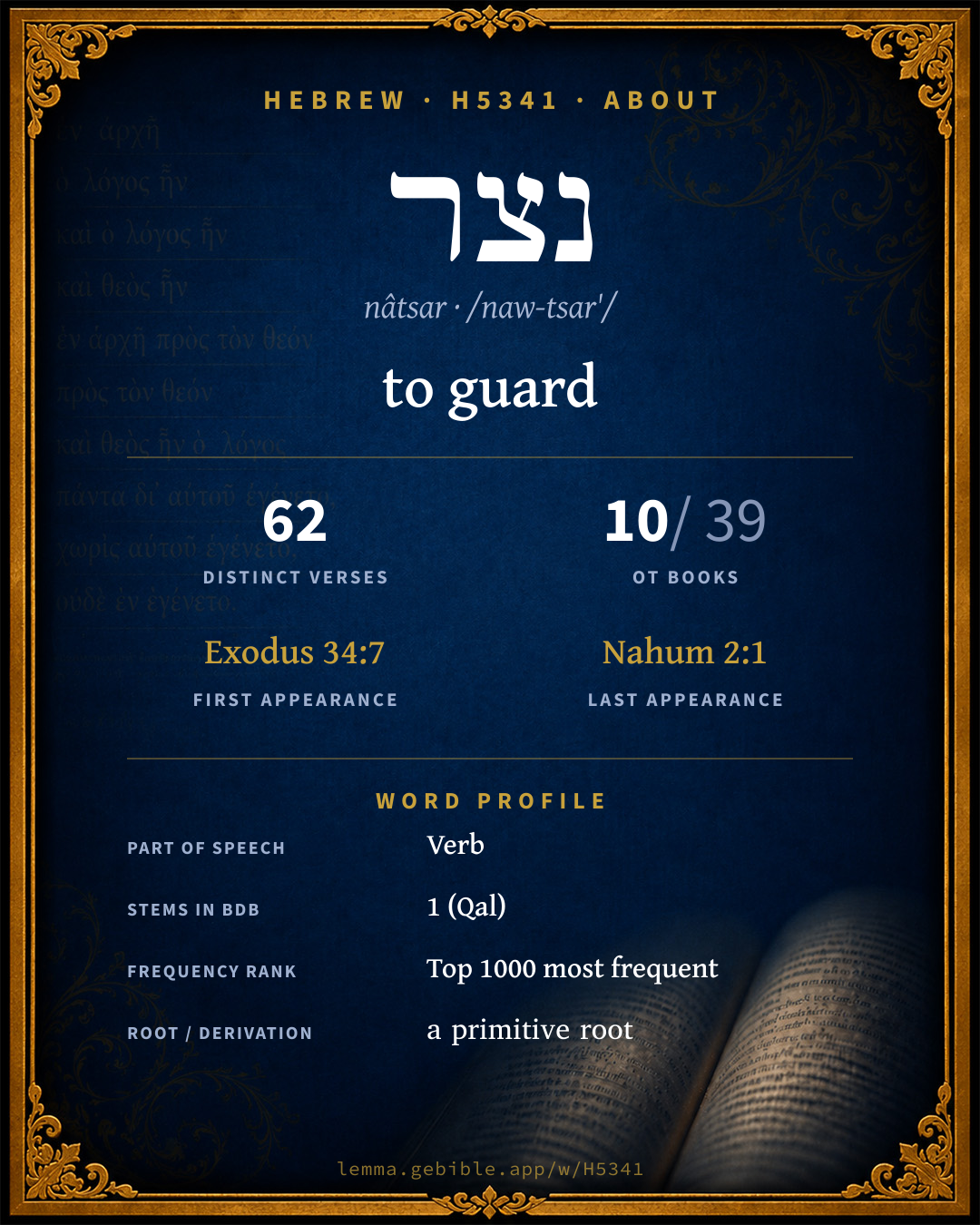
נָצַר
to guard
also: watch, watch over, keep fuller range ↓
Full lexicon entry — Brown-Driver-Briggs (BDB)
From Brown-Driver-Briggs (BDB)
Where this word appears
Grammar key — what these labels mean
Part of speech
- Verb
- An action or state-of-being word.
Noun type
- Common
- A common noun — a general class of person, place, or thing (“king,” “city,” “water”), not a specific name.
Stem
- Qal
- The basic, simple active stem — the plain form of the verb (“he wrote”).
Form
- Participle Active
- A verbal adjective expressing ongoing or characteristic action (“writing / one who writes”).
- Imperfect
- An incomplete, ongoing, or future action (“he will / would write”).
- Imperative
- A direct command (“write!”).
- Perfect
- A completed action or state — Hebrew marks aspect (completeness) more than strict tense (“he wrote”).
- Cohortative
- A first-person volitional form expressing wish or resolve (“let me / let us write”).
- Participle Passive
- A verbal adjective expressing action received (“written”).
- Infinitive Construct
- A bound verbal noun, frequently with prepositions (“to write / in writing”).
- Infinitive Absolute
- An unbound verbal noun, often intensifying or standing in for a finite verb.
- Jussive
- A third- or second-person volitional form expressing wish or command (“let him write”).
State
- Absolute
- The independent form of a noun, not bound to a following word.
- Construct
- A noun bound to a following noun in a possessive / “of” relationship (the construct chain).
Person
- 3rd Person
- The one spoken about (“he / she / it / they”).
- 2nd Person
- The one addressed (“you”).
- 1st Person
- The speaker (“I / we”).
Gender
- Masculine
- Grammatically masculine.
- Common
- Either gender — not distinguished for this form.
- Feminine
- Grammatically feminine.
Number
- Singular
- One.
- Plural
- More than one (in Hebrew, generally three or more).
Every verse where H5341 appears in the Book of Psalms — 24 distinct verses. Click any verse to open its interlinear word-by-word view. Verse text shown in the World English Bible for context — . Each verse’s Hebrew form is shown with its reference; the English is not keyword-highlighted, since the data carries no word-level English alignment. Use “Compare translations” on any verse to read it across multiple English versions. This concordance covers the Hebrew Bible; Septuagint (Greek Old Testament) occurrences are not indexed here.
Psalms
- Psalms 12:7 תִּצְּרֶ֓/נּוּ Qal impf 2ms + sfx pers 3ms You will keep them, Yahweh, You will preserve them from this generation forever.
- Psalms 25:10 לְ/נֹצְרֵ֥י prep + Qal ptcp.act mp cs All the paths of Yahweh are loving kindness and truth To such as keep his covenant and his testimonies.
- Psalms 25:21 יִצְּר֑וּ/נִי Qal impf 3mp + sfx pers 1cs Let integrity and uprightness preserve me, For I wait for you.
- Psalms 31:23 נֹצֵ֣ר Qal ptcp.act ms Oh love Yahweh, all you his saints! Yahweh preserves the faithful, And pays back him who deals proudly in full.
- Psalms 32:7 תִּ֫צְּרֵ֥/נִי Qal impf 2ms + sfx pers 1cs You are my hiding place. You will preserve me from trouble. You will surround me with songs of deliverance. Selah.
- Psalms 34:13 נְצֹ֣ר Qal impv 2ms Keep your tongue from evil, And your lips from speaking lies.
- Psalms 40:11 יִצְּרֽוּ/נִי Qal impf 3mp + sfx pers 1cs Don't withhold your tender mercies from me, Yahweh. Let your loving kindness and your truth continually preserve me.
- Psalms 61:7 יִנְצְרֻֽ/הוּ Qal impf 3mp + sfx pers 3ms He shall be enthroned in God's presence forever. Appoint your loving kindness and truth, that they may preserve him.
- Psalms 64:1 תִּצֹּ֥ר Qal impf 2ms Hear my voice, God, in my complaint. Preserve my life from fear of the enemy.
- Psalms 78:7 יִנְצֹֽרוּ Qal impf 3mp That they might set their hope in God, And not forget the works of God, But keep his commandments,
- Psalms 105:45 יִנְצֹ֗רוּ Qal impf 3mp That they might keep his statutes, And observe his laws. Praise Yah!
- Psalms 119:2 נֹצְרֵ֥י Qal ptcp.act mp cs Blessed are those who keep his statutes, Who seek him with their whole heart.
- Psalms 119:22 נָצָֽרְתִּי Qal pf 1cs Take reproach and contempt away from me, For I have kept your statutes.
- Psalms 119:33 וְ/אֶצְּרֶ֥/נָּה conj + Qal impf 1cs + sfx pers 3fs Teach me, Yahweh, the way of your statutes. I will keep them to the end.
- Psalms 119:34 וְ/אֶצְּרָ֥ה conj + Qal coh 1cs Give me understanding, and I will keep your law. Yes, I will obey it with my whole heart.
- Psalms 119:56 נָצָֽרְתִּי Qal pf 1cs This is my way, That I keep your precepts.
- Psalms 119:69 אֱצֹּ֬ר Qal impf 1cs The proud have smeared a lie upon me. With my whole heart, I will keep your precepts.
- Psalms 119:100 נָצָֽרְתִּי Qal pf 1cs I understand more than the aged, Because I have kept your precepts.
- Psalms 119:115 וְ֝/אֶצְּרָ֗ה conj + Qal coh 1cs Depart from me, you evildoers, That I may keep the commandments of my God.
- Psalms 119:129 נְצָרָ֥תַ/ם Qal pf 3fs + sfx pers 3mp Your testimonies are wonderful, Therefore my soul keeps them.
- Psalms 119:145 אֶצֹּֽרָה Qal coh 1cs I have called with my whole heart. Answer me, Yahweh! I will keep your statutes.
- Psalms 140:1 תִּנְצְרֵֽ/נִי Qal impf 2ms + sfx pers 1cs Deliver me, Yahweh, from the evil man. Preserve me from the violent man;
- Psalms 140:4 תִּנְצְרֵ֑/נִי Qal impf 2ms + sfx pers 1cs Yahweh, keep me from the hands of the wicked. Preserve me from the violent men who have determined to trip my feet.
- Psalms 141:3 נִ֝צְּרָ֗/ה Qal impv 2ms + sfx h Set a watch, Yahweh, before my mouth. Keep the door of my lips.
About this entry
At a glance — auto-summarized from this page’s data, not written by a person. Every figure links to its source below. This summary describes the numbers; it doesn’t interpret them.
At its core, נצר (nâtsar) means “to guard.” Older and newer Bibles part ways — “keep” in the King James Version, “guard” (unfoldingWord Literal Text) in modern versions. See the renderings breakdown. It appears 62 verses across 10 books of the Hebrew Bible, among its moderately common vocabulary. The word gravitates to Psalms (39%), then Proverbs and Isaiah. Beyond its headline sense, its full sense range takes in “watch”, “watch over”, and “keep”. Each statement above links to its evidence; the full detail follows below.
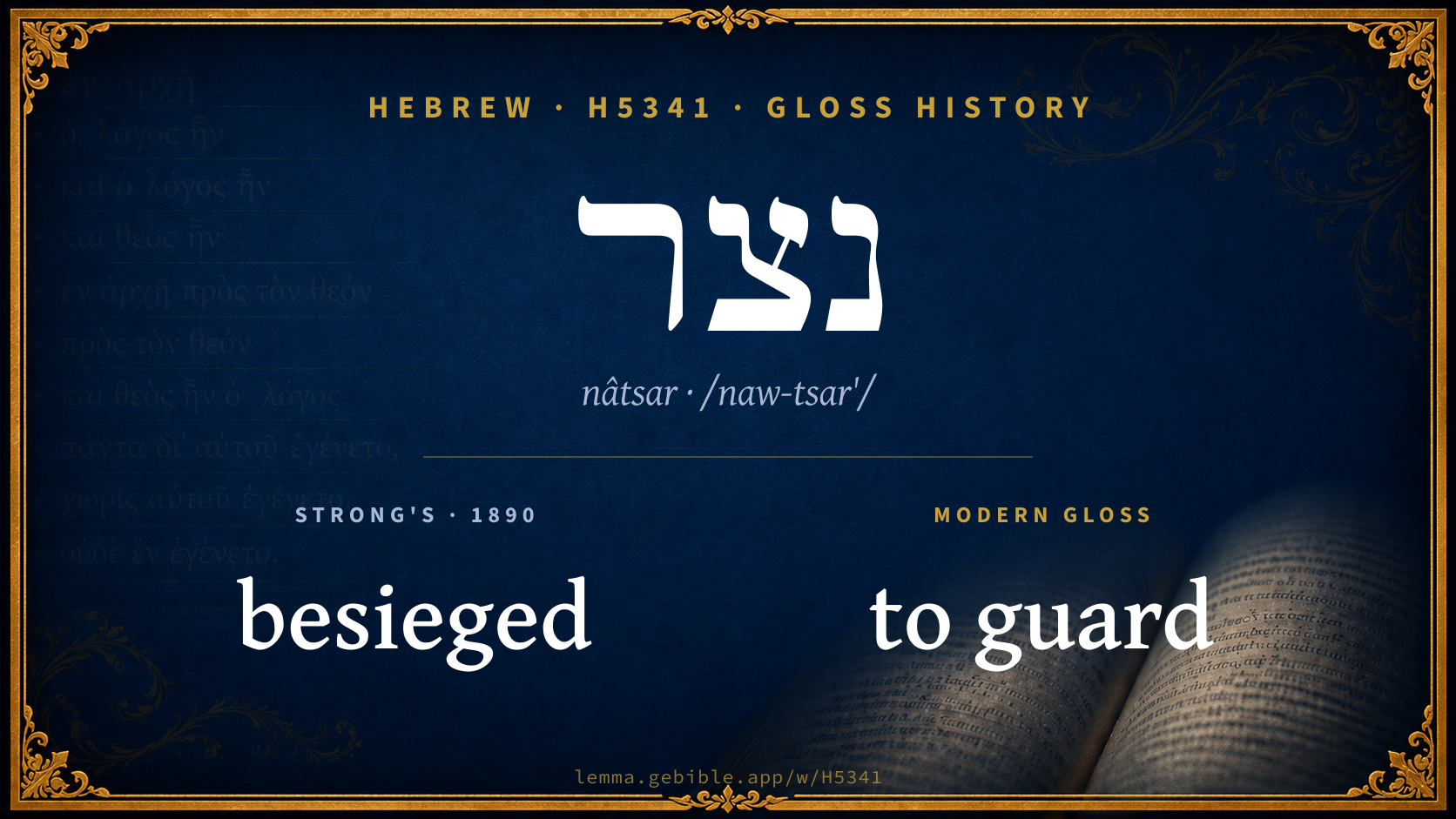
Gloss history
Strong's 1890 vs modern scholarship
About this word
Strong's H5341 catalogs a Hebrew word from the Hebrew Old Testament.
These counts are not copied from any lexicon or concordance. They are computed here, from the morphology-tagged Hebrew Old Testament. What Lemma adds →
- 62
- distinct verses
- The word appears in 62 distinct verses.
- 10 / 39
- OT books
- The word appears in 10 of 39 Old Testament books.
- #611
- by frequency
- Top 1000 most frequent Hebrew words (rank 611 of 8,640 Hebrew words by occurrence).
View all 62 occurrences in the concordance →
By section of the Old Testament
By traditional corpus
Conventional, traditional groupings — biblical authorship is debated, so this is a traditional corpus grouping, not an authorship claim. Each share is this word’s portion of its verses in that division of the Hebrew canon. Each figure is a share of the word’s 62 distinct verses.
- Writings (Ketuvim) 45 verses · 73%
- Prophets (Nevi'im) 14 verses · 23%
- Torah (Pentateuch) 3 verses · 5%
How translations render this word
Counts come from each version’s own published word-to-Strong’s tagging or interlinear alignment — an approximate guide to how each version renders this word, not a word-level alignment the data otherwise carries. Because each total is that version’s own tagged count, the per-version totals vary from one another and need not match the appearance or distinct-verse counts above. These counts may also differ from a printed concordance because Lemma counts each distinctly tagged rendering and does not collapse phrase taggings into a single head-word total. This is a fixed set of word-tagged versions (KJV, ASV, BSB, ULT) and does not change with the reading translation you choose elsewhere. Each version’s license is shown beside its name below (and on Sources).
BDB lists this Strong’s number as 3 distinct words (homographs). Each count above pools all of them and is not split by sense — see the Senses section below. A low-frequency rendering may belong to a different one of those words, not the primary meaning.
- King James Version†: Keep 12×, Preserve 7×, He that keepeth 3×
- American Standard Version†: Keep 11×, Preserve 6×, I have kept 2×
- Berean Standard Bible†: Keep 5×, Guard 3×, Preserve 3×
- unfoldingWord Literal Text†: Guard 11×, And 4×, Preserve me 4×
King James Version Public Domain
Renders H5341 across 62† tagged occurrences — most commonly:
Plus 28 renderings that appear only once — usually multi-word phrases or single function words the recovered tagging swept in, not distinct renderings. Not rendered by a distinct English word in 1 further occurrence.
American Standard Version Public Domain
Renders H5341 across 60† tagged occurrences — most commonly:
Plus 33 renderings that appear only once — usually multi-word phrases or single function words the recovered tagging swept in, not distinct renderings.
Berean Standard Bible Public Domain
Renders H5341 across 59† tagged occurrences — most commonly:
Plus 38 renderings that appear only once — usually multi-word phrases or single function words the recovered tagging swept in, not distinct renderings. Not rendered by a distinct English word in 2 further occurrences.
unfoldingWord Literal Text CC BY-SA 4.0
Renders H5341 across 68† tagged occurrences — most commonly:
Plus 40 renderings that appear only once — usually multi-word phrases or single function words the recovered tagging swept in, not distinct renderings.
Senses in the full BDB
What do BDB’s symbols mean?
BDB uses these scholarly abbreviations:
| Symbol | Meaning |
|---|---|
| 𝔊 | the Septuagint (the ancient Greek translation, LXX) |
| 𝔙 | the Vulgate (the Latin translation) |
| 𝔖 | the Syriac version (the Peshitta) |
| 𝔗 | the Targum (the Aramaic translation) |
| ψ | the Psalms |
| √ | root (the underlying root or stem) |
| ‖ | parallel passage (a synonymous or contrasted parallel) |
| † | the dagger: every passage where the word occurs is cited |
The 6 senses and sub-senses the full Brown-Driver-Briggs lexicon distinguishes for this word, in lexicon order (not ranked by frequency), with BDB’s own verbatim wording and sub-sense lettering. Shown in Hebrew script with BDB’s own scholarly abbreviations. The condensed entry is in the Lexicon Entry tab. See also the Forms in the corpus table below.
Qal
- Pf. 3 fs. sf. נְצָרָ֫תַם ψ 119:129; 1 s. נָצָ֑רְתִּי ψ 119:22, 56, 100; 3 mpl. נָֽצְרוּ Pr 22:12; Impf. יִצֹּר Pr 3:1; sf. יִצְּרֶ֫נְהוּ (Ges§ 58, 4 R.) Dt 32:10; m. sf. תִּנְצְרֶ֑כָּה Pr 2:11 (Ges§ 58, 4 R.); 1 s. אֶצֹּר ψ 119:69; אֶצְּרָה ψ 119:34, 115; אֶצֹּ֑רָה ψ 119:145; sf. אֶצָּרְךָ Is 42:6; 49:8 (Ges Bö Ew al. from יצר); אֶצֳּרֶ֑נָּה Is 27:3; 3 mpl. יִצְּרוּ Pr 20:28; יִנְצֹ֑רוּ Dt 33:9 (on forms v. Ges§ 66, 2, R. 1) + 15 times Impf.; Imv. נְצֹר ψ 34:14 + 3 times; נִצְּרָה ψ 141:3 (d. f. dirim. Ges§ 20, 2 b); sf. נִצְּרֶ֑הָ Pr 4:13; Inf. abs. נָצוֹר Na 2:2; cstr. נְצֹר Pr 2:8; Pt. נוֹצֵר; Pr 28:7; נֹצֵר Ex 34:7 + 7 times; sf. נֹצְרָהּ Is 27:3; pl. נוֹצְרִים 2 K 17:9; 18:8, etc.; pass. נָצוּר Ez 6:12; pl. נְצוּרִים Is 65:4 (𝔊 ἐν τοῖς σπηλαίοις, בַּמְּעָרוֹת); cstr. נְצוּרֵי (Kt נְצִירֵי only here) Is 49:6; f. נְצוּרָה Is 1:8 (Di reads נְצוֹרָה Niph. Pt. √ צוּר); cstr. נְצֻרַת Pr 7:10; pl. נְצֻרוֹת Is 48:6 (Che reads בְּצֻרוֹת). e.g. Psalms 119:129
- 1. Watch, guard, keep, a vineyard Jb 27:18 (cf. Wetzst in De Job (2)ad loc.), Is 27:3(×2), fig-tree Pr 27:18, fortification Na 2:2; נֹצְרִים watchmen Je 31:6; מִגְדַּל נ׳ tower of watchmen 2 K 17:9; 18:8; in ethical sense of men, guarding the mouth Pr 13:3, the way Pr 16:17, לֵב Pr 4:23; the tongue מֵרַע ψ 34:14; c. על, over the door of the lips ψ 141:3; of God נֹצֵר הָאָדָם Jb 7:20 (thou) watcher of men (iron.). e.g. Job 27:18
- 2. Guard from dangers, preserve, c. acc. subj. God or his attributes Dt 32:10 ψ 25:21; 31:24; 40:12; 61:8; Is 26:3; 42:6; 49:8 Pr 2:8; 20:28; 22:12; נֹצֵר נֶפֶשׁ Pr 24:12; c. acc. and מן from which ψ 12:8; 32:7; 64:2; 140:2, 5. In Wisd. Lit. subj. is abstr.: חכמה Pr 4:6; תבונה Pr 2:11; צדקה Pr 13:6; נְצוּרֵי ישׂראל Is 49:6 preserved of Israel. e.g. Deuteronomy 32:10
- 3. Guard with fidelity, keep, observe: of י׳, נֹצֵר חֶסֶד לאלפים Ex 34:7 (J); elsewhere of man observing the covenant Dt 33:9 (poem) ψ 25:10, the divine law ψ 78:7; 105:45; 119:2, 22, 33, 34, 56, 69, 100, 115, 129, 145; commands of parents Pr 6:20; 28:7; and discipline of Wisdom Pr 3:1, 21; 4:13; 5:2. e.g. Exodus 34:7
- 4. Guard, keep secret, dub.: נְצֻרוֹת secret things Is 48:6; נְצוּרִים secret places Is 65:4 (see forms above); נְצֻרַת לֵב secret, wily minded Pr 7:10 (of harlot, so RVm close, i.e. secretive). e.g. Isaiah 48:6
- 5. Kept close, blockaded, dub.: הַנָּצוּר the blockaded (so Ew Hi Co Toy; but Ke Bth Kau preserved; Hi Co Bth Toy del. והנשׁאר) Ez 6:12; עִיר נְצוּרָה blockaded city Is 1:8 (see form above); נֹצְרִים blockaders Je 4:16 (but 𝔊 συστροφαί = צררים i.e. foes). e.g. Ezekiel 6:12
Senses from the full Brown-Driver-Briggs lexicon (Brown, Driver, Briggs; Oxford 1906 — public domain), digitized via Sefaria, supplemented by the OpenScriptures HebrewLexicon (CC BY 4.0). Full attribution on Sources.
Word origin
I. vb. watch, guard, keep (NH id., observe; Assyrian naṣâru, watch over, protect; Old Aramaic נצר protect Lzb 325 Cook 83; Palm. in n.pr. Vog 150, 4 Cook 124; Aramaic נְטַר, ܢܛܰܪ (cf. Wetzst in De Job (2) on 27:18); Arabic نَظَرَ look at, consider, examine (نَاطُورٌ, overseer is Aramaic loan-word Frä 138); Sab. להנצרהמו to aid them Hal Rev. Sém. iv (1896), 71; Ethiopic ነጸረ spectare, intueri, etc., Di701;—cf. also נטר);—
I. v. I. נצר Qal Pt. pass.
I. ψ 141:3 v. I. נצר Qal Imv.
— Brown-Driver-Briggs (Oxford 1906, public domain), digitized via Sefaria, supplemented by the OpenScriptures HebrewLexicon (CC BY 4.0). See Sources.
Origin: a primitive root
Jastrow Dictionary
A second Hebrew/Aramaic lexicon for comparison, covering Aramaic and post-biblical (Talmudic, Targumic, Midrashic) usage that the biblical-Hebrew BDB does not. Matched by lemma rather than by Strong’s number, so a lemma may carry more than one Jastrow headword (shown separately below), and the entries cover usage well beyond the Bible.
נָצַר
- to preserve, guard. B. Bath. 91ᵇ (play on היוצרים, I Chr. IV, 23) שנָצְרוּ שבועות וכ׳ who guarded their father’s oath (of abstinence). Ber. 17ᵃ נְצוֹר תורתי וכ׳ keep my law in thy heart. Ib. נצור לשוני מרע guard my tongue from evil. Tanḥ. B’midbar 13 עד היכן נְצָרָן up to what degree did He guard them?; Num. R. s. 2. Midr. Till. to Ps. CXL רצונך שאֶצָּרְךָ נצור וכ׳ if it is thy desire that I guard thee, guard thou my law; a. fr. e.g. 1 Chronicles 4:23
נְצַר
- (cmp. Arab. ṣarṣara, a. צַרְצוּר) to chirp. Lev. R. s. 33 end (play on נבוכד נצר) נבח … נ׳ כצרצרא bark like a dog …, chirp like a cricket; מיד … נ׳ וכ׳ presently he … chirped &c.; Cant. R. to II, 14.
נֵצֶר I
- (preced.) cricket.—Pl. נְצָרִין. Tosef. Ḥull. III, 25 (Ḥull. 65ᵇ צרצור).
נֵצֶר II
- cmp. Arab. naḍara, sprout, offshoot. Tanḥ. Lekh, ed. Bub. 9 אם ניטלין נ׳ מהם וכ׳ if you take a shoot of them (the felled trees) and plant it &c.; Tanḥ. ib. 5 ונוטעין מנִצְרָה שלהן.
נֵצֶר III
- (cmp. מֵצַר II) [twist,] willow, wicker. Erub. 58ᵃ (חבל) של נ׳ a wicker rope.—Pl. נְצָרִים. Ib. Kel. XX, 2 כלי נ׳ (ed. Dehr. נְסָרִים) vessels of wickerwork. Bicc. III, 8 סלי נ׳ (Ms. M. נס׳) wicker baskets; a. fr.—Tosef. Toh. XI, 16 נוֹצְרִין.
נֵצֶר IV
- 1. Netsar, one of the alleged disciples of Jesus of Nazareth. Snh. 43ᵃ Ms. M. a. ed. Ven. (omitted in later edit., v. בּוּנִי).
- 2. בֶּן נ׳ Ben-Netsar (son of Nassor) name of a chief of robbers who became founder of a dynasty, i.e. Odenathus of Palmyra (v. Cyclop. Brit. s. v. Palmyra, Ersch u. Gruber II, Vol. 27, p. 185, Fürst Gloss., p. 145). Keth. 51ᵇ (opp. to מלכות אחשורוש the legitimate Persian dynasty). Gen. R. s. 76; Yalk. Dan. 1064 בן נָצוֹר. Y. Ter. VIII, 46ᵇ bot. בר ניצור.
A Dictionary of the Targumim, the Talmud Babli and Yerushalmi, and the Midrashic Literature (Marcus Jastrow; London, Luzac, 1903) — Public Domain. Digitized via Sefaria. Digitized via Sefaria. Full attribution on Sources.
Forms in the corpus
The 52 distinct written forms H5341 takes in the Hebrew Bible, most frequent first — each parse links to that stem’s occurrences in the concordance. Hebrew forms include their vowel points and cantillation, so a single lemma takes many written forms.
| Form | Parsing | Example | Uses |
|---|---|---|---|
| נֹצֵ֣ר | Verb, Qal, Participle Active, Masculine, Singular, Absolute | Proverbs 13:3 | 3 |
| יִנְצֹֽרוּ | Verb, Qal, Imperfect, 3rd Person, Masculine, Plural | Deuteronomy 33:9 | 3 |
| נְצֹ֣ר | Verb, Qal, Imperative, 2nd Person, Masculine, Singular | Proverbs 4:23 | 3 |
| נָצָֽרְתִּי | Verb, Qal, Perfect, 1st Person, Common, Singular | Psalms 119:22 | 3 |
| וְ/אֶצָּרְ/ךָ֗ | Verb, Qal, Imperfect, 1st Person, Common, Singular | Isaiah 42:6 | 2 |
| נֹצֵ֥ר | Verb, Qal, Participle Active, Masculine, Singular, Absolute | Exodus 34:7 | 2 |
| נוֹצְרִ֖ים | Verb, Qal, Participle Active, Masculine, Plural, Absolute | 2 Kings 17:9 | 2 |
| אֱצֹּ֬ר | Verb, Qal, Imperfect, 1st Person, Common, Singular | Psalms 119:69 | 1 |
| אֶצֳּרֶֽ/נָּה | Verb, Qal, Imperfect, 1st Person, Common, Singular | Isaiah 27:3 | 1 |
| אֶצֹּֽרָה | Verb, Qal, Cohortative, 1st Person, Common, Singular | Psalms 119:145 | 1 |
| וְ/אֶצְּרֶ֥/נָּה | Verb, Qal, Imperfect, 1st Person, Common, Singular | Psalms 119:33 | 1 |
| וְ/אֶצְּרָ֥ה | Verb, Qal, Cohortative, 1st Person, Common, Singular | Psalms 119:34 | 1 |
| וְ/הַ/נָּצ֔וּר | Verb, Qal, Participle Passive, Masculine, Singular, Absolute | Ezekiel 6:12 | 1 |
| וְ/נֹצֵ֣ר | Verb, Qal, Participle Active, Masculine, Singular, Absolute | Proverbs 24:12 | 1 |
| וְ/תִצְּרֶֽ/ךָּ | Verb, Qal, Imperfect, 3rd Person, Feminine, Singular | Proverbs 4:6 | 1 |
| וְ֝/אֶצְּרָ֗ה | Verb, Qal, Cohortative, 1st Person, Common, Singular | Psalms 119:115 | 1 |
| וּ/בַ/נְּצוּרִ֖ים | Noun, Common, Masculine, Plural, Absolute | Isaiah 65:4 | 1 |
| וּ/נְצֻ֥רַת | Verb, Qal, Participle Passive, Feminine, Singular, Construct | Proverbs 7:10 | 1 |
| וּ/נְצֻר֖וֹת | Verb, Qal, Participle Passive, Feminine, Plural, Absolute | Isaiah 48:6 | 1 |
| וּ/נְצוּרֵ֥י | Verb, Qal, Participle Passive, Masculine, Plural, Construct | Isaiah 49:6 | 1 |
| יִנְצְרֻֽ/הוּ | Verb, Qal, Imperfect, 3rd Person, Masculine, Plural | Psalms 61:7 | 1 |
| יִנְצֹ֗רוּ | Verb, Qal, Imperfect, 3rd Person, Masculine, Plural | Psalms 105:45 | 1 |
| יִצְּר֑וּ/נִי | Verb, Qal, Imperfect, 3rd Person, Masculine, Plural | Psalms 25:21 | 1 |
| יִצְּרֶ֖/נְהוּ | Verb, Qal, Imperfect, 3rd Person, Masculine, Singular | Deuteronomy 32:10 | 1 |
| יִצְּרֽוּ/נִי | Verb, Qal, Imperfect, 3rd Person, Masculine, Plural | Psalms 40:11 | 1 |
| יִצְּרוּ | Verb, Qal, Imperfect, 3rd Person, Masculine, Plural | Proverbs 20:28 | 1 |
| יִצֹּ֥ר | Verb, Qal, Jussive, 3rd Person, Masculine, Singular | Proverbs 3:1 | 1 |
| לְ/נֹצְרֵ֥י | Verb, Qal, Participle Active, Masculine, Plural, Construct | Psalms 25:10 | 1 |
| לִ֭/נְצֹר | Verb, Qal, Infinitive Construct | Proverbs 2:8 | 1 |
| נְצָרָ֥תַ/ם | Verb, Qal, Perfect, 3rd Person, Feminine, Singular | Psalms 119:129 | 1 |
| נְצֹ֥ר | Verb, Qal, Imperative, 2nd Person, Masculine, Singular | Proverbs 3:21 | 1 |
| נְצוּרָֽה | Verb, Qal, Participle Passive, Feminine, Singular, Absolute | Isaiah 1:8 | 1 |
| נִ֝צְּרֶ֗/הָ | Verb, Qal, Imperative, 2nd Person, Masculine, Singular | Proverbs 4:13 | 1 |
| נִ֝צְּרָ֗/ה | Verb, Qal, Imperative, 2nd Person, Masculine, Singular | Psalms 141:3 | 1 |
| נָ֣צְרוּ | Verb, Qal, Perfect, 3rd Person, Common, Plural | Proverbs 22:12 | 1 |
| נָצ֣וֹר | Verb, Qal, Infinitive Absolute | Nahum 2:1 | 1 |
| נֹֽצְרָ֔/הּ | Verb, Qal, Participle Active, Masculine, Singular, Construct | Isaiah 27:3 | 1 |
| נֹצְרִ֖ים | Verb, Qal, Participle Active, Masculine, Plural, Absolute | Jeremiah 31:6 | 1 |
| נֹצְרִ֥ים | Verb, Qal, Participle Active, Masculine, Plural, Absolute | Jeremiah 4:16 | 1 |
| נֹצְרֵ֥י | Verb, Qal, Participle Active, Masculine, Plural, Construct | Psalms 119:2 | 1 |
| נֹצֵ֪ר | Verb, Qal, Participle Active, Masculine, Singular, Construct | Job 7:20 | 1 |
| נֹצֵֽר | Verb, Qal, Participle Active, Masculine, Singular, Absolute | Job 27:18 | 1 |
| נוֹצֵ֣ר | Verb, Qal, Participle Active, Masculine, Singular, Absolute | Proverbs 28:7 | 1 |
| תִנְצְרֶֽ/כָּה | Verb, Qal, Imperfect, 3rd Person, Feminine, Singular | Proverbs 2:11 | 1 |
| תִּ֫צְּרֵ֥/נִי | Verb, Qal, Imperfect, 2nd Person, Masculine, Singular | Psalms 32:7 | 1 |
| תִּנְצְרֵ֑/נִי | Verb, Qal, Imperfect, 2nd Person, Masculine, Singular | Psalms 140:4 | 1 |
| תִּנְצְרֵֽ/נִי | Verb, Qal, Imperfect, 2nd Person, Masculine, Singular | Psalms 140:1 | 1 |
| תִּצְּרֶ֓/נּוּ | Verb, Qal, Imperfect, 2nd Person, Masculine, Singular | Psalms 12:7 | 1 |
| תִּצֹּ֖ר | Verb, Qal, Imperfect, 2nd Person, Masculine, Singular | Isaiah 26:3 | 1 |
| תִּצֹּ֣ר | Verb, Qal, Imperfect, 3rd Person, Feminine, Singular | Proverbs 13:6 | 1 |
| תִּצֹּ֥ר | Verb, Qal, Imperfect, 2nd Person, Masculine, Singular | Psalms 64:1 | 1 |
| תִּצֹּֽרְנָה | Verb, Qal, Jussive, 3rd Person, Feminine, Plural | Proverbs 23:26 | 1 |
Same root — word family
Other BDB entries built from the same root as H5341, grouped by Strong’s listed origin. These share a root / origin per the lexicon — not necessarily a shared meaning. Each links to that word’s own entry.
Derived from this word
Compare all same-root words → They share a root, not necessarily a meaning.
Septuagint verse parallels
This word appears in 49 verses that also exist in the Greek Old Testament (Septuagint), out of the 62 Hebrew verses it occurs in. You can read those verses in Greek by switching the Old Testament edition to the Septuagint.
Read these verses in the Septuagint
- Exodus 34:7
- Deuteronomy 32:10
- 2 Kings 17:9
- Job 7:20
- Psalms 25:10
- Proverbs 2:8
- Isaiah 1:8
- Jeremiah 4:16
- Ezekiel 6:12
- Nahum 2:1
This is a verse-level parallel only — the same verses exist in both the Hebrew and Greek Old Testaments. No word-level Hebrew↔Greek correspondence is claimed: the data carries no such alignment, so no Greek word is shown as this Hebrew word’s translation. Coverage is not total — the Septuagint omits the deuterocanon and renumbers the Psalms, so some Hebrew verses have no direct Greek parallel.