
Proverbs 22:12

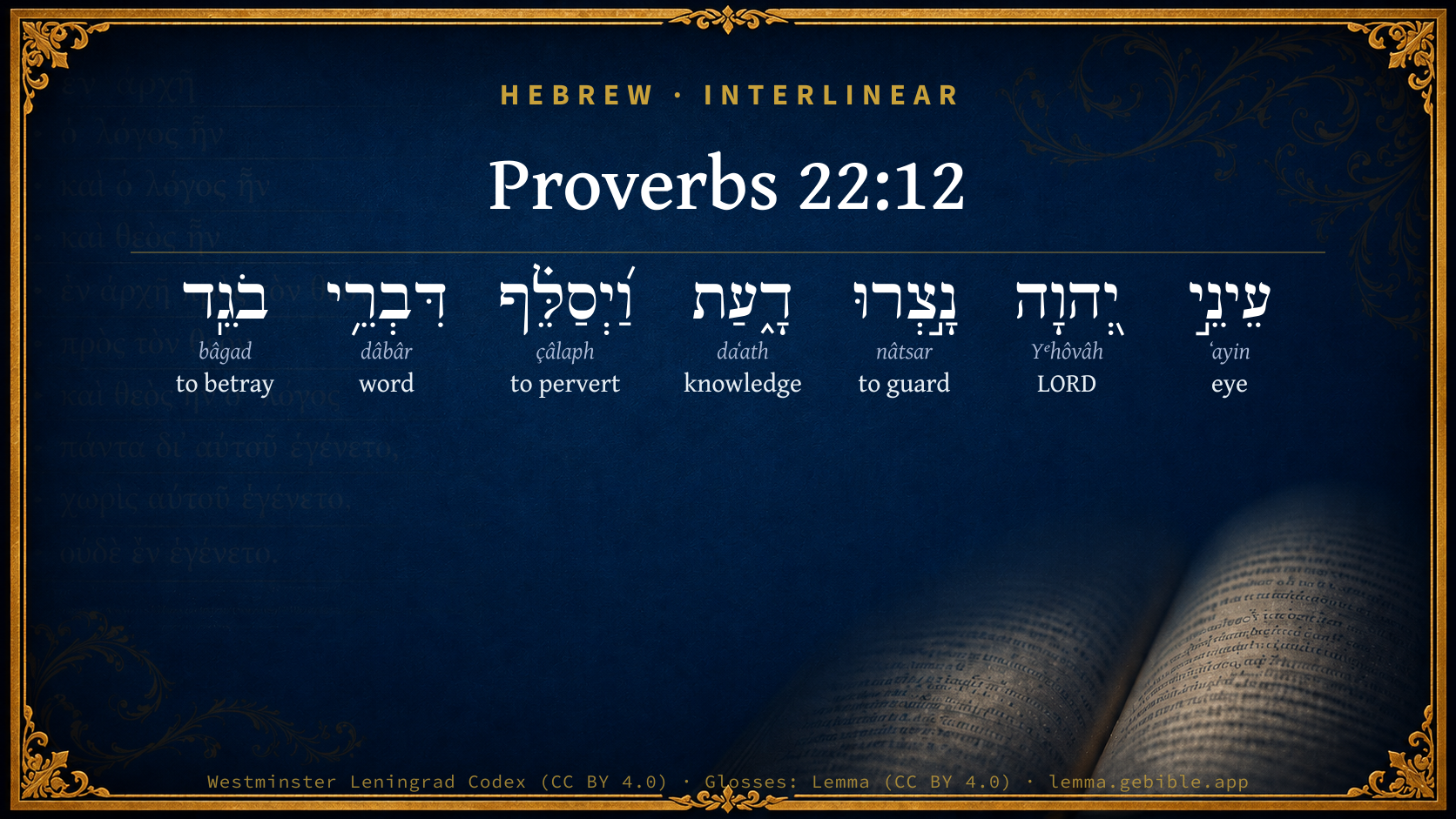
Hebrew (Westminster Leningrad Codex) Proverbs 22:12 appears in the Hebrew Old Testament. The text above is from the Westminster Leningrad Codex. Each word links to its Strong’s number, a concise gloss, and parsing drawn from the Open Scriptures Hebrew Bible morphology. Click any word for its full Brown-Driver-Briggs (BDB) entry.
Download image
Cite this verse

Proverbs 22:12 (World English Bible). Public Domain. Lemma interlinear Bible study tool, https://lemma.gebible.app/v/proverbs/22/12.

Show BibTeX & RIS
BibTeX
RIS
English Translation
The eyes of Yahweh watch over knowledge; But he frustrates the words of the unfaithful.
World English Bible · Public Domain
Download a study sheet

One document with this verse’s original text, its word-by-word gloss line, the meaning frame, cross-references with their text, attributed commentary, and full source and license credits — printable, and it pastes into notes with its structure intact.

This verse Autodidact and up

Study sheet (.html) Plain text (.txt)

A passage Seminary Student

Up to 50 verses in one chapter. A passage sheet keeps up to 6 commentary sources and 12 cross-references per verse, in the order this page ranks them, and says so on the sheet whenever that leaves anything out. Ask for a single verse and you get the Autodidact verse sheet above.

Everything on this page stays free to read, with no account — the sheet is a download of what is already on screen, not access to it.

Want to remove ads? Support Godless Engineer
Compare translations 3

The same verse in 3 English versions, stacked beneath the original-language interlinear above. Click any original word for its lexicon entry.

Each is an independent rendering of the whole verse — the interlinear is not word-aligned to these translations.

Highlighted words mark where these versions differ — a whole-verse word diff, not a word-by-word alignment.

  • World English Bible Public Domain
    The eyes of Yahweh watch over knowledge; But he frustrates the words of the unfaithful.
  • King James Version Public Domain
    The eyes of the LORD preserve knowledge, and he overthroweth the words of the transgressor.
  • unfoldingWord Literal Text CC BY-SA 4.0
    The eyes of Yahweh guard knowledge, but he overturns the words of a treacherous one.

unfoldingWord Literal Text — © unfoldingWord, licensed CC BY-SA 4.0. Word-aligned USFM3 via Door43 (git.door43.org/unfoldingWord/en_ult).

Versions to compare (up to 4)

3 of 4 selected

Show all 18 translations

Every available English version of this verse, each an independent rendering of the whole verse.

  • World English Bible Public Domain
    The eyes of Yahweh watch over knowledge; But he frustrates the words of the unfaithful.
  • Berean Standard Bible Public Domain
    The LORD’s eyes keep watch over knowledge, but He frustrates the words of the faithless.
  • Majority Standard Bible Public Domain
    The LORD’s eyes keep watch over knowledge, but He frustrates the words of the faithless.
  • King James Version Public Domain
    The eyes of the LORD preserve knowledge, and he overthroweth the words of the transgressor.
  • American Standard Version (1901) Public Domain
    The eyes of Jehovah preserve `him that hath' knowledge; But he overthroweth the words of the treacherous man.
  • Revised Version (1885) Public Domain
    The eyes of the LORD preserve him that hath knowledge, but he overthroweth the words of the treacherous man.
  • Geneva Bible (1599) Public Domain
    The eyes of the Lord preserue knowledge: but hee ouerthroweth the wordes of the transgressour.
  • Douay-Rheims (1899) Public Domain
    The eyes of the Lord preserve knowledge: and the words of the unjust are overthrown.
  • Young's Literal Translation Public Domain
    The eyes of Jehovah have kept knowledge, And He overthroweth the words of the treacherous.
  • Literal Standard Version CC BY-SA 4.0
    The eyes of YHWH have kept knowledge, || And He overthrows the words of the treacherous.
  • Unlocked Literal Bible CC BY-SA 4.0
    The eyes of Yahweh keep watch over knowledge, but he overthrows the words of the treacherous.
  • unfoldingWord Literal Text CC BY-SA 4.0
    The eyes of Yahweh guard knowledge, but he overturns the words of a treacherous one.
  • Darby Bible Public Domain
    The eyes of Jehovah preserve knowledge; but he overthroweth the words of the unfaithful.
  • World Messianic Bible Public Domain
    The LORD’s eyes watch over knowledge, but he frustrates the words of the unfaithful.
  • Webster's Bible Public Domain
    The eyes of the LORD preserve knowledge, and he overthroweth the words of the transgressor.
  • Free Bible Version CC BY-SA 4.0
    The Lord watches over true knowledge, but counteracts the words of liars.
  • Bible in Basic English Public Domain
    The eyes of the Lord keep knowledge, but by him the acts of the false man will be overturned.
  • JPS Tanakh (1917) Public Domain
    The eyes of the LORD preserve him that hath knowledge, but He overthroweth the words of the faithless man.

Literal Standard Version (2020), Covenant Press — licensed CC BY-SA 4.0. Text via the HelloAO Bible API (eBible.org). Unlocked Literal Bible (unfoldingWord) — licensed CC BY-SA 4.0. Text via the HelloAO Bible API (eBible.org). unfoldingWord Literal Text — © unfoldingWord, licensed CC BY-SA 4.0. Word-aligned USFM3 via Door43 (git.door43.org/unfoldingWord/en_ult). Free Bible Version, Dr. Jonathan Gallagher — licensed CC BY-SA 4.0. Text via the HelloAO Bible API (eBible.org).

Word by word

More ways to search: Search by grammar → Find every occurrence → Compare this word →

Practice this passage: Drill this verse → Learn its vocabulary →

About this verse

These counts appear in no published source. They are computed here, from the morphology-tagged text and Lemma’s own curated glosses. What Lemma adds →

7
words
7
distinct lemmas
Wisdom
section

Notable vocabulary

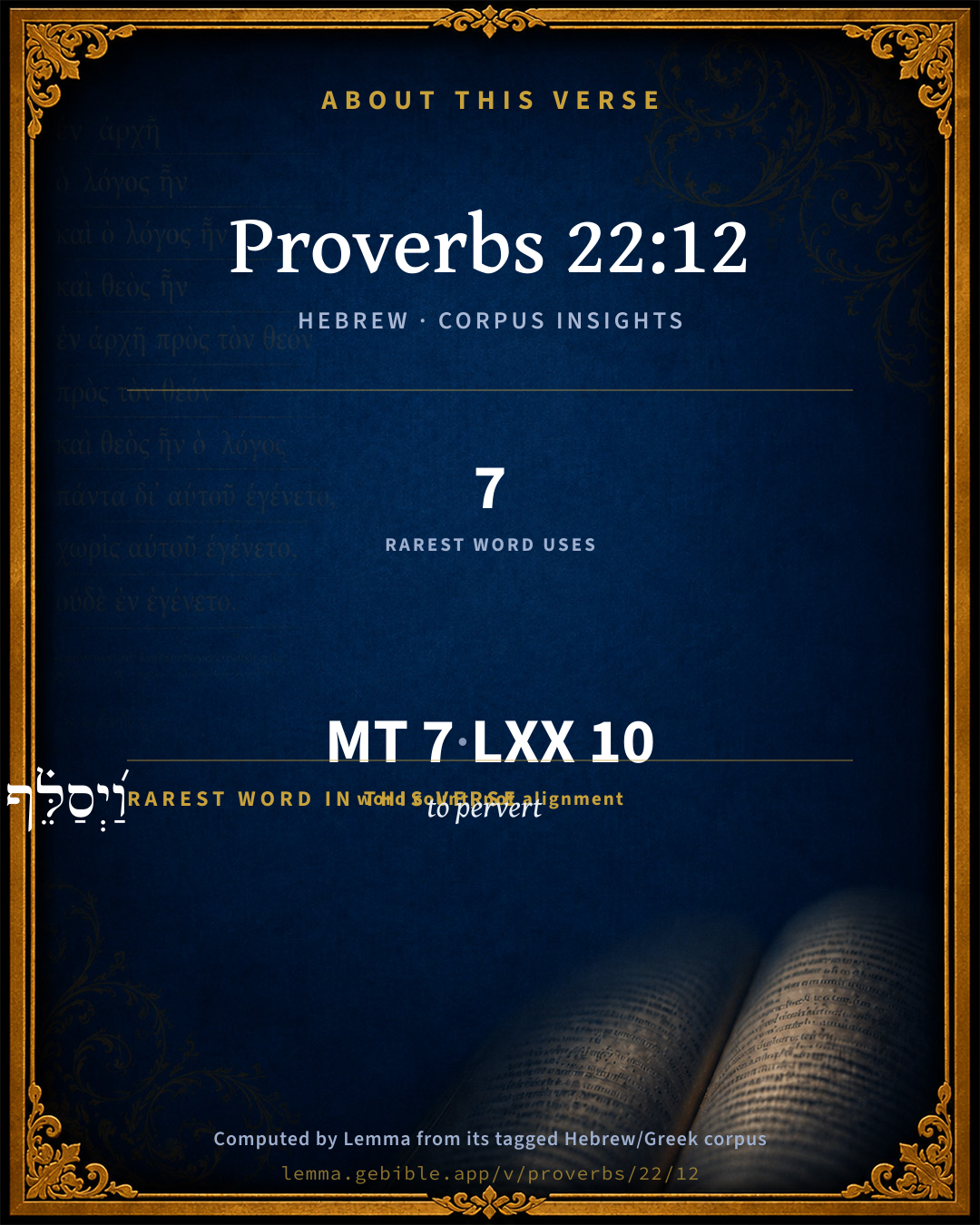
The rarest word here is וַ֝יְסַלֵּ֗ף to pervert H5557 — appearing just 7 times in the whole Hebrew Bible.

Shared distinctive vocabulary

וַ֝יְסַלֵּ֗ף to pervert H5557 occurs in 7 verses of the Hebrew Bible. Also found in:

Grammatical profile

  • 3 verbs
  • 4 nouns

Verb forms

  • נָ֣צְרוּ Qal · Perfect
  • וַ֝יְסַלֵּ֗ף Piel · Sequential Imperfect
  • בֹגֵֽד Qal · Participle Active

Hebrew & Septuagint length

In English translation the verse runs 15 words from the Hebrew and 14 from the Septuagint (LXX English) — closely comparable.

A rough comparison of the two English renderings, which tokenize alike — not a word-level alignment.

Word counts can differ between the Hebrew and the Greek without any difference in meaning — e.g. the Hebrew direct-object marker אֵת has no separate Greek word, and Greek often adds the article ὁ.

In the original languages it is 7 Hebrew tokens and 10 Greek tokens — but the two are counted differently (Hebrew bundles its prefixes and suffixes into one token; the Greek is in lemma form), so that isn’t a like-for-like length.

Cross-references

12

Topical passages linked to Proverbs 22:12 in the Treasury of Scripture Knowledge — connected by theme and wording, ordered by reader-vote popularity; previews shown in the World English Bible.

  • 2 Timothy 3:8–9 Even as Jannes and Jambres opposed Moses, so do these also oppose the truth; men corrupted in mind, reprobate concerning the faith.
  • 2 Chronicles 16:9 For the eyes of Yahweh run back and forth throughout the whole earth, to show himself strong in the behalf of them whose heart is perfect toward him. Herein you have done foolishly; for from henceforth you shall have wars.
  • Acts 13:8–12 But Elymas the sorcerer (for so is his name by interpretation) withstood them, seeking to turn aside the proconsul from the faith.
  • Job 5:12–13 He frustrates the devices of the crafty, So that their hands can't perform their enterprise.
  • Acts 12:23–24 Immediately an angel of the Lord struck him, because he didn't give God the glory, and he was eaten by worms and died.
  • 2 Thessalonians 2:8 Then the lawless one will be revealed, whom the Lord will kill with the breath of his mouth, and bring to nothing by the brightness of his coming;
  • Isaiah 59:19–21 So shall they fear the name of Yahweh from the west, and his glory from the rising of the sun; for he will come as a rushing stream, which the breath of Yahweh drives.
  • Matthew 16:16–18 Simon Peter answered, "You are the Christ, the Son of the living God."
  • Acts 5:39 But if it is of God, you will not be able to overthrow it, and you would be found even to be fighting against God!"
  • Acts 8:9–12 But there was a certain man, Simon by name, who used to practice sorcery in the city, and amazed the people of Samaria, making himself out to be some great one,
  • Revelation 11:3–11 I will give power to my two witnesses, and they will prophesy one thousand two hundred sixty days, clothed in sackcloth."
  • Revelation 12:14–17 Two wings of the great eagle were given to the woman, that she might fly into the wilderness to her place, so that she might be nourished for a time, and times, and half a time, from the face of the serpent.

Cross-references courtesy of OpenBible.info (CC BY 4.0).

Hebrew and Greek witnesses Masoretic Hebrew ↔ Greek Septuagint

The same verse in the two great witnesses to the Old Testament, shown verse-for-verse.

These are two independent witnesses, not word-aligned to each other, and the Septuagint is shown in lemma (dictionary) form.

Hebrew Proverbs 22:12 Masoretic · Westminster Leningrad Codex

עֵינֵ֣י יְ֭הוָה נָ֣צְרוּ דָ֑עַת וַ֝יְסַלֵּ֗ף דִּבְרֵ֥י בֹגֵֽד

The eyes of Yahweh watch over knowledge; But he frustrates the words of the unfaithful.

World English Bible · Public Domain

Greek LXX Proverbs 22:12 Septuagint · lemma form

ὁ δέ ὀφθαλμός κύριος διατηρέω αἴσθησις φαυλίζω δέ λόγος παράνομος

But the eyes of the Lord preserve discretion; but the transgressor despises wise words.

LXX2012 (modern English Septuagint) · Public Domain

On this verse, The Pulpit Commentary discusses the Septuagint’s reading. Read the note in Commentary ↓

Hebrew: Westminster Leningrad Codex (CC BY 4.0). Greek: Septuagint (public domain); English from LXX2012 (modern English Septuagint) (Public Domain). How the Septuagint differs from the Hebrew →

Commentary

Notes on Proverbs 22:12 from classic Christian and Jewish commentators (each source and its license shown beneath its notes). The classic Christian expositions comment on the surrounding passage and are grouped to its opening verse, so a note may address several verses; the Jewish commentaries on the Tanakh (Rashi and others) are per-verse, so they appear only where the commentator wrote on this verse.

Lemma curates 59 commentaries, every one of them public domain or Creative Commons licensed, each selected and text-cleaned for this edition rather than reprinted as found. About our sources →

Trapp's Complete Commentary

John Trapp

Pro 22:12 The eyes of the LORD preserve knowledge, and he overthroweth the words of the transgressor.

Ver. 12. The eyes of the Lord preserve knowledge.] That is, Knowing persons. Those in the former verse that love truth in the inward parts, and hold this a rule, Truth must be spoken, however it be taken; these, howsoever they may suffer for a season, as Daniel in the den, Micaiah in the stock house, yet the watchful providence of God will preserve them, and provide for them. He will clear their innocence, and so plead for them in the hearts of greatest princes, that they shall find the truth of this divine proverb, and the falsity of that other so common among men, Obsequium amicos, veritas odium parit; Flattery gets friends, but truth hatred.

And he overthroweth the words (or matters) of the transgressors.] That is, Of the court parasites, who speak only pleasing things, et saepe leonum laudibus murem obruunt, flatter abominably, as those in Act 12:21-23 did Herod; as the false prophets did Ahab. God will confute and convince their soothing words of singular vanity; he will also overthrow their matters, attempts, practices, "as a man wipeth a dish, turning it upside down." {2Ki 21:13} See in that claw back Amalekite, {2Sa 1:4-10} in Ahithophel, Haman, Sejanus, &c.

John Trapp, A Commentary or Exposition upon All the Books of the Old and New Testament (1647–1656) — public domain. Text from a community e-Sword module.

Joseph Benson's Commentary

Pro 22:12. The eyes of the Lord preserve knowledge — God, by the watchful eye of his providence, maintains and defends men of knowledge, or wise and good men, such as the last verse spoke of, whose hearts are pure, and speeches gracious. Not only shall the king be their friend, as he said there, but God also, which he adds here. And he overthroweth the words of the transgressor — Their false and flattering speeches, whereby they designed and expected to gain the favour and friendship of great men, which are opposed to the sincere and gracious speeches of good men, implied in the first clause of this verse, and expressed in the foregoing verse.

Joseph Benson's Commentary on the Old and New Testaments (1811–1818) — public domain. Text from a community e-Sword module.

The Preacher's Complete Homiletical Commentary

Joseph S. Exell (gen. ed.)

MAIN HOMILETICS OF Pro_22:12

THE PRESERVATION OF KNOWLEDGE

I. God preserves knowledge by preserving the man who possesses the knowledge. The preservation of the life of the man of science who has discovered some secret of nature is a preservation of the knowledge that he has gained. If the discovery has been made by him alone and he dies before he has revealed it, the knowledge is lost to the world. When a physician is acquainted with a special remedy or method of treatment for a certain disease which is known only to himself, the preservation of his life is the preservation of this special knowledge. If he leaves the world without imparting what he knows to another man, his secret dies with him—the abstract knowledge is not left behind when the man who possessed it is gone. All knowledge is preserved to us from age to age by its being communicated from one human being to another, as one generation succeeds the other, and the hand of God is to be recognised in its preservation. But this is especially true of the knowledge of God. In the days of old, God long preserved a knowledge of Himself in the world by preserving the life of Noah, of Abraham, of Isaac and of Jacob. They stood almost alone in the world in this respect, and were like lighthouses on a dark and stormy ocean, sheltering and preserving a moral light in the moral darkness. If the lighthouse is destroyed the light goes out; and if these men had died without transmitting to others the light which they possessed, the world would have been left in ignorance of God. As the ages have rolled on, there have been more of these spiritual lighthouses, and God has always preserved a sufficient number upon the earth to bear witness of Himself.

II. God has preserved knowledge by causing special care to be taken of His written Word. Holy men of old wrote as they were moved by the Holy Ghost, and the record of the truths which were revealed to them is with us until this day. The knowledge of the way of salvation through Jesus Christ has thus been preserved for nearly nineteen centuries, and to-day we can become as familiar with the events of the Incarnation, and with the teachings of the Apostles, as if we had lived in the first century of the Christian era. Although many efforts have been made to destroy the Scriptures of truth, they are with us still, preserved by the providence of their Divine author, in order that men may not be without the means of becoming wise unto salvation through believing the truths which they contain. There have been dark days when the living guardians of Divine truth were hardly to be found; but if they had quite died out after the Bible was written we should still have had this source of spiritual knowledge with us, like a seed-corn, preserving within its husk the living germ, ready to burst forth and grow when it found a congenial soil. God, as the preserver of the knowledge of Himself, has made its safety doubly sure by not only committing it to the living man, but by causing it to be committed to the written page.

III. The preservation of knowledge by the Lord counteracts the evil and false words of wicked men. Acquaintance with truth concerning anything overthrows all false ideas and teachings concerning it. The coming of the morning light scatters all the darkness of night, and with it many false conceptions as to what is around a traveller on an unknown road. So a knowledge of Divine truth scatters error, and overthrows false conceptions concerning God and godliness, and convicts their enemies of falsehood, thus rendering them powerless to do harm. Our Lord, by His knowledge, thus overthrew the words of a great transgressor in His temptation in the wilderness, and it is by the spread of this knowledge of God which He has Himself preserved to us that the final overthrow of evil will be accomplished.

OUTLINES AND SUGGESTIVE COMMENTS

There is still another sense of the words,—which they may bear; though by some, perhaps, it may be regarded as fanciful:—“The eyes of the Lord keep knowledge:”—they retain it. What He sees, be it but for a moment, does not, as with our vision, pass away. It remains. We see, and, having seen, what passes from the eye passes also from the memory. Not so is it with God’s vision. The sight of His eye is no uncertain or forgetful glance. It is unerring and permanent. All that His eyes have ever seen is known as perfectly now as when it passed before them,—as when it existed or happened!—And in the exercise of this permanent and perfect knowledge, “He overthroweth the words of the transgressors.” All their evil desert remains before Him. They can neither elude His knowledge, nor bribe His justice, nor resist His power. They shall all be made to learn by fearful experience, “whose words shall stand, His, or theirs!”—Wardlaw.

When knowledge seemed on the eve of perishing, a single copy of the Scriptures, found as it were accidentally, preserved it from utter extinction. (2Ch_34:14-18). For successive generations the Book was in the custody of faithful librarians, handed down in substantial integrity. (Rom_3:2) When the church herself was on the side of the Arian heresy, the same watchful eyes raised up a champion (Athanasius) to preserve the testimony. Often has the infidel transgressor laboured with all the might of man for its destruction. Often has Rome partially suppressed it, or committed it to the flames, or circulated perverted copies and false interpretations. Yet all these words and deeds of the transgressors have been overthrown.—Bridges.

The eyes of the Lord are His knowledge, and it is in Him, in His knowledge that knowledge is preserved. That is the bottomless treasure of it; from thence issue out all the veins of knowledge, wherewith the world is enriched. It is He that preserveth knowledge for the seekers of it, it is He that preserveth knowledge in the teachers of it.… His eyes shall watch over it, and though blindness put out the eyes of many, yet in Goshen it shall shine and bring comfort to His people.—Jermin.

The Preacher's Complete Homiletical Commentary (gen. ed. Joseph S. Exell; Funk & Wagnalls, c. 1892) — public domain (pre-1929). A full-Bible homiletical/sermon-outline anthology covering 65 of 66 books (2 John is absent from the source module). Text from a community e-Sword module.

Tyndale Open Study Notes

Tyndale Open Resources

22:12 This proverb reminds the wise (those with knowledge) that the Lord is in control.

Tyndale Open Study Notes — © Tyndale Open Resources, licensed CC BY-SA 4.0. Text via the HelloAO Bible API.

Geneva Bible (1599)

Geneva Bible translators

Favor them that love knowledge.

Geneva Bible (1599) marginal notes — public domain. Text via Bolls.life.

Matthew Henry's Commentary

Here is, 1. The special care God takes to preserve knowledge, that is, to keep up religion in the world by keeping up among men the knowledge of himself and of good and evil, notwithstanding the corruption of mankind, and the artifices of Satan to blind men's minds and keep them in ignorance. It is a wonderful instance of the power and goodness of the eyes of the Lord, that is, his watchful providence. He preserves men of knowledge, wise and good men (Ch2 16:9), particularly faithful witnesses, who speak what they know; God protects such, and prospers their counsels. He does by his grace preserve knowledge in such, secures his own work and interest in them. See Pro 2:7, Pro 2:8. 2. The just vengeance God takes on those that speak and act against knowledge and against the interests of knowledge and religion in the world: He overthrows the words of the transgressor, and preserves knowledge in spite of him. He defeats all the counsels and designs of false and treacherous men, and turns them to their own confusion.

Matthew Henry's Commentary on the Whole Bible (1708–1710) — public domain (CC PDM 1.0). Text via the HelloAO Bible API.

Jamieson, Fausset & Brown

Robert Jamieson, A. R. Fausset & David Brown

preserve--or guard.

knowledge--its principles and possessors.

overthroweth--utterly confounds and destroys the wicked.

Jamieson, Fausset & Brown — Commentary Critical and Explanatory on the Whole Bible (1871) — public domain (CC PDM 1.0). Text via the HelloAO Bible API.

Adam Clarke's Commentary

Verse 12. The eyes of the Lord - (the Divine providence) preserve knowledge] This providence has been wonderfully manifested in preserving the sacred oracles, and in preserving many ancient authors, which have been of great use to the civil interests of man.

Adam Clarke's Commentary on the Bible (1810–1826) — public domain. Text from a community e-Sword/MySword module.

Ellicott's Commentary for English Readers

(12) The eyes of the Lord preserve knowledge—i.e., men who know and speak the truth. (See above on Pro_21:28.)

He overthroweth the words of the transgressor—i.e., the deceitful; He brings his lies to light.

A Bible Commentary for English Readers, edited by Charles John Ellicott (1878–1897) — public domain. Text from a community e-Sword module.

The Cambridge Bible for Schools and Colleges

gen. ed. J. J. S. Perowne

12. knowledge] R.V. rightly inserts him that hath, before knowledge.

transgressor] Rather, treacherous man, R.V.

The Cambridge Bible for Schools and Colleges (gen. ed. J. J. S. Perowne; Cambridge University Press, 1878–1918) — public domain. Text from a community e-Sword module.

John Gill's Exposition

The eyes of the Lord preserve knowledge,.... That is, the providence of God, whose eyes run to and fro throughout the whole earth; these preserve the knowledge of himself, even among the Heathens in some measure; for what may be known of God is manifest in them, and showed to them: more particularly his providence has preserved the Scriptures, the means of knowledge, which men would have destroyed; and preserves men of knowledge, as Aben Ezra interprets it, the ministers of the word, the stars he holds in his right hand; and he preserves spiritual and experimental knowledge in the hearts of his people, and causes it to increase; and continues his Gospel and a Gospel ministry in the world, till they all come to the unity of the faith, and the knowledge of the Son of God. Or his eyes observe, look unto with delight and pleasure, knowledge and men of knowledge, that know him, and do his will;

and he overthroweth the words of the transgressor; the perfidious, treacherous man; the false teacher, that corrupts the word of God, and handles it deceitfully: the doctrines of such he overthrows, and confutes, and brings to nothing, by his Spirit in his faithful ministers; and causes truth to prevail, and all iniquity to stop its mouth: particularly the words and doctrines of the great transgressor, the lawless and wicked one, the man of sin, antichrist; these have been exposed and overthrown already, and will be more and more so in God's due time.

John Gill's Exposition of the Whole Bible (1746–1763) — public domain (CC PDM 1.0). Text via the HelloAO Bible API.

Matthew Poole's English Annotations

The eyes of the Lord preserve, God by the watchful eye of his providence maintains and defends,

knowledge, to wit, men of knowledge; the abstract being put for the concrete, as pride is put for a proud man, Psa 36:11, deceit for the deceitful, as Pro 12:17; so here knowledge for knowing and good men, such as the last verse spoke of, whose hearts are pure, and speeches gracious; not only the king shall be their friend, as he said there, but God also, which he adds here,

The words; their false and flattering speeches, whereby they designed and expected to gain the favour and friendship of great men, which are opposed to the sincere and gracious speeches of good men, implied in the first cause of this verse, and expressed in the foregoing verse; or, as others render it, and the word is very commonly used, the matters; all his counsels, hopes, enterprises, and concerns.

Matthew Poole's English Annotations on the Holy Bible (1683–1685) — public domain. Text from a community e-Sword/MySword module.

Whedon's Commentary on the Bible

Daniel D. Whedon

12. Preserve knowledge — Stand guard over it. It would seem from the next clause that knowledge is here used for the concrete — the knowing, the intelligent. Providence especially guards those who join piety with intelligence, or defends their sayings and teachings — the knowledge which they communicate.

Transgressor — The treacherous. Comp. Pro_13:6; Pro_21:12.

Daniel D. Whedon (gen. ed.), Commentary on the Old and New Testaments (1874–1909) — public domain. Text from a community e-Sword module.

The Pulpit Commentary

The eyes of the Lord preserve knowledge. The expression, "preserve knowledge," is found at Pro_5:2 (where see note) in the sense of "keep," "retain," and, taken by itself, it might here signify that the Lord alone possesses knowledge, and alone imparts it to his servants; (1Sa_2:3) but as in the following clause a person, the transgressor, is spoken of, it is natural to expect a similar expression in the former. The Revised Version is correct in rendering the abstract "knowledge" by the concrete "him that hath knowledge;" so that the clause says that God watches over and protects the man who knows him and walks in his ways, and uses his means and abilities for the good of others. (see Pro_11:9) But he (the Lord) overthroweth the words of the transgressor. The transgressor here is the false, treacherous, perfidious man; and the gnome asserts that God frustrates by turning in another direction the outspoken intentions of this man, which he had planned against the righteous. (comp. Pro_13:6 Pro_21:12) Septuagint, "But the eves of the Lord preserve knowledge, but the transgressor despiseth words," i.e. commands, or words of wisdom and warning.

The Pulpit Commentary (1880–1919), ed. H.D.M. Spence-Jones & Joseph S. Exell — public domain. Text from a community e-Sword module.

John Wesley's Explanatory Notes

Preserve - God by the watchful eye of his providence maintains and defends. Knowledge - Men of knowledge, knowing and good men. The matters - All his hopes, enterprizes, and concerns.

John Wesley, Explanatory Notes Upon the Whole Bible (1754–1765) — public domain. Text via the GEBible commentary corpus.

Keil & Delitzsch

C. F. Keil & F. Delitzsch

12 The eyes of Jahve preserve knowledge;

So he frustrateth the words of the false.

The phrase "to preserve knowledge" is found at Pro 5:2; there, in the sense of to keep, retain; here, of protecting, guarding; for it cannot possibly be said that the eyes of God keep themselves by the rule of knowledge, and thus preserve knowledge; this predicate is not in accord with the eyes, and is, as used of God, even inappropriate. On the other hand, after "to preserve," in the sense of watching, guarding a concrete object is to be expected, cf. Isa 26:3. We need not thus with Ewald supply יודע; the ancients are right that דעת, knowledge, stands metonymically for אישׁ (Meri), or אנשׁי (Aben Ezra), or יודעי דעת (Arama); Schultens rightly: Cognitio veritatis ac virtutis practica fertur ad homines eam colentes ac praestantes. Where knowledge of the true and the good exists, there does it stand under the protection of God. 12b shows how that is meant, for there the perf. is continued in the second consec. modus (fut. consec.): there is thus protection against the assaults of enemies who oppose the knowledge which they hate, and seek to triumph over it, and to suppress it by their crooked policy. But God stands on the side of knowledge and protects it, and consequently makes vain the words (the outspoken resolutions) of the deceitful. Regarding סלף (סלף), vid., Pro 11:3 and Pro 19:3. The meaning of סלּף דּברי is here essentially different from that in Exo 23:8; Deu 16:19 : he perverteth their words, for he giveth them a bearing that is false, i.e., not leading to the end. Hitzig reads רעות [wickedness] for דעת, which Zckler is inclined to favour: God keeps the evil which is done in His eyes, and hinders its success; but "to observe wickedness" is an ambiguous, untenable expression; the only passage that can be quoted in favour of this "to observe" is Job 7:20. The word דעת, handed down without variation, is much rather justified.

Keil & Delitzsch — Biblical Commentary on the Old Testament (1861–1891) — public domain (CC PDM 1.0). Text via the HelloAO Bible API. (Old Testament only.)

Bridges on Proverbs

Charles Bridges

The eyes of the LORD often describe his searching Omniscience;†1 here his fatherly care.†2 There are so many inlets to false principles; such spacious appearances to warp the judgment, does the subtle enemy pour in; so strong is the natural tendency in the same direction; that but for this gracious covering to preserve knowledge in our hearts, the words of the transgressor might "overthrow our faith." (2Ti 2:17-19 .) Oh! let us seek in close communion with him continued preservation from a cloud upon our intellectual faculties, and spiritual apprehensions for our Christian establishment.

But the proverb illustrates upon a wider scale his faithful keeping of the truth in the world. Indeed it may be regarded as a prophecy in the course of fulfillment to the very end of time.†3 For how wonderfully has the knowledge of God been preserved from age to age; and all the plausible or malignant schemes to blot it out been overthrown! The Scriptures, as the words of knowledge, have been preserved in a far more accurate state than any other book of corresponding antiquity; though man’s wisdom has never been wanting in ingenuity to corrupt it. When knowledge seemed on the eve of perishing, a single copy of the Scriptures, found as it were accidentally, preserved it from utter extinction. (2Ch 34:14-18 .) For successive generations the Book was in the custody of faithful librarians, handed down in substantial integrity. (Rom 3:2 .) When the church herself was on the side of the Arian heresy, the same watchful eyes raised up a champion,†4 to preserve the testimony. In the succeeding dark ages witnesses prophesied, as from the earliest eras of Revelation,†5 some indeed for a long time in sackcloth,†6 until the dawn of a brighter day. Nor was this in peace and quietness. Often has the infidel transgressor labored with all the might of man for its destruction.†7 Often has Rome partially suppressed it, or committed it to the flames, or circulated perverted copies and false interpretations. Yet all these words and deeds of the transgressors have been overthrown. And notwithstanding all heretical corruptions, the eyes of the LORD have preserved knowledge. Still is his word continued among us, with its Divine credentials unimpaired, and its unsearchable store undiminished — a standing miracle of the faithfulness of its Almighty Keeper. Full of joy and confidence is the believer’s acknowledgment — "Concerning thy testimonies, I have known of old, that thou hast founded them for ever." (Psa 119:152 .)

Footnotes:

†1 Pro 5:21; Pro 15:3 . Psa 11:4 .

†2 2Ch 16:9 . Psa 34:15 . Zec 4:10 .

†3 Scott in loco.

†4 Athanasius.

†5 Enoch, Jud 1:14-15 . Noah, 2Pe 2:5 .

†6 Rev 11:3-11; Rev 12:14-17 .

†7 Jer 36:23. The company of Voltaire and his associates.

Charles Bridges, An Exposition of the Book of Proverbs (1846) — public domain. Text from a community e-Sword module.

Kretzmann's Popular Commentary

Paul E. Kretzmann

v. 12. The eyes of the Lord preserve knowledge, for His eyes are fixed in protecting care upon those who observe the norm of true knowledge as found in His Word, and He overthroweth the words of the transgressor, all the proposals and plans by which the wicked intends to harm the believer.

Paul E. Kretzmann, Popular Commentary of the Bible (1921–1924) — public domain. Text from a community e-Sword module.

Lesson kit

Teaching starters — assembled from the data on this page, not authored interpretation. Every prompt links to the verse data it draws on. Edit before teaching.

Proverbs, in the Wisdom, opens this verse with 7 words (7 distinct Hebrew lemmas). Its most distinctive word is çâlaph (“to pervert”). A historical commentator’s framing appears above. Read the whole chapter for the surrounding context.

Discussion questions

  1. The word çâlaph carries the sense “to pervert.” How does it shape the verse?
  2. Exodus 23:8 shares the word «to pervert» with this verse. How do the two illuminate each other?
  3. The translations on this page render this verse differently — a whole-verse word diff, not a word-by-word alignment. What might account for the different wordings?
  4. The verb «נָ֣צְרוּ» is Qal Perfect. How does its form color the action?
  5. Reading how Trapp's Complete Commentary and Joseph Benson's Commentary read this verse, where do the two commentators agree and where do they part?

Things to notice

Reading settings

Reading text

Shown beneath each verse's original-language words.

Old Testament
Old Testament edition

Read the OT as the Masoretic Hebrew (MT) or the Greek Septuagint (LXX).

English shown for the Greek Septuagint (in the Hebrew ↔ Greek comparison).

Comparing translations? Open the Compare panel on any verse page to stack up to four side by side.