
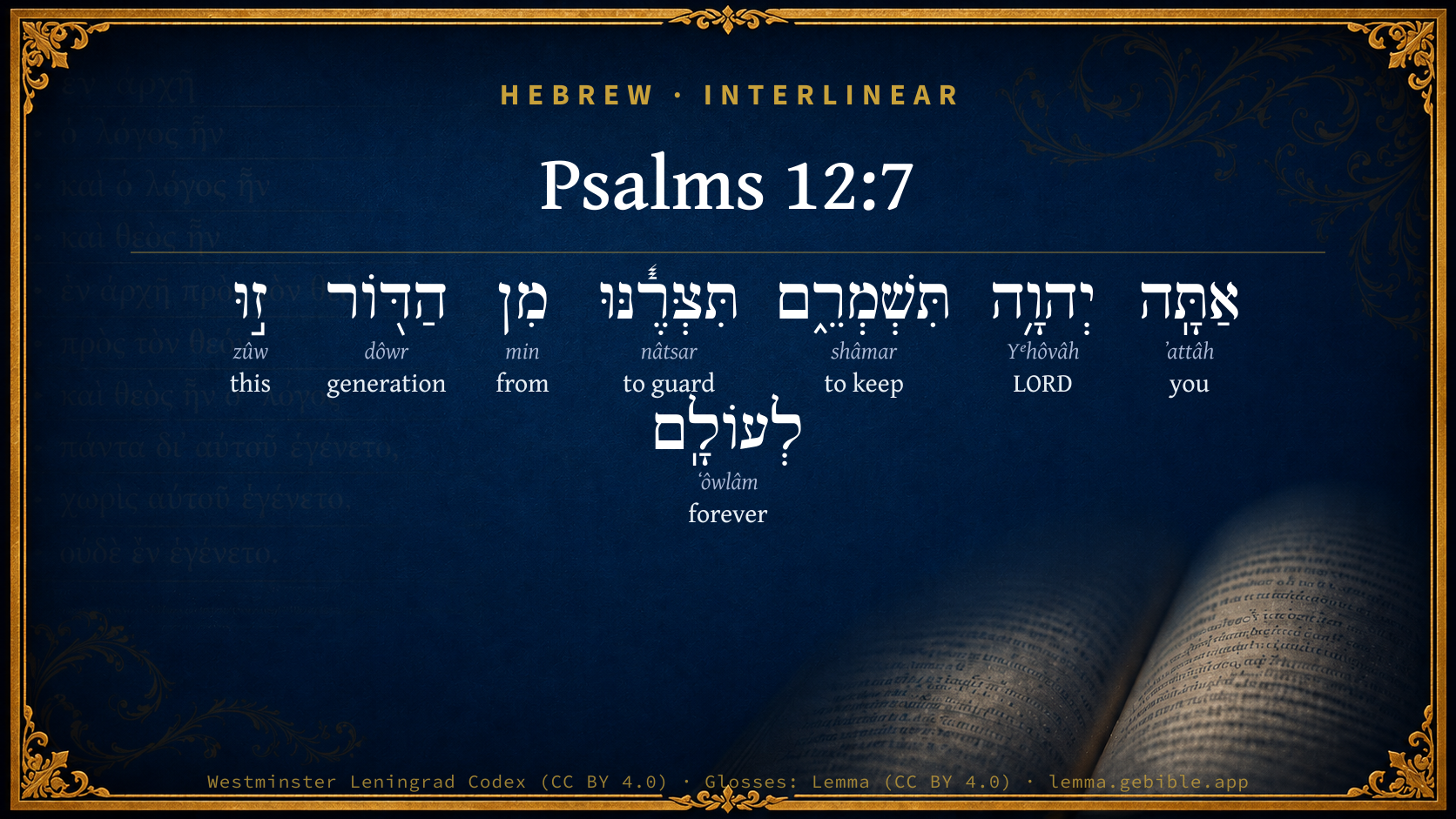
Psalms 12:7

Hebrew (Westminster Leningrad Codex) Psalms 12:7 appears in the Hebrew Old Testament. The text above is from the Westminster Leningrad Codex. Each word links to its Strong’s number, a concise gloss, and parsing drawn from the Open Scriptures Hebrew Bible morphology. Click any word for its full Brown-Driver-Briggs (BDB) entry.
Download image
Cite this verse

Psalms 12:7 (World English Bible). Public Domain. Lemma interlinear Bible study tool, https://lemma.gebible.app/v/psalms/12/7.

Show BibTeX & RIS
BibTeX
RIS
English Translation
You will keep them, Yahweh, You will preserve them from this generation forever.
World English Bible · Public Domain
Download a study sheet

One document with this verse’s original text, its word-by-word gloss line, the meaning frame, cross-references with their text, attributed commentary, and full source and license credits — printable, and it pastes into notes with its structure intact.

This verse Autodidact and up

Study sheet (.html) Plain text (.txt)

A passage Seminary Student

Up to 50 verses in one chapter. A passage sheet keeps up to 6 commentary sources and 12 cross-references per verse, in the order this page ranks them, and says so on the sheet whenever that leaves anything out. Ask for a single verse and you get the Autodidact verse sheet above.

Everything on this page stays free to read, with no account — the sheet is a download of what is already on screen, not access to it.

Want to remove ads? Support Godless Engineer
Compare translations 3

The same verse in 3 English versions, stacked beneath the original-language interlinear above. Click any original word for its lexicon entry.

Each is an independent rendering of the whole verse — the interlinear is not word-aligned to these translations.

Highlighted words mark where these versions differ — a whole-verse word diff, not a word-by-word alignment.

  • World English Bible Public Domain
    You will keep them, Yahweh, You will preserve them from this generation forever.
  • King James Version Public Domain
    Thou shalt keep them, O LORD, thou shalt preserve them from this generation for ever.
  • unfoldingWord Literal Text CC BY-SA 4.0
    You Yahweh, you will keep them. You will protect him from this generation for eternity.

unfoldingWord Literal Text — © unfoldingWord, licensed CC BY-SA 4.0. Word-aligned USFM3 via Door43 (git.door43.org/unfoldingWord/en_ult).

Versions to compare (up to 4)

3 of 4 selected

Show all 18 translations

Every available English version of this verse, each an independent rendering of the whole verse.

  • World English Bible Public Domain
    You will keep them, Yahweh, You will preserve them from this generation forever.
  • Berean Standard Bible Public Domain
    You, O LORD, will keep us; You will forever guard us from this generation.
  • Majority Standard Bible Public Domain
    You, O LORD, will keep us; You will forever guard us from this generation.
  • King James Version Public Domain
    Thou shalt keep them, O LORD, thou shalt preserve them from this generation for ever.
  • American Standard Version (1901) Public Domain
    Thou wilt keep them, O Jehovah, Thou wilt preserve them from this generation for ever.
  • Revised Version (1885) Public Domain
    Thou shalt keep them, O LORD, thou shalt preserve them from this generation for ever.
  • Geneva Bible (1599) Public Domain
    Thou wilt keepe them, O Lord: thou wilt preserue him from this generation for euer.
  • Douay-Rheims (1899) Public Domain
    The words of the Lord are pure words: as silver tried by the fire, purged from the earth refined seven times.
  • Young's Literal Translation Public Domain
    Thou, O Jehovah, dost preserve them, Thou keepest us from this generation to the age.
  • Literal Standard Version CC BY-SA 4.0
    You, O YHWH, preserve them, || You keep us from this generation for all time.
  • Unlocked Literal Bible CC BY-SA 4.0
    You are Yahweh! You keep them. You preserve the godly people from this wicked generation and forever.
  • unfoldingWord Literal Text CC BY-SA 4.0
    You Yahweh, you will keep them. You will protect him from this generation for eternity.
  • Darby Bible Public Domain
    Thou, Jehovah, wilt keep them, thou wilt preserve them from this generation for ever.
  • World Messianic Bible Public Domain
    You will keep them, LORD. You will preserve them from this generation forever.
  • Webster's Bible Public Domain
    \\12:6\\The words of the LORD are pure words: as silver tried in a furnace of earth, purified seven times.
  • Free Bible Version CC BY-SA 4.0
    You, Lord will keep the oppressed safe; you will protect us from these kinds of people forever;
  • Bible in Basic English Public Domain
    You will keep them, O Lord, you will keep them safe from this generation for ever.
  • JPS Tanakh (1917) Public Domain
    (12-8) Thou wilt keep them, O LORD; Thou wilt preserve us from this generation for ever.

Literal Standard Version (2020), Covenant Press — licensed CC BY-SA 4.0. Text via the HelloAO Bible API (eBible.org). Unlocked Literal Bible (unfoldingWord) — licensed CC BY-SA 4.0. Text via the HelloAO Bible API (eBible.org). unfoldingWord Literal Text — © unfoldingWord, licensed CC BY-SA 4.0. Word-aligned USFM3 via Door43 (git.door43.org/unfoldingWord/en_ult). Free Bible Version, Dr. Jonathan Gallagher — licensed CC BY-SA 4.0. Text via the HelloAO Bible API (eBible.org).

Word by word

More ways to search: Search by grammar → Find every occurrence → Compare this word →

Practice this passage: Drill this verse → Learn its vocabulary →

About this verse

These counts appear in no published source. They are computed here, from the morphology-tagged text and Lemma’s own curated glosses. What Lemma adds →

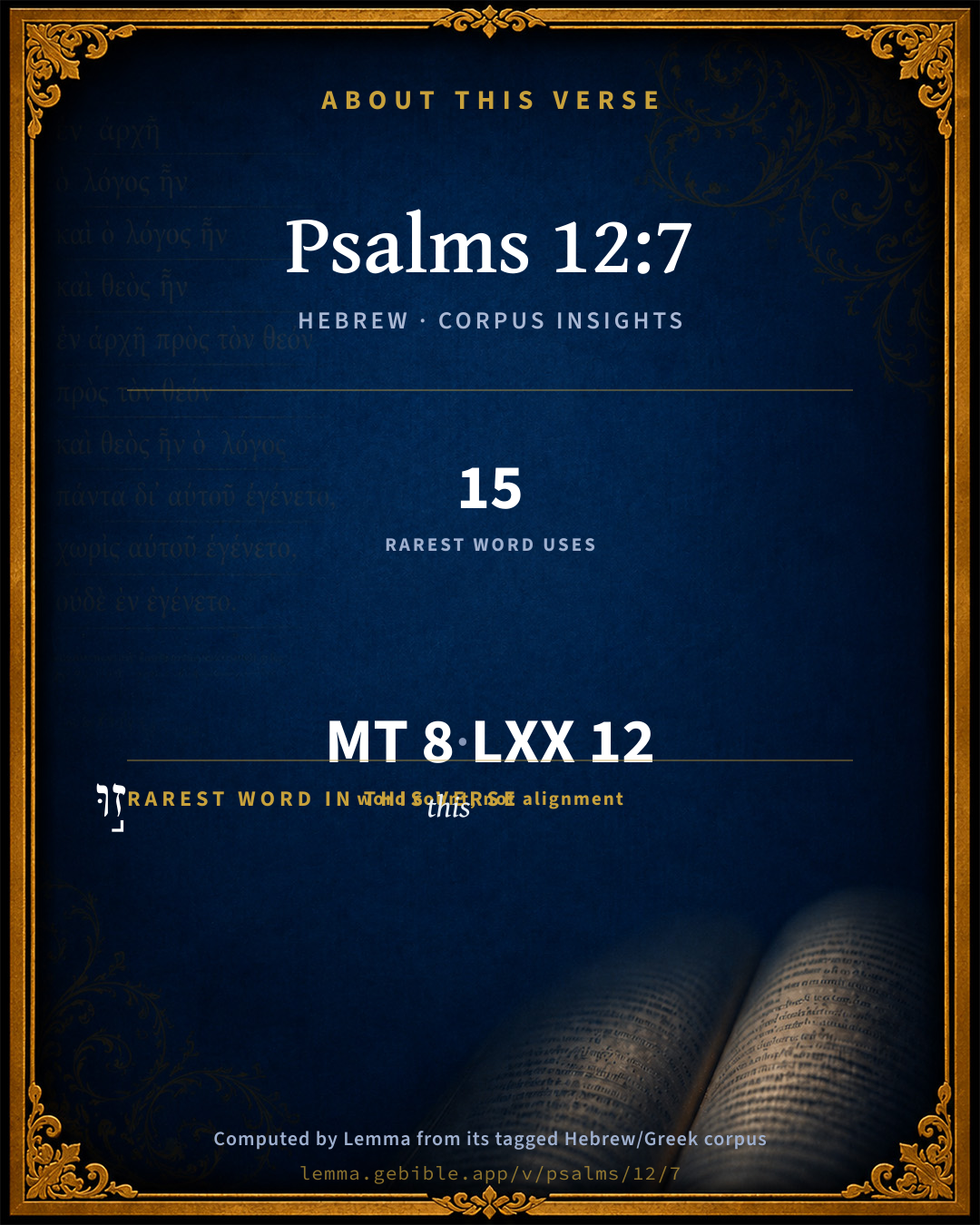
8
words
8
distinct lemmas
Wisdom
section

Notable vocabulary

The rarest word here is ז֣וּ this H2098 — appearing just 15 times in the whole Hebrew Bible.

Shared distinctive vocabulary

ז֣וּ this H2098 occurs in 15 verses of the Hebrew Bible. Also found in:

Grammatical profile

  • 2 verbs
  • 3 nouns
  • 1 pronoun
  • 1 preposition
  • 1 particle

Verb forms

  • תִּשְׁמְרֵ֑ם Qal · Imperfect
  • תִּצְּרֶ֓נּוּ Qal · Imperfect

Hebrew & Septuagint length

In English translation the verse runs 13 words from the Hebrew and 16 from the Septuagint (LXX English) — closely comparable.

A rough comparison of the two English renderings, which tokenize alike — not a word-level alignment.

Word counts can differ between the Hebrew and the Greek without any difference in meaning — e.g. the Hebrew direct-object marker אֵת has no separate Greek word, and Greek often adds the article ὁ.

In the original languages it is 8 Hebrew tokens and 12 Greek tokens — but the two are counted differently (Hebrew bundles its prefixes and suffixes into one token; the Greek is in lemma form), so that isn’t a like-for-like length.

Cross-references

12

Topical passages linked to Psalms 12:7 in the Treasury of Scripture Knowledge — connected by theme and wording, ordered by reader-vote popularity; previews shown in the World English Bible.

  • 1 Samuel 2:9 He will keep the feet of his holy ones; But the wicked shall be put to silence in darkness; For by strength shall no man prevail.
  • Psalms 121:8 Yahweh will keep your going out and your coming in, From this time forth, and forevermore.
  • Psalms 37:40 Yahweh helps them, and rescues them. He rescues them from the wicked, and saves them, Because they have taken refuge in him.
  • Psalms 145:20 Yahweh preserves all those who love him, But all the wicked he will destroy.
  • 1 Peter 1:5 who by the power of God are guarded through faith for a salvation ready to be revealed in the last time.
  • Deuteronomy 33:3 Yes, he loves the people; All his saints are in your hand: They sat down at your feet; [Everyone] shall receive of your words.
  • Psalms 10:18 To judge the fatherless and the oppressed, That man who is of the earth may terrify no more.
  • Psalms 16:1 Preserve me, God, for in you do I take refuge.
  • Psalms 37:28 For Yahweh loves justice, And doesn't forsake his saints. They are preserved forever, But the children of the wicked shall be cut off.
  • Isaiah 27:3 I Yahweh am its keeper; I will water it every moment: lest any hurt it, I will keep it night and day.
  • Matthew 3:7 But when he saw many of the Pharisees and Sadducees coming for his baptism, he said to them, "You offspring of vipers, who warned you to flee from the wrath to come?
  • Jude 1:1 Jude, a servant of Jesus Christ, and brother of James, to those who are called, sanctified by God the Father, and kept for Jesus Christ:

Cross-references courtesy of OpenBible.info (CC BY 4.0).

Hebrew and Greek witnesses Masoretic Hebrew ↔ Greek Septuagint

The same verse in the two great witnesses to the Old Testament, shown verse-for-verse.

You’re reading Greek Psalm 11 (Hebrew Psalm 12). The Septuagint counts the superscription, so verse numbers can differ from the Hebrew — chapter-level alignment, not verse-by-verse. Numbering follows Rahlfs.

These are two independent witnesses, not word-aligned to each other, and the Septuagint is shown in lemma (dictionary) form.

Hebrew Psalms 12:7 Masoretic · Westminster Leningrad Codex

אַתָּֽה יְהוָ֥ה תִּשְׁמְרֵ֑ם תִּצְּרֶ֓נּוּ מִן הַדּ֖וֹר ז֣וּ לְעוֹלָֽם

You will keep them, Yahweh, You will preserve them from this generation forever.

World English Bible · Public Domain

Greek LXX Greek Psalm 11:7 Septuagint · lemma form

ὁ λόγιον κύριος λόγιον ἁγνός ἀργύριον πυρόω δοκίμιον ὁ γῆ καθαρίζω ἑπταπλασίως

You, O Lord, shall keep us, and shall preserve us, from this generation, and for ever.

LXX2012 (modern English Septuagint) · Public Domain

On this verse, Adam Clarke's Commentary discusses the Septuagint’s reading. Read the note in Commentary ↓

Hebrew: Westminster Leningrad Codex (CC BY 4.0). Greek: Septuagint (public domain); English from LXX2012 (modern English Septuagint) (Public Domain). How the Septuagint differs from the Hebrew →

Commentary

Notes on Psalms 12:7 from classic Christian and Jewish commentators (each source and its license shown beneath its notes). The classic Christian expositions comment on the surrounding passage and are grouped to its opening verse, so a note may address several verses; the Jewish commentaries on the Tanakh (Rashi and others) are per-verse, so they appear only where the commentator wrote on this verse.

Lemma curates 59 commentaries, every one of them public domain or Creative Commons licensed, each selected and text-cleaned for this edition rather than reprinted as found. About our sources →

Trapp's Complete Commentary

John Trapp

Psa 12:7 Thou shalt keep them, O LORD, thou shalt preserve them from this generation for ever.

Ver. 7. Thou shall keep them] That is, Verba praedicta, the forementioned words or promises, saith Aben Ezra. Or, keep thou them (prayerwise), and so David puts God’s promises in suit. A certain good man having all taken from him, and his wife desiring to know how he and his family should live? He answered, he would now put his bond in suit; that is, he would urge God with his promises.

Thou shall preserve them] Heb. him, that is, every one of them, viz. the poor and needy, among whom David reckons himself, which shows his humility.

From this generation] So they are called for their multitude, in opposition to those few faithful ones, Psa 12:1. An evil and adulterous generation they were, a bastardly brood, as Mat 12:39. Omne tempus ferct Clodios, Catones non omne feret, saith Seneca.

John Trapp, A Commentary or Exposition upon All the Books of the Old and New Testament (1647–1656) — public domain. Text from a community e-Sword module.

Joseph Benson's Commentary

Psa 12:7. Thou shalt keep them — Thy words or promises last mentioned. Hebrew, תשׁמרם, tishmerem, thou wilt observe them; and what thou hast promised shall surely be performed, since with thee is no variableness nor shadow of turning. Thou wilt preserve them — Hebrew, תצרני, titzrennu thou wilt keep him, that is, thy poor and lowly servant, (spoken of Psa 12:5,) from the craft and malice of this crooked and perverse generation of men, so that he shall neither be circumvented by treachery, nor crushed by power; and thou wilt keep him undefiled amid a corrupt age; and all that trust in and cleave to thee from generation to generation.

Joseph Benson's Commentary on the Old and New Testaments (1811–1818) — public domain. Text from a community e-Sword module.

J. A. Alexander on Psalms

Joseph Addison Alexander

8. (Psa 12:7). Thou, Jehovah, wilt keep them; thou wilt guard him from this generation to eternity, i.e. for ever. In the first clause, though not in the second, the pronoun thou is expressed in Hebrew, and may therefore be regarded as emphatic; see above, on Psa 2:6; Psa 3:4 (3). Thou, and no other, or, thou without the aid of others, wilt preserve them. The plural pronoun in the first clause, and the singular in the second, refer to the same persons, viz., the' sufferers mentioned in Psa 12:7 (6). By a licence common in the Psalms, they are first spoken of as a plurality, and then as an ideal person; see above, on Psa 10:10. This generation, this contemporary race of wicked men, with reference perhaps to the description, in Psa 12:2 (1), of the disproportion between these and the righteous. For ever, as long as the necessity or danger lasts, so long shall the injured innocent experience the divine protection.

Joseph Addison Alexander, The Psalms Translated and Explained (1850) — public domain. Text from a community e-Sword module.

Tyndale Open Study Notes

Tyndale Open Resources

12:7-8 The godly know that the Lord cares, even though the wicked continue to oppress them. The Lord sees the corrupt and foolish people who praise evildoers (see 9:19-20; 14:2-6).

Tyndale Open Study Notes — © Tyndale Open Resources, licensed CC BY-SA 4.0. Text via the HelloAO Bible API.

Geneva Bible (1599)

Geneva Bible translators

That is, thine though he were but one man.

Geneva Bible (1599) marginal notes — public domain. Text via Bolls.life.

Jamieson, Fausset & Brown

Robert Jamieson, A. R. Fausset & David Brown

them--(Margin.)

Jamieson, Fausset & Brown — Commentary Critical and Explanatory on the Whole Bible (1871) — public domain (CC PDM 1.0). Text via the HelloAO Bible API.

Adam Clarke's Commentary

Verse 7. Thou shalt keep them - thou shalt preserve them] Instead of the pronoun them in these clauses, several MSS., with the Septuagint, the Vulgate, and the Arabic, have us. The sense is equally good in both readings. God did bring forth the Israelites from Babylon, according to his word; he separated them from that generation, and reinstated them in their own land, according to his word; and most certainly he has preserved them from generation to generation to the present day, in a most remarkable manner.

Adam Clarke's Commentary on the Bible (1810–1826) — public domain. Text from a community e-Sword/MySword module.

John Calvin's Commentaries

7. Thou, O Jehovah. Some think that the language of the Psalmist here is that of renewed prayer; and they, therefore, understand the words as expressive of his desire, and translate them in the optative mood, thus, Do thou, O Jehovah, keep them “Que tu les gardes, Seigneur.” — Fr.

This is the view adopted by Hammond. He refers the them to the words of the Lord mentioned in the preceding verse, and the him following to the godly, or just man, and explains the verse thus: ”Thou, O Lord, shalt keep, or perform, those words, thou shalt preserve the just man from this generation for ever.” The Chaldee version reads, “Thou wilt keep the just;” the Septuagint, Vulgate, Arabic, and Ethiopic versions read, “Thou wilt keep us;”

“Mais quant a ceux qui elisent, Tu les garderas, as avoir Tes paroles; l’exposition ne me semble pas propre.” — Fr.

“Car il dit premierement, Tu les garderas; et puis, Tu le preserveras.” — Fr.

John Calvin's Commentaries (1540-1563) — public domain. Text from the Calvin Translation Society English edition (1840s-50s) via the Christian Classics Ethereal Library (ccel.org). Calvin's coverage is partial (roughly two-thirds of the Bible); uncommented books and verses are honest gaps, never fabricated. The 19th-century editor's footnotes and remarks are omitted so the notes are faithfully Calvin's own voice.

The Cambridge Bible for Schools and Colleges

gen. ed. J. J. S. Perowne

7. More exactly:

Thou, O Jehovah, wilt preserve them (as Psa_16:1);

Thou wilt guard him &c.

The first Thou is emphatic: them refers to the poor and needy of Psa_12:5 : him in the second line singles out each one of the victims of persecution as the object of divine care. Comp. the similar change from plur. (poor and needy) to sing. in Psa_12:5. But possibly we should follow the LXX and read us, instead of them and him, or at any rate in place of him.

this generation] As the men of one age are commonly distinguished by special characteristics, generation acquires an ethical significance, and denotes kind, class, in good or bad sense. Comp. Psa_14:5; Pro_30:11-14; Mat_17:17.

7, 8. Concluding expression of confidence in Jehovah’s protection, which is sorely needed when wickedness prevails unchecked.

The Cambridge Bible for Schools and Colleges (gen. ed. J. J. S. Perowne; Cambridge University Press, 1878–1918) — public domain. Text from a community e-Sword module.

John Gill's Exposition

Thou shall keep them, O Lord,.... Not the words before mentioned, as Aben Ezra explains it, for the affix is masculine and not feminine; not but God has wonderfully kept and preserved the sacred writings; and he keeps every word of promise which he has made; and the doctrines of the Gospel will always continue from one generation to another; but the sense is, that God will keep the poor and needy, and such as he sets in safety, as Kimchi rightly observes: they are not their own keepers, but God is the keeper of them; he keeps them by his power, and in his Son, in whose hands they are, and who is able to keep them from falling; they are kept by him from a total and final falling away; from the dominion and damning power of sin, and from being devoured by Satan, and from the evil of the world: and this the psalmist had good reason to believe, because of the love of God to them, his covenant with them, and the promises of safety and salvation he has made unto them;

thou shalt preserve them from this generation for ever; or "thou shalt preserve him" (p); that is, everyone of the poor and needy, from the wicked generation of men in which they live, from being corrupted or intimidated by them; and who are described in the beginning of the psalm. Some take these words to be a prayer, "keep thou them, O Lord, and preserve them", &c. (q); and so the following words may be thought to be a reason or argument enforcing the request.

(p) "custodies eum", Pagninus, Montanus, Gejerus, Michaelis; so Ainsworth. (q) "Custodi eum", Tigurine version, Vatablus, "custodito eorum quemque", Junius & Tremellius, Piscator.

John Gill's Exposition of the Whole Bible (1746–1763) — public domain (CC PDM 1.0). Text via the HelloAO Bible API.

Albert Barnes' Notes on the Bible

“Thou shalt keep them That is, the persons referred to in Psa 12:5 - the poor and the needy who were suffering from the wrongs inflicted on them. The idea is, that God would guard and defend them. They were safe in his hands. Compare Psa 37:3-7.

From this generation - This generation, or this race of detractors, flatterers, and oppressors. The idea is, that that entire generation was eminently wicked, and that none but God could deliver the poor and the needy from their designs.

Forever - That is, “constantly,” or as long as they would need the divine protection. God would not interpose and save them from the “present” trouble, and then leave them to the designs of their enemies, but he would “always” interpose as often as there was any need of his help. That is, they were now, and would be at all times, entirely safe. They had nothing to fear, for God was their refuge and their help.

Albert Barnes' Notes on the Bible (1834–1885) — public domain. Text from a community e-Sword/MySword module.

Matthew Poole's English Annotations

Thou shalt keep them; either,

1. The poor and needy, Psa 12:5, from the crafts and malice of this crooked and perverse generation of men, and for ever. Or,

2. Thy words or promises last mentioned, Psa 12:6. These thou wilt observe and keep (as these two verbs commonly signify) both now, and

from this generation for ever, i.e. Thou wilt not only keep thy promise to me in preserving me, and advancing me to the throne, but also to my posterity from generation to generation.

Matthew Poole's English Annotations on the Holy Bible (1683–1685) — public domain. Text from a community e-Sword/MySword module.

The Treasury of David

Charles H. Spurgeon

Ver. 7. To fall into the hands of an evil generation, so as to be baited by their cruelty, or polluted by their influence, is an evil to be dreaded beyond measure; but it is an evil foreseen and provided for in the text. In life many a saint has lived a hundred years before his age, as though he had darted his soul into the brighter future, and escaped the mists of the beclouded present: he has gone to his grave unreverenced and misunderstood, and lo! as generations come and go, upon a sudden the hero is unearthed, and lives in the admiration and love of the excellent of the earth; preserved for ever from the generation which stigmatised him as a sower of sedition, or burned him as a heretic. It should be our daily prayer that we may rise above our age as the mountain tops above the clouds, and may stand out as heaven pointing pinnacle high above the mists of ignorance and sin which roll around us. O Eternal Spirit, fulfil in us the faithful saying of this verse! Our faith believes those two assuring words, and cries, Thou shalt, thou shalt.

None.

Ver. 7. Preservation from one's generation in this life and for ever. A very suggestive theme.

Psalms 12:8*

Charles H. Spurgeon's The Treasury of David (1869–1885) — public domain. Psalms only. Text from a community e-Sword/MySword module.

Whedon's Commentary on the Bible

Daniel D. Whedon

7. Thou shalt keep them—That is, thy people, thy suffering people, though surrounded on all sides by wicked persecutors.

Thou shalt preserve them—Hebrew, Thou wilt preserve him, the persecuted saint, the singular being used as a personification.

From this generation—From the men of this age, and from the same men of every age. The character of the age is given in Psa_12:1-2. Compare Act_2:40; Mat_11:16; Mat_11:22. The hostile attitude of the world towards the Church distinguishes all generations.

For ever—To eternity. The deliverance of the righteous shall not be temporal only, but perpetual, for ever. Less than this neither the language nor subject will admit.

Daniel D. Whedon (gen. ed.), Commentary on the Old and New Testaments (1874–1909) — public domain. Text from a community e-Sword module.

The Pulpit Commentary

Thou shalt keep them, O Lord. God having promised to set the righteous, who are oppressed, in a place of safety (ver. 5), the psalmist is sure that he will keep them and preserve them from the wicked "generation," which has possession of the earth, and bears rule in it, always. It is, no doubt, for the greater consolation and encouragement of these unfortunates that he dwells on the subject, and adds his own assurances to the Divine promise which he has recorded. Man"s faith is so weak that, unless promises and assurances are reiterated, they make little impression. Thou shalt preserve them (Hebrew, him) from this generation for ever. The "generation" is that of the worldly men in power at the time, of whom we have heard in Psa_3:1, Psa_3:2, Psa_3:6, 7 4:2 5:4-6, 9, 10 6:8 7:1, 2, 9, 13-16 10:2-11, 15 11:2, 3, 6. "For ever" means "so long as they live." The substitution of "him" for "them" in this clause is an instance of that generalization by which a whole class is summed up in a single individual men" in "man," "all good men" in "the righteous" (qyDix), and the like.

The Pulpit Commentary (1880–1919), ed. H.D.M. Spence-Jones & Joseph S. Exell — public domain. Text from a community e-Sword module.

John Wesley's Explanatory Notes

Thou shalt keep them - Thy words or promises: these thou wilt observe and keep, both now, and from this generation forever. 8. Walk - They fill all places, and go about boldly and securely.

John Wesley, Explanatory Notes Upon the Whole Bible (1754–1765) — public domain. Text via the GEBible commentary corpus.

Keil & Delitzsch

C. F. Keil & F. Delitzsch

(Heb.: 12:8-9) The supplicatory complaint contained in the first strophe has passed into an ardent wish in the second; and now in the fourth there arises a consolatory hope based upon the divine utterance which was heard in the third strophe. The suffix eem in Psa 12:8 refers to the miserable and poor; the suffix ennu in Psa 12:8 (him, not: us, which would be pointed תצרנוּ, and more especially since it is not preceded by תשׁמרנוּ) refers back to the man who yearns for deliverance mentioned in the divine utterance, Psa 12:6. The "preserving for ever" is so constant, that neither now nor at any future time will they succumb to this generation. The oppression shall not become a thorough depression, the trial shall not exceed their power of endurance. What follows in Psa 12:8 is a more minute description of this depraved generation. דּור is the generation whole and entire bearing one general character and doing homage to the one spirit of the age (cf. e.g., Pro 30:11-14, where the characteristics of a corrupt age are portrayed). זוּ (always without the article, Ew. 293, a) points to the present and the character is has assumed, which is again described here finally in a few outlines of a more general kind than in Psa 12:3. The wicked march about on every side (התחלּך used of going about unopposed with an arrogant and vaunting mien), when (while) vileness among ()ל the children of men rises to eminence (רוּם as in Pro 11:11, cf. משׁל Pro 29:2), so that they come to be under its dominion. Vileness is called זלּוּת from זלל (cogn. דּלל) to be supple and lax, narrow, low, weak and worthless. The form is passive just as is the Talm. זילוּת (from זיל = זליל), and it is the epithet applied to that which is depreciated, despised, and to be despised; here it is the opposite of the disposition and conduct of the noble man, נדיב, Isa 32:8, - a baseness which is utterly devoid not only of all nobler principles and motives, but also of all nobler feelings and impulses. The כּ of כּרם is not the expression of simultaneousness (as e.g., in Pro 10:25): immediately it is exalted - for then Psa 12:8 would give expression to a general observation, instead of being descriptive - but כּרם is equivalent to בּרם, only it is intentionally used instead of the latter, to express a coincidence that is based upon an intimate relation of cause and effect, and is not merely accidental. The wicked are puffed up on all sides, and encompass the better disposed on every side as their enemies. Such is the state of things, and it cannot be otherwise at a time when men allow meanness to gain the ascendency among and over them, as is the case at the present moment. Thus even at last the depressing view of the present prevails in the midst of the confession of a more consolatory hope. The present is gloomy. But in the central hexastich the future is lighted up as a consolation against this gloominess. The Psalm is a ring and this central oracle is its jewel.

Keil & Delitzsch — Biblical Commentary on the Old Testament (1861–1891) — public domain (CC PDM 1.0). Text via the HelloAO Bible API. (Old Testament only.)

Rashi

Rabbi Shlomo Yitzchaki (Rashi)

The sayings of the Lord are pure sayings for He has the ability to fulfill them, but the sayings of the sons of men are not sayings when they die and are unable to fulfill [them].

pure Clear and permanent. Whatever He promises He does, for He promised me salvation and the throne.

silver refined They are like refined silver that is exposed to the entire land. exposed Heb. בעליל, an expression of revealing; in the language of the Mishna (Rosh Hashanah 21b, see Gemara): “whether it was plainly (בעליל) visible or whether it was not plainly (בעליל) visible, etc.” Others explain בעליל as an expression of elevation, and this is its explanation: silver refined with the best earth. That is to say, like silver that is refined with the best earth and its upper layer, because a person makes a crucible to refine the silver from the best earth. Another explanation: בעליל is like בעלי, with a mortar (as in Prov. 27:22): “among grain with a pestle,” which is the name of a utensil in which [grain] is crushed. Similarly, בעליל is the crucible in which gold and silver are smelted. However, this does not seem correct because he does not call עלי the mortar in which [the grain] is crushed, but the handle of the pestle with which they crush. This is called pilon in French, pestle. Another explanation: בעליל is an expression of the master of a hand, i.e., the master of the earth, and the praise of the word applies to God. Targum Jonathan, too, renders it as an expression of lordship. He says that His sayings are like silver, refined by the Lord of the earth, Who is God, for He refined and clarified them.

Rashi on the Tanakh — English translations: “The Judaica Press complete Tanach with Rashi, translated by A. J. Rosenberg” (CC BY 4.0); “Pentateuch with Rashi's commentary by M. Rosenbaum and A.M. Silbermann, 1929-1934” (public domain); “The Metsudah Tanach series, Lakewood, N.J” (CC BY 4.0); and “The Book of Joshua, Metsudah Publications, 1997” (CC BY 4.0). Text via Sefaria.

Lesson kit

Teaching starters — assembled from the data on this page, not authored interpretation. Every prompt links to the verse data it draws on. Edit before teaching.

Psalms, in the Wisdom, opens this verse with 8 words (8 distinct Hebrew lemmas). Its most distinctive word is zûw (“this”). A historical commentator’s framing appears above. Read the whole chapter for the surrounding context.

Discussion questions

  1. What does “this” (zûw) contribute to the verse as a whole?
  2. Exodus 15:13 shares the word «this» with this verse. How do the two illuminate each other?
  3. These translations render this verse differently; the difference is in the English rendering, not the original. What questions does that raise?
  4. The verb «תִּשְׁמְרֵ֑ם» is Qal Imperfect. How does its form color the action?
  5. Reading how Trapp's Complete Commentary and Joseph Benson's Commentary read this verse, where do the two commentators agree and where do they part?

Things to notice

Reading settings

Reading text

Shown beneath each verse's original-language words.

Old Testament
Old Testament edition

Read the OT as the Masoretic Hebrew (MT) or the Greek Septuagint (LXX).

English shown for the Greek Septuagint (in the Hebrew ↔ Greek comparison).

Comparing translations? Open the Compare panel on any verse page to stack up to four side by side.