
Psalms 119:129

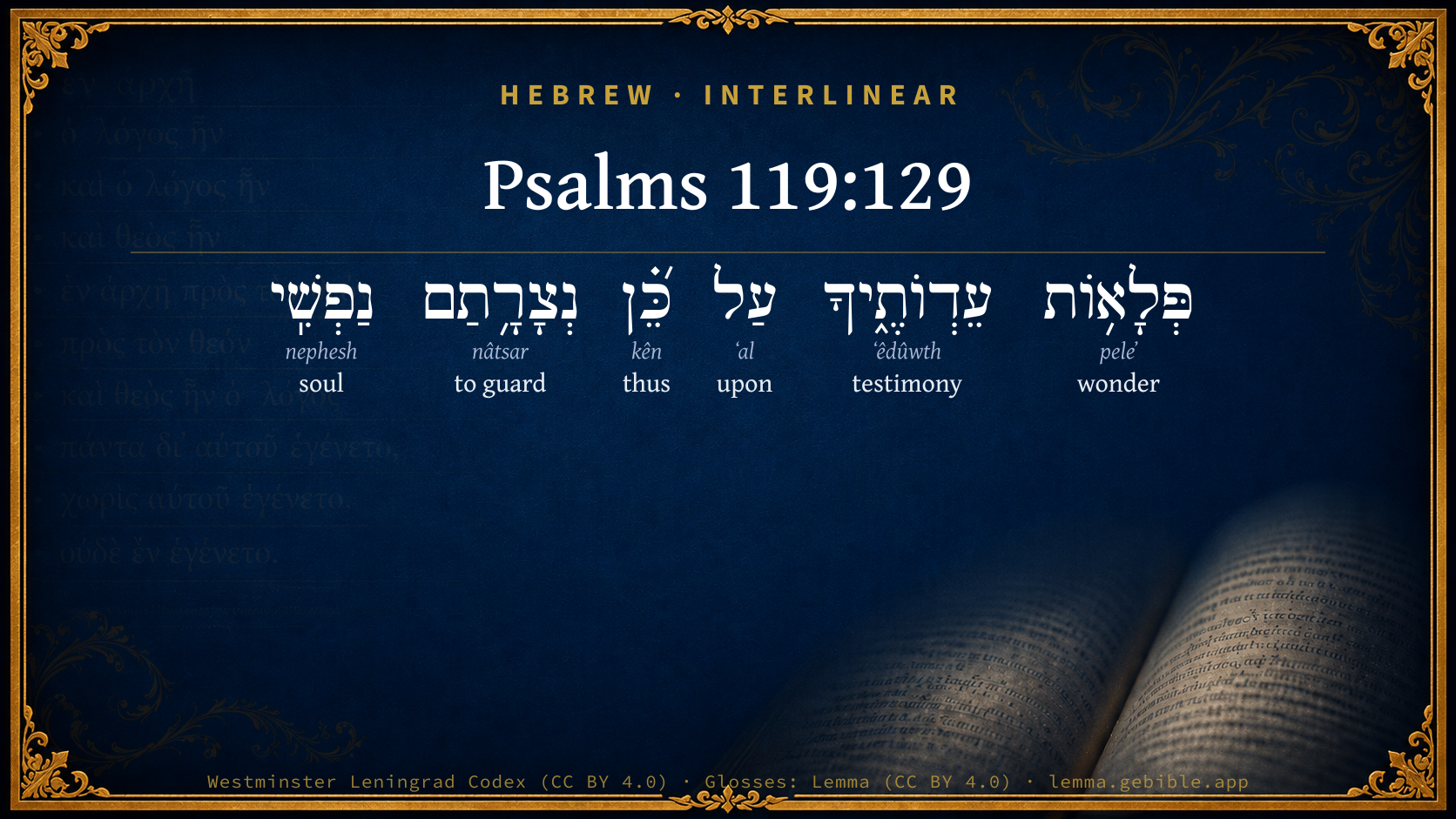
Hebrew (Westminster Leningrad Codex) Psalms 119:129 appears in the Hebrew Old Testament. The text above is from the Westminster Leningrad Codex. Each word links to its Strong’s number, a concise gloss, and parsing drawn from the Open Scriptures Hebrew Bible morphology. Click any word for its full Brown-Driver-Briggs (BDB) entry.
Download image
Cite this verse

Psalms 119:129 (World English Bible). Public Domain. Lemma interlinear Bible study tool, https://lemma.gebible.app/v/psalms/119/129.

Show BibTeX & RIS
BibTeX
RIS
English Translation
Your testimonies are wonderful, Therefore my soul keeps them.
World English Bible · Public Domain
Download a study sheet

One document with this verse’s original text, its word-by-word gloss line, the meaning frame, cross-references with their text, attributed commentary, and full source and license credits — printable, and it pastes into notes with its structure intact.

This verse Autodidact and up

Study sheet (.html) Plain text (.txt)

A passage Seminary Student

Up to 50 verses in one chapter. A passage sheet keeps up to 6 commentary sources and 12 cross-references per verse, in the order this page ranks them, and says so on the sheet whenever that leaves anything out. Ask for a single verse and you get the Autodidact verse sheet above.

Everything on this page stays free to read, with no account — the sheet is a download of what is already on screen, not access to it.

Want to remove ads? Support Godless Engineer
Compare translations 3

The same verse in 3 English versions, stacked beneath the original-language interlinear above. Click any original word for its lexicon entry.

Each is an independent rendering of the whole verse — the interlinear is not word-aligned to these translations.

Highlighted words mark where these versions differ — a whole-verse word diff, not a word-by-word alignment.

  • World English Bible Public Domain
    Your testimonies are wonderful, Therefore my soul keeps them.
  • King James Version Public Domain
    Thy testimonies are wonderful: therefore doth my soul keep them.
  • unfoldingWord Literal Text CC BY-SA 4.0
    Your testimonies wonderful; therefore, my soul has kept them.

unfoldingWord Literal Text — © unfoldingWord, licensed CC BY-SA 4.0. Word-aligned USFM3 via Door43 (git.door43.org/unfoldingWord/en_ult).

Versions to compare (up to 4)

3 of 4 selected

Show all 17 translations

Every available English version of this verse, each an independent rendering of the whole verse.

  • World English Bible Public Domain
    Your testimonies are wonderful, Therefore my soul keeps them.
  • Berean Standard Bible Public Domain
    Wonderful are Your testimonies; therefore I obey them.
  • Majority Standard Bible Public Domain
    Wonderful are Your testimonies; therefore I obey them.
  • King James Version Public Domain
    Thy testimonies are wonderful: therefore doth my soul keep them.
  • American Standard Version (1901) Public Domain
    PE. Thy testimonies are wonderful; Therefore doth my soul keep them.
  • Revised Version (1885) Public Domain
    Thy testimonies are wonderful: therefore doth my soul keep them.
  • Geneva Bible (1599) Public Domain
    PE. Thy testimonies are wonderfull: therefore doeth my soule keepe them.
  • Young's Literal Translation Public Domain
    `Pe.' Wonderful `are' Thy testimonies, Therefore hath my soul kept them.
  • Literal Standard Version CC BY-SA 4.0
    [PE] Your testimonies [are] wonderful, || Therefore my soul has kept them.
  • Unlocked Literal Bible CC BY-SA 4.0
    Your rules are wonderful, that is why I obey them.
  • unfoldingWord Literal Text CC BY-SA 4.0
    Your testimonies wonderful; therefore, my soul has kept them.
  • Darby Bible Public Domain
    PE. Thy testimonies are wonderful; therefore doth my soul observe them.
  • World Messianic Bible Public Domain
    Your testimonies are wonderful, therefore my soul keeps them.
  • Webster's Bible Public Domain
    PE. Thy testimonies are wonderful: therefore doth my soul keep them.
  • Free Bible Version CC BY-SA 4.0
    Your laws are truly wonderful—that's why I keep them!
  • Bible in Basic English Public Domain
    PE Your unchanging word is full of wonder; for this reason my soul keeps it.
  • JPS Tanakh (1917) Public Domain
    PE. Thy testimonies are wonderful; therefore doth my soul keep them.

Literal Standard Version (2020), Covenant Press — licensed CC BY-SA 4.0. Text via the HelloAO Bible API (eBible.org). Unlocked Literal Bible (unfoldingWord) — licensed CC BY-SA 4.0. Text via the HelloAO Bible API (eBible.org). unfoldingWord Literal Text — © unfoldingWord, licensed CC BY-SA 4.0. Word-aligned USFM3 via Door43 (git.door43.org/unfoldingWord/en_ult). Free Bible Version, Dr. Jonathan Gallagher — licensed CC BY-SA 4.0. Text via the HelloAO Bible API (eBible.org).

Word by word

More ways to search: Search by grammar → Find every occurrence → Compare this word →

Practice this passage: Drill this verse → Learn its vocabulary →

About this verse

These counts appear in no published source. They are computed here, from the morphology-tagged text and Lemma’s own curated glosses. What Lemma adds →

6
words
6
distinct lemmas
Wisdom
section

Notable vocabulary

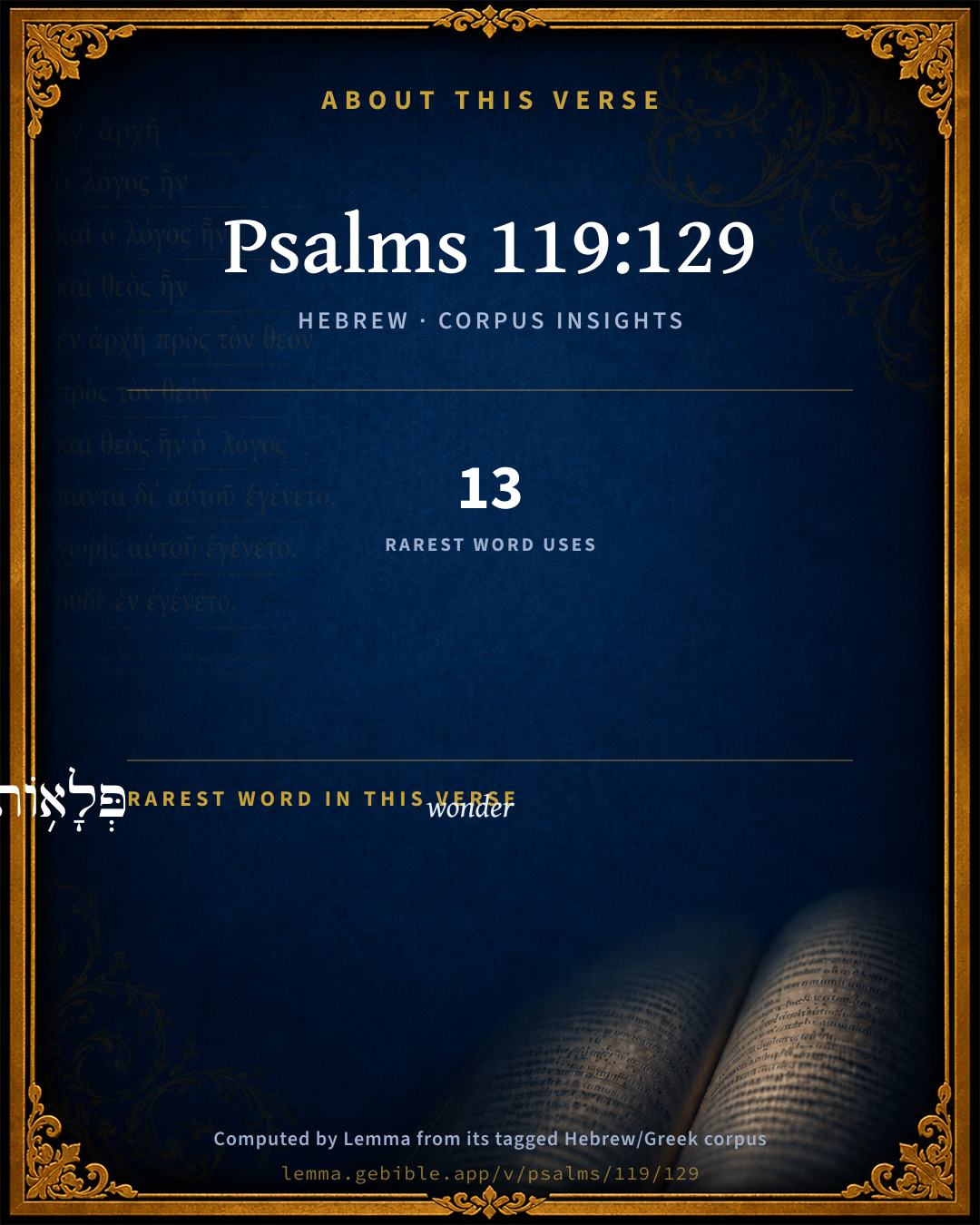
The rarest word here is פְּלָא֥וֹת wonder H6382 — appearing just 13 times in the whole Hebrew Bible.

Shared distinctive vocabulary

פְּלָא֥וֹת wonder H6382 occurs in 13 verses of the Hebrew Bible. Also found in:

Grammatical profile

  • 1 verb
  • 3 nouns
  • 1 preposition
  • 1 particle

Verb forms

  • נְצָרָ֥תַם Qal · Perfect

Hebrew & Septuagint length

In English translation the verse runs 9 words from the Hebrew and 11 from the Septuagint (LXX English) — closely comparable.

A rough comparison of the two English renderings, which tokenize alike — not a word-level alignment.

Word counts can differ between the Hebrew and the Greek without any difference in meaning — e.g. the Hebrew direct-object marker אֵת has no separate Greek word, and Greek often adds the article ὁ.

Cross-references

9

Topical passages linked to Psalms 119:129 in the Treasury of Scripture Knowledge — connected by theme and wording, ordered by reader-vote popularity; previews shown in the World English Bible.

  • Psalms 25:10 All the paths of Yahweh are loving kindness and truth To such as keep his covenant and his testimonies.
  • Psalms 139:6 This knowledge is beyond me. It's lofty. I can't attain it.
  • Psalms 119:18 Open my eyes, That I may see wondrous things out of your law.
  • Isaiah 25:1 Yahweh, you are my God; I will exalt you, I will praise your name; for you have done wonderful things, [even] counsels of old, in faithfulness [and] truth.
  • Psalms 119:2 Blessed are those who keep his statutes, Who seek him with their whole heart.
  • Psalms 119:31 I cling to your statutes, Yahweh. Don't let me be disappointed.
  • Psalms 119:146 I have called to you. Save me! I will obey your statutes.
  • Isaiah 9:6 For to us a child is born, to us a son is given; and the government shall be on his shoulder: and his name shall be called Wonderful, Counselor, Mighty God, Everlasting Father, Prince of Peace.
  • Revelation 19:10 I fell down before his feet to worship him. He said to me, "Look! Don't do it! I am a fellow bondservant with you and with your brothers who hold the testimony of Jesus. Worship God, for the testimony of Jesus is the Spirit of Prophecy."

Cross-references courtesy of OpenBible.info (CC BY 4.0).

Hebrew and Greek witnesses Masoretic Hebrew ↔ Greek Septuagint

The same verse in the two great witnesses to the Old Testament, shown verse-for-verse.

You’re reading Greek Psalm 118 (Hebrew Psalm 119). The Septuagint counts the superscription, so verse numbers can differ from the Hebrew — chapter-level alignment, not verse-by-verse. Numbering follows Rahlfs.

These are two independent witnesses, not word-aligned to each other, and the Septuagint is shown in lemma (dictionary) form.

Hebrew Psalms 119:129 Masoretic · Westminster Leningrad Codex

פְּלָא֥וֹת עֵדְוֺתֶ֑יךָ עַל כֵּ֝֗ן נְצָרָ֥תַם נַפְשִֽׁי

Your testimonies are wonderful, Therefore my soul keeps them.

World English Bible · Public Domain

Greek LXX Greek Psalm 118:129 Septuagint · lemma form

φη θαυμά ὁ μαρτύριον σύ διά οὗτος ἐκἐρευνάω αὐτός ὁ ψυχή ἐγώ

Your testimonies are wonderful: therefore my soul has sought them out.

LXX2012 (modern English Septuagint) · Public Domain

Hebrew: Westminster Leningrad Codex (CC BY 4.0). Greek: Septuagint (public domain); English from LXX2012 (modern English Septuagint) (Public Domain). How the Septuagint differs from the Hebrew →

Commentary

Notes on Psalms 119:129 from classic Christian and Jewish commentators (each source and its license shown beneath its notes). The classic Christian expositions comment on the surrounding passage and are grouped to its opening verse, so a note may address several verses; the Jewish commentaries on the Tanakh (Rashi and others) are per-verse, so they appear only where the commentator wrote on this verse.

Lemma curates 59 commentaries, every one of them public domain or Creative Commons licensed, each selected and text-cleaned for this edition rather than reprinted as found. About our sources →

Trapp's Complete Commentary

John Trapp

Psa 119:129 PE. Thy testimonies [are] wonderful: therefore doth my soul keep them.

Ver. 129. Thy testimonies are wonderful] As comprehending high and hidden mysteries, such as are far above the reach of human reason; such as the very angels admire and adore. A man must have more than common faith to subject his reason to them. But all men are Socinians by nature; they will believe God’s word no farther than they can see reason; which while men make the rule of their faith (as did the wise Greeks, the rational Romans), they stumble at the preaching of the cross of foolishness; and disbelieve the riches of Christ, which are unsearchable.

Therefore doth my soul keep them] Though I cannot comprehend them, yet I am comprehended by them; and though I cannot do them as I would, yet I am doing at them as I can. I admire what I cannot attain to.

John Trapp, A Commentary or Exposition upon All the Books of the Old and New Testament (1647–1656) — public domain. Text from a community e-Sword module.

The Biblical Illustrator

Joseph S. Exell

Psa_119:129

Thy testimonies are wonderful; therefore doth my soul keep them.

Wonder an element of religion

The Scriptures, says an old bishop, are wonderful with respect to the matter which they contain, the manner in which they are written, and the effects which they produce. What, then, is the Bible? The reply is this--the Bible is the history of sin; and so viewed, it stands forth, indeed, as a record surprisingly wonderful. It may be said that it is in a measure the history of righteousness also; but indeed the history of Gods righteousness is the history of mans sin. There is a strange unity in the Bible thus viewed. It is not on the excellency of this or that portion, but upon their unity and self-completeness, that we would base our assertion of the wonderfulness of the testimonies of God. Let us, then, assuming its wonderfulness, inquire how this should produce obedience. The whole of this psalm is occupied in setting forth the Divine law in every variety of aspect, and Davids own appreciation of it; and it is observable that it is on the depth, the vastness, the wonderfulness of Gods Word that he dwells. In the text he assigns, expressly, the motive of his own obedience. His language is not that of a deep thinker, who has examined and understood more thoroughly than his brethren; it is that of a child gazing upwards to the firmament, and impressed with an awe which it cannot explain; it is language not of reason, but of faith: not of understanding, but of astonishment, in which he sketches the impulse of his own obedience. His spirit, as he meditated upon Gods law, beheld therein a mighty mystery, wide as the east from the west; and as he gazed, he saw in that law unsearchable doctrines, and dispensations not to be accounted for, and rules and regulations laid down but not explained; there was much which might be regarded as superfluous, much which man would have ordered otherwise; so, as he pondered, he marvelled; and then his heart grew at once humbled, yet elevated, by the mysterious web that was around him. Now, if it be true that wonder is closely connected with reverence, that in short the marvellous exerts in religion, as in other things, a great power over the soul of man, then we shall cease to be surprised that the Almighty has not spoken more clearly. Strip religion of whatever baffles the understanding, and you will have a system quite incapable of enlisting the heart in its cause. No deeds of high, unselfish heroism, such as those which have rendered everlastingly illustrious the names of apostles and confessors; no lives of self-denying exertion like those which adorn the annals of missionary enterprise will be produced by this religion of reason. His Name shall be called Wonderful. By such title did the Hebrew prophet proclaim Him, around whose cradle all Christendom is about to gather. Wonderful in His nature, being both God and man; Wonderful in the ordinances of His kingdom; Wonderful in His continual presence with His people; Wonderful in the dispensations of His grace. Even, then, as Wonderful, let us bow down before Him; never seeking to rend, with unhallowed hand, the veil that is upon His face; never recoiling from His Word by reason of its marvellousness; never trying to bring Him down to us because we cannot rise up to Him. Yea, rather, in the wonderfulness of all that emanates from Him, let us recognize a propriety. Rightly viewed, the incomprehensibleness of Christ is a bond to obedience. His statutes are wonderful, and therefore should our souls not resist, but keep them. (Bp. Woodford.)

The testimonies of God

I. Why are the Divine laws here called testimonies?

1. Because they bear testimony to the goodness of God in condescending to guide men by His law.

2. Because they bear testimony to the holiness of God.

3. Because they bear testimony to the respect that God has for the happiness of His creatures. He has connected the highest pleasures with obedience.

4. Because they bear testimony to the wisdom and justice of God. They are adapted to the present imperfect state of man, going upon the principle, where little is given little will be required, and where much is given much will be required.

II. The character of the divine testimonies. they are wonderful. How?

1. In respect of the discoveries they make of God. Look to people without these testimonies. How ignorant of the Supreme!

2. In respect of the discoveries of Gods providence.

3. In respect of the provision which the Scriptures discover for our repentance and pardon.

4. In respect of their universal application to us.

5. In respect of the assistance which they offer in the keeping of them.

(1) A Divine Agent to strengthen, that is, the Holy Ghost.

(2) Sublime motives to stimulate and encourage us.

6. In respect of their weight and importance. They determine the eternal conditions of men.

III. The practical regard which a good man has for the Divine testimonies. Therefore doth my soul keep them.

1. As a precious treasure of knowledge.

2. As objects of affection and study.

3. As the rules--the guiding lights of my conduct.

4. As embodied in my daily life and practice. (J. Walker, D. D.)

The admirable nature of the Divine oracles

I. His profound admiration of the Divine oracles. They are wonderful in their--

1. Style and composition.

(1) Wonderfully simple and plain.

(2) Wonderfully grand and sublime.

(3) Wonderfully concise and expressive.

2. Contents.

(1) The most interesting records of facts.

(2) The most astonishing displays of truth.

(3) The most admirable and perfect rules of life.

(4) The most animating promises,

(5) The moat tremendous threatenings.

3. Efficacy.

(1) Alarming the sinner.

(2) Consoling the mourner.

(3) Transforming the most degraded.

(4) Supporting the believer through life and over death.

II. Their practical influence.

1. He treasured them up in his memory.

2. He kept them in exercises of faith.

3. He held them in constant esteem, and embraced them with earnest affection.

4. He kept them in obedient practices. (Sketches of Four Hundred Sermons.)

The wonderful character of Gods testimonies

1. They are wonderfully adapted to the purposes intended, and are fully adequate to all the wants and necessities of mankind. They are consonant to right reason, and adapted to promote our true interest; they confer upon us the highest benefits, and the loss of them would deprive us of the richest treasure. They secure the honour of God, and the rights of the creature.

2. They are wonderfully expressed; there is in them a mixture of the greatest majesty and simplicity.

3. They are wonderfully consistent and harmonious. The laws of men often militate one against another; but there is no discord or contrariety in the laws of God. They all bear the impress of infinite wisdom, purity and goodness.

4. They are wonderfully extensive.

5. They are wonderfully useful and important.

6. They have been wonderfully preserved.

Conclusion:

1. If the Divine law be so wonderful, what must the Gospel be? (Eph_3:1-10).

2. If the law and Gospel are so wonderful, what must their Author be? (Job_11:7).

3. The reason why men treat the Divine law with contempt is because they are not acquainted with its excellence, and their eyes are not open to behold its dignity and glory (Hos_8:12).

4. If Gods Word is so precious and important, let us manifest a suitable regard towards it. (B. Beddome, M. A.)

The Biblical Illustrator, edited by Joseph S. Exell (c. 1880s–1900s) — public domain. Text from a community e-Sword module.

The Treasury of David

Charles H. Spurgeon

Ver. 129. Thy testimonies are wonderful. The Scriptures are "wonderful, "with respect to the matter which they contain, the manner in which they are written, and the effects which they produce. They contain the most sublime spiritual truths, veiled under external ceremonies and sacraments, figurative descriptions, typical histories, parables, similitudes, etc. When properly opened and enforced, they terrify and humble, they convert and transform, they console and strengthen. Who but must delight to study and to "observe" these "testimonies" of the will and the wisdom, the love and the power of God Most High! While we have these holy writings, let us not waste our time, misemploy our thoughts, and prostitute our admiration, by doting on human follies, and wondering at human trifles. George Horne.

Ver. 129. Thy testimonies are wonderful. God's testimonies are "wonderful" (1) In their majesty and composure, which striketh reverence into the hearts of those that consider; the Scripture speaketh to us at a God like rate. (2) It is "wonderful" for the matter and depth of mystery, which cannot be found elsewhere, concerning God, and Christ, the creation of the world, the souls of men, and their immortal and everlasting condition, the fall of man, etc. (3) It is "wonderful" for purity and perfection. The Decalogue in ten words comprise the whole duty of man, and reacheth to the very soul, and all the motions of the heart. (4) It is "wonderful" for the harmony and consent of all the parts. All religion is of a piece, and one part doth not interfere with another, but conspires to promote the great end, of subjection of the creature to God. (5) It is "wonderful" for the power of it. There is a mighty power which goeth along with the word of God, and astonishes the hearts of those that consider it and feel it. 1Th 1:5. Thomas Manton.

Ver. 129. Thy testimonies are wonderful. The Bible itself is an astonishing and standing miracle. Written fragment by fragment through the course of fifteen centuries, under different states of society, and in different languages, by persons of the most opposite tempers, talents, and conditions, learned and unlearned, prince and peasant, bond and free; cast into every form of instructive composition and good writing; history, prophecy, poetry, allegory, emblematic representation, judicious interpretation, literal statement, precept, example, proverbs, disquisition, epistle, sermon, prayer in short, all rational shapes of human discourse, and treating, moreover, on subjects not obvious, but most difficult; its authors are not found like other men, contradicting one another upon the most ordinary matters of fact and opinion, but are at harmony upon the whole of their sublime and momentous scheme. J. Maclagan, 1788-1852.

Ver. 129. Highly prize the Scriptures, or you will not obey them. David said, "therefore doth my soul keep them"; and why was this, but that he counted them to be wonderful? Can he make a proficiency in any art, who doth slight and deprecate it? Prize this book of God above all other books. St. Gregory calls the Bible "the heart and soul of God." The rabbins say, that there is a mountain of sense hangs upon every apex and tittle of Scripture. "The law of the Lord is perfect" (Ps 14:7). The Scripture is the library of the Holy Ghost; it is a pandect of divine knowledge, an exact model and platform of religion. The Scripture contains in it the credenda, "the things which we are to believe, "and the agenda, "the things which we are to practise." It is "able to make us wise unto salvation": 2Ti 3:15. "The Scripture is the standard of truth, "the judge of controversies; it is the pole star to direct us to heaven (Isa 8:20). "The commandment is a lamp": Pr 6:23. The Scripture is the compass by which the rudder of our will is to be steered; it is the field in which Christ, the Pearl of price, is hid; it is a rock of diamonds, it is a sacred collyrium, or "we salve; " it mends their eyes that look upon it; it is a spiritual optic glass in which the glory of God is resplendent; it is the panacea or "universal medicine" for the soul. The leaves of Scripture are like the leaves of the tree of life, "for the healing of the nations": Re 22:2. The Scripture is both the breeder and feeder of grace. How is the convert born, but by "the word of truth"? Jas 1:18. How doth he grow, but by "the sincere milk of the word"? 1Pe 2:2. The word written is the book out of which our evidences for heaven are fetched; it is the sea mark which shows us the rocks of sin to avoid; it is the antidote against error and apostasy, the two edged sword which wounds the old serpent. It is our bulwark to withstand the force of lust; like the Capitol of Rome, which was a place of strength and ammunition. The Scripture is the "tower of David, "whereon the shields of our faith hang: So 4:4. "Take away the word, and you deprive us of the sun, "said Luther. The word written is above an angelic embassy, or voice from heaven. "This voice which came from heaven we heard. We have also, "bebaioteron lolon, "a more sure word": 2Pe 1:18-19 O, prize the word written; prizing is the way to profiting. If Caesar so valued his Commentaries, that for preserving them he lost his purple robe, how should we estimate the sacred oracles of God? "I have esteemed the words of his mouth more than my necessary food": Job 23:12. King Edward the Sixth, on the day of his coronation, had presented before him three swords, signifying that he was monarch of three kingdoms. The king said, there was one sword wanting; being asked what that was, he answered, "The Holy Bible, which is the sword of the Spirit, and is to be preferred before these ensigns of royalty." Robert King of Sicily did so prize God's word, that, speaking to his friend Petrarcha, he said, "I protest, the Scriptures are dearer to me than my kingdom; and if I must be deprived of one of them, I had rather lose my diadem than the Scriptures." Thomas Watson, in "The Morning Exercises."

Ver. 129. The word contains matter to exercise the greatest minds. Many men cannot endure to spend their thoughts and time about trivial matters; whereas others think it happiness enough if they can, by the meanest employments, procure subsistence. Oh, let all those of high aspirations exercise themselves in the law of God; here are objects fit for great minds, yea, objects that will elevate the greatest: and indeed none in the world are truly great but the saints, for they exercise themselves in the great counsels of God. We account those men the greatest that are employed in state affairs: now the saints are lifted up above all things in the world, and regard them all as little and mean, and are exercised in the great affairs of the kingdom of Jesus Christ. Hence the Lord would have the kings and the judges to have the book of the law written, De 17:18-19; and it is reported of Alphonsus, king of Arragon, that in the midst of all his great and manifold occupations, he read over the Scriptures fourteen times with commentaries. How many have we, men of great estates, and claiming to be of great minds, that scarce regard the law of God: they look upon his law as beneath them. Books of history and war they will peruse with diligence; but for the Scripture, it is a thing that has little in it. It is a special means to obedience to have high thoughts of God's law. That is the reason why the prophet speaks thus, "I have written to him the great things of my law, but they were counted as a strange thing": Ho 8:12. As if he should say, if they had had the things of my law in their thoughts, they would never so have acted. Ps 114:129, "Thy testimonies are wonderful, therefore doth my soul keep them." He saith not, therefore do I keep them; but, therefore doth my soul keep them; my very soul is in this, in keeping thy testimonies, for I look upon them as wonderful things. It is a good sign that the spirit of the great God is in a man, when it raises him above other things, to look upon the things of his word as the only great things in the world. "All flesh is grass, and all the godliness thereof is as the flower of the field: the grass withereth, the flower fadeth: but the word of our God shall stand for ever:" Isa 40:6, 8. There is a vanity in all things of the world; but in that which the word reveals, in that there is an eternity: we should therefore admire at nothing so as at the word, and we should greatly delight in God's commandments; an ordinary degree of admiration or delight is not sufficient, but great admiration and great delight there should be in the law of God. And all arguments drawn from God's law should powerfully prevail with you. Jeremiah Burroughs.

Ver. 129. Thy testimonies are wonderful. Wonders will never cease. Air, earth, water, the world above, the world beneath, time, eternity, worms, birds, fishes, beasts men, angels are all full of wonders. The more all things are studied, the more do wonders appear. It is idle, therefore, to find fault with the mysteries of Scripture, or to deny them. Inspiration glories in them. He who rejects the mysteries of love, grace, truth, power, justice and thankfulness of God's word, rejects salvation. It has marvels in itself, and marvels in its operation. They are good cause of love, not of offence; of keeping, not of breaking God's precepts. William S. Plumer.

Ver. 129. My soul, not merely I, but I with all my heart and soul. Joseph Addison Alexander.

Ver. 129. I have completed reading the whole Bible through since January last. I began it on the first day of the present year, and finished it on the 26th of October. I have read it in that space four times, and not without real profit to myself. I always find in it something new; it being, like its Author, infinite and inexhaustible. Samuel Eyles Pierce, 1814.

Ver. 129. What do I not owe to the Lord for permitting me to take a part in the translation of his word? Never did I see such wonders, and wisdom, and love, in the blessed book, as since I have been obliged to study every expression; and it is a delightful reflection, that death cannot deprive us of the pleasure of studying its mysteries. Henry Martyn.

Outlines Upon Keywords of the Psalm, by Pastor C. A. Davis.

Ver. 129-136. The wonderfulness of God's testimonies. (Ps 119:129), instanced as light giving (Ps 119:130), pantingly longed (Ps 119:131). An appeal for divine ordering in the word (Ps 119:132-135) at its rejection by others (Ps 119:136).

Ver. 129-136. In this division the Psalmist

1. Praises God's word.

2. Shows his affection to it.

3. Prays for grace to keep it.

4. Mourns for those who do not. Adam Clarke.

Ver. 129. The wonderful character of the word a reason for obedience. So wonderfully pure, just, balanced, elevating. So much for our own benefit, for the good of society, and for the divine glory.

Ver. 129.

1. What is wonderful in God's word should be believed.

2. What is believed should be obeyed. G.R.

Ver. 129. Thy testimonies are wonderful.

1. The facts which they record are wonderful so wonderful, that, if the book recording them were now published for the first time, there would be no bounds to the avidity and curiosity with which it would be sought and perused.

2. The morality which they inculcate is wonderful.

3. If you turn from the morality to the doctrines of the Bible, your admiration will rather increase than diminish at the contents of the singular book.

4. These testimonies are wonderful for the style in which they are written.

5. They are wonderful for their preservation in the world.

6. They are wonderful for the effects which they have produced. Hugh Hughes, 1838.

Ver. 129. Thy testimonies are wonderful. The ceremonial law is wonderful, because the mystery of our redemption by the blood of Christ is pointed out in it.

2. The prophecies are wonderful, as predicting things, humanly speaking, so uncertain, and at such great distance of time, with so much accuracy.

3. The decalogue is wonderful, as containing in a very few words all the principles of justice and charity.

4. Were we to go to the New Testament, here wonders rise on wonders! All is astonishing; but the Psalmist could not have had this in view. Adam Clarke.

Ver. 129 (first clause).

1. Let us look at five of the wonders of the Bible.

(a) Its authority. It prefaces every statement with a "Thus

saith the Lord."

(b) Its light.

(c) Its power it has a convincing, awakening, drawing,

life giving power.

(d) Its depth.

(e) Its universal adaptation.

2. Indicate three practical uses.

(a) Study the Bible daily.

(b) Pray for the Spirit to grave it on your heart with a

pen of iron.

(c) Practise it daily. D. Macgregor.

Ver. 129. To whom and in what respects are God's testimonies wonderful?

1. To whom? To those, and those only, who through grace do know, believe, and experience the truth and power of them for themselves.

2. In what respects wonderful, i.e., astonishingly pleasing, delightful, and profitable (see Ps 119:174).

(a) In respect of the Author and origin of them, whose they

are and from whence they come.

(b) In respect of the subject matter of them, which they

contain and reveal.

(c) In respect of the manner of language in which they are

revealed and declared.

(d) In respect of the multitude and variety of them suited

to every case.

(e) In respect of the usefulness of them, and the great

benefit and advantage he received from them.

(f) In the respect of the pleasure and delight he finds in

them (see Ps 119:111).

(g) In respect of the final design, intent, and end of

them: viz., eternal life, salvation, and glory. Samuel Medley, 1738-1799.

Psalms 119:130*

Charles H. Spurgeon's The Treasury of David (1869–1885) — public domain. Psalms only. Text from a community e-Sword/MySword module.

Joseph Benson's Commentary

PE.

Psa 119:129. Thy testimonies are wonderful — In regard of the deep mysteries, the most excellent counsels and directions, and the exceeding great and precious promises contained in them; the manner in which they are written, and the effects which they produce. “They contain the sublimest spiritual truths, veiled under external ceremonies and sacraments, figurative descriptions, typical histories, parables, similitudes, &c. When properly opened and enforced, they terrify and humble, they convert and transform, they console and strengthen.” Therefore doth my soul keep them — Hebrew, נצרתם, netzaratam, guard, preserve, and watch over them as a precious treasure, therefore I attend to them and make them the rule of my faith and practice, of my principles and actions, of my tempers, words, and works, and of my whole conduct toward God and man. And “who but must delight to study and observe these testimonies of the will and wisdom, the love and power of God most high! While we have these holy writings, let us not waste our time, misemploy our thoughts, and prostitute our admiration, by doting on human follies, and wondering at human trifles.” — Horne.

Joseph Benson's Commentary on the Old and New Testaments (1811–1818) — public domain. Text from a community e-Sword module.

J. A. Alexander on Psalms

Joseph Addison Alexander

129. (Psa 119:129) Wonderful (are) thy testimonies; therefore my soul keepeth them. The first word in Hebrew is a plural form of that in Psa 77:11; Psa 77:14; Psa 78:12; Psa 88:10, and properly means wonders, i.e. miracles or prodigies of moral excellence. My soul, not merely I, but I with all my heart or soul.

Joseph Addison Alexander, The Psalms Translated and Explained (1850) — public domain. Text from a community e-Sword module.

Tyndale Open Study Notes

Tyndale Open Resources

119:129-136 Pe (פ): The psalmist prays earnestly for God to speak to him as he suffers from his adversities.

Tyndale Open Study Notes — © Tyndale Open Resources, licensed CC BY-SA 4.0. Text via the HelloAO Bible API.

Geneva Bible (1599)

Geneva Bible translators

Containing high and secret mysteries, so that I am moved with admiration and reverence.

Geneva Bible (1599) marginal notes — public domain. Text via Bolls.life.

Matthew Henry's Commentary

See here how David was affected towards the word of God. 1. He admired it, as most excellent in itself: Thy testimonies are wonderful. The word of God gives us admirable discoveries of God, and Christ, and another world; admirable proofs of divine love and grace. The majesty of the style, the purity of the matter, the harmony of the parts, are all wonderful. Its effects upon the consciences of men, both for conviction and comfort, are wonderful; and it is a sign that we are not acquainted with God's testimonies, or do not understand them, if we do not admire them. 2. He adhered to it as of constant use to him: "Therefore doth my soul keep them, as a treasure of inestimable value, which I cannot be without." We do not keep them to any purpose unless our souls keep them. There they must be deposited, as the tables of testimony in the ark, there they must have the innermost and uppermost place. Those that see God's word to be admirable will prize it highly and preserve it carefully, as that which they promise themselves great things from.

Matthew Henry's Commentary on the Whole Bible (1708–1710) — public domain (CC PDM 1.0). Text via the HelloAO Bible API.

Adam Clarke's Commentary

LETTER פ PE. - Seventeenth Division

Verse 129. Thy testimonies are wonderful] There is a height, length, depth, and breadth in thy word and testimonies that are truly astonishing; and on this account my soul loves them, and I deeply study them. The more I study, the more light and salvation I obtain.

Adam Clarke's Commentary on the Bible (1810–1826) — public domain. Text from a community e-Sword/MySword module.

John Calvin's Commentaries

129. Thy testimonies are marvelous. I have given this translation to avoid an ambiguous form of expression. The Prophet does not simply mean, that the doctrine of the law is wonderful, but that it contains high and hidden mysteries. Accordingly he declares, that the sublime and admirable wisdom which he found comprehended in the divine law led him to regard it with reverence. This is to be carefully marked, for the law of God is proudly despised by the great majority of mankind, when they do not duly taste its doctrine, nor acknowledge that God speaks from his throne in heaven, that, the pride of the flesh being abased, he may raise us upward by the apprehension of faith. We also gather from this passage, that it is impossible for any man to keep the law of God from the heart, unless he contemplate it with feelings of reverence: for reverence is the beginning of pure and right subjection. Accordingly, I have said that many despise God’s Word, because they think it inferior to the acuteness of their own understandings. Yea, many are led to break forth more audaciously into this heaven-daring contempt, from the vanity of showing their own ingenuity. But, although worldly men may flatter themselves in that proud disdain of the divine law, yet the commendation which the Prophet pronounces upon it still holds true, that it comprehends mysteries which far transcend all the conceptions of the human mind.

John Calvin's Commentaries (1540-1563) — public domain. Text from the Calvin Translation Society English edition (1840s-50s) via the Christian Classics Ethereal Library (ccel.org). Calvin's coverage is partial (roughly two-thirds of the Bible); uncommented books and verses are honest gaps, never fabricated. The 19th-century editor's footnotes and remarks are omitted so the notes are faithfully Calvin's own voice.

The Cambridge Bible for Schools and Colleges

gen. ed. J. J. S. Perowne

129. wonderful] Superhuman in their excellence: lit. wonders, the term often used of God’s revelation of His power in miraculous acts (Exo_15:11; Psa_77:11; Psa_77:14; cp. Psa_119:18).

therefore &c.] Their sublimity and mystery does not repel but attracts.

129–136. Pç. The marvellousness of God’s law: the Psalmist’s prayers that it may be the rule of his life in spite of temptation: his grief at the neglect of it.

The Cambridge Bible for Schools and Colleges (gen. ed. J. J. S. Perowne; Cambridge University Press, 1878–1918) — public domain. Text from a community e-Sword module.

John Gill's Exposition

Order my steps in thy word,.... Or, "by thy word" (s), or "according" to it. Which is the rule of practice and action, as well as of faith; and happy are they who walk according to the directions of it; but it is not in the power of man to order and direct his steps: this is done by the Lord; and such who acknowledge him in their ways, and apply to him for direction, are and shall be thus favoured by him; see Jer 10:23;

and let not any iniquity have dominion over me; not only greater sins or presumptuous ones, very gross iniquities, as in Psa 19:13; but lesser ones, even the least of them. It is a sad thing to be enslaved to any lust or sin, be it what it will: sin reigns over wicked men even unto death; and it oftentimes has great power over good men, puts them upon doing that which is evil, and hinders them from doing that which is good; it carries them captive, and threatens to have the ascendant over them, and rule in them, which they deprecate; and such a prayer may be the prayer of faith, since it is promised "sin shall not have the dominion over you", Rom 6:14. Kimchi interprets this of the evil imagination or corruption of nature; R. Moses understands it of a wicked man; and so the Syriac version.

(s) "eloquio tuo", Tigurine version; "secundum eloquium tuum", Musculus.

John Gill's Exposition of the Whole Bible (1746–1763) — public domain (CC PDM 1.0). Text via the HelloAO Bible API.

Albert Barnes' Notes on the Bible

Thy testimonies are wonderful - This commences a new division of the psalm, indicated by the Hebrew letter Pe (פ p), corresponding to our “p.” The meaning of the expression here is, that the laws of God - the revelations of his will - are adapted to fill the mind with wonder. The mind is awed by their wisdom; their comprehensiveness; their extent; their spirituality; their benevolence: by the fact that laws are framed, so perfectly adapted to the end; so well suited to secure order, and to promote happiness.

Therefore doth my soul keep them - Because they are so surpassingly wise and benevolent; because they are so manifestly the work of wisdom and goodness.

Albert Barnes' Notes on the Bible (1834–1885) — public domain. Text from a community e-Sword/MySword module.

Matthew Poole's English Annotations

PE

Wonderful; in regard of the deep and wonderful mysteries, and most excellent counsels and directions, far exceeding all the rules of the greatest philosophers, and the exceeding great and precious promises of God contained in them. This is the reason of his high estimation of them, expressed in the last verse.

Matthew Poole's English Annotations on the Holy Bible (1683–1685) — public domain. Text from a community e-Sword/MySword module.

Whedon's Commentary on the Bible

Daniel D. Whedon

פ, Pe.

129-136. Let not any iniquity have dominion over me—A sense of his own peril leads the writer to a still deeper, intenser longing for perfected holiness within himself. As he feels the growing strength of his own heart, so he the more grieves over those who, departing from the law, depart from the joys of grace. The experience here given of the law is, in our day, found in Christ, who gives to his servants “grace for grace;” that is, grace enjoyed in proportion to grace employed.

Daniel D. Whedon (gen. ed.), Commentary on the Old and New Testaments (1874–1909) — public domain. Text from a community e-Sword module.

The Pulpit Commentary

pPE.

Thy testimonies are wonderful; literally, wonders; i.e. prodigies of moral excellence. Therefore doth my soul keep them. I obey thy Law, not only because it is thy Law, but still more because it is intrinsically "holy, just, and good". (Rom_7:12)

Vers. 129-136. "Thy testimonies are wonderful.

The tone and spirit of this section are much brighter than those of the foregoing one. Something had happened. The plaintive and heart-broken appeal of those verses is followed by the joyous confession with which these, in this section, begin. Believing that there is a real connection in these sections, and that they are not so many disjointed and disconnected sayings, we infer that help had come to the psalmist had come through God"s Word, and had come in wonderful way and power.

I THESE WORDS DECLARE A FACT.

1. In the psalmists own experience. He had found God"s testimonies wonderful. They had lifted him up from the depths of sorrow to blessed calm, confidence, and delight in God. Not that his outward circumstances appear to have been much changed, but the mood of his mind about them, and the thoughts of his heart, had greatly changed.

2. And this was because of the light-giving power of Gods Word. (Ver. 130) Light reveals what was hidden before truths that had remained in obscurity, and which had great bearing on his condition, he could now see. His mind had been illuminated, and he was as in a new world. And light cheers and gladdens the heart. By means of the Word of God such light had come to him, and with such power, that he could only exclaim, "Thy testimonies are wonderful.

3. And the like experience has been reproduced in all men like-minded to the psalmist. Wonderful is the book of Holy Scripture, for its age, preservation, interest, adaptation to all, for its inspiration, for its spread, for its blessed and ever-increasing power, for the revelation of God given in it, and for many more and personal reasons beside.

II THEY REVEAL THE INFLUENCE AND EFFECT THEY EVER HAVE.

1. They explain the tenacity with which the soul clings to God"s Word. (Ver. 129) Of course, the soul which has had such experience of its power will "keep them." Do we fling gold away? Neither will such soul the testimonies of God.

2. They produce deep humility. Ver. 139 is a plea for mercy. The psalmist knew that he needed that. These wonderful testimonies had made that clear to him, as they ever do. But as one of the company of them that loved God"s Name, he pleads for the mercy he needs.

3. Made him long for complete rectitude in Gods sight. (Ver. 133) He would have his every step, not merely his general walk, ordered in God s Word, and he would that no iniquity should have, etc. This is a constant result of such a realization of the power of God"s Word. Nothing less than complete obedience win serve.

4. Gives renewed force to his prayers.for grace to obey. Hence he prays

(1) that man"s oppression may cease (ver. 134). How often such oppression does hinder the keeping of God"s precepts! Not entirely, but largely. How many would openly serve God, but are cruelly forbidden or held back by fear! God"s people have to hide away; they cannot do the things that they would. Also he prays

(2) that God"s face may shine upon him; for that is like the warm shining of the sun upon the plant-world, causing it to spring and grow as otherwise it could not.

5. Made him deeply grieve over mens sin. (Ver. 136) We do not grieve over what we do not value. If, therefore, we do not value the grace of God, we shall not, etc.

III THE CONDITION OF REALIZING ALL THIS. Fervent desire (ver. 131). S.C.

High estimates of God"s Word.

"Thy testimonies are wonderful." Dr. Barry"s outline of this section is suggestive. "The key-note of this meditative section is struck in the first words. God"s dispensation is wonderful: " As the heaven is higher than the earth, so are his ways higher than our ways." His Word gives light only to simple faith (ver, 130); it satisfies only those who long for it and love it (vers. 131, 132); it saves from oppression only those who rest on his promise, and are willing to be taught (vers. 133-135); for those who will not bow their hearts to it, there is no salvation; over them we can but weep (ver. 136)." S.T. Coleridge says, "All knowledge begins and ends with wonder; the first wonder is the child of ignorance; the last wonder the parent of adoration." The Scriptures are "wonderful," with respect to

(1) the matter which they contain;

(2) the manner in which they are written; and

(3) the effects which they produce.

The following outline is from T. Manton: Wonderful

(1) in their majesty and composure; which striketh reverence into the hearts of those that consider.

(2) They are wonderful for the matter and depth of mystery, which cannot be found elsewhere, concerning God, and Christ, the creation of the world, the souls of men, and their immortal and everlasting condition, the Fall of man, etc.

(3) They are wonderful for their purity and perfection. The Decalogue in ten words compriseth the whole duty of man, and reacheth to the very soul, and all the motions of the heart.

(4) They are wonderful for the harmony and consent of all the parts. All religion is of a piece, and one part doth not interfere with another, but conspireth to promote the great end of subjection of the creature to God.

(5) They are wonderful for the power of them. There is a mighty power which goeth along with the Word of God, and astonisheth the hearts of those that consider it and feel it. Wonderful, as a term, does much more than express admiration and appreciation. It implies unusualness; the thing to which it is applied is other than we expected. And the otherwiseness suggests a higher and Divine source. The wonderful is the supernatural. R.T.

The Pulpit Commentary (1880–1919), ed. H.D.M. Spence-Jones & Joseph S. Exell — public domain. Text from a community e-Sword module.

John Wesley's Explanatory Notes

Wonderful - In regard of the deep mysteries, the most excellent directions, and the exceeding great and precious promises of God contained in them.

John Wesley, Explanatory Notes Upon the Whole Bible (1754–1765) — public domain. Text via the GEBible commentary corpus.

Keil & Delitzsch

C. F. Keil & F. Delitzsch

The eightfold Phe. The deeper his depression of spirit concerning those who despise the word of God, the more ardently does he yearn after the light and food of that word. The testimonies of God are פּלאות, wonderful and strange (paradoxical) things, exalted above every-day life and the common understanding. In this connection of the thoughts נצרתם is not intended of careful observance, but of attentive contemplation that is prolonged until a clear penetrating understanding of the matter is attained. The opening, disclosure (פּתח, apertio, with Tsere in distinction from פּתח, porta) of God's word giveth light, inasmuch as it makes the simple (פּתיים as in Pro 22:3) wise or sagacious; in connection with which it is assumed that it is God Himself who unfolds the mysteries of His word to those who are anxious to learn. Such an one, anxious to learn, is the poet: he pants with open mouth, viz., for the heavenly fare of such disclosures (פּער like פּער פּה in Job 29:23, cf. Psa 81:11). יאב is a hapaxlegomenon, just as תּאב is also exclusively peculiar to the Psalm before us; both are secondary forms of אבה. Love to God cannot indeed remain unresponded to. The experience of helping grace is a right belonging to those who love the God of revelation; love in return for love, salvation in return for the longing for salvation, is their prerogative. On the ground of this reciprocal relation the petitions in Psa 119:133-135 are then put up, coming back at last to the one chief prayer "teach me." אמרה, Psa 119:133, is not merely a "promise" in this instance, but the declared will of God in general. כּל־און refers pre-eminently to all sin of disavowal (denying God), into which he might fall under outward and inward pressure (עשׁק). For he has round about him those who do not keep God's law. On account of these apostates (על לא as in Isa 53:9, equivalent to על־אשׁר לא) his eyes run down rivers of water (ירד as in Lam 3:48, with an accusative of the object). His mood is not that of unfeeling self-glorying, but of sorrow like that of Jeremiah, because of the contempt of Jahve, and the self-destruction of those who contemn Him.

Keil & Delitzsch — Biblical Commentary on the Old Testament (1861–1891) — public domain (CC PDM 1.0). Text via the HelloAO Bible API. (Old Testament only.)

Kretzmann's Popular Commentary

Paul E. Kretzmann

Pe. The Need Of Spiritual Light in the Midst of Godlessness. —

v. 129. Thy testimonies are wonderful, elevated above everyday life and the common understanding, becoming more marvelous the longer one contemplates them; therefore doth my soul keep them, anxious to have the light of the Word fall into his dark heart and illumine it with rays of divine mercy and beauty.

v. 130. The entrance of Thy words giveth light, that is, the opening, the unfolding, of His Word, as His Holy Spirit explains it to the heart of man, makes the words of divine wisdom clear; it giveth understanding unto the simple, to those without any pretense or show of learning in this world’s wisdom, for that is not essential for the understanding of the fundamental divine truths.

v. 131. I opened my mouth and panted, with great eagerness, as a traveler in a hot desert pants for a cooling breeze and for a refreshing draft of water; for I longed for Thy commandments, his desire was for the refreshment of God’s Word.

v. 132. Look Thou upon me, instead of averting His face in anger, and be merciful unto me, as Thou usest to do unto those that love Thy name, or, "according to the right of those that love Thy name. " It is true that God’s gift of grace is a gift of His free love, but it is true also that the believers may expect it of Him on the basis of His merciful promise.

v. 133. Order my steps in Thy Word, making them firm in accordance with His promise, and let not any iniquity have dominion over me, which would cause him to stray from the path of rectitude and obedience to God.

v. 134. Deliver me from the oppression of man, since it was bound to hinder him in his duties of obedience toward God; so will I keep Thy precepts, observing them with eager cheerfulness.

v. 135. Make Thy face to shine upon Thy servant, with the assurance of His grace, Num 6:25, and teach me Thy statutes, His Word assuring the believer that he was truly a child of God.

v. 136. Rivers of waters run down mine eyes, in deep grief and sorrow over the manner in which men reject the Lord and bring destruction upon themselves, because they keep not Thy Law. It is not overweening pride which causes the believers to speak to the godless in such an emphatic manner, but a sincere love for their soul’s salvation.

Paul E. Kretzmann, Popular Commentary of the Bible (1921–1924) — public domain. Text from a community e-Sword module.

unfoldingWord translationNotes

Door43 World Missions Community

PE

This is the name of the seventeenth letter of the Hebrew alphabet. In the Hebrew language, each line of verses 129-136 begins with this letter.

The unfolding of your words gives light

The writer speaks of Yahweh's words as if those words were fabric that is folded, and of the person who explains Yahweh's words as if they are unfolding that fabric. AT: "The explanation of your words gives light" or "When someone explains your words, they give light" (See: Metaphor)

The unfolding of your words gives light

The writer speaks of Yahweh's words giving wisdom to a person as if his words were shining a light on them. AT: "The explanation of your words gives people wisdom" (See: Metaphor)

translationWords

word of God

light

unfoldingWord translationNotes — © Distant Shores Media and the Door43 World Missions Community, licensed CC BY-SA 4.0. Source: git.door43.org/Door43/en_tn.

Rashi

Rabbi Shlomo Yitzchaki (Rashi)

Your testimonies are hidden They are covered, and your testimonies are hidden from the sons of men. There are easy commandments for which He gave a large reward, such as sending away the nest.

therefore, my soul kept them All of them, because it is not known which is better.

Rashi on the Tanakh — English translations: “The Judaica Press complete Tanach with Rashi, translated by A. J. Rosenberg” (CC BY 4.0); “Pentateuch with Rashi's commentary by M. Rosenbaum and A.M. Silbermann, 1929-1934” (public domain); “The Metsudah Tanach series, Lakewood, N.J” (CC BY 4.0); and “The Book of Joshua, Metsudah Publications, 1997” (CC BY 4.0). Text via Sefaria.

Lesson kit

Teaching starters — assembled from the data on this page, not authored interpretation. Every prompt links to the verse data it draws on. Edit before teaching.

Psalms, in the Wisdom, opens this verse with 6 words (6 distinct Hebrew lemmas). Its most distinctive word is peleʼ (“wonder”). A historical commentator’s framing appears above. Read the whole chapter for the surrounding context.

Discussion questions

  1. What does “wonder” (peleʼ) contribute to the verse as a whole?
  2. How does Exodus 15:11, which shares the word «wonder», read alongside this verse?
  3. These translations render this verse differently; the difference is in the English rendering, not the original. What questions does that raise?
  4. «נְצָרָ֥תַם» is a Qal Perfect verb. How does that grammatical form shape the action described?
  5. Compare how Trapp's Complete Commentary and The Biblical Illustrator read this verse. Where do they agree or differ?

Things to notice

Reading settings

Reading text

Shown beneath each verse's original-language words.

Old Testament
Old Testament edition

Read the OT as the Masoretic Hebrew (MT) or the Greek Septuagint (LXX).

English shown for the Greek Septuagint (in the Hebrew ↔ Greek comparison).

Comparing translations? Open the Compare panel on any verse page to stack up to four side by side.