

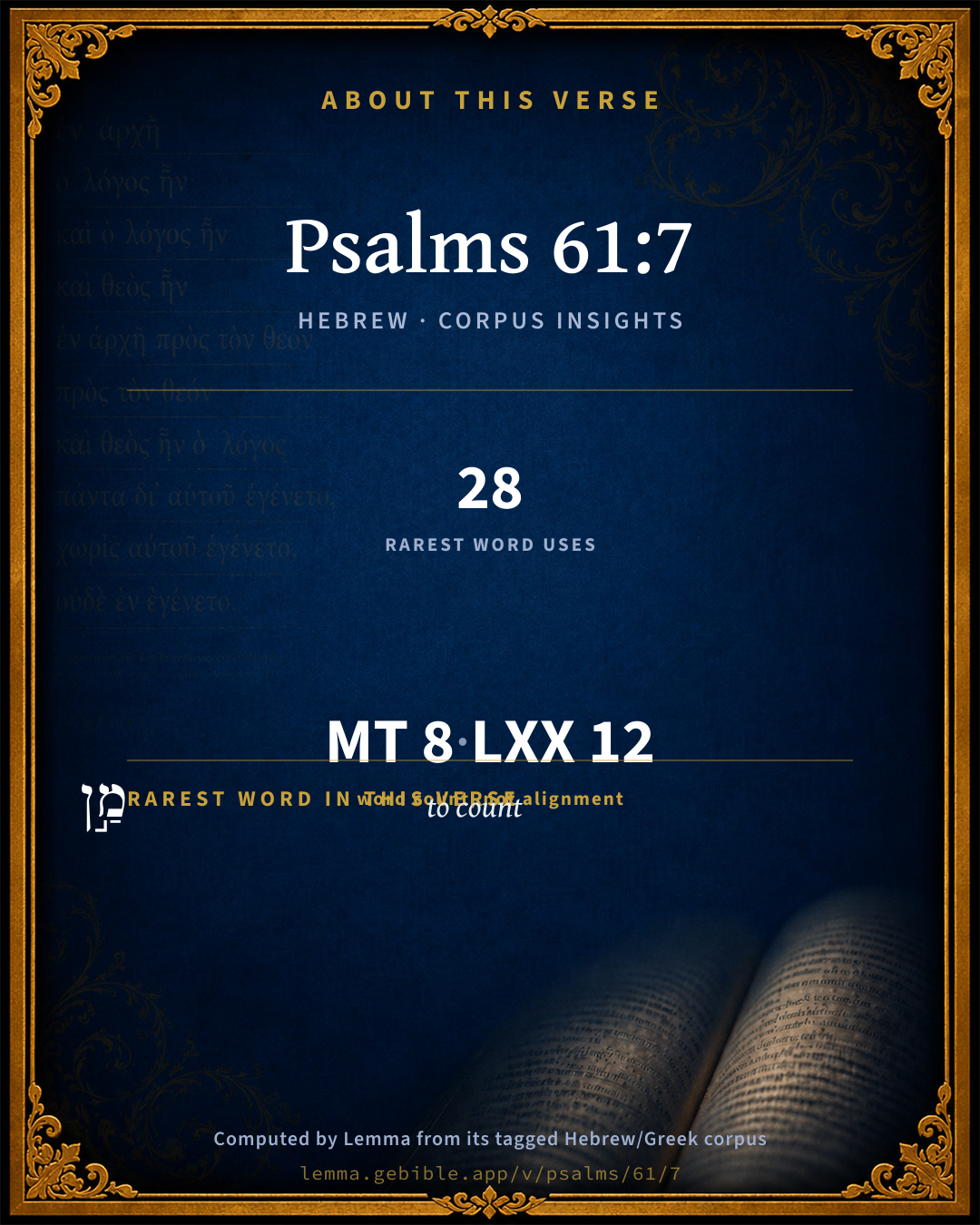
Psalms 61:7

Hebrew (Westminster Leningrad Codex) Psalms 61:7 appears in the Hebrew Old Testament. The text above is from the Westminster Leningrad Codex. Each word links to its Strong’s number, a concise gloss, and parsing drawn from the Open Scriptures Hebrew Bible morphology. Click any word for its full Brown-Driver-Briggs (BDB) entry.
Download image
Cite this verse

Psalms 61:7 (World English Bible). Public Domain. Lemma interlinear Bible study tool, https://lemma.gebible.app/v/psalms/61/7.

Show BibTeX & RIS
BibTeX
RIS
English Translation
He shall be enthroned in God's presence forever. Appoint your loving kindness and truth, that they may preserve him.
World English Bible · Public Domain
Download a study sheet

One document with this verse’s original text, its word-by-word gloss line, the meaning frame, cross-references with their text, attributed commentary, and full source and license credits — printable, and it pastes into notes with its structure intact.

This verse Autodidact and up

Study sheet (.html) Plain text (.txt)

A passage Seminary Student

Up to 50 verses in one chapter. A passage sheet keeps up to 6 commentary sources and 12 cross-references per verse, in the order this page ranks them, and says so on the sheet whenever that leaves anything out. Ask for a single verse and you get the Autodidact verse sheet above.

Everything on this page stays free to read, with no account — the sheet is a download of what is already on screen, not access to it.

Want to remove ads? Support Godless Engineer
Compare translations 3

The same verse in 3 English versions, stacked beneath the original-language interlinear above. Click any original word for its lexicon entry.

Each is an independent rendering of the whole verse — the interlinear is not word-aligned to these translations.

Highlighted words mark where these versions differ — a whole-verse word diff, not a word-by-word alignment.

  • World English Bible Public Domain
    He shall be enthroned in God's presence forever. Appoint your loving kindness and truth, that they may preserve him.
  • King James Version Public Domain
    He shall abide before God for ever: O prepare mercy and truth, which may preserve him.
  • unfoldingWord Literal Text CC BY-SA 4.0
    May he dwell forever to the face of God. Appoint covenant faithfulness and truth; may they preserve him.

unfoldingWord Literal Text — © unfoldingWord, licensed CC BY-SA 4.0. Word-aligned USFM3 via Door43 (git.door43.org/unfoldingWord/en_ult).

Versions to compare (up to 4)

3 of 4 selected

Show all 18 translations

Every available English version of this verse, each an independent rendering of the whole verse.

  • World English Bible Public Domain
    He shall be enthroned in God's presence forever. Appoint your loving kindness and truth, that they may preserve him.
  • Berean Standard Bible Public Domain
    May he sit enthroned in God’s presence forever; appoint Your loving devotion and Your faithfulness to guard him.
  • Majority Standard Bible Public Domain
    May he sit enthroned in God’s presence forever; appoint Your loving devotion and Your faithfulness to guard him.
  • King James Version Public Domain
    He shall abide before God for ever: O prepare mercy and truth, which may preserve him.
  • American Standard Version (1901) Public Domain
    He shall abide before God for ever: Oh prepare lovingkindness and truth, that they may preserve him.
  • Revised Version (1885) Public Domain
    He shall abide before God for ever: O prepare lovingkindness and truth, that they may preserve him.
  • Geneva Bible (1599) Public Domain
    Hee shall dwell before God for euer: prepare mercie and faithfulnes that they may preserue him.
  • Douay-Rheims (1899) Public Domain
    Thou wilt add days to the days of the king: his years even to generation and generation.
  • Young's Literal Translation Public Domain
    He dwelleth to the age before God, Kindness and truth appoint -- they keep him.
  • Literal Standard Version CC BY-SA 4.0
    He dwells before God for all time, || Appoint kindness and truth—they keep him.
  • Unlocked Literal Bible CC BY-SA 4.0
    He will remain before God forever.
  • unfoldingWord Literal Text CC BY-SA 4.0
    May he dwell forever to the face of God. Appoint covenant faithfulness and truth; may they preserve him.
  • Darby Bible Public Domain
    He shall abide before God for ever: bestow loving-kindness and truth, that they may preserve him.
  • World Messianic Bible Public Domain
    He shall be enthroned in God’s presence forever. Appoint your loving kindness and truth, that they may preserve him.
  • Webster's Bible Public Domain
    \\61:6\\Thou wilt prolong the king's life: and his years as many generations.
  • Free Bible Version CC BY-SA 4.0
    May he always live in your presence; may your trustworthy love and faithfulness protect him.
  • Bible in Basic English Public Domain
    May the seat of his authority be before God for ever; may mercy and righteousness keep him safe.
  • JPS Tanakh (1917) Public Domain
    (61-8) May he be enthroned before God for ever! Appoint mercy and truth, that they may preserve him.

Literal Standard Version (2020), Covenant Press — licensed CC BY-SA 4.0. Text via the HelloAO Bible API (eBible.org). Unlocked Literal Bible (unfoldingWord) — licensed CC BY-SA 4.0. Text via the HelloAO Bible API (eBible.org). unfoldingWord Literal Text — © unfoldingWord, licensed CC BY-SA 4.0. Word-aligned USFM3 via Door43 (git.door43.org/unfoldingWord/en_ult). Free Bible Version, Dr. Jonathan Gallagher — licensed CC BY-SA 4.0. Text via the HelloAO Bible API (eBible.org).

Word by word

More ways to search: Search by grammar → Find every occurrence → Compare this word →

Practice this passage: Drill this verse → Learn its vocabulary →

מַ֣ן
mânâh
H4487
“count”
Verb, Piel, Imperative, 2nd Person, Masculine, Singular
Part of Speech
Verb
Stem
Piel
Form
Imperative
Person
2nd Person
Gender
Masculine
Number
Singular
Full BDB Definition

Origin: a primitive root

TWOT: 1213

to count, reckon, number, assign, tell, appoint, prepare - (Qal) - to count, number - reckon, assign, appoint - (Niphal) - to be counted, be numbered - to be reckoned, be assigned - (Piel) to appoint, ordain - (Pual) appointed (participle)
  1. יֵשֵׁ֣ב yâshab H3427 “to dwell” Verb, Qal, Imperfect, 3rd Person, Masculine, Singular
  2. ע֭וֹלָם ʻôwlâm H5769 “forever” Noun, Common, Masculine, Singular, Absolute
  3. לִפְנֵ֣י pânîym H6440 “to/for · face(s) of” Preposition + Noun, Common, Both, Plural, Construct
  4. אֱלֹהִ֑ים ʼĕlôhîym H430 “God(s)” Noun, Common, Masculine, Plural, Absolute
  5. חֶ֥סֶד chêçêd H2617 “kindness” Noun, Common, Masculine, Singular, Absolute
  6. וֶ֝אֱמֶ֗ת ʼemeth H571 “and · faithfulness” Conjunction + Noun, Common, Feminine, Singular, Absolute
  7. יִנְצְרֻֽהוּ nâtsar H5341 “to guard · him” Verb, Qal, Imperfect, 3rd Person, Masculine, Plural + Suffix, Personal, 3rd Person, Masculine, Singular

About this verse

These counts appear in no published source. They are computed here, from the morphology-tagged text and Lemma’s own curated glosses. What Lemma adds →

8
words
8
distinct lemmas
Wisdom
section

Shared distinctive vocabulary

מַ֣ן to count H4487 occurs in 27 verses of the Hebrew Bible. Also found in:

Grammatical profile

  • 3 verbs
  • 5 nouns

Verb forms

  • יֵשֵׁ֣ב Qal · Imperfect
  • מַ֣ן Piel · Imperative
  • יִנְצְרֻֽהוּ Qal · Imperfect

Hebrew & Septuagint length

In English translation the verse runs 19 words from the Hebrew and 17 from the Septuagint (LXX English) — closely comparable.

A rough comparison of the two English renderings, which tokenize alike — not a word-level alignment.

Word counts can differ between the Hebrew and the Greek without any difference in meaning — e.g. the Hebrew direct-object marker אֵת has no separate Greek word, and Greek often adds the article ὁ.

In the original languages it is 8 Hebrew tokens and 12 Greek tokens — but the two are counted differently (Hebrew bundles its prefixes and suffixes into one token; the Greek is in lemma form), so that isn’t a like-for-like length.

Cross-references

13

Topical passages linked to Psalms 61:7 in the Treasury of Scripture Knowledge — connected by theme and wording, ordered by reader-vote popularity; previews shown in the World English Bible.

  • Psalms 40:11 Don't withhold your tender mercies from me, Yahweh. Let your loving kindness and your truth continually preserve me.
  • Genesis 24:27 He said, "Blessed be Yahweh, the God of my master Abraham, who has not forsaken his loving kindness and his truth toward my master. As for me, Yahweh has led me in the way to the house of my master's relatives."
  • Psalms 41:12 As for me, you uphold me in my integrity, And set me in your presence forever.
  • Psalms 57:3 He will send from heaven, and save me, He rebukes the one who is pursuing me. Selah. God will send out his loving kindness and his truth.
  • Isaiah 9:6–7 For to us a child is born, to us a son is given; and the government shall be on his shoulder: and his name shall be called Wonderful, Counselor, Mighty God, Everlasting Father, Prince of Peace.
  • Luke 1:33 and he will reign over the house of Jacob forever. There will be no end to his Kingdom."
  • Psalms 43:3 Oh, send out your light and your truth. Let them lead me. Let them bring me to your holy hill, To your tents.
  • Proverbs 20:28 Love and faithfulness keep the king safe. His throne is sustained by love.
  • Micah 7:20 You will give truth to Jacob, and mercy to Abraham, As you have sworn to our fathers from the days of old.
  • Luke 1:54–55 He has given help to Israel, his servant, that he might remember mercy,
  • Hebrews 9:24 For Christ hasn't entered into holy places made with hands, which are representations of the true, but into heaven itself, now to appear in the presence of God for us;
  • Genesis 32:10 I am not worthy of the least of all the loving kindnesses, and of all the truth, which you have shown to your servant; for with just my staff I passed over this Jordan; and now I have become two companies.
  • Hebrews 7:21–25 (for they indeed have been made priests without an oath), but he with an oath by him that says of him, "The Lord swore and will not change his mind, 'You are a priest forever, According to the order of Melchizedek'".

Cross-references courtesy of OpenBible.info (CC BY 4.0).

Hebrew and Greek witnesses Masoretic Hebrew ↔ Greek Septuagint

The same verse in the two great witnesses to the Old Testament, shown verse-for-verse.

You’re reading Greek Psalm 60 (Hebrew Psalm 61). The Septuagint counts the superscription, so verse numbers can differ from the Hebrew — chapter-level alignment, not verse-by-verse. Numbering follows Rahlfs.

These are two independent witnesses, not word-aligned to each other, and the Septuagint is shown in lemma (dictionary) form.

Hebrew Psalms 61:7 Masoretic · Westminster Leningrad Codex

יֵשֵׁ֣ב ע֭וֹלָם לִפְנֵ֣י אֱלֹהִ֑ים חֶ֥סֶד וֶ֝אֱמֶ֗ת מַ֣ן יִנְצְרֻֽהוּ

He shall be enthroned in God's presence forever. Appoint your loving kindness and truth, that they may preserve him.

World English Bible · Public Domain

Greek LXX Greek Psalm 60:7 Septuagint · lemma form

ἡμέρα ἐπί ἡμέρα βασιλεύς προςτίθημι ἔτος αὐτός ἕως ἡμέρα γενεά καί γενεά

He shall endure for ever before God: which of them will seek out his mercy and truth?

LXX2012 (modern English Septuagint) · Public Domain

On this verse, Ellicott's Commentary for English Readers discusses the Septuagint’s reading. Read the note in Commentary ↓

Hebrew: Westminster Leningrad Codex (CC BY 4.0). Greek: Septuagint (public domain); English from LXX2012 (modern English Septuagint) (Public Domain). How the Septuagint differs from the Hebrew →

Commentary

Notes on Psalms 61:7 from classic Christian and Jewish commentators (each source and its license shown beneath its notes). The classic Christian expositions comment on the surrounding passage and are grouped to its opening verse, so a note may address several verses; the Jewish commentaries on the Tanakh (Rashi and others) are per-verse, so they appear only where the commentator wrote on this verse.

Lemma curates 59 commentaries, every one of them public domain or Creative Commons licensed, each selected and text-cleaned for this edition rather than reprinted as found. About our sources →

Trapp's Complete Commentary

John Trapp

Psa 61:7 He shall abide before God for ever: O prepare mercy and truth, [which] may preserve him.

Ver. 7. He shall abide before God for ever] Or, He shall sit, viz. upon the throne, a long while in his person; but for ever in his Son Christ, Luk 1:32-33 : and this affordeth sweet and singular comfort to the whole Church and each member thereof; forasmuch as the dignity of a king cannot stand unless his subjects be in safety.

O prepare mercy and truth, which may preserve him] Hos duos custodes adhibe quibus unis innitatur, let these two (thy mercy and thy truth) be the supporters of his throne, let them be of his lifeguard, let them be his due and prepared portion, as the Hebrew word Man here used signifieth (Junius). Some understand the words thus, furnish the king with these two virtues, clemency and truth, that thereby his throne may be established. See Pro 20:28; Pro 29:14.

John Trapp, A Commentary or Exposition upon All the Books of the Old and New Testament (1647–1656) — public domain. Text from a community e-Sword module.

J. A. Alexander on Psalms

Joseph Addison Alexander

8. (Psa 61:7). He shall sit (enthroned) to eternity before God; mercy and truth do thou provide; let them preserve him (or they shall preserve him). The first verb suggests the two ideas of continuance or permanence and regal exaltation. Compare 2Sa 7:29. Before God, in his presence and under his protection. See above, on Psa 56:13. Provide, prepare, afford, or have in readiness. Mercy and Truth are personified, as in Psa 40:11; Psa 57:3. Compare Psa 43:3. They seem to be here represented as God's messengers or agents in preserving his Anointed.

Joseph Addison Alexander, The Psalms Translated and Explained (1850) — public domain. Text from a community e-Sword module.

Geneva Bible (1599)

Geneva Bible translators

For the stability of my kingdom standeth in thy mercy and truth.

Geneva Bible (1599) marginal notes — public domain. Text via Bolls.life.

Jamieson, Fausset & Brown

Robert Jamieson, A. R. Fausset & David Brown

abide before God--literally, "sit as a king in God's presence," under His protection.

Jamieson, Fausset & Brown — Commentary Critical and Explanatory on the Whole Bible (1871) — public domain (CC PDM 1.0). Text via the HelloAO Bible API.

Adam Clarke's Commentary

Verse 7. He shall abide before God for ever] Literally, "He shall sit for ever before the faces of God." He shall ever appear in the presence of God for us. And he ever sits at the right hand of the Majesty on high; for he undertook this office after having, by his sacrificial offering, made atonement for our sins.

Prepare mercy and truth, which may preserve him.] As Mediator, his attendants will ever be mercy and truth. He will dispense the mercy of God, and thus fulfil the truth of the various promises and predictions which had preceded his incarnation. There is an obscurity in this clause, חסד ואמת מן ינצרהו chesed veemeth man yintseruhu, owing to the particle מן man, which some translate who or what; and others, number thou, from מנה manah, to count. Houbigant, and he is followed by Bishop Lowth, would read מיהוה miyehovah, Mercy and truth from Jehovah shall preserve him. The Anglo-Saxon has, [A.S.] Mildheartedness, and soothfastness his, who seeketh? which is nearly the rendering of the old Psalter: Mercy and sothfastnes of him, wha sall seke? Dr. Kennicott says, מן man is a Syriasm; and should be translated quaesoutinam, I beseech thee, - I wish, - O that! On this very ground Coverdale appears to have translated, O let thy lovynge mercy and faithfulnes preserve him! The sense I have given above I conceive to be the true one.

Adam Clarke's Commentary on the Bible (1810–1826) — public domain. Text from a community e-Sword/MySword module.

John Calvin's Commentaries

7. He shall abide before the face of God for ever. This is only a simpler way of expressing what he had said before, I will abide in thy tabernacle for ever. He refers to the security and peace which he would enjoy under the protection of God, who would effectually preserve his life. By the face of God, must be meant the fatherly care and providence which he extends to his people. So numerous are the dangers which surround us, that we could not stand a single moment, if his eye did not watch over our preservation. But the true security for a happy life lies in being persuaded that we are under divine government. There follows a prayer that God would appoint mercy and truth for preserving the king. And this admits of two meanings. As clemency and truth are the best safeguards of a kingdom, it would not be altogether unreasonable to suppose that David prays here to be endued with these dispositions, as a means of establishing his throne. But the other meaning is perhaps preferable, that God would gird himself with clemency and truth in order to the preservation of the king. The Hebrew term מנה, manah, signifies not only to prepare, but to set over, or appoint; and he speaks as if the true defense of the kingdom was only to be found in the mercy and faithfulness of God. He uses the expression prepare, or command, to intimate how easily God can provide the means necessary for preserving his people. In the concluding words, he expresses his resolution to persevere in the constant celebration of the praises of God, with a view to fulfilling the vows which he had contracted — and this again may lead us to remark the agreement which ought ever to subsist between the two parts of invocation: for David, while he applied to God for help, under the pressure of calamity, showed himself uniformly grateful when he had experienced deliverance.

John Calvin's Commentaries (1540-1563) — public domain. Text from the Calvin Translation Society English edition (1840s-50s) via the Christian Classics Ethereal Library (ccel.org). Calvin's coverage is partial (roughly two-thirds of the Bible); uncommented books and verses are honest gaps, never fabricated. The 19th-century editor's footnotes and remarks are omitted so the notes are faithfully Calvin's own voice.

Ellicott's Commentary for English Readers

(7) He shall abide.—Better, may he sit enthroned.

Prepare.—Rather, appoint. But the LXX. had a different reading, and an ingenious emendation has been suggested from a comparison with Psa_40:11, viz., “let mercy and truth continually preserve him.”

A Bible Commentary for English Readers, edited by Charles John Ellicott (1878–1897) — public domain. Text from a community e-Sword module.

The Cambridge Bible for Schools and Colleges

gen. ed. J. J. S. Perowne

7. He shall abide before God for ever] Rather, He shall sit enthroned before God for ever, an allusion to the promise of eternal dominion to the house of David, ‘in the presence of God,’ enjoying His favour and protection. See 2Sa_7:16 (read with LXX before me), 26, 29; Psa_21:6; Psa_89:36 b: and for the pregnant sense of ‘sit’ cp. Psa_9:7.

O prepare &c.] Appoint lovingkindness and truth that they may guard him. Cp. Psa_40:11; 2Sa_15:20; Psa_42:8; Psa_89:14. God’s covenant love and faithfulness to His promise are like guardian angels to the king; and the reflection of these attributes of God in his own character and administration will be the safeguard of his throne (Pro_20:28).

The word prepare (‘appoint’) is ignored by some of the Ancient Versions (Jer. Aq. Symm.), and variously rendered by others. It is in itself suspicious both for its form and for its position, and perhaps should simply be omitted. Possibly it may be a corruption of the word for ‘continually’ (Psa_40:11), or of an emphatic they (‘Lovingkindness and truth shall continually—or, even they shall—guard him’). Such a statement agrees better with Psa_61:6-7 a than a prayer does.

The Cambridge Bible for Schools and Colleges (gen. ed. J. J. S. Perowne; Cambridge University Press, 1878–1918) — public domain. Text from a community e-Sword module.

John Gill's Exposition

He shall abide before God for ever,.... Or "sit" (b); or "may he sit". Being raised from the dead he was received up to heaven into the presence of God, and sat down at his right hand; where he abides for ever, a Priest upon his throne, having an unchangeable priesthood, Heb 7:24;

and prepare mercy and truth, which may preserve him; which, if literally understood of David, is a prayer that the Lord would show him favour and kindness, and perform his promises to him, whereby his life would be preserved from the plots and, conspiracies of his enemies, and his kingdom be established; or that he might be exalted to exercise mercy towards his subjects, and administer justice, or execute the judgment of truth among them; which would make for the preservation of his person, and the support of his throne and government, Pro 20:28. But as the words may be applied to the Messiah, they are to be understood, not of the preservation of his corporeal life while here on earth; but either of the preservation of his people, in whom he lives, through the mercy and truth of God, expressed in the exertion of his power, by which they are preserved unto the heavenly kingdom and glory; or of the security of his kingdom, which not being of this world, is not supported by worldly power and policy, but in a spiritual manner, and by spiritual means; such as mercy, or "grace and truth"; that is, the doctrines of grace and truth, which came by Christ, and are preached by his ministers, and are the means of continuing, promoting, and preserving his kingdom and interest in the world, Or the words may be rendered, "may mercy and the truth of manna keep thee"; the true manna, Christ; see Joh 6:32; or "mercy and truth, as the manna, keep thee" (c); as that was kept in the golden pot, Exo 16:33; or rather as that kept and sustained the Israelites in the wilderness.

(b) "sedebit", Tigurine version, Vatablus, Musculus, Cocceius, Michaelis; so Ainsworth; "vel sedeat", Vatablus, Gejerus, Amama. (c) Vid. Hackman. Praecidan. Sacr. tom. 1. p. 71.

John Gill's Exposition of the Whole Bible (1746–1763) — public domain (CC PDM 1.0). Text via the HelloAO Bible API.

Albert Barnes' Notes on the Bible

He shall abide before God for ever - That is, perpetually; without danger of change, or of being driven into exile. This may allude, however, to the hope which David had that he would always live with God in a higher world - a world where there would be no danger of change or banishment. His restoration to his home, to his throne, and to the privileges of the sanctuary, he may have regarded as an emblem of his ultimate reception into a peaceful heaven, and his mind may have glanced rapidly from the one to the other. On earth, after his restoration, he would have no fear that he would be banished again; in heaven, of which such a restoration might be regarded as an emblem, there could be no change, no exile.

O prepare mercy and truth - literally, divide, or divide out; then, allot or appoint; and then, make ready or prepare. The prayer is, that God would measure out to him, or impart to him, such favor that this desire of his heart would be realized. On the phrase mercy and truth, see Psa 25:10, note; Psa 57:3, note; Psa 57:10, note.

Which may preserve him - They will preserve him. That is, the manifestation of such mercy and truth would make his permanent occupancy of his throne on earth, and his ultimate reception into heaven, secure.

Albert Barnes' Notes on the Bible (1834–1885) — public domain. Text from a community e-Sword/MySword module.

Matthew Poole's English Annotations

He shall abide, or sit, to wit, in the throne, Jer 13:13.

Before God; living and ruling as in God’s presence, and serving God with his royal power, and worshipping him in his tabernacle.

Prepare, or order, or appoint, as this word signifies, Jon 1:17; 4:6.

Mercy and truth; either,

1. The graces of mercy or compassion, and truth or faithfulness; which are the great supporters of thrones, Pro 20:28; 29:14. Or rather,

2. Thy mercy and truth, i.e. the effects of them; thy truth in giving me those mercies which thou hast promised to me, and thy mercy in giving me such further blessings as I need and thou seest fit to give me.

Matthew Poole's English Annotations on the Holy Bible (1683–1685) — public domain. Text from a community e-Sword/MySword module.

The Treasury of David

Charles H. Spurgeon

Ver. 7. He shall abide before God for ever. Though this is true of David in a modified sense, we prefer to view the Lord Jesus as here intended as the lineal descendant of David, and the representative of his royal race. Jesus is enthroned before God to eternity; here is our safety, dignity, and delight. We reign in him; in him we are made to sit together in the heavens. David's personal claim to sit enthroned for ever is but a foreshadowing of the revealed privilege of all true believers.

O prepare mercy and truth, which may preserve him. As men cry, "Long live the king, "so we hail with acclamation our enthroned Immanuel, and cry, "Let mercy and truth preserve him." Eternal love and immutable faithfulness are the bodyguards of Jesus' throne, and they are both the providers and the preservers of all those who in him are made kings and priests unto God. We cannot keep ourselves, and nothing short of divine mercy and truth can do it; but these both can and will, nor shall the least of the people of God be suffered to perish.

Ver. 7. O prepare mercy. David having declared in his own behalf the purpose of God towards him for everlasting salvation, he, speaking of himself, shall abide before God for ever: he withal considering what he was to run through in this life, and what it might require to keep him unto the end, and so for ever, doth presently thereupon, in way of prayer, subjoin prepare mercy and truth, which may preserve me. As if he had said, I have yet a long journey to go, and through many hazards, and thy promise is, I shall abide before thee for ever. Lord, thou hast need lay up and aforehand prepare an abundance of mercy and truth to preserve me for time to come. Thomas Goodwin.

Charles H. Spurgeon's The Treasury of David (1869–1885) — public domain. Psalms only. Text from a community e-Sword/MySword module.

Whedon's Commentary on the Bible

Daniel D. Whedon

7. He shall abide before God—That is, he shall be established upon his throne in the presence, and by the favour, of God. “When kings are said to ‘abide’ or sit, it is commonly in the more formal sense of sitting on the throne, the judgment seat.”—Perowne.

Oh prepare mercy and truth— Or, appoint mercy and truth, distinguishing qualities of the divine character and government. These he would have appointed as his watch and guard, that his acts might conform to the divine model.

Daniel D. Whedon (gen. ed.), Commentary on the Old and New Testaments (1874–1909) — public domain. Text from a community e-Sword module.

The Pulpit Commentary

He shall abide (or, may he abide) before God forever: O prepare mercy and truth, which may preserve him; literally, appoint that mercy and truth may preserve him. Let "mercy and truth," the highest of thy attributes, preserve him, and keep him in life forever.

The Pulpit Commentary (1880–1919), ed. H.D.M. Spence-Jones & Joseph S. Exell — public domain. Text from a community e-Sword module.

Rashi

Rabbi Shlomo Yitzchaki (Rashi)

Add days to the days of the king If it has been decreed upon me to die young, add days to my days until my years will equal seventy years, as the years of every generation.

Rashi on the Tanakh — English translations: “The Judaica Press complete Tanach with Rashi, translated by A. J. Rosenberg” (CC BY 4.0); “Pentateuch with Rashi's commentary by M. Rosenbaum and A.M. Silbermann, 1929-1934” (public domain); “The Metsudah Tanach series, Lakewood, N.J” (CC BY 4.0); and “The Book of Joshua, Metsudah Publications, 1997” (CC BY 4.0). Text via Sefaria.

Lesson kit

Teaching starters — assembled from the data on this page, not authored interpretation. Every prompt links to the verse data it draws on. Edit before teaching.

Psalms, in the Wisdom, opens this verse with 8 words (8 distinct Hebrew lemmas). Its most distinctive word is mânâh (“to count”). A historical commentator’s framing appears above. Read the whole chapter for the surrounding context.

Discussion questions

  1. How does “to count” (mânâh) shape what this verse is saying?
  2. Genesis 13:16 shares the word «to count» with this verse. How do the two illuminate each other?
  3. The translations on this page render this verse differently — a whole-verse word diff, not a word-by-word alignment. What might account for the different wordings?
  4. The verb «יֵשֵׁ֣ב» is Qal Imperfect. How does its form color the action?
  5. Reading how Trapp's Complete Commentary and J. A. Alexander on Psalms read this verse, where do the two commentators agree and where do they part?

Things to notice

Reading settings

Reading text

Shown beneath each verse's original-language words.

Old Testament
Old Testament edition

Read the OT as the Masoretic Hebrew (MT) or the Greek Septuagint (LXX).

English shown for the Greek Septuagint (in the Hebrew ↔ Greek comparison).

Comparing translations? Open the Compare panel on any verse page to stack up to four side by side.