
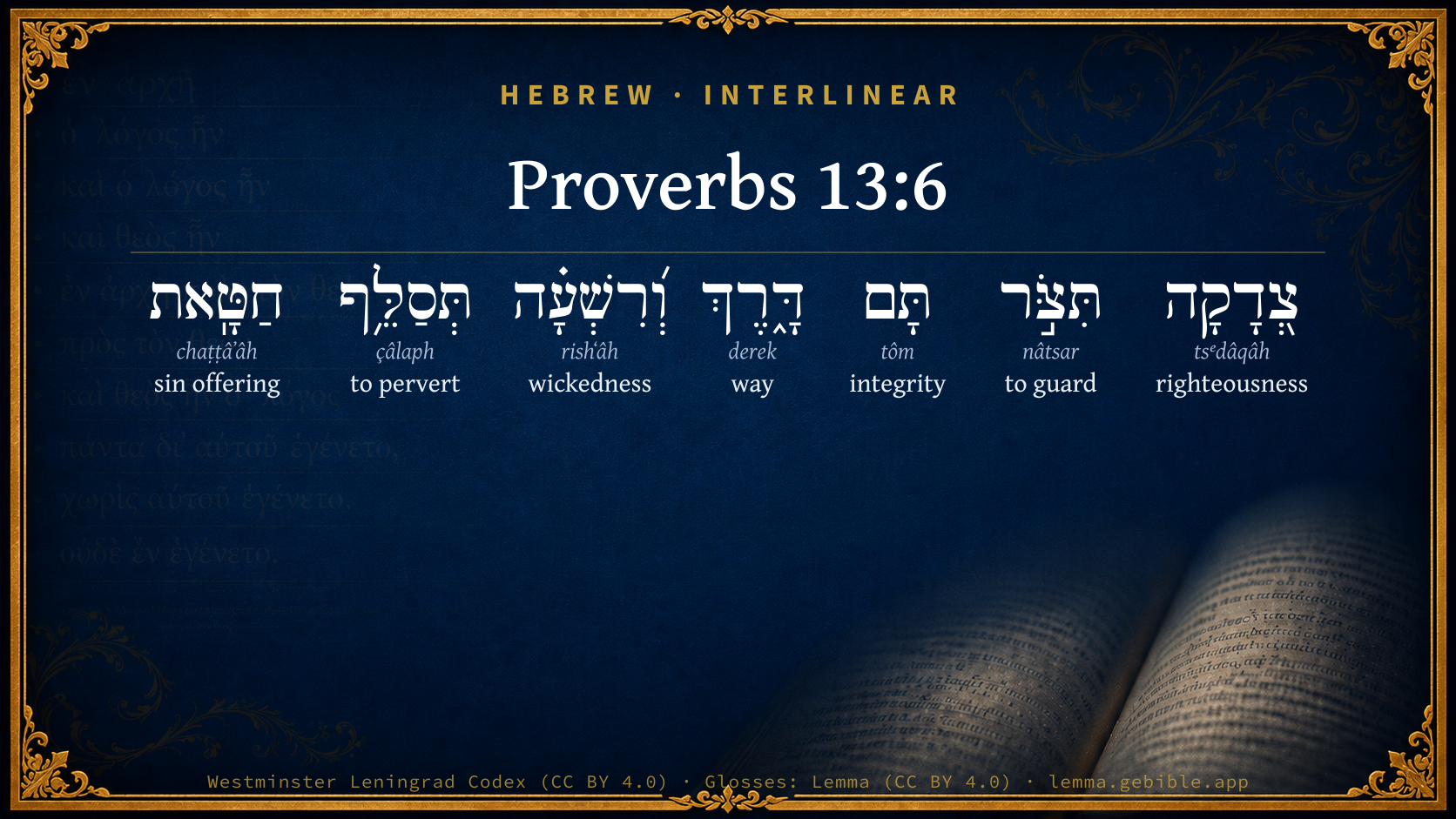
Proverbs 13:6

Hebrew (Westminster Leningrad Codex) Proverbs 13:6 appears in the Hebrew Old Testament. The text above is from the Westminster Leningrad Codex. Each word links to its Strong’s number, a concise gloss, and parsing drawn from the Open Scriptures Hebrew Bible morphology. Click any word for its full Brown-Driver-Briggs (BDB) entry.
Download image
Cite this verse

Proverbs 13:6 (World English Bible). Public Domain. Lemma interlinear Bible study tool, https://lemma.gebible.app/v/proverbs/13/6.

Show BibTeX & RIS
BibTeX
RIS
English Translation
Righteousness guards the way of integrity, But wickedness overthrows the sinner.
World English Bible · Public Domain
Download a study sheet

One document with this verse’s original text, its word-by-word gloss line, the meaning frame, cross-references with their text, attributed commentary, and full source and license credits — printable, and it pastes into notes with its structure intact.

This verse Autodidact and up

Study sheet (.html) Plain text (.txt)

A passage Seminary Student

Up to 50 verses in one chapter. A passage sheet keeps up to 6 commentary sources and 12 cross-references per verse, in the order this page ranks them, and says so on the sheet whenever that leaves anything out. Ask for a single verse and you get the Autodidact verse sheet above.

Everything on this page stays free to read, with no account — the sheet is a download of what is already on screen, not access to it.

Want to remove ads? Support Godless Engineer
Compare translations 3

The same verse in 3 English versions, stacked beneath the original-language interlinear above. Click any original word for its lexicon entry.

Each is an independent rendering of the whole verse — the interlinear is not word-aligned to these translations.

Highlighted words mark where these versions differ — a whole-verse word diff, not a word-by-word alignment.

  • World English Bible Public Domain
    Righteousness guards the way of integrity, But wickedness overthrows the sinner.
  • King James Version Public Domain
    Righteousness keepeth him that is upright in the way: but wickedness overthroweth the sinner.
  • unfoldingWord Literal Text CC BY-SA 4.0
    Righteousness guards the blameless of way, but wickedness leads a sinful one astray.

unfoldingWord Literal Text — © unfoldingWord, licensed CC BY-SA 4.0. Word-aligned USFM3 via Door43 (git.door43.org/unfoldingWord/en_ult).

Versions to compare (up to 4)

3 of 4 selected

Show all 18 translations

Every available English version of this verse, each an independent rendering of the whole verse.

  • World English Bible Public Domain
    Righteousness guards the way of integrity, But wickedness overthrows the sinner.
  • Berean Standard Bible Public Domain
    Righteousness guards the man of integrity, but wickedness undermines the sinner.
  • Majority Standard Bible Public Domain
    Righteousness guards the man of integrity, but wickedness undermines the sinner.
  • King James Version Public Domain
    Righteousness keepeth him that is upright in the way: but wickedness overthroweth the sinner.
  • American Standard Version (1901) Public Domain
    Righteousness guardeth him that is upright in the way; But wickedness overthroweth the sinner.
  • Revised Version (1885) Public Domain
    Righteousness guardeth him that is upright in the way: but wickedness overthroweth the sinner.
  • Geneva Bible (1599) Public Domain
    Righteousnesse preserueth the vpright of life: but wickednes ouerthroweth the sinner.
  • Douay-Rheims (1899) Public Domain
    Justice keepeth the way of the innocent: but wickedness overthroweth the sinner.
  • Young's Literal Translation Public Domain
    Righteousness keepeth him who is perfect in the way, And wickedness overthroweth a sin offering.
  • Literal Standard Version CC BY-SA 4.0
    Righteousness keeps him who is perfect in the way, || And wickedness overthrows a sin offering.
  • Unlocked Literal Bible CC BY-SA 4.0
    Righteousness protects those who are faultless in their path, but wickedness turns away those who commit sin.
  • unfoldingWord Literal Text CC BY-SA 4.0
    Righteousness guards the blameless of way, but wickedness leads a sinful one astray.
  • Darby Bible Public Domain
    Righteousness preserveth him that is perfect in the way; but wickedness overthroweth the sinner.
  • World Messianic Bible Public Domain
    Righteousness guards the way of integrity, but wickedness overthrows the sinner.
  • Webster's Bible Public Domain
    Righteousness keepeth him that is upright in the way: but wickedness overthroweth the sinner.
  • Free Bible Version CC BY-SA 4.0
    Goodness protects those who live right, but sin overcomes the wicked.
  • Bible in Basic English Public Domain
    Righteousness keeps safe him whose way is without error, but evil-doers are overturned by sin.
  • JPS Tanakh (1917) Public Domain
    Righteousness guardeth him that is upright in the way; but wickedness overthroweth the sinner.

Literal Standard Version (2020), Covenant Press — licensed CC BY-SA 4.0. Text via the HelloAO Bible API (eBible.org). Unlocked Literal Bible (unfoldingWord) — licensed CC BY-SA 4.0. Text via the HelloAO Bible API (eBible.org). unfoldingWord Literal Text — © unfoldingWord, licensed CC BY-SA 4.0. Word-aligned USFM3 via Door43 (git.door43.org/unfoldingWord/en_ult). Free Bible Version, Dr. Jonathan Gallagher — licensed CC BY-SA 4.0. Text via the HelloAO Bible API (eBible.org).

Word by word

More ways to search: Search by grammar → Find every occurrence → Compare this word →

Practice this passage: Drill this verse → Learn its vocabulary →

About this verse

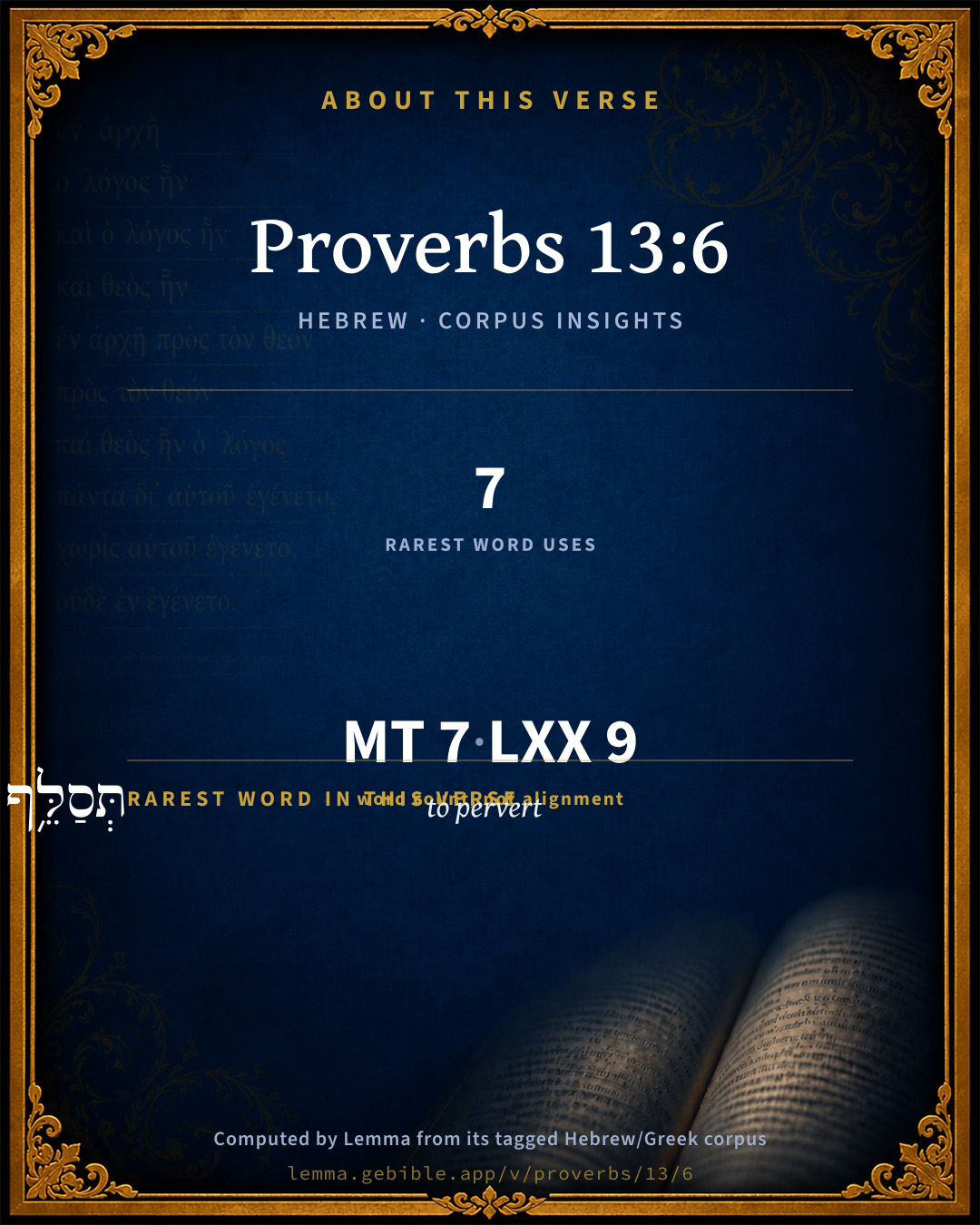
These counts appear in no published source. They are computed here, from the morphology-tagged text and Lemma’s own curated glosses. What Lemma adds →

7
words
7
distinct lemmas
Wisdom
section

Notable vocabulary

The rarest word here is תְּסַלֵּ֥ף to pervert H5557 — appearing just 7 times in the whole Hebrew Bible.

Shared distinctive vocabulary

תְּסַלֵּ֥ף to pervert H5557 occurs in 7 verses of the Hebrew Bible. Also found in:

Grammatical profile

  • 2 verbs
  • 5 nouns

Verb forms

  • תִּצֹּ֣ר Qal · Imperfect
  • תְּסַלֵּ֥ף Piel · Imperfect

Hebrew & Septuagint length

In the original languages it is 7 Hebrew tokens and 9 Greek tokens — but the two are counted differently (Hebrew bundles its prefixes and suffixes into one token; the Greek is in lemma form), so that isn’t a like-for-like length.

Cross-references

9

Topical passages linked to Proverbs 13:6 in the Treasury of Scripture Knowledge — connected by theme and wording, ordered by reader-vote popularity; previews shown in the World English Bible.

  • Proverbs 11:3 The integrity of the upright shall guide them, But the perverseness of the treacherous shall destroy them.
  • Proverbs 11:5–6 The righteousness of the blameless will direct his way, But the wicked shall fall by his own wickedness.
  • Psalms 15:2 He who walks blamelessly does what is right, And speaks truth in his heart;
  • Psalms 25:21 Let integrity and uprightness preserve me, For I wait for you.
  • Psalms 26:1 Judge me, Yahweh, for I have walked in my integrity. I have trusted also in Yahweh without wavering.
  • Psalms 140:11 An evil speaker won't be established in the earth. Evil will hunt the violent man to overthrow him.
  • Proverbs 21:12 The Righteous One considers the house of the wicked, And brings the wicked to ruin.
  • Proverbs 5:22 The evil deeds of the wicked ensnare him. The cords of his sin hold him firmly.
  • 2 Chronicles 28:23 For he sacrificed to the gods of Damascus, which struck him; and he said, Because the gods of the kings of Syria helped them, [therefore] will I sacrifice to them, that they may help me. But they were the ruin of him, and of all Israel.

Cross-references courtesy of OpenBible.info (CC BY 4.0).

Hebrew and Greek witnesses Masoretic Hebrew ↔ Greek Septuagint

The same verse in the two great witnesses to the Old Testament, shown verse-for-verse.

These are two independent witnesses, not word-aligned to each other, and the Septuagint is shown in lemma (dictionary) form.

Hebrew Proverbs 13:6 Masoretic · Westminster Leningrad Codex

צְ֭דָקָה תִּצֹּ֣ר תָּם דָּ֑רֶךְ וְ֝רִשְׁעָ֗ה תְּסַלֵּ֥ף חַטָּֽאת

Righteousness guards the way of integrity, But wickedness overthrows the sinner.

World English Bible · Public Domain

Greek LXX Proverbs 13:6 Septuagint · lemma form

δικαιοσύνη φυλάσσω ἄκακος ὁ δέ ἀσεβής φαῦλος ποιέω ἁμαρτία

No English rendering of this Greek verse — the small residue in the structurally divergent books.

On this verse, The Pulpit Commentary discusses the Septuagint’s reading. Read the note in Commentary ↓

Hebrew: Westminster Leningrad Codex (CC BY 4.0). Greek: Septuagint (public domain); English from a public-domain English Septuagint. How the Septuagint differs from the Hebrew →

Commentary

Notes on Proverbs 13:6 from classic Christian and Jewish commentators (each source and its license shown beneath its notes). The classic Christian expositions comment on the surrounding passage and are grouped to its opening verse, so a note may address several verses; the Jewish commentaries on the Tanakh (Rashi and others) are per-verse, so they appear only where the commentator wrote on this verse.

Lemma curates 59 commentaries, every one of them public domain or Creative Commons licensed, each selected and text-cleaned for this edition rather than reprinted as found. About our sources →

Trapp's Complete Commentary

John Trapp

Pro 13:6 Righteousness keepeth [him that is] upright in the way: but wickedness overthroweth the sinner.

Ver. 6. Righteousness keepeth him that is upright.] That, though belied or otherwise abused, he will not let go his integrity. {Job 27:5} David’s "feet stood on an even place." {Psa 26:12} The spouse, though despoiled of her veil, and wounded by the watch, yet cleaves close to Christ. {Son 5:7-8} Not but that the best are sometimes disquieted in such cases; for not the evenest weights but, at their first putting into the balance, somewhat sway both parts thereof, not without some show of inequality, which yet after some little motion, settle themselves in a meet poise and posture.

But wickedness overthroweth the sinner.] Heb., The sin; as if the man were transformed into sin’s image. "What is the transgression of Jacob? Is it not Samaria?" {Mic 1:5} Tubulus quidam paulo supra Ciceronem Praetor fuit: homo tam proiecte improbus ut eius nomen non hominis sed vitii esse videretur, saith Lipsius. {a} The Pope is called "the man of sin," {2Th 2:3} to note him merum scelus, saith Beza, - made up merely of sin.

{a} Lips. Antiq. lect.

John Trapp, A Commentary or Exposition upon All the Books of the Old and New Testament (1647–1656) — public domain. Text from a community e-Sword module.

The Biblical Illustrator

Joseph S. Exell

Pro_13:6

Wickedness overthroweth the sinner.

The effects of sin

There is a cause for every effect. Moral evil, as a cause, has produced the most awful, alarming, and extensive consequences.

I. Give the character of the sinner.

1. What is sin? The transgression of the law (1Jn_3:4). No law, no transgression. There is a law, which is grounded in the moral perfections of God.

2. Sin is a contempt of Gods authority. It is s forfeiture of His favour, and an exposure to His sore displeasure.

3. Sinners who refuse to submit to Christ--the Saviour from sin--sin against the gospel law of liberty and love.

II. Wickedness is the sinners ruin.

1. It exhausts his property. Sin is a very expensive thing. The passions are clamorous, exorbitant, and reckless, till gratified.

2. It blasts his reputation. Sin can never be deemed honourable, on correct principles.

3. It destroys his health. Intemperance has a natural tendency to undermine the best constitution.

4. It hastens the approach of death.

5. It effects the damnation of the soul. Coming to sin beyond remedy, he goes to his own place.

Improvement:

1. How awfully destructive is the love of sin.

2. It is the interest of every person to hate and shun sin.

3. A sinner, perishing in his sin, has no one to blame but himself.

4. From the whole subject we perceive the necessity, expedience, and advantage of securing true religion, by repentance toward God and faith in our Lord Jesus Christ. (Sketches of Four Hundred Sermons.)

The consequences of sin

I. What is meant by the teem sinner? Bold, brazen sinners.

1. The profligate.

2. The sceptical.

3. The deliberately worldly-minded.

II. What is meant by these sinners being overthrown? Wickedness works its own punishment.

1. It overthrows the sinners health.

2. It overthrows his character.

3. It overthrows his life.

The sinner here is a wreck, floating about like a derelict log. His happiness is wrecked. His future prospects are destroyed. (Homilist.)

The Biblical Illustrator, edited by Joseph S. Exell (c. 1880s–1900s) — public domain. Text from a community e-Sword module.

The Preacher's Complete Homiletical Commentary

Joseph S. Exell (gen. ed.)

CRITICAL NOTES.—

Pro_13:6. Sinner, literally “sin,” hence Miller reads “wickedness subverts the sin-offering,” and Zöckler “wickedness plungeth into sin.”

MAIN HOMILETICS OF Pro_13:6

OVERTHROW BY SIN

For Homiletics on the first clause of this verse see on chap. Pro_11:3; Pro_11:5-6.

I. The person overthrown—the sinner.

1. To be a sinner implies the existence of a law. Where there is no law there is no transgression. The sinner here spoken of is a transgressor against moral, Divine law.

2. There may be sin against a law which is in existence but which is not known. A man may not know of the existence of a law, and thus may sin ignorantly.

3. But the sinner of the Bible is one who, if he does not possess a written revelation, does possess a “law written in his heart”—his conscience. (See Rom_2:14-15.) Though the guilt is incomparably greater when a man sins against both conscience and revelation, yet he who transgresses the law of the first only is a sinner, and there must be overthrow in both cases, because moral transgression contains within itself the elements of destruction.

II. His overthrow.

1. For a man to be overthrown by breaking a law, that law must be good. There have been laws that common integrity has compelled men to transgress, and men have been rewarded by the Great Lawgiver for the transgression. There are still laws in force in the world, the violation of which is a proof of moral courage. But the sinner here doomed to overthrow is a sinner against a law to which his own conscience bears witness that it is holy and just, and good (Rom_7:12).

2. The breaking of this law must overthrow a man, even if no power were ever put forth against him. Sin debases a man by the law of cause and effect. Nothing can prevent a man who throws himself over a precipice from finding the bottom of the chasm—nothing can keep a sinner from sinking lower and lower in the moral scale. The first man finds a bottom—comes to the end of his fall—he who sins keeps sinking lower and lower while he continues in sin.

3. The law against which the sinner transgresses is backed by the highest authority, and by the greatest power of the universe. It represents the greatest Being. Sin is not directed against an abstraction, but against a person. He who has promulgated it is a living personality, and has all power to enforce its penalties. The Almighty God is against the sinner. Must he not then be overthrown?

4. The sinner can be placed in such a position as will justify him from the guilt of his past transgressions, and will enable him to keep the law in the future. The Lawgiver has Himself provided this way of escape. He Himself gives the power to obey. Hence he who sins against this law sins against mercy too, and doubles his condemnation, “is overthrown,” not by God’s law, but by his rejection of God’s method of deliverance from the guilt and power of sin.

OUTLINES AND SUGGESTIVE COMMENTS

Wickedness is ruin.

1. It exhausts a man’s property, whether much or little. Sin is a very expensive thing; a person cannot commit it to any extent, but at a considerable loss, not of time only, but of substance. The passions are clamorous, exorbitant, and restless, till gratified, and this must be repeated. The case of the prodigal is in point, he wasted all his patrimony in riotous living.

2. It blasts his reputation. Sin can never be deemed honourable on correct principles; yet while sinners possess means of supporting themselves in their vices, they still keep up their name and rank in the world; not in the Church of God, or in the estimation of heaven. But when the means of supplying fuel to feed the fires of foul desire and towering ambition fail, then their outward splendours go out into darkness. (See Pro_10:7; Pro_24:30).

3. It destroys health. Intemperance undermines the best constitution; it is a violence done to the physical order of things; it renders a man old in constitution, while he is young in years.

4. It hastens the approach of death. Wicked men frequently do “not live out half their days” (Psa_55:23), “for when they shall say, Peace and safety, then sudden destruction cometh as a thief in the night” (1Th_5:3). Sometimes their passions hurry them forward to the commission of crimes which terminate in the most disgraceful exit.

5. It effects the damnation of the soul. A sinner “wrongeth his own soul” (Pro_8:36). He quenches the Spirit of grace, neglects the salvation of the gospel, till he goes to his own place. “The wicked shall be turned into hell” (Psa_9:17).—Theta, from Sketches of Sermons.

Righteousness keepeth the upright, so that, though belied or abused, he will not let go his integrity (Job_27:5). David’s “feet stood in an even place” (Psa_26:12). The spouse, though despoiled of her veil and wounded by the watch, yet keeps close to Christ (Song of Solomon 5). Not but that the best are sometimes disquieted in such cases; for not the evenest weights, but at their first putting into the balance, somewhat sway both parts thereof, not without some show of inequality, which yet, after some little motion, settle themselves in a meet poise and posture.—Trapp.

As he walketh safely in the way who hath a faithful convoy with him, so he is most sure of a faithful convoy who is a strong convoy unto himself. Righteousness alone is a puissant army, and he cannot perish whom righteousness preserveth. But how can he escape who is beset in the way by his own villany. The Hebrew is, that wickedness overthroweth sin. When a sinner is grown settled in sinning, he justly getteth the name of sin, and such an one it is that it is here spoken of.—Jermin.

“Righteousness,” that good claim in law which merit gives some of the creatures. Our righteousness comes to us as the merit of Christ. The condition of our being held righteous is faith and new obedience. Therefore, if one is obedient, or, as this verse expresses it, “is upright” or “of integrity in the way,” “righteousness keeps guard over him.” Once righteous, always righteous. Having the proof of our righteousness now, that righteousness, or good standing in the law, shall guard us for ever; while sin, becoming equally perpetual, does not only not guard us, but (another intensive second clause) rejects what guard we have; that is, as it is most evangelically expressed, “subverts” or “overturns” the sin-offering. This word, sin-offering, instead of allowing such an interpretation (see Critical Notes) has it in all preceding books. “Sin” is the rare rendering. Some of the most beautiful Scriptures, that are Messianic in their cast (Gen_4:7), are ruined by the translation “sin.” Leviticus never has the translation “sin” even in the English version.—Miller.

There is more bitterness following upon sin’s ending than ever there was sweetness flowing from sin’s acting. You that see nothing but well in its commission will suffer nothing but woe in its conclusion. You that sin for your profits will never profit by your sins.—Dyer.

The Preacher's Complete Homiletical Commentary (gen. ed. Joseph S. Exell; Funk & Wagnalls, c. 1892) — public domain (pre-1929). A full-Bible homiletical/sermon-outline anthology covering 65 of 66 books (2 John is absent from the source module). Text from a community e-Sword module.

Geneva Bible (1599)

Geneva Bible translators

Hebrew, way.

Geneva Bible (1599) marginal notes — public domain. Text via Bolls.life.

Matthew Henry's Commentary

See here, 1. Saints secured from ruin. Those that are upright in their way, that mean honestly in all their actions, adhere conscientiously to the sacred and eternal rules of equity, and deal sincerely both with God and man, their integrity will keep them from the temptations of Satan, which shall not prevail over them, the reproaches and injuries of evil men, which shall not fasten upon them, to do them any real mischief, Psa 25:21.

Hic murus aheneus esto, nil conscire sibi.

Be this thy brazen bulwark of defence,

Still to preserve thy conscious innocence.

2. Sinners secured for ruin. Those that are wicked, even their wickedness will be their overthrow at last, and they are held in the cords of it in the mean time. Are they corrected, destroyed? It is their own wickedness that corrects them, that destroys them; they alone shall bear it.

Matthew Henry's Commentary on the Whole Bible (1708–1710) — public domain (CC PDM 1.0). Text via the HelloAO Bible API.

Jamieson, Fausset & Brown

Robert Jamieson, A. R. Fausset & David Brown

A sentiment of frequent recurrence, that piety benefits and sin injures.

Jamieson, Fausset & Brown — Commentary Critical and Explanatory on the Whole Bible (1871) — public domain (CC PDM 1.0). Text via the HelloAO Bible API.

Ellicott's Commentary for English Readers

(6) Righteousness keepeth him that is upright in the way.—See above on Pro_11:5.

A Bible Commentary for English Readers, edited by Charles John Ellicott (1878–1897) — public domain. Text from a community e-Sword module.

The Cambridge Bible for Schools and Colleges

gen. ed. J. J. S. Perowne

6. keepeth] Rather, guardeth, as in Pro_13:3 above.

him that is upright in the way] “Heb. uprightness of way,” R.V. marg.

the sinner] “Heb. sin,” R.V. marg.

The Cambridge Bible for Schools and Colleges (gen. ed. J. J. S. Perowne; Cambridge University Press, 1878–1918) — public domain. Text from a community e-Sword module.

John Gill's Exposition

Righteousness keepeth him that is upright in the way,.... Men of uprightness and integrity, whose hearts are sincere in the ways of God; the principle of grace and righteousness in them keeps them in those ways, and will not suffer them to turn aside into crooked paths; the word of righteousness, the doctrine of the Gospel, is a means of preserving them from sin, and of keeping them in the right way; particularly the doctrine of Christ's righteousness, and justification by it, is a great antidote against sin, and a powerful motive and incentive to the performance of good works, and all the duties of religion: it engages men to observe every command of Christ, to walk in all his ways; and is a great preservative from false doctrine and antichristian worship;

but wickedness overthroweth the sinner; it is the cause of his utter overthrow, of his being punished with everlasting destruction. It is, in the Hebrew text, "sin" (b) itself; the sinner is so called, because he is perfectly wicked, as Jarchi observes; he is nothing but sin, a mere mass of sin and corruption. Aben Ezra renders it, "the man of sin"; and it may be well applied to him, who is emphatically called so, and is likewise the son of perdition; who, for his wickedness, will be overthrown and destroyed at the coming of Christ, and with the brightness of it, Th2 2:3.

(b) "peccatum"; Montanus, Vatablus, Cocceius, Michaelis; "lapsationem", Schultens.

John Gill's Exposition of the Whole Bible (1746–1763) — public domain (CC PDM 1.0). Text via the HelloAO Bible API.

Haydock's Catholic Bible Commentary

Sinner. Symmachus, "draweth on sin." Virtue is the best safeguard.

George Leo Haydock (1774–1849), Haydock's Catholic Family Bible and Commentary, 1859 edition — public domain. Excludes Psalms (Douay-Rheims chapter numbering differs from Protestant) and Deuterocanonical books (Catholic canon only).

Matthew Poole's English Annotations

Keepeth him; either from sin, or from that overthrow which befalls sinners, in the next clause.

The sinner, Heb. the man of sin, who giveth up himself to wicked courses.

Matthew Poole's English Annotations on the Holy Bible (1683–1685) — public domain. Text from a community e-Sword/MySword module.

Whedon's Commentary on the Bible

Daniel D. Whedon

6. Upright in the way — תם דרךְ. (tam darek,) perfect of way, a periphrasis for a man of integrity, an upright, perfect man; his righteousness guards him — is his protection.

Overthroweth — The primary meaning of the verb סלŠ(salaph) is, to slip, and in the form used here, to cause to slip. See Gesenius, who renders this clause, “Wickedness causeth the erring (fool) to slip.” Substantially followed by Noyes: “Wickedness causeth the sinner to slip.” This makes a good antithesis.

The sinner — Literally, sin; but the abstract is often put for the concrete — the sinner or the sinful — their own wickedness hurls them down. The proverb, so rendered, asserts the natural consequences of righteousness on the one hand, and of wickedness on the other. But some contend that חשׂאת(hhattath) means sin offering. Miller renders: “Wickedness subverts the sin offering.”

Daniel D. Whedon (gen. ed.), Commentary on the Old and New Testaments (1874–1909) — public domain. Text from a community e-Sword module.

The Pulpit Commentary

Righteousness keepeth (guardeth) him that is upright in the way; literally, uprightness of way, abstract for concrete, as in the second member, sin for sinner. Those who are good and innocent in the walk of life are preserved from evil, moral and material. Wickedness overthroweth the sinner; literally, sin "Overthroweth," makes to slip. Vulgate, supplantet. The LXX inverts the clause, "Sin makes the impious worthless (faulouv )". (see Pro_11:3, Pro_11:5, Pro_11:6) The verse is omitted in many Greek manuscripts.

The outward correspondence with the inward.

I UPRIGHTNESS IS THE DESIGNATION OF BOTH AN INWARD AND AN OUTWARD STATE.

1. As a sensuous image, uprightness suggests strength, confidence, well grounded stability.

2. As a figure of the mind and character, it denotes moral principle, fixed purpose, based upon firm faith in God and his moral order.

3. Its consequence is a state of security amidst danger, freedom from evil.

II WICKEDNESS AND RUIN ARE INTERCHANGEABLE THOUGHTS.

1. The ruin begins in the inward decay of moral principle.

2. It is consummated in outward decay of reputation, of possessions, of health, of life. J.

The Pulpit Commentary (1880–1919), ed. H.D.M. Spence-Jones & Joseph S. Exell — public domain. Text from a community e-Sword module.

John Wesley's Explanatory Notes

Keepeth him - From that over-throw which befall sinners.

John Wesley, Explanatory Notes Upon the Whole Bible (1754–1765) — public domain. Text via the GEBible commentary corpus.

Keil & Delitzsch

C. F. Keil & F. Delitzsch

6 Righteousness protecteth an upright walk,

And godlessness bringeth sinners to destruction.

The double thought is closely like that of Pro 11:5, but is peculiarly and almost enigmatically expressed. As there, צדקה and רשׁעה are meant of a twofold inner relation to God, which consists of a ruling influence over man's conduct and a determination of his walk. But instead of naming the persons of the תּמימי דּרך and חטּאים as the objects of this influence, the proverb uses the abstract expression, but with personal reference, תּם־דּרך and חטּאת dna תּם, and designates in two words the connection of this twofold character with the principles of their conduct. What is meant by תּצּר and תּסלּף proceeds from the contrasted relationship of the two (cf. Pro 22:12). נצר signifies observare, which is not suitable here, but also tueri (τηρεῖν), to which סלּף (vid., at Pro 11:3, and in Gesen. Thesaurus), not so much in the sense of "to turn upside down," pervertere (as Pro 11:3; Pro 23:8), as in the sense of "to overthrow," evertere (as e.g., Pro 21:12), forms a fitting contrast. He who walks forth with an unfeigned and untroubled pure mind stands under the shield and the protection of righteousness (cf. with this prosopopoeia Psa 25:21), from which such a walk proceeds, and at the same time under the protection of God, to whom righteousness appertains, is well-pleasing. but he who in his conduct permits himself to be determined by sin, godlessness (cf. Zac 5:8) from which such a love for sin springs forth, brings to destruction; in other words: God, from whom the רשע, those of a perverse disposition, tear themselves away, makes the sin their snare by virtue of the inner connection established by Him between the רשׁעה and the destruction (Isa 9:17). In the lxx this 6th verse was originally wanting; the translation in the version of Aquila, in the Complut. and elsewhere, which the Syr. follows, falsely makes חטאת the subj.: τοὺς δὲ ἀσεβεῖς φαύλους ποιεῖ ἁμαρτία.

Keil & Delitzsch — Biblical Commentary on the Old Testament (1861–1891) — public domain (CC PDM 1.0). Text via the HelloAO Bible API. (Old Testament only.)

Bridges on Proverbs

Charles Bridges

Would that this repetition of the aphorism (Pro 11:3, Pro 11:5-6 ) might deepen its impression! It is indeed a straight way to heaven. "Lead me in it, O my God" (Psa 5:8 ), and keep me there. The many deviations even of the children of God prove our need of Divine keeping. The fear of man;†1 the flinching of the flesh from positive duty;†2 the grasp of some desired object;†3 the subtle allurements of sin†4 — all these have turned him out of the path; embracing his Father’s will in many things; in others preferring his own. Righteousness — steady conformity to the mind of God — keeps the soul upright, and so keeps it in the way. (Psa 25:21 .) Not that we exalt it to any meritorious efficacy, or put it in the place of simply "looking unto Jesus" (Heb 12:2 ) for life and salvation. The Christian, while "walking in his integrity" (Psa 26:11 ), never loses his sense of sin, or forgets his need of mercy. Yet his "righteousness is a breast-plate" (Eph 6:14 ) keeping him from many assaults of sin (Gen 39:9 ), and covering him from threatening wrath. (Gen 7:1 . 2Pe 2:7-9 .) But this is righteousness, not perfection, mixed with much cleaving infirmity. Yet — blessed be God — the uprightness is accepted, and the fault is covered. (2Ch 15:17 .)

But while ’saints are secured from ruin, sinners are secured for ruin.’†5 The sinner’s own wickedness overthroweth him. (2Ch 28:23 .) He is bent upon his own way, the sure road to destruction. ’Let him not blame the Lord, or any mortal man beside himself, inasmuch as he is the author of ruin to himself.’†6

Footnotes:

†1 Gen 12:11-13; Gen 20:2 .

†2 Jon 1:1-3.

†3 Gen 27:19-24.

†4 2Sa 11:2 . 1Ki 11:1-4 .

†5 Henry in loco.

†6 Muffet’s (Peter) Commentary on Proverbs, 12mo. 1596.

Charles Bridges, An Exposition of the Book of Proverbs (1846) — public domain. Text from a community e-Sword module.

Kretzmann's Popular Commentary

Paul E. Kretzmann

v. 6. Righteousness keepeth him that is upright in the way, protecting those whose conduct is straightforward, being itself a gift of the Lord; but wickedness overthroweth the sinner, since his sin becomes a snare to his feet, and plunges him into destruction.

Paul E. Kretzmann, Popular Commentary of the Bible (1921–1924) — public domain. Text from a community e-Sword module.

Rashi

Rabbi Shlomo Yitzchaki (Rashi)

but wickedness brings ruin upon the sinner Heb. חטאת, lit. sin. Like חטאת, a sinner, but since he is completely wicked, he calls him חטאת, sin. The meaning is that his wickedness will bring ruin upon the sinner and humble him. Every expression of סלוף means ruin and stumbling, like (below 19:3) “A person’s foolishness ruins (תסלף) his way,” and brings evil upon him.

Rashi on the Tanakh — English translations: “The Judaica Press complete Tanach with Rashi, translated by A. J. Rosenberg” (CC BY 4.0); “Pentateuch with Rashi's commentary by M. Rosenbaum and A.M. Silbermann, 1929-1934” (public domain); “The Metsudah Tanach series, Lakewood, N.J” (CC BY 4.0); and “The Book of Joshua, Metsudah Publications, 1997” (CC BY 4.0). Text via Sefaria.

Lesson kit

Teaching starters — assembled from the data on this page, not authored interpretation. Every prompt links to the verse data it draws on. Edit before teaching.

Proverbs, in the Wisdom, opens this verse with 7 words (7 distinct Hebrew lemmas). Its most distinctive word is çâlaph (“to pervert”). A historical commentator’s framing appears above. Read the whole chapter for the surrounding context.

Discussion questions

  1. The word çâlaph carries the sense “to pervert.” How does it shape the verse?
  2. How does Exodus 23:8, which shares the word «to pervert», read alongside this verse?
  3. These translations render this verse differently; the difference is in the English rendering, not the original. What questions does that raise?
  4. «תִּצֹּ֣ר» is a Qal Imperfect verb. How does that grammatical form shape the action described?
  5. Compare how Trapp's Complete Commentary and The Biblical Illustrator read this verse. Where do they agree or differ?

Things to notice

Reading settings

Reading text

Shown beneath each verse's original-language words.

Old Testament
Old Testament edition

Read the OT as the Masoretic Hebrew (MT) or the Greek Septuagint (LXX).

English shown for the Greek Septuagint (in the Hebrew ↔ Greek comparison).

Comparing translations? Open the Compare panel on any verse page to stack up to four side by side.