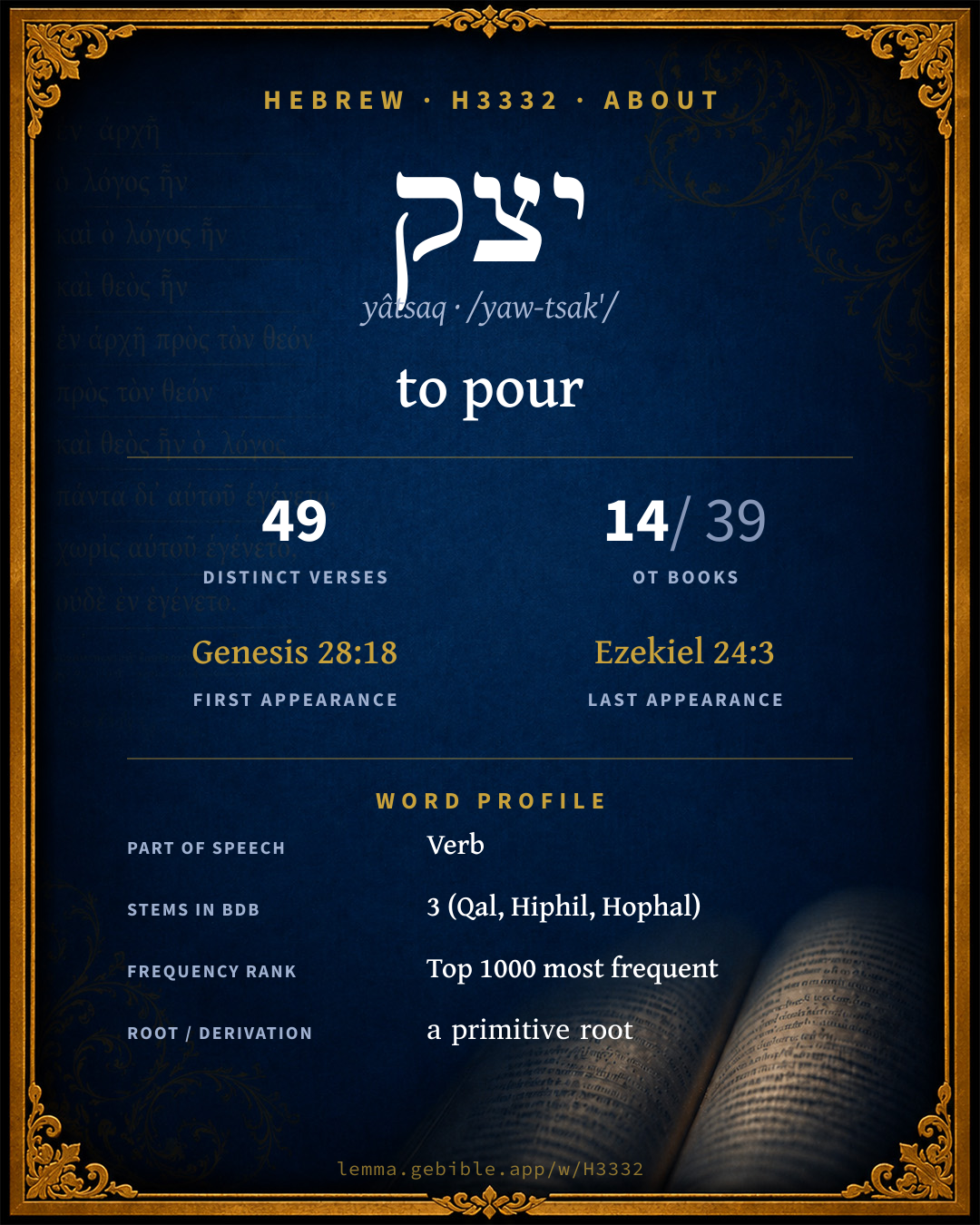
יָצַק
to pour
also: flow, cast, pour out fuller range ↓
Full lexicon entry — Brown-Driver-Briggs (BDB)
From Brown-Driver-Briggs (BDB)
Where this word appears
See every Qal verb in the Hebrew Bible →
Grammar key — what these labels mean
Part of speech
- Verb
- An action or state-of-being word.
Stem
- Qal
- The basic, simple active stem — the plain form of the verb (“he wrote”). Here: ‘pour’
- Hophal
- The passive counterpart of the Hiphil (“he was caused to…”). Here: ‘be poured’
- Hiphil
- The causative active stem (“he caused / brought about”).
Form
- Sequential Imperfect
- An imperfect with prefixed waw — the standard past-narrative form (waw-consecutive imperfect).
- Sequential Perfect
- A perfect with prefixed waw continuing a preceding imperfect or command (waw-consecutive perfect).
- Participle Passive
- A verbal adjective expressing action received (“written”).
- Perfect
- A completed action or state — Hebrew marks aspect (completeness) more than strict tense (“he wrote”).
- Infinitive Construct
- A bound verbal noun, frequently with prepositions (“to write / in writing”).
- Imperfect
- An incomplete, ongoing, or future action (“he will / would write”).
- Participle Active
- A verbal adjective expressing ongoing or characteristic action (“writing / one who writes”).
- Imperative
- A direct command (“write!”).
State
- Absolute
- The independent form of a noun, not bound to a following word.
- Construct
- A noun bound to a following noun in a possessive / “of” relationship (the construct chain).
Person
- 3rd Person
- The one spoken about (“he / she / it / they”).
- 2nd Person
- The one addressed (“you”).
- 1st Person
- The speaker (“I / we”).
Gender
- Masculine
- Grammatically masculine.
- Feminine
- Grammatically feminine.
- Common
- Either gender — not distinguished for this form.
Number
- Singular
- One.
- Plural
- More than one (in Hebrew, generally three or more).
Grammatical forms 20 distinct
- Verb, Qal, Sequential Imperfect, 3rd Person, Masculine, Singular 10 times (19%)
- Verb, Qal, Sequential Perfect, 2nd Person, Masculine, Singular 5 times (10%)
- Verb, Qal, Perfect, 3rd Person, Masculine, Singular 5 times (10%)
- Verb, Hophal, Participle Passive, Masculine, Singular, Absolute 4 times (8%)
- Verb, Qal, Participle Passive, Masculine, Singular, Absolute 4 times (8%)
- Verb, Qal, Sequential Perfect, 3rd Person, Masculine, Singular 2 times (4%)
- Verb, Qal, Infinitive Construct 2 times (4%)
- Verb, Hophal, Imperfect, 3rd Person, Masculine, Singular 2 times (4%)
+12 more forms (18 occurrences)
Parsed forms decoded from the imported morphology (morphhb / Westminster Leningrad Codex — WLC text public domain, morphhb tagging CC BY 4.0), counted across 52 parsed occurrences — not distinct verses.
Every verse where H3332 appears — 49 distinct verses across 14 books. Click any verse to open its interlinear word-by-word view. Verse text shown in the World English Bible for context — . Each verse’s Hebrew form is shown with its reference; the English is not keyword-highlighted, since the data carries no word-level English alignment. Use “Compare translations” on any verse to read it across multiple English versions. This concordance covers the Hebrew Bible; Septuagint (Greek Old Testament) occurrences are not indexed here.
Genesis 2 verses
- Genesis 28:18 וַ/יִּצֹ֥ק conj + Qal wimpf 3ms Jacob rose up early in the morning, and took the stone that he had put under his head, and set it up for a pillar, and poured oil on the top of it.
- Genesis 35:14 וַ/יִּצֹ֥ק conj + Qal wimpf 3ms Jacob set up a pillar in the place where he spoke with him, a pillar of stone. He poured out a drink-offering on it, and poured oil on it.
Exodus 8 verses
- Exodus 25:12 וְ/יָצַ֣קְתָּ conj + Qal wpf 2ms You shall cast four rings of gold for it, and put them in its four feet. Two rings shall be on the one side of it, and two rings on the other side of it.
- Exodus 26:37 וְ/יָצַקְתָּ֣ conj + Qal wpf 2ms You shall make for the screen five pillars of acacia, and overlay them with gold: their hooks shall be of gold: and you shall cast five sockets of brass for them.
- Exodus 29:7 וְ/יָצַקְתָּ֖ conj + Qal wpf 2ms Then you shall take the anointing oil, and pour it on his head, and anoint him.
- Exodus 36:36 וַ/יִּצֹ֣ק conj + Qal wimpf 3ms He made four pillars of acacia for it, and overlaid them with gold. Their hooks were of gold. He cast four sockets of silver for them.
- Exodus 37:3 וַ/יִּצֹ֣ק conj + Qal wimpf 3ms He cast four rings of gold for it, in its four feet; even two rings on its one side, and two rings on its other side.
- Exodus 37:13 וַ/יִּצֹ֣ק conj + Qal wimpf 3ms He cast four rings of gold for it, and put the rings in the four corners that were on its four feet.
- Exodus 38:5 וַ/יִּצֹ֞ק conj + Qal wimpf 3ms He cast four rings for the four ends of brass grating, to be places for the poles.
- Exodus 38:27 לָ/צֶ֗קֶת prep + Qal inf.cs The one hundred talents of silver were for casting the sockets of the sanctuary, and the sockets of the veil; one hundred sockets for the one hundred talents, a talent for a socket.
Leviticus 8 verses
- Leviticus 2:1 וְ/יָצַ֤ק conj + Qal wpf 3ms "'When anyone offers an offering of a meal offering to Yahweh, his offering shall be of fine flour; and he shall pour oil on it, and put frankincense on it.
- Leviticus 2:6 וְ/יָצַקְתָּ֥ conj + Qal wpf 2ms You shall cut it in pieces, and pour oil on it. It is a meal offering.
- Leviticus 8:12 וַ/יִּצֹק֙ conj + Qal wimpf 3ms He poured some of the anointing oil on Aaron's head, and anointed him, to sanctify him.
- Leviticus 8:15 יָצַק֙ Qal pf 3ms He killed it; and Moses took the blood, and put it on the horns of the altar round about with his finger, and purified the altar, and poured out the blood at the base of the altar, and sanctified it, to make atonement for it.
- Leviticus 9:9 יָצַ֔ק Qal pf 3ms The sons of Aaron presented the blood to him; and he dipped his finger in the blood, and put it on the horns of the altar, and poured out the blood at the base of the altar:
- Leviticus 14:15 וְ/יָצַ֛ק conj + Qal wpf 3ms The priest shall take some of the log of oil, and pour it into the palm of his own left hand.
- Leviticus 14:26 יִצֹ֣ק Qal impf 3ms The priest shall pour some of the oil into the palm of his own left hand;
- Leviticus 21:10 יוּצַ֥ק Hophal impf 3ms "'He who is the high priest among his brothers, upon whose head the anointing oil is poured, and that is consecrated to put on the garments, shall not let the hair of his head hang loose, nor tear his clothes;
Numbers 1 verse
Joshua 1 verse
1 Samuel 1 verse
2 Samuel 2 verses
- 2 Samuel 13:9 וַ/תִּצֹ֣ק conj + Qal wimpf 3fs She took the pan, and poured them out before him; but he refused to eat. Amnon said, Have out all men from me. They went out every man from him.
- 2 Samuel 15:24 וַ/יַּצִּ֨קוּ֙ conj + Hiphil wimpf 3mp Behold, Zadok also [came], and all the Levites with him, bearing the ark of the covenant of God; and they set down the ark of God; and Abiathar went up, until all the people had done passing out of the city.
1 Kings 6 verses
- 1 Kings 7:16 מֻצַ֣ק Hophal ptcp.pass ms cs He made two capitals of molten brass, to set on the tops of the pillars: the height of the one capital was five cubits, and the height of the other capital was five cubits.
- 1 Kings 7:24 יְצֻקִ֖ים Qal ptcp.pass mp Under the brim of it round about there were buds which did compass it, for ten cubits, compassing the sea round about: the buds were in two rows, cast when it was cast.
- 1 Kings 7:33 מוּצָֽק Hophal ptcp.pass ms The work of the wheels was like the work of a chariot wheel: their axles, and their rims, and their spokes, and their naves, were all molten.
- 1 Kings 7:46 יְצָקָ֣/ם Qal pf 3ms + sfx pers 3mp In the plain of the Jordan did the king cast them, in the clay ground between Succoth and Zarethan.
- 1 Kings 18:33 וְ/יִֽצְק֥וּ conj + Qal impv 2mp He put the wood in order, and cut the bull in pieces, and laid it on the wood. He said, Fill four jars with water, and pour it on the burnt offering, and on the wood.
- 1 Kings 22:35 וַ/יִּ֥צֶק conj + Qal wimpf 3ms The battle increased that day: and the king was stayed up in his chariot against the Syrians, and died at even; and the blood ran out of the wound into the bottom of the chariot.
2 Kings 7 verses
- 2 Kings 3:11 יָ֥צַק Qal pf 3ms But Jehoshaphat said, Isn't there here a prophet of Yahweh, that we may inquire of Yahweh by him? One of the king of Israel's servants answered, Elisha the son of Shaphat is here, who poured water on the hands of Elijah.
- 2 Kings 4:4 וְ/יָצַ֕קְתְּ conj + Qal pf 2fs You shall go in, and shut the door on you and on your sons, and pour out into all those vessels; and you shall set aside that which is full.
- 2 Kings 4:5 מיצקת מוֹצָֽקֶת Hiphil ptcp.act fs Hiphil ptcp.act fs So she went from him, and shut the door on her and on her sons; they brought [the vessels] to her, and she poured out.
- 2 Kings 4:40 וַ/יִּֽצְק֥וּ conj + Qal wimpf 3mp So they poured out for the men to eat. It happened, as they were eating of the stew, that they cried out, and said, man of God, there is death in the pot. They could not eat of it.
- 2 Kings 4:41 צַ֤ק Qal impv 2ms But he said, Then bring meal. He cast it into the pot; and he said, Pour out for the people, that they may eat. There was no harm in the pot.
- 2 Kings 9:3 וְ/יָצַקְתָּ֣ conj + Qal wpf 2ms Then take the vial of oil, and pour it on his head, and say, Thus says Yahweh, I have anointed you king over Israel. Then open the door, and flee, and don't wait.
- 2 Kings 9:6 וַ/יִּצֹ֥ק conj + Qal wimpf 3ms He arose, and went into the house; and he poured the oil on his head, and said to him, Thus says Yahweh, the God of Israel, I have anointed you king over the people of Yahweh, even over Israel.
2 Chronicles 3 verses
- 2 Chronicles 4:2 מוּצָ֑ק Hophal ptcp.pass ms Also he made the molten sea of ten cubits from brim to brim, round in compass; and the height of it was five cubits; and a line of thirty cubits compassed it round about.
- 2 Chronicles 4:3 יְצוּקִ֖ים Qal ptcp.pass mp Under it was the likeness of oxen, which did compass it round about, for ten cubits, compassing the sea round about. The oxen were in two rows, cast when it was cast.
- 2 Chronicles 4:17 יְצָקָ֣/ם Qal pf 3ms + sfx pers 3mp In the plain of the Jordan did the king cast them, in the clay ground between Succoth and Zeredah.
Job 6 verses
- Job 11:15 מֻ֝צָ֗ק Hophal ptcp.pass ms Surely then shall you lift up your face without spot; Yes, you shall be steadfast, and shall not fear:
- Job 22:16 יוּצַ֥ק Hophal impf 3ms Who were snatched away before their time, Whose foundation was poured out as a stream,
- Job 37:18 מוּצָֽק Hophal ptcp.pass ms Can you, with him, spread out the sky, Which is strong as a cast metal mirror?
- Job 38:38 בְּ/צֶ֣קֶת prep + Qal inf.cs When the dust runs into a mass, And the clods of earth stick together?
- Job 41:23 יָצ֥וּק Qal ptcp.pass ms The flakes of his flesh are joined together. They are firm on him. They can't be moved.
- Job 41:24 יָצ֣וּק וְ֝/יָצ֗וּק Qal ptcp.pass ms conj + Qal ptcp.pass ms His heart is as firm as a stone, Yes, firm as the lower millstone.
Psalms 2 verses
Isaiah 1 verse
Ezekiel 1 verse
About this entry
At a glance — auto-summarized from this page’s data, not written by a person. Every figure links to its source below. This summary describes the numbers; it doesn’t interpret them.
יצק — transliterated yâtsaq — is a Hebrew verb carrying the sense “to pour.” Debuting at Genesis 28:18, it then recurs through the corpus. With 49 verses in 14 books, it is a moderately common word in the Hebrew Bible. Read the stem: it spans 3 stems, including Qal and Hiphil. Sharing its root, it stands alongside יצקה, מוצק and מוצקה. Each statement above links to its evidence; the full detail follows below.
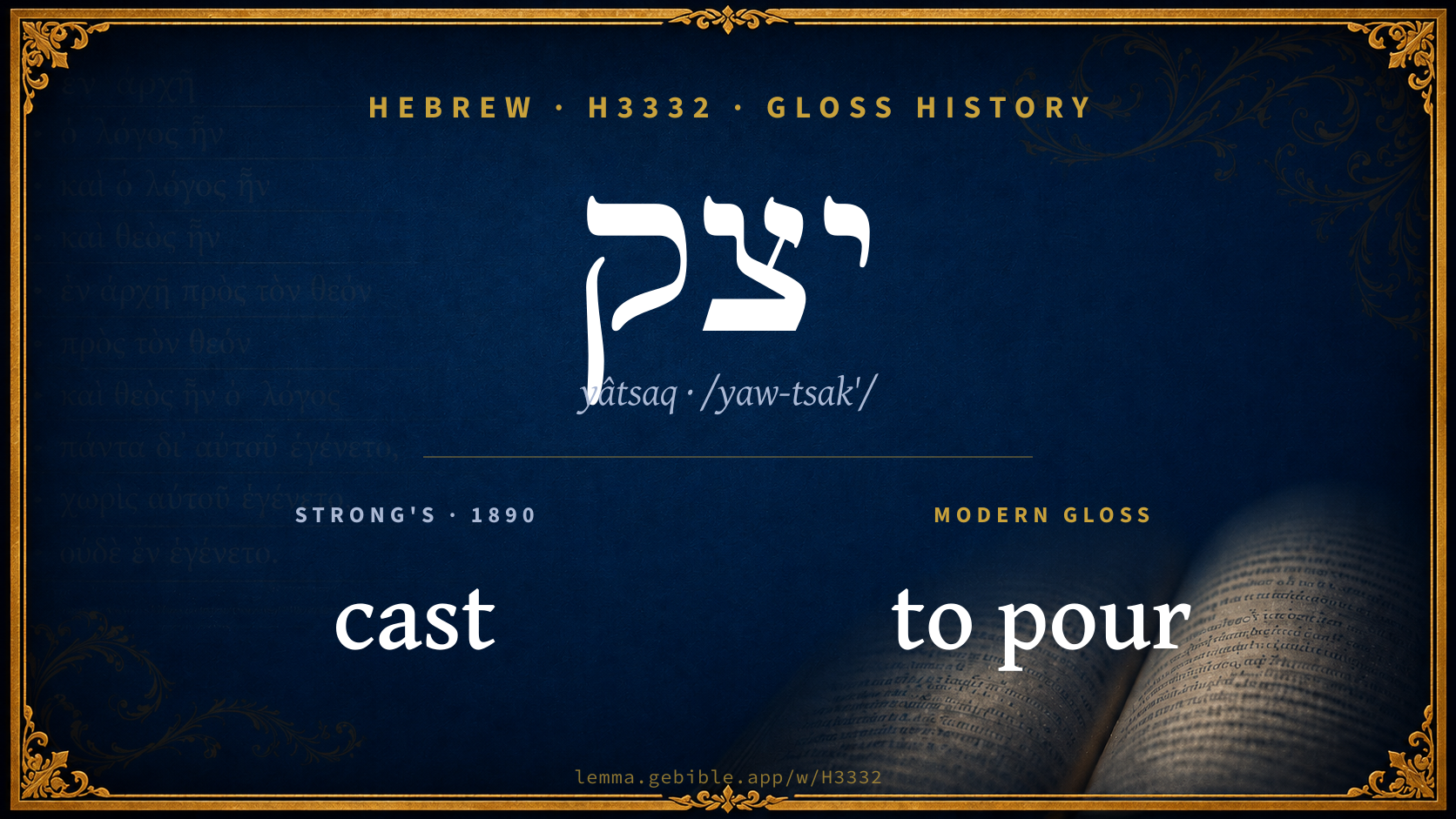
Gloss history
Strong's 1890 vs modern scholarship
About this word
Strong's H3332 catalogs a Hebrew word from the Hebrew Old Testament.
These counts are not copied from any lexicon or concordance. They are computed here, from the morphology-tagged Hebrew Old Testament. What Lemma adds →
- 49
- distinct verses
- The word appears in 49 distinct verses.
- 14 / 39
- OT books
- The word appears in 14 of 39 Old Testament books.
- #718
- by frequency
- Top 1000 most frequent Hebrew words (rank 718 of 8,640 Hebrew words by occurrence).
View all 49 occurrences in the concordance →
By section of the Old Testament
By traditional corpus
Conventional, traditional groupings — biblical authorship is debated, so this is a traditional corpus grouping, not an authorship claim. Each share is this word’s portion of its verses in that division of the Hebrew canon. Each figure is a share of the word’s 49 distinct verses.
- Torah (Pentateuch) 19 verses · 39%
- Prophets (Nevi'im) 19 verses · 39%
- Writings (Ketuvim) 11 verses · 22%
How translations render this word
Counts come from each version’s own published word-to-Strong’s tagging or interlinear alignment — an approximate guide to how each version renders this word, not a word-level alignment the data otherwise carries. Because each total is that version’s own tagged count, the per-version totals vary from one another and need not match the appearance or distinct-verse counts above. These counts may also differ from a printed concordance because Lemma counts each distinctly tagged rendering and does not collapse phrase taggings into a single head-word total. This is a fixed set of word-tagged versions (KJV, ASV, BSB, ULT) and does not change with the reading translation you choose elsewhere. Each version’s license is shown beside its name below (and on Sources).
- King James Version: Pour 6×, Molten 5×, Poured 5×
- American Standard Version: Pour 6×, Molten 5×, He cast 4×
- Berean Standard Bible: Pour 7×, Cast 4×, He cast 4×
- unfoldingWord Literal Text: Pour 5×, He cast 4×, He poured 4×
King James Version Public Domain
Renders H3332 across 53 tagged occurrences — most commonly:
Plus 21 renderings that appear only once — usually multi-word phrases or single function words the recovered tagging swept in, not distinct renderings.
American Standard Version Public Domain
Renders H3332 across 53 tagged occurrences — most commonly:
Plus 17 renderings that appear only once — usually multi-word phrases or single function words the recovered tagging swept in, not distinct renderings.
Berean Standard Bible Public Domain
Renders H3332 across 50 tagged occurrences — most commonly:
Plus 29 renderings that appear only once — usually multi-word phrases or single function words the recovered tagging swept in, not distinct renderings.
unfoldingWord Literal Text CC BY-SA 4.0
Renders H3332 across 59 tagged occurrences — most commonly:
Plus other, less common renderings. Plus 21 renderings that appear only once — usually multi-word phrases or single function words the recovered tagging swept in, not distinct renderings.
10 senses and sub-senses in the full BDB
Hebrew verbs can shift meaning by stem (binyan): Qal is the basic action, Niphal is often passive or reflexive, Piel often intensifies or makes it factitive, and Hiphil is typically causative. The senses below are grouped under the stem BDB assigns to each. This entry also uses Hophal (the passive of Hiphil).
What do BDB’s symbols mean?
BDB uses these scholarly abbreviations:
| Symbol | Meaning |
|---|---|
| 𝔊 | the Septuagint (the ancient Greek translation, LXX) |
| 𝔙 | the Vulgate (the Latin translation) |
| 𝔖 | the Syriac version (the Peshitta) |
| 𝔗 | the Targum (the Aramaic translation) |
| ψ | the Psalms |
| √ | root (the underlying root or stem) |
| ‖ | parallel passage (a synonymous or contrasted parallel) |
| † | the dagger: every passage where the word occurs is cited |
The 10 senses and sub-senses the full Brown-Driver-Briggs lexicon distinguishes for this word, in lexicon order (not ranked by frequency), with BDB’s own verbatim wording and sub-sense lettering. Shown in Hebrew script with BDB’s own scholarly abbreviations. The condensed entry is in the Lexicon Entry tab. See also the Forms in the corpus table below.
Qal
- Pf. יָצַק Lv 8:15 + 2 times; וְיָצַק consec. 2:1; 14:15; וַיִּצֹק Lv 8:12 sf. יְצָקָם 1 K 7:46 2 Ch 4:17, etc.; Impf. יִצֹּק Lv 14:26 Nu 5:15; וַיִּצֹּק Gn 28:18 + 8 times; וַיִּ֫צֶק 1 K 22:35 (intrans.); 3 fs. וַתִּצֹּק 2 S 13:9; אֶצֹּק Is 44:3; אֶצָּק־ v 3; וַיִּֽצְקוּ 2 K 4:40; Imv. יְצֹק Ez 24:3; צַק 2 K 4:41; יִצְקוּ 1 K 18:34; Inf. צֶ֫קֶת Ex 38:27 Jb 38:38; Pt. pass. Jb 28:2 + 5 times; pl. יְצוּקִים 2 Ch 4:3; יְצֻקִים 1 K 7:24; יְצֻקוֹת v 30;— e.g. Leviticus 8:15
- 1. pour, pour out, oil, in anointing, sq. acc. (שׁמן) + על Gn 28:18 (E), 35:14 (J); sq. מִשֶּׁמֶן + על Lv 8:12 (P); sq. על (שׁמן implied from context) Ex 29:7 (P), 1 S 10:1 2 K 9:3; sq. שֶׁמֶן + אֶל־ v 6; fig., c. רוּחִי + על Is 44:3; oil in sacrifice, + על Lv 2:1, 6 Nu 5:15; in cleansing, + על Lv 14:15, 26 (upon his palm; all P); oil into (על) vessels 2 K 4:4; water, for washing, + על 3:11; for drenching, + על 1 K 18:34; for boiling (into (בְ) the caldron), symbol., Ez 24:3; for satisfying thirst (fig.) + על Is 44:3; blood (of sacrifice) + אֶל־יְסוֹד Lv 8:15; 9:9 (P); pottage, for eating, 2 K 4:40, 41; cakes (לְבִבוֹת) 2 S 13:9; fig. of disease יָצוּק בּוֹ ψ 41:9 infused into him (al. less prob. as 3 molten, i. e. fixed upon). e.g. Genesis 28:18
- 2. cast (objects of metal) Ex 25:12; 26:37; 36:36; 37:3, 13; 38:5, 27 (all P), 1 K 7:46 = 2 Ch 4:17, 1 K 7:24, 30; 2 Ch 4:3. e.g. Exodus 25:12
- 3. Pt. pass. as adj. fig. cast, hard, of crocodile’s scales Jb 41:15; of crocodile’s heart v 16(×2) (as stone). e.g. Job 41:15
- 4. intrans. flow, pour, only וַיִּצֶ֫ק 1 K 22:35 (of blood), Jb 38:38 בְּצֶקֶת עָפָר לַמּוּצָק. e.g. 1 Kings 22:35
Hiphil
- Impf. וַיַּצִּ֫קוּ 2 S 15:24; וַיַּצִּקֻם Jos 7:23; Pt. f. מֹי֯צָ֑קֶת 2 K 4:5;—pour (oil) 2 K 4:5, fig. of shekels of silver, etc., pour out Jos 7:23; of the ark, 2 S 15:24 set down (?); but read וַיַּצִּיגוּ (Dr Gr). e.g. 2 Samuel 15:24
Hophal
- Pf. הוּצַק ψ 45:3; Impf. יוּצַק Lv 21:10 Jb 22:16; Pt. מוּצָ֑ק 1 K 7:23, 33 2 Ch 4:2 Jb 37:18; מֻצָק 11:15; cstr. מֻצַּק 1 K 7:16;— e.g. Psalms 45:3
- 1. be poured, subj. שֶׁמֶן, sq. על (in anointing), Lv 21:10 (H); fig. of foundation of wicked Jb 22:16, v. Di; of grace חֵן, on lips, ψ 45:3 (sq. ב), v. Che. e.g. Leviticus 21:10
- 2. Pt. = cast, molten הים המ׳ 1 K 7:23 = 2 Ch 4:2, ראי Jb 37:18; as pred. 1 K 7:33; cstr. as subst. מֻֽצַּק נְחֹשֶׁת 1 K 7:16. e.g. 1 Kings 7:23
- 3. Pt., fig. firmly established, pred. of pers., וְהָיִיתָ מ׳ Jb 11:15 and thou shalt be established (‖ לֹא תִירָא). Cf. II צוק (p. 848). e.g. Job 11:15
Senses from the full Brown-Driver-Briggs lexicon (Brown, Driver, Briggs; Oxford 1906 — public domain), digitized via Sefaria, supplemented by the OpenScriptures HebrewLexicon (CC BY 4.0). Full attribution on Sources.
Word origin
vb. pour, cast, flow (Talm. id.)—
— Brown-Driver-Briggs (Oxford 1906, public domain), digitized via Sefaria, supplemented by the OpenScriptures HebrewLexicon (CC BY 4.0). See Sources.
Origin: a primitive root
Jastrow Dictionary
A second Hebrew/Aramaic lexicon for comparison, covering Aramaic and post-biblical (Talmudic, Targumic, Midrashic) usage that the biblical-Hebrew BDB does not. Matched by lemma rather than by Strong’s number, so a lemma may carry more than one Jastrow headword (shown separately below), and the entries cover usage well beyond the Bible.
יָצַק
- to pour, cast. Zeb. 112ᵇ; Snh. 82ᵇ היוֹצֵק a non-priest who pours oil, v. יְצִיקָה. Ib. 83ᵃ אזהרה ליוצק וכ׳ where in the Scriptures is the warning for the non-priest not to pour oil &c.?—Men. III, 2; a. fr.—Part. pass. יָצוּק (or מָצוּק, fr. מָצַק) cast, a poetic expression for mortal, opp. to angel.—Pl. (מְצוּקִים) יְצוּקִים. Y. Kil. IX, 32ᵇ top; Y. Keth. XII, 35ᵃ י׳; Keth. 104ᵃ מ׳ a. e., v. אֶרְאֵל.
- same. Hor. 12ᵃ מַצִּיקִין לו על ראשו Ms. M. (ed. מוֹצְקִין שמן, v. מָצַק) they pour oil upon his head; Kerith. 5ᵇ מַצִּיק לו שמן וכ׳. Yalk. Gen. 19 בו"ד מַצִּיק וכ׳ (Gen. R. s. 12 מוֹצֵק) a human being casts a lens, v. בּוּלָס.
- to be poured, cast. Snh. 92ᵇ יוּצַק זהב רותח וכ׳ may hot gold be poured into the mouth &c.; Yalk. Dan. 1062 י׳ סיד רותח.—Part. מוּצָק a) cast (metal), bright. Y. Ber. I, 2ᵈ top (ref. to כראי מוצק, Job XXXVII, 18) כראי מ׳ בכל שעה וכ׳ ‘like a cast metal mirror’, at all times the heavens look as bright &c., v. יְצִיקָה; Yalk. Gen. 19; Gen. R. s. 12, end.—b) (cmp. זקק) well-joined, firm (cmp. II Sam. XV, 24; = מוצג). Yalk. Kings 185 (ref. to I Kings VII, 23) זה העולם שהוא מ׳ the basin is typical of the world which is called mutsak (firm), as we read &c. (Job XXXVIII, 38). Y. Ber. I, 2ᶜ bot. (ref. to Job XXXVII, 18, v. supra) you might think that the heavens become lax, … ת"ל כראי מוּצָקִים therefore it is said …, at all times they appear firmly joined. e.g. Job 37:18
- q. v.
A Dictionary of the Targumim, the Talmud Babli and Yerushalmi, and the Midrashic Literature (Marcus Jastrow; London, Luzac, 1903) — Public Domain. Digitized via Sefaria. Digitized via Sefaria. Full attribution on Sources.
Forms in the corpus
The 42 distinct written forms H3332 takes in the Hebrew Bible, most frequent first — each parse links to that stem’s occurrences in the concordance. Hebrew forms include their vowel points and cantillation, so a single lemma takes many written forms.
Same root — word family
Other BDB entries built from the same root as H3332, grouped by Strong’s listed origin. These share a root / origin per the lexicon — not necessarily a shared meaning. Each links to that word’s own entry.
Derived from this word
Compare all same-root words → They share a root, not necessarily a meaning.
Septuagint verse parallels
This word appears in 48 verses that also exist in the Greek Old Testament (Septuagint), out of the 49 Hebrew verses it occurs in. You can read those verses in Greek by switching the Old Testament edition to the Septuagint.
Read these verses in the Septuagint
- Genesis 28:18
- Exodus 25:12
- Leviticus 2:1
- Numbers 5:15
- Joshua 7:23
- 1 Samuel 10:1
- 2 Samuel 13:9
- 1 Kings 7:16
- 2 Kings 3:11
- 2 Chronicles 4:2
- Job 11:15
- Psalms 41:8
This is a verse-level parallel only — the same verses exist in both the Hebrew and Greek Old Testaments. No word-level Hebrew↔Greek correspondence is claimed: the data carries no such alignment, so no Greek word is shown as this Hebrew word’s translation. Coverage is not total — the Septuagint omits the deuterocanon and renumbers the Psalms, so some Hebrew verses have no direct Greek parallel.