Ezekiel 24:3

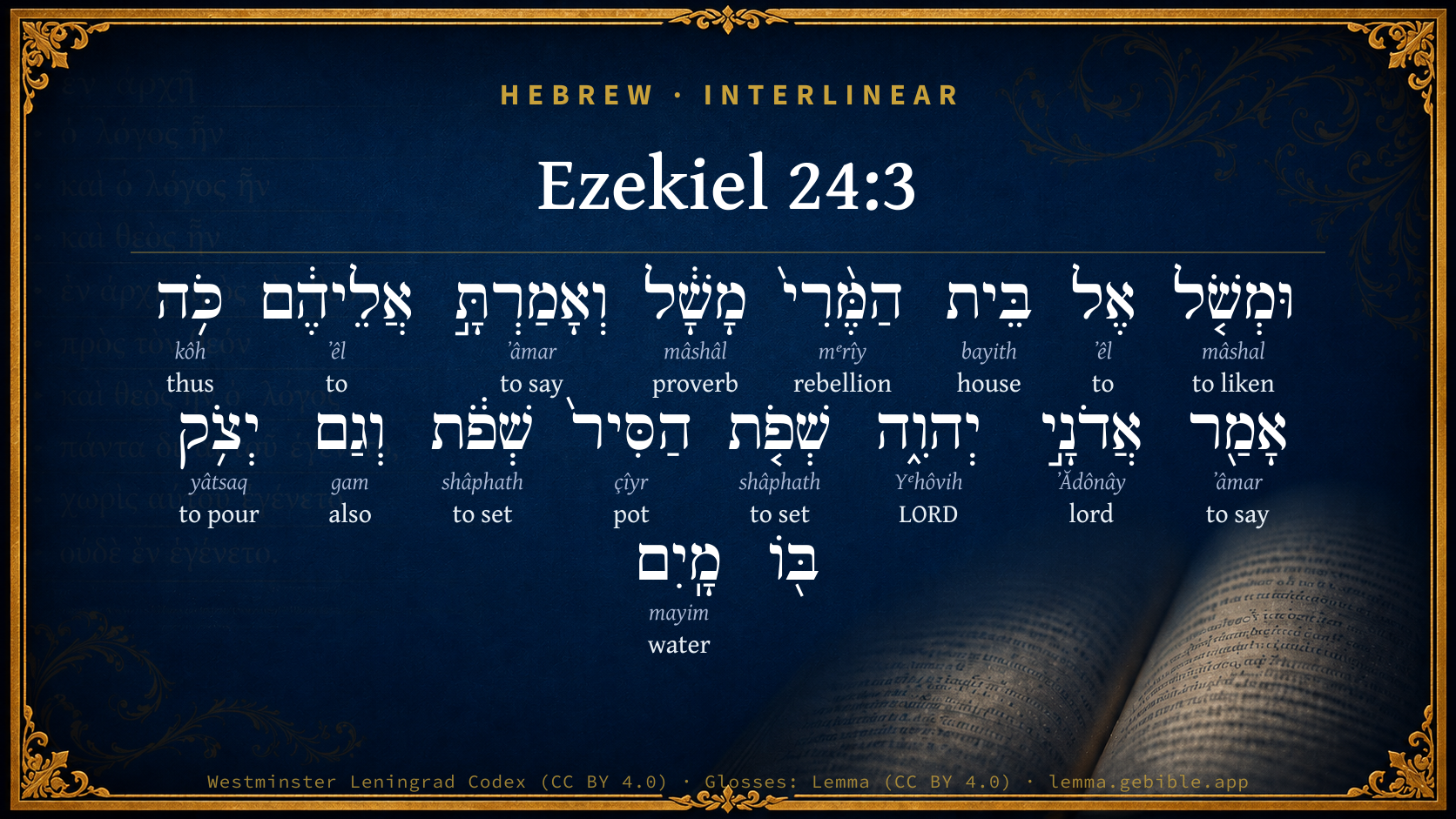
Hebrew (Westminster Leningrad Codex) Ezekiel 24:3 appears in the Hebrew Old Testament. The text above is from the Westminster Leningrad Codex. Each word links to its Strong’s number, a concise gloss, and parsing drawn from the Open Scriptures Hebrew Bible morphology. Click any word for its full Brown-Driver-Briggs (BDB) entry.
Download image
Cite this verse

Ezekiel 24:3 (World English Bible). Public Domain. Lemma interlinear Bible study tool, https://lemma.gebible.app/v/ezekiel/24/3.

Show BibTeX & RIS
BibTeX
RIS
English Translation
Utter a parable to the rebellious house, and tell them, Thus says the Lord Yahweh, Set on the caldron, set it on, and also pour water into it:
World English Bible · Public Domain
Download a study sheet

One document with this verse’s original text, its word-by-word gloss line, the meaning frame, cross-references with their text, attributed commentary, and full source and license credits — printable, and it pastes into notes with its structure intact.

This verse Autodidact and up

Study sheet (.html) Plain text (.txt)

A passage Seminary Student

Up to 50 verses in one chapter. A passage sheet keeps up to 6 commentary sources and 12 cross-references per verse, in the order this page ranks them, and says so on the sheet whenever that leaves anything out. Ask for a single verse and you get the Autodidact verse sheet above.

Everything on this page stays free to read, with no account — the sheet is a download of what is already on screen, not access to it.

Want to remove ads? Support Godless Engineer
Compare translations 3

The same verse in 3 English versions, stacked beneath the original-language interlinear above. Click any original word for its lexicon entry.

Each is an independent rendering of the whole verse — the interlinear is not word-aligned to these translations.

Highlighted words mark where these versions differ — a whole-verse word diff, not a word-by-word alignment.

  • World English Bible Public Domain
    Utter a parable to the rebellious house, and tell them, Thus says the Lord Yahweh, Set on the caldron, set it on, and also pour water into it:
  • King James Version Public Domain
    And utter a parable unto the rebellious house, and say unto them, Thus saith the Lord GOD; Set on a pot, set it on, and also pour water into it:
  • unfoldingWord Literal Text CC BY-SA 4.0
    So speak a proverb against this rebellious house, a parable. Say to them, ‘The Lord Yahweh says this: Place the cooking pot. Place it and pour water into it.

unfoldingWord Literal Text — © unfoldingWord, licensed CC BY-SA 4.0. Word-aligned USFM3 via Door43 (git.door43.org/unfoldingWord/en_ult).

Versions to compare (up to 4)

3 of 4 selected

Show all 18 translations

Every available English version of this verse, each an independent rendering of the whole verse.

  • World English Bible Public Domain
    Utter a parable to the rebellious house, and tell them, Thus says the Lord Yahweh, Set on the caldron, set it on, and also pour water into it:
  • Berean Standard Bible Public Domain
    Now speak a parable to this rebellious house and tell them that this is what the Lord GOD says: ‘Put the pot on the fire; put it on and pour in the water.
  • Majority Standard Bible Public Domain
    Now speak a parable to this rebellious house and tell them that this is what the Lord GOD says: ‘Put the pot on the fire; put it on and pour in the water.
  • King James Version Public Domain
    And utter a parable unto the rebellious house, and say unto them, Thus saith the Lord GOD; Set on a pot, set it on, and also pour water into it:
  • American Standard Version (1901) Public Domain
    And utter a parable unto the rebellious house, and say unto them, Thus saith the Lord Jehovah, Set on the caldron, set it on, and also pour water into it:
  • Revised Version (1885) Public Domain
    And utter a parable unto the rebellious house, and say unto them, Thus saith the Lord GOD, Set on the caldron, set it on, and also pour water into it:
  • Geneva Bible (1599) Public Domain
    Therefore speake a parable vnto the rebellious house, and say vnto them, Thus sayth the Lord God, Prepare a pot, prepare it, and also powre water into it.
  • Douay-Rheims (1899) Public Domain
    And thou shalt speak by a figure a parable to the provoking house, and say to them: Thus saith the Lord God: Set on a pot, set it on, I say, and put water into it.
  • Young's Literal Translation Public Domain
    and use unto the rebellious house a simile, and thou hast said unto them: Thus said the Lord Jehovah: To set on the pot, to set `it' on, and also to pour into it water,
  • Literal Standard Version CC BY-SA 4.0
    And use an allegory toward the house of rebellion, and you have said to them, Thus said Lord YHWH: To set on the pot, to set [it] on, and also to pour water into it,
  • Unlocked Literal Bible CC BY-SA 4.0
    So speak a proverb against this rebellious house, a parable. Say to them, 'The Lord Yahweh says this: Place the cooking pot. Place it and pour water into it.
  • unfoldingWord Literal Text CC BY-SA 4.0
    So speak a proverb against this rebellious house, a parable. Say to them, ‘The Lord Yahweh says this: Place the cooking pot. Place it and pour water into it.
  • Darby Bible Public Domain
    And propose a parable unto the rebellious house, and say unto them, Thus saith the Lord Jehovah: Set on the pot, set [it] on, and also pour water into it.
  • World Messianic Bible Public Domain
    Utter a parable to the rebellious house, and tell them, ‘The Lord GOD says, “Put the cauldron on the fire. Put it on, and also pour water into it.
  • Webster's Bible Public Domain
    And utter a parable to the rebellious house, and say to them, Thus saith the Lord GOD; Set on a pot, set it on, and also pour water into it:
  • Free Bible Version CC BY-SA 4.0
    Then repeat the following parable to these rebellious people. Tell them that this is what the Lord God says: Get a pot and set it on the fire. Pour in some water.
  • Bible in Basic English Public Domain
    And make a comparison for this uncontrolled people, and say to them, This is what the Lord has said: Put on the cooking-pot, put it on the fire and put water in it:
  • JPS Tanakh (1917) Public Domain
    And utter a parable concerning the rebellious house, and say unto them: Thus saith the Lord GOD: Set on the pot, set it on, and also pour water into it;

Literal Standard Version (2020), Covenant Press — licensed CC BY-SA 4.0. Text via the HelloAO Bible API (eBible.org). Unlocked Literal Bible (unfoldingWord) — licensed CC BY-SA 4.0. Text via the HelloAO Bible API (eBible.org). unfoldingWord Literal Text — © unfoldingWord, licensed CC BY-SA 4.0. Word-aligned USFM3 via Door43 (git.door43.org/unfoldingWord/en_ult). Free Bible Version, Dr. Jonathan Gallagher — licensed CC BY-SA 4.0. Text via the HelloAO Bible API (eBible.org).

Word by word

More ways to search: Search by grammar → Find every occurrence → Compare this word →

Practice this passage: Drill this verse → Learn its vocabulary →

שְׁפֹ֤ת
shâphath
H8239
“set”
Verb, Qal, Imperative, 2nd Person, Masculine, Singular
Part of Speech
Verb
Stem
Qal
Form
Imperative
Person
2nd Person
Gender
Masculine
Number
Singular
Full BDB Definition

Origin: a primitive root

TWOT: 2441a

to set, place, put, ordain - (Qal) - to set - to ordain, establish
  1. וּמְשֹׁ֤ל mâshal H4911 “and · liken” Conjunction + Verb, Qal, Imperative, 2nd Person, Masculine, Singular
  2. אֶל ʼêl H413 “to” Preposition
  3. בֵּית bayith H1004 “house of” Noun, Common, Masculine, Singular, Construct
  4. הַמֶּ֨רִי֙ mᵉrîy H4805 “the · rebellion” Particle, Definite Article + Noun, Common, Masculine, Singular, Absolute
  5. מָשָׁ֔ל mâshâl H4912 “proverb” Noun, Common, Masculine, Singular, Absolute
  6. וְאָמַרְתָּ֣ ʼâmar H559 “and · to say” Conjunction + Verb, Qal, Sequential Perfect, 2nd Person, Masculine, Singular
  7. אֲלֵיהֶ֔ם ʼêl H413 “to · them” Preposition + Suffix, Personal, 3rd Person, Masculine, Plural
  8. כֹּ֥ה kôh H3541 “thus” Adverb
  9. אָמַ֖ר ʼâmar H559 “to say” Verb, Qal, Perfect, 3rd Person, Masculine, Singular
  10. אֲדֹנָ֣י ʼĂdônây H136 “Lord · my” Noun, Common, Masculine, Plural, Construct + Suffix, Personal, 1st Person, Common, Singular
  11. יְהוִ֑ה Yᵉhôvih H3069 “LORD” Noun, Proper
  12. הַסִּיר֙ çîyr H5518 “the · pot” Particle, Definite Article + Noun, Common, Both, Singular, Absolute
  13. שְׁפֹ֔ת shâphath H8239 “set” Verb, Qal, Imperative, 2nd Person, Masculine, Singular
  14. וְגַם gam H1571 “and · also” Conjunction + Particle, Accusative
  15. יְצֹ֥ק yâtsaq H3332 “pour” Verb, Qal, Imperative, 2nd Person, Masculine, Singular
  16. מָֽיִם mayim H4325 “water(s)” Noun, Common, Masculine, Plural, Absolute

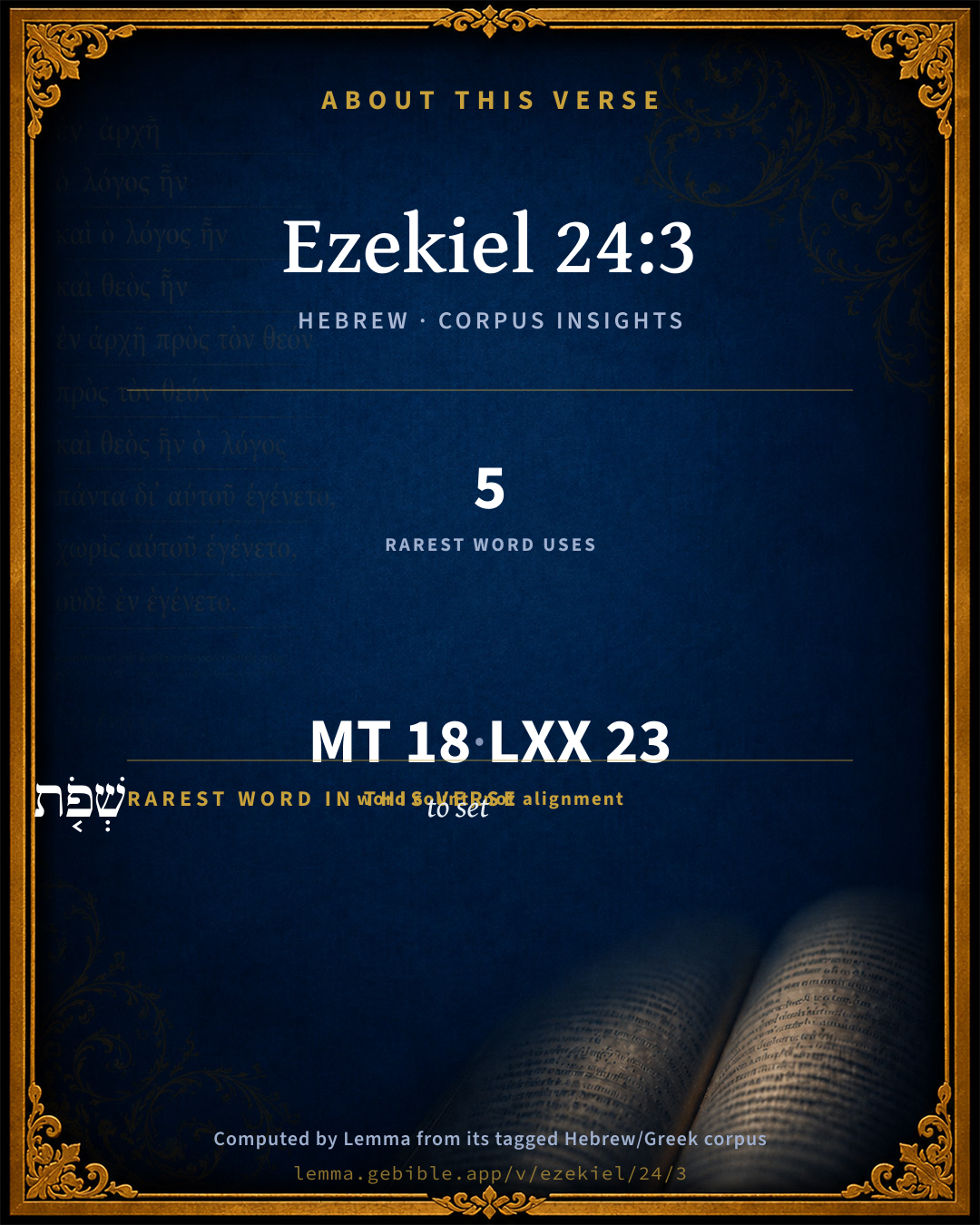
About this verse

These counts appear in no published source. They are computed here, from the morphology-tagged text and Lemma’s own curated glosses. What Lemma adds →

18
words
14
distinct lemmas
Prophets
section

Notable vocabulary

The rarest word here is שְׁפֹ֤ת to set H8239 — appearing just 5 times in the whole Hebrew Bible.

Shared distinctive vocabulary

שְׁפֹ֤ת to set H8239 occurs in 4 verses of the Hebrew Bible. Also found in:

Grammatical profile

  • 6 verbs
  • 7 nouns
  • 3 prepositions
  • 1 adverb
  • 1 particle

Verb forms

  • וּמְשֹׁ֤ל Qal · Imperative
  • וְאָמַרְתָּ֣ Qal · Sequential Perfect
  • אָמַ֖ר Qal · Perfect
  • שְׁפֹ֤ת Qal · Imperative
  • שְׁפֹ֔ת Qal · Imperative
  • יְצֹ֥ק Qal · Imperative

Repetition

Words recur within this verse — often emphatic in Hebrew:

  • וְאָמַרְתָּ֣ to say H559 ×2
  • שְׁפֹ֤ת to set H8239 ×2
  • אֶל to H413 ×2

Hebrew & Septuagint length

In English translation the verse runs 28 words from the Hebrew and 27 from the Septuagint (LXX English) — closely comparable.

A rough comparison of the two English renderings, which tokenize alike — not a word-level alignment.

Word counts can differ between the Hebrew and the Greek without any difference in meaning — e.g. the Hebrew direct-object marker אֵת has no separate Greek word, and Greek often adds the article ὁ.

In the original languages it is 18 Hebrew tokens and 23 Greek tokens — but the two are counted differently (Hebrew bundles its prefixes and suffixes into one token; the Greek is in lemma form), so that isn’t a like-for-like length.

Cross-references

25

Topical passages linked to Ezekiel 24:3 in the Treasury of Scripture Knowledge — connected by theme and wording, ordered by reader-vote popularity; previews shown in the World English Bible.

  • Ezekiel 11:3 who say, [The time] is not near to build houses: this [city] is the caldron, and we are the flesh.
  • Ezekiel 17:2 Son of man, put forth a riddle, and speak a parable to the house of Israel;
  • Ezekiel 20:49 Then said I, Ah Lord Yahweh! they say of me, Isn't he a speaker of parables?
  • Isaiah 1:2 Hear, heavens, And listen, earth; for Yahweh has spoken: I have nourished and brought up children, And they have rebelled against me.
  • Ezekiel 2:3 He said to me, Son of man, I send you to the children of Israel, to nations that are rebellious, which have rebelled against me: they and their fathers have transgressed against me even to this very day.
  • Ezekiel 2:6 You, son of man, don't be afraid of them, neither be afraid of their words, though briers and thorns are with you, and you do dwell among scorpions: don't be afraid of their words, nor be dismayed at their looks, though they are a rebellious house.
  • Psalms 78:2 I will open my mouth in a parable. I will utter dark sayings of old,
  • Isaiah 30:1 Woe to the rebellious children, says Yahweh, who take counsel, but not of me; and who make a league, but not of my Spirit, that they may add sin to sin,
  • Isaiah 30:9 For it is a rebellious people, lying children, children who will not hear the law of Yahweh;
  • Ezekiel 2:8 But you, son of man, hear what I tell you; don't be you rebellious like that rebellious house: open your mouth, and eat that which I give you.
  • Ezekiel 24:6 Therefore thus says the Lord Yahweh: Woe to the bloody city, to the caldron whose rust is therein, and whose rust is not gone out of it! take out of it piece after piece; No lot is fallen on it.
  • Isaiah 63:10 But they rebelled, and grieved his holy Spirit: therefore he was turned to be their enemy, [and] himself fought against them.
  • Jeremiah 1:13 The word of Yahweh came to me the second time, saying, What see you? I said, I see a boiling caldron; and the face of it is from the north.
  • Jeremiah 50:13–14 Because of the wrath of Yahweh she shall not be inhabited, but she shall be wholly desolate: everyone who goes by Babylon shall be astonished, and hiss at all her plagues.
  • Ezekiel 3:9 As an adamant harder than flint have I made your forehead: don't be afraid of them, neither be dismayed at their looks, though they are a rebellious house.
  • Ezekiel 11:7 Therefore thus says the Lord Yahweh: Your slain whom you have laid in the midst of it, they are the flesh, and this [city] is the caldron; but you shall be brought forth out of the midst of it.
  • Ezekiel 11:11 This [city] shall not be your caldron, neither shall you be the flesh in the midst of it; I will judge you in the border of Israel;
  • Ezekiel 12:2 Son of man, you dwell in the midst of the rebellious house, who have eyes to see, and don't see, who have ears to hear, and don't hear; for they are a rebellious house.
  • Ezekiel 12:25 For I am Yahweh; I will speak, and the word that I shall speak shall be performed; it shall be no more deferred: for in your days, rebellious house, will I speak the word, and will perform it, says the Lord Yahweh.
  • Ezekiel 17:12 Say now to the rebellious house, Don't you know what these things mean? tell them, Behold, the king of Babylon came to Jerusalem, and took the king of it, and the princes of it, and brought them to him to Babylon:
  • Ezekiel 19:2–14 and say, What was your mother? A lioness: she couched among lions, in the midst of the young lions she nourished her cubs.
  • Micah 2:4 In that day they will take up a parable against you, And lament with a doleful lamentation, saying, 'We are utterly ruined! My people's possession is divided up. Indeed he takes it from me and assigns our fields to traitors!'"
  • Mark 12:12 They tried to seize him, but they feared the multitude; for they perceived that he spoke the parable against them. They left him, and went away.
  • Luke 8:10 He said, "To you it is given to know the mysteries of the Kingdom of God, but to the rest in parables; that 'seeing they may not see, and hearing they may not understand.'
  • Acts 7:51 "You stiff-necked and uncircumcised in heart and ears, you always resist the Holy Spirit! As your fathers did, so you do.

Cross-references courtesy of OpenBible.info (CC BY 4.0).

Hebrew and Greek witnesses Masoretic Hebrew ↔ Greek Septuagint

The same verse in the two great witnesses to the Old Testament, shown verse-for-verse.

These are two independent witnesses, not word-aligned to each other, and the Septuagint is shown in lemma (dictionary) form.

Hebrew Ezekiel 24:3 Masoretic · Westminster Leningrad Codex

וּמְשֹׁ֤ל אֶל בֵּית הַמֶּ֨רִי֙ מָשָׁ֔ל וְאָמַרְתָּ֣ אֲלֵיהֶ֔ם כֹּ֥ה אָמַ֖ר אֲדֹנָ֣י יְהוִ֑ה שְׁפֹ֤ת הַסִּיר֙ שְׁפֹ֔ת וְגַם יְצֹ֥ק בּ֖וֹ מָֽיִם

Utter a parable to the rebellious house, and tell them, Thus says the Lord Yahweh, Set on the caldron, set it on, and also pour water into it:

World English Bible · Public Domain

Greek LXX Ezekiel 24:3 Septuagint · lemma form

καί εἶπον ἐπί ὁ οἶκος ὁ παραπικραίνω παραβολή καί εἶπον πρός αὐτός ὅδε λέγω κύριος ἐπιἵστημι ὁ λέβης καί ἐκχέω εἰς αὐτός ὕδωρ

And speak a parable to the provoking house, and you shall say to them, Thus says the Lord; Set on the caldron, and pour water into it:

LXX2012 (modern English Septuagint) · Public Domain

Hebrew: Westminster Leningrad Codex (CC BY 4.0). Greek: Septuagint (public domain); English from LXX2012 (modern English Septuagint) (Public Domain). How the Septuagint differs from the Hebrew →

Targum (Aramaic paraphrase)

1

The Targum is the ancient Jewish Aramaic paraphrase of the Hebrew Scriptures — an interpretive translation, not the Hebrew text itself. Onkelos (literal) and Pseudo-Jonathan (expansive) render the Torah, and Jonathan the Prophets. Coverage is partial: where no permissively-licensed English translation exists for a verse, only the Aramaic is shown. This is verse-level text, not a word-by-word alignment to the Hebrew.

  1. Targum Jonathan Prophets (Joshua–Malachi)
    וְאִתְנַבֵּי לְעַמָא סַרְבָנָא נְבוּאָה וְתֵימַר לְהוֹן כִּדְנַן אֲמַר יְיָ אֱלֹהִים אִתְנַבֵּי דְיִסְקוּן מַשִׁרְיָן עַל קַרְתָּא הָדָא וְאַף יִתְיְהֵיב לָהּ אַרְכָא לְקַבָּלָא מְצִירָא:

    (no public-domain English translation for this verse)

    Targum Jonathan — Aramaic: “Mikraot Gedolot” (public domain). English: “Sefaria Community Translation” (CC0 1.0 (public-domain dedication)); “London "Chaldee Paraphrase," 1871” (public domain). Text via Sefaria.

Commentary

Notes on Ezekiel 24:3 from classic Christian and Jewish commentators (each source and its license shown beneath its notes). The classic Christian expositions comment on the surrounding passage and are grouped to its opening verse, so a note may address several verses; the Jewish commentaries on the Tanakh (Rashi and others) are per-verse, so they appear only where the commentator wrote on this verse.

Lemma curates 59 commentaries, every one of them public domain or Creative Commons licensed, each selected and text-cleaned for this edition rather than reprinted as found. About our sources →

Ellicott's Commentary for English Readers

(3) Utter a parable.—What follows (Eze_24:3-14) was not a symbolical action, but was simply a parable spoken to the people, although the language is just that which would describe action.

Set on a pot.—Rather, the cauldron, the word being the same as in Eze_11:3, and preceded by the definite article referring to that passage. Urgency is indicated by the repetition of the command “set on.” The people in Eze_11:3 had called their city the cauldron; so let it be, the Divine word now says, and set that city upon the fire of the armies of my judgment, and gather into it for destruction the people who have boasted of it as their security.

A Bible Commentary for English Readers, edited by Charles John Ellicott (1878–1897) — public domain. Text from a community e-Sword module.

Trapp's Complete Commentary

John Trapp

Eze 24:3 And utter a parable unto the rebellious house, and say unto them, Thus saith the Lord GOD; Set on a pot, set [it] on, and also pour water into it:

Ver. 3. Set on a pot.] Deus cum propheta loquitur tanquam cum coquo: anything to make them sensible of their danger, and the destruction of their city now fully determined. This pot is Jerusalem, and a lively representation of hell, saith A Lapide; {a} the pouring of water into it, a long siege; the flesh, the citizens; the fat, the rich ones, lauti et lascivi; the bones, the stoutest and best warriors, &c. These scurrilous Jews had jeered at Jeremiah’s caldron or pot; {Jer 1:13 Eze 11:3} now they are cast into the pot, and their jeer driven back down their very throats.

{a} Repraesentat Tartarum, et ollam Vulcaniam inferni.

John Trapp, A Commentary or Exposition upon All the Books of the Old and New Testament (1647–1656) — public domain. Text from a community e-Sword module.

Joseph Benson's Commentary

Eze 24:3-5. Utter a parable unto the rebellious house — Though the house of Judah has as yet paid no due regard to what thou and the rest of the prophets have uttered or done; nevertheless, still further represent to them the destruction coming upon them by a symbolical action. Set on a pot, &c. — By the pot was signified Jerusalem, (under which figure it is represented, both by this prophet, Eze 11:3, and by Jeremiah, Jer 1:13.) and by the pieces gathered into it, the different ranks of men gathered into that city, by taking refuge within its walls, when the Chaldean army approached to besiege it. By the water and fire were signified the calamities which they were to suffer. By every good piece, the thigh and the shoulder, the wealthiest and chief of the inhabitants of the land seem to be meant, who would flee from their country houses to live in safety in Jerusalem; and by the choice bones, the bravest and strongest among the common people, or the most warlike, who would betake themselves to the city for its defence. Burn also the bones under it — Not the bones of the pieces to be boiled, but of the many innocent persons to be murdered in Jerusalem, whose blood cried for vengeance, and their bones, scattered on the face of the earth, will both make and maintain this fire. Bishop Newcome renders the clause, Pile also (in the margin we read heap) the bones under it: namely, as he explains it, “the useless bones (Eze 24:10) which the coals (Eze 24:11) would consume, to show what a general destruction of the meaner sort would be caused by the Chaldeans.” And make it boil well — To denote the heat or violence of the calamity, and perhaps also that the city would be set on fire and consumed.

Joseph Benson's Commentary on the Old and New Testaments (1811–1818) — public domain. Text from a community e-Sword module.

The Preacher's Complete Homiletical Commentary

Joseph S. Exell (gen. ed.)

(Eze_24:3-14.)

EXEGETICAL NOTES.—The prophet illustrates the destruction of Jerusalem by the allegory of a cauldron which he was to set on the fire, and having put water into it, to boil therein choice pieces of meat (Eze_24:3-5). Then he follows with an application of the allegory to Jerusalem, as describing her irrevocable doom.

Eze_24:3. “Utter a parable.” “The contents of these verses are called a proverb or parable. It follows from this that the ensuing act which the prophet is commanded to perform is not to be regarded as a symbolical act which he really carried out, but that the act forms the substance of the parable—in other words, belongs to the parable itself; consequently the interpretation of the parable (Eze_24:10, etc.) is clothed in the form of a thing actually done” (Keil.) “Set on a pot … pour water into it.” The repeated demand expresses urgent haste. The pot is Jerusalem, which had become so foul as to poison all meats which were put into it.

Eze_24:4. “The pieces.” The pieces represent the inhabitants of Jerusalem. By the “thigh, the shoulder, choice bones,” we are to understand the wealthy, the nobles, and chiefs of the people.

Eze_24:5. “Burn also the bones under it, and make it boil well.” “The bones that had been stripped of their flesh were to be used for fuel: those to which it still adhered were to be thrown into the pot, that it might be boiled” (Henderson). “The fire with which they are boiled is the fire of war, and the setting of the pot upon the fire is the commencement of the siege, by which the population of the city is to be boiled away like the flesh and bones in a pot.”—Keil.

Eze_24:6. “Whose scum is therein.” “We are not to understand such scum as gathers on the surface of the contents of a pot, but the rust or verdigris contracted by copper. The moral impurity of the city is intended. The prophet begins here to give the explanation of the parable. The Jews, indeed, could be at little loss to know what was intended by it. They had already themselves bandied the metaphor about as a taunt, boasting that they should dwell securely in Jerusalem.”—(Henderson). “Piece by piece.” The pieces were the various members of the body corporate. They were all to be brought out, no favour was to be shown, but all without discrimination were to be put into the cauldron. “Let no lot fall upon it.” No lot was to be cast in order to decide what part should be taken, and what should be spared (Nah_3:10). All are doomed to be carried off, by death or by captivity.

Eze_24:7. “She set it upon the top of a rock.” “Here we have the cause of this judgment: deeds of murder are done in Jerusalem boldly and without abhorrence, by which we are to under stand the numerous judicial murders which were perpetrated by the party who had at that time seized the helm of the state, the party of the external alliances, against which all were indignant, who in the name of the God of Israel raised a protest against this adulterous movement. An example of such judicial murder is the prophet Urijah (Jer_26:20. &c.)” (Hengstenberg). “Poured it not upon the ground.” It was commanded in the Law, that the blood of animals slain for food should be poured on the earth and covered up with dust (Lev_17:13). Idolatrous Jerusalem recklessly poured out even human blood under the open sky, and covered it not up. She sinned shamelessly, and before the face of all. Therefore the Lord will not cover up her sin, but her blood shall be ruthlessly poured out in the sight of all nations.

Eze_24:8. “Upon the top of a rock.” “The Hebrew word signifies a sunny rock, the highest part of a bare rock exposed to the rays of the sun. In just retribution, Jehovah declares that He would expose them with equal publicity, that the blood might call for vengeance.”—(Henderson).

Eze_24:10. “Spice it well.” “There are differences of opinion as to the meaning of this word. The rendering sometimes given, namely ‘to spice,’ is at all events unsuitable, and cannot be sustained by the usage of language. It is true that in Exo_30:25, &c., the verb is used for the preparation of the anointing oil, but it is not the mixing of the different ingredients that is referred to, but in all probability the thorough boiling of the spices, for the purpose of extracting their essence, so that ‘thorough boiling’ is no doubt the true meaning of the word.”—(Keil).

Eze_24:11. “That the filthiness of it may be molten in it.” The uncleanness of the pot is the rust upon it. The impurity and rust of the pot itself must be consumed by the fire. Thus when the guilty inhabitants are slain, the city itself will be destroyed. In the Old Testament, impurity is considered as being attached to things as well is persons (Lev_18:25; Lev_27:28). Leprosy not only polluted men, but clothes also and houses.Thus God’s judgments fell not upon men only, but also upon cities and lands.

Eze_24:12. “She wearied herself with lies.” The idea is, that the pot wearied and exhausted men in their exertions to cleanse it. All the labours spent upon the devoted city were of no avail.

Eze_24:14. “I will not go back, neither will I spare, neither will I repent.” “The impurity of the inhabitants of Jerusalem was of the most atrocious character. It was crime, deliberate wickedness. Jehovah had used a variety of means, both physical and moral, to restore them to purity, but they had produced no effect. It remained now only for the Chaldeans to do their work. The decree was irrevocable, and the execution inevitable.”—(Henderson).

HOMILETICS

THE FINAL JUDGMENTS OF GOD UPON JERUSALEM

I. They would be severe. The judgments coming upon Jerusalem are set forth under the parable of a boiling pot, tilled with flesh and bones and set over a fierce file. Not only are the contents to be completely destroyed by fire, but also the rust of the pot itself. This declares that God’s purpose is to destroy Jerusalem itself as well as the guilty inhabitants (Eze_24:11). They are to be burned well until the whole is consumed (Eze_24:10). The blood Jerusalem had shed must now be avenged upon her before the eyes of all nations (Eze_24:8).

II. They would be a just retribution. For corruption had spread to all ranks and conditions of the people (Eze_24:4). Sin, like rust, had eaten into the very substance of the nation. The “scum” had cleaved to the vessel (Eze_24:6). So universal was the corruption that there was no need for the “lot” to be cast in order to decide what part should be taken for destruction, and what spared. All were doomed to be carried off, by death, or by captivity. Nor were these judgments a sudden thought, or expedient—a desperate remedy applied at the last moment. They had often been warned and corrected before. God by the ministry of His prophets had effected some reformations, but the effect of these soon wore off and the nation refused to be purged of her iniquity (Eze_24:13). Holy men were wearied with toil to cleanse the sinful city, but their labours were in vain (Eze_24:12). She had sinned in the most open and shamless manner, had done nothing to cover her sin, had shown no signs of repentance, and had resisted all the instruments which God had used to restore her. There was nothing arbitrary or vindictive in her punishment, which was but a just recompense for her sin. The city with her sinful population were left to share the inevitable consequences which arise from the persistent breach of moral laws. “According to thy ways, and according to thy doings, shall they judge thee, saith the Lord God” (Eze_24:14). The judgments were to fall upon the city itself as well as upon the inhabitants. The works of man are turned by his sin into the instruments of his punishment. The blood of Christ was shed at Jerusalem, and retribution came, at length, when Titus burned the city. Divine grace abused will bring sure vengeance. Sin must be put away out of God’s sight, either by cleansing it away, or by overwhelming it under His dire judgments. When God Himself has done all that could be done, consistent with man’s moral liberty, then judgment must take it course. “Thus also it was not cleansed by Christ, who had wearied Himself in labours for Jerusalem even to hot tears.”—(Jerome).

III. They would be irrevocable. The Lord had spoken, and He would not repent of His word (Eze_24:14). Their time of grace had run out.

“As to the principle of dealing, there is no essential difference between what God did then with Israel, and what He still does with those who stand in a similar relation to Him, and pursue a similar course. Where there is the profession of a belief in God’s word, and a regard to God’s authority, though intermingled with much that is false in sentiment, or unrighteous in conduct, there must still be dealings of severity and rebuke, to bring the professor, if possible, to a sense of his sinfulness, and lead him to renounce it; but, failing this, to vindicate concerning him the righteousness of God, and leave him without excuse if iniquity should prove his ruin. In the case of sincere, God-fearing people, the severity exercised will always be attended with salutary results; for they have the root of the matter in them, and are sure to profit by the chastening of the Lord. But with those who have the profession only, without the principle of true godliness, the iniquity is clung to in spite of all the severity that is exercised, until the wrath falls on them to the uttermost. There may be signs of the Divine displeasure sufficient to startle the tender conscience, and call for deep humiliation of spirit, while nothing appears outwardly wrong, and all may even wear a smiling aspect as far as regards social and public relations. Should there be a restraining of Divine grace within, an absence of spiritual refreshment, a felt discomfort of mind, or an obvious withdrawal of spiritual privileges, there is beyond doubt the commencement of a work of judgment; and if such marks of God’s displeasure are slighted, others of a more severe and alarming kind may assuredly be looked for. But as men’s tempers and circumstances in life are infinitely varied, so there is a corresponding variety in the methods employed by God to check the risings of sin, and expel its poison from the heart. And it is the part of spiritual wisdom to seek for the wakeful ear and the discerning eye, which may enable one to catch even the earliest intimations of God’s displeasure, and so improve these as to render unnecessary the heavier visitations of wrath.”—(Fairbairn.)

The Preacher's Complete Homiletical Commentary (gen. ed. Joseph S. Exell; Funk & Wagnalls, c. 1892) — public domain (pre-1929). A full-Bible homiletical/sermon-outline anthology covering 65 of 66 books (2 John is absent from the source module). Text from a community e-Sword module.

Keil & Delitzsch

C. F. Keil & F. Delitzsch

Parable of the Pot with the Boiling Pieces

Eze 24:3. And relate a parable to the rebellious house, and say to them, Thus saith the Lord Jehovah, Set on the pot, set on and also pour water into it. Eze 24:4. Gather its pieces of flesh into it, all the good pieces, haunch and shoulder, fill it with choice bones. Eze 24:5. Take the choice of the flock, and also a pile of wood underneath for the bones; make it boil well, also cook its bones therein. Eze 24:6. Therefore, thus saith the Lord Jehovah, Woe! O city of murders! O pot in which is rust, and whose rust doth not depart from it; piece by piece fetch it out, the lot hath not fallen upon it. Eze 24:7. For her blood is in the midst of her; she hath placed it upon the naked rock; she hath not poured it upon the ground, that they might cover it with dust. Eze 24:8. To bring up fury, to take vengeance, I have made her blood come upon the naked rock, that it might not be covered. Eze 24:9. Therefore thus saith the Lord Jehovah, Woe to the city of murders! I also will make the pile of wood great. Eze 24:10. Heap up the wood, stir the fire, do the flesh thoroughly, make the broth boil, that the bones may also be cooked away. Eze 24:11. And set it empty upon the coals thereof, that its brass may become hot and glowing, that the uncleanness thereof may melt within it, its rust pass away. Eze 24:12. He hath exhausted the pains, and her great rust doth not go from her; into the fire with her rust! Eze 24:13. In thine uncleanness is abomination; because I have cleansed thee, and thou hast not become clean, thou wilt no more become clean from thy uncleanness, till I quiet my fury upon thee. Eze 24:14. I Jehovah have spoken it; it cometh, and I will do it; I will not cease, nor spare, nor let it repent me. According to thy ways, and according to thy deeds, shall they judge thee, is the saying of the Lord Jehovah.

The contents of these verses are called משׁל, a proverb or parable; and Ezekiel is to communicate them to the refractory generation. It follows from this that the ensuing act, which the prophet is commanded to perform, is not to be regarded as a symbolical act which he really carried out, but that the act forms the substance of the mâshâl, in other words, belongs to the parable itself. Consequently the interpretation of the parable in vv. 10ff. is clothed in the form of a thing actually done. The pot with the pieces of flesh and the bones, which are to be boiled in it and boiled away, represents Jerusalem with its inhabitants. The fire, with which they are boiled, is the fire of war, and the setting of the pot upon the fire is the commencement of the siege, by which the population of the city is to be boiled away like the flesh and bones in a pot. שׁפת is used, as in Kg2 4:38, to signify the setting of a pot by or upon the fire. 'אסף וגו: put in its pieces all together. נתחיה, its pieces of flesh, i.e., the pieces belonging to the cooking-pot. These are defined still more minutely as the best of the pieces of flesh, and of these the thigh (haunch) and shoulder are mentioned as the most important pieces, to which the choicest of the bones are to be added. This is rendered still more emphatic by the further instruction to take the choice of the flock in addition to these. The choicest pieces of flesh and the pieces of bone denote the strongest and ablest portion of the population of the city. To boil these pieces away, more especially the bones, a large fire is requisite. This is indicated by the words, "and also a pile of wood underneath for the bones." דּוּר in Eze 24:5, for which מדוּרה is substituted in Eze 24:9, signifies a pile of wood, and occurs in this sense in Isa 30:33, from דּוּר, to lay round, to arrange, pile up. דּוּר cannot mean a heap of bones, on account of the article, but simply a pile of wood for the (previously mentioned) bones, namely, for the purpose of boiling them away. If we pay attention to the article, we shall see that the supposition that Ezekiel was to place a heap of bones under the pot, and the alteration proposed by Bצttcher, Ewald, and Hitzig of העצמים into `eeעצים צים, are alike untenable. Even if דּוּר in itself does not mean a pile of wood, but simply strues, an irregular heap, the fact that it is wood which is piled up is apparent enough from the context. If העצמים had grown out of עצים through a corruption of the text, under the influence of the preceding עצמים, it would not have had an article prefixed. Hitzig also proposes to alter רתחיה into נתחיה, though without any necessity. The fact that רתחים does not occur again proves nothing at all. The noun is added to the verb to intensify its force, and is plurale tant. in the sense of boiling. גּם־בּשׁלוּ וגו' is dependent upon the previous clause גּם taking the place of the copulative ו. בּשׁל, to be cooked, thoroughly done, see the comm. on Exo 12:9.

In Eze 24:6-8 the interpretation of the parable is given, and that in two trains of thought introduced by לכן (Eze 24:6 and Eze 24:9). The reason for commencing with לכן, therefore, may be found in the fact that in the parable contained in Eze 24:3., or more correctly in the blockade of Jerusalem, which furnished the occasion for the parable, the judgment about to burst upon Jerusalem is plainly indicated. The train of thought is the following: - Because the judgment upon Jerusalem is now about to commence, therefore woe to her, for her blood-guiltiness is so great that she must be destroyed. But the punishment answering to the magnitude of the guilt is so distributed in the two strophes, Eze 24:6-8 and Eze 24:9-13, that the first strophe treats of the punishment of the inhabitants of Jerusalem; the second, of the punishment of the city itself. To account for the latter feature, there is a circumstance introduced which is not mentioned in the parable itself, namely, the rust upon the pot, and the figure of the pot is thereby appropriately extended. Moreover, in the explanation of the parable the figure and the fact pass repeatedly the one into the other. Because Jerusalem is a city of murders, it resembles a pot on which there are spots of rust that cannot be removed. Eze 24:6 is difficult, and has been expounded in various ways. The ל before the twofold נתחיה is, no doubt, to be taken distributively: according to its several pieces, i.e., piece by piece, bring it out. But the suffix attached to הוציאהּ cannot be taken as referring to סיר, as Kliefoth proposes, for this does not yield a suitable meaning. One would not say: bring out the pot by its pieces of flesh, when nothing more is meant than the bringing of the pieces of flesh out of the pot. And this difficulty is not removed by giving to הוציא the meaning to reach hither. For, apart from the fact that there is nothing in the usage of the language to sustain the meaning, reach it hither for the purpose of setting it upon the fire, one would not say: reach hither the pot according to its several pieces of flesh, piece by piece, when all that was meant was, bring hither the pot filled with pieces of flesh. The suffix to הוציאהּ refers to the city (עיר), i.e., to its population, "to which the blood-guiltiness really adhered, and not to its collection of houses" (Hitzig). It is only in appearance also that the suffix to נתחיה refers to the pot; actually it refers to the city, i.e., to the whole of its population, the different individuals in which are the separate pieces of flesh. The meaning of the instructions therefore is by no means doubtful: the whole of the population to be found in Jerusalem is to be brought out, and that without any exception, inasmuch as the lot, which would fall upon one and not upon another, will not be cast upon her. There is no necessity to seek for any causal connection between the reference to the rust upon the pot and the bringing out of the pieces of flesh that are cooking within it, and to take the words as signifying that all the pieces, which had been rendered useless by the rust upon the pot, were to be taken out and thrown away (Hvernick); but through the allusion to the rust the interpretation already passes beyond the limits of the figure. The pieces of the flesh are to be brought out, after they have been thoroughly boiled, to empty the pot, that it may then be set upon the fire again, to burn out the rust adhering to it (Eze 24:11). There is no force in Kliefoth's objection, that this exposition does not agree with the context, inasmuch as, "according to the last clause of Eze 24:5 and Eze 24:10 and Eze 24:11, the pieces of flesh and even the bones are not to be taken out, but to be boiled away by a strong fire; and the pot is to become empty not by the fact that the pieces of flesh are taken out and thrown away, but by the pieces being thoroughly boiled away, first to broth and then to nothing." For "boiling away to nothing" is not found in the text, but simply that even the bones are to be thoroughly done, so as to turn into the softness of jelly. - So far as the fact is concerned, we cannot follow the majority of commentators, who suppose that the reference is simply to the carrying away of the inhabitants into exile. Bringing the pieces of flesh out of the pot, denotes the sweeping away of the inhabitants from the city, whether by death (vid., Eze 11:7) or by their being carried away captive. The city is to be emptied of men in consequence of its being blockaded by the king of Babylon. The reason of this is given in Eze 24:7 and Eze 24:8, where the guilt of Jerusalem is depicted. The city has shed blood, which is not covered with earth, but has been left uncovered, like blood poured out upon a hard rock, which the stone cannot absorb, and which cries to God for vengeance, because it is uncovered (cf. Gen 4:10; Job 16:18; and Isa 26:21). The thought is this: she has sinned in an insolent and shameless manner, and has done nothing to cover her sin, has shown no sign of repentance or atonement, by which she might have got rid of her sin. This has all been ordered by God. He has caused the blood that was shed to fall upon a bare rock, that it might lie uncovered, and He might be able to execute vengeance for the crime.

The second turn in the address (Eze 24:9) commences in just the same manner as the first in Eze 24:6, and proceeds with a further picture of the execution of punishment. To avenge the guilt, God will make the pile of wood large, and stir up a fierce fire. The development of this thought is given in Eze 24:10 in the form of a command addressed to the prophet, to put much wood underneath, and to kindle a fire, so that both flesh and bones may boil away. התם, from תּמם, to finish, complete; with בּשׂר, to cook thoroughly. There are differences of opinion as to the true meaning of הרקח ; but the rendering sometimes given to רקח, namely, to spice, is at all events unsuitable, and cannot be sustained by the usage of the language. It is true that in Exo 30:25. the verb רקח is used for the preparation of the anointing oil, but it is not the mixing of the different ingredients that is referred to, but in all probability the thorough boiling of the spices, for the purpose of extracting their essence, so that "thorough boiling" is no doubt the true meaning of the word. In Job 41:23 (31), מרקחה is the boiling unguent-pot. יחרוּ is a cohortative Hiphil, from חרר, to become red-hot, to be consumed. - Eze 24:11. When the flesh and bones have thus been thoroughly boiled, the pot is to be placed upon the coals empty, that the rust upon it may be burned away by the heat. The emptying of the pot or kettle by pouring out the flesh, which has been boiled to broth, is passed over as self-evident. The uncleanness of the pot is the rust upon it. תּתּם is an Aramaean form for תּתּם = תּתּם. Michaelis has given the true explanation of the words: "civibus caesis etiam urbs consumetur" (when the inhabitants are slain, the city itself will be destroyed).

(Note: Hitzig discovers a Hysteronproteron in this description, because the cleaning of the pot ought to have preceded the cooking of the flesh in it, and not to have come afterwards, and also because, so far as the actual fact is concerned, the rust of sin adhered to the people of the city, and not to the city itself as a collection of houses. But neither of these objections is sufficient to prove what Hitzig wants to establish, namely, that the untenable character of the description shows that it is not really a prophecy; nor is there any force in them. It is true that if one intended to boil flesh in a pot for the purpose if eating, the first thing to be done would be to clean the pot itself. But this is not the object in the present instance. The flesh was simply to be thoroughly boiled, that it might be destroyed and thrown away, and there was no necessity to clean the pot for this purpose. And so far as the second objection is concerned, the defilement of sin does no doubt adhere to man, though not, as Hitzig assumes, to man alone. According to the Old Testament view, it extends to things as well (vid., Lev 18:25; Lev 27:28). Thus leprosy, for example, did not pollute men only, but clothes and houses also. And for the same reason judgments were not restricted to men, but also fell upon cities and lands.)

In Eze 24:12. the reason is given, which rendered it necessary to inflict this exterminating judgment. In Eze 24:12 the address still keeps to the figure, but in Eze 24:13 it passes over to the actual fact. It (the pot) has exhausted the pains (תּאנים, ἁπ λεγ.., namely, as Eze 24:13 clearly shows, the pains, or wearisome exertions, to make it clean by milder means, and not (as Hitzig erroneously infers from the following clause) to eat away the rust by such extreme heat. הלאת, third pers. Hiphil of לאה fo lih, is the earlier form, which fell into almost entire disuse in later times (vid., Ges. 75, Anm. 1). The last words of Eze 24:11, I agree with Hitzig, Hvernick, and others, in taking as an exclamation. Because the pot has exhausted all the efforts made to cleanse it, its rust is to go into the fire. In Eze 24:13 Jerusalem is addressed, and זמּה is not a genitive belonging to בּטמאתך, "on account of thy licentious uncleanness" (Ewald and Hitzig), but a predicate, "in thine uncleanness is (there lies) זמּה, i.e., an abomination deserving of death" (see Lev 18:17 and Lev 20:14, where the fleshly sins, which are designated as zimmâh, are ordered to be punished with death). The cleansings which God had attempted, but without Jerusalem becoming clean, consisted in the endeavour, which preceded the Chaldean judgment of destruction, to convert the people from their sinful ways, partly by threats and promises communicated through the prophets (vid., Ch2 36:15), and partly by means of chastisements. For הניח חמה, see Eze 5:13. In Eze 24:14 there is a summary of the whole, which brings the threat to a close.

Keil & Delitzsch — Biblical Commentary on the Old Testament (1861–1891) — public domain (CC PDM 1.0). Text via the HelloAO Bible API. (Old Testament only.)

Tyndale Open Study Notes

Tyndale Open Resources

24:3 The people of Jerusalem were rebels against their treaty with Babylon and against their covenant with the Lord.

Tyndale Open Study Notes — © Tyndale Open Resources, licensed CC BY-SA 4.0. Text via the HelloAO Bible API.

Geneva Bible (1599)

Geneva Bible translators

Whereby was meant Jerusalem.

Geneva Bible (1599) marginal notes — public domain. Text via Bolls.life.

Jamieson, Fausset & Brown

Robert Jamieson, A. R. Fausset & David Brown

pot--caldron. Alluding to the self-confident proverb used among the people, Eze 11:3 (see on Eze 11:3), "This city is the caldron and we be the flesh"; your proverb shall prove awfully true, but in a different sense from what you intend. So far from the city proving an iron, caldron-like defense from the fire, it shall be as a caldron set on the fire, and the people as so many pieces of meat subjected to boiling heat. See Jer 1:13.

Jamieson, Fausset & Brown — Commentary Critical and Explanatory on the Whole Bible (1871) — public domain (CC PDM 1.0). Text via the HelloAO Bible API.

Adam Clarke's Commentary

Verse 3. Set on a pot] The pot was Jerusalem; the flesh, the inhabitants in general; every good piece, the thigh and the shoulder, King Zedekiah and his family; the bones, the soldiers; and the setting on the pot, the commencement of the siege. The prophet was then in Mesopotamia; and he was told particularly to mark the day, c., that it might be seen how precisely the spirit of prophecy had shown the very day in which the siege took place. Under the same image of a boiling pot, Jeremiah had represented the siege of Jerusalem, Jer 1:13. Ezekiel was a priest the action of boiling pots was familiar to him, as these things were much in use in the temple service.

Adam Clarke's Commentary on the Bible (1810–1826) — public domain. Text from a community e-Sword/MySword module.

The Cambridge Bible for Schools and Colleges

gen. ed. J. J. S. Perowne

3. Set on a pot] the caldron.

The Cambridge Bible for Schools and Colleges (gen. ed. J. J. S. Perowne; Cambridge University Press, 1878–1918) — public domain. Text from a community e-Sword module.

John Gill's Exposition

And utter a parable to the rebellious house,.... The people of the Jews so called, not so much on account of their rebellion against the king of Babylon, which caused him to come against them, as on account of their rebellion against God, and the breach of his laws; see Eze 2:3. The prophet is bid to represent to them, in a figurative and emblematic way, the miseries that were coming upon them for their wickedness, namely, under the parable of a boiling pot:

and say unto them, thus saith the Lord God; speaking in his name, and as coming from him, and clothed with his authority; that the following parable might not be thought to be a fancy and chimera of his own: "set on a pot, set it on"; set a pot on the fire, and do it quickly. This "pot" is the city of Jerusalem, which was to be brought into great distress and ruin; not a cauldron of brass, wherein the inhabitants should be as safe as if they had walls of brass about them, as they vainly boasted, Eze 11:3, but a seething pot, such an one as Jeremiah saw, to which, it may be, reference is here had, Jer 1:13, in which the people should be destroyed:

and also pour water into it; which, as it is some time a boiling, may denote the length of the siege of the city, which held two years; and of the troubles and miseries attending it; and of the greatness of them, which were as intolerable as boiling water. The Targum is,

"prophesy that armies shall come against this city; and also there shall be given unto it length of time to receive the siege.''

John Gill's Exposition of the Whole Bible (1746–1763) — public domain (CC PDM 1.0). Text via the HelloAO Bible API.

Albert Barnes' Notes on the Bible

A pot - Or, the caldron; with reference to Eze 11:3. The prophet indicates by the figure utter destruction. The caldron is the city, the fire is the surrounding army, the flesh and bones are the inhabitants shut in within the walls.

Albert Barnes' Notes on the Bible (1834–1885) — public domain. Text from a community e-Sword/MySword module.

Matthew Poole's English Annotations

Utter a parable; in somewhat a dark, yet apt similitude, or in an allegory, declare what they should know and consider.

Rebellious house: see Eze 2:3,6. Set on a pot; set upon the fire a pot, or caldron.

Set it on; do it quickly, be sure to do it: this pot is Jerusalem.

Pour water into it; fill it with water; for as the pot full of water on the fire till the water be thoroughly heated, so shall Jerusalem be filled with the judgments of God.

Matthew Poole's English Annotations on the Holy Bible (1683–1685) — public domain. Text from a community e-Sword/MySword module.

The Pulpit Commentary

Vers. 3, 4Set on a pot, etc. The words contain an obvious reference to the imagery of Eze_11:3-7. The people had used that imagery either in the spirit of a false security or in the recklessness of despair. It is now the prophet"s work to remind them that the interpretation which he gave to their own comparison had proved to be the true one. The cauldron is the city, the fire is the invading army, the metal of the cauldron does not protect them. The pieces , the choice bones, were the princes and chief men of the people.

The Pulpit Commentary (1880–1919), ed. H.D.M. Spence-Jones & Joseph S. Exell — public domain. Text from a community e-Sword module.

unfoldingWord translationNotes

Door43 World Missions Community

General Information:

Yahweh speaks a parable to Ezekiel about a cooking pot that represents Jerusalem. This parable continues through Ezekiel 24:14. (See: Parables)

this rebellious house

This is a metonym for the family that lives in the house, in this case the Israelites, the descendants of Jacob over many years. See how you translated this in Ezekiel 2:5. AT: "this rebellious people" (See: Metonymy)

Gather pieces of food

Here "food" refers specifically to meat. AT: "Place pieces of meat" (See: Synecdoche)

the best of the flock

Here the "flock" refers to sheep, not birds.

pile up the bones under it

Some cultures add bones to a fire because they burn longer than wood. This refers to the bones that remained after the best bones were placed in the pot. AT: "place the rest of the bones under the pot to fuel the fire" (See: Assumed Knowledge and Implicit Information)

translationWords

proverb

rebel

house

parable

Lord Yahweh

flocks

unfoldingWord translationNotes — © Distant Shores Media and the Door43 World Missions Community, licensed CC BY-SA 4.0. Source: git.door43.org/Door43/en_tn.

Rashi

Rabbi Shlomo Yitzchaki (Rashi)

Set the pot [Heb. שְׂפֹת, set.] On the mouth of the stove on the place where it is set. That is called שְׂפִיתָה in Mishnaic Hebrew, for our Rabbis said (Shab. 38b): “[A stove has] a place for the setting of ] שְׂפִיתַת[two pots.” We learned also (Beizah 34a): “If one sets the pot, one puts in water, and one puts in the condiments...” We learn that is the placing it on the mouth of the stove before they put anything into it. This figure represents Jerusalem, about which you said, “It is the pot.” Now the time has come for it to become a pot, and you will become the meat inside it, and Nebuchadnezzar is coming and will put in on the fire. Menachem (p. 179) explained it as an expression of placing.

and also pour water into it These [represent] the accessories for the siege. יִצֹק is like שְׁפֹךְ, pour.

Rashi on the Tanakh — English translations: “The Judaica Press complete Tanach with Rashi, translated by A. J. Rosenberg” (CC BY 4.0); “Pentateuch with Rashi's commentary by M. Rosenbaum and A.M. Silbermann, 1929-1934” (public domain); “The Metsudah Tanach series, Lakewood, N.J” (CC BY 4.0); and “The Book of Joshua, Metsudah Publications, 1997” (CC BY 4.0). Text via Sefaria.

Lesson kit

Teaching starters — assembled from the data on this page, not authored interpretation. Every prompt links to the verse data it draws on. Edit before teaching.

Ezekiel, in the Prophets, opens this verse with 18 words (14 distinct Hebrew lemmas). Its most distinctive word is shâphath (“to set”). A historical commentator’s framing appears above. Read the whole chapter for the surrounding context.

Discussion questions

  1. The word shâphath carries the sense “to set.” How does it shape the verse?
  2. 2 Kings 4:38 shares the word «to set» with this verse. How do the two illuminate each other?
  3. “to say” occurs 2× in this one verse. What is the effect of the repetition?
  4. The translations on this page render this verse differently — a whole-verse word diff, not a word-by-word alignment. What might account for the different wordings?
  5. The verb «וּמְשֹׁ֤ל» is Qal Imperative. How does its form color the action?
  6. Reading how Ellicott's Commentary for English Readers and Trapp's Complete Commentary read this verse, where do the two commentators agree and where do they part?

Things to notice

Reading settings

Reading text

Shown beneath each verse's original-language words.

Old Testament
Old Testament edition

Read the OT as the Masoretic Hebrew (MT) or the Greek Septuagint (LXX).

English shown for the Greek Septuagint (in the Hebrew ↔ Greek comparison).

Comparing translations? Open the Compare panel on any verse page to stack up to four side by side.