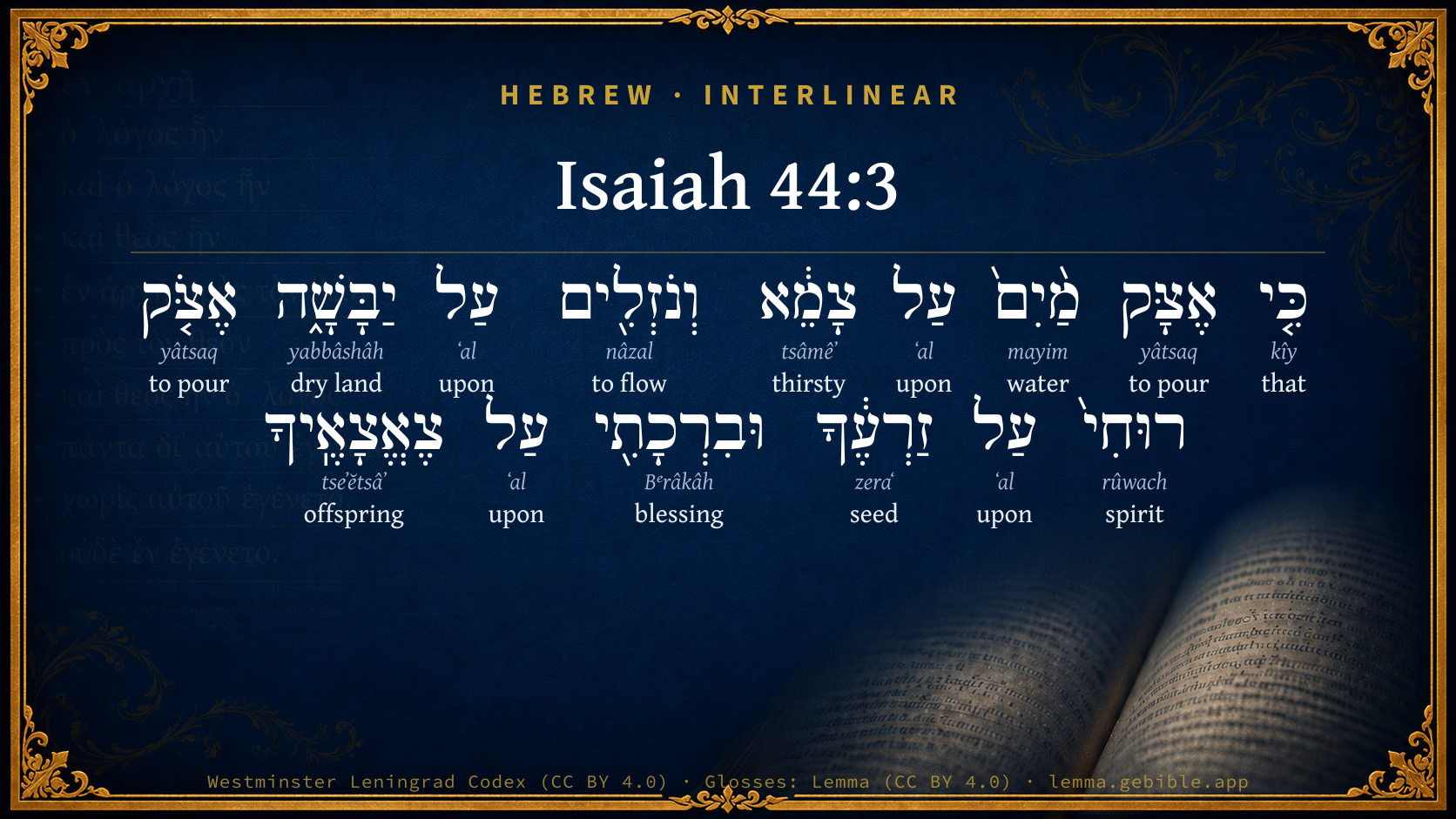
Isaiah 44:3

Hebrew (Westminster Leningrad Codex) Isaiah 44:3 appears in the Hebrew Old Testament. The text above is from the Westminster Leningrad Codex. Each word links to its Strong’s number, a concise gloss, and parsing drawn from the Open Scriptures Hebrew Bible morphology. Click any word for its full Brown-Driver-Briggs (BDB) entry.
Download image
Cite this verse

Isaiah 44:3 (World English Bible). Public Domain. Lemma interlinear Bible study tool, https://lemma.gebible.app/v/isaiah/44/3.

Show BibTeX & RIS
BibTeX
RIS
English Translation
For I will pour water on him who is thirsty, and streams on the dry ground; I will pour my Spirit on your seed, and my blessing on your offspring:
World English Bible · Public Domain
Download a study sheet

One document with this verse’s original text, its word-by-word gloss line, the meaning frame, cross-references with their text, attributed commentary, and full source and license credits — printable, and it pastes into notes with its structure intact.

This verse Autodidact and up

Study sheet (.html) Plain text (.txt)

A passage Seminary Student

Up to 50 verses in one chapter. A passage sheet keeps up to 6 commentary sources and 12 cross-references per verse, in the order this page ranks them, and says so on the sheet whenever that leaves anything out. Ask for a single verse and you get the Autodidact verse sheet above.

Everything on this page stays free to read, with no account — the sheet is a download of what is already on screen, not access to it.

Want to remove ads? Support Godless Engineer
Compare translations 3

The same verse in 3 English versions, stacked beneath the original-language interlinear above. Click any original word for its lexicon entry.

Each is an independent rendering of the whole verse — the interlinear is not word-aligned to these translations.

Highlighted words mark where these versions differ — a whole-verse word diff, not a word-by-word alignment.

  • World English Bible Public Domain
    For I will pour water on him who is thirsty, and streams on the dry ground; I will pour my Spirit on your seed, and my blessing on your offspring:
  • King James Version Public Domain
    For I will pour water upon him that is thirsty, and floods upon the dry ground: I will pour my spirit upon thy seed, and my blessing upon thine offspring:
  • unfoldingWord Literal Text CC BY-SA 4.0
    For I will pour water on the thirsty and streams on the dry ground; I will pour my Spirit on your seed and my blessing on your offspring.

unfoldingWord Literal Text — © unfoldingWord, licensed CC BY-SA 4.0. Word-aligned USFM3 via Door43 (git.door43.org/unfoldingWord/en_ult).

Versions to compare (up to 4)

3 of 4 selected

Show all 18 translations

Every available English version of this verse, each an independent rendering of the whole verse.

  • World English Bible Public Domain
    For I will pour water on him who is thirsty, and streams on the dry ground; I will pour my Spirit on your seed, and my blessing on your offspring:
  • Berean Standard Bible Public Domain
    For I will pour water on the thirsty land, and currents on the dry ground. I will pour out My Spirit on your descendants, and My blessing on your offspring.
  • Majority Standard Bible Public Domain
    For I will pour water on the thirsty land, and currents on the dry ground. I will pour out My Spirit on your descendants, and My blessing on your offspring.
  • King James Version Public Domain
    For I will pour water upon him that is thirsty, and floods upon the dry ground: I will pour my spirit upon thy seed, and my blessing upon thine offspring:
  • American Standard Version (1901) Public Domain
    For I will pour water upon him that is thirsty, and streams upon the dry ground; I will pour my Spirit upon thy seed, and my blessing upon thine offspring:
  • Revised Version (1885) Public Domain
    For I will pour water upon him that is thirsty, and streams upon the dry ground: I will pour my spirit upon thy seed, and my blessing upon thine offspring:
  • Geneva Bible (1599) Public Domain
    For I will powre water vpon the thirstie, and floods vpon the drie grounde: I will powre my Spirit vpon thy seede, and my blessing vpon thy buddes.
  • Douay-Rheims (1899) Public Domain
    For I will pour out waters upon the thirsty ground, and streams upon the dry land: I will pour out my spirit upon thy seed, and my blessing upon thy stock.
  • Young's Literal Translation Public Domain
    For I pour waters on a thirsty one, And floods on a dry land, I pour My Spirit on thy seed, And My blessing on thine offspring.
  • Literal Standard Version CC BY-SA 4.0
    For I pour waters on a thirsty one, || And floods on a dry land, || I pour My Spirit on your seed, || And My blessing on your offspring.
  • Unlocked Literal Bible CC BY-SA 4.0
    For I will pour water on the thirsty ground, and flowing streams on the dry ground; I will pour my Spirit on your offspring, and my blessing on your children.
  • unfoldingWord Literal Text CC BY-SA 4.0
    For I will pour water on the thirsty and streams on the dry ground; I will pour my Spirit on your seed and my blessing on your offspring.
  • Darby Bible Public Domain
    For I will pour water upon him that is thirsty, and floods upon the dry ground; I will pour my Spirit upon thy seed, and my blessing upon thine offspring.
  • World Messianic Bible Public Domain
    For I will pour water on him who is thirsty, and streams on the dry ground. I will pour my Spirit on your descendants, and my blessing on your offspring;
  • Webster's Bible Public Domain
    For I will pour water upon him that is thirsty, and floods upon the dry ground: I will pour my spirit upon thy seed, and my blessing upon thy offspring:
  • Free Bible Version CC BY-SA 4.0
    For I'm going to pour out water on the thirsty land, and streams on the dry ground. I'm going to pour out my Spirit on your descendants, and my blessing on your children.
  • Bible in Basic English Public Domain
    For I will send water on the land needing it, and streams on the dry earth: I will let my spirit come down on your seed, and my blessing on your offspring.
  • JPS Tanakh (1917) Public Domain
    For I will pour water upon the thirsty land, and streams upon the dry ground; I will pour My spirit upon thy seed, and My blessing upon thine offspring;

Literal Standard Version (2020), Covenant Press — licensed CC BY-SA 4.0. Text via the HelloAO Bible API (eBible.org). Unlocked Literal Bible (unfoldingWord) — licensed CC BY-SA 4.0. Text via the HelloAO Bible API (eBible.org). unfoldingWord Literal Text — © unfoldingWord, licensed CC BY-SA 4.0. Word-aligned USFM3 via Door43 (git.door43.org/unfoldingWord/en_ult). Free Bible Version, Dr. Jonathan Gallagher — licensed CC BY-SA 4.0. Text via the HelloAO Bible API (eBible.org).

Word by word

More ways to search: Search by grammar → Find every occurrence → Compare this word →

Practice this passage: Drill this verse → Learn its vocabulary →

צָמֵ֔א
tsâmêʼ
H6771
“thirsty”
Adjective, Adjective, Masculine, Singular, Absolute
Part of Speech
Adjective
Type
Adjective
Gender
Masculine
Number
Singular
State
Absolute
Full BDB Definition

Origin: from H6770

TWOT: 1926b

thirsty
  1. כִּ֤י kîy H3588 “that” Conjunction
  2. אֶצָּק yâtsaq H3332 “to pour” Verb, Qal, Imperfect, 1st Person, Common, Singular
  3. מַ֨יִם֙ mayim H4325 “water(s)” Noun, Common, Masculine, Plural, Absolute
  4. עַל ʻal H5921 “upon” Preposition
  5. וְנֹזְלִ֖ים nâzal H5140 “and · flowing” Conjunction + Verb, Qal, Participle Active, Masculine, Plural, Absolute
  6. עַל ʻal H5921 “upon” Preposition
  7. יַבָּשָׁ֑ה yabbâshâh H3004 “dry land” Noun, Common, Feminine, Singular, Absolute
  8. אֶצֹּ֤ק yâtsaq H3332 “to pour” Verb, Qal, Imperfect, 1st Person, Common, Singular
  9. רוּחִי֙ rûwach H7307 “spirit · my” Noun, Common, Both, Singular, Construct + Suffix, Personal, 1st Person, Common, Singular
  10. עַל ʻal H5921 “upon” Preposition
  11. זַרְעֶ֔ךָ zeraʻ H2233 “seed · your” Noun, Common, Masculine, Singular, Construct + Suffix, Personal, 2nd Person, Masculine, Singular
  12. וּבִרְכָתִ֖י Bᵉrâkâh H1293 “and · blessing · my” Conjunction + Noun, Common, Feminine, Singular, Construct + Suffix, Personal, 1st Person, Common, Singular
  13. עַל ʻal H5921 “upon” Preposition
  14. צֶאֱצָאֶֽיךָ tseʼĕtsâʼ H6631 “offspring · your” Noun, Common, Masculine, Plural, Construct + Suffix, Personal, 2nd Person, Masculine, Singular

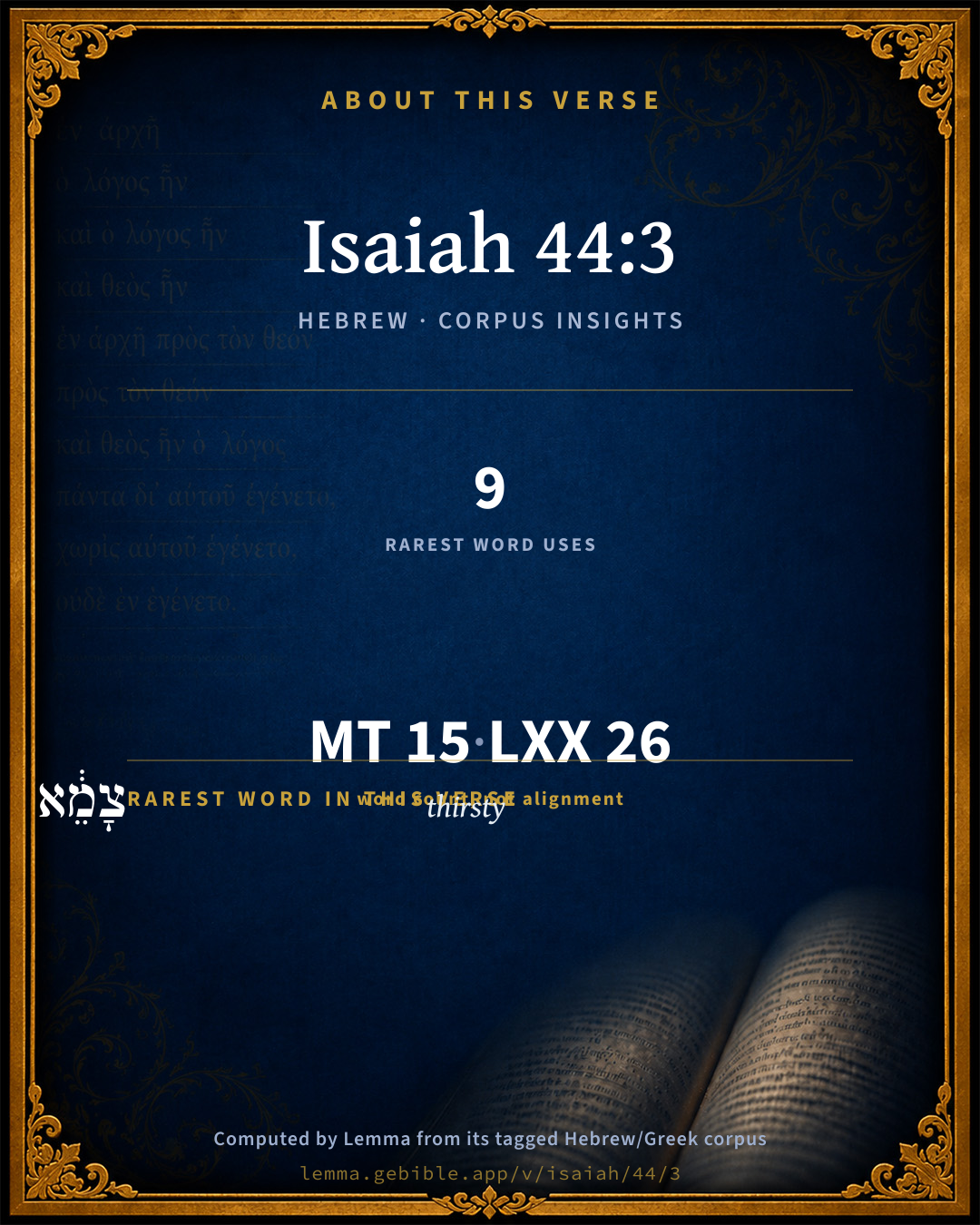
About this verse

These counts appear in no published source. They are computed here, from the morphology-tagged text and Lemma’s own curated glosses. What Lemma adds →

15
words
11
distinct lemmas
Prophets
section

Notable vocabulary

The rarest word here is צָמֵ֔א thirsty H6771 — appearing just 9 times in the whole Hebrew Bible.

Shared distinctive vocabulary

צָמֵ֔א thirsty H6771 occurs in 9 verses of the Hebrew Bible. Also found in:

Grammatical profile

  • 3 verbs
  • 6 nouns
  • 1 adjective
  • 4 prepositions
  • 1 conjunction

Verb forms

  • אֶצָּק Qal · Imperfect
  • וְנֹזְלִ֖ים Qal · Participle Active
  • אֶצֹּ֤ק Qal · Imperfect

Repetition

Words recur within this verse — often emphatic in Hebrew:

  • עַל upon H5921 ×4
  • אֶצָּק to pour H3332 ×2

Hebrew & Septuagint length

In English translation the verse runs 30 words from the Hebrew and 28 from the Septuagint (LXX English) — closely comparable.

A rough comparison of the two English renderings, which tokenize alike — not a word-level alignment.

Word counts can differ between the Hebrew and the Greek without any difference in meaning — e.g. the Hebrew direct-object marker אֵת has no separate Greek word, and Greek often adds the article ὁ.

In the original languages it is 15 Hebrew tokens and 26 Greek tokens — but the two are counted differently (Hebrew bundles its prefixes and suffixes into one token; the Greek is in lemma form), so that isn’t a like-for-like length.

Cross-references

28

Topical passages linked to Isaiah 44:3 in the Treasury of Scripture Knowledge — connected by theme and wording, ordered by reader-vote popularity; previews shown in the World English Bible.

  • Joel 2:28 "It will happen afterward, that I will pour out my Spirit on all flesh; And your sons and your daughters will prophesy. Your old men will dream dreams. Your young men will see visions.
  • Acts 2:17 'It will be in the last days, says God, That I will pour out my Spirit on all flesh. Your sons and your daughters will prophesy. Your young men will see visions. Your old men will dream dreams.
  • Isaiah 59:21 As for me, this is my covenant with them, says Yahweh: my Spirit who is on you, and my words which I have put in your mouth, shall not depart out of your mouth, nor out of the mouth of your seed, nor out of the mouth of your seed's seed, says Yahweh, from henceforth and forever.
  • John 7:37–39 Now on the last and greatest day of the feast, Jesus stood and cried out, "If anyone is thirsty, let him come to me and drink!
  • Proverbs 1:23 Turn at my reproof. Behold, I will pour out my spirit on you. I will make known my words to you.
  • Revelation 21:6 He said to me, "It is done! I am the Alpha and the Omega, the Beginning and the End. I will give freely to him who is thirsty from the spring of the water of life.
  • Acts 2:39 For to you is the promise, and to your children, and to all who are far off, even as many as the Lord our God will call to himself."
  • Zechariah 12:10 I will pour on the house of David, and on the inhabitants of Jerusalem, the spirit of grace and of supplication; and they will look to me whom they have pierced; and they shall mourn for him, as one mourns for his only son, and will grieve bitterly for him, as one grieves for his firstborn.
  • Ezekiel 39:29 neither will I hide my face any more from them; for I have poured out my Spirit on the house of Israel, says the Lord Yahweh.
  • Isaiah 32:15 until the Spirit be poured on us from on high, and the wilderness become a fruitful field, and the fruitful field be esteemed as a forest.
  • Acts 10:45 They of the circumcision who believed were amazed, as many as came with Peter, because the gift of the Holy Spirit was also poured out on the Gentiles.
  • Titus 3:5–6 not by works of righteousness, which we did ourselves, but according to his mercy, he saved us, through the washing of regeneration and renewing by the Holy Spirit,
  • Psalms 107:35 He turns a desert into a pool of water, And a dry land into water springs.
  • Isaiah 43:19–20 Behold, I will do a new thing; now shall it spring forth; shall you not know it? I will even make a way in the wilderness, and rivers in the desert.
  • Isaiah 41:17 The poor and needy seek water, and there is none, and their tongue fails for thirst; I, Yahweh, will answer them, I, the God of Israel, will not forsake them.
  • Joel 3:18 It will happen in that day, That the mountains will drop down sweet wine, The hills will flow with milk, All the brooks of Judah will flow with waters; And a fountain will come forth from the house of Yahweh, And will water the valley of Shittim.
  • Acts 2:33 Being therefore exalted by the right hand of God, and having received from the Father the promise of the Holy Spirit, he has poured out this, which you now see and hear.
  • Ezekiel 34:26 I will make them and the places round about my hill a blessing; and I will cause the shower to come down in its season; there shall be showers of blessing.
  • Isaiah 35:6–7 Then shall the lame man leap as a hart, and the tongue of the mute shall sing; for in the wilderness shall waters break out, and streams in the desert.
  • Isaiah 61:9 Their seed shall be known among the nations, and their offspring among the peoples; all who see them shall acknowledge them, that they are the seed which Yahweh has blessed.
  • Psalms 78:15–16 He split rocks in the wilderness, And gave them drink abundantly as out of the depths.
  • Revelation 22:17 The Spirit and the bride say, "Come!" He who hears, let him say, "Come!" He who is thirsty, let him come. He who desires, let him take the water of life freely.
  • Isaiah 48:21 They didn't thirst when he led them through the deserts; he caused the waters to flow out of the rock for them; he split the rock also, and the waters gushed out.
  • Isaiah 65:23 They shall not labor in vain, nor bring forth for calamity; for they are the seed of the blessed of Yahweh, and their offspring with them.
  • Psalms 63:1 God, you are my God. I will earnestly seek you. My soul thirsts for you, My flesh longs for you, In a dry and weary land, where there is no water.
  • Isaiah 49:10 They shall not hunger nor thirst; neither shall the heat nor sun strike them: for he who has mercy on them will lead them, even by springs of water will he guide them.
  • Isaiah 32:2 A man shall be as a hiding-place from the wind, and a covert from the tempest, as streams of water in a dry place, as the shade of a great rock in a weary land.
  • Matthew 12:43 But the unclean spirit, when he is gone out of the man, passes through waterless places, seeking rest, and doesn't find it.

Cross-references courtesy of OpenBible.info (CC BY 4.0).

Hebrew and Greek witnesses Masoretic Hebrew ↔ Greek Septuagint

The same verse in the two great witnesses to the Old Testament, shown verse-for-verse.

These are two independent witnesses, not word-aligned to each other, and the Septuagint is shown in lemma (dictionary) form.

Hebrew Isaiah 44:3 Masoretic · Westminster Leningrad Codex

כִּ֤י אֶצָּק מַ֨יִם֙ עַל צָמֵ֔א וְנֹזְלִ֖ים עַל יַבָּשָׁ֑ה אֶצֹּ֤ק רוּחִי֙ עַל זַרְעֶ֔ךָ וּבִרְכָתִ֖י עַל צֶאֱצָאֶֽיךָ

For I will pour water on him who is thirsty, and streams on the dry ground; I will pour my Spirit on your seed, and my blessing on your offspring:

World English Bible · Public Domain

Greek LXX Isaiah 44:3 Septuagint · lemma form

ὅτι ἐγώ δίδωμι ὕδωρ ἐν δίψος ὁ πορεύομαι ἐν ἄνυδρος ἐπιτίθημι ὁ πνεῦμα ἐγώ ἐπί ὁ σπέρμα σύ καί ὁ εὐλογία ἐγώ ἐπί ὁ τέκνον σύ

For I will give water to the thirsty that walk in a dry land: I will put my Spirit upon your seed, and my blessings upon your children:

LXX2012 (modern English Septuagint) · Public Domain

Hebrew: Westminster Leningrad Codex (CC BY 4.0). Greek: Septuagint (public domain); English from LXX2012 (modern English Septuagint) (Public Domain). How the Septuagint differs from the Hebrew →

Targum (Aramaic paraphrase)

1

The Targum is the ancient Jewish Aramaic paraphrase of the Hebrew Scriptures — an interpretive translation, not the Hebrew text itself. Onkelos (literal) and Pseudo-Jonathan (expansive) render the Torah, and Jonathan the Prophets. Coverage is partial: where no permissively-licensed English translation exists for a verse, only the Aramaic is shown. This is verse-level text, not a word-by-word alignment to the Hebrew.

  1. Targum Jonathan Prophets (Joshua–Malachi)
    אֲרֵי כְמָא דְמִתְיַהֲבִין מַיָא עַל אֲרַע בֵּית צַחֲוָנָא וּמִתְנַגְדִין עַל יַבֶּשְׁתָּא כֵּן אֶתֵּן רוּחַ קוּדְשִׁי עַל בְּנָךְ וּבִרְכָתִי עַל בְּנֵי בְנָךְ:

    For as waters are discharged upon the thirsty land, and are set flowing upon the dry land, so will I give my Holy Spirit unto thy children, and my blessing unto thy children's children.

    Targum Jonathan — Aramaic: “Mikraot Gedolot” (public domain). English: “Sefaria Community Translation” (CC0 1.0 (public-domain dedication)); “London "Chaldee Paraphrase," 1871” (public domain). Text via Sefaria.

Commentary

Notes on Isaiah 44:3 from classic Christian and Jewish commentators (each source and its license shown beneath its notes). The classic Christian expositions comment on the surrounding passage and are grouped to its opening verse, so a note may address several verses; the Jewish commentaries on the Tanakh (Rashi and others) are per-verse, so they appear only where the commentator wrote on this verse.

Lemma curates 59 commentaries, every one of them public domain or Creative Commons licensed, each selected and text-cleaned for this edition rather than reprinted as found. About our sources →

Trapp's Complete Commentary

John Trapp

Isa 44:3 For I will pour water upon him that is thirsty, and floods upon the dry ground: I will pour my spirit upon thy seed, and my blessing upon thine offspring:

Ver. 3. For I will pour water upon him that is thirsty.] Or, Upon the thirsty place; hearts that hunger and thirst after righteousness. {Mat 5:6} {See Trapp on "Mat 5:6"}

I will pour my spirit and my blessing.] When God giveth a man his Holy Spirit, he giveth him blessing in abundance; even all good things at once, as appeareth by Mat 7:11 Luk 11:13. Here are three special operations of the Spirit instanced: 1. Comfort; 2. Fruitfulness; 3. Courage for Christ. {Isa 44:5}

John Trapp, A Commentary or Exposition upon All the Books of the Old and New Testament (1647–1656) — public domain. Text from a community e-Sword module.

The Biblical Illustrator

Joseph S. Exell

Isa_44:3-5

For I will pour water upon him that is thirsty

Gods Spirit as water and floods

The double figure is expressive of copiousness, abundance, variety (both the water and the floods), the rain from heaven and the mountain torrents to refresh the parched land.

(J. R.Macduff, D. D.)

The Holy Spirit For both Jews and Gentiles:

If these expressions are intended to signify different classes of people, the former may denote, in a figurative sense, the Jews, who had not yet received the Holy Spirit in that plentiful measure which they earnestly desired, and, unsatisfied with present enjoyments, were ardently longing for further communications of Divine grace, and the salvation of the Lord. The latter may signify the Gentiles, who had not been favoured with Divine ordinances and Divine influences, whose condition had been exhibited in preceding passages of these prophecies as uncultivated and barren, resembling a wilderness. (R. Macculloch.)

Revival:

A work of revival almost always begins with the children of God. God pours water first on him that is thirsty, and then on the dry ground. (R. M. MCheyne.)

The influences of the Holy Spirit:

I. THE HOLY SPIRIT IS A DISTINCT AGENT IN THE SCHEME OF REDEMPTION.

II. THE PROMISE OF THE DIVINE SPIRIT TO SECURE THE GRAND PURPOSES OF REDEMPTION FORMS A PROMINENT AND INTERESTING PART OF REVELATION.

III. EVERY PERSON WHO BELIEVES THE GOSPEL RECEIVES THE DIVINE INFLUENCE WHICH IT PROMISES.

IV. THE HAPPINESS AND USEFULNESS OF BELIEVERS REQUIRE THEM TO SEEK A MOST COPIOUS EFFUSION OF THE INFLUENCES OF THE SPIRIT. The Spirit promotes the happiness of believers

1. By gradually advancing their sanctification.

2. By making them increasingly the objects of Divine complacency.

3. By preserving them from temptation, and habitually disposing them to seek communion with God.

V. EVERY BELIEVER HAS REASON TO EXPECT THAT THE INFLUENCES OF THE HOLY SPIRIT WILL RE MOST COPIOUSLY IMPARTED TO HIM.

VI. THERE IS AN APPOINTED ORDER OF MEANS WITH WHICH THE BESTOWMENT OF DIVINE INFLUENCE IS CONNECTED, and in the constant observance of which its most copious effusion should be sought.

VII. IF WE HAVE NOT THE INFLUENCES OF THE HOLY SPIRIT, OR IF WE DO NOT POSSESS THEM IN AN EMINENT DEGREE, WE ARE NOT MERELY UNFORTUNATE BUT GUILTY. (L. Forster.)

Water an emblem of the Holy Spirit:

1. Water is a blessing universally necessary.

2. A blessing universally diffused.

3. An abundant blessing.

4. A cheap blessing. (D. Rees.)

The Spirit acts through believers:

The Spirit must first show forth His virtue in us according to our faith before He can act upon our neighbours. He must be a Spirit of revealing truth in us before He can go forth from us to illuminate the world. He must be a Spirit of conviction in us, making us mindful of our errancies, before He can lead the world to penitence. He must be a Spirit of assurance in us before He can chase the fears and dry the tears of a mourning world. He must be a Spirit of holy, tender, undefiled charity in us before He can assimilate the world to Christs great law of love. And all these things the Spirit becomes to us through faith. Some districts are riverless, not because the rain never falls, but because the soil for a great depth down is so porous that the rainfall passes through it like a sieve. The district that cradles rivers must have a soil and underlying foundation that will hold the rain like a sponge. And the graces and virtues present in the character whose root-principle is unfeigned faith hold the benign influences of the Spirit as in hidden fountains and storehouses, so that the world may be blessed by the steadfast outflow. (T. G.Selby.)

The essential diffusiveness of spiritual religion:

These words remind us of the essential diffusiveness of the religion which has faith for its ruling principle and the presence of the Holy Ghost for its daily heritage. The scale according to which we receive the Spirit must not be that of our own personal necessities only or the demands of the passing opportunity. As the Spirit dwelt in Christ with inexhaustible spontaneity for the sake of the larger humanity He had come to bless, as well as for Himself, so must it be with us. However narrow the visible measurements of our life, if we receive the fulness of the Spirit we shall touch the entire world through those subtle and expansive forces which brood within us. We are sometimes humbled because our sphere of action seems so cramped and circumscribed. We long for wider fields. We should like to be the instruments of Divine activities which will affect continents and live through centuries. But into what a little space our aspiring natures seem to be shut up! There are Christians, excellent in character and rich in mental gifts, whose influence seems to go no further than the home, the shop, the office, a select coterie of friends. If the Spirit is in us, however, these mystic rivers will flow forth, and for the honour of Him whose name we trust the Spirit will see to it that our opportunities are imperial in their magnitude. We shall affect for good the fortunes of many lands, and our destiny shall be large and resplendent as our best aspirations. In ninety-nine cases out of a hundred we will not let our influence take wings and pass through its appointed realms and latitudes. The panting springs can find no outlet, and the Spirit is restrained because those are so narrow who give to Him an earthly home. Our religious toleration, for instance, we carry to an extent that is simply sinful. We see men in process of being ruined, and, forsooth, we do not wish to interfere with their religious convictions, as we call them,--just as if any mans convictions were worthy of respect when they do not keep him from sin! We think of ourselves as wells to which our neighbours may come if they wish; but the murmuring streams are forced back into the fountain-head, and wells become little better than cesspools. There must be an onward-pushing force in our religious life. (T. G.Selby.)

Vitalising power in Spirit filled men:

There are souls around us so arid, scorched, and desolate that it seems almost impossible to educe within them a single grace or morality. Races are to be found--at least such is the testimony of the white men who are anxious to supplant them--which lack the rudimentary aptitudes for virtue, humanity, religion. They have received a prodigious endowment of appetite, passion, blood-thirstiness from the beast-world below them; but the spirit-world above them seems to have failed to filter down into their lives a single principle of light, truth, tenderness. Even these may be vitalised with a new ethic and fitted for a higher destiny than that of the dust-heap. But it must be by the Spirit in Christs disciples. The trader who is a nominal Christian and a practical savage goes into their borders, and is an emissary of swift and complete destruction. They are touched by European commerce, and deteriorate and die off m swarms. They are forced into contact with Western civilisation, and they resent its restraints and perish from the lands of their forefathers. All these secondary influences are but as rivers of poison flowing through their borders, and a strange fate compels them to drink what they know to be the cup of death. The streams which can make this human desert, without a hint of verdure and land-marked with whitened bones, into a paradise, and keep it shaded with foliage, glorious with fruit, thick-set with holy homes and song-filled temples, must go out from the souls of men and women who have received the Holy Ghost. (T. G. Selby.)

Encouragement for parents and children:

In its relation to the Jews, there was a partial and very interesting fulfilment of this promise on the day of Pentecost, in the remarkable effusion of the Holy Spirit which then took place, and the blessed effects by which this was followed: but there is a still more striking and illustrious accomplishment to be realised, when, as the result of Divine influence, the Jews, as a nation and people, shall be brought back to God, and become incorporated with the Gentiles in that one fold, of which Christ shall be acknowledged the true and only Shepherd. As a promise pertaining to Gospel times, it is one in which we have a clear and direct interest. As to the particular design of the promise, the very terms in which it is expressed show that it is intended to refer, not perhaps exclusively, but still most emphatically, to the children and posterity of those who have themselves loved and feared God. Consider the promise,--

I. IN ITS APPLICATION TO CHRISTIAN PARENTS. It should be regarded--

1. As an encouragement to the faithful exercise of parental discipline and instruction.

2. As a warrant for believing application at the throne of grace.

3. As a satisfactory ground for hope and encouragement, even under the most unpromising appearances.

II. IN ITS APPLICATION TO THE DESCENDANTS, AND MORE ESPECIALLY THE CHILDREN OF PIOUS PARENTS.

1. This promise affords you no security, apart from your personal acceptance of Christ and submission to His authority.

2. This promise supplies you with the richest encouragement in seeking your salvation and an interest in the Divine favour.

3. This promise should encourage the pious descendants of godly ancestors to aim at more than ordinary eminence in their personal devotedness to God. The imagery of the text seems to imply that a special decision and fixedness of purpose may be expected: One shall say, I am the Lords, &c. It indicates, too, great vigour and rapidity of growth: they shall grow as willows by the water-courses.

4. This promise will leave you doubly without excuse, and greatly aggravate your guilt, if you persist in neglecting salvation. How pleasing to perceive that while the promise applies more especially to the posterity of believers, it does not exclude others! Not only will God give His Spirit and impart His blessing to the seed and offspring of His people, but He will pour water upon every one who is thirsty and floods upon the dry ground. (Essex Remembrancer.)

The Church and the children:

These exceeding great and precious promises are unto us and our children.

I. GODS PROMISE OF BLESSING UPON THE CHURCH.

1. Its import. Refers to the effusion of the Spirit.

2. Its participants. Gods ancient people--in a sadly backsliding state. How deeply they needed the effusion of the Spirit! Two facts prove this to be our great want.

(1) The low and languid piety of many.

(2) The comparatively small success of the various agencies for the conversion of souls.

3. Its abundance. God gives what He promises only in answer to prayer. His promise cannot fail. I will.

II. GODS PROMISE OF BLESSING UPON THE CHILDREN OF THE CHURCH.

1. Our children need the Holy Spirit. Religion is not hereditary. No natural goodness can supersede His work. Spiritual life is not natural life carried up to its highest point of attainment.

2. God promises to give the Spirit as abundantly to them as to us. Same terms used. And having received the Spirit, they are to grow in grace vigorously (Isa_44:4). The manifestation of this in public (Isa_44:5). (A. Tucker.)

Revival:

Foremost among the judgments which followed Israels idolatries was the visitation of drought. Dwelling, as we do, under milder skies, and in a sea-girt isle, we enjoy copious supplies of fertilising rain. Yet, even in our own land, a sensible reduction of the rainfall in spring is followed by empty shocks in August. But in the sunny climes of Syria, if the half-yearly gift of rain failed, the effect was disastrous in the extreme. In the footsteps of famine marched dark-robed pestilence, and grim Death with his scythe of keenest edge. Nor was this all. Towns and hamlets, stripped of strong men, became an easy prey to the marauder. Successful raids paved the way for desolating war; and defeat, oppression, national ruin, came in swift procession. Hence, impiety, must have grown bold indeed, if the Hebrews did not earnestly ask for the early and the latter rain. Now if drought is so injurious in the fields of nature, is it not equally injurious in the Church?

I. A STATE OF BARRENNESS DESCRIBED. The ground is said to be dry--that is, in a parched and impenetrable condition. This is not its normal state: this is deadly to vegetable growth. For some reason the land has been deprived of dew and rain. No seed, however big with latent life, can break its rigid shell; much less spring up or prosper. With such homely imagery as this the prophet leads our thoughts from the outer world to the inner. There is a sense of need expressed. Here is a marked improvement. The soul is athirst; the insensibility is guns. The rigid hardness of winter is at an end.

II. A GENEROUS GIFT PROVIDED. A promise from God is as good as its performance.

1. The Source of the supply. It must come from above. The great folly to which all men are prone, is to seek the supply of their wants apart from God.

2. The suitableness of the means. What can be more suitable than showers of rain for a thirsty soil? Yet equally suitable is every gift of God to satisfy the wants of dependent man!

3. The copiousness of the gift. If showers will not suffice, there shall be floods.

4. The range of the promise. It shall not terminate with ourselves: it shall extend to our children--ay, to our childrens children!

III. ABUNDANT FERTILITY FORESEEN. There shall be a revival of life in the Church, as in the parched fields after a copious shower--as in nature, at the advent of spring.

1. Multiplicity of conversions is here predicted They shall spring up as amongst the grass.

2. Rapidity of growth shall be another feature of this era.

3. Constancy of verdure will be enjoyed. They shall be as willows by the water-courses. In the arid deserts of the East you will find here and there--conspicuous for their rarity--bright spots of luxuriant herbage, fruitfulpalms, flagrant flowers, in the midst of scorching sand. The secret is here,--that far down beneath the surface, a fount bubbles from the riven rock, which, watering the roots of trees and grass, produces beauty, shade, and fruit. So have we seen a man, placed in a very desert of privation--exposed to a scorching sun of trial--yet retaining all the freshness of his piety, and yielding fruits of wisdom, patience, hope. For the roots of his faith were nourished from a secret spring. (Dickerson Davies, M. A.)

A revival promise:

I. THE GREAT COVENANT BLESSING OF THE CHURCH The gift of the Holy Ghost. Whatever metaphor is used this is the meaning of it.

1. This blessing has been already given. We must never underrate the importance of the ascension of our Lord, and the gift of the Spirit which followed thereupon. He is permanently resident in the midst of the Church.

2. This blessing is the subject of a promise. A promise of God is the essence of truth, the soul of certainty, the voice of faithfulness, and the substance of blessing. What a right royal promise it is! We hear the double I will, I will.

3. This gift is a most needful blessing.

4. While we need the Spirit of God, His working is most effectual to supply all our needs when He does come upon us. In the East, you can generally tell where there is a stream or a river by the line of emerald which marks it. If you stood on a hill, you coma see certain lines of green, made up of grass, reeds, rushes, and occasional trees, which have sprung up along the water-courses. Nothing is required to make the land fertile but to water it. Even thus let the Spirit of God come upon any Church, and it is all that it needs to make it living and fruitful.

5. The promise is liberal and unstinted. Pour floods. I have seen in Italy the fields watered by the processes of irrigation: there are trenches made to run along the garden, and smaller gutters to carry the lesser streams to each bed, so that each plant gets its share of water; but the husbandman has to be very careful, for he has but little water in his tank, and only an allotted share of the public reservoir. No plant must have too much; no plot of ground must be drenched. How different is this from the methods of the Lord! He pours the water; He deluges the land.

6. This covenant blessing is peculiarly promised to a certain class of persons who are especially dear to us. I will pour My Spirit upon thy seed, &c.

II. THE GLORIOUS-RESULT OF THIS COVENANT BLESSING.

1. The upspringing of spiritual life. Wherever the Spirit of God comes, there will be life in the Church and in the ministry; life in prayer, in effort, in holiness, in brotherly love.

2. The next effect will be seen in the calling out of numerous converts by the Holy Spirit. They shall spring up as among the grass, and as willows by the water-courses. Who can count the blades of grass? The converts called out by the Spirit of God are vigorous and lively. The grass in the East springs up without any sowing, cultivating, or any other attention: it comes up of itself from the fruitful soil. There is the water, and there is the grass. So where the Spirit of God is with a Church there are sure to be conversions, it cannot be otherwise.

3. These conversions will come from all quarters. One shall say, another shall call, another shall subscribe. One comes from the wealthy, another from the poor, a third from nobody knows where. They shall come from all trades and occupations, from all churches and denominations.

4. These converted people shall be led to avow their faith. They shall not, like Nicodemus, come to Jesus by night.

III. THE CONDUCT SUITABLE IF WE OBTAIN THIS BLESSING.

1. We must confess how dry, how wilderness-like we are.

2. Let us cultivate prayer.

3. We must put forth our own personal effort. (C. H. Spurgeon.)

Overflowing in usefulness to other:

Egypt has the river Nile all the year round, but as a fertilizing power the Nile is practically useless till it is in flood and overflowing its banks. Then it bestows the needed blessing upon every foot of land it touches. It is when we are filled with the Spirit to the point of overflowing that we become a power for good to others. (T. Waugh.)

Revived Churches:

If you go down to some of our Thames bridges, you will find the barges stuck fast in the mud, and you cannot stir them. It would be a very difficult thing to provide machinery with which to move them; all the kings horses and all the kings men could not do it. But wait till the tide comes in; now every black, heavy old barge walks the waters like a thing of life. Everything that can feat is movable as soon as the silver flood has returned. So, many of our Churches lie in the mud. Everything seems motionless, powerless; but when the Spirit of God comes in like a flood, all is altered. (C. H. Spurgeon.)

I will pour My Spirit upon thy seed

Gods covenant with Christian parents

(with Act_2:39):--Has God given to us any sure grounds to expect the conversion of the children of His people. Note--

I. THE RELATIONSHIP OF THE CHILDREN TO THE PARENTS, as it is laid down in Scripture. It is plain that when God becomes our God, He becomes the God of our children.

II. CHRISTIAN NURTURE furnishes us with another reason for expecting the salvation of our children. Train up a child, &c.

III. WE MAY FOUND OUR HOPES UPON GODS FAITHFULNESS AS A PRAYER-HEARING GOD. Let us not despair if the answer to prayer be long delayed. The Rev. Mr. Grimshaw, rector of Haworth, had but one son, and he did not follow his fathers footsteps. After his fathers death, he was heard to say, in his maudlin drunkenness, when riding, This horse once carried a saint; now it carries a devil. Yet, hopeless as this case seemed, he became a true penitent, and one of his deathbed sayings was, How astonished my father will be to see me in heaven! (Evangelical Advocate.)

Christian home environment:

There have been few of the great teachers of Christendom who have not derived their deepest convictions from the impressions made by their earliest domestic environment. (J. Stalker, D. D.)

The value of young life:

The nation of the future rests upon the cradles of to-day. The young life in any institution is that which repairs its defects, enlarges its usefulness, and stimulates its charities. The young life, in any family, is the influence which suns the path of age, invigorates exertion, and quickens the growth of the virtues. Where would the valour and vigour of the country be if deprived of the support of young life? Disraeli says that almost everything that is great has been done by youth; and the history of heroes is the history of youth. In the vegetable world the mission and influence of the young life is not less plain than powerful. According to Louis Figuier, the bud must be considered as a fundamental element in the plant, which, without it, would soon perish. It is the bud which year by year repairs the losses, supplies the flowers, the leaves, the branches which nave disappeared. Through its means the plant increases in growth. Through it its existence is prolonged. The bud is the true renovator of the vegetable world. Therefore these buds are everywhere--on the roots, the leaves, and sometimes even on the flowers, for Nature never loses sight of the phenomena essential to organic life--namely, the production of new beings. (Scientific Illustrations and Symbols.)

Child-piety:

A Christian gentlemans little son, just before he died, said to his father: When I get to heaven, I shall go up to Jesus and say, Jesus, I know You; my papa told me about You. (T. Champness.)

A Christian childhood:

Rev. F. B. Meyer was asked: How did you find Christ? This is his written reply: I do not remember when first I became a Christian. The love of God came over me as the dawn over a summer sky; and it was only in after years that I realised what God had done for me in those early days. My mother and father were godly people. They expected me to be a Christian, and at my mothers knee I said my morning and evening prayers. It is to their prayer and faith and unremitting care that I owe everything.

Gods blessing on the offspring of His people

Speaking of the way in which his mother received him when he informed her that he had decided to leave the railway office and become a minister, the Rev. John MNeill said: Taking my face between her hands, she drew it close to her own and said, John, I meant you for that before I ever saw your face. I knew then, what I had never guessed before, that I owe my conversion and my ministry to my mothers prayer. (Presbyterian.)

The Biblical Illustrator, edited by Joseph S. Exell (c. 1880s–1900s) — public domain. Text from a community e-Sword module.

Joseph Benson's Commentary

Isa 44:3-5. I will pour water — My Spirit, as it is expounded in the latter part of the verse, frequently compared to water in the Scriptures; upon him that is thirsty — That is destitute of it, and that sincerely and earnestly desires it; and my blessing upon thine offspring — All the blessings of my covenant, especially those of a spiritual nature. This promise seems to have been made with a design to raise the minds and hearts of the Jews from carnal and worldly things, to which they were too much addicted, to spiritual and heavenly blessings, and thereby to prepare them for the reception of the gospel. And they shall spring up, &c. — They shall increase and flourish like grass, and those herbs and plants which grow up in the midst of it. One shall say, I am the Lord’s, &c. — This verse seems to relate to the increase of the church by the accession of the Gentiles: as if he had said, The blessing of God upon the Jews shall be so remarkable that many of the Gentiles shall join themselves unto them, and accept Jehovah for their God, and own themselves for his people.

Joseph Benson's Commentary on the Old and New Testaments (1811–1818) — public domain. Text from a community e-Sword module.

Tyndale Open Study Notes

Tyndale Open Resources

44:3 The restoration theme is connected with God’s promise to pour out the Spirit (see also 32:15-17; Joel 2:28-32; Acts 2:16-18). • on your descendants . . . children: The next generation of Israelites offered hope.

Tyndale Open Study Notes — © Tyndale Open Resources, licensed CC BY-SA 4.0. Text via the HelloAO Bible API.

Geneva Bible (1599)

Geneva Bible translators

Because man of himself is as the dry and barren land, he promiseth to moisten him with the waters of his holy Spirit, Joel 2:28; John 7:38; Acts 2:17.

Geneva Bible (1599) marginal notes — public domain. Text via Bolls.life.

Jamieson, Fausset & Brown

Robert Jamieson, A. R. Fausset & David Brown

(Isa 41:18).

him . . . thirsty--rather, "the land" (Isa 35:6-7), figuratively for man thirsting after righteousness (Mat 5:6).

floods--the abundant influences of the Holy Spirit, stronger than "water."

spirit--including all spiritual and temporal gifts, as the parallel, "blessing," proves (Isa 11:2; Isa 32:15).

seed-- (Isa 59:21).

Jamieson, Fausset & Brown — Commentary Critical and Explanatory on the Whole Bible (1871) — public domain (CC PDM 1.0). Text via the HelloAO Bible API.

Ellicott's Commentary for English Readers

(3) I will pour water . . .—The latter words of the verse interpret the former. It is not the union of material or spiritual blessings, but first the symbol, and then the reality. The “thirst” is that of Psa_42:1; Joh_4:13-14. In the promise of the Spirit we have an echo of Joe_2:28.

A Bible Commentary for English Readers, edited by Charles John Ellicott (1878–1897) — public domain. Text from a community e-Sword module.

The Cambridge Bible for Schools and Colleges

gen. ed. J. J. S. Perowne

3. On the first half of the verse see ch. Isa_41:17 ff. Here, however, a figurative sense predominates, as is shewn by what follows. The “spirit” is the agent both of physical and moral regeneration, as in ch. Isa_32:15 (cf. Eze_37:11-14); the former idea being prominent; hence the parallelism “spirit”—“blessing,” the former being the cause, the latter the effect. On the figure of water for the spirit, cf. Joh_1:33 etc. seed and offspring are individual Israelites.

The Cambridge Bible for Schools and Colleges (gen. ed. J. J. S. Perowne; Cambridge University Press, 1878–1918) — public domain. Text from a community e-Sword module.

John Gill's Exposition

For I will pour water oh him that is thirsty,.... Or rather upon the thirsty land, as the Targum; and so the Syriac version, "in a thirsty place"; as a dry land is a thirsty land; it thirsts for water, gapes and opens for it: see Psa 63:1 "and floods upon the dry ground"; large quantities of rain to moisten it, and make it fruitful; these figurative expressions are explained in the next clauses:

I will pour my Spirit upon thy seed, and my blessing upon thine offspring; by which "seed" and "offspring" are meant the spiritual seed of this remnant or little church of Christ among the Jews, in the first times of the Gospel: such as should be regenerated and converted in it, and who are signified by the "dry" and "thirsty" ground; for being made sensible of their desolate condition, their barrenness and unfruitfulness, they hungered and thirsted after righteousness; were desirous of Christ and his grace, and more knowledge of him, and eagerly sought after them; and to these are promised the Spirit, and his gifts and graces, compared to water, for its purifying, softening, fructifying, and refreshing nature, and for extinguishing thirst, and giving a real pleasure and delight; see Eze 36:25 and the abundance thereof is signified by "floods" of water; for in first conversion especially, there is an abounding, yea a superabounding of the grace of God; it is a well of living water; yea, out of the believer flow rivers of living water, Joh 4:14 and this grace of the Spirit is always a blessing: and indeed all the blessings of grace go along with it, as to the manifestation and application of them as justification, pardon of sin, adoption, &c.; here perhaps a more special regard is had to the extraordinary effusion of the Spirit, on the day of Pentecost, when the apostles of Christ being furnished with his gifts and graces, were fitted to go forth with the "fullness of the blessing" of the Gospel of Christ. The Targum of the whole is,

"for as waters are given upon the thirsty land, and they flow upon the dry land, so will I give my Holy Spirit on thy children, and my blessing upon thy children's children;''

a succession of converts in the Christian church.

John Gill's Exposition of the Whole Bible (1746–1763) — public domain (CC PDM 1.0). Text via the HelloAO Bible API.

Albert Barnes' Notes on the Bible

For I will pour water - Floods, rivers, streams, and waters, are often used in the Scriptures, and especially in Isaiah, to denote plenteous divine blessings, particularly the abundant influences of the Holy Spirit (see the note at Isa 35:6-7). That it here refers to the Holy Spirit and his influences, is proved by the parallel expressions in the subsequent part of the verse.

Upon him that is thirsty - Or rather, ‘on the thirsty land.’ The word צמא tsâmē' refers here rather to land, and the figure is taken from a burning sandy desert, where waters would be made to burst out in copious streams (see Isa 35:6-7). The sense is, that God would bestow blessings upon them as signal and marvelous, as if floods of waters were made to descend on the dry, parched, and desolated earth.

And floods - The word נוזלים nôzelı̂ym, from נזל nâzal, “to flow,” to run as liquids, means properly flowings, and is used for streams and rivers Exo 15:8; Psa 78:16; Pro 5:15; Jer. 18 It means here that the spiritual influences which would descend on the afflicted, desolate, comfortless, and exiled people, would be like torrents of rain poured on the thirsty earth. This beautiful figure is common in the Scriptures:

He shall come down like rain upon the grass,

And as showers that water the earth.

Psa 72:6

My doctrine shall drop as the rain

My speech shall distil as the dew

As the small rain upon the tender herb,

And as the showers upon the grass.

Deu 32:2

I will pour my Spirit upon thy seed - (See Isa 59:21). This is in accordance with the promises everywhere made in he Bible to the people of God (see Gen 12:7; Gen 13:15; Gen 15:18; Gen 17:7-8; Exo 20:6; Deu 7:9; Psa 89:4; Isa 43:5). It may be regarded, first, as a promise of the richest blessings to them as parents - since there is to a parent’s heart no prospect so consoling as that which relates to his offspring; and, secondly, as an assurance of the perpetuity of their religion; of their return from captivity, and their restoration to their own land.

Albert Barnes' Notes on the Bible (1834–1885) — public domain. Text from a community e-Sword/MySword module.

Haydock's Catholic Bible Commentary

Stock. I will give fresh life to my people, as to the figure of Christ’s Church.

George Leo Haydock (1774–1849), Haydock's Catholic Family Bible and Commentary, 1859 edition — public domain. Excludes Psalms (Douay-Rheims chapter numbering differs from Protestant) and Deuterocanonical books (Catholic canon only).

Matthew Poole's English Annotations

I will pour water; my Spirit and blessing, which is frequently compared to water; and so it is expounded in the latter part of the verse.

Upon him that is thirsty: either,

1. Upon him that desires it. Or rather,

2. Upon him that is destitute of it; for what is here thirsty, in the next clause it is called dry ground.

My Spirit; the gifts and graces of my Spirit; which expression he seems designedly to use, to lift up the minds and hearts of the Jews from carnal and worldly things, to which they were too much addicted, unto spiritual and heavenly blessings, and thereby to prepare them for the better entertainment of the gospel.

My blessing; all the blessings of my covenant, both spiritual and temporal.

Matthew Poole's English Annotations on the Holy Bible (1683–1685) — public domain. Text from a community e-Sword/MySword module.

Whedon's Commentary on the Bible

Daniel D. Whedon

3. Water… thirsty… floods… ground — Of the two parallelisms here the second explains the first. “Here, the Lord says to the beloved people why they need not be afraid. In the judgment that is to consume the fleshly Israel, the spiritual Israel is to remain unharmed.” — Nagelsbach. Abundant water promised in drought symbolizes great spiritual outpourings upon the true Israel, as predicted in the second chapter of Joel. See also Isa_41:17-18; Isa_43:18-21. Floods, rivers, streams, waters, and the like, are staple terms with the prophet to illustrate copious outpourings of the Holy Spirit in Messianic times.

Daniel D. Whedon (gen. ed.), Commentary on the Old and New Testaments (1874–1909) — public domain. Text from a community e-Sword module.

John Wesley's Explanatory Notes

Water - Upon him that is destitute of it.

John Wesley, Explanatory Notes Upon the Whole Bible (1754–1765) — public domain. Text via the GEBible commentary corpus.

J. A. Alexander on Isaiah

Joseph Addison Alexander

“For I will pour waters on the thirsty, and flowing (waters) on the dry (land); I will pour my spirit on thy seed, and my blessing on thine offspring.” This is the grand reason why God’s people should not despair. The two clauses explain each other, the water of the first being clearly identical with the spirit of the second. This is a common figure for influence from above. (See Isa 32:15; Eze 34:26; Mal 3:10). This promise includes all the influences of the Holy Spirit. The ideal object of address is Jacob as the national progenitor, and the Jews themselves are here described as his descendants. Even this, however, does not necessarily exclude the spiritual offspring of the patriarch, who are explicitly referred to in the context.

Joseph Addison Alexander, The Prophecies of Isaiah (1846–1847; New York: Scribner, 1870–1878) — public domain. Text from a community e-Sword module.

unfoldingWord translationNotes

Door43 World Missions Community

General Information:

Yahweh continues speaking to the people of Israel.

I will pour water on the thirsty ground, and flowing streams on the dry ground

Yahweh speaks of giving his Spirit to the people of Israel as if he were causing rain to fall and streams to flow on dry ground. (See: Metaphor)

the thirsty ground

Dry ground is spoken of as if it were a thirsty person. AT: "the dry ground" (See: Metaphor and Personification)

I will pour my Spirit on your offspring

Yahweh speaks of giving his Spirit to the people as if his Spirit were liquid that he pours out on them. AT: "I will give my Spirit to your offspring" (See: Metaphor)

my blessing on your children

The verb may be supplied from the previous phrase. AT: "I will pour out my blessing on your children" or "I will give my blessing to your children" (See: Ellipsis)

They will spring up among the grass, like willows by the streams of water

The people of Israel being prosperous and multiplying is spoken of as if they were plants that grow because they have plenty of water. (See: Metaphor)

willows

A willow is a tree with thin branches that grows near the water.

translationWords

Holy Spirit

offspring

bless

children

unfoldingWord translationNotes — © Distant Shores Media and the Door43 World Missions Community, licensed CC BY-SA 4.0. Source: git.door43.org/Door43/en_tn.

Rashi

Rabbi Shlomo Yitzchaki (Rashi)

As I will pour water on the thirsty Just as I pour water on the thirsty, so will I pour My spirit on your seed.

Rashi on the Tanakh — English translations: “The Judaica Press complete Tanach with Rashi, translated by A. J. Rosenberg” (CC BY 4.0); “Pentateuch with Rashi's commentary by M. Rosenbaum and A.M. Silbermann, 1929-1934” (public domain); “The Metsudah Tanach series, Lakewood, N.J” (CC BY 4.0); and “The Book of Joshua, Metsudah Publications, 1997” (CC BY 4.0). Text via Sefaria.

Ibn Ezra

Rabbi Abraham ibn Ezra

For I will pour water, etc. As I pour water over the place that is thirsty, so will I pour out the spirit of my holiness, or of my salvation, etc. אֶצּׁק I will pour out. The Dagesh in צ compensates for the י which is omitted; comp. אצרך I shall form thee (Jer. 1:5)

Ibn Ezra on the Tanakh — English translations: “Sefaria Community Translation” (CC0 1.0 (public-domain dedication)); “Yalkut, Sifsei Chachomim Chumash, Metsudah Publications, 2009” (CC BY 4.0); and “Commentary of Ibn Ezra on Isaiah - trans. by M. Friedlander, 1873” (public domain). Text via Sefaria.

Lesson kit

Teaching starters — assembled from the data on this page, not authored interpretation. Every prompt links to the verse data it draws on. Edit before teaching.

Isaiah, in the Prophets, opens this verse with 15 words (11 distinct Hebrew lemmas). Its most distinctive word is tsâmêʼ (“thirsty”). A historical commentator’s framing appears above. Read the whole chapter for the surrounding context.

Discussion questions

  1. How does “thirsty” (tsâmêʼ) shape what this verse is saying?
  2. Deuteronomy 29:19 shares the word «thirsty» with this verse. How do the two illuminate each other?
  3. “upon” occurs 4× in this one verse. What is the effect of the repetition?
  4. The translations on this page render this verse differently — a whole-verse word diff, not a word-by-word alignment. What might account for the different wordings?
  5. The verb «אֶצָּק» is Qal Imperfect. How does its form color the action?
  6. Reading how Trapp's Complete Commentary and The Biblical Illustrator read this verse, where do the two commentators agree and where do they part?

Things to notice

Reading settings

Reading text

Shown beneath each verse's original-language words.

Old Testament
Old Testament edition

Read the OT as the Masoretic Hebrew (MT) or the Greek Septuagint (LXX).

English shown for the Greek Septuagint (in the Hebrew ↔ Greek comparison).

Comparing translations? Open the Compare panel on any verse page to stack up to four side by side.