
Psalms 105:41

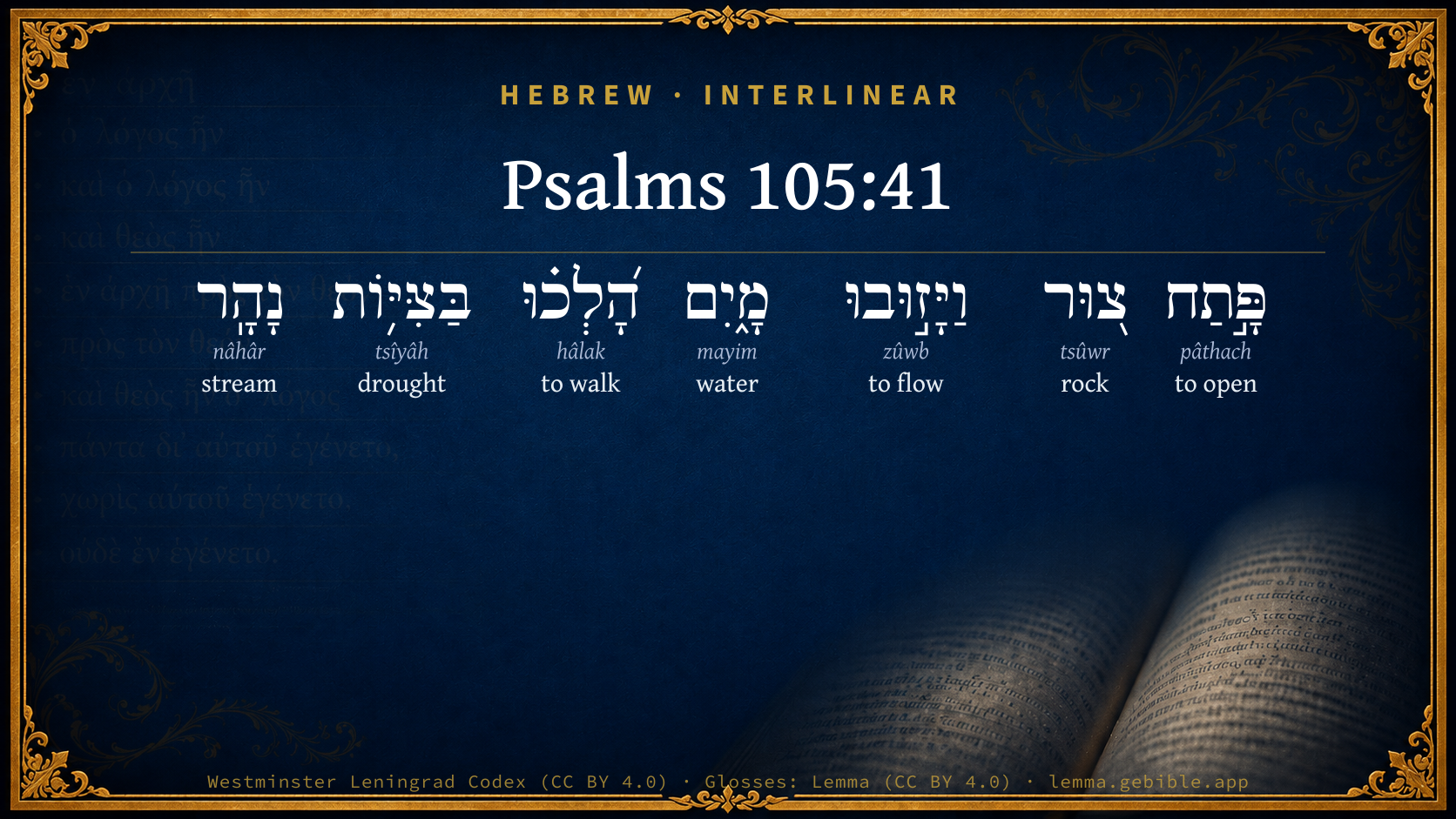
Hebrew (Westminster Leningrad Codex) Psalms 105:41 appears in the Hebrew Old Testament. The text above is from the Westminster Leningrad Codex. Each word links to its Strong’s number, a concise gloss, and parsing drawn from the Open Scriptures Hebrew Bible morphology. Click any word for its full Brown-Driver-Briggs (BDB) entry.
Download image
Cite this verse

Psalms 105:41 (World English Bible). Public Domain. Lemma interlinear Bible study tool, https://lemma.gebible.app/v/psalms/105/41.

Show BibTeX & RIS
BibTeX
RIS
English Translation
He opened the rock, and waters gushed out. They ran as a river in the dry places.
World English Bible · Public Domain
Download a study sheet

One document with this verse’s original text, its word-by-word gloss line, the meaning frame, cross-references with their text, attributed commentary, and full source and license credits — printable, and it pastes into notes with its structure intact.

This verse Autodidact and up

Study sheet (.html) Plain text (.txt)

A passage Seminary Student

Up to 50 verses in one chapter. A passage sheet keeps up to 6 commentary sources and 12 cross-references per verse, in the order this page ranks them, and says so on the sheet whenever that leaves anything out. Ask for a single verse and you get the Autodidact verse sheet above.

Everything on this page stays free to read, with no account — the sheet is a download of what is already on screen, not access to it.

Want to remove ads? Support Godless Engineer
Compare translations 3

The same verse in 3 English versions, stacked beneath the original-language interlinear above. Click any original word for its lexicon entry.

Each is an independent rendering of the whole verse — the interlinear is not word-aligned to these translations.

Highlighted words mark where these versions differ — a whole-verse word diff, not a word-by-word alignment.

  • World English Bible Public Domain
    He opened the rock, and waters gushed out. They ran as a river in the dry places.
  • King James Version Public Domain
    He opened the rock, and the waters gushed out; they ran in the dry places like a river.
  • unfoldingWord Literal Text CC BY-SA 4.0
    He split the rock and waters gushed out; they went forth in the desert a river.

unfoldingWord Literal Text — © unfoldingWord, licensed CC BY-SA 4.0. Word-aligned USFM3 via Door43 (git.door43.org/unfoldingWord/en_ult).

Versions to compare (up to 4)

3 of 4 selected

Show all 18 translations

Every available English version of this verse, each an independent rendering of the whole verse.

  • World English Bible Public Domain
    He opened the rock, and waters gushed out. They ran as a river in the dry places.
  • Berean Standard Bible Public Domain
    He opened a rock, and water gushed out; it flowed like a river in the desert.
  • Majority Standard Bible Public Domain
    He opened a rock, and water gushed out; it flowed like a river in the desert.
  • King James Version Public Domain
    He opened the rock, and the waters gushed out; they ran in the dry places like a river.
  • American Standard Version (1901) Public Domain
    He opened the rock, and waters gushed out; They ran in the dry places `like' a river.
  • Revised Version (1885) Public Domain
    He opened the rock, and waters gushed out; they ran in the dry places like a river.
  • Geneva Bible (1599) Public Domain
    He opened the rocke, and the waters flowed out, and ranne in the drye places like a riuer.
  • Douay-Rheims (1899) Public Domain
    He opened the rock, and waters flowed: rivers ran down in the dry land.
  • Young's Literal Translation Public Domain
    He hath opened a rock, and waters issue, They have gone on in dry places -- a river.
  • Literal Standard Version CC BY-SA 4.0
    He has opened a rock, and waters flow, || They have gone on in dry places—a river.
  • Unlocked Literal Bible CC BY-SA 4.0
    He split the rock, and waters gushed from it; they flowed in the wilderness like a river.
  • unfoldingWord Literal Text CC BY-SA 4.0
    He split the rock and waters gushed out; they went forth in the desert a river.
  • Darby Bible Public Domain
    He opened the rock, and waters gushed forth; they ran in the dry places [like] a river.
  • World Messianic Bible Public Domain
    He opened the rock, and waters gushed out. They ran as a river in the dry places.
  • Webster's Bible Public Domain
    He opened the rock, and the waters gushed out; they ran in the dry places like a river.
  • Free Bible Version CC BY-SA 4.0
    He split the rock open, and water gushed out—a river flowing through the desert.
  • Bible in Basic English Public Domain
    His hand made the rock open, and the waters came streaming out; they went down through the dry places like a river.
  • JPS Tanakh (1917) Public Domain
    He opened the rock, and waters gushed out; they ran, a river in the dry places.

Literal Standard Version (2020), Covenant Press — licensed CC BY-SA 4.0. Text via the HelloAO Bible API (eBible.org). Unlocked Literal Bible (unfoldingWord) — licensed CC BY-SA 4.0. Text via the HelloAO Bible API (eBible.org). unfoldingWord Literal Text — © unfoldingWord, licensed CC BY-SA 4.0. Word-aligned USFM3 via Door43 (git.door43.org/unfoldingWord/en_ult). Free Bible Version, Dr. Jonathan Gallagher — licensed CC BY-SA 4.0. Text via the HelloAO Bible API (eBible.org).

Word by word

More ways to search: Search by grammar → Find every occurrence → Compare this word →

Practice this passage: Drill this verse → Learn its vocabulary →

About this verse

These counts appear in no published source. They are computed here, from the morphology-tagged text and Lemma’s own curated glosses. What Lemma adds →

7
words
7
distinct lemmas
Wisdom
section

Notable vocabulary

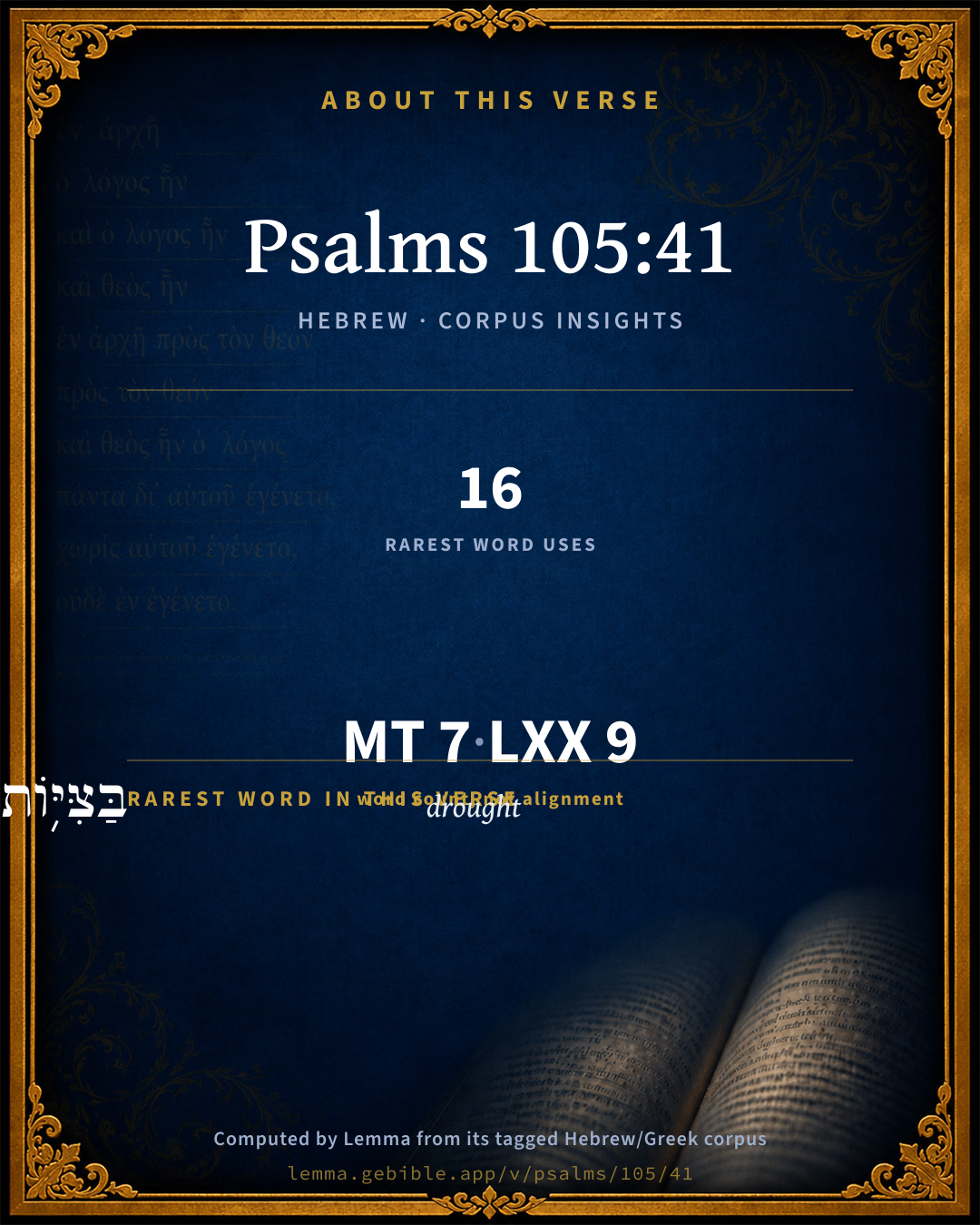
The rarest word here is בַּצִּיּ֥וֹת drought H6723 — appearing just 16 times in the whole Hebrew Bible.

Shared distinctive vocabulary

בַּצִּיּ֥וֹת drought H6723 occurs in 16 verses of the Hebrew Bible. Also found in:

Grammatical profile

  • 3 verbs
  • 4 nouns

Verb forms

  • פָּ֣תַח Qal · Perfect
  • וַיָּז֣וּבוּ Qal · Sequential Imperfect
  • הָ֝לְכ֗וּ Qal · Perfect

Hebrew & Septuagint length

In English translation the verse runs 17 words from the Hebrew and 13 from the Septuagint (LXX English) — closely comparable.

A rough comparison of the two English renderings, which tokenize alike — not a word-level alignment.

Word counts can differ between the Hebrew and the Greek without any difference in meaning — e.g. the Hebrew direct-object marker אֵת has no separate Greek word, and Greek often adds the article ὁ.

In the original languages it is 7 Hebrew tokens and 9 Greek tokens — but the two are counted differently (Hebrew bundles its prefixes and suffixes into one token; the Greek is in lemma form), so that isn’t a like-for-like length.

Cross-references

8

Topical passages linked to Psalms 105:41 in the Treasury of Scripture Knowledge — connected by theme and wording, ordered by reader-vote popularity; previews shown in the World English Bible.

  • Numbers 20:11 Moses lifted up his hand, and struck the rock with his rod twice: and water came forth abundantly, and the congregation drank, and their cattle.
  • 1 Corinthians 10:4 and all drank the same spiritual drink. For they drank of a spiritual rock that followed them, and the rock was Christ.
  • Exodus 17:6 Behold, I will stand before you there on the rock in Horeb. You shall strike the rock, and water will come out of it, that the people may drink." Moses did so in the sight of the elders of Israel.
  • Isaiah 48:21 They didn't thirst when he led them through the deserts; he caused the waters to flow out of the rock for them; he split the rock also, and the waters gushed out.
  • Psalms 78:15–16 He split rocks in the wilderness, And gave them drink abundantly as out of the depths.
  • Psalms 114:8 Who turned the rock into a pool of water, The flint into a spring of waters.
  • Psalms 78:20 Behold, he struck the rock, so that waters gushed out, Streams overflowed. Can he give bread also? Will he provide flesh for his people?"
  • Nehemiah 9:15 and gave them bread from the sky for their hunger, and brought forth water for them out of the rock for their thirst, and commanded those who they should go in to possess the land which you had sworn to give them.

Cross-references courtesy of OpenBible.info (CC BY 4.0).

Hebrew and Greek witnesses Masoretic Hebrew ↔ Greek Septuagint

The same verse in the two great witnesses to the Old Testament, shown verse-for-verse.

You’re reading Greek Psalm 104 (Hebrew Psalm 105). The Septuagint counts the superscription, so verse numbers can differ from the Hebrew — chapter-level alignment, not verse-by-verse. Numbering follows Rahlfs.

These are two independent witnesses, not word-aligned to each other, and the Septuagint is shown in lemma (dictionary) form.

Hebrew Psalms 105:41 Masoretic · Westminster Leningrad Codex

פָּ֣תַח צ֭וּר וַיָּז֣וּבוּ מָ֑יִם הָ֝לְכ֗וּ בַּצִּיּ֥וֹת נָהָֽר

He opened the rock, and waters gushed out. They ran as a river in the dry places.

World English Bible · Public Domain

Greek LXX Greek Psalm 104:41 Septuagint · lemma form

διαῥήγνυμι πέτρα καί ῥέω ὕδωρ πορεύομαι ἐν ἄνυδρος ποταμός

He clave the rock, and the waters flowed, rivers ran in dry places.

LXX2012 (modern English Septuagint) · Public Domain

Hebrew: Westminster Leningrad Codex (CC BY 4.0). Greek: Septuagint (public domain); English from LXX2012 (modern English Septuagint) (Public Domain). How the Septuagint differs from the Hebrew →

Commentary

Notes on Psalms 105:41 from classic Christian and Jewish commentators (each source and its license shown beneath its notes). The classic Christian expositions comment on the surrounding passage and are grouped to its opening verse, so a note may address several verses; the Jewish commentaries on the Tanakh (Rashi and others) are per-verse, so they appear only where the commentator wrote on this verse.

Lemma curates 59 commentaries, every one of them public domain or Creative Commons licensed, each selected and text-cleaned for this edition rather than reprinted as found. About our sources →

Trapp's Complete Commentary

John Trapp

Psa 105:41 He opened the rock, and the waters gushed out; they ran in the dry places [like] a river.

Ver. 41. He opened the rock] Set it abroach, giving them pluviam escatilem, et petram aquatilem, as Tertullian hath it.

They ran in the dry places] Per deserta Sinis et Tzinis, saith Junius. See 1Co 10:4.

John Trapp, A Commentary or Exposition upon All the Books of the Old and New Testament (1647–1656) — public domain. Text from a community e-Sword module.

The Biblical Illustrator

Joseph S. Exell

Psa_105:41

He opened the rock.

The rock at Horeb

I. The source whence the waters are said to have sprung. A rock is in many respects an appropriate emblem of Christ.

1. It suggests the ideas of stability and unchangeableness.

2. Chosen by God Himself.

3. Smitten.

II. The uses for which they were designed.

1. To save from death by thirst.

2. To purify.

3. To refresh.

Hungry and thirsty, we are told, their soul fainted in them. But the same waters that saved them from perishing, renewed their strength, and enabled them to prosecute their journeyings to Canaan with fresh vigour and alacrity. And is it not thus with the weary and heavy-laden traveller to Zion, when supplies from the Redeemers grace are afforded to his soul?

III. The manner in which the waters flowed from the opened rock.

1. Abundantly. So it is with the grace of Christ. It is exceeding abundant. Its efficacy to save, to purify, and to refresh our souls is inexhaustible.

2. Freely. So with the blood of Christ. It is open even to the vilest and guiltiest.

3. Constantly. No drought could exhaust nor cold arrest the waters which the Israelites enjoyed in the wilderness; so neither shall any worldly trial deprive the true Israel of the reviving streams of the Redeemers grace. Goodness and mercy shall surely follow the ransomed of the Lord through all their earthly pilgrimage. (P. Grant.)

.

Psa_106:1-48

The Biblical Illustrator, edited by Joseph S. Exell (c. 1880s–1900s) — public domain. Text from a community e-Sword module.

J. A. Alexander on Psalms

Joseph Addison Alexander

7. (Psa 105:41) He is Jehovah our God; in all the earth (are) his judgments. His covenant relations are with us the seed of Abraham; but the proofs of his existence and vindicatory justice are common to all nations. This whole introduction seems intended to dispose both Jews and Gentiles to the praise of God.

41. (Psa 105:41) He opened a rock and forth gushed waters; they ran in the wastes, a river. See above, on Psa 78:16; Psa 78:20. The word translated wastes means, according to its etymology, dry places.

Joseph Addison Alexander, The Psalms Translated and Explained (1850) — public domain. Text from a community e-Sword module.

Adam Clarke's Commentary

Verse 41. He opened the rock, and the waters rushed out] See Clarke on Ex 17:6, to which I can now add, that a piece of this rock, broken off by the hand of my nephew, E. S. A. Clarke, in the course of the present year [1822,] now lies before me. It is fine granite; and so well distinguished as a granite, that the feldt-spar, the mica, and the quartz, of which granite is composed, appear very distinctly. It is worthy of remark, that, as granite is supposed, in the most accredited systems of geology, to be the very basis of the earth, the original rock, and all other substances to be superimpositions upon it, and as the decompositions of the feldt-spar produce pure vegetable earth, this rock should be used for this purpose, and should be an emblem of Jesus Christ, the Creator and Redeemer of the human race; and that it should signify him who is the basis of all things; who upholds all by the word of his power; without whom nothing is stable, nothing fruitful; from whom alone the water of life proceeds; and in whose name only is salvation. And that rock (in the wilderness) was Christ! and it is the only remaining emblem of him in creation.

Adam Clarke's Commentary on the Bible (1810–1826) — public domain. Text from a community e-Sword/MySword module.

Ellicott's Commentary for English Readers

(41) Rock.—The Hebrew tsûr refers us to the miracle at Horeb.

A Bible Commentary for English Readers, edited by Charles John Ellicott (1878–1897) — public domain. Text from a community e-Sword module.

The Cambridge Bible for Schools and Colleges

gen. ed. J. J. S. Perowne

41. the rock] In Rephidim, Exo_17:1 ff. A different word (‘cliff’) is used in Num_20:8 ff. The language is borrowed from Psa_78:15-16; Psa_78:20 : cp. Isa_41:18; Isa_48:21.

The Cambridge Bible for Schools and Colleges (gen. ed. J. J. S. Perowne; Cambridge University Press, 1878–1918) — public domain. Text from a community e-Sword module.

John Gill's Exposition

For he remembered his holy promise,.... It was not owing to the goodness of this people, to their obedience to the divine will, to any worthiness or merit of theirs, that such signs and wonders were wrought for them in Egypt; and that they were brought out from thence in such a manner as they were; and were protected and so plentifully provided for in the wilderness; but it was owing to the grace and goodness of God, to his covenant and promise, which he sacredly and inviolably observed; the grace and covenant of God are the source and spring of all blessings of goodness; he is ever mindful of his covenant, and therefore sends meat to them that fear him, as he did to the Israelites, Psa 111:5.

And Abraham his servant; or the promise he made to Abraham his servant; so the Targum,

"which "was" with Abraham his servant;''

that is, which holy word or promise was with Abraham, was spoken to him; and was with him, that he would give him and his seed the land of Canaan; and that though they should be afflicted long in Egypt, yet should come out from thence with great substance, Gen 15:13, this he remembered, as he never forgets any promise of his, nor ever suffers his faithfulness to fail, nor his covenant to be broken. Hence it follows,

John Gill's Exposition of the Whole Bible (1746–1763) — public domain (CC PDM 1.0). Text via the HelloAO Bible API.

Albert Barnes' Notes on the Bible

He opened the rock ... - See the notes at Psa 78:15. “They ran in the dry places like a river.” Or, “a river.” They flowed along in the desert - a river of waters. See the notes at 1Co 10:4.

Albert Barnes' Notes on the Bible (1834–1885) — public domain. Text from a community e-Sword/MySword module.

Matthew Poole's English Annotations

They flowed in channels which God provided for them, and followed the Israelite’s in their march, as is noted, 1Co 10:4. Hence they complained no more of want of water till they came to Kadesh, Num 20, which was many years after this time.

Matthew Poole's English Annotations on the Holy Bible (1683–1685) — public domain. Text from a community e-Sword/MySword module.

The Treasury of David

Charles H. Spurgeon

Ver. 41. He opened the rock, and the waters gushed out. With Moses' rod and his own word he cleft the rock in the desert, and forth leaped abundant floods for their drinking where they had feared to die of thirst. From most unlikely sources the all sufficient God can supply his people's needs; hard rocks become springing fountains at the Lord's command.

They ran in the dry places like a river: so that those at a distance from the rock could stoop down and refresh themselves, and the stream flowed on, so that in future journeyings they were supplied. The desert sand would naturally swallow up the streams, and yet it did not so, the refreshing river ran "in the dry places." We know that the rock set forth our Lord Jesus Christ, from whom there flows a fountain of living waters which shall never be exhausted till the last pilgrim has crossed the Jordan and entered Canaan.

Ver. 41. We have,

1. A type of the person of Christ, in the rock.

(a) Unsightly as Horeb"When we shall see him, there

is no beauty, "etc. (Isa 43:2).

(b) Firm and immovable "Who is a rock, save our God?"

(2Sa 22:32).

2. A type of the sufferings of Christ, in the smitten rock.

(a) Smitten by the rod of the Law.

(b) Smitten to the heart.

3. A type of the benefits of Christ, in the water flowing from the rockpure, refreshing, perpetual, abundant. James Bennett, 1828.

Ver. 41.

1. The miraculous energy of God's grace in the conversion of a sinner: "He opened the rock, and the waters gushed out."

2. The effect in relation to others, which demonstrates at once the excellence and the reality of the miracle in ourselves: "They ran in the dry places like a river." Thomas Dale, 1836.

Ver. 41.

1. The grand sourcethe rock opened.

2. The liberal stream"gushed out".

3. The continued flow"in dry places".

Psalms 105:42*

Charles H. Spurgeon's The Treasury of David (1869–1885) — public domain. Psalms only. Text from a community e-Sword/MySword module.

Whedon's Commentary on the Bible

Daniel D. Whedon

41. The rock—The reference is particularly to Horeb, Exo_17:6. See note on Psa_78:16

Daniel D. Whedon (gen. ed.), Commentary on the Old and New Testaments (1874–1909) — public domain. Text from a community e-Sword module.

The Pulpit Commentary

He opened the rock, and the waters gushed out. (see Exo_17:5, Exo_17:6, and Num_20:8-11) They ran in the dry places like a river. A poetical exaggeration of Num_20:11, "The water came out abundantly, and the congregation drank, and their beasts also."

The Pulpit Commentary (1880–1919), ed. H.D.M. Spence-Jones & Joseph S. Exell — public domain. Text from a community e-Sword module.

John Wesley's Explanatory Notes

River - They flowed in channels which God provided for them, and followed the Israelites in their march.

John Wesley, Explanatory Notes Upon the Whole Bible (1754–1765) — public domain. Text via the GEBible commentary corpus.

Rashi

Rabbi Shlomo Yitzchaki (Rashi)

in the deserts ran rivers Rivers flowed from the well in an arid land.

Rashi on the Tanakh — English translations: “The Judaica Press complete Tanach with Rashi, translated by A. J. Rosenberg” (CC BY 4.0); “Pentateuch with Rashi's commentary by M. Rosenbaum and A.M. Silbermann, 1929-1934” (public domain); “The Metsudah Tanach series, Lakewood, N.J” (CC BY 4.0); and “The Book of Joshua, Metsudah Publications, 1997” (CC BY 4.0). Text via Sefaria.

Lesson kit

Teaching starters — assembled from the data on this page, not authored interpretation. Every prompt links to the verse data it draws on. Edit before teaching.

Psalms, in the Wisdom, opens this verse with 7 words (7 distinct Hebrew lemmas). Its most distinctive word is tsîyâh (“drought”). A historical commentator’s framing appears above. Read the whole chapter for the surrounding context.

Discussion questions

  1. What does “drought” (tsîyâh) contribute to the verse as a whole?
  2. How does Job 24:19, which shares the word «drought», read alongside this verse?
  3. The translations on this page render this verse differently — a whole-verse word diff, not a word-by-word alignment. What might account for the different wordings?
  4. «פָּ֣תַח» is a Qal Perfect verb. How does that grammatical form shape the action described?
  5. Compare how Trapp's Complete Commentary and The Biblical Illustrator read this verse. Where do they agree or differ?

Things to notice

Reading settings

Reading text

Shown beneath each verse's original-language words.

Old Testament
Old Testament edition

Read the OT as the Masoretic Hebrew (MT) or the Greek Septuagint (LXX).

English shown for the Greek Septuagint (in the Hebrew ↔ Greek comparison).

Comparing translations? Open the Compare panel on any verse page to stack up to four side by side.