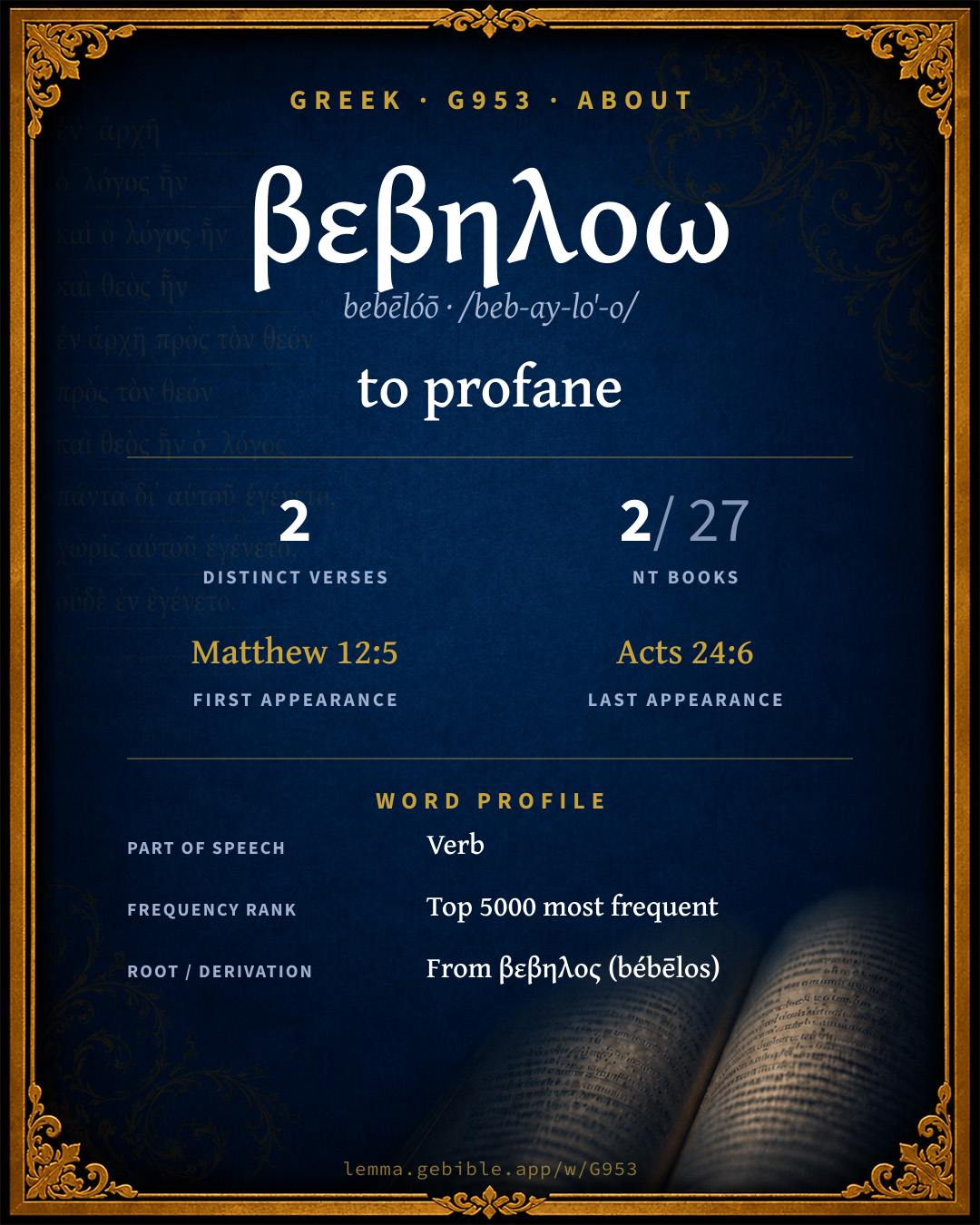
βεβηλόω
to profane
Full lexicon entry — Thayer's Greek Lexicon
From Thayer's Greek Lexicon
Where this word appears
See every Aorist-tense verb in the Greek New Testament →
Grammar key — what these labels mean
Part of speech
- Verb
- An action or state-of-being word.
Tense
- Aorist
- Action viewed as a simple whole, without regard to duration — often past (perfective aspect).
- Present
- Ongoing or general action in present time (imperfective aspect).
Voice
- Active
- The subject performs the action.
Mood
- Infinitive
- A verbal noun (“to write”), unmarked for person or number.
- Indicative
- States a fact or asks a factual question (the mood of reality).
Person
- 3rd person
- The one spoken about (“he / she / it / they”).
Number
- Plural
- More than one.
Grammatical forms
- Verb, Aorist, Active, Infinitive 1 time (50%)
- Verb, Present, Active, Indicative, 3rd person, Plural 1 time (50%)
Parsed forms decoded from the imported morphology (Robinson–Tischendorf, public domain), counted across 2 parsed occurrences — not distinct verses.
Every verse where G953 appears — 2 distinct verses across 2 books. Click any verse to open its interlinear word-by-word view. Verse text shown in the World English Bible for context — . Each verse’s Greek form is shown with its reference; the English is not keyword-highlighted, since the data carries no word-level English alignment. Use “Compare translations” on any verse to read it across multiple English versions. This concordance covers the Greek New Testament; Septuagint (Greek Old Testament) occurrences of this word are not indexed here.
Matthew 1 verse
Acts 1 verse
About this entry
At a glance — auto-summarized from this page’s data, not written by a person. Every figure links to its source below. This summary describes the numbers; it doesn’t interpret them.
At its core, βεβηλοω (bebēlóō) means “to profane.” A scarce word — 2 verses in all of the Greek New Testament. Its uses cluster heavily in Matthew (50% of all occurrences). Scripture first uses it in Matthew 12:5. Dig into 2-verse concordance and the renderings breakdown below.
Gloss history
Strong's 1890 vs modern scholarship
About this word
Strong's G953 catalogs a Greek word from the Greek New Testament.
These counts are not copied from any lexicon or concordance. They are computed here, from the morphology-tagged Greek New Testament. What Lemma adds →
- 2
- distinct verses
- The word appears in 2 distinct verses.
- 2 / 27
- NT books
- The word appears in 2 of 27 New Testament books.
- #2,678
- by frequency
- Top 5000 most frequent Greek words (rank 2,678 of 5,347 Greek words by occurrence).
View all 2 occurrences in the concordance →
By traditional corpus
Conventional, traditional groupings — biblical authorship is debated, so this is a traditional corpus grouping, not an authorship claim. Some books belong to more than one corpus (Luke is in both the Gospels and the Lukan corpus, and so on), so these shares overlap and need not total 100%. Each figure is a share of the word’s 2 distinct verses.
- Gospels 1 verse · 50%
- Lukan (Luke–Acts) 1 verse · 50%
How translations render this word
Counts come from each version’s own published word-to-Strong’s tagging or interlinear alignment — an approximate guide to how each version renders this word, not a word-level alignment the data otherwise carries. Because each total is that version’s own tagged count, the per-version totals vary from one another and need not match the appearance or distinct-verse counts above. These counts may also differ from a printed concordance because Lemma counts each distinctly tagged rendering and does not collapse phrase taggings into a single head-word total. This is a fixed set of word-tagged versions (KJV, ASV, BSB, ULT) and does not change with the reading translation you choose elsewhere. Each version’s license is shown beside its name below (and on Sources).
- King James Version: Profane 2×
- American Standard Version: Profane 2×
- Berean Standard Bible: Break 1×, Desecrate 1×
- unfoldingWord Literal Text: Desecrate 1×, Profane 1×
King James Version Public Domain
Renders G953 across 2 tagged occurrences — most commonly:
American Standard Version Public Domain
Renders G953 across 2 tagged occurrences — most commonly:
Berean Standard Bible Public Domain
Renders G953 across 2 tagged occurrences — most commonly:
unfoldingWord Literal Text CC BY-SA 4.0
Renders G953 across 2 tagged occurrences — most commonly:
Senses in Thayer's
The 1 sense Thayer's distinguishes for this word, in lexicon order (not ranked by frequency or importance). The full entry — with sub-senses — is in the Lexicon Entry tab.
- to profane, desecrate
Word origin
Derived from βεβηλος (bébēlos) (G952) — profane.
From G952 ; to desecrate : - profane.
— Strong’s Exhaustive Concordance (1890), public domain.
Forms in the corpus
The 2 distinct written forms G953 takes in the Greek New Testament, most frequent first — each parse links to that tense’s occurrences in the concordance.
| Form | Parsing | Example | Uses |
|---|---|---|---|
| βεβηλοῦσιν bebēloûsin | Verb, Present, Active, Indicative, 3rd person, Plural | Matthew 12:5 | 1 |
| βεβηλῶσαι bebēlō̂sai | Verb, Aorist, Active, Infinitive | Acts 24:6 | 1 |
Septuagint usage
The same Greek word βεβηλοω appears 69 times in the Greek Old Testament (Septuagint), across 66 verses in 12 books.
- 69
- LXX occurrences
- Tagged occurrences of this Greek word in the Septuagint.
- 66
- verses
- Distinct Septuagint verses containing this word.
- 12 / 39
- OT books
- The word appears in 12 of the 39 Old Testament books.
Sample Septuagint occurrences
- Exodus 31:14 βεβηλόω
- Leviticus 18:21 βεβηλόω
- Numbers 18:32 βεβηλόω
- Ezra 23:17 βεβηλόω
- Psalms 9:26 βεβηλόω
- Isaiah 48:11 βεβηλόω
- Jeremiah 16:18 βεβηλόω
- Lamentations 2:2 βεβηλόω
- Ezekiel 7:21 βεβηλόω
- Amos 2:7 βεβηλόω
- Zephaniah 3:4 βεβηλόω
- Malachi 1:12 βεβηλόω
Septuagint occurrences (same lexeme)
Every verse where the same Strong’s number (G953) appears in the Greek Septuagint — showing the first 50 of 66. Verse text shown in the World English Bible for context; the Greek form is the matched word — the English is not keyword-highlighted.
- Exodus 31:14 βεβηλόω You shall keep the Sabbath therefore; for it is holy to you. Everyone who profanes it shall surely be put to death; for whoever does any work therein, that soul shall be cut off from among his people.
- Leviticus 18:21 βεβηλόω "'You shall not give any of your children to sacrifice to Molech; neither shall you profane the name of your God: I am Yahweh.
- Leviticus 19:8 βεβηλόω but everyone who eats it shall bear his iniquity, because he has profaned the holy thing of Yahweh, and that soul shall be cut off from his people.
- Leviticus 19:12 βεβηλόω "'You shall not swear by my name falsely, and profane the name of your God. I am Yahweh.
- Leviticus 19:29 βεβηλόω Don't profane your daughter, to make her a prostitute; lest the land fall to prostitution, and the land become full of wickedness.
- Leviticus 20:3 βεβηλόω I also will set my face against that person, and will cut him off from among his people because he has given of his seed to Molech, to defile my sanctuary, and to profane my holy name.
- Leviticus 21:6 βεβηλόω They shall be holy to their God, and not profane the name of their God; for they offer the offerings of Yahweh made by fire, the bread of their God; therefore they shall be holy.
- Leviticus 21:7 βεβηλόω "'They shall not marry a woman who is a prostitute, or profane; neither shall they marry a woman divorced from her husband: for he is holy to his God.
- Leviticus 21:9 βεβηλόω "'The daughter of any priest, if she profanes herself by playing the prostitute, she profanes her father: she shall be burned with fire.
- Leviticus 21:12 βεβηλόω neither shall he go out of the sanctuary, nor profane the sanctuary of his God; for the crown of the anointing oil of his God is upon him. I am Yahweh.
- Leviticus 21:14 βεβηλόω A widow, or one divorced, or a woman who has been defiled, or a prostitute, these he shall not marry: but a virgin of his own people shall he take as a wife.
- Leviticus 21:15 βεβηλόω He shall not profane his seed among his people: for I am Yahweh who sanctifies him.'"
- Leviticus 21:23 βεβηλόω He shall not come near to the veil, nor come near to the altar, because he has a blemish; that he may not profane my sanctuaries, for I am Yahweh who sanctifies them.'"
- Leviticus 22:2 βεβηλόω "Tell Aaron and his sons to separate themselves from the holy things of the children of Israel, which they make holy to me, and that they not profane my holy name. I am Yahweh.
- Leviticus 22:9 βεβηλόω "'They shall therefore keep my charge, lest they bear sin for it, and die therein, if they profane it. I am Yahweh who sanctifies them.
- Leviticus 22:15 βεβηλόω The priests shall not profane the holy things of the children of Israel, which they offer to Yahweh,
- Leviticus 22:32 βεβηλόω You shall not profane my holy name, but I will be made holy among the children of Israel. I am Yahweh who makes you holy,
- Numbers 18:32 βεβηλόω You shall bear no sin by reason of it, when you have heaved from it the best of it: and you shall not profane the holy things of the children of Israel, that you not die.
- Numbers 25:1 βεβηλόω Israel abode in Shittim; and the people began to play the prostitute with the daughters of Moab:
- Numbers 30:3 βεβηλόω Also when a woman vows a vow to Yahweh, and binds herself by a bond, being in her father's house, in her youth,
- Ezra 23:17 βεβηλόω
- Ezra 23:18 βεβηλόω
- Psalms 9:26 βεβηλόω
- Psalms 54:21 βεβηλόω
- Psalms 73:7 βεβηλόω Their eyes bulge with fat. Their minds pass the limits of conceit.
- Psalms 88:32 βεβηλόω
- Psalms 88:35 βεβηλόω
- Psalms 88:40 βεβηλόω
- Isaiah 48:11 βεβηλόω For my own sake, for my own sake, will I do it; for how should [my name] be profaned? and my glory I will not give to another.
- Isaiah 56:2 βεβηλόω Blessed is the man who does this, and the son of man who holds it fast; who keeps the Sabbath from profaning it, and keeps his hand from doing any evil.
- Isaiah 56:6 βεβηλόω Also the foreigners who join themselves to Yahweh, to minister to him, and to love the name of Yahweh, to be his servants, everyone who keeps the Sabbath from profaning it, and holds fast my covenant;
- Jeremiah 16:18 βεβηλόω First I will recompense their iniquity and their sin double, because they have polluted my land with the carcasses of their detestable things, and have filled my inheritance with their abominations.
- Jeremiah 41:16 βεβηλόω Then took Johanan the son of Kareah, and all the captains of the forces who were with him, all the remnant of the people whom he had recovered from Ishmael the son of Nethaniah, from Mizpah, after that he had killed Gedaliah the son of Ahikam, [to wit], the men of war, and the women, and the children, and the eunuchs, whom he had brought back from Gibeon:
- Lamentations 2:2 βεβηλόω The Lord has swallowed up all the habitations of Jacob, and has not pitied: He has thrown down in his wrath the strongholds of the daughter of Judah; He has brought them down to the ground; he has profaned the kingdom and the princes of it.
- Ezekiel 7:21 βεβηλόω I will give it into the hands of the strangers for a prey, and to the wicked of the earth for a spoil; and they shall profane it.
- Ezekiel 7:22 βεβηλόω My face will I turn also from them, and they shall profane my secret [place]; and robbers shall enter into it, and profane it.
- Ezekiel 13:19 βεβηλόω You have profaned me among my people for handfuls of barley and for pieces of bread, to kill the souls who should not die, and to save the souls alive who should not live, by your lying to my people who listen to lies.
- Ezekiel 20:9 βεβηλόω But I worked for my name's sake, that it should not be profaned in the sight of the nations, among which they were, in whose sight I made myself known to them, in bringing them forth out of the land of Egypt.
- Ezekiel 20:13 βεβηλόω But the house of Israel rebelled against me in the wilderness: they didn't walk in my statutes, and they rejected my ordinances, which if a man keep, he shall live in them; and my Sabbaths they greatly profaned. Then I said I would pour out my wrath on them in the wilderness, to consume them.
- Ezekiel 20:14 βεβηλόω But I worked for my name's sake, that it should not be profaned in the sight of the nations, in whose sight I brought them out.
- Ezekiel 20:16 βεβηλόω because they rejected my ordinances, and didn't walk in my statutes, and profaned my Sabbaths: for their heart went after their idols.
- Ezekiel 20:21 βεβηλόω But the children rebelled against me; they didn't walk in my statutes, neither kept my ordinances to do them, which if a man do, he shall live in them; they profaned my Sabbaths. Then I said I would pour out my wrath on them, to accomplish my anger against them in the wilderness.
- Ezekiel 20:22 βεβηλόω Nevertheless I withdrew my hand, and worked for my name's sake, that it should not be profaned in the sight of the nations, in whose sight I brought them forth.
- Ezekiel 20:24 βεβηλόω because they had not executed my ordinances, but had rejected my statutes, and had profaned my Sabbaths, and their eyes were after their fathers' idols.
- Ezekiel 20:39 βεβηλόω As for you, house of Israel, thus says the Lord Yahweh: Go you, serve everyone his idols, and hereafter also, if you will not listen to me; but my holy name shall you no more profane with your gifts, and with your idols.
- Ezekiel 20:44 βεβηλόω You shall know that I am Yahweh, when I have dealt with you for my name's sake, not according to your evil ways, nor according to your corrupt doings, you house of Israel, says the Lord Yahweh.
- Ezekiel 22:8 βεβηλόω You have despised my holy things, and have profaned my Sabbaths.
- Ezekiel 22:26 βεβηλόω Her priests have done violence to my law, and have profaned my holy things: they have made no distinction between the holy and the common, neither have they caused men to discern between the unclean and the clean, and have hid their eyes from my Sabbaths, and I am profaned among them.
- Ezekiel 23:38 βεβηλόω Moreover this they have done to me: they have defiled my sanctuary in the same day, and have profaned my Sabbaths.
- Ezekiel 23:39 βεβηλόω For when they had slain their children to their idols, then they came the same day into my sanctuary to profane it; and, behold, thus have they done in the midst of my house.
These are occurrences of the same Greek lexeme (G953) in the Septuagint — not a translation of any one Hebrew word. The store carries no word-level Hebrew↔Greek alignment, so no Hebrew original is asserted here. Counts come from the recovered LXX Strong's tagging — high-frequency vocabulary is well covered, while rare or late forms may be untagged — so they reflect tagged occurrences and may slightly undercount.