Malachi 1:12

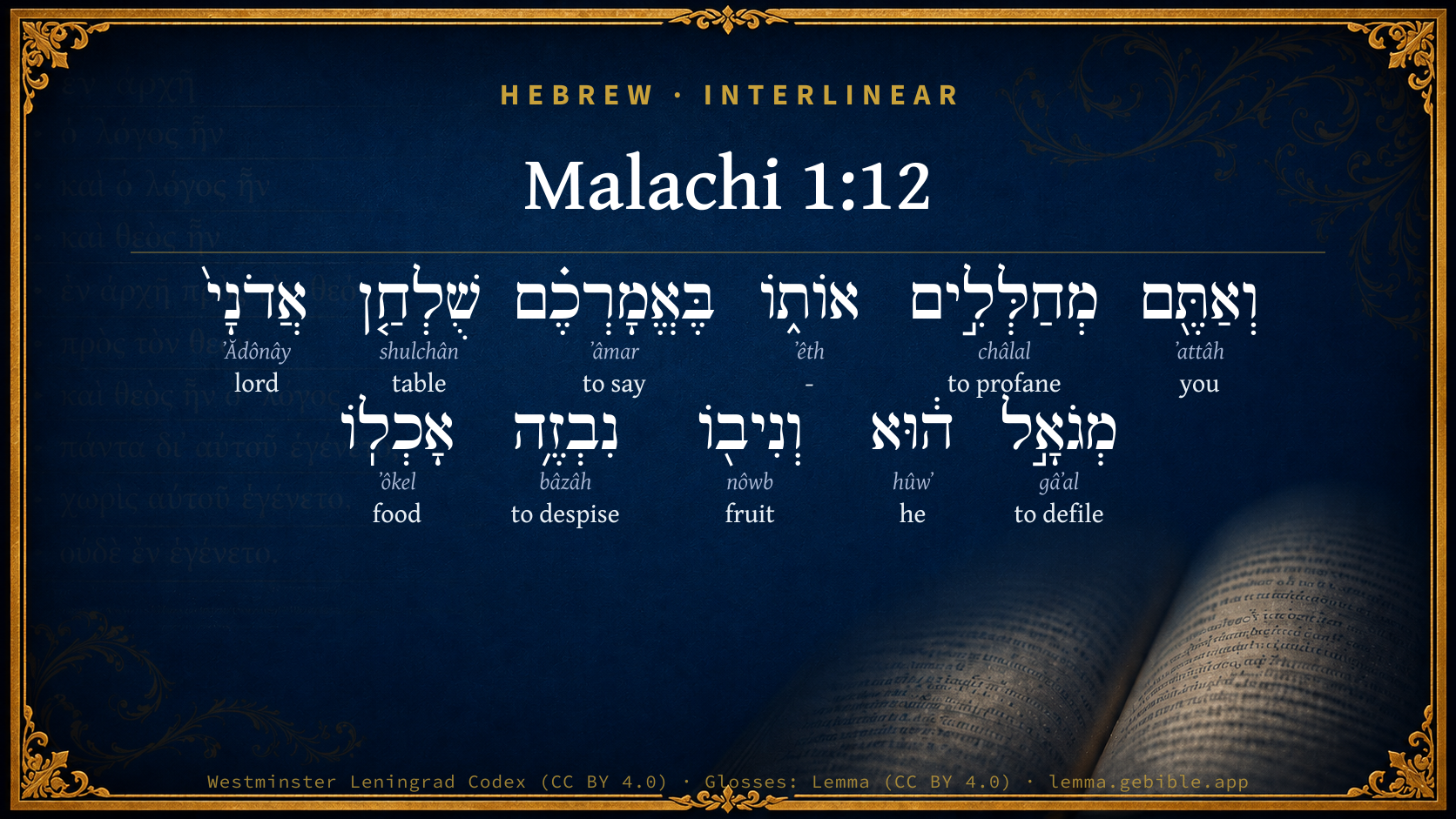
Hebrew (Westminster Leningrad Codex) Malachi 1:12 appears in the Hebrew Old Testament. The text above is from the Westminster Leningrad Codex. Each word links to its Strong’s number, a concise gloss, and parsing drawn from the Open Scriptures Hebrew Bible morphology. Click any word for its full Brown-Driver-Briggs (BDB) entry.
Download image
Cite this verse

Malachi 1:12 (World English Bible). Public Domain. Lemma interlinear Bible study tool, https://lemma.gebible.app/v/malachi/1/12.

Show BibTeX & RIS
BibTeX
RIS
English Translation
"But you profane it, in that you say, 'Yahweh's table is polluted, and its fruit, even its food, is contemptible.'
World English Bible · Public Domain
Download a study sheet

One document with this verse’s original text, its word-by-word gloss line, the meaning frame, cross-references with their text, attributed commentary, and full source and license credits — printable, and it pastes into notes with its structure intact.

This verse Autodidact and up

Study sheet (.html) Plain text (.txt)

A passage Seminary Student

Up to 50 verses in one chapter. A passage sheet keeps up to 6 commentary sources and 12 cross-references per verse, in the order this page ranks them, and says so on the sheet whenever that leaves anything out. Ask for a single verse and you get the Autodidact verse sheet above.

Everything on this page stays free to read, with no account — the sheet is a download of what is already on screen, not access to it.

Want to remove ads? Support Godless Engineer
Compare translations 3

The same verse in 3 English versions, stacked beneath the original-language interlinear above. Click any original word for its lexicon entry.

Each is an independent rendering of the whole verse — the interlinear is not word-aligned to these translations.

Highlighted words mark where these versions differ — a whole-verse word diff, not a word-by-word alignment.

  • World English Bible Public Domain
    "But you profane it, in that you say, 'Yahweh's table is polluted, and its fruit, even its food, is contemptible.'
  • King James Version Public Domain
    But ye have profaned it, in that ye say, The table of the LORD is polluted; and the fruit thereof, even his meat, is contemptible.
  • unfoldingWord Literal Text CC BY-SA 4.0
    “But you are profaning it in your saying, ‘The table of the Lord, it defiled, and its fruit, its food, is despised.’

unfoldingWord Literal Text — © unfoldingWord, licensed CC BY-SA 4.0. Word-aligned USFM3 via Door43 (git.door43.org/unfoldingWord/en_ult).

Versions to compare (up to 4)

3 of 4 selected

Show all 18 translations

Every available English version of this verse, each an independent rendering of the whole verse.

  • World English Bible Public Domain
    "But you profane it, in that you say, 'Yahweh's table is polluted, and its fruit, even its food, is contemptible.'
  • Berean Standard Bible Public Domain
    “But you profane it when you say, ‘The table of the Lord is defiled, and as for its fruit, its food is contemptible.’
  • Majority Standard Bible Public Domain
    “But you profane it when you say, ‘The table of the Lord is defiled, and as for its fruit, its food is contemptible.’
  • King James Version Public Domain
    But ye have profaned it, in that ye say, The table of the LORD is polluted; and the fruit thereof, even his meat, is contemptible.
  • American Standard Version (1901) Public Domain
    But ye profane it, in that ye say, The table of Jehovah is polluted, and the fruit thereof, even its food, is contemptible.
  • Revised Version (1885) Public Domain
    But ye profane it, in that ye say, The table of the LORD is polluted, and the fruit thereof, even his meat, is contemptible.
  • Geneva Bible (1599) Public Domain
    But ye haue polluted it, in that ye say, The table of the Lord is polluted and the fruit thereof, euen his meat is not to be regarded.
  • Douay-Rheims (1899) Public Domain
    And you have profaned it in that you say: The table of the Lord is defiled: and that which is laid thereupon is contemptible with the fire that devoureth it.
  • Young's Literal Translation Public Domain
    And ye are polluting it in your saying, `The table of Jehovah -- it is polluted, As to its fruit -- despicable is its food.'
  • Literal Standard Version CC BY-SA 4.0
    “And you are defiling it in your saying, || The table of YHWH—it is defiled, || As for its fruit—its food is despicable.
  • Unlocked Literal Bible CC BY-SA 4.0
    “But you are profaning it when you say the Lord's table is polluted, and that its fruit, its food, is to be despised.
  • unfoldingWord Literal Text CC BY-SA 4.0
    “But you are profaning it in your saying, ‘The table of the Lord, it defiled, and its fruit, its food, is despised.’
  • Darby Bible Public Domain
    But ye profane it, in that ye say, The table of the Lord is polluted; and the fruit thereof, his food, is contemptible.
  • World Messianic Bible Public Domain
    “But you profane it when you say, ‘The LORD’s table is polluted, and its fruit, even its food, is contemptible.’
  • Webster's Bible Public Domain
    But ye have profaned it, in that ye say, The table of the LORD is polluted; and the fruit of it, even his provision, is contemptible.
  • Free Bible Version CC BY-SA 4.0
    But you dishonor me when you say the Lord's table doesn't deserve respect, and that its food can be treated with contempt.
  • Bible in Basic English Public Domain
    But you make it unholy by saying, The Lord's table has become unclean, and his food is of no value.
  • JPS Tanakh (1917) Public Domain
    But ye profane it, in that ye say: 'The table of the LORD is polluted, and the fruit thereof, even the food thereof, is contemptible.'

Literal Standard Version (2020), Covenant Press — licensed CC BY-SA 4.0. Text via the HelloAO Bible API (eBible.org). Unlocked Literal Bible (unfoldingWord) — licensed CC BY-SA 4.0. Text via the HelloAO Bible API (eBible.org). unfoldingWord Literal Text — © unfoldingWord, licensed CC BY-SA 4.0. Word-aligned USFM3 via Door43 (git.door43.org/unfoldingWord/en_ult). Free Bible Version, Dr. Jonathan Gallagher — licensed CC BY-SA 4.0. Text via the HelloAO Bible API (eBible.org).

Word by word

More ways to search: Search by grammar → Find every occurrence → Compare this word →

Practice this passage: Drill this verse → Learn its vocabulary →

וְנִיב֖וֹ
nôwb
H5108
“and · fruit · his”
Conjunction + Noun, Common, Masculine, Singular, Construct + Suffix, Personal, 3rd Person, Masculine, Singular
Part of Speech
Conjunction + Noun
Type
Common
Gender
Masculine
Number
Singular
State
Construct
Full BDB Definition

Origin: from H5107

TWOT: 1318a , 1318b

fruit
  1. וְאַתֶּ֖ם ʼattâh H859 “and · you” Conjunction + Pronoun, Personal, 2nd Person, Masculine, Plural
  2. מְחַלְּלִ֣ים châlal H2490 “profaning” Verb, Piel, Participle Active, Masculine, Plural, Absolute
  3. אוֹת֑וֹ ʼêth H853 “- · him” Particle, Direct Object + Suffix, Personal, 3rd Person, Masculine, Singular
  4. בֶּאֱמָרְכֶ֗ם ʼâmar H559 “in/at · to say · you” Preposition + Verb, Qal, Infinitive Construct + Suffix, Personal, 2nd Person, Masculine, Plural
  5. שֻׁלְחַ֤ן shulchân H7979 “table of” Noun, Common, Masculine, Singular, Construct
  6. אֲדֹנָי֙ ʼĂdônây H136 “Lord · my” Noun, Common, Masculine, Plural, Construct + Suffix, Personal, 1st Person, Common, Singular
  7. מְגֹאָ֣ל gâʼal H1351 “defiled” Verb, Pual, Participle Passive, Masculine, Singular, Absolute
  8. ה֔וּא hûwʼ H1931 “he” Pronoun, Personal, 3rd Person, Masculine, Singular
  9. נִבְזֶ֥ה bâzâh H959 “despising” Verb, Niphal, Participle Active, Masculine, Singular, Absolute
  10. אָכְלֽוֹ ʼôkel H400 “food · his” Noun, Common, Masculine, Singular, Construct + Suffix, Personal, 3rd Person, Masculine, Singular

About this verse

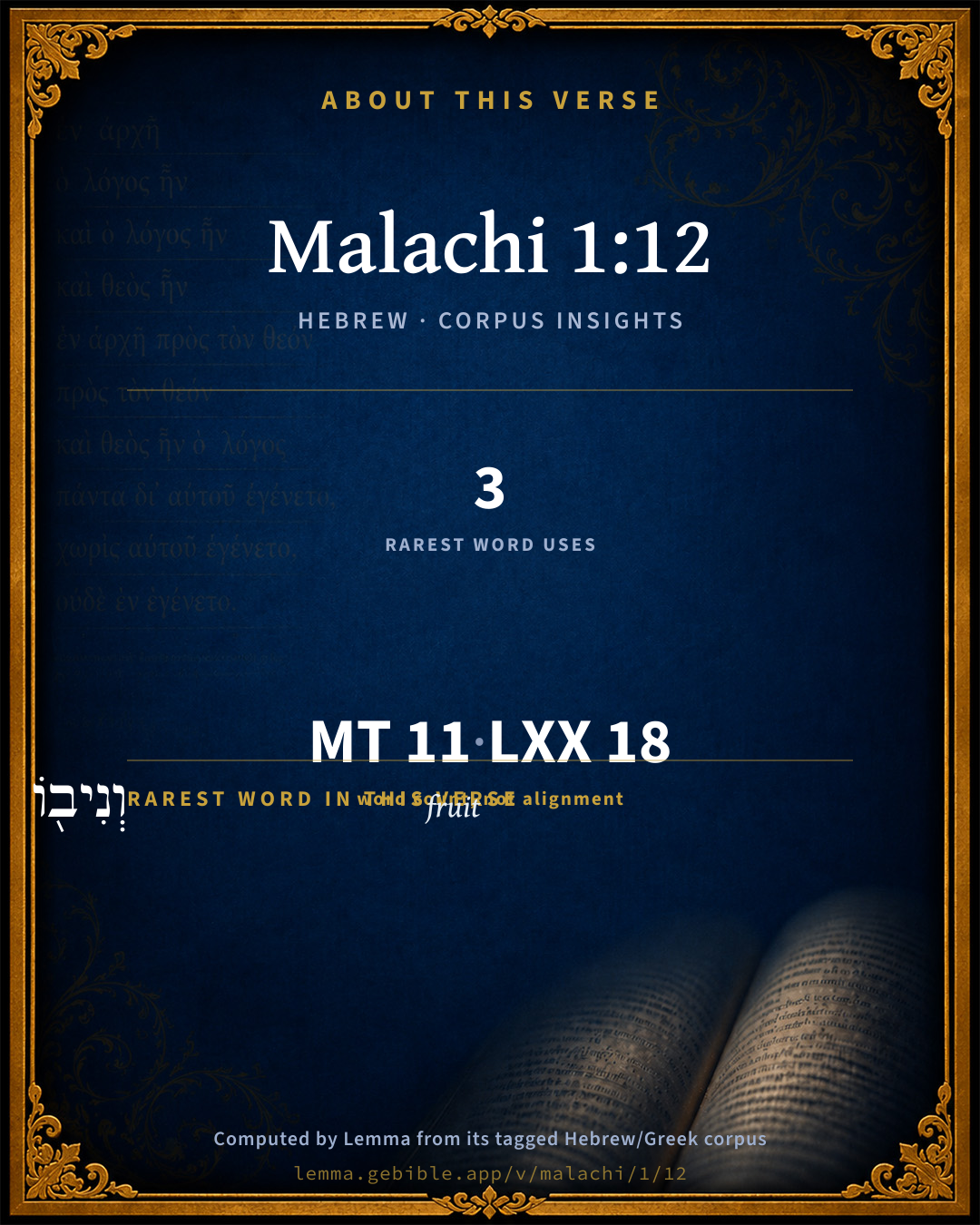
These counts appear in no published source. They are computed here, from the morphology-tagged text and Lemma’s own curated glosses. What Lemma adds →

11
words
11
distinct lemmas
Prophets
section

Notable vocabulary

The rarest word here is וְנִיב֖וֹ fruit H5108 — appearing just 3 times in the whole Hebrew Bible.

Shared distinctive vocabulary

וְנִיב֖וֹ fruit H5108 occurs in 2 verses of the Hebrew Bible. Also found in:

Grammatical profile

  • 4 verbs
  • 4 nouns
  • 2 pronouns
  • 1 particle

Verb forms

  • מְחַלְּלִ֣ים Piel · Participle Active
  • בֶּאֱמָרְכֶ֗ם Qal · Infinitive Construct
  • מְגֹאָ֣ל Pual · Participle Passive
  • נִבְזֶ֥ה Niphal · Participle Active

Hebrew & Septuagint length

In English translation the verse runs 20 words from the Hebrew and 22 from the Septuagint (LXX English) — closely comparable.

A rough comparison of the two English renderings, which tokenize alike — not a word-level alignment.

Word counts can differ between the Hebrew and the Greek without any difference in meaning — e.g. the Hebrew direct-object marker אֵת has no separate Greek word, and Greek often adds the article ὁ.

In the original languages it is 11 Hebrew tokens and 18 Greek tokens — but the two are counted differently (Hebrew bundles its prefixes and suffixes into one token; the Greek is in lemma form), so that isn’t a like-for-like length.

Cross-references

9

Topical passages linked to Malachi 1:12 in the Treasury of Scripture Knowledge — connected by theme and wording, ordered by reader-vote popularity; previews shown in the World English Bible.

  • Malachi 1:6–8 "A son honors his father, and a servant his master. If I am a father, then where is my honor? And if I am a master, where is the respect due me? Says Yahweh of Hosts to you, priests, who despise my name. You say, 'How have we despised your name?'
  • Numbers 11:4–8 The mixed multitude that was among them lusted exceedingly: and the children of Israel also wept again, and said, Who shall give us flesh to eat?
  • 2 Samuel 12:14 However, because by this deed you have given great occasion to Yahweh's enemies to blaspheme, the child also who is born to you shall surely die."
  • Ezekiel 36:21–23 But I had regard for my holy name, which the house of Israel had profaned among the nations, where they went.
  • Daniel 5:3–4 Then they brought the golden vessels that were taken out of the temple of the house of God which was at Jerusalem; and the king and his lords, his wives and his concubines, drank from them.
  • Amos 2:7 They trample on the dust of the earth on the head of the poor, And deny justice to the oppressed; And a man and his father use the same maiden, to profane my holy name;
  • Malachi 1:13 You say also, 'Behold, what a weariness it is!' and you have sniffed at it," says Yahweh of Hosts; "and you have brought that which was taken by violence, the lame, and the sick; thus you bring the offering. Should I accept this at your hand?" says Yahweh.
  • Malachi 2:8 But you have turned aside out of the way. You have caused many to stumble in the law. You have corrupted the covenant of Levi," says Yahweh of Hosts.
  • Romans 2:24 For "the name of God is blasphemed among the Gentiles because of you," just as it is written.

Cross-references courtesy of OpenBible.info (CC BY 4.0).

Hebrew and Greek witnesses Masoretic Hebrew ↔ Greek Septuagint

The same verse in the two great witnesses to the Old Testament, shown verse-for-verse.

These are two independent witnesses, not word-aligned to each other, and the Septuagint is shown in lemma (dictionary) form.

Hebrew Malachi 1:12 Masoretic · Westminster Leningrad Codex

וְאַתֶּ֖ם מְחַלְּלִ֣ים אוֹת֑וֹ בֶּאֱמָרְכֶ֗ם שֻׁלְחַ֤ן אֲדֹנָי֙ מְגֹאָ֣ל ה֔וּא וְנִיב֖וֹ נִבְזֶ֥ה אָכְלֽוֹ

"But you profane it, in that you say, 'Yahweh's table is polluted, and its fruit, even its food, is contemptible.'

World English Bible · Public Domain

Greek LXX Malachi 1:12 Septuagint · lemma form

σύ δέ βεβηλόω αὐτός ἐν ὁ λέγω σύ τράπεζα κύριος ἀλισγέω εἰμί καί ὁ ἐπιτίθημι ἐξουδενόω βρῶμα αὐτός

But you⌃ profane it, in that you⌃ say, The table of the Lord is polluted, and his meats set thereon are despised.

LXX2012 (modern English Septuagint) · Public Domain

On this verse, The Cambridge Bible for Schools and Colleges discusses the Septuagint’s reading. Read the note in Commentary ↓

Hebrew: Westminster Leningrad Codex (CC BY 4.0). Greek: Septuagint (public domain); English from LXX2012 (modern English Septuagint) (Public Domain). How the Septuagint differs from the Hebrew →

Targum (Aramaic paraphrase)

1

The Targum is the ancient Jewish Aramaic paraphrase of the Hebrew Scriptures — an interpretive translation, not the Hebrew text itself. Onkelos (literal) and Pseudo-Jonathan (expansive) render the Torah, and Jonathan the Prophets. Coverage is partial: where no permissively-licensed English translation exists for a verse, only the Aramaic is shown. This is verse-level text, not a word-by-word alignment to the Hebrew.

  1. Targum Jonathan Prophets (Joshua–Malachi)
    וְאַתּוּן מְחַלְלִין יָתֵיהּ בִּדְאַתּוּן אָמְרִין פְּתוֹרָא דַייָ בְּסִיר הוּא וּבְסִירָן מַתְּנָתָא מִנֵיהּ:

    (no public-domain English translation for this verse)

    Targum Jonathan — Aramaic: “Mikraot Gedolot” (public domain). English: “Sefaria Community Translation” (CC0 1.0 (public-domain dedication)); “London "Chaldee Paraphrase," 1871” (public domain). Text via Sefaria.

Commentary

Notes on Malachi 1:12 from classic Christian and Jewish commentators (each source and its license shown beneath its notes). The classic Christian expositions comment on the surrounding passage and are grouped to its opening verse, so a note may address several verses; the Jewish commentaries on the Tanakh (Rashi and others) are per-verse, so they appear only where the commentator wrote on this verse.

Lemma curates 59 commentaries, every one of them public domain or Creative Commons licensed, each selected and text-cleaned for this edition rather than reprinted as found. About our sources →

Trapp's Complete Commentary

John Trapp

Mal 1:12 But ye have profaned it, in that ye say, The table of the LORD [is] polluted; and the fruit thereof, [even] his meat, [is] contemptible.

Ver. 12. But ye have profaned it] Ye Jews, in general, though my peculiar people, and called by my name. You that quarter arms with me, as it were, and should, therefore, lift up my name as an ensign; that you should use me thus coarsely, and cast dirt upon my name by your irreligion, this moves me not a little; so that I cannot but once and again complain of it. Had it been an enemy I should better have borne it. But it was thou, my familiar, &c. What, thou, my son Brutus? Kαι συ τεκνον βρουτε. Friend, betrayest thou the Son of man, and that with a kiss? Scipio had rather Hannibal should eat his heart with salt, than Laelius, his friend, do him the least discourtesy. God will take that from a profane person that he will not take from a professor. Philistines may cart the ark, and escape scotfree; but if David does it, God will punish him in the death of Uzzah. Augustus Caesar may send forth a decree that all the (Roman) world should be taxed or numbered, Luk 2:1; but if David number his people God will make bloody welts upon his back; and if he make God’s name to stink among the heathen, God will scour out that blemish cast upon his name with David’s tears and blood. See Eze 36:21; Eze 39:7 Amo 2:7 Lev 10:3; I will be sanctified in all them that draw near unto me. Sanctified he will be, either actively or passively; either in the sincerity of their conversation or else in the severity of their condemnation. If Solomon forsake the Lord, that appeared unto him twice, God will chastise him with the rods of men, at least. If Israel profess God’s name, and yet profane it, God will cast them off, and turn to the Gentiles. And, indeed, what could he do less to a nation so incorrigibly flagitious, a nation so unthankful for mercies, so impatient of remedies, so incapable of repentance, so obliged, so warned, so shamelessly, so lawlessly wicked?

The table of the Lord] That is, the altar; see Mal 1:7.

And the fruit thereof] Or the revenue, the income of it: it is a base allowance that the priests have; prisoner’s pittance; they live, that is all. Or thus, The table of the Lord is polluted, &c. That is, it is no better worth than to be polluted; neither do his priests deserve either countenance or maintenance. So many wretched people in these days think there is more ado made than needs in the worship and service of God, Colo Deum, ut par est. Whereas, indeed, we that have received so many mercies, and have lived in such an age of miracles, should not only servire Deo, sed et adulari, as Tertullian phraseth it, serve God, but be unsatisfiable in serving him. And as God’s service is slighted, so his ministers are well nigh starved in many places; the common people holding the ministry no better than an idle, useless trade, taken up to make a living. How shamefully are God’s ablest servants defrauded, mocked, misused! A sad prognostic of a dying state, 2Ch 36:16.

John Trapp, A Commentary or Exposition upon All the Books of the Old and New Testament (1647–1656) — public domain. Text from a community e-Sword module.

Joseph Benson's Commentary

Mal 1:12-13. But ye — O priests, and the people, by your example; have profaned it — Namely, my great name. You have used it as a common thing, and as of no importance or consideration. In that ye say — Namely, by your deportment; The table of the Lord is polluted — Not a sacred thing, or a thing to be revered; and the fruit thereof, his meat, is contemptible — Either the meat which fell to the priests’ share, or the portion which was laid upon the altar. They were neither pleased with that which the Lord reserved for himself, nor with that which he gave to them, but they found fault with both; the latter, in particular, they termed contemptible, a poor, sordid allowance, scarce fit for meaner persons and less service. Ye said also — To the sins before mentioned, the priests chiefly, and the people with them, added this also, that they openly complained of God’s service. Behold what a weariness — What a toil and drudgery is it to observe every point of the law! Ye have complained of the constant attendance upon my altar as a wearisome employment. And ye have snuffed — Have expressed your disgust, at it. And ye have brought that which was torn — Ye have brought into the temple, for victims, that which had been torn by wild beasts, &c. It was forbidden even to eat in common that which had been torn, Exo 22:31, and therefore nothing could show higher contempt than to bring such things for offerings to God.

Joseph Benson's Commentary on the Old and New Testaments (1811–1818) — public domain. Text from a community e-Sword module.

Tyndale Open Study Notes

Tyndale Open Resources

1:12 Dishonor was an ongoing state of affairs. Ironically, the guardians of Israel’s covenant relationship with the Lord were habitually profaning his Temple with impure sacrifices.

Tyndale Open Study Notes — © Tyndale Open Resources, licensed CC BY-SA 4.0. Text via the HelloAO Bible API.

Geneva Bible (1599)

Geneva Bible translators

Both the Priests and the people were infected with this error, that they passed not what was offered: for they thought that God was as well content with the lean, as with the fat: but in the mean season they showed not that obedience to God, which he required, and so committed both impiety, and also showed their contempt of God, and covetousness.

Geneva Bible (1599) marginal notes — public domain. Text via Bolls.life.

Jamieson, Fausset & Brown

Robert Jamieson, A. R. Fausset & David Brown

Renewal of the charge in Mal 1:7.

fruit . . . meat--the offerings of the people. The "fruit" is the produce of the altar, on which the priests subsisted. They did not literally say, The Lord's table is contemptible; but their acts virtually said so. They did not act so as to lead the people to reverence, and to offer their best to the Lord on it. The people were poor, and put off God with the worst offerings. The priests let them do so, for fear of offending the people, and so losing all gains from them.

Jamieson, Fausset & Brown — Commentary Critical and Explanatory on the Whole Bible (1871) — public domain (CC PDM 1.0). Text via the HelloAO Bible API.

Adam Clarke's Commentary

Verse 12. Ye have profaned it] Ye have desecrated God's worship; is it any wonder that God should cast you off, and follow you with his judgments?

Adam Clarke's Commentary on the Bible (1810–1826) — public domain. Text from a community e-Sword/MySword module.

John Calvin's Commentaries

This verse may be confined to the priests, or it may be extended to the whole people; for both views are appropriate. As to my own view, I doubt not but that the Prophet here reproves with additional severity the priests, and that at the same time he extends his reproof to the people in general. We saw in our yesterday’s lecture how religion had been polluted by the priests, and how impiously they had profaned the worship of God: but this was the general sin of the whole people, as we shall presently see. Let us then know that the whole people, as well as the priests, are here reproved: but as a crime in the priests was more grievous, they being the occasion of sacrilege to others, the Prophet assails them in an especial manner, Ye, he says, have polluted my name

He gives a reason, and at the same time enhances their guilt: for they might have complained, that God not only put them on a level with the Gentiles, but also rejected them, and substituted aliens in their place. He shows that God had a just cause for disinheriting them, and for adopting the Gentiles as his children, for they had polluted God’s name. He at the same time amplifies their sin, when he says, “The Gentiles, by whom I have been hitherto despised, and to whom my name was not made known, will soon come to the faith; thus my name shall be great, it shall be reverently worshipped by all nations; but ye have polluted it.” It was certainly very strange, that the Jews, peculiarly chosen and illuminated by the doctrine of the Law, so presumptuously polluted God’s worship, as though they despised him, and that the Gentiles, being novices, rendered obedience to God as soon as they tasted of the truth of religion, so that his glory became through them illustrious.

He afterwards shows how the name of Gog was polluted, Ye say, The table of Jehovah is polluted; that is, ye distinguish not between what is sacred and profane: for he repeats what we noticed yesterday, — that the Jews thought it a frivolous matter, when the Prophets taught them that God was to be worshipped with all reverence. It is not however probable, that they openly uttered such a blasphemy as that the table of God was polluted; but it is easy to conclude from what is said, that God’s table was profaned by them, for they made no account of it. The holiness of the table ought to have been so regarded by the Jews, as not to approach the sanctuary without true repentance and faith; they ought to have known that they had to do with God, and that his majesty ought to have deeply touched them. When therefore they came to the temple, and brought with them their uncleanness like swine, it was quite evident that they had no reverence for the temple, or the altar, or the table. According to this sense then are the words of the Prophet to be understood, — not that the Jews openly mocked God, but that the holiness of the temple was with them of no account.

With regard to the Table, we stated yesterday, that when God ordered sacrifices to be offered to him, it was the same as though he familiarly dwelt among the Jews, and became as it were their companion. It was the highest honor and an instance of God’s ineffable goodness, that he thus condescended, so that the people might know that he was not to be sought afar off. And for this reason the less excusable was their impiety, as they did not consider that sacrifices were celebrated on earth, that their minds might be raised up above the heavens: for it is to this purpose that God descends to us, even to raise us above, as we have elsewhere stated. It was then an extremely base and shameful senselessness and stupidity in the Jews, that they did not consider that God’s table was set among them, that they might by faith penetrate into heaven, and know it to be even before their eyes.

As to the words, Its fruit is his contemptible food, we must observe, that some render, ניב, nib, word, and bring this passage from Isaiah, “I have created the fruit of the lips, peace, peace,” (Isaiah 57:19.) The verb, נוב, nub, means to fructify; hence, ניב, nib, is fruit or produce. Were we to grant that it is metaphorically taken for word, yet I see no reason why we should depart from its simple and real meaning. For first there will be a relative without an antecedent, ניבו, nibu, his word; and then there will be a change of number; for they apply it to the priests, his word, that is, the word of them — of whom? of the priests. It is common, I know, in Hebrew, to put a relative without an antecedent; but as I have said, nothing requires this here. The most suitable rendering then is, Its provision, that is, of the altar, is the contemptible food of God. I take then the words to mean this, that a speech of this kind was often in the mouth of the people as well as of the priests, — “Oh! the provision for the altar is any kind of meat; be not so anxious in your choice, so as to offer the best animals; for God is satisfied even with the lean and the maimed.”

And here again God reproves the impiety and contempt of the people; and at the same time he condemns their avarice, because they took the worst of their animals to offer in the temple, as though they lost everything they consecrated to God.

Why he calls the sacrifices the meat or food of God, we now sufficiently understand. Only this ought to be observed, that the impiety of the people was evident, as they were so unconcerned in their duties; for God had not in vain instituted sacrifices and other rites. The contempt then of the signs openly showed not only the negligence of the people, but also their contempt of all religion. Were any one at this day to regard as nothing outward teaching and the sacraments, would he not prove himself to be an impious despiser of God? Yet religion, I allow, does not consist in these things; for though hypocrites pretend the most ardent zeal, they yet profane the name of God, whenever the truth sounds in their ears and the heart is not touched, and when they come to the Lord’s table and are at the same time alienated from Christ. These things I allow; but as no true servant of God can despise these ordinances, which on account of our common infirmity are useful to us, and without which we cannot be as long as we sojourn in this world, whosoever derides our simplicity in frequenting God’s house, or if silent abstains from doing so, and regards such a practice as nothing or as unimportant, he is thus, as I have said, proved guilty of impiety. This is the reason why the Prophet so sharply reproves the Jews, because they said that the provision for the altar was God’s contemptible food. It follows —

John Calvin's Commentaries (1540-1563) — public domain. Text from the Calvin Translation Society English edition (1840s-50s) via the Christian Classics Ethereal Library (ccel.org). Calvin's coverage is partial (roughly two-thirds of the Bible); uncommented books and verses are honest gaps, never fabricated. The 19th-century editor's footnotes and remarks are omitted so the notes are faithfully Calvin's own voice.

Ellicott's Commentary for English Readers

(12) But ye have.—Better, but ye profane it—viz., “my name” (Mal_1:11). The word “it” is said by Jewish tradition to be an euphemism for “me.” The present contemptuous conduct of God’s priests is contrasted with the prophesied reverence of heathen nations.

Fruit . . . meat, denote the same as “bread” of Mal_1:7. They show that they think it contemptible by not taking the trouble to offer such things as are prescribed by the Law.

A Bible Commentary for English Readers, edited by Charles John Ellicott (1878–1897) — public domain. Text from a community e-Sword module.

The Cambridge Bible for Schools and Colleges

gen. ed. J. J. S. Perowne

12. have profaned] Rather, profane, R.V. lit. are (habitually) profaning.

the table of the Lord &c.] The reference is to the maintenance of the priests by their share in the sacrifices. After allowing unworthy sacrifices to be offered (Mal_1:8), they complained that their service at the altar was inadequately remunerated, and murmured at their allotted portion as “contemptible”. The expression, “the fruit thereof,” is very doubtful. The word occurs again (K’ri) Isa_57:19, but there the K’thibh is נוב. Probably it should be omitted here altogether. The mistake may have arisen from a scribe beginning to write וניב instead of ונבזה. Then he put dots over the first word וֹנֹיֹבֹ to denote that it was to be cancelled, but this was overlooked. Jerome explains it of the fire on the altar, taking also אכלו as a verb, ‘cum igne qui illud devorat,’ which of course is wrong. The LXX render it τὰ ἐπιτιθέμενα αὐτῷ.

The Cambridge Bible for Schools and Colleges (gen. ed. J. J. S. Perowne; Cambridge University Press, 1878–1918) — public domain. Text from a community e-Sword module.

John Gill's Exposition

But ye have profaned it,.... That is, the name of the Lord, which they are said to despise, Mal 1:6 and pollute, Mal 1:7 and is a reason why they and their offerings were rejected: and that they profaned the name of the Lord appears by this,

in that ye say, The table of the Lord is polluted: the same with "contemptible", Mal 1:7 as Kimchi observes; See Gill on Mal 1:7,

and the fruit thereof, even his meat is contemptible; the word for fruit (o) sometimes is used for speech, the fruit of the lips, Isa 57:19 and taken in this sense here, as it is by some, may be understood either of the word of God, which commanded such and such sacrifices to be offered up upon the altar, and was despised, so Abarbinel: or the word of the priests, who were continually saying that what was offered up on the altar was contemptible, even the food which they ate of; so Jarchi and Kimchi. "Fruit" and "meat" seem to signify one and the same thing, and design the fruit and meat of the altar; either that which belonged to the Lord, the fat and the blood, which were offered to him, and were reckoned contemptible; or that which fell to the share of the priests, which they thought mean and worthless. Cocceius interprets this of Christ the Branch of the Lord, and fruit of the earth, Isa 4:2 whose meat it was to do the will of him that sent him, and was despised and rejected by the Jews; and which was the reason of God's casting them off, and taking in the Gentiles.

(o) "et verbum ejus", Pagninus, Munster; "sermo ejus, vel eorum", Vatablus; so Ben Melech.

John Gill's Exposition of the Whole Bible (1746–1763) — public domain (CC PDM 1.0). Text via the HelloAO Bible API.

Albert Barnes' Notes on the Bible

And ye have profaned - o (are habitually profaning it), in that ye say It was the daily result of their daily lives and acts. “It is probable that the priests did not use such words, but that by their very deeds, they proclaimed this aloud: as in the, ‘The fool hath said in his heart, There is no God.’ For in that he is seen to be a despiser, though he say it not in words, yet, by their very deeds and by the crookedness of their lives, they all but cry out, There is no God. For they who live as though God beheld not, and do all things recklessly and unholily, by their own deeds and works deny God. So they who are not earnest to preserve to the holy altar the reverence becoming to it, by the very things which they do, say,

The table of the Lord is despised - Not the “table of showbread,” since it is so called in reference to the sacrifice offered thereon. Ezekiel had probably so called the altar, which he saw in his vision of the new temple. Eze 44:16. It is what was before called “the altar;” an altar, in regard to the sacrifices offered to God; a “table,” in regard to the food of the sacrifice therefrom received. Both names, “altar” Mat 5:23; Heb 13:10. and “table” 1Co 10:21. being received in the New Testament, both were received in the early Church. For each represented one side of the great eucharistic action, as it is a Sacrifice and a sacrament. But the title “altar” was the earliest.

It may be here a different profaneness of the priests. They connived at the sin of the people in sacrificing the maimed animals which they brought, and yet, since they had their food from the sacrifices, and such animals are likely to have been neglected and ill-conditioned, they may very probably have complained of the poverty of their lot, and despised the whole service. For the words used, “its produce, the eating thereof is contemptible” belong to their portion, not to what was consumed by fire. With this agrees their cry.

Albert Barnes' Notes on the Bible (1834–1885) — public domain. Text from a community e-Sword/MySword module.

Haydock's Catholic Bible Commentary

It. The priests complain that ll is burnt, (Grotius) or rather they treat sacred things with contempt. (Calmet) --- They falsely pretend that they give their best, being poor. (Menochius)

George Leo Haydock (1774–1849), Haydock's Catholic Family Bible and Commentary, 1859 edition — public domain. Excludes Psalms (Douay-Rheims chapter numbering differs from Protestant) and Deuterocanonical books (Catholic canon only).

Matthew Poole's English Annotations

But ye, O priests, principally and first; the people next, by their examples;

have profaned it; used it as a common thing, and valued it at a strange undervalue, as if neither excellent nor useful.

Ye say; by your deportment you say so; perhaps you do not say so in words, this were two impudent indeed.

The table of the Lord is polluted; not a sacred thing, or to be revered.

His meat; either the meat which fell to the priests’ share, and was for them to live upon, this they despised; or else the portion which did belong to God himself, and was laid upon the altar; they were neither pleased with that the Lord did reserve to himself, nor with that he gave to them, but they found fault with both.

Is contemptible; a poor, sordid allowance, scarce fit for meaner persons and less service.

Matthew Poole's English Annotations on the Holy Bible (1683–1685) — public domain. Text from a community e-Sword/MySword module.

The Pulpit Commentary

But ye have profaned it; ye profane God"s Name. The prophet contrasts the negligence and profanity of the priests with the piety of the Gentile nations, which he foresees. The table of the Lord (see note on ver. 7). The fruit thereof, even his meat. The food and meat of the altar are the victims offered thereon. By their conduct the priests made both altar and offerings contemptible. Septuagint, Ta epitiyemena exoudenwtai brwmata autou , "Its meats that are laid thereon are set at naught;" Vulgate, Quod superponitur contemptibile est, cum igne qui illud devorat. This is either a free paraphrase, or for "meat" Jerome must have read a participle, "eating," and taken "that which eats" the offering to be the fire which consumes it, as "lick up". (1Ki_18:38) Others explain the Vulgate to mean that the priests complain of the scantiness and inferiority of the victims, the flesh of which formed their support. But as this was owing to their own neglect, they were not likely to make it a subject of complaint

The Pulpit Commentary (1880–1919), ed. H.D.M. Spence-Jones & Joseph S. Exell — public domain. Text from a community e-Sword module.

John Wesley's Explanatory Notes

But ye - O priests! And the people by your examples. Ye say - By your deportment. Is polluted - Not a sacred thing. His meat - Either the meat which fell to the priest's share, or the portion which was laid upon the altar.

John Wesley, Explanatory Notes Upon the Whole Bible (1754–1765) — public domain. Text via the GEBible commentary corpus.

Rashi

Rabbi Shlomo Yitzchaki (Rashi)

and its expression is “Its food is contemptible.” The expression of the altar that is fluent on your lips is always, “Its food is contemptible”; that [is all] you say about it. You have already spread this slander, and you have strongly attached this expression to My altar.

its food its food.

Rashi on the Tanakh — English translations: “The Judaica Press complete Tanach with Rashi, translated by A. J. Rosenberg” (CC BY 4.0); “Pentateuch with Rashi's commentary by M. Rosenbaum and A.M. Silbermann, 1929-1934” (public domain); “The Metsudah Tanach series, Lakewood, N.J” (CC BY 4.0); and “The Book of Joshua, Metsudah Publications, 1997” (CC BY 4.0). Text via Sefaria.

Lesson kit

Teaching starters — assembled from the data on this page, not authored interpretation. Every prompt links to the verse data it draws on. Edit before teaching.

Malachi, in the Prophets, opens this verse with 11 words (11 distinct Hebrew lemmas). Its most distinctive word is nôwb (“fruit”). A historical commentator’s framing appears above. Read the whole chapter for the surrounding context.

Discussion questions

  1. The word nôwb carries the sense “fruit.” How does it shape the verse?
  2. How does Isaiah 57:19, which shares the word «fruit», read alongside this verse?
  3. The translations on this page render this verse differently — a whole-verse word diff, not a word-by-word alignment. What might account for the different wordings?
  4. «מְחַלְּלִ֣ים» is a Piel Participle Active verb. How does that grammatical form shape the action described?
  5. Compare how Trapp's Complete Commentary and Joseph Benson's Commentary read this verse. Where do they agree or differ?

Things to notice

Reading settings

Reading text

Shown beneath each verse's original-language words.

Old Testament
Old Testament edition

Read the OT as the Masoretic Hebrew (MT) or the Greek Septuagint (LXX).

English shown for the Greek Septuagint (in the Hebrew ↔ Greek comparison).

Comparing translations? Open the Compare panel on any verse page to stack up to four side by side.