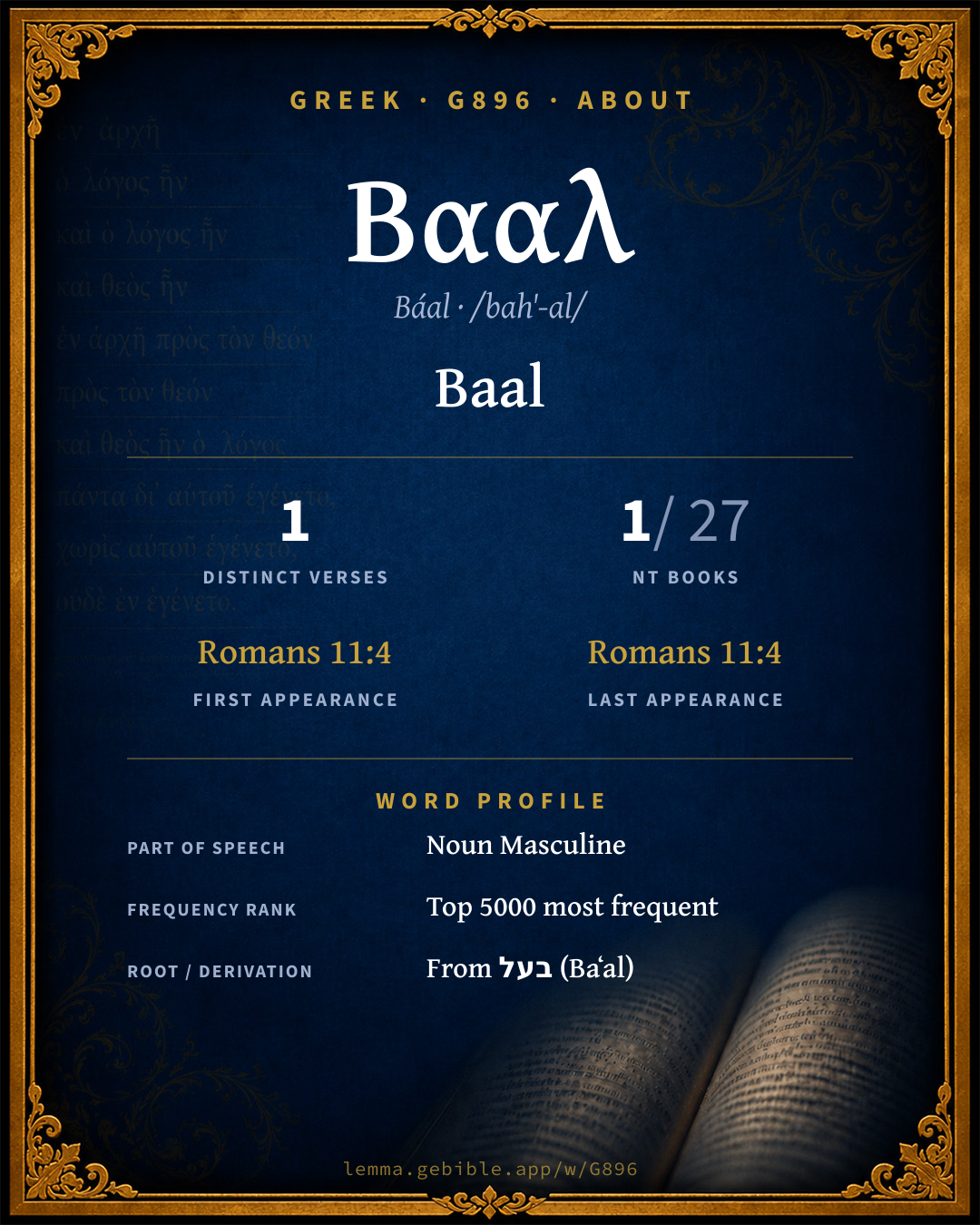
Βάαλ
Baal
Thayer's lists 2 entries for ‘Baal’ fuller range ↓
Full lexicon entry — Thayer's Greek Lexicon
From Thayer's Greek Lexicon
Where this word appears
Every verse where G896 appears — 1 distinct verse across 1 book. Click any verse to open its interlinear word-by-word view. Verse text shown in the World English Bible for context — . Each verse’s Greek form is shown with its reference; the English is not keyword-highlighted, since the data carries no word-level English alignment. Use “Compare translations” on any verse to read it across multiple English versions. This concordance covers the Greek New Testament; Septuagint (Greek Old Testament) occurrences of this word are not indexed here.
Romans 1 verse
About this entry
At a glance — auto-summarized from this page’s data, not written by a person. Every figure links to its source below. This summary describes the numbers; it doesn’t interpret them.
The Greek name Βααλ centers on the idea of “Baal.” It is rare — just 1 verse in the entire Greek New Testament. The word gravitates to Romans (100%). Scripture uses it exactly once, at Romans 11:4. For the data behind this summary, explore 1-verse concordance and the renderings breakdown below.
Gloss history
Strong's 1890 vs modern scholarship
About this word
Strong's G896 catalogs a Greek word from the Greek New Testament.
These counts are not copied from any lexicon or concordance. They are computed here, from the morphology-tagged Greek New Testament. What Lemma adds →
- 1
- distinct verses
- The word appears in 1 distinct verse.
- 1 / 27
- NT books
- The word appears in 1 of 27 New Testament books.
- #3,503
- by frequency
- Top 5000 most frequent Greek words (rank 3,503 of 5,347 Greek words by occurrence).
View all 1 occurrence in the concordance →
Most concentrated in
- Romans 1 verse 100%
By section of the New Testament
By traditional corpus
Conventional, traditional groupings — biblical authorship is debated, so this is a traditional corpus grouping, not an authorship claim. Some books belong to more than one corpus (Luke is in both the Gospels and the Lukan corpus, and so on), so these shares overlap and need not total 100%. Each figure is a share of the word’s 1 distinct verse.
- Pauline corpus 1 verse · 100%
How translations render this word
Counts come from each version’s own published word-to-Strong’s tagging or interlinear alignment — an approximate guide to how each version renders this word, not a word-level alignment the data otherwise carries. Because each total is that version’s own tagged count, the per-version totals vary from one another and need not match the appearance or distinct-verse counts above. These counts may also differ from a printed concordance because Lemma counts each distinctly tagged rendering and does not collapse phrase taggings into a single head-word total. This is a fixed set of word-tagged versions (KJV, ASV, BSB, ULT) and does not change with the reading translation you choose elsewhere. Each version’s license is shown beside its name below (and on Sources).
- King James Version: Image of baal 1×
- American Standard Version: Baal 1×, To 1×
- Berean Standard Bible: Baal 1×
- unfoldingWord Literal Text: Baal 1×
King James Version Public Domain
Renders G896 across 1 tagged occurrence — most commonly:
American Standard Version Public Domain
Renders G896 across 2 tagged occurrences — most commonly:
Berean Standard Bible Public Domain
Renders G896 across 1 tagged occurrence — most commonly:
unfoldingWord Literal Text CC BY-SA 4.0
Renders G896 across 1 tagged occurrence — most commonly:
Senses in Thayer's
The 2 senses Thayer's distinguishes for this word, in lexicon order (not ranked by frequency or importance). The full entry — with sub-senses — is in the Lexicon Entry tab.
- Baal = "lord"
- the supreme male divinity of the Phoenician and Canaanitish nations, as Ashtoreth was their supreme female divinity
Word origin
Derived from בעל (Baʻal) (H1168) — Baal.
Of hebrew origin [ H1168 ]; Baal a Phaenician deity (used as a symbol of idolatry): - Baal.
— Strong’s Exhaustive Concordance (1890), public domain.
Same root — word family
Other Thayer's entries built from the same root as G896, grouped by Strong’s listed origin. These share a root / origin per the lexicon — not necessarily a shared meaning. Each links to that word’s own entry.
Derives from
Shares the same root
Proper names from this root
People and places named from this root — a name, not an additional meaning of the word.
- בל Bêl H1078 Bel
- בעל ברית Baʻal Bᵉrîyth H1170 Baal-berith
- בעל גד Baʻal Gâd H1171 Baal-gad
- בעל זבוב Baʻal Zᵉbûwb H1176 Baal-zebub
- בעלידע Bᵉʻelyâdâʻ H1182 Beeliada
- בעל מעון Baʻal Mᵉʻôwn H1186 Baal-meon
- בעל פעור Baʻal Pᵉʻôwr H1187 Baal-peor
- בעל צפון Baʻal Tsᵉphôwn H1189 Baal-zephon
- בעל שלשה Baʻal Shâlishâh H1190 Baal-shalisha
Compare all same-root words → Showing 4 of 12 — not the complete family. 10 of the same-root words are proper names (people or places). They share a root, not necessarily a meaning.
Bible dictionary
Public-domain dictionary articles matched to this entry by name (Baal). A biblical name can be shared by more than one person or place, so an article may treat several.
Easton's Bible Dictionary · M. G. Easton, 1897
Lord. (1.) The name appropriated to the principal male god of the Phoenicians. It is found in several places in the plural BAALIM (Judg. 2:11; 10:10; 1 Kings 18:18; Jer. 2:23; Hos. 2:17). Baal is identified with Molech (Jer. 19:5). It was known to the Israelites as Baal-peor (Num. 25:3; Deut. 4:3), was worshipped till the time of Samuel (1 Sam 7:4), and was afterwards the religion of the ten tribes in the time of Ahab (1 Kings 16:31-33; 18:19, 22). It prevailed also for a time in the kingdom of Judah (2 Kings 8:27; comp. 11:18; 16:3; 2 Chr. 28:2), till finally put an end to by the severe discipline of the Captivity (Zeph. 1:4-6). The priests of Baal were in great numbers (1 Kings 18:19), and of various classes (2 Kings 10:19). Their mode of offering sacrifices is described in 1 Kings 18:25-29. The sun-god, under the general title of Baal, or "lord," was the chief object of worship of the Canaanites. Each locality had its special Baal, and the various local Baals were summed up under the name of Baalim, or "lords." Each Baal had a wife, who was a colourless reflection of himself.
(2.) A Benjamite, son of Jehiel, the progenitor of the Gibeonites (1 Chr. 8:30; 9:36).
(3.) The name of a place inhabited by the Simeonites, the same probably as Baal-ath-beer (1 Chr. 4:33; Josh. 19:8).
Smith's Bible Dictionary · William Smith, 1863
geographical. This word occurs as the prefix or suffix to the names of several places in Palestine, some of which are as follows:
+ BAAL a town of Simeon, named only in (1 Chronicles 4:33) which from the parallel list in (Joshua 19:8) seems to have been identical with BAALATH-BEER. + Baalah (mistress). A. Another name for Kirjath-JEARIM, or Kirjath BAAL, the well-known town now Kuriet el Enab . (Joshua 15:9,10; 1 Chronicles 13:6) b. A town in the south of Judah, (Joshua 15:29) which in Josh 19:3 Is called Balah, and in the parallel list, (1 Chronicles 4:29) Bilhah. + Baalath (mistress), a town of Dan named with Gibbethon, Gath-rim-mon and other Philistine places. (Joshua 19:44) + BAALATH-BEER (lord of the well). BAAL 1, a town among those in the south part of Judah, given to Simeon, which also bore the name of RAMATH-NEGEB, or "the height of the south." (Joshua 19:8) + BAAL-GAD (lord of fortune), used to denote the most northern, (Joshua 11:17; 12:7) or perhaps northwestern, (Joshua 13:5) point to which Joshua's victories extended. It was in all probability a Phoenician or Canaanite sanctuary of Baal under the aspect of Gad or Fortune. + BAAL-HAMON (lord of a multitude), a place at which Solomon had a vineyard, evidently of great extent. (Song of Solomon 8:11) + BAAL-HAZOR (village of Baal), a place where Absalom appears to have had a sheep-farm, and where Amnon was murdered. (2 Samuel 13:23) + Mount, Mount, Mountain BAAL-HERMON (Lord of Hermon), (Judges 3:3) and simply Baal-hermon. (1 Chronicles 5:23) This is usually considered as a distinct place from Mount Hermon; but we know that this mountain had at least three names (3:9) and Baal-hermon may have been a fourth in use among the Phoenician worshippers. + BAAL-MEON (lord of the house), one of the towns which were built by the Reubenites. (Numbers 32:38) It also occurs in (1 Chronicles 5:8) and on each occasion with Nebo. In the time of Ezekiel it was Moabite, one of the cities which were the "glory of the country." (Ezekiel 25:9) + BAAL-Perazim (lord of divisions), the scene of a victory of David over the Philistines, and of a great destruction of their images. (2 Samuel 5:20; 1 Chronicles 14:11) See (Isaiah 28:21) where it is called Mount, Mount, Mountain Perazim. + BAAL-SHALISHA (lord of Shalisha), a place named only in (2 Kings 4:42) apparently not far from Gilgal; comp. (2 Kings 4:38) + BAAL-TAMAR (lord of the palm tree), a place named only in (Judges 20:33) as near Gibeah of Benjamin. The palm tree (tamar) of Deborah, (Judges 4:5) was situated somewhere in the locality, and is possibly alluded to. + BAAL-ZEPHON (lord of the north), a place in Egypt near where the Israelites crossed the Red Sea. (Numbers 33:7; Ezekiel 14:2,9) We place Baal-zephon on the western shore of the Gulf of Suez, a little below its head, which at that time was about 30 or 40 miles northward of the Present head.
the supreme male divinity of the Phoenician and Canaanitish nations, as Ashtoreth was their supreme female divinity. Some suppose Baal to correspond to the sun and Ashtoreth to the moon; others that Baal was Jupiter and Ashtoreth Venus. There can be no doubt of the very high antiquity of the worship of Baal. It prevailed in the time of Moses among the Moabites and Midianites, (Numbers 22:41) and through them spread to the Israelites. (Numbers 25:3-18; 4:3) In the times of the kings it became the religion of the court and people of the ten tribes, (1 Kings 16:31-33; 18:19,22) and appears never to have been permanently abolished among them. (2 Kings 17:16) Temples were erected to Baal in Judah, (1 Kings 16:32) and he was worshipped with much ceremony. (1 Kings 18:19,26-28; 2 Kings 10:22) The attractiveness of this worship to the Jews undoubtedly grew out of its licentious character. We find this worship also in Phoenician colonies. The religion of the ancient British islands much resembled this ancient worship of Baal, and may have been derived from it. Nor need we hesitate to regard the Babylonian Bel, (Isaiah 46:1) or Beaus, as essentially identical with Baal, though perhaps under some modified form. The plural, Baalim, is found frequently, showing that he was probably worshipped under different compounds, among which appear--
+ BAAL-BERITH (the covenant Baal), (Judges 8:33; 9:4) the god who comes into covenant with the worshippers. + BAAL-ZEBUB (lord of the fly), and worshipped at Ekron. (2 Kings 1:2,3,16) + BAAL-HANAN. a. The name of one of the early kings of Edom. (Genesis 36:38,39; 1 Chronicles 1:49,50) b. The name of one of David's officers, who had the superintendence of his olive and sycamore plantations. (1 Chronicles 27:28) + BAAL-PEOR (lord of the opening, i.e. for others to join in the worship). We have already referred to the worship of this god. The narrative (Numb 25) seems clearly to show that this form of Baal-worship was connected with licentious rites.
(lord).
+ A Reubenite (1 Chronicles 5:5) + The son of Jehiel, and grandfather of Saul. (1 Chronicles 8:30; 9:36)
Hitchcock's Bible Names Dictionary · Roswell D. Hitchcock, 1869
master; lord
Classic public-domain reference works; full attribution on Sources.
Septuagint usage
The same Greek word Βααλ appears 71 times in the Greek Old Testament (Septuagint), across 60 verses in 10 books.
- 71
- LXX occurrences
- Tagged occurrences of this Greek word in the Septuagint.
- 60
- verses
- Distinct Septuagint verses containing this word.
- 10 / 39
- OT books
- The word appears in 10 of the 39 Old Testament books.
Sample Septuagint occurrences
- Numbers 22:41 βααλ
- Joshua 15:9 βααλ
- Judges 2:13 βααλ
- 1 Kings 6:1 βααλ
- 2 Kings 1:2 βααλ
- 1 Chronicles 4:33 βααλ
- 2 Chronicles 23:17 βααλ
- Jeremiah 2:8 βααλ
- Hosea 2:10 βααλ
- Zephaniah 1:4 βααλ
Septuagint occurrences (same lexeme)
Every verse where the same Strong’s number (G896) appears in the Greek Septuagint — showing the first 50 of 60. Verse text shown in the World English Bible for context; the Greek form is the matched word — the English is not keyword-highlighted.
- Numbers 22:41 βααλ It happened in the morning, that Balak took Balaam, and brought him up into the high places of Baal; and he saw from there the utmost part of the people.
- Joshua 15:9 βααλ and the border extended from the top of the mountain to the spring of the waters of Nephtoah, and went out to the cities of Mount Ephron; and the border extended to Baalah (the same is Kiriath Jearim);
- Joshua 15:10 βααλ and the border turned about from Baalah westward to Mount Seir, and passed along to the side of Mount Jearim on the north (the same is Chesalon), and went down to Beth-shemesh, and passed along by Timnah;
- Judges 2:13 βααλ They forsook Yahweh, and served Baal and the Ashtaroth.
- Judges 6:25 βααλ It happened the same night, that Yahweh said to him, Take your father's bull, even the second bull seven years old, and throw down the altar of Baal that your father has, and cut down the Asherah that is by it;
- Judges 6:28 βααλ When the men of the city arose early in the morning, behold, the altar of Baal was broken down, and the Asherah was cut down that was by it, and the second bull was offered on the altar that was built.
- Judges 6:30 βααλ Then the men of the city said to Joash, Bring out your son, that he may die, because he has broken down the altar of Baal, and because he has cut down the Asherah that was by it.
- Judges 6:31 βααλ Joash said to all who stood against him, Will you contend for Baal? Or will you save him? he who will contend for him, let him be put to death while [it is yet] morning: if he be a god, let him contend for himself, because one has broken down his altar.
- Judges 6:32 βααλ Therefore on that day he named him Jerubbaal, saying, Let Baal contend against him, because he has broken down his altar.
- Judges 8:33 βααλ It happened, as soon as Gideon was dead, that the children of Israel turned again, and played the prostitute after the Baals, and made Baal Berith their god.
- 1 Kings 6:1 βααλ It happened in the four hundred and eightieth year after the children of Israel were come out of the land of Egypt, in the fourth year of Solomon's reign over Israel, in the month Ziv, which is the second month, that he began to build the house of Yahweh.
- 1 Kings 16:31 βααλ It happened, as if it had been a light thing for him to walk in the sins of Jeroboam the son of Nebat, that he took as wife Jezebel the daughter of Ethbaal king of the Sidonians, and went and served Baal, and worshiped him.
- 1 Kings 16:32 βααλ He reared up an altar for Baal in the house of Baal, which he had built in Samaria.
- 1 Kings 18:21 βααλ Elijah came near to all the people, and said, "How long will you waver between the two sides? If Yahweh is God, follow him; but if Baal, then follow him." The people answered him not a word.
- 1 Kings 18:22 βααλ Then Elijah said to the people, "I, even I only, am left a prophet of Yahweh; but Baal's prophets are four hundred fifty men.
- 1 Kings 18:26 βααλ They took the bull which was given them, and they dressed it, and called on the name of Baal from morning even until noon, saying, Baal, hear us. But there was no voice, nor any who answered. They leaped about the altar which was made.
- 1 Kings 18:40 βααλ and Elijah said to them, Take the prophets of Baal; don't let one of them escape. They took them; and Elijah brought them down to the brook Kishon, and killed them there.
- 1 Kings 19:18 βααλ Yet will I leave [me] seven thousand in Israel, all the knees which have not bowed to Baal, and every mouth which has not kissed him.
- 2 Kings 1:2 βααλ Ahaziah fell down through the lattice in his upper chamber that was in Samaria, and was sick: and he sent messengers, and said to them, Go, inquire of Baal Zebub, the god of Ekron, whether I shall recover of this sickness.
- 2 Kings 1:3 βααλ But the angel of Yahweh said to Elijah the Tishbite, Arise, go up to meet the messengers of the king of Samaria, and tell them, Is it because there is no God in Israel, that you go to inquire of Baal Zebub, the god of Ekron?
- 2 Kings 1:6 βααλ They said to him, There came up a man to meet us, and said to us, Go, turn again to the king who sent you, and tell him, Thus says Yahweh, Is it because there is no God in Israel, that you send to inquire of Baal Zebub, the god of Ekron? therefore you shall not come down from the bed where you are gone up, but shall surely die.
- 2 Kings 1:16 βααλ He said to him, Thus says Yahweh, Because you have sent messengers to inquire of Baal Zebub, the god of Ekron, is it because there is no God in Israel to inquire of his word? therefore you shall not come down from the bed where you are gone up, but shall surely die.
- 2 Kings 1:18 βααλ Now the rest of the acts of Ahaziah which he did, aren't they written in the book of the chronicles of the kings of Israel?
- 2 Kings 3:2 βααλ He did that which was evil in the sight of Yahweh, but not like his father, and like his mother; for he put away the pillar of Baal that his father had made.
- 2 Kings 10:18 βααλ Jehu gathered all the people together, and said to them, Ahab served Baal a little; but Jehu will serve him much.
- 2 Kings 10:19 βααλ Now therefore call to me all the prophets of Baal, all his worshippers, and all his priests; let none be wanting: for I have a great sacrifice [to do] to Baal; whoever shall be wanting, he shall not live. But Jehu did it in subtlety, to the intent that he might destroy the worshippers of Baal.
- 2 Kings 10:20 βααλ Jehu said, Sanctify a solemn assembly for Baal. They proclaimed it.
- 2 Kings 10:21 βααλ Jehu sent through all Israel: and all the worshippers of Baal came, so that there was not a man left that didn't come. They came into the house of Baal; and the house of Baal was filled from one end to another.
- 2 Kings 10:22 βααλ He said to him who was over the vestry, Bring forth vestments for all the worshippers of Baal. He brought them forth vestments.
- 2 Kings 10:23 βααλ Jehu went, and Jehonadab the son of Rechab, into the house of Baal; and he said to the worshippers of Baal, Search, and look that there be here with you none of the servants of Yahweh, but the worshippers of Baal only.
- 2 Kings 10:25 βααλ It happened, as soon as he had made an end of offering the burnt offering, that Jehu said to the guard and to the captains, Go in, and kill them; let none come forth. They struck them with the edge of the sword; and the guard and the captains cast them out, and went to the city of the house of Baal.
- 2 Kings 10:26 βααλ They brought forth the pillars that were in the house of Baal, and burned them.
- 2 Kings 10:27 βααλ They broke down the pillar of Baal, and broke down the house of Baal, and made it a latrine, to this day.
- 2 Kings 10:28 βααλ Thus Jehu destroyed Baal out of Israel.
- 2 Kings 11:18 βααλ All the people of the land went to the house of Baal, and broke it down; his altars and his images broke they in pieces thoroughly, and killed Mattan the priest of Baal before the altars. The priest appointed officers over the house of Yahweh.
- 2 Kings 17:16 βααλ They forsook all the commandments of Yahweh their God, and made them molten images, even two calves, and made an Asherah, and worshiped all the host of the sky, and served Baal.
- 2 Kings 21:3 βααλ For he built again the high places which Hezekiah his father had destroyed; and he reared up altars for Baal, and made an Asherah, as did Ahab king of Israel, and worshiped all the host of the sky, and served them.
- 2 Kings 23:4 βααλ The king commanded Hilkiah the high priest, and the priests of the second order, and the keepers of the threshold, to bring forth out of the temple of Yahweh all the vessels that were made for Baal, and for the Asherah, and for all the host of the sky, and he burned them outside of Jerusalem in the fields of the Kidron, and carried the ashes of them to Bethel.
- 2 Kings 23:5 βααλ He put down the idolatrous priests, whom the kings of Judah had ordained to burn incense in the high places in the cities of Judah, and in the places round about Jerusalem; those also who burned incense to Baal, to the sun, and to the moon, and to the planets, and to all the host of the sky.
- 1 Chronicles 4:33 βααλ and all their villages that were round about the same cities, to Baal. These were their habitations, and they have their genealogy.
- 1 Chronicles 5:5 βααλ Micah his son, Reaiah his son, Baal his son,
- 1 Chronicles 8:30 βααλ and his firstborn son Abdon, and Zur, and Kish, and Baal, and Nadab,
- 1 Chronicles 9:36 βααλ and his firstborn son Abdon, and Zur, and Kish, and Baal, and Ner, and Nadab,
- 2 Chronicles 23:17 βααλ All the people went to the house of Baal, and broke it down, and broke his altars and his images in pieces, and killed Mattan the priest of Baal before the altars.
- 2 Chronicles 24:7 βααλ For the sons of Athaliah, that wicked woman, had broken up the house of God; and also all the dedicated things of the house of Yahweh did they bestow on the Baals.
- Jeremiah 2:8 βααλ The priests didn't say, Where is Yahweh? and those who handle the law didn't know me: the rulers also transgressed against me, and the prophets prophesied by Baal, and walked after things that do not profit.
- Jeremiah 2:23 βααλ How can you say, I am not defiled, I have not gone after the Baals? see your way in the valley, know what you have done: [you are] a swift dromedary traversing her ways;
- Jeremiah 2:28 βααλ But where are your gods that you have made you? let them arise, if they can save you in the time of your trouble: for according to the number of your cities are your gods, Judah.
- Jeremiah 7:9 βααλ Will you steal, murder, and commit adultery, and swear falsely, and burn incense to Baal, and walk after other gods that you have not known,
- Jeremiah 11:13 βααλ For according to the number of your cities are your gods, Judah; and according to the number of the streets of Jerusalem have you set up altars to the shameful thing, even altars to burn incense to Baal.
These are occurrences of the same Greek lexeme (G896) in the Septuagint — not a translation of any one Hebrew word. The store carries no word-level Hebrew↔Greek alignment, so no Hebrew original is asserted here. Counts come from the recovered LXX Strong's tagging — high-frequency vocabulary is well covered, while rare or late forms may be untagged — so they reflect tagged occurrences and may slightly undercount.