
2 Chronicles 24:7

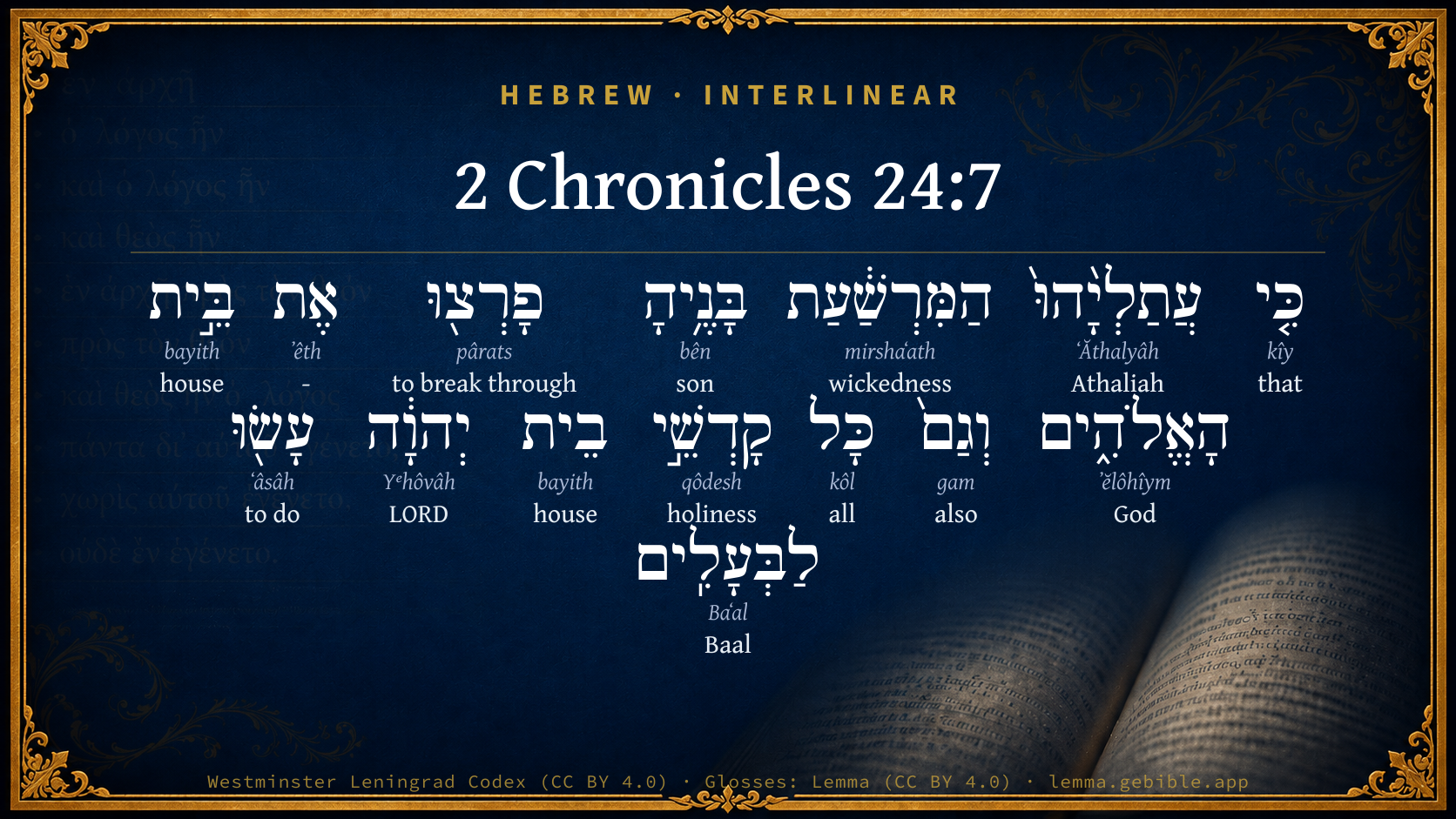
Hebrew (Westminster Leningrad Codex) 2 Chronicles 24:7 appears in the Hebrew Old Testament. The text above is from the Westminster Leningrad Codex. Each word links to its Strong’s number, a concise gloss, and parsing drawn from the Open Scriptures Hebrew Bible morphology. Click any word for its full Brown-Driver-Briggs (BDB) entry.
Download image
Cite this verse

2 Chronicles 24:7 (World English Bible). Public Domain. Lemma interlinear Bible study tool, https://lemma.gebible.app/v/2-chronicles/24/7.

Show BibTeX & RIS
BibTeX
RIS
English Translation
For the sons of Athaliah, that wicked woman, had broken up the house of God; and also all the dedicated things of the house of Yahweh did they bestow on the Baals.
World English Bible · Public Domain
Highlights
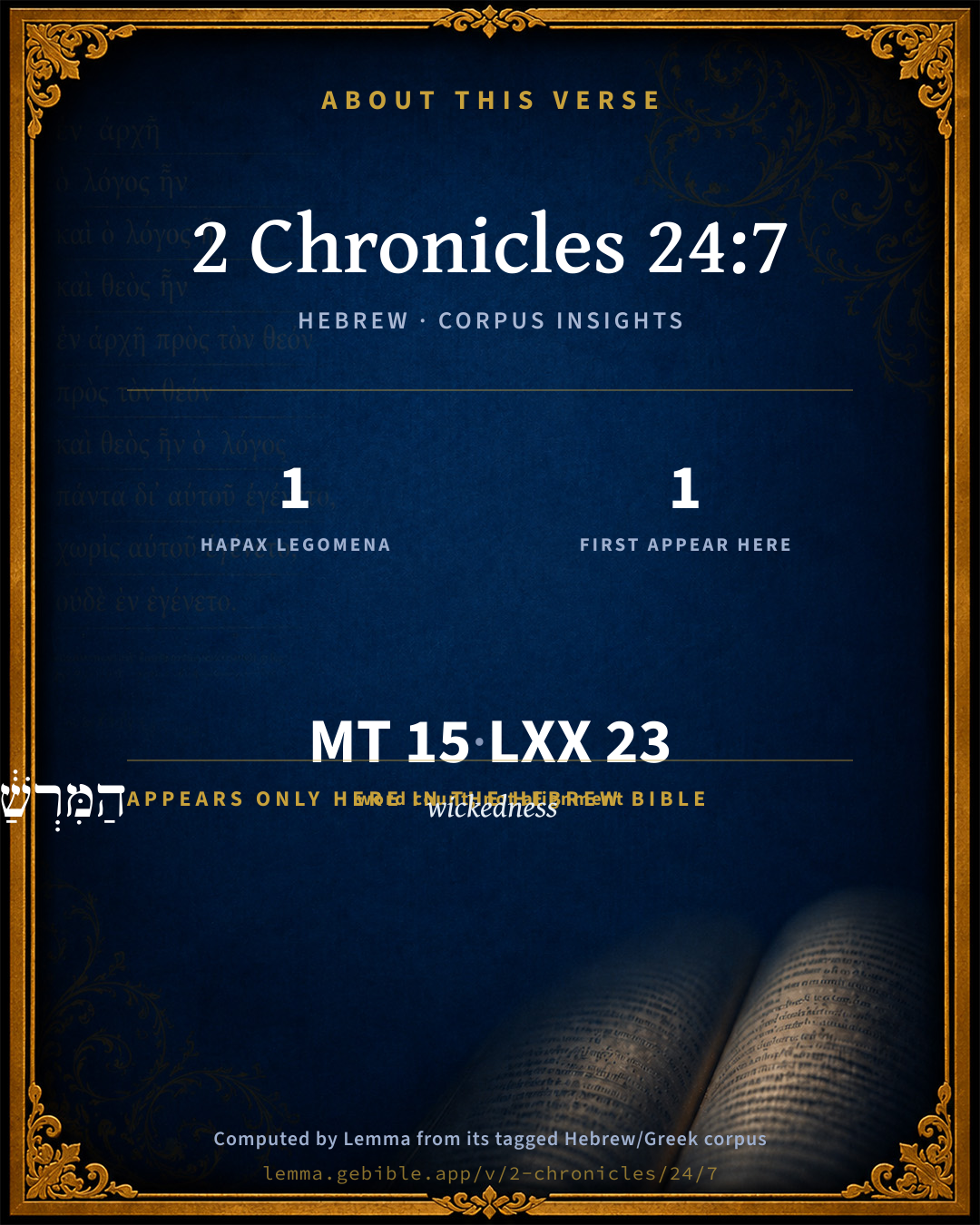
  • 1 hapax legomenon — only here in the Hebrew Bible
  • 1 first appearance in the Hebrew Bible
Full analysis ↓
Download a study sheet

One document with this verse’s original text, its word-by-word gloss line, the meaning frame, cross-references with their text, attributed commentary, and full source and license credits — printable, and it pastes into notes with its structure intact.

This verse Autodidact and up

Study sheet (.html) Plain text (.txt)

A passage Seminary Student

Up to 50 verses in one chapter. A passage sheet keeps up to 6 commentary sources and 12 cross-references per verse, in the order this page ranks them, and says so on the sheet whenever that leaves anything out. Ask for a single verse and you get the Autodidact verse sheet above.

Everything on this page stays free to read, with no account — the sheet is a download of what is already on screen, not access to it.

Want to remove ads? Support Godless Engineer
Compare translations 3

The same verse in 3 English versions, stacked beneath the original-language interlinear above. Click any original word for its lexicon entry.

Each is an independent rendering of the whole verse — the interlinear is not word-aligned to these translations.

Highlighted words mark where these versions differ — a whole-verse word diff, not a word-by-word alignment.

  • World English Bible Public Domain
    For the sons of Athaliah, that wicked woman, had broken up the house of God; and also all the dedicated things of the house of Yahweh did they bestow on the Baals.
  • King James Version Public Domain
    For the sons of Athaliah, that wicked woman, had broken up the house of God; and also all the dedicated things of the house of the LORD did they bestow upon Baalim.
  • unfoldingWord Literal Text CC BY-SA 4.0
    For wicked Athaliah, her sons had broken into the house of God and also, all the sacred things of the house of Yahweh, they used for the Baals.

unfoldingWord Literal Text — © unfoldingWord, licensed CC BY-SA 4.0. Word-aligned USFM3 via Door43 (git.door43.org/unfoldingWord/en_ult).

Versions to compare (up to 4)

3 of 4 selected

Show all 18 translations

Every available English version of this verse, each an independent rendering of the whole verse.

  • World English Bible Public Domain
    For the sons of Athaliah, that wicked woman, had broken up the house of God; and also all the dedicated things of the house of Yahweh did they bestow on the Baals.
  • Berean Standard Bible Public Domain
    For the sons of that wicked woman Athaliah had broken into the house of God and had even used the sacred objects of the house of the LORD for the Baals.
  • Majority Standard Bible Public Domain
    For the sons of that wicked woman Athaliah had broken into the house of God and had even used the sacred objects of the house of the LORD for the Baals.
  • King James Version Public Domain
    For the sons of Athaliah, that wicked woman, had broken up the house of God; and also all the dedicated things of the house of the LORD did they bestow upon Baalim.
  • American Standard Version (1901) Public Domain
    For the sons of Athaliah, that wicked woman, had broken up the house of God; and also all the dedicated things of the house of Jehovah did they bestow upon the Baalim.
  • Revised Version (1885) Public Domain
    For the sons of Athaliah, that wicked woman, had broken up the house of God; and also all the dedicated things of the house of the LORD did they bestow upon the Baalim.
  • Geneva Bible (1599) Public Domain
    For wicked Athaliah, and her children brake vp the house of God: and all the things that were dedicate for the house of the Lord, did they bestowe vpon Baalim.
  • Douay-Rheims (1899) Public Domain
    For that wicked woman Athalia, and her children have destroyed the house of God, and adorned the temple of Baal with all the things that had been dedicated in the temple of the Lord.
  • Young's Literal Translation Public Domain
    for sons of Athaliah, the wicked one, have broken up the house of God, and also, all the holy things of the house of Jehovah they have prepared for Baalim.'
  • Literal Standard Version CC BY-SA 4.0
    For sons of Athaliah, the wicked one, have broken up the house of God, and also, they have prepared all the holy things of the house of YHWH for Ba‘alim.”
  • Unlocked Literal Bible CC BY-SA 4.0
    For the sons of Athaliah, that wicked woman, had broken up the house of God and had given all the holy things of the house of Yahweh to the Baals.
  • unfoldingWord Literal Text CC BY-SA 4.0
    For wicked Athaliah, her sons had broken into the house of God and also, all the sacred things of the house of Yahweh, they used for the Baals.
  • Darby Bible Public Domain
    For the wicked Athaliah [and] her sons had devastated the house of God; and also all the hallowed things of the house of Jehovah had they employed for the Baals.
  • World Messianic Bible Public Domain
    For the sons of Athaliah, that wicked woman, had broken up God’s house; and they also gave all the dedicated things of the LORD’s house to the Baals.
  • Webster's Bible Public Domain
    For the sons of Athaliah that wicked woman, had broken up the house of God; and also all the dedicated things of the house of the LORD they bestowed upon Baalim.
  • Free Bible Version CC BY-SA 4.0
    (The supporters of that wicked woman Athaliah had broken into God's Temple and had stolen the holy objects of the Lord's Temple and used them to worship the Baals.)
  • Bible in Basic English Public Domain
    For the house of the Lord had been broken up by Athaliah, that evil woman, and her sons; and all its holy things they had given to the Baals.
  • JPS Tanakh (1917) Public Domain
    For the sons of Athaliah, that wicked woman, had broken up the house of God; and also all the hallowed things of the house of the LORD did they bestow upon the Baalim.

Literal Standard Version (2020), Covenant Press — licensed CC BY-SA 4.0. Text via the HelloAO Bible API (eBible.org). Unlocked Literal Bible (unfoldingWord) — licensed CC BY-SA 4.0. Text via the HelloAO Bible API (eBible.org). unfoldingWord Literal Text — © unfoldingWord, licensed CC BY-SA 4.0. Word-aligned USFM3 via Door43 (git.door43.org/unfoldingWord/en_ult). Free Bible Version, Dr. Jonathan Gallagher — licensed CC BY-SA 4.0. Text via the HelloAO Bible API (eBible.org).

Word by word

More ways to search: Search by grammar → Find every occurrence → Compare this word →

Practice this passage: Drill this verse → Learn its vocabulary →

הַמִּרְשַׁ֔עַת
mirshaʻath
H4849
“the · wickedness”
Particle, Definite Article + Noun, Common, Feminine, Singular, Absolute
Part of Speech
Particle + Noun
Type
Common
Gender
Feminine
Number
Singular
State
Absolute
Full BDB Definition

Origin: from H7561

TWOT: 2222d

wickedness
  1. כִּ֤י kîy H3588 “that” Conjunction
  2. עֲתַלְיָ֨הוּ֙ ʻĂthalyâh H6271 “Athaliah” Noun, Proper
  3. בָּנֶ֥יהָ bên H1121 “sons · her” Noun, Common, Masculine, Plural, Construct + Suffix, Personal, 3rd Person, Feminine, Singular
  4. פָרְצ֖וּ pârats H6555 “to break through” Verb, Qal, Perfect, 3rd Person, Common, Plural
  5. אֶת ʼêth H853 “-” Particle, Direct Object
  6. בֵּ֣ית bayith H1004 “house of” Noun, Common, Masculine, Singular, Construct
  7. הָאֱלֹהִ֑ים ʼĕlôhîym H430 “the · God(s)” Particle, Definite Article + Noun, Common, Masculine, Plural, Absolute
  8. וְגַם֙ gam H1571 “and · also” Conjunction + Particle, Accusative
  9. כָּל kôl H3605 “all of” Noun, Common, Masculine, Singular, Construct
  10. קָדְשֵׁ֣י qôdesh H6944 “holy things of” Noun, Common, Masculine, Plural, Construct
  11. בֵית bayith H1004 “house of” Noun, Common, Masculine, Singular, Construct
  12. יְהוָ֔ה Yᵉhôvâh H3068 “LORD” Noun, Proper
  13. עָשׂ֖וּ ʻâsâh H6213 “to do” Verb, Qal, Perfect, 3rd Person, Common, Plural
  14. לַבְּעָלִֽים Baʻal H1168 “to/for the · Baal” Preposition, Determined + Noun, Proper

About this verse

These counts appear in no published source. They are computed here, from the morphology-tagged text and Lemma’s own curated glosses. What Lemma adds →

15
words
14
distinct lemmas
Historical
section

Notable vocabulary

1 hapax legomenon — a word that appears only here in the entire Hebrew Bible:

  • הַמִּרְשַׁ֔עַת wickedness H4849

First appearance in Scripture

This word makes its first canonical appearance in the Hebrew Bible here:

  • הַמִּרְשַׁ֔עַת wickedness H4849

Shared distinctive vocabulary

עֲתַלְיָ֨הוּ֙ Athaliah H6271 occurs in 17 verses of the Hebrew Bible. Also found in:

Grammatical profile

  • 2 verbs
  • 10 nouns
  • 1 conjunction
  • 2 particles

Verb forms

  • פָרְצ֖וּ Qal · Perfect
  • עָשׂ֖וּ Qal · Perfect

Repetition

A word recurs within this verse — often emphatic in Hebrew:

  • בֵּ֣ית house H1004 ×2

Hebrew & Septuagint length

In English translation the verse runs 32 words from the Hebrew and 28 from the Septuagint (LXX English) — closely comparable.

A rough comparison of the two English renderings, which tokenize alike — not a word-level alignment.

Word counts can differ between the Hebrew and the Greek without any difference in meaning — e.g. the Hebrew direct-object marker אֵת has no separate Greek word, and Greek often adds the article ὁ.

In the original languages it is 15 Hebrew tokens and 23 Greek tokens — but the two are counted differently (Hebrew bundles its prefixes and suffixes into one token; the Greek is in lemma form), so that isn’t a like-for-like length.

Cross-references

13

Topical passages linked to 2 Chronicles 24:7 in the Treasury of Scripture Knowledge — connected by theme and wording, ordered by reader-vote popularity; previews shown in the World English Bible.

  • 2 Chronicles 21:17 and they came up against Judah, and broke into it, and carried away all the substance that was found in the king's house, and his sons also, and his wives; so that there was never a son left him, save Jehoahaz, the youngest of his sons.
  • Deuteronomy 32:15–17 But Jeshurun grew fat, and kicked: You have grown fat, you are grown thick, you are become sleek; Then he forsook God who made him, Lightly esteemed the Rock of his salvation.
  • 2 Kings 12:4 Jehoash said to the priests, All the money of the holy things that is brought into the house of Yahweh, in current money, the money of the persons for whom each man is rated, and all the money that it comes into any man's heart to bring into the house of Yahweh,
  • 2 Chronicles 28:22–24 In the time of his distress did he trespass yet more against Yahweh, this same king Ahaz.
  • Esther 7:6 Esther said, An adversary and an enemy, even this wicked Haman. Then Haman was afraid before the king and the queen.
  • Proverbs 10:7 The memory of the righteous is blessed, But the name of the wicked will rot.
  • Ezekiel 16:17–21 You also took your beautiful jewels of my gold and of my silver, which I had given you, and made for yourself images of men, and played the prostitute with them;
  • Daniel 5:2–4 Belshazzar, while he tasted the wine, commanded to bring the golden and silver vessels which Nebuchadnezzar his father had taken out of the temple which was in Jerusalem; that the king and his lords, his wives and his concubines, might drink from it.
  • Daniel 5:23 but have lifted up yourself against the Lord of heaven; and they have brought the vessels of his house before you, and you and your lords, your wives and your concubines, have drunk wine from them; and you have praised the gods of silver and gold, of brass, iron, wood, and stone, which don't see, nor hear, nor know; and the God in whose hand your breath is, and whose are all your ways, you have not glorified.
  • Hosea 2:8–9 For she did not know that I gave her the grain, the new wine, and the oil, And multiplied to her silver and gold, which they used for Baal.
  • Hosea 2:13 I will visit on her the days of the Baals, To which she burned incense, When she decked herself with her earrings and her jewels, And went after her lovers, And forgot me," says Yahweh.
  • 2 Thessalonians 2:8 Then the lawless one will be revealed, whom the Lord will kill with the breath of his mouth, and bring to nothing by the brightness of his coming;
  • Revelation 2:20 But I have this against you, that you tolerate your woman, Jezebel, who calls herself a prophetess. She teaches and seduces my servants to commit sexual immorality, and to eat things sacrificed to idols.

Cross-references courtesy of OpenBible.info (CC BY 4.0).

Hebrew and Greek witnesses Masoretic Hebrew ↔ Greek Septuagint

The same verse in the two great witnesses to the Old Testament, shown verse-for-verse.

These are two independent witnesses, not word-aligned to each other, and the Septuagint is shown in lemma (dictionary) form.

Hebrew 2 Chronicles 24:7 Masoretic · Westminster Leningrad Codex

כִּ֤י עֲתַלְיָ֨הוּ֙ הַמִּרְשַׁ֔עַת בָּנֶ֥יהָ פָרְצ֖וּ אֶת בֵּ֣ית הָאֱלֹהִ֑ים וְגַם֙ כָּל קָדְשֵׁ֣י בֵית יְהוָ֔ה עָשׂ֖וּ לַבְּעָלִֽים

For the sons of Athaliah, that wicked woman, had broken up the house of God; and also all the dedicated things of the house of Yahweh did they bestow on the Baals.

World English Bible · Public Domain

Greek LXX 2 Chronicles 24:7 Septuagint · lemma form

ὅτι γοθολια εἰμί ὁ ἄνομος καί ὁ υἱός αὐτός κατασπάω ὁ οἶκος ὁ θεός καί γάρ ὁ ἅγιος οἶκος κύριος ποιέω ὁ βααλ

For Gotholia was a transgressor, and her sons tore down the house of God; for they offered the holy things of the house of the Lord to Baalim.

LXX2012 (modern English Septuagint) · Public Domain

Hebrew: Westminster Leningrad Codex (CC BY 4.0). Greek: Septuagint (public domain); English from LXX2012 (modern English Septuagint) (Public Domain). How the Septuagint differs from the Hebrew →

Commentary

Notes on 2 Chronicles 24:7 from classic Christian and Jewish commentators (each source and its license shown beneath its notes). The classic Christian expositions comment on the surrounding passage and are grouped to its opening verse, so a note may address several verses; the Jewish commentaries on the Tanakh (Rashi and others) are per-verse, so they appear only where the commentator wrote on this verse.

Lemma curates 59 commentaries, every one of them public domain or Creative Commons licensed, each selected and text-cleaned for this edition rather than reprinted as found. About our sources →

Trapp's Complete Commentary

John Trapp

2Ch 24:7 For the sons of Athaliah, that wicked woman, had broken up the house of God; and also all the dedicated things of the house of the LORD did they bestow upon Baalim.

Ver. 7. For the sons of Athaliah.] This they might do before they were slain by the Arabians. {2Ch 21:17} Her son Ahaziah, who escaped them, was wholly ruled by her. Jerome and Lyra by her sons understand her Baal’s priests, whom she cherished and chuckered as if they had been born of her body.

John Trapp, A Commentary or Exposition upon All the Books of the Old and New Testament (1647–1656) — public domain. Text from a community e-Sword module.

Joseph Benson's Commentary

2Ch 24:7. The sons of Athaliah, &c. — To wit, Ahaziah and his brethren, before they were carried away captive, (2Ch 21:17,) who did this by her instigation, as this phrase implies; had broken up the house of God — Had both broken up the treasures, and defaced the house itself. And the dedicated things did they bestow upon Baalim — Gave them, either to adorn the temples of those false gods, or to promote their worship.

Joseph Benson's Commentary on the Old and New Testaments (1811–1818) — public domain. Text from a community e-Sword module.

Geneva Bible (1599)

Geneva Bible translators

The Scriptures doth term her thus, because she was a cruel murderer, and a blasphemous idolatress.

Geneva Bible (1599) marginal notes — public domain. Text via Bolls.life.

Ellicott's Commentary for English Readers

(7) For the sons of Athaliah.—There is nothing corresponding to the statements of this verse in the parallel account. Literally, For Athaliah, the evildoer (or, who did wickedly, 2Ch_20:35), her sons had broken down (Isa_5:5; Psa_80:14) the house of God. Ahaziah and his elder brothers, and perhaps other relatives, may be intended. The young princes thus gratified the queen’s hatred of the exclusive cultus of Jehovah. (Comp. 2Ch_22:3-4.) Perhaps some portions of the Temple buildings were demolished, in order to make room for the temple of Baal. (Comp. Notes on 2Ki_11:18.)

The dedicated things—i.e., the moneys given for the use of the sanctuary.

Did they bestow upon Baalim.—Or, they made into the Baals, i.e., used them in making idolatrous images and symbols. (Comp. the same expression, Hos_2:8 : “Her silver and gold, which they made into Baal;” comp. also Hos_8:4.)

A Bible Commentary for English Readers, edited by Charles John Ellicott (1878–1897) — public domain. Text from a community e-Sword module.

The Cambridge Bible for Schools and Colleges

gen. ed. J. J. S. Perowne

7. the sons of Athaliah] To be understood figuratively, “the adherents of Athaliah.” So “a son of the apothecaries” (Neh_3:8; cp. A.V. with R.V.) is “a member of the apothecaries’ guild” and “the sons of the prophets” (2Ki_2:15 etc.) are “the adherents (or ‘scholars’) of the prophets.” So again in Psa_137:8 Edom is called “daughter of Babylon” as having attached herself to the Chaldeans at the destruction of Jerusalem.

had broken up] Rather, had broken into.

all the dedicate things] Cp. 2Ch_15:18; 1Ch_18:10-11. Probably gold, silver and brass.

did they bestow upon Baalim] Or, did they make into images of Baal. Cp. Hos_2:8, R.V. mg.

The Cambridge Bible for Schools and Colleges (gen. ed. J. J. S. Perowne; Cambridge University Press, 1878–1918) — public domain. Text from a community e-Sword module.

John Gill's Exposition

And at the king's commandment they made a chest,.... See Gill on Kg2 12:9.

.

2 Chronicles 24:9

ch2 24:9

ch2 24:9

ch2 24:9And they made a proclamation through Judah and Jerusalem,.... By heralds appointed for the purpose:

to bring in to the Lord; into the house of the Lord, and for the reparation of it; and so for his service, honour, and glory:

the collection that Moses the servant of the Lord laid upon Israel in the wilderness; not to bring in the tabernacle of Moses, as the Targum here and in Ch2 24:6, but such a voluntary gift as Moses moved the children of Israel to bring, when in the wilderness, for the service of the tabernacle.

John Gill's Exposition of the Whole Bible (1746–1763) — public domain (CC PDM 1.0). Text via the HelloAO Bible API.

Haydock's Catholic Bible Commentary

Children. All but Ochozias had been slain by the Arabs. The plural is often put for the singular. S. Jerom (Trad.) explains it of the priests of the idols, whom Athalia cherished as her own offspring.

George Leo Haydock (1774–1849), Haydock's Catholic Family Bible and Commentary, 1859 edition — public domain. Excludes Psalms (Douay-Rheims chapter numbering differs from Protestant) and Deuterocanonical books (Catholic canon only).

Matthew Poole's English Annotations

The sons of Athaliah, to wit, Ahaziah and his brethren, before they were carried away captive, 2Ch 21:17, who did this by her instigation, as this phrase implies.

Had broken up the house of God; both broken up the treasuries, and defaced the house itself.

Matthew Poole's English Annotations on the Holy Bible (1683–1685) — public domain. Text from a community e-Sword/MySword module.

The Pulpit Commentary

The sons of Athaliah. This verse"s testimony against Athaliah"s sons explains 2Ch_21:17, and is explained and corroborated by it. That wicked woman; Hebrew, tvrMih fem. noun, derivative of vr meaning strictly in the abstract, "the wickedness," equal to that incarnation of wickedness. All the dedicated things; i.e. the holy vessels, treasure, and holy furniture of the house of the Lord, had they desecrated, and robbed" them thence to squander them on their various Baals. (2Ch_17:3)

The Pulpit Commentary (1880–1919), ed. H.D.M. Spence-Jones & Joseph S. Exell — public domain. Text from a community e-Sword module.

John Wesley's Explanatory Notes

The sons - Ahaziah, and his brethren before they were carried away captive, chap. xxi, 17, who did this by her instigation, as this phrase implies. Broke up - Both broke up the treasuries, and defaced the house itself.

John Wesley, Explanatory Notes Upon the Whole Bible (1754–1765) — public domain. Text via the GEBible commentary corpus.

Rashi

Rabbi Shlomo Yitzchaki (Rashi)

For the wicked Athaliah—her sons had breached He had to say this because Solomon had built it as a new sturdy edifice. Only 125 years elapsed from the time that Solomon built it until the days of Joash and it was already breached. Had Athaliah and her sons not breached it, it would have continued to endure, for more than 200 years elapsed from Joash to Josiah and they did not have to repair it until Josiah, although Joash did not make it new as it was originally. One hundred and twenty-five years elapsed from the completion of the Temple until Joash. How so? Solomon reigned 40 years, and in the fourth year of his reign he commenced to build it. It took 7 years to build, totaling 10 years, leaving him 30. Rehoboam reigned 17, totaling 47; Abijah 3, totaling 50; Asa 41, totaling 91; Jehoshaphat 25, totaling 116; Jehoram 8, totaling 124, and Ahaziah one, totaling 125. And from Joash until Josiah were 200 years. How so? Amaziah reigned 29 years, Uzziah 52, Jotham 16, Ahaz 16, Hezekiah 29, Manasseh 55, Amon 2, totaling 200 less 1, in addition to those years that Joash lived after he had repaired the Temple. We find that they would not have had to repair the damage of the Temple had not the wicked Athaliah and her sons breached it.

For Athaliah, etc. It is therefore no wonder that it needed repairs so soon, and also no wonder that there was no hallowed silver and gold in the treasuries of the House of the Lord, so that they had to make an announcement in Judah and Jerusalem to bring the tax, for they had also used all the hallowed things of the House of the Lord for the baalim.

Rashi on the Tanakh — English translations: “The Judaica Press complete Tanach with Rashi, translated by A. J. Rosenberg” (CC BY 4.0); “Pentateuch with Rashi's commentary by M. Rosenbaum and A.M. Silbermann, 1929-1934” (public domain); “The Metsudah Tanach series, Lakewood, N.J” (CC BY 4.0); and “The Book of Joshua, Metsudah Publications, 1997” (CC BY 4.0). Text via Sefaria.

Lesson kit

Teaching starters — assembled from the data on this page, not authored interpretation. Every prompt links to the verse data it draws on. Edit before teaching.

2 Chronicles, in the Historical, opens this verse with 15 words (14 distinct Hebrew lemmas). Its most distinctive word is mirshaʻath (“wickedness”). A historical commentator’s framing appears above. Read the whole chapter for the surrounding context.

Discussion questions

  1. How does “wickedness” (mirshaʻath) shape what this verse is saying?
  2. 1 word here appears nowhere else in the Hebrew Bible. Why might the author reach for such rare wording?
  3. This is the first place “wickedness” appears in Scripture (first appears here). What does its debut here establish?
  4. How does 2 Kings 8:26, which shares the word «Athaliah», read alongside this verse?
  5. What does the repetition of “house” (2× in this one verse) do in this verse?
  6. The translations on this page render this verse differently — a whole-verse word diff, not a word-by-word alignment. What might account for the different wordings?
  7. «פָרְצ֖וּ» is a Qal Perfect verb. How does that grammatical form shape the action described?
  8. Compare how Trapp's Complete Commentary and Joseph Benson's Commentary read this verse. Where do they agree or differ?

Things to notice

  • 1 word in this verse appears nowhere else in the Hebrew Bible.
  • 1 word makes its first canonical appearance in Scripture here.
  • This verse counts 15 Hebrew ↔ 23 Greek words.
  • These translations choose different wording for 13 words in this verse.
  • “house” occurs 2× in this single verse.

Reading settings

Reading text

Shown beneath each verse's original-language words.

Old Testament
Old Testament edition

Read the OT as the Masoretic Hebrew (MT) or the Greek Septuagint (LXX).

English shown for the Greek Septuagint (in the Hebrew ↔ Greek comparison).

Comparing translations? Open the Compare panel on any verse page to stack up to four side by side.