
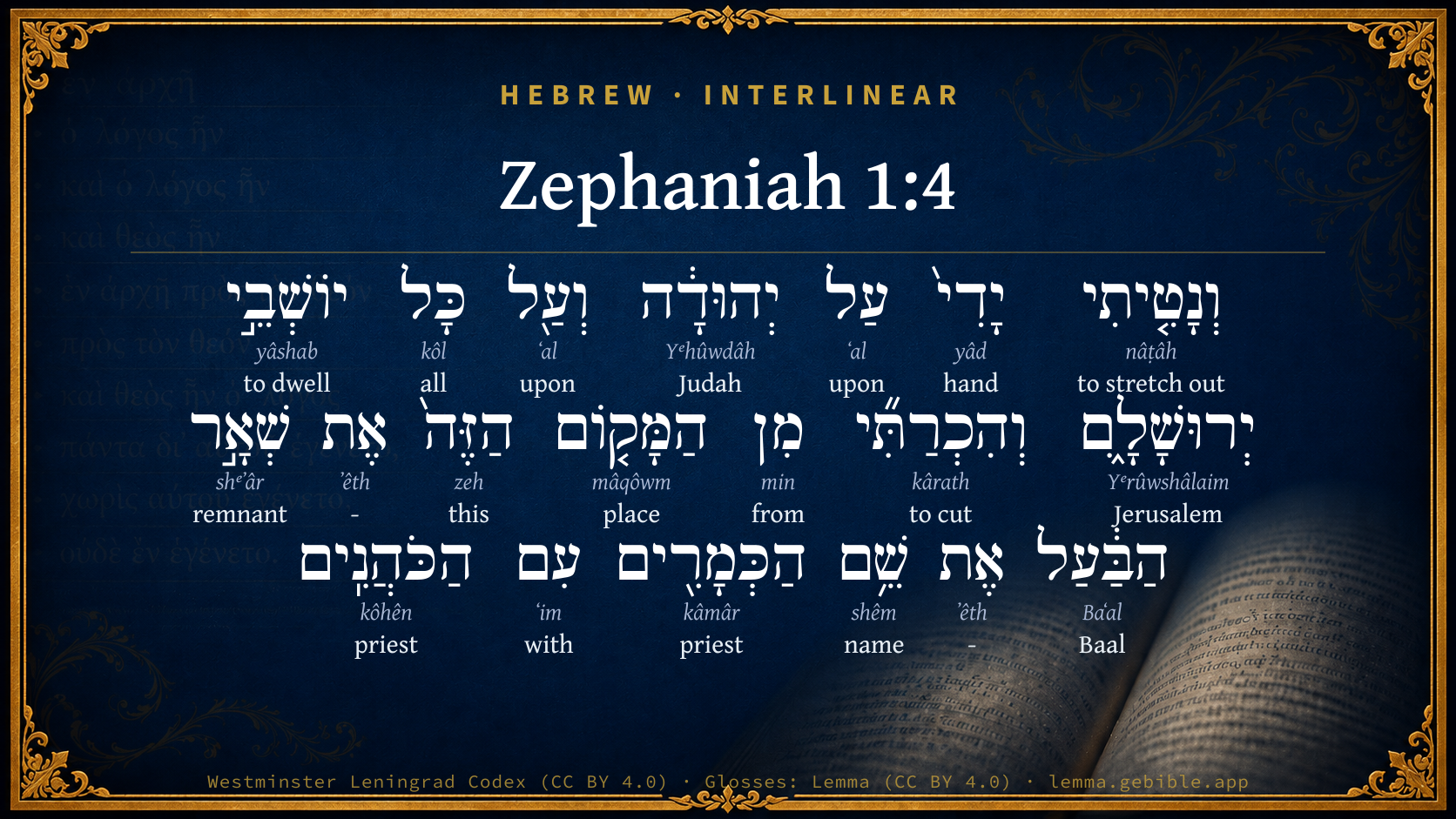
Zephaniah 1:4

Hebrew (Westminster Leningrad Codex) Zephaniah 1:4 appears in the Hebrew Old Testament. The text above is from the Westminster Leningrad Codex. Each word links to its Strong’s number, a concise gloss, and parsing drawn from the Open Scriptures Hebrew Bible morphology. Click any word for its full Brown-Driver-Briggs (BDB) entry.
Download image
Cite this verse

Zephaniah 1:4 (World English Bible). Public Domain. Lemma interlinear Bible study tool, https://lemma.gebible.app/v/zephaniah/1/4.

Show BibTeX & RIS
BibTeX
RIS
English Translation
I will stretch out my hand against Judah, and against all the inhabitants of Jerusalem. I will cut off the remnant of Baal from this place: the name of the idolatrous and pagan priests,
World English Bible · Public Domain
Download a study sheet

One document with this verse’s original text, its word-by-word gloss line, the meaning frame, cross-references with their text, attributed commentary, and full source and license credits — printable, and it pastes into notes with its structure intact.

This verse Autodidact and up

Study sheet (.html) Plain text (.txt)

A passage Seminary Student

Up to 50 verses in one chapter. A passage sheet keeps up to 6 commentary sources and 12 cross-references per verse, in the order this page ranks them, and says so on the sheet whenever that leaves anything out. Ask for a single verse and you get the Autodidact verse sheet above.

Everything on this page stays free to read, with no account — the sheet is a download of what is already on screen, not access to it.

Want to remove ads? Support Godless Engineer
Compare translations 3

The same verse in 3 English versions, stacked beneath the original-language interlinear above. Click any original word for its lexicon entry.

Each is an independent rendering of the whole verse — the interlinear is not word-aligned to these translations.

Highlighted words mark where these versions differ — a whole-verse word diff, not a word-by-word alignment.

  • World English Bible Public Domain
    I will stretch out my hand against Judah, and against all the inhabitants of Jerusalem. I will cut off the remnant of Baal from this place: the name of the idolatrous and pagan priests,
  • King James Version Public Domain
    I will also stretch out mine hand upon Judah, and upon all the inhabitants of Jerusalem; and I will cut off the remnant of Baal from this place, and the name of the Chemarims with the priests;
  • unfoldingWord Literal Text CC BY-SA 4.0
    “And I will stretch out my hand against Judah and against all of the ones living in Jerusalem, and I will cut off from this place the remnant of Baal, the name of the idol-priests with the priests,

unfoldingWord Literal Text — © unfoldingWord, licensed CC BY-SA 4.0. Word-aligned USFM3 via Door43 (git.door43.org/unfoldingWord/en_ult).

Versions to compare (up to 4)

3 of 4 selected

Show all 18 translations

Every available English version of this verse, each an independent rendering of the whole verse.

  • World English Bible Public Domain
    I will stretch out my hand against Judah, and against all the inhabitants of Jerusalem. I will cut off the remnant of Baal from this place: the name of the idolatrous and pagan priests,
  • Berean Standard Bible Public Domain
    “I will stretch out My hand against Judah and against all who dwell in Jerusalem. I will cut off from this place every remnant of Baal, the names of the idolatrous and pagan priests—
  • Majority Standard Bible Public Domain
    “I will stretch out My hand against Judah and against all who dwell in Jerusalem. I will cut off from this place every remnant of Baal, the names of the idolatrous and pagan priests—
  • King James Version Public Domain
    I will also stretch out mine hand upon Judah, and upon all the inhabitants of Jerusalem; and I will cut off the remnant of Baal from this place, and the name of the Chemarims with the priests;
  • American Standard Version (1901) Public Domain
    And I will stretch out my hand upon Judah, and upon all the inhabitants of Jerusalem; and I will cut off the remnant of Baal from this place, `and' the name of the Chemarim with the priests;
  • Revised Version (1885) Public Domain
    And I will stretch out mine hand upon Judah, and upon all the inhabitants of Jerusalem; and I will cut off the remnant of Baal from this place, and the name of the Chemarim with the priests;
  • Geneva Bible (1599) Public Domain
    I will also stretch out mine hand vpon Iudah, and vpon all the inhabitants of Ierusalem, and I wil cut off the remnant of Baal from this place, and the name of the Chemarims with ye Priestes,
  • Douay-Rheims (1899) Public Domain
    And I will stretch out my hand upon Juda, and upon all the inhabitants of Jerusalem: and I will destroy out of this place the remnant of Baal, and the names of the wardens of the temples with the priests:
  • Young's Literal Translation Public Domain
    And stretched out My hand against Judah, And against all inhabiting Jerusalem, And cut off from this place the remnant of Baal, The name of the idolatrous priests, with the priests,
  • Literal Standard Version CC BY-SA 4.0
    “And I have stretched out My hand against Judah, || And against all inhabiting Jerusalem, || And cut off from this place the remnant of Ba‘al, || The name of the idolatrous priests, with the priests,
  • Unlocked Literal Bible CC BY-SA 4.0
    I will reach out with my hand over Judah and all the inhabitants of Jerusalem. I will cut off every remnant of Baal from this place and the names of the idolatrous people among the priests,
  • unfoldingWord Literal Text CC BY-SA 4.0
    “And I will stretch out my hand against Judah and against all of the ones living in Jerusalem, and I will cut off from this place the remnant of Baal, the name of the idol-priests with the priests,
  • Darby Bible Public Domain
    And I will stretch forth my hand upon Judah, and upon all the inhabitants of Jerusalem; and I will cut off the remnant of Baal from this place, the name of the Chemarim with the priests;
  • World Messianic Bible Public Domain
    I will stretch out my hand against Judah and against all the inhabitants of Jerusalem. I will cut off the remnant of Baal from this place—the name of the idolatrous and pagan priests,
  • Webster's Bible Public Domain
    I will also stretch out my hand upon Judah and upon all the inhabitants of Jerusalem; and I will cut off the remnant of Baal from this place, and the name of the Chemarims with the priests;
  • Free Bible Version CC BY-SA 4.0
    I will strike Judah and everyone who lives in Jerusalem. I will destroy all that remains of their Baal worship along with their pagan priests so that even their names will be forgotten.
  • Bible in Basic English Public Domain
    And my hand will be stretched out on Judah and on all the people of Jerusalem, cutting off the name of the Baal from this place, and the name of the false priests,
  • JPS Tanakh (1917) Public Domain
    And I will stretch out My hand upon Judah, and upon all the inhabitants of Jerusalem; and I will cut off the remnant of Baal from this place, and the name of the idolatrous priests with the priests;

Literal Standard Version (2020), Covenant Press — licensed CC BY-SA 4.0. Text via the HelloAO Bible API (eBible.org). Unlocked Literal Bible (unfoldingWord) — licensed CC BY-SA 4.0. Text via the HelloAO Bible API (eBible.org). unfoldingWord Literal Text — © unfoldingWord, licensed CC BY-SA 4.0. Word-aligned USFM3 via Door43 (git.door43.org/unfoldingWord/en_ult). Free Bible Version, Dr. Jonathan Gallagher — licensed CC BY-SA 4.0. Text via the HelloAO Bible API (eBible.org).

Word by word

More ways to search: Search by grammar → Find every occurrence → Compare this word →

Practice this passage: Drill this verse → Learn its vocabulary →

הַכְּמָרִ֖ים
kâmâr
H3649
“the · priests”
Particle, Definite Article + Noun, Common, Masculine, Plural, Absolute
Part of Speech
Particle + Noun
Type
Common
Gender
Masculine
Number
Plural
State
Absolute
Full BDB Definition

Origin: from H3648

TWOT: 996

priest, idolatrous priest
  1. וְנָטִ֤יתִי nâṭâh H5186 “and · to stretch out” Conjunction + Verb, Qal, Sequential Perfect, 1st Person, Common, Singular
  2. יָדִי֙ yâd H3027 “hand · my” Noun, Common, Both, Singular, Construct + Suffix, Personal, 1st Person, Common, Singular
  3. עַל ʻal H5921 “upon” Preposition
  4. יְהוּדָ֔ה Yᵉhûwdâh H3063 “Judah” Noun, Proper
  5. וְעַ֖ל ʻal H5921 “and · upon” Conjunction + Preposition
  6. כָּל kôl H3605 “all of” Noun, Common, Masculine, Singular, Construct
  7. יוֹשְׁבֵ֣י yâshab H3427 “dwelling” Verb, Qal, Participle Active, Masculine, Plural, Construct
  8. יְרוּשָׁלִָ֑ם Yᵉrûwshâlaim H3389 “Jerusalem” Noun, Proper
  9. וְהִכְרַתִּ֞י kârath H3772 “and · to cut” Conjunction + Verb, Hiphil, Sequential Perfect, 1st Person, Common, Singular
  10. מִן min H4480 “from” Preposition
  11. הַמָּק֤וֹם mâqôwm H4725 “the · place” Particle, Definite Article + Noun, Common, Masculine, Singular, Absolute
  12. הַזֶּה֙ zeh H2088 “the · this” Particle, Definite Article + Pronoun, Demonstrative, Masculine, Singular
  13. אֶת ʼêth H853 “-” Particle, Direct Object
  14. שְׁאָ֣ר shᵉʼâr H7605 “remnant of” Noun, Common, Masculine, Singular, Construct
  15. הַבַּ֔עַל Baʻal H1168 “the · Baal” Particle, Definite Article + Noun, Proper
  16. אֶת ʼêth H853 “-” Particle, Direct Object
  17. שֵׁ֥ם shêm H8034 “name of” Noun, Common, Masculine, Singular, Construct
  18. עִם ʻim H5973 “with” Preposition
  19. הַכֹּהֲנִֽים kôhên H3548 “the · priests” Particle, Definite Article + Noun, Common, Masculine, Plural, Absolute

About this verse

These counts appear in no published source. They are computed here, from the morphology-tagged text and Lemma’s own curated glosses. What Lemma adds →

20
words
18
distinct lemmas
Prophets
section

Notable vocabulary

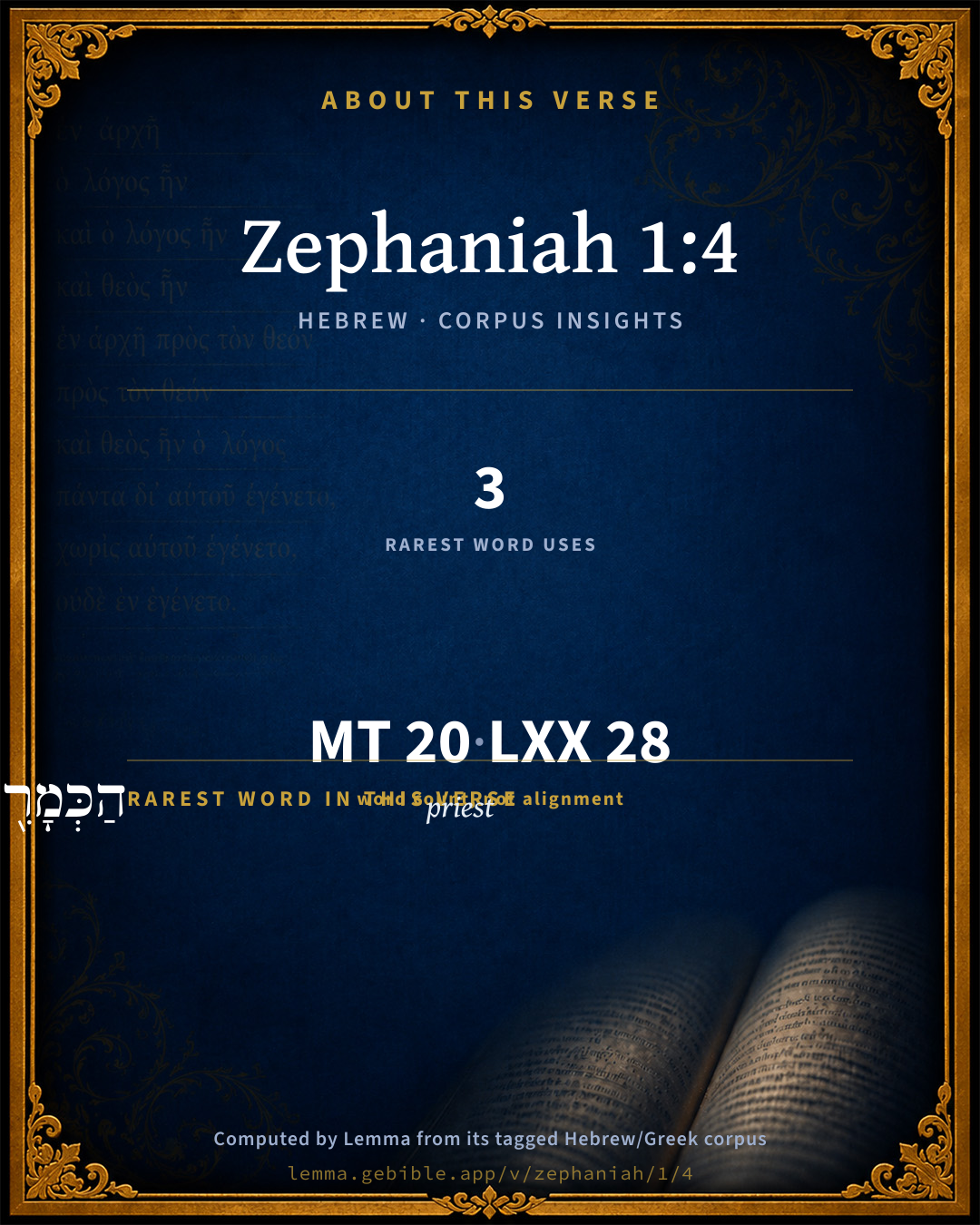
The rarest word here is הַכְּמָרִ֖ים priest H3649 — appearing just 3 times in the whole Hebrew Bible.

Shared distinctive vocabulary

הַכְּמָרִ֖ים priest H3649 occurs in 3 verses of the Hebrew Bible. Also found in:

Grammatical profile

  • 3 verbs
  • 10 nouns
  • 1 pronoun
  • 4 prepositions
  • 2 particles

Verb forms

  • וְנָטִ֤יתִי Qal · Sequential Perfect
  • יוֹשְׁבֵ֣י Qal · Participle Active
  • וְהִכְרַתִּ֞י Hiphil · Sequential Perfect

Repetition

A word recurs within this verse — often emphatic in Hebrew:

Hebrew & Septuagint length

In English translation the verse runs 34 words from the Hebrew and 34 from the Septuagint (LXX English) — the same length.

A rough comparison of the two English renderings, which tokenize alike — not a word-level alignment.

Word counts can differ between the Hebrew and the Greek without any difference in meaning — e.g. the Hebrew direct-object marker אֵת has no separate Greek word, and Greek often adds the article ὁ.

In the original languages it is 20 Hebrew tokens and 28 Greek tokens — but the two are counted differently (Hebrew bundles its prefixes and suffixes into one token; the Greek is in lemma form), so that isn’t a like-for-like length.

Cross-references

8

Topical passages linked to Zephaniah 1:4 in the Treasury of Scripture Knowledge — connected by theme and wording, ordered by reader-vote popularity; previews shown in the World English Bible.

  • Hosea 10:5 The inhabitants of Samaria will be in terror for the calves of Beth Aven; For its people will mourn over it, Along with its priests who rejoiced over it, For its glory, because it has departed from it.
  • 2 Kings 23:4–5 The king commanded Hilkiah the high priest, and the priests of the second order, and the keepers of the threshold, to bring forth out of the temple of Yahweh all the vessels that were made for Baal, and for the Asherah, and for all the host of the sky, and he burned them outside of Jerusalem in the fields of the Kidron, and carried the ashes of them to Bethel.
  • Micah 5:13 I will cut off your engraved images and your pillars out of your midst; And you shall no more worship the work of your hands.
  • 2 Kings 21:13 I will stretch over Jerusalem the line of Samaria, and the plummet of the house of Ahab; and I will wipe Jerusalem as a man wipes a dish, wiping it and turning it upside down.
  • 2 Chronicles 34:4 They broke down the altars of the Baals in his presence; and the sun-images that were on high above them he hewed down; and the Asherim, and the engraved images, and the molten images, he broke in pieces, and made dust of them, and strewed it on the graves [of those] who had sacrificed to them.
  • Isaiah 14:26–27 This is the purpose that is purposed on the whole earth; and this is the hand that is stretched out on all the nations.
  • Jeremiah 6:12 Their houses shall be turned to others, their fields and their wives together; for I will stretch out my hand on the inhabitants of the land, says Yahweh.
  • Exodus 15:12 You stretched out your right hand. The earth swallowed them.

Cross-references courtesy of OpenBible.info (CC BY 4.0).

Hebrew and Greek witnesses Masoretic Hebrew ↔ Greek Septuagint

The same verse in the two great witnesses to the Old Testament, shown verse-for-verse.

These are two independent witnesses, not word-aligned to each other, and the Septuagint is shown in lemma (dictionary) form.

Hebrew Zephaniah 1:4 Masoretic · Westminster Leningrad Codex

וְנָטִ֤יתִי יָדִי֙ עַל יְהוּדָ֔ה וְעַ֖ל כָּל יוֹשְׁבֵ֣י יְרוּשָׁלִָ֑ם וְהִכְרַתִּ֞י מִן הַמָּק֤וֹם הַזֶּה֙ אֶת שְׁאָ֣ר הַבַּ֔עַל אֶת שֵׁ֥ם הַכְּמָרִ֖ים עִם הַכֹּהֲנִֽים

I will stretch out my hand against Judah, and against all the inhabitants of Jerusalem. I will cut off the remnant of Baal from this place: the name of the idolatrous and pagan priests,

World English Bible · Public Domain

Greek LXX Zephaniah 1:4 Septuagint · lemma form

καί ἐκτείνω ὁ χείρ ἐγώ ἐπί ἰούδας καί ἐπί πᾶς ὁ καταοἰκέω ἰερουσαλήμ καί ἐκαἴρω ἐκ ὁ τόπος οὗτος ὁ ὄνομα ὁ βααλ καί ὁ ὄνομα ὁ ἱερεύς

And I will stretch out my hand upon Juda, and upon all the inhabitants of Jerusalem; and I will remove the names of Baal out of this place, and the names of the priests;

LXX2012 (modern English Septuagint) · Public Domain

On this verse, Whedon's Commentary on the Bible discusses the Septuagint’s reading. Read the note in Commentary ↓

Hebrew: Westminster Leningrad Codex (CC BY 4.0). Greek: Septuagint (public domain); English from LXX2012 (modern English Septuagint) (Public Domain). How the Septuagint differs from the Hebrew →

Targum (Aramaic paraphrase)

1

The Targum is the ancient Jewish Aramaic paraphrase of the Hebrew Scriptures — an interpretive translation, not the Hebrew text itself. Onkelos (literal) and Pseudo-Jonathan (expansive) render the Torah, and Jonathan the Prophets. Coverage is partial: where no permissively-licensed English translation exists for a verse, only the Aramaic is shown. This is verse-level text, not a word-by-word alignment to the Hebrew.

  1. Targum Jonathan Prophets (Joshua–Malachi)
    וַאֲרִים מְחַת גְבוּרְתִּי עַל אֱנַשׁ יְהוּדָה וְעַל כָּל יַתְבֵי יְרוּשְׁלֵם וֶאֱשֵׁיצֵי מִן אַתְרָא הָדֵין יַת שְׁאַר בַּעֲלָא וְיַת שׁוּם פָּלְחֵיהוֹן עִם כּוּמָרֵיהוֹן:

    (no public-domain English translation for this verse)

    Targum Jonathan — Aramaic: “Mikraot Gedolot” (public domain). English: “Sefaria Community Translation” (CC0 1.0 (public-domain dedication)); “London "Chaldee Paraphrase," 1871” (public domain). Text via Sefaria.

Commentary

Notes on Zephaniah 1:4 from classic Christian and Jewish commentators (each source and its license shown beneath its notes). The classic Christian expositions comment on the surrounding passage and are grouped to its opening verse, so a note may address several verses; the Jewish commentaries on the Tanakh (Rashi and others) are per-verse, so they appear only where the commentator wrote on this verse.

Lemma curates 59 commentaries, every one of them public domain or Creative Commons licensed, each selected and text-cleaned for this edition rather than reprinted as found. About our sources →

Trapp's Complete Commentary

John Trapp

Zep 1:4 I will also stretch out mine hand upon Judah, and upon all the inhabitants of Jerusalem; and I will cut off the remnant of Baal from this place, [and] the name of the Chemarims with the priests;

Ver. 4. I will also stretch out mine hand upon Judah] To whom I have so long stretched out my hand in vain to reclaim them, Isa 65:2 Pro 1:25. If God do but put forth his hand to afflict, as Satan solicited him to do against Job, Job 1:11; Job 2:5, who can abide it? but if he stretch it out as here, woe be to those that must feel the weight of it! His hand is a mighty hand, 1Pe 5:6, the same that spans the heavens, and holds the earth as a very little thing, Isa 40:15. "Lord," saith David (who had felt it in part), "who knoweth the power of thine anger? Even according to thy fear, so is thy wrath." q.d. Let a man fear thee never so much, he is sure to feel thee much more who falleth under the stroke of thine heavy hand. Oh keep out of his fingers, who can crush us to death before the moth, Job 4:19.

And upon all the inhabitants of Jerusalem] Who are therefore worse than others because they should be better; and shall fare the worse for their external privileges wherein they glory.

And I will cut off the remnant of Baal from this place] That which remained since Josiah’s reformation, 2Ki 23:3-5, saith Diodati, shall a nation be born at once? Isa 66:8.

And the name of the Chemarims] Baal’s chimney chaplains, they are translated idolatrous priests, 1Ch 23:5. But because we find them here mentioned as distinct from the priests, therefore many expositors hold that they were certain ministers of their idolatry different from the priests; such as the monks are among the Papists. The Vulgate rendereth it Aedituos, underlings to the other priests: Elias in Tisby, saith they were such as were shut up in cloisters, Chemarim Atrati they are called, either from their black garments, or because they were smutched with burning incense, or from the brandmarks they had superstitiously set upon their bodies, or because of their pretended fiery zeal and fervency in their religion, such as are the Sacrifici Seraphici among the Papists, who falsely and foolishly call them the lights of the world, sc. to light them into utter darkness.

John Trapp, A Commentary or Exposition upon All the Books of the Old and New Testament (1647–1656) — public domain. Text from a community e-Sword module.

The Biblical Illustrator

Joseph S. Exell

Zep_1:4-5

And that swear by the Lord, and that swear by Malcham

The demonstrativeness of true religion

In this text it is a sort of mixed religion that the Lord declares He will not tolerate.

Impress t he necessity of decision in religion. What is the lowest amount of faith in Jesus Christ which will avail to save a mans soul?

1. What definition the Scripture gives us of true Christianity. Mark the distinction between coming to Christ and following Christ. Coming to Christ costs a man nothing; but following Christ and remaining with Christ involve the taking up the cross and the exercise of stern self-denial. True Christianity demands an entire surrender of the heart to God, a thorough abandonment of wilful sin, an unceasing vigilance against the wiles of the devil.

2. If a man has cordially embraced, with a living faith, the truth as it is in Jesus, will he--can he--be undemonstrative? By demonstrativeness is not meant talkativeness, nor can it be explained by formalism. When forms are allowed to usurp the place of the heart, they demonstrate too much. Nor is it being charitable, or regularly attending worship. By demonstrativeness is meant a quiet earnestness, which will show itself as much by what it does not as by what it does. A man cannot, in a proper sense, be undemonstrative if he has embraced, with a living faith, the truth as it is in Jesus.

3. To what is the undemonstrativeness of the mere professor of religion traceable? Is it not that he makes God the offering of half his heart, while he gives the other half to the world?

4. Are we to call the undemonstrative true Christians, and the demonstrative advanced Christians? Let God answer. See the text. He who readeth the heart will not be mocked and trifled with. God will cut off the undecided. In the last great assize those who in their lives have halted between two opinions shall find no mercy. (W. I. Chapman, M. A.)

Double-hearted people

A little while ago I was with some friends, going through Her Majestys State apartments in Windsor Castle. At the end of the great banquet-hall we were shown, in a gallery above our heads, a fine organ. Now this organ, I found, was just like one of the double-hearted people; for the old man who was taking us round explained carefully that it performed double duty, having two finger-boards. At the sides from which we saw it it was played on the occasion of a royal banquet, to the delight and pleasure of those who feasted below. But on the side which we could not see it had another finger-board, and performed a wholly different service, for it was in the royal chapel, and pealed forth strains of sacred music to help the worship of those who gathered there. Well, I despised that organ for its double-dealing, though, of course, you know the organ could not help itself. It was only what it had been made, but it seemed to me like a double-minded man, unstable in all his ways. God keep us from having two finger-beards. Do you understand what I mean. Do you see that we, who are blood-bought and made nigh to God, have the blessed privilege of being brought as worshippers into the holiest? That there we may be as beautiful instruments, in full tune for the Masters hand, that, when He strikes the chords, there may rise rich swelling notes of worship and praise to His ear and heart. Having, then, a finger-board in the holiest, in the place of worship, let us be very jealous that there be none to which the revellers of this world can have access, that no note of sympathy may be ever struck from our hearts by the world, that has rejected Christ, the David whom we own as Lord. (A. J. Gordon, D. D.)

There ought to be continuity in our religious life

There should be continuity in our religious life. Some people are pious by fits and starts. They are with God in the sanctuary, but not in the shop; they drink the cup of the Lord on Sunday, and the cup of the devil on Monday. At the mouths of certain large rivers are formed what geologists call lagoons. A lagoon is a small lake separated from the sea by a bar of sand, and is filled with fresh and salt water by turns. Often a lagoon communicates exclusively with the river for months, and during this period its water is fresh. Then a breach is made in the bar of sand and there is an eruption of salt water, which for a season holds undisputed sway. In these lagoons we may find an illustration of not a few people connected with all our churches. For a time they are seemingly in communication with God and spiritual things, and these are the forces that shape and mould and colour their life. But suddenly that communication seems to break off, to be interrupted; the world rushes in through some breach of their own making, and for a season, at least, the things that are seen and temporal gain complete mastery over them. The change in their life and conduct is no less marked than the change in the waters of the lagoon. This type of Christian, this religious Reuben, will never attain to spiritual strength and ripeness, the stature of the perfect man Christ Jesus. The true follower of the Son of Man finds his illustration not in the lagoon, but in the glory of the Shechinah which shone continuously and with unabated splendour in the temple. (W. B. Sproule.)

The Biblical Illustrator, edited by Joseph S. Exell (c. 1880s–1900s) — public domain. Text from a community e-Sword module.

Joseph Benson's Commentary

Zep 1:4-6. I will also stretch out my hand upon Judah — I will manifest my power upon Judah, as I have done upon Israel. And I will cut off the remnant of Baal — The altars, or places of worship, dedicated to Baal, which still remain in this place, namely, Jerusalem; and the name of the Chemarims — Of the idolatrous priests, for so the same word is rendered 2Ki 23:5, where see the note; with the priests — That is, I will destroy these together with the priests of the tribe of Levi, who have been joined in the worship of idols, in which, as we learn from Eze 8:11; Eze 22:26, some of them were joined. And them that worship the host of heaven upon the house-tops — They were wont to worship the moon and stars upon the roofs of their houses, which were made flat. And that swear by the Lord, and by Malcham — That join the worship of idols to that of the true God. Malcham is the same with Moloch, to whom many of the people of Judah continued to offer their children, as Jeremiah upbraids them, Jer 7:31; Jer 19:5; and that, it seems, after the reformation that Josiah had made. Swearing is an act of religious worship, or a solemn invocation of God, as a witness and a judge, Deu 10:20; and therefore the Israelites were expressly forbidden to swear by idols, Jos 23:7. And them that are turned back, &c. — That are apostates to idolatry. And those that have not sought the Lord — That live without any sense of religion, and, as it were, without God in the world.

Joseph Benson's Commentary on the Old and New Testaments (1811–1818) — public domain. Text from a community e-Sword module.

Whedon's Commentary on the Bible

Daniel D. Whedon

Judgment upon Judah and Jerusalem, Zep_1:4-9.

The judgment will be particularly severe upon Judah and Jerusalem (4), because they “have not sought Jehovah nor inquired after him”; instead, they have practiced idolatrous rites of various kinds (Zep_1:4-6). In Jerusalem the ungodly nobles will suffer the most, because they are arrogant and have practiced oppression, violence, and deceit (Zep_1:7-9).

4. Stretch out mine hand — To smite (Isa_5:25; Isa_9:12 ff.). Equivalent to “turn my hand against” (see on Amo_1:8).

Judah,… Jerusalem — Zephaniah prophesies concerning the southern kingdom; the northern kingdom was destroyed a century before his day.

Remnant of Baal — Literally, remnant of the Baal. The translators of LXX. have been influenced by Hos_2:17, “the names of the Baalim”; at any rate, there seems insufficient reason for doubting the originality of the present Hebrew text. The Baal is not the Tyrian Baal, but the Canaanitish Baal, or rather Baals (see on Hos_2:5), for the noun is used here collectively. Zephaniah may use the term in an even wider sense, as including all forms of illegitimate worship, all of which were due very largely to Canaanitish influence. The expression remnant does not presuppose necessarily the reform of 621 B.C., as if the prophet desired to say that all that was left from that reform would be destroyed in a judgment to come; it means, rather, “every vestige of Baal worship,” that is, all there is of it (compare Isa_14:22). The expression does not presuppose even a preliminary attempt at purifying the worship of Jehovah (see p. 508).

From this place — Jerusalem. If Zephaniah prophesied in the capital this expression is perfectly intelligible even before the concentration of worship in Jerusalem.

The name of the Chemarims with the priests — LXX. simply, “the names of the priests,” which reading implies the omission of either “Chemarims” or “priests,” and the omission of one of these words is favored by most recent commentators, including the cautious Davidson. Both nouns mean priests; the second is the common Old Testament term, the other is used only three times. Its etymology is uncertain, but the usage in the other passages (Hos_10:5; 2Ki_23:5) shows that it is applied to the priests at the local sanctuaries, officiating at the counterfeit Jehovah worship practiced there. If both words are original, the second refers to priests practicing out-and-out idolatry. Against this interpretation Davidson raises the objection that “in such a case the term priest would have been more fully defined.” But such definition is not needed, because the context leaves no doubt as to the persons in the prophet’s mind. At any rate, the arguments against the originality of the present Hebrew text are by no means conclusive. May not the omission of LXX. be due to the failure of the translators to grasp fully the thought of the prophet and the distinction he desired to make? In Zep_1:5 he distinguishes between two classes of worshipers; why might he not also make a distinction between two classes of priests? Counterfeit Jehovah priests as well as out-and-out idol priests are to be cut off, so that even their names shall be heard no more. If one name is omitted, the remaining one must include both classes.

Daniel D. Whedon (gen. ed.), Commentary on the Old and New Testaments (1874–1909) — public domain. Text from a community e-Sword module.

The Preacher's Complete Homiletical Commentary

Joseph S. Exell (gen. ed.)

CRITICAL NOTES.]

Zep_1:4.] Judgment, especially upon Judah. Stretch] Not only threaten, but exert power to injury. Remnant] Statues, images dedicated to Baal, domestic and tutelary god of the Phœnicians.

Zep_1:5.] The people now denounced for star-worship and incense-burning upon the flat roofs of houses (cf. Jer_19:13; 2Ki_23:12); for combining the worship of God with idolatry. Swear] Acknowledge in public, solemn manner; openly to pledge one’s service (2Ch_15:14).

Zep_1:6.] Two further classes mentioned—those who entirely apostate, and those who are indifferent.

HOMILETICS

JUDGMENT AT THE HOUSE OF GOD.—Zep_1:4-6

The prophet now declares upon whom the sore desolation must come. Even Judah, where God is known, and Jerusalem, the holy city, must suffer. Those most exalted are most responsible, and those who sin against greater privileges will be most signally punished. Judgment must begin at the house of God. Six classes are singled out for judgment.

I. Idolatrous priests destroyed. Two kinds are specified.

1. Inferior priests. “The Chemarims,” priests ordained by the kings of Judah to minister at high places, or at the altar of Jehovah, with alien and impure rites (cf. 2Ki_23:5; Hos_10:5). “In either case,” says one, “they were renegades from the national faith; miscreants, who, to earn a loaf of bread or to win the favour of the court, were prepared to stand at any altar and administer any ritual.”

2. Superior priests. “The Chemarims with the priests.” Those of the family of Aaron, Levitical priests, who have apostatized to idolatry. Such ministers are not worthy of the name and office of priest. Corrupt in doctrine, flagrant in practice, their very name shall be blotted out of existence. Ministers who pervert the national faith, and sell their birthright to gain the favour of the world, will suffer awful punishment. “A wonderful and horrible thing is committed in the land, the prophets prophesy falsely, and the priests bear rule at their hands.”

II. Idolatrous people destroyed. Corrupt priests influence the people. From the ministers the judgments pass to the people. Three classes are pointed out.

1. Open idolaters. These blended the worship of Baal (sun) and Astarte (moon) with Sabæism or pure star-worship. The stars were thought to be originators of all growth and decay in nature, and rulers of all sublunary events (2Ki_21:3). The housetop was chosen for secrecy, or to obtain fuller views of the heavenly bodies. This custom was (a) prevalent, and (b) popular. Public idolatry was individualized and adopted, family by family. From house to house, from street to street, incense burned and homage rendered to the queen of heaven. “The children gather wood, and the fathers kindle the fire, and the women knead the dough to make cakes to the queen of heaven, and to pour out drink-offerings unto other gods.”

2. Time-servers. “Them that swear by the Lord, and by Malcham.” They swore allegiance to God, but lived to Moloch or Baal as their king. To the service of Jehovah they joined that of idols, and sought to be on good terms with both. One of our own poets stigmatizes them, “as willing to serve God, so that they did not offend the devil.” They thought Jehovah the true God, but yielded to the fashion and adopted the religion of the day. Principle had no hold upon them, and reproach was endured for present advantage. “Will ye steal, swear falsely, and burn incense to Baal, and walk after other gods, and come and stand before me in this house; which is called by my name” (Jer_7:8-10; Jer_5:7).

3. Religiously indifferent. “Returning behind Jehovah, drawing back from him, turning the back upon God, is just the same as not seeking Jehovah, or not inquiring after him. The persons referred to are the religiously indifferent, those who do not trouble themselves about God, the despisers of God” [Keil]. Notice the steps of this departure. They do not want God, and therefore do not seek him. They fear his presence might embarrass them, and therefore forget him as much as they can. Then they cast him behind them, abstain from all worship, and renounce every custom that would bring him to their minds. “Thou hast forsaken me, saith the Lord, thou art gone backward: therefore will I stretch out my hand against thee, and destroy thee.”

FOUR CLASSES OF UNGODLY MEN.—Zep_1:5-6

I. The worshippers of nature. When men see beauty in creatures, and derive advantage from them, their hearts dote upon them, and are drawn from God. Men adore nature, and forget nature’s God. A specious and plausible idolatry abounds in our day. To honour a star is quite as offensive to God as to honour a stone. To worship the splendours of heaven or the wealth of earth; to love self, family, or business more than God is “to change the truth of God into a lie, and worship and serve the creature more than the Creator, who is blessed for ever.”

“They trifle with the truth, until, at last,

Delusions strong as hell shall bind them fast” [Cowper].

II. The half-hearted in religion. By acts of solemn profession they worship God, and then try to serve the world. They pledge themselves first to one and then the other, and try to serve two masters. This is morally impossible. The affections cannot be divided. One only can be our master, call him Baal, Moloch, or Christ. All men are made to serve something. The choice lies between Christ and the world. Compromise and neutrality are impossible. “How long halt ye between two opinions?”

III. The backsliders from God. This class is too common. Many once started well, were firm in purpose, and kept their face Zionwards, but have ceased to follow after, and utterly forsaken the Lord. To go back from God is virtually to join the enemy. “He that is not with me is against me.” Wandering is the natural tendency of man; but to wander out of the way of understanding, amid light, conviction, and privileges, awfully aggravates the sin. Watch the first step in feeling and practice, lest it fix you in a state of apostasy among “the mighty dead.” Backsliding is the fountain of its own misery, and the most fearful of Divine judgments. “The backslider in heart shall be filled with his own ways.”

IV. The practical atheists. Those guilty of defection will soon live in total neglect of God and his ways. It is said that a sheep, having once wandered from the fold, never tries to return, but “wanders on still more and more astray;” so in many cases backslidings are multiplied until men are reduced to extremity and ruin. “Ah, sinful nation, a people laden with iniquity, a seed of evildoers, children that are corrupters: they have forsaken the Lord, they have provoked the Holy One of Israel unto anger, they are gone away backward.”

HOMILETIC HINTS AND SUGGESTIONS

Zep_1:4. The remnant of Baal.

1. Good men may be hindered in their work, or leave it partially done. Hezekiah’s and Josiah’s reformation did not clear away the idolatry of Baal. Moses and Luther did not entirely finish their work. “Good and evil have each a root, which remains in the ground when the trunk has been hewn down. There is a remnant of grace when the rest have been blinded (Rom_11:5-7); and this is a holy seed to carry on the line of God (Isa_6:13). Evil too has its remnant, which, unless diligently kept down, shoots up again, after the conversion of peoples or individuals” [Pusey].

2. The presence and efforts of good men increase the guilt and the responsibility of any nations.

3. If these nations heed not their warnings or hinder their work, God may justly punish them for their sin. God will consume Judah for the remnant that remains. The reign of the pious Josiah preceded the doom of Judah, to deprive the people of all excuse. “I will also stretch out mine hand upon Judah, and upon all the inhabitants of Jerusalem.”

Zep_1:6. Positive and negative apostasy. Positive, in forsaking the Lord for idols; negative, in ceasing to “seek” after him in real prayer. The latter is the forerunner of the former: many who do not go so far as open apostasy, are virtually guilty of it, for they do not “inquire for” the Lord. This verse describes more comprehensively those guilty of defection from Jehovah in any way. “My people have committed two evils; they have forsaken me, the fountain of living waters, and hewed them out cisterns, broken cisterns, that can hold no water” [Fausset].

Seeking God.

1. God must be sought diligently to be found.

2. Men do not seek God diligently.

3. The natural consequences are, turning back, forgetfulness, and carelessness. “Not sought. Diligently sought him (Heb_11:6), zealously inquired after him, as after a lost jewel (Jer_29:13) God will visit for unzealousness; and curse those that do his work carelessly, cursorily, in a perfunctory, formal way” [Trapp].

ILLUSTRATIONS TO CHAPTER 1

Zep_1:4-6. Remnant. Baal was the Phœnician tutelary god. His name means lord; and the feminine deity corresponding, and generally associated, with him, was Ashtoreth. As he was represented by the sun, so she was the goddess answering to the moon and the rest of the heavenly bodies. In fact, it was the worship of nature; a worship to which correspond the pantheism and scientific exaltation of nature and her laws in our days [Fausset]. They offered the sacrifices upon the roofs, that they might be the better able to see the stars in heaven [Theodoret]. Swear. A neuter is a monster; he hath two tongues, two minds, two souls: he hath a tongue for God, and a tongue for the world too: he looks up to God, and saith, certainly thou art mine: he looks down upon the world, and saith, surely I am thine; he hath a mind to be religious, and a mind to save his own stake in the world too [Brooks].

The Preacher's Complete Homiletical Commentary (gen. ed. Joseph S. Exell; Funk & Wagnalls, c. 1892) — public domain (pre-1929). A full-Bible homiletical/sermon-outline anthology covering 65 of 66 books (2 John is absent from the source module). Text from a community e-Sword module.

Keil & Delitzsch

C. F. Keil & F. Delitzsch

The judgment coming upon the whole earth with all its inhabitants will fall especially upon Judah and Jerusalem. Zep 1:4. "And I stretch my hand over Judah, and over all the inhabitants of Jerusalem, and cut off from this place the remnant of Baal, the name of the consecrated servants, together with the priests. Zep 1:5. And those who worship the army of heaven upon the roofs, and the worshippers who swear to Jehovah, and who swear by their king. Zep 1:6. And those who draw back from Jehovah, and who did not seek Jehovah, and did not inquire for Him." God stretches out His hand (יד) or His arm (זרוע) to smite the ungodly with judgments (compare Zephaniah 6:6, Deu 4:34; Deu 5:15, with Isa 5:25; Isa 9:11, Isa 9:16, Isa 9:20; Isa 10:4; Isa 14:26.). Through the judgment upon Judah and Jerusalem He will cut off שׁאר הבּעל, the remnant of Baal, i.e., all that remains of Baal and of idolatry; for Baal or the Baal-worship stands per synecdochen for idolatry of every kind (see at Hos 2:10). The emphasis lies upon "the remnant," all that still exists of the Baal-worship or idolatry, even to the very last remnant; so that the emphasis presupposes that the extermination has already begun, that the worship of Baal no longer exists in undiminished force and extent. It must not be limited, however, to the complete abolition of the outward or grosser idolatry, but includes the utter extermination of the grosser as well as the more refined Baal-worship. That the words should be so understood is required by the parallel clause: the name of the consecrated servants together with the priests. Kemârı̄m are not prophets of Baal, but, as in Kg2 23:5 and Hos 10:5, the priests appointed by the kings of Judah for the worship of the high places and the idolatrous worship of Jehovah (for the etymology of the word, see at Kg2 23:5). The kōhănı̄m, as distinguished from these, are idolatrous priests in the stricter sense of the word (i.e., those who conducted the literal idolatry). The names of both the idolatrous priests of Jehovah and the literal priests of the idols are to be cut off, so that not only the persons referred to will disappear, but even their names will be heard no more. Along with the idols and their priests, the worshippers of idols are also to be destroyed. Just as in Zep 1:4 two classes of priests are distinguished, so in Zep 1:5 are two classes of worshippers, viz., (1) the star-worshippers, and (2) those who tried to combine the worship of Jehovah and the worship of idols; and to these a third class is added in Zep 1:6. The worship of the stars was partly Baal-worship, the sun, moon, and stars being worshipped as the bearers of the powers of nature worshipped in Baal and Asherah (see at Kg2 23:5); and partly Sabaeism or pure star-worship, the stars being worshipped as the originators of all growth and decay in nature, and the leaders and regulators of all sublunary things (see at Kg2 21:3). The worship took place upon the roofs, i.e., on altars erected upon the flat roofs of the houses, chiefly by the burning of incense (Jer 19:13), but also by the offering of sacrifices (Kg2 23:12; see the comm. in loc.). "They offered the sacrifices upon the roofs, that they might be the better able to see the stars in the heavens" (Theodoret). Along with the star-worshippers as the representatives of literal idolatry, Zephaniah mentions as a second class the worshippers who swear partly to Jehovah, and partly by their king, i.e., who go limping on two sides (Kg1 18:21), or try to combine the worship of Jehovah with that of Baal. Malkâm, their king, is Baal, who is distinctly called king in the inscriptions (see Movers, Phnizier, i. pp. 171-2), and not the "earthly king of the nation," as Hitzig has erroneously interpreted the Masoretic text, in consequence of which he proposes to read milkōm, i.e., Moloch. נשׁבּע with ל signifies to take an oath to Jehovah, i.e., to bind one's self on oath to His service; whereas נשׁבּע with ב (to swear by a person) means to call upon Him as God when taking an oath. The difference between the two expressions answers exactly to the religious attitude of the men in question, who pretended to be worshippers of Jehovah, and yet with every asseveration took the name of Baal into their mouth. In Zep 1:6 we have not two further classes mentioned, viz., "the vicious and the irreligious," as Hitzig supposes; but the persons here described form only one single class. Retiring behind Jehovah, drawing back from Him, turning the back upon God, is just the same as not seeking Jehovah, or not inquiring after Him. The persons referred to are the religiously indifferent, those who do not trouble themselves about God, the despisers of God.

Keil & Delitzsch — Biblical Commentary on the Old Testament (1861–1891) — public domain (CC PDM 1.0). Text via the HelloAO Bible API. (Old Testament only.)

Tyndale Open Study Notes

Tyndale Open Resources

1:4-6 Having pronounced judgment on the whole earth (1:2-3), Zephaniah now focuses attention on his own people, Judah and Jerusalem.

1:4 When Zephaniah made this prophecy, before Josiah’s reforms in 622 BC, idolatrous priests rampantly promoted Baal worship and other forms of paganism (2 Kgs 23:5).

Tyndale Open Study Notes — © Tyndale Open Resources, licensed CC BY-SA 4.0. Text via the HelloAO Bible API.

unfoldingWord translationNotes

Door43 World Missions Community

General Information:

Verses Zep 1:2-18 refer to Yahweh's judgment. Verses Zep 1:4-16 describe Yahweh's judgment on the people of Judah.

I will reach out with my hand over Judah

This is an idiom that means God will punish. AT: "I will punish Judah" (See: Idiom)

I will cut off every remnant ... the names of the idolatrous people among the priests ... the people who on the housetops ... the people who worship and swear

The verb "cut off" applies to each of these phrases, but has been used only once to avoid repetition. AT: "I will cut off every remnant ... I will cut off the names of the idolatrous people among the priests ... I will cut off the people who on the housetops ... I will cut off the people who worship and swear" (See: Ellipsis)

cut off

Destroying is spoken of as if it were cutting something off from what it was a part of. See how you translated this in Zephaniah 1:3. AT: "destroy" (See: Metaphor)

cut off ... the names of the idolatrous people among the priests

Here "cut off ... the names" is an idiom that means to cause people to forget them. AT: "cause everyone ... to forget the priests who are idolatrous" (See: Idiom)

by their king

See the footnote about the possible rendering of this as "by Milcom."

neither seek Yahweh nor ask for his guidance

Seeking Yahweh represents either 1) asking God for help or 2) thinking about God and obeying him. AT: "do not think about Yahweh or ask him to guide them" (See: Metaphor)

translationWords

Judah

Jerusalem

cut off

remnant

Baal

false god

priest

unfoldingWord translationNotes — © Distant Shores Media and the Door43 World Missions Community, licensed CC BY-SA 4.0. Source: git.door43.org/Door43/en_tn.

Geneva Bible (1599)

Geneva Bible translators

Which were an order of superstitious priests appointed to minister in the service of Baal, and were as his peculiar chaplains, read 2 Kings 23:5; Hos. 10:5.

Geneva Bible (1599) marginal notes — public domain. Text via Bolls.life.

Jamieson, Fausset & Brown

Robert Jamieson, A. R. Fausset & David Brown

stretch out mine hand--indicating some remarkable and unusual work of vengeance (Isa 5:25; Isa 9:12, Isa 9:17, Isa 9:21).

Judah--including Benjamin. These two tribes are to suffer, which thought themselves perpetually secure, because they escaped the captivity in which the ten tribes were involved.

Jerusalem--the fountainhead of the evil. God begins with His sanctuary (Eze 9:6), and those who are nigh Him (Lev 10:3).

the remnant of Baal--the remains of Baal worship, which as yet Josiah was unable utterly to eradicate in remote places. Baal was the Phœnician tutelary god. From the time of the Judges (Jdg 2:13), Israel had fallen into this idolatry; and Manasseh lately had set up this idol within Jehovah's temple itself (Kg2 21:3, Kg2 21:5, Kg2 21:7). Josiah began his reformation in the twelfth year of his reign (Ch2 34:4, Ch2 34:8), and in the eighteenth had as far as possible completed it.

Chemarims--idol priests, who had not reached the age of puberty; meaning "ministers of the gods" [SERVIUS on Æneid, 11], the same name as the Tyrian Camilli, r and l being interchangeable (compare Hos 10:5, Margin). Josiah is expressly said (Kg2 23:5, Margin) to have "put down the Chemarim." The Hebrew root means "black" (from the black garments which they wore or the marks which they branded on their foreheads); or "zealous," from their idolatrous fanaticism. The very "name," as well as themselves, shall be forgotten.

the priests--of Jehovah, of Aaronic descent, who ought to have used all their power to eradicate, but who secretly abetted, idolatry (compare Zep 3:4; Eze. 8:1-18; Eze 22:26; Eze 44:10). From the priests Zephaniah passes to the people.

Jamieson, Fausset & Brown — Commentary Critical and Explanatory on the Whole Bible (1871) — public domain (CC PDM 1.0). Text via the HelloAO Bible API.

Adam Clarke's Commentary

Verse 4. I will cut off the remnant of Baal] I think he refers here, partly at least, to the reformation which Josiah was to bring about. See the account, 2Kg 23:5.

The Chemarims] The black-robed priests of different idols. 2Kg 23:5. These were put down by Josiah.

Adam Clarke's Commentary on the Bible (1810–1826) — public domain. Text from a community e-Sword/MySword module.

John Calvin's Commentaries

The Prophet explains still more clearly why he directed his discourse in the last verse against the beasts of the earth and the birds of heaven, even for this end—that the Jews might understand that God was angry with them. I will stretch forth, he says, my hand on Judah and on Jerusalem. God, then, by executing his vengeance on animals, intended to exhibit to the Jews, as in a picture, the dreadfulness of his wrath, which yet they despised and regarded as nothing. The stretching forth of God’s hand I have elsewhere explained; and it means even this—that he stretches forth his hand when he acts in an unusual manner, and employs means beyond what is common. We indeed know that God has no hands, and we also know that he performs all things by his command alone: but as everything seen in the world is called the work of his hands, so he is said to stretch forth his hand when he mentions a work that is remarkable and worthy of being remembered. In a like manner, when I intend to do some slight work, I only move my hand; but when I have some difficult work to do, I prepare myself more carefully, and also stretch forth my arms. This metaphor, then, is intended only for this purpose, to render men more attentive to God’s works, when he is set forth as stretching forth his hand.

But he says, on Judah and on the inhabitants of Jerusalem. The kingdom of Israel had now been abolished, and the ten tribes had been led into exile; and a few only of the lowest and the poorest remained. The Jews thought themselves safe for ever, because they had escaped that calamity. This is the reason why the Prophet declares that God’s judgment was impending not only over the kingdom of Judah, but also over the holy city, which thought itself exempt from all such evil, because there were the sacrifices performed, and there was the royal city, and, in short, because God had testified that his habitation was to be there for ever. Since, then, by this vain confidence the inhabitants of Jerusalem deceived themselves and others, Zephaniah specifically addresses them. And as he had before spoken of the wicked, he intended here, no doubt, sharply to reprove the Jews, as though he said by way of anticipation, There is no reason for you to enquire who are the wicked; for ye yourselves are they, even ye who are the holy people of God and God’s chosen inheritance, ye who are the race of Abraham, who flatter yourselves so much on account of your excellency; ye are the wicked, who have not hitherto ceased to provoke the vengeance of God. And at the same time he shows, as it were by the finger, some of their sins, though he mentions others afterwards: but he speaks now of their superstitions.

I will cut off, he says, the remnants of Baal and the name of Chamerim. The severity of the Prophet may seem here again to be excessive, for being so incensed against superstitions which had been abolished by the great zeal and singular diligence of the king; but, as we have already intimated, he regarded not so much the king as the people. For though they dared not openly to adulterate God’s worship, they yet cherished those corruptions at home to which they had before been accustomed, as we see to be done at this day. For when it is not allowed to worship idols, many mutter their prayers in secret and invoke their idols: and, in short, they are restrained only by the fear of men from manifesting their own impiety; and in the meantime, they retain before God the same abominations. So it was in the time of Josiah; the people were wedded to their corruptions, and this we may easily conclude from the words of Zephaniah: for the remnants of Baal were not seen in the temple, nor in the streets, nor in their chapels, nor in the high places; but their hidden impiety is here discovered by the Spirit of God; and no doubt their sin was the more heinous and less excusable, because the people refused to follow their pious leader. It was indeed the most abominable ingratitude; for when they saw that the right worship was restored to them, they preferred to remain fixed in their own filth, rather than to return to God, even when they had liberty to do so, and also when that pious king extended his hand to them.

As to the word כמרים, chemarim, it designated either the worshipers of Baal or some such men as our monks at this day: and they are supposed by some to have been thus called, because they were clothed in black vestments; while others think that they derived this name from their fervor, because they were madly devoted to their superstitions, or because they had marks on their foreheads, or because they imposed, as is commonly the case, on the simple by the ardor of their zeal. The name is also found in 2 Kings 23:1 in the account given of Josiah: for it is said there, that the כמרים, chemarim, were taken away, together with other abominations of superstition. But as Zephaniah connects priests with them, it is probable that they were a kind of people like the monks, who did not themselves offer sacrifices, but were a sort of attendants, who undertook vows and offered prayers in the name of the whole people. For what some think, that they were thus called because they burnt incense, appears not to me probable; for then they must have been priests. They were then inferior to the sacrificers, and occupying a station between them and the people, like the monks and hermits of this day, who deceive foolish men by their sanctity. Such, then, were the Chemarim.

But as Josiah could not attain his object, so as immediately to cleanse the land from these pollutions, we need not wonder that at this day we are not able immediately to remove superstitions from the world: but let us in the meantime ever proceed in our course. Let those endued with authority, who bear the sword, that is, all magistrates, perform their office with greater diligence, inasmuch as they see how difficult and protracted is the contest with the ministers of idolatry. Let also the ministers of the gospel earnestly cry against idolatry, and all ungodly ceremonies, and not desist. Though they may not effect as much as they wish, yet let them follow the example of Josiah. If God should in the meantime thunder from heaven, let them not be discouraged, but, on the contrary, know that their labor is approved by him, and never doubt of their own safety; for though all were destroyed, their godly efforts would not be in vain, nor fail of a reward before God. Thus, then, ought all God’s servants to animate themselves, each in his particular sphere and vocation, whenever they have to contend with superstitions, and with such corruptions as vitiate and adulterate the pure worship of God.

John Calvin's Commentaries (1540-1563) — public domain. Text from the Calvin Translation Society English edition (1840s-50s) via the Christian Classics Ethereal Library (ccel.org). Calvin's coverage is partial (roughly two-thirds of the Bible); uncommented books and verses are honest gaps, never fabricated. The 19th-century editor's footnotes and remarks are omitted so the notes are faithfully Calvin's own voice.

Ellicott's Commentary for English Readers

(4) The remnant of Baal.—i.e., Baal worship shall he completely and utterly abolished. Not even a remnant of it shall be left. The term “remnant” need not imply, as Kleinert argues, that a large part of the Baal-worship had been already overthrown, by Josiah’s reformation.

The Chemarims.—In 2Ki_23:5, this is the designation of the “idolatrous priests whom the kings of Judah had ordained to burn incense in the high places.” The term is used again in Hos_10:5. Even the very name of these intruders is to be abolished.

The priests.—Are probably a certain section of the Jewish priesthood who had winked at this establishment of false worship.

A Bible Commentary for English Readers, edited by Charles John Ellicott (1878–1897) — public domain. Text from a community e-Sword module.

The Cambridge Bible for Schools and Colleges

gen. ed. J. J. S. Perowne

4. The prophet turns to Judah and Jerusalem. Though the Day of the Lord was the revelation of Jehovah to the world, and therefore a thing universal, the centre of the judgment in the view of the pre-exile prophets was Israel (Amos 1, 2; Isaiah 2, 3), for judgment began at the house of God (Amo_3:2). With the exile the judgment on Israel seemed to have been fulfilled, and during the exile and later the judgment of the Day of the Lord is represented as falling on the heathen world (Isaiah 13; Zechariah 1-6), and its issue is Israel’s redemption. But after the Restoration, when Israel was again a people and far from answering to its ideal, prophets have to threaten it anew with the refiner’s fire of the Day of the Lord (Mal_3:2 ff.).

I will also stretch] And I will stretch out my hand, i.e. in order to smite, Isa_5:25; Isa_9:12; Isa_14:26-27. As in Amos 1, 2 the cloud laden with judgment trails round the horizon, discharging itself on one nation after another, and finally settles over Israel, so here Jehovah’s wrath against all created things concentrates itself on Judah and Jerusalem.

the remnant of Baal from this place] The words “from this place” imply that Zephaniah lived in Jerusalem. The term Baal appears to he used, particularly in later writers, not only of Baal proper, but also of the images of Jehovah, and even in a wider way of Jehovah under any false conception of His being. Worship rendered nominally to Jehovah, but unworthy of Him, and implying an inadequate conception of His nature, was stigmatised as Baal-worship. The expression the remnant, besides its natural sense of “that which is left,” may mean “the whole,” so that “remnant of Baal” may have the sense of “false worship wholly” (Isa_14:22), and this is probably the meaning here. For “remnant” Sept. gives names of Baal, a rendering which may be due to the influence of Hos_2:17, “I will take away the names of the Baalim out of her mouth.” Cf. Zec_13:2.

the name of the Chemarims] The A.V. plur. Chemarims is of the same sort as Cherubims (Gen_3:24) and Seraphims (Isa_6:2); in Heb. the word Chemarim (pronounced Kemârim) is itself a plural. The term is derived from an Aramaic root, meaning “to be black,” but whether the priests were so named as “black-robed” or for some other reason is not certain. In addition to the present passage the word is used in Hos_10:5 of the priests of the calves in the northern kingdom, and in 2Ki_23:5 of the priests of the high places in the cities of Judah and outside Jerusalem (A.V. idolatrous priests). In the latter passage the construction leaves it somewhat uncertain whether the strictly idolatrous priests who offered sacrifice to Baal, the sun and the moon, be also included among the Chemarim. In Hos_10:5 the Sept. does not read the word, and in 2Ki_23:5 it merely transcribes the name in Greek letters.

with the priests] The clause is wanting in Sept., and may be a later addition. The view of Keil that “the priests” are the strictly idolatrous priests who sacrificed to Baal and other deities, while the Chemarim are the priests of the high places, has little probability; in such a case the term “priests” would have been more fully defined. Whether the clause be a gloss or not, the “priests” are probably the degenerate regular priests of Jehovah, such as are described in ch. Zep_3:4.

The Cambridge Bible for Schools and Colleges (gen. ed. J. J. S. Perowne; Cambridge University Press, 1878–1918) — public domain. Text from a community e-Sword module.

John Gill's Exposition

I will also stretch out mine hand upon Judah Under whom the tribe of Benjamin is comprehended, which are only designed; the ten tribes having been carried captive in Hezekiah's time many years before this: not "to Judah", as beckoning to come and hearken to him, as calling to repentance and reformation; this he had done, but was rejected, and therefore determines to stretch out his hand "upon" them; nor "over Judah", to protect and defend them; but "upon Judah", exerting his power, stirring up his wrath, and executing his vengeance; and this is dreadful and intolerable to bear! and when his hand is stretched out, it cannot be turned back; and when laid on, can never be removed, till he pleases: and upon all the inhabitants of Jerusalem; the metropolis of Judea, the royal seat of the kings of the house of David; where were the temple of the Lord; the ark, the symbol of his presence; the altar, where his priests sacrificed, and the place where his people worshipped; and yet these inhabitants should not escape the hand of the Lord, having sinned against him; nor should these things be any security to them: and I will cut off the remnant of Baal from this place; either what of the idolatry of Baal, or belonging to it, remained among the Jews after the ten tribes were carried captive; which must be the sense, if this prophecy was before the reformation was begun by Josiah; or, if after, the meaning is, what was left unremoved by him, as any of the images of Baal, or altars erected for his worship, or vessels consecrated to his service, or groves that were for his use; all which would be cut off and destroyed by the Chaldeans, as well as the worshippers of him that remained: [and] the name of the Chemarims with the priests; that is, the priests of Baal, with the priests of the tribe of Levi, who sometimes tampered and officiated with them in idolatrous service; for the word "Chemarim" is translated "idolatrous priests", ( 2 Kings 23:5 ) said to be put down by Josiah, in whose days Zephaniah prophesied; and must be the same with these, and it is used for such in ( Hosea 10:5 ) so called, either from the black garments they wore, as some think; or from the colour of their faces, smutted with the smoke of the incense they frequently offered; or of the fires in which they sacrificed, or made the children to pass through to Molech. Hillerus F11 thinks they are the same with those heathen priests called "Phallophori"; deriving the word from one in the Arabic language, which has the signification of the "Phalli"; which were obscene images, carried about in an impudent manner by the priests of Bacchus, in the performance of his sacred rites: the carrying of them was first instituted by Isis, as Plutarch FOOTNOTES: F12 says; and if this was the case here, it is no wonder they should be so severely threatened. Some take them to be a sort of servants or ministers to the priests of Baal, who waited on them at the time of service; and so are distinguished from them in this clause, taking the word "priests" in it to design the priests of Baal; and the Vulgate Latin version renders it, "the name of sextons with the priests". The word is used now by the Jews for Popish monks that live in cloisters; and Elias Levita F13 thinks these here are so called from their living in such like recluse places. The Targum is, ``and the name of their worshippers with their priests;'' one and the other; priests of Baal, and apostate priests of the Lord; the worshippers of Baal, and those that attend upon his priests, shall all feel the weight of Jehovah's hand, and the lighting down of his arm with indignation. F11 Onomastic. Sacr. p. 113. F12 De Iside & Osiride. F13 Tishbi, p. 163. Vid. Buxtorf. Lex. Talmud. in voce (rmk) .

John Gill's Exposition of the Whole Bible (1746–1763) — public domain (CC PDM 1.0). Text via the HelloAO Bible API.

Albert Barnes' Notes on the Bible

I will also stretch out Mine Hand - As before on Egypt . Judah had gone in the ways of Egypt and learned her sins, and sinned worse than Egypt. “The mighty Hand and stretched-out Arm” Jer 2:10-11, with which she had been delivered, shall be again “stretched out,” yet, not for her but “upon” her, “upon all the inhabitants of Jerusalem.” In this threatened destruction of all, Judah and Jerusalem are singled out, because “judgment” shall “begin at the house of God” 1Pe 4:17; Jer 25:29. They who have sinned against the greater grace shall be most signally punished. Yet, the punishment of those whom God had so chosen and loved is an earnest of the general judgment. This too is not a partial but a general judgment “upon “all” the inhabitants of Jerusalem.”

And I will cut off the remnant of Baal - that is, to the very last vestige of it. Isaiah unites “name and residue” Isa 14:22, as equivalents, together with the proverbial, posterity and descendant. Zephaniah distributes them in parallel clauses, “the “residue” of Baal and the “name” of the Chemarim.” Good and evil have each a root, which remains in the ground, when the trunk has been hewn down. There is “a remnant according to the election of grace,” when “the rest have been blinded” Rom 11:5, Rom 11:7; and this is a “holy seed” Isa 6:13 to carry on the line of God. Evil too has its remnant, which, unless diligently kept down, shoots up again, after the conversion of peoples or individuals. The “mind of the flesh” remains in the regenerate also. The prophet foretells the complete excision of the whole “remnant of Baal,” which was fulfilled in it after the captivity, and shall be fulfilled as to all which it shadows forth, in the Day of Judgment. “From this place;” for in their phrensy, they dared to bring the worship of Baal into the very temple of the Lord 2Ki 23:4. Ribera: “Who would ever believe that in Jerusalem, the holy city, and in the very temple idols should be consecrated? Whoso seeth the ways of our times will readily believe it. For among Christians and in the very temple of God, the abominations of the pagan are worshiped. Riches, pleasures, honors, are they not idols which Christians prefer to God Himself?”

And the name of the Chemarim with the priests - Of the “idolatrous priests” the very name shall be cut off, as God promises by Hosea, that He will “take away the names of Baalim” Hos 2:17, and by Zechariah, that He “will cut off the names of the idols out of the land” Zec 13:2. Yet this is more. Not the “name” only “of the Chemarim,” but themselves with their name, their posterity, shall be blotted out; still more, it is God who cuts off all memory of them, blotting them out of the book of the living and out of His own.

They had but a name before, “that they were living, but were dead” Rev 3:1. Jerome: “The Lord shall take away names of vain glory, wrongly admired, out of the Church yea, the very names of the priests with the priests who vainly flatter themselves with the name of Bishops and the dignity of Presbyters without their deeds. Whence he markedly says, not, “and the deeds of priests with the priests,” but the “names;” who only bear the false name, of dignities, and with evil works destroy their own names.” The “priests are priests of the Lord,” who live not like priests, corrupt in life and doctrine and corrupters of God’s people (see Jer 2:8;Jer 5:31). The judgment is pronounced alike on what was intrinsically evil, and on good which had corrupted itself into evil. The title of priest is no where given to the priest of a false God, without some mention in the context, implying that they were idolatrous priests; as the priests of Dagon 1Sa 5:5, of the high places as ordained by Jeroboam 1Ki 13:2, 1Ki 13:33; 2Ki 23:20; 2Ch 11:15, of Baal 2Ki 10:19; 2Ki 11:18; 2Ch 23:17, of Bethel Amo 7:10, of Ahab 2Ki 10:11, of those who were not gods 2Ch 13:9, of On, where the sun was worshiped . “The priests” then were God’s priests, who in the evil days of Manasseh had manifoldly corrupted their life or their faith, and who were still evil.

The “priests” of Judah, with its kings its princes and the people of the land, were in Jeremiah’s inaugural vision enumerated as those, who “shall,” God says, “fight against thee, but shall not prevail against thee” Jer 1:18-19. “The priests said not, Where is the Lord? and they that handle the law knew Me not” Jer 2:7-8. In the general corruption, “A wonderful and horrible thing is committed in the land, the prophets prophesy falsely, and the priests bear rule at their hands” Jer 5:30-31 : “the children of Israel and the children of Judah, their kings, their princes, their priests, and their prophets, and the men of Judah, and the inhabitants of Jerusalem, have turned unto Me the back, and not the face” Jer 32:32-33. Jeremiah speaks specifically of heavy moral sins. “From the prophet even unto the priest everyone dealeth falsely” Jer 6:13; Jer 8:10; “both prophet and priest are profane” Jer 23:11; “for the sins of her prophets, the iniquities of her” Lam 4:13. And Isaiah says of her sensuality; “the priests and the prophets have erred through strong drink; they are swallowed up of wine; they are out of the way through strong drink” Isa 28:7.

Albert Barnes' Notes on the Bible (1834–1885) — public domain. Text from a community e-Sword/MySword module.

Haydock's Catholic Bible Commentary

Baal. Josias had not yet begun his reformation, 4 Kings xxiii. 4. (Calmet) --- At least he had not brought it to perfection, though from his infancy he had encouraged religion. (Haydock) --- Wardens of the temples of the idols. Ædituos, in Hebrew, the Cemarim, that is such as kindle the fires or burn incense. (Challoner) --- Literally, "the blacks, (Haydock) or those in black," whether it alludes to their clothes or to the colour of their bodies, in consequence of their going almost naked. Camilli, which may be derived from this root, (Calmet) cemarim, (Haydock) in Tuscan, signifies priests, or rather (Calmet) children who went naked before them. (Macrobius iii. 8.) --- The priests of Baal appeared in this manner, and cut themselves, (3 Kings xviii. 28.) committing great indecencies, while God ordered his ministers to be clothed in white with the utmost gravity. (Calmet) --- The very remembrance of such idols and priests shall be abolished, Osee ii. 16. They were designed for the worship of fire. Baal was the sun. (Haydock)

George Leo Haydock (1774–1849), Haydock's Catholic Family Bible and Commentary, 1859 edition — public domain. Excludes Psalms (Douay-Rheims chapter numbering differs from Protestant) and Deuterocanonical books (Catholic canon only).

Matthew Poole's English Annotations

I will also, Heb. And I will, or, And I have; so prophets speak of what shall most certainly be as if already done.

Stretch out mine hand: this seems to intimate. some immediate stroke from God, he speaks so in Jer 51:25; Eze 6:14; 14:13; 25:13.

Upon Judah; Benjamin is included, though Judah only is named.

Upon all the inhabitants; it will be universal destruction of them, either by sword, famine, pestilence, or captivity; both citizens and sojourners, all shall perish, or suffer by some or other of these ways.

Of Jerusalem: though it was the holy city, beautified with the temple of God, yet all should not secure it, Jer 7:4; Eze 9:6.

I will cut off the remnant of Baal; whatsoever remains of the idolatry of Baal, both the idols, their temples, sacrifices, priests, ornaments, and worshippers: whether this refers to times after the reformation by Josiah, or to times before it, needs not scrupulously be inquired into.

From this place: this idolatry had filled Jerusalem itself.

The names; both the persons, and the memory of them also, for names includeth both.

The Chemarims; either called so from their black garments they went in, or from their swarthy colour accustomed by the black smoke of incense, which they were almost continually in; or door-keepers, sextons of Baal; or voluntary servants; or such as the popish monks, some ministers of Baal distinct from the priests.

The priests; either the priests of Baal, or the apostates of Aaron’s house, who (though priests by birth and office) should have been stedfast to, but had fallen from the true God and his worship to Baal and his worship.

Matthew Poole's English Annotations on the Holy Bible (1683–1685) — public domain. Text from a community e-Sword/MySword module.

The Pulpit Commentary

Vers. 4-6. The judgment will fall especially upon Judah and Jerusalem for their idolatry.

Vers. 4, 5. A corrupt priesthood and its pernicious influence.

The work of reformation carried on by Hezekiah was unquestionably great, yet it cannot be correctly described as having been complete. The weeds of idolatry were extensively destroyed by him, yet many roots remained, and, springing up, bore a fresh harvest of evil in the succeeding reigns, so that the godly Josiah found himself confronted with a powerful remnant of idolatry. In dealing with this he must have been materially assisted by the bold denunciations of Zephaniah; and these were fittingly directed first of all against the corrupt priesthood (ver. 4). We have here

I AN EXALTED OFFICE. That of the priest. The Jewish priesthood was of Divine appointment, chosen and set apart by God to the most sacred duties, and the whole being typical of the character and mission of the great High Priest who was in the fulness of time to appear. And whilst in his work these functions received their consummation, and the Aaronic priesthood passed away, yet Christ when he ascended upon high "gave gifts unto men," etc. (Eph_4:11-13) The work of the ministry is scriptural, noble, honourable. Those divinely called to it have to teach the truth of God, to seek to win men to righteousness and heaven, to lead worshippers to the very throne of the Eternal, to direct the activities of the Church, and to shepherd the flock of Christ. The work is "a good work", (1Ti_3:1) and faithfully to do it is to secure present and eternal honour.

II THEIR HIGH OFFICE CORRUPTED. Those here styled "the Chemarims" were Jewish priests, some of whom were of the tribe of Levi, and others chosen from the lowest of the people, who sold themselves to the faithless kings of Judah, and at their bidding offered polluted rites at the altar of God, and joined with the heathen priests in serving the altars of Baal. (2Ki_23:5 Hos_10:5) The highest and holiest functions may still be perverted. This is the case when motives other than those of love to God and to the souls of men impel to engaging in ministerial service, or when in rendering such service any compromise is made with error and sin.

III THE PERNICIOUS INFLUENCE RESULTING FROM SUCH CORRUPTION, "Like priests, like people." Hence, immediately following the allusion to the corrupt priesthood, reference is made to the people as worshipping the host of heaven upon the house tops (ver. 5). Luther says, "The chemarim produced an erroneous opinion among the people that they were of all others the most assiduous in religion and Divine worship," and if so, their influence over the people would be proportionately increased through their zeal, and no wonder that, following these false guides, idolatry and irreligion so widely prevailed in the land. A faithless and disloyal ministry in any age must prove a blight and a curse.

IV THE DIVINE JUDGMENTS PRONOUNCED AGAINST THESE FAITHLESS ONES AND THEIR ADHERENTS. Their followers should be visited with retribution, whilst as to these false leaders, they should be "cut off," and their very name be blotted out. Their fate speaks silently and solemnly to all who claim to be ministers of God. His charge to all such is, "Son of man, I have made thee a watchman," etc., (Eze 2) and this is his promise attached to fidelity, "Be thou faithful unto death, and I will give thee a crown of life". (Rev_2:10)

The Pulpit Commentary (1880–1919), ed. H.D.M. Spence-Jones & Joseph S. Exell — public domain. Text from a community e-Sword module.

John Wesley's Explanatory Notes

The remnant - Whatsoever remains of the idolatry of Baal. This place - Jerusalem. The name - Both the persons, and the memory of them. The Chemarims - Either called so from their black garments they went in, or, from their swarthy colour occasioned by the black smoak of incense: they were door-keepers, and sextons of Baal. The priests - The priests of Baal.

John Wesley, Explanatory Notes Upon the Whole Bible (1754–1765) — public domain. Text via the GEBible commentary corpus.

Scofield Reference Notes

C. I. Scofield

Chemarims

i.e. idolatrous priests. Cf. 2Ki 23:5.

The Scofield Reference Bible (1917 edition), notes by C. I. Scofield — public domain. Text from a community e-Sword module.

Rashi

Rabbi Shlomo Yitzchaki (Rashi)

the remnant of Baal that there shall be no remnant of its remembrance.

the name of the idolatrous priests with the ancillary priests Their worshippers with their priests.

Rashi on the Tanakh — English translations: “The Judaica Press complete Tanach with Rashi, translated by A. J. Rosenberg” (CC BY 4.0); “Pentateuch with Rashi's commentary by M. Rosenbaum and A.M. Silbermann, 1929-1934” (public domain); “The Metsudah Tanach series, Lakewood, N.J” (CC BY 4.0); and “The Book of Joshua, Metsudah Publications, 1997” (CC BY 4.0). Text via Sefaria.

Lesson kit

Teaching starters — assembled from the data on this page, not authored interpretation. Every prompt links to the verse data it draws on. Edit before teaching.

Zephaniah, in the Prophets, opens this verse with 20 words (18 distinct Hebrew lemmas). Its most distinctive word is kâmâr (“priest”). A historical commentator’s framing appears above. Read the whole chapter for the surrounding context.

Discussion questions

  1. The word kâmâr carries the sense “priest.” How does it shape the verse?
  2. How does 2 Kings 23:5, which shares the word «priest», read alongside this verse?
  3. What does the repetition of “upon” (2× in this one verse) do in this verse?
  4. The translations on this page render this verse differently — a whole-verse word diff, not a word-by-word alignment. What might account for the different wordings?
  5. «וְנָטִ֤יתִי» is a Qal Sequential Perfect verb. How does that grammatical form shape the action described?
  6. Compare how Trapp's Complete Commentary and The Biblical Illustrator read this verse. Where do they agree or differ?

Things to notice

Reading settings

Reading text

Shown beneath each verse's original-language words.

Old Testament
Old Testament edition

Read the OT as the Masoretic Hebrew (MT) or the Greek Septuagint (LXX).

English shown for the Greek Septuagint (in the Hebrew ↔ Greek comparison).

Comparing translations? Open the Compare panel on any verse page to stack up to four side by side.