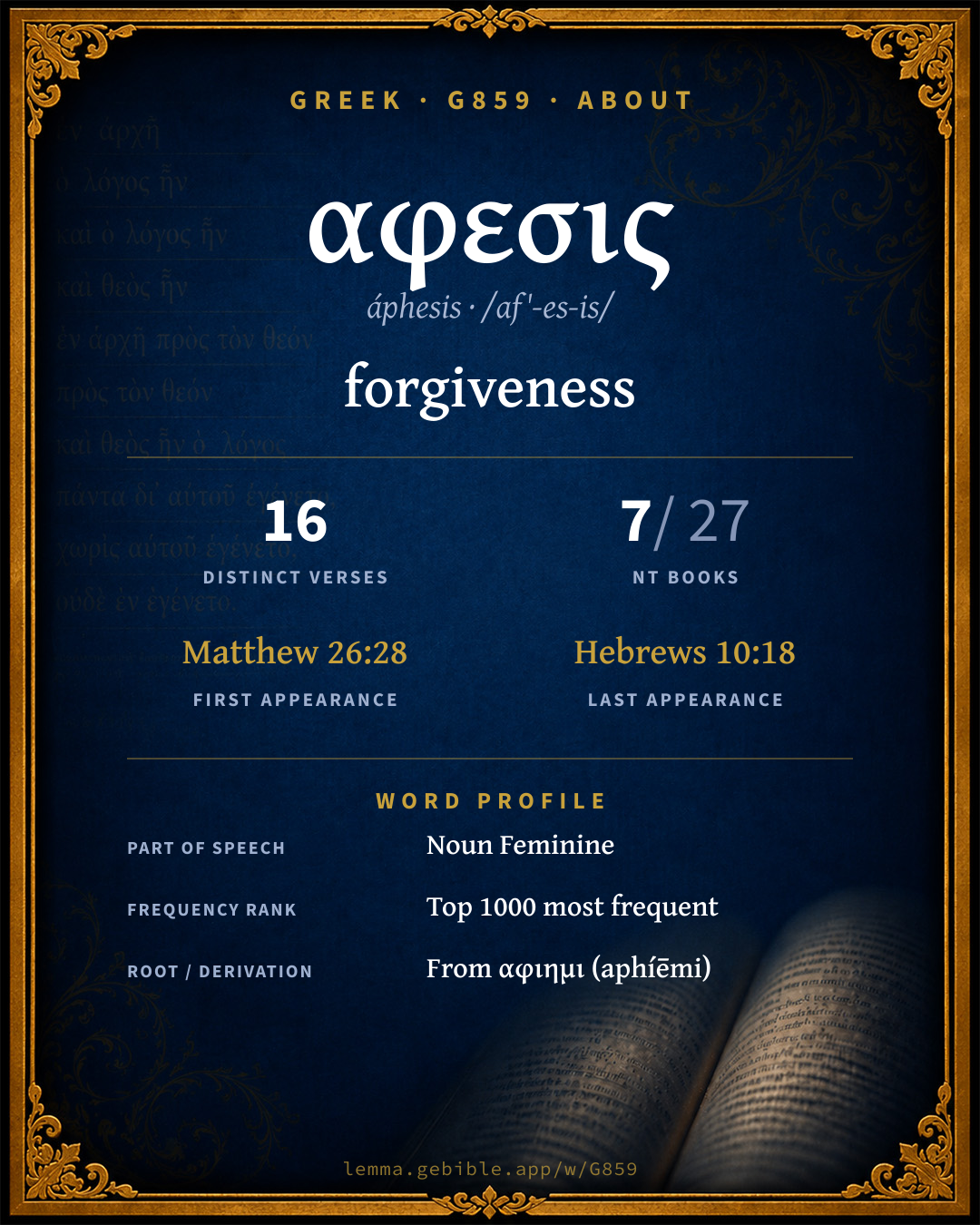
ἄφεσις
forgiveness
‘forgiveness’ is one of 2 main senses fuller range ↓
Full lexicon entry — Thayer's Greek Lexicon
From Thayer's Greek Lexicon
Where this word appears
See every Accusative-case word in the Greek New Testament →
Grammar key — what these labels mean
Part of speech
- Noun
- A naming word — a person, place, thing, or idea.
Case
- Accusative
- The case of the direct object and of extent.
- Nominative
- The case of the subject (and the predicate nominative).
- Dative
- The case of the indirect object, means, or location — “to / for / with / in.”
Gender
- Feminine
- Grammatically feminine.
Number
- Singular
- One.
Grammatical forms
- Noun, Accusative, Singular, Feminine 12 times (71%)
- Noun, Nominative, Singular, Feminine 3 times (18%)
- Noun, Dative, Singular, Feminine 2 times (12%)
Parsed forms decoded from the imported morphology (Robinson–Tischendorf, public domain), counted across 17 parsed occurrences — not distinct verses.
Every verse where G859 appears — 16 distinct verses across 7 books. Click any verse to open its interlinear word-by-word view. Verse text shown in the World English Bible for context — . Each verse’s Greek form is shown with its reference; the English is not keyword-highlighted, since the data carries no word-level English alignment. Use “Compare translations” on any verse to read it across multiple English versions. This concordance covers the Greek New Testament; Septuagint (Greek Old Testament) occurrences of this word are not indexed here.
Matthew 1 verse
Mark 2 verses
Luke 4 verses
- Luke 1:77 ἀφέσει n dat sg fem To give knowledge of salvation to his people by the remission of their sins,
- Luke 3:3 ἄφεσιν n acc sg fem He came into all the region around the Jordan, preaching the baptism of repentance for remission of sins.
- Luke 4:19 ἄφεσιν ἀφέσει n acc sg fem n dat sg fem And to proclaim the acceptable year of the Lord."
- Luke 24:47 ἄφεσιν n acc sg fem and that repentance and remission of sins should be preached in his name to all the nations, beginning at Jerusalem.
Acts 5 verses
- Acts 2:38 ἄφεσιν n acc sg fem Peter said to them, "Repent, and be baptized, everyone of you, in the name of Jesus Christ for the forgiveness of sins, and you will receive the gift of the Holy Spirit.
- Acts 5:31 ἄφεσιν n acc sg fem God exalted him with his right hand to be a Prince and a Savior, to give repentance to Israel, and remission of sins.
- Acts 10:43 ἄφεσιν n acc sg fem All the prophets testify about him, that through his name everyone who believes in him will receive remission of sins."
- Acts 13:38 ἄφεσις n nom sg fem Be it known to you therefore, brothers, that through this man is proclaimed to you remission of sins,
- Acts 26:18 ἄφεσιν n acc sg fem to open their eyes, that they may turn from darkness to light and from the power of Satan to God, that they may receive remission of sins and an inheritance among those who are sanctified by faith in me.'
Ephesians 1 verse
Colossians 1 verse
Hebrews 2 verses
About this entry
At a glance — auto-summarized from this page’s data, not written by a person. Every figure links to its source below. This summary describes the numbers; it doesn’t interpret them.
At its core, αφεσις (áphesis) means “forgiveness.” First canonically at Matthew 26:28, it enters the text early. It appears 16 verses across 7 books of the Greek New Testament, among its uncommon vocabulary. The word gravitates to Acts (31%), then Luke and Mark. Catalogued under 2 senses, its meaning is not single-sense. Dig into 16-verse concordance and the renderings breakdown below.
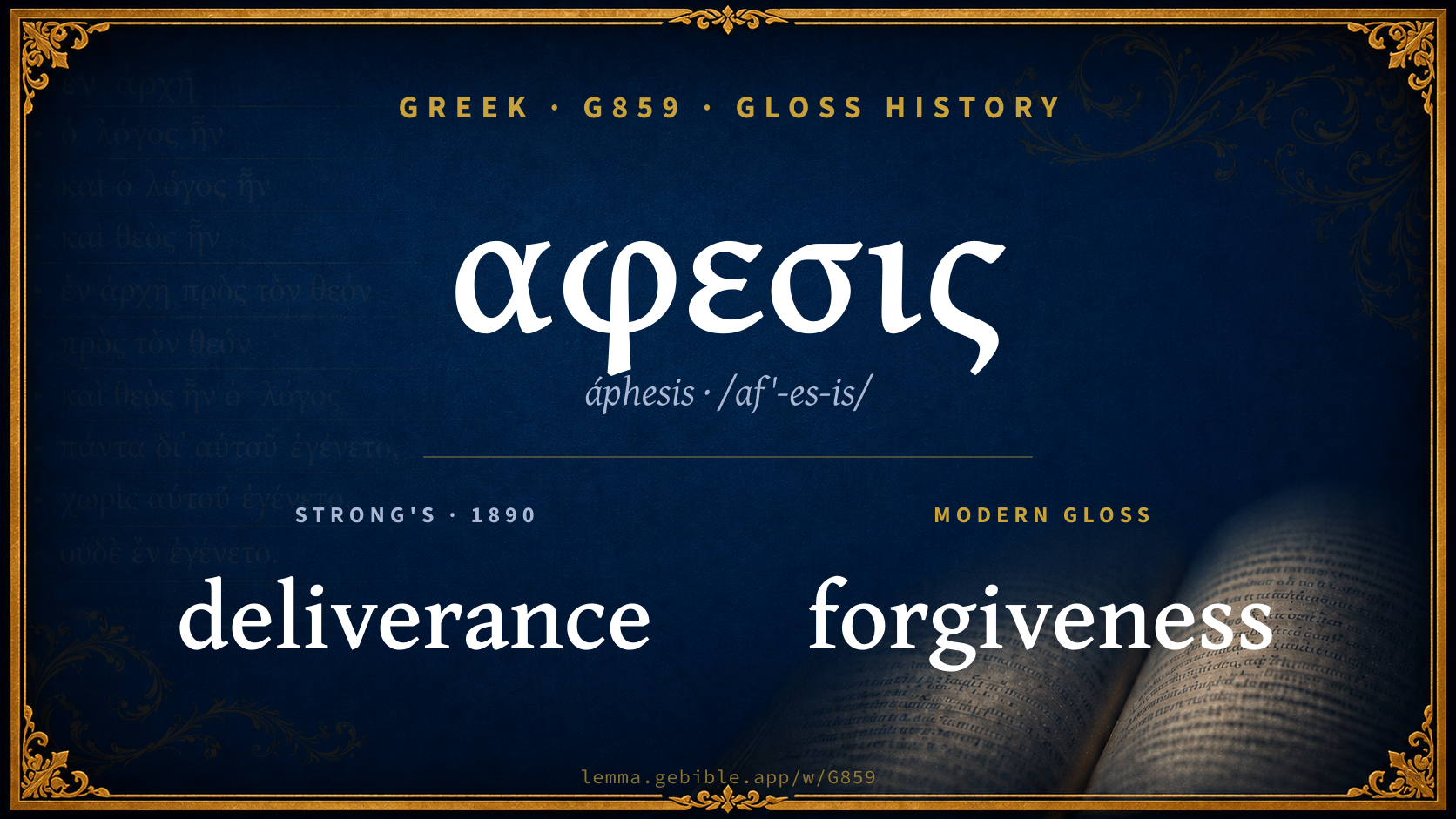
Gloss history
Strong's 1890 vs modern scholarship
About this word
Strong's G859 catalogs a Greek word from the Greek New Testament.
These counts are not copied from any lexicon or concordance. They are computed here, from the morphology-tagged Greek New Testament. What Lemma adds →
- 16
- distinct verses
- The word appears in 16 distinct verses.
- 7 / 27
- NT books
- The word appears in 7 of 27 New Testament books.
- #697
- by frequency
- Top 1000 most frequent Greek words (rank 697 of 5,347 Greek words by occurrence).
View all 16 occurrences in the concordance →
By section of the New Testament
By traditional corpus
Conventional, traditional groupings — biblical authorship is debated, so this is a traditional corpus grouping, not an authorship claim. Some books belong to more than one corpus (Luke is in both the Gospels and the Lukan corpus, and so on), so these shares overlap and need not total 100%. Each figure is a share of the word’s 16 distinct verses.
- Lukan (Luke–Acts) 9 verses · 56%
- Gospels 7 verses · 44%
- Pauline corpus 2 verses · 13%
- Hebrews 2 verses · 13%
How translations render this word
Counts come from each version’s own published word-to-Strong’s tagging or interlinear alignment — an approximate guide to how each version renders this word, not a word-level alignment the data otherwise carries. Because each total is that version’s own tagged count, the per-version totals vary from one another and need not match the appearance or distinct-verse counts above. These counts may also differ from a printed concordance because Lemma counts each distinctly tagged rendering and does not collapse phrase taggings into a single head-word total. This is a fixed set of word-tagged versions (KJV, ASV, BSB, ULT) and does not change with the reading translation you choose elsewhere. Each version’s license is shown beside its name below (and on Sources).
- King James Version: Remission 9×, Forgiveness 6×
- American Standard Version: Remission 12×, Forgiveness 3×
- Berean Standard Bible: Forgiveness 13×
- unfoldingWord Literal Text: Forgiveness 13×
King James Version Public Domain
Renders G859 across 17 tagged occurrences — most commonly:
Plus 2 renderings that appear only once — usually multi-word phrases or single function words the recovered tagging swept in, not distinct renderings.
American Standard Version Public Domain
Renders G859 across 17 tagged occurrences — most commonly:
Plus 2 renderings that appear only once — usually multi-word phrases or single function words the recovered tagging swept in, not distinct renderings.
Berean Standard Bible Public Domain
Renders G859 across 16 tagged occurrences — most commonly:
Plus 3 renderings that appear only once — usually multi-word phrases or single function words the recovered tagging swept in, not distinct renderings. Not rendered by a distinct English word in 1 further occurrence.
unfoldingWord Literal Text CC BY-SA 4.0
Renders G859 across 17 tagged occurrences — most commonly:
Plus 4 renderings that appear only once — usually multi-word phrases or single function words the recovered tagging swept in, not distinct renderings.
Senses in Thayer's
The 2 senses Thayer's distinguishes for this word, in lexicon order (not ranked by frequency or importance). The full entry — with sub-senses — is in the Lexicon Entry tab.
- release from bondage or imprisonment
- forgiveness or pardon, of sins (letting them go as if they had never been committed), remission of the penalty
Word origin
Derived from αφιημι (aphíēmi) (G863) — to send away.
From G863 ; freedom ; (figuratively) pardon : - deliverance forgiveness liberty remission.
— Strong’s Exhaustive Concordance (1890), public domain.
Forms in the corpus
The 3 distinct written forms G859 takes in the Greek New Testament, most frequent first — each parse links to that case’s occurrences in the concordance.
| Form | Parsing | Example | Uses |
|---|---|---|---|
| ἄφεσιν áphesin | Noun, Accusative, Singular, Feminine | Matthew 26:28 | 12 |
| ἄφεσις áphesis | Noun, Nominative, Singular, Feminine | Acts 13:38 | 3 |
| ἀφέσει aphései | Noun, Dative, Singular, Feminine | Luke 1:77 | 2 |
Septuagint usage
The same Greek word αφεσις appears 45 times in the Greek Old Testament (Septuagint), across 40 verses in 12 books.
- 45
- LXX occurrences
- Tagged occurrences of this Greek word in the Septuagint.
- 40
- verses
- Distinct Septuagint verses containing this word.
- 12 / 39
- OT books
- The word appears in 12 of the 39 Old Testament books.
Sample Septuagint occurrences
- Exodus 18:2 ἄφεσις
- Leviticus 16:26 ἄφεσις
- Numbers 36:4 ἄφεσις
- Deuteronomy 15:1 ἄφεσις
- 2 Samuel 22:16 ἄφεσις
- Esther 2:18 ἄφεσις
- Isaiah 58:6 ἄφεσις
- Jeremiah 41:8 ἄφεσις
- Lamentations 3:48 ἄφεσις
- Ezekiel 46:17 ἄφεσις
- Daniel 12:7 ἄφεσις
- Joel 1:20 ἄφεσις
Septuagint occurrences (same lexeme)
Every verse where the same Strong’s number (G859) appears in the Greek Septuagint. Verse text shown in the World English Bible for context; the Greek form is the matched word — the English is not keyword-highlighted.
- Exodus 18:2 ἄφεσις Jethro, Moses' father-in-law, received Zipporah, Moses' wife, after he had sent her away,
- Exodus 23:11 ἄφεσις but the seventh year you shall let it rest and lie fallow, that the poor of your people may eat; and what they leave the animal of the field shall eat. In like manner you shall deal with your vineyard and with your olive grove.
- Leviticus 16:26 ἄφεσις "He who lets the goat go for the scapegoat shall wash his clothes, and bathe his flesh in water, and afterward he shall come into the camp.
- Leviticus 25:10 ἄφεσις You shall make the fiftieth year holy, and proclaim liberty throughout the land to all its inhabitants. It shall be a jubilee to you; and each of you shall return to his own property, and each of you shall return to his family.
- Leviticus 25:11 ἄφεσις That fiftieth year shall be a jubilee to you. In it you shall not sow, neither reap that which grows of itself, nor gather from the undressed vines.
- Leviticus 25:12 ἄφεσις For it is a jubilee; it shall be holy to you. You shall eat of its increase out of the field.
- Leviticus 25:13 ἄφεσις "'In this Year of Jubilee each of you shall return to his property.
- Leviticus 25:28 ἄφεσις But if he isn't able to get it back for himself, then what he has sold shall remain in the hand of him who has bought it until the Year of Jubilee: and in the Jubilee it shall be released, and he shall return to his propery.
- Leviticus 25:30 ἄφεσις If it isn't redeemed within the space of a full year, then the house that is in the walled city shall be made sure in perpetuity to him who bought it, throughout his generations. It shall not be released in the Jubilee.
- Leviticus 25:31 ἄφεσις But the houses of the villages which have no wall round about them shall be reckoned with the fields of the country: they may be redeemed, and they shall be released in the Jubilee.
- Leviticus 25:33 ἄφεσις The Levites may redeem the house that was sold, and the city of his possession, and it shall be released in the Jubilee; for the houses of the cities of the Levites are their possession among the children of Israel.
- Leviticus 25:40 ἄφεσις As a hired servant, and as a sojourner, he shall be with you; he shall serve with you until the Year of Jubilee:
- Leviticus 25:41 ἄφεσις then he shall go out from you, he and his children with him, and shall return to his own family, and to the possession of his fathers.
- Leviticus 25:50 ἄφεσις He shall reckon with him who bought him from the year that he sold himself to him to the Year of Jubilee: and the price of his sale shall be according to the number of years; according to the time of a hired servant shall he be with him.
- Leviticus 25:52 ἄφεσις If there remain but a few years to the year of jubilee, then he shall reckon with him; according to his years of service he shall give back the price of his redemption.
- Leviticus 25:54 ἄφεσις "'If he isn't redeemed by these means, then he shall be released in the Year of Jubilee, he, and his children with him.
- Leviticus 27:17 ἄφεσις If he dedicates his field from the Year of Jubilee, according to your valuation it shall stand.
- Leviticus 27:18 ἄφεσις But if he dedicates his field after the Jubilee, then the priest shall reckon to him the money according to the years that remain to the Year of Jubilee; and an abatement shall be made from your valuation.
- Leviticus 27:21 ἄφεσις but the field, when it goes out in the Jubilee, shall be holy to Yahweh, as a field devoted; it shall be owned by the priests.
- Leviticus 27:23 ἄφεσις then the priest shall reckon to him the worth of your valuation up to the Year of Jubilee; and he shall give your valuation on that day, as a holy thing to Yahweh.
- Leviticus 27:24 ἄφεσις In the Year of Jubilee the field shall return to him from whom it was bought, even to him to whom the possession of the land belongs.
- Numbers 36:4 ἄφεσις When the jubilee of the children of Israel shall be, then will their inheritance be added to the inheritance of the tribe whereunto they shall belong: so will their inheritance be taken away from the inheritance of the tribe of our fathers.
- Deuteronomy 15:1 ἄφεσις At the end of every seven years you shall make a release.
- Deuteronomy 15:2 ἄφεσις This is the manner of the release: every creditor shall release that which he has lent to his neighbor; he shall not exact it of his neighbor and his brother; because Yahweh's release has been proclaimed.
- Deuteronomy 15:3 ἄφεσις Of a foreigner you may exact it: but whatever of your is with your brother your hand shall release.
- Deuteronomy 15:9 ἄφεσις Beware that there not be a base thought in your heart, saying, The seventh year, the year of release, is at hand; and your eye be evil against your poor brother, and you give him nothing; and he cry to Yahweh against you, and it be sin to you.
- Deuteronomy 31:10 ἄφεσις Moses commanded them, saying, At the end of [every] seven years, in the set time of the year of release, in the feast of tents,
- 2 Samuel 22:16 ἄφεσις Then the channels of the sea appeared, The foundations of the world were laid bare, By the rebuke of Yahweh, At the blast of the breath of his nostrils.
- Esther 2:18 ἄφεσις Then the king made a great feast to all his princes and his servants, even Esther's feast; and he made a release to the provinces, and gave gifts, according to the bounty of the king.
- Isaiah 58:6 ἄφεσις Isn't this the fast that I have chosen: to loose the bonds of wickedness, to undo the bands of the yoke, and to let the oppressed go free, and that you break every yoke?
- Isaiah 61:1 ἄφεσις The Spirit of the Lord Yahweh is on me; because Yahweh has anointed me to preach good news to the humble; he has sent me to bind up the broken-hearted, to proclaim liberty to the captives, and the opening [of the prison] to those who are bound;
- Jeremiah 41:8 ἄφεσις But ten men were found among those who said to Ishmael, Don't kill us; for we have stores hidden in the field, of wheat, and of barley, and of oil, and of honey. So he stopped, and didn't kill them among their brothers.
- Jeremiah 41:15 ἄφεσις But Ishmael the son of Nethaniah escaped from Johanan with eight men, and went to the children of Ammon.
- Jeremiah 41:17 ἄφεσις and they departed, and lived in Geruth Chimham, which is by Bethlehem, to go to enter into Egypt,
- Lamentations 3:48 ἄφεσις My eye runs down with streams of water, for the destruction of the daughter of my people.
- Ezekiel 46:17 ἄφεσις But if he give of his inheritance a gift to one of his servants, it shall be his to the year of liberty; then it shall return to the prince; but as for his inheritance, it shall be for his sons.
- Ezekiel 47:3 ἄφεσις When the man went forth eastward with the line in his hand, he measured one thousand cubits, and he caused me to pass through the waters, waters that were to the ankles.
- Daniel 12:7 ἄφεσις I heard the man clothed in linen, who was above the waters of the river, when he held up his right hand and his left hand to heaven, and swore by him who lives forever that it shall be for a time, times, and a half; and when they have made an end of breaking in pieces the power of the holy people, all these things shall be finished.
- Joel 1:20 ἄφεσις Yes, the animals of the field pant to you, For the water brooks have dried up, And the fire has devoured the pastures of the wilderness.
- Joel 4:18 ἄφεσις
These are occurrences of the same Greek lexeme (G859) in the Septuagint — not a translation of any one Hebrew word. The store carries no word-level Hebrew↔Greek alignment, so no Hebrew original is asserted here. Counts come from the recovered LXX Strong's tagging — high-frequency vocabulary is well covered, while rare or late forms may be untagged — so they reflect tagged occurrences and may slightly undercount.