
Lamentations 3:48

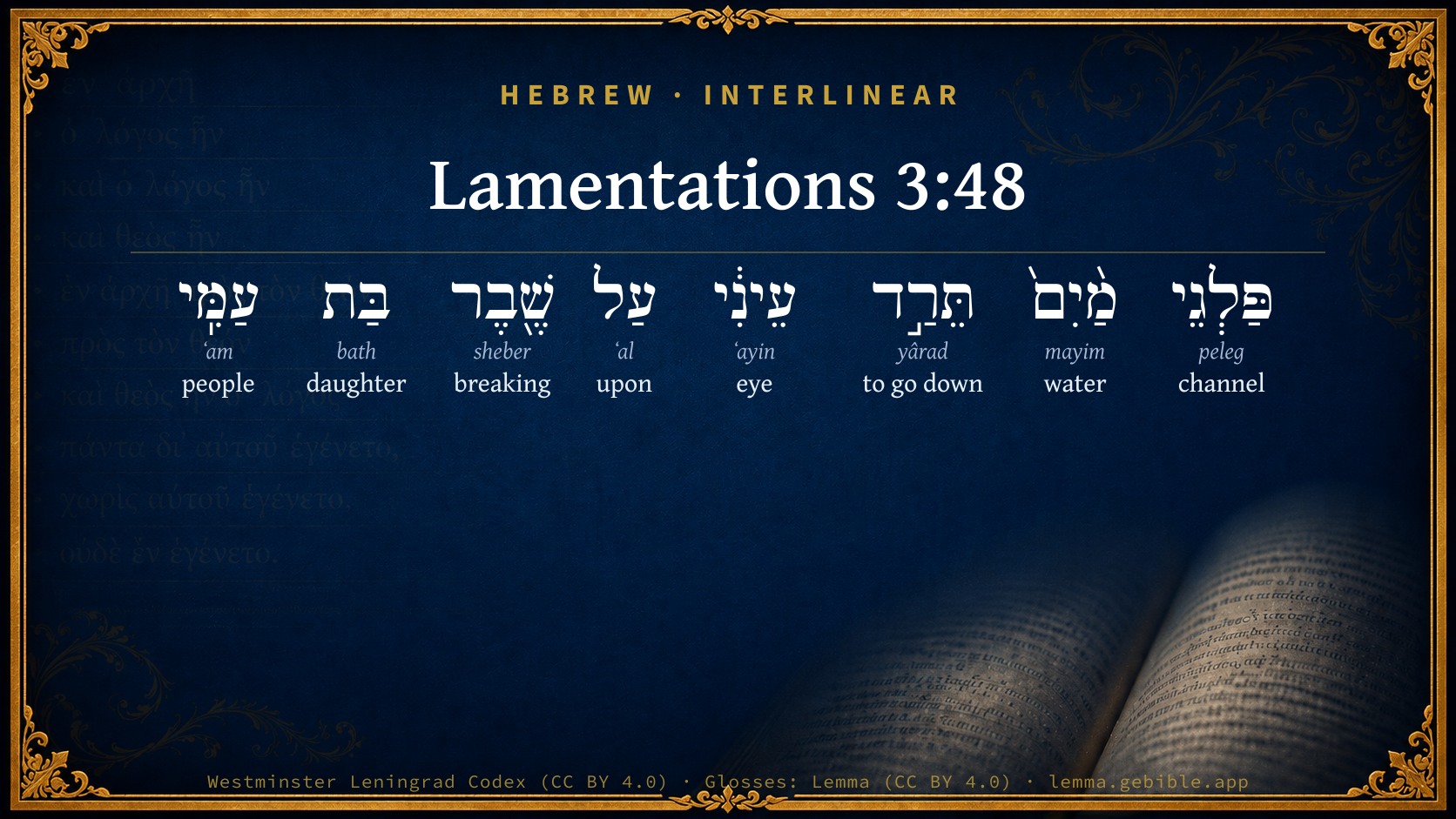
Hebrew (Westminster Leningrad Codex) Lamentations 3:48 appears in the Hebrew Old Testament. The text above is from the Westminster Leningrad Codex. Each word links to its Strong’s number, a concise gloss, and parsing drawn from the Open Scriptures Hebrew Bible morphology. Click any word for its full Brown-Driver-Briggs (BDB) entry.
Download image
Cite this verse

Lamentations 3:48 (World English Bible). Public Domain. Lemma interlinear Bible study tool, https://lemma.gebible.app/v/lamentations/3/48.

Show BibTeX & RIS
BibTeX
RIS
English Translation
My eye runs down with streams of water, for the destruction of the daughter of my people.
World English Bible · Public Domain
Download a study sheet

One document with this verse’s original text, its word-by-word gloss line, the meaning frame, cross-references with their text, attributed commentary, and full source and license credits — printable, and it pastes into notes with its structure intact.

This verse Autodidact and up

Study sheet (.html) Plain text (.txt)

A passage Seminary Student

Up to 50 verses in one chapter. A passage sheet keeps up to 6 commentary sources and 12 cross-references per verse, in the order this page ranks them, and says so on the sheet whenever that leaves anything out. Ask for a single verse and you get the Autodidact verse sheet above.

Everything on this page stays free to read, with no account — the sheet is a download of what is already on screen, not access to it.

Want to remove ads? Support Godless Engineer
Compare translations 3

The same verse in 3 English versions, stacked beneath the original-language interlinear above. Click any original word for its lexicon entry.

Each is an independent rendering of the whole verse — the interlinear is not word-aligned to these translations.

Highlighted words mark where these versions differ — a whole-verse word diff, not a word-by-word alignment.

  • World English Bible Public Domain
    My eye runs down with streams of water, for the destruction of the daughter of my people.
  • King James Version Public Domain
    Mine eye runneth down with rivers of water for the destruction of the daughter of my people.
  • unfoldingWord Literal Text CC BY-SA 4.0
    Streams of water go down my eye, over the destruction of the daughter of my people. PE

unfoldingWord Literal Text — © unfoldingWord, licensed CC BY-SA 4.0. Word-aligned USFM3 via Door43 (git.door43.org/unfoldingWord/en_ult).

Versions to compare (up to 4)

3 of 4 selected

Show all 18 translations

Every available English version of this verse, each an independent rendering of the whole verse.

  • World English Bible Public Domain
    My eye runs down with streams of water, for the destruction of the daughter of my people.
  • Berean Standard Bible Public Domain
    Streams of tears flow from my eyes over the destruction of the daughter of my people.
  • Majority Standard Bible Public Domain
    Streams of tears flow from my eyes over the destruction of the daughter of my people.
  • King James Version Public Domain
    Mine eye runneth down with rivers of water for the destruction of the daughter of my people.
  • American Standard Version (1901) Public Domain
    Mine eye runneth down with streams of water, for the destruction of the daughter of my people.
  • Revised Version (1885) Public Domain
    Mine eye runneth down with rivers of water, for the destruction of the daughter of my people.
  • Geneva Bible (1599) Public Domain
    Mine eye casteth out riuers of water, for the destruction of the daughter of my people.
  • Douay-Rheims (1899) Public Domain
    Phe. My eye hath run down with streams of water, for the destruction of the daughter of my people.
  • Young's Literal Translation Public Domain
    Rivulets of water go down my eye, For the destruction of the daughter of my people.
  • Literal Standard Version CC BY-SA 4.0
    Streams of water go down my eye, || For the destruction of the daughter of my people.
  • Unlocked Literal Bible CC BY-SA 4.0
    My eyes flow with streams of tears because my people are destroyed.
  • unfoldingWord Literal Text CC BY-SA 4.0
    Streams of water go down my eye, over the destruction of the daughter of my people. PE
  • Darby Bible Public Domain
    Mine eye runneth down with streams of water for the ruin of the daughter of my people.
  • World Messianic Bible Public Domain
    My eye runs down with streams of water, for the destruction of the daughter of my people.
  • Webster's Bible Public Domain
    My eye runneth down with rivers of water for the destruction of the daughter of my people.
  • Free Bible Version CC BY-SA 4.0
    Tears stream from my eyes over the death of my people.
  • Bible in Basic English Public Domain
    Rivers of water are running down from my eyes, for the destruction of the daughter of my people.
  • JPS Tanakh (1917) Public Domain
    Mine eye runneth down with rivers of water, for the breach of the daughter of my people.

Literal Standard Version (2020), Covenant Press — licensed CC BY-SA 4.0. Text via the HelloAO Bible API (eBible.org). Unlocked Literal Bible (unfoldingWord) — licensed CC BY-SA 4.0. Text via the HelloAO Bible API (eBible.org). unfoldingWord Literal Text — © unfoldingWord, licensed CC BY-SA 4.0. Word-aligned USFM3 via Door43 (git.door43.org/unfoldingWord/en_ult). Free Bible Version, Dr. Jonathan Gallagher — licensed CC BY-SA 4.0. Text via the HelloAO Bible API (eBible.org).

Word by word

More ways to search: Search by grammar → Find every occurrence → Compare this word →

Practice this passage: Drill this verse → Learn its vocabulary →

About this verse

These counts appear in no published source. They are computed here, from the morphology-tagged text and Lemma’s own curated glosses. What Lemma adds →

8
words
8
distinct lemmas
Prophets
section

Notable vocabulary

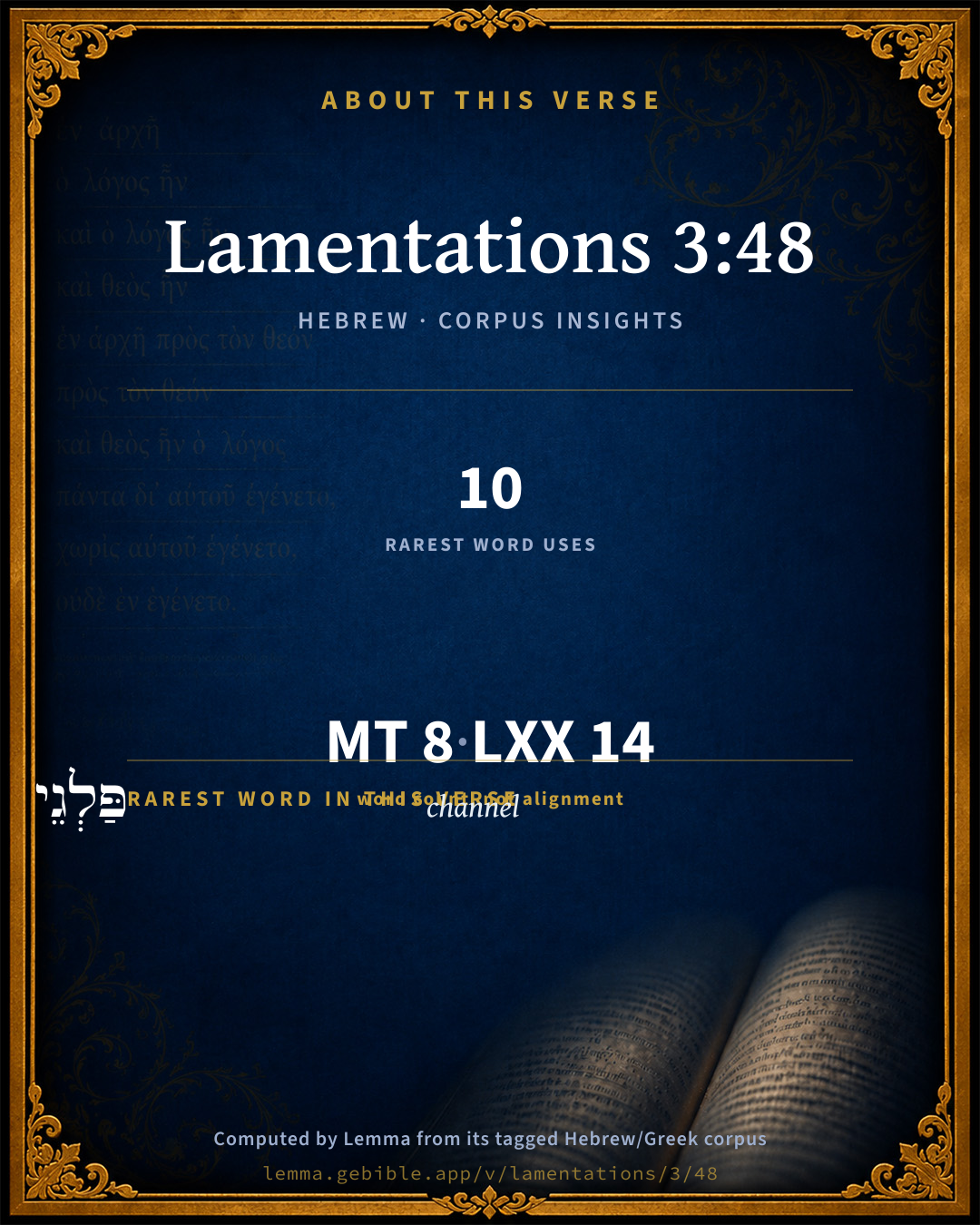
The rarest word here is פַּלְגֵי channel H6388 — appearing just 10 times in the whole Hebrew Bible.

Shared distinctive vocabulary

פַּלְגֵי channel H6388 occurs in 10 verses of the Hebrew Bible. Also found in:

Grammatical profile

  • 1 verb
  • 6 nouns
  • 1 preposition

Verb forms

  • תֵּרַ֣ד Qal · Imperfect

Hebrew & Septuagint length

In English translation the verse runs 17 words from the Hebrew and 17 from the Septuagint (LXX English) — the same length.

A rough comparison of the two English renderings, which tokenize alike — not a word-level alignment.

Word counts can differ between the Hebrew and the Greek without any difference in meaning — e.g. the Hebrew direct-object marker אֵת has no separate Greek word, and Greek often adds the article ὁ.

In the original languages it is 8 Hebrew tokens and 14 Greek tokens — but the two are counted differently (Hebrew bundles its prefixes and suffixes into one token; the Greek is in lemma form), so that isn’t a like-for-like length.

Cross-references

9

Topical passages linked to Lamentations 3:48 in the Treasury of Scripture Knowledge — connected by theme and wording, ordered by reader-vote popularity; previews shown in the World English Bible.

  • Jeremiah 9:1 Oh that my head were waters, and my eyes a spring of tears, that I might weep day and night for the slain of the daughter of my people!
  • Jeremiah 9:18 and let them make haste, and take up a wailing for us, that our eyes may run down with tears, and our eyelids gush out with waters.
  • Lamentations 2:11 My eyes do fail with tears, my heart is troubled; My liver is poured on the earth, because of the destruction of the daughter of my people, Because the young children and the infants swoon in the streets of the city.
  • Psalms 119:136 Streams of tears run down my eyes, Because they don't observe your law.
  • Jeremiah 4:19 My anguish, my anguish! I am pained at my very heart; my heart is disquieted in me; I can't hold my peace; because you have heard, O my soul, the sound of the trumpet, the alarm of war.
  • Jeremiah 13:17 But if you will not hear it, my soul shall weep in secret for [your] pride; and my eye shall weep sore, and run down with tears, because Yahweh's flock is taken captive.
  • Lamentations 1:16 For these things I weep; my eye, my eye runs down with water; Because the comforter who should refresh my soul is far from me: My children are desolate, because the enemy has prevailed.
  • Lamentations 2:18 Their heart cried to the Lord: wall of the daughter of Zion, let tears run down like a river day and night; Give yourself no respite; don't let the apple of your eye cease.
  • Romans 9:1–3 I tell the truth in Christ. I am not lying, my conscience testifying with me in the Holy Spirit,

Cross-references courtesy of OpenBible.info (CC BY 4.0).

Hebrew and Greek witnesses Masoretic Hebrew ↔ Greek Septuagint

The same verse in the two great witnesses to the Old Testament, shown verse-for-verse.

These are two independent witnesses, not word-aligned to each other, and the Septuagint is shown in lemma (dictionary) form.

Hebrew Lamentations 3:48 Masoretic · Westminster Leningrad Codex

פַּלְגֵי מַ֨יִם֙ תֵּרַ֣ד עֵינִ֔י עַל שֶׁ֖בֶר בַּת עַמִּֽי

My eye runs down with streams of water, for the destruction of the daughter of my people.

World English Bible · Public Domain

Greek LXX Lamentations 3:48 Septuagint · lemma form

ἄφεσις ὕδωρ καταἄγω ὁ ὀφθαλμός ἐγώ ἐπί ὁ σύντριμμα ὁ θυγάτηρ ὁ λαός ἐγώ

My eye shall pour down torrents of water, for the destruction of the daughter of my people.

LXX2012 (modern English Septuagint) · Public Domain

Hebrew: Westminster Leningrad Codex (CC BY 4.0). Greek: Septuagint (public domain); English from LXX2012 (modern English Septuagint) (Public Domain). How the Septuagint differs from the Hebrew →

Commentary

Notes on Lamentations 3:48 from classic Christian and Jewish commentators (each source and its license shown beneath its notes). The classic Christian expositions comment on the surrounding passage and are grouped to its opening verse, so a note may address several verses; the Jewish commentaries on the Tanakh (Rashi and others) are per-verse, so they appear only where the commentator wrote on this verse.

Lemma curates 59 commentaries, every one of them public domain or Creative Commons licensed, each selected and text-cleaned for this edition rather than reprinted as found. About our sources →

Trapp's Complete Commentary

John Trapp

Lam 3:48 Mine eye runneth down with rivers of water for the destruction of the daughter of my people.

Ver. 48. Mine eye runneth down.] Heb., Mine eye descendeth; i.e., falleth, as it were, wholly away. See Lam 1:16; Lam 2:18.

John Trapp, A Commentary or Exposition upon All the Books of the Old and New Testament (1647–1656) — public domain. Text from a community e-Sword module.

Joseph Benson's Commentary

Lam 3:48-51. Mine eye runneth down with rivers of water — In this and the three following verses the prophet shows that the misfortunes of his country constituted no small part of his personal affliction. Mine eye affecteth my heart — Hebrew, עוללה לנפשׁי, preys upon my soul, as the Vulgate renders the expression, that is, my grief wears out my health and strength; because of all the daughters of my city — On account of the sufferings of the inhabitants of my city.

Joseph Benson's Commentary on the Old and New Testaments (1811–1818) — public domain. Text from a community e-Sword module.

The Preacher's Complete Homiletical Commentary

Joseph S. Exell (gen. ed.)

EXEGETICAL NOTES.—

(פ) Lam_3:46-48 present significant intimations of their base condition. Enemies making sport of them fear and pitfalls surrounding them, and the oft-recurring feeling of utter destruction instigating tears shed as copiously as rivers of water.

(ע) Lam_3:49. The excessive weeping is continuous. Mine eye poureth down tears, and that without interruption. Nor will the sound of weeping be stanched, except when his undercurrent of hope reaches its terminus.

Lam_3:50. Till Jehovah looks down and beholds from heaven. When He sees the bearing and result of afflictions on His Name’s glory, then He hears the sighing of the prisoner. For He will not contend for ever, neither will He be always wroth.

Lam_3:51. Beyond what the eye shows externally it exerts influence upon the inward part. Mine eye hurts my soul: not in the rather jejune sense that the flood of tears had made the eye painful, and that pain was felt in the soul; but the soul was pained because of the eye beholding the sad lot of the more delicate and defenceless part of the population, the daughters of my city.

HOMILETICS

A SYMPATHETIC NATURE

(Lam_3:48-51)

I. Is pained by the evidences of national distress everywhere visible. “Mine eye affecteth mine heart because of all the daughters of my city” (Lam_3:51). What I see I feel. I see nothing but misery, and I feel nothing but pain. Amid the general suffering, the tender heart of the prophet mourned over the cruel fate of the Jewish maidens. This is a subject to which he often refers (ch. Lam_1:4; Lam_1:18; Lam_2:10; Lam_2:21; Lam_5:11). “Jeremiah suffered not in his own person, being under the protection of the Divine Being; but though he dwelt securely from the hand of mortality, yet he was filled with the bowels of sympathy. Though he wrote of the Jews’ desolations, yet he named them Jeremiah’s Lamentations.”

II. Is aggravated in its grief because God, who sees the calamity, does not at once remove it. “Till the Lord look down and behold from heaven” (Lam_3:50). While the Lord looks down. He sees all this suffering; every feature of it is fully known to Him. Why does He not interfere? How can He be so indifferent to the agonies of His people? The prophet’s heart is breaking, and it is a mystery and an addition to his pain that Jehovah does nothaste to the rescue. Sympathy is not always wise. Our emotions are apt to swamp our judgment. God knows infallibly how much suffering is necessary, and when the right moment is come for Him to interpose.

III. Expresses its sorrow in a copious outflow of tears. “Mine eye runneth down with rivers of water, without any intermission” (Lam_3:48-49). The measure of our being is our capacity for sorrow or joy. A certain traveller states that the shadow cast by Mount Hermon at some periods is as much as seventy miles long. A sensitive nature is susceptible of great sorrow, and has manifold ways of expressing the same. While the cause of sorrow remains, the sympathetic heart will mourn.

LESSONS.—

1. Callons indeed is the heart that can witness suffering without emotion.

2. The heart that loves intensely suffers intensely.

3. A sympathetic nature finds a merciful relief in tears.

GERM NOTES ON THE VERSES

Lam_3:51. Sin the cause of suffering: I. To the patriot, as he sees its effect upon the nation. II. To the philanthropist, as he observes the mischief it works in the world. III. To the individual believer, as he is conscious of its presence in his own heart.

ILLUSTRATIONS.—The power of sympathy. Happy is the man who has that in his soul which acts upon the dejected as April airs upon violet roots. Gifts from the hand are silver and gold; but the heart gives that which neither silver nor gold can buy. To be full of goodness, full of cheerfulness, full of sympathy, full of helpful hope, causes a man to carry blessings of which he is himself as unconscious as a lamp of its own shining. Such an one moves on human life as stars move on dark seas to bewildered mariners; as the sun wheels, bringing all the seasons with him from the south.—Beecher.

Grief leaves its mark. Sir Walter Scott says of himself after a sore bereavement, “I was broken-hearted for two years; and though handsomely pieced again, the crack will remain to my dying day”

Practical sympathy. When St. Remy was preaching before King Clovis of France, telling with passionate pathos the story of Christ’s suffering and death, the monarch suddenly sprang from his throne, and, grasping his spear, cried, “Had I been there with my brave Franks, I would have avenged His wrongs.”

The relief of tears. A maniac while listening to a thrilling recital was moved to tears Lifting her withered finger she exclaimed, “Do you see that tear? It is the first tear that I have shed for seven years, and it will relieve my poor burning head. I have often wished that I could weep, but I could not.”

The Preacher's Complete Homiletical Commentary (gen. ed. Joseph S. Exell; Funk & Wagnalls, c. 1892) — public domain (pre-1929). A full-Bible homiletical/sermon-outline anthology covering 65 of 66 books (2 John is absent from the source module). Text from a community e-Sword module.

Tyndale Open Study Notes

Tyndale Open Resources

3:48-66 The author focuses on the viciousness of the enemies and cries out to the Lord.

Tyndale Open Study Notes — © Tyndale Open Resources, licensed CC BY-SA 4.0. Text via the HelloAO Bible API.

Jamieson, Fausset & Brown

Robert Jamieson, A. R. Fausset & David Brown

(Jer 4:19).

Jamieson, Fausset & Brown — Commentary Critical and Explanatory on the Whole Bible (1871) — public domain (CC PDM 1.0). Text via the HelloAO Bible API.

Adam Clarke's Commentary

Verse 48. Mine eye runneth down] I weep incessantly.

Adam Clarke's Commentary on the Bible (1810–1826) — public domain. Text from a community e-Sword/MySword module.

John Calvin's Commentaries

Interpreters give different explanations of the beginning of this verse: some render it thus, “My eye comes down unto rivers of waters;” others, “My eye flows down unto rivers of waters,” or, “rivers of waters flow down.” But as I have explained elsewhere, the Prophet rather means, that his eye came down like rivers; and to come down, or to descend, is a metaphor for flowing down; for water, as it is well known, descends when it flows. And there is a change of number when he says, “My eye descends;” there is also raider-stood the particle of comparison, כ, caph The meaning is, that his eyes descended or flowed down as rivers. The last: word properly signifies divisions, but; he means that many streams flowed down, as though they were so many rivers.

For the bruising, or the breach, of my people: the Prophet speaks here in his own person, though there is no doubt but that he exhorts all others to join him in his sorrow. For the faithful would not have prayed to God with sufficient ardor, had they not been dreadfully broken and confounded; had not the calamity deeply affected them, as it ought to have done, there would have been no serious attention to prayer. This is the reason why the Prophet here mentions his own weepings, and groanings, and tears, even that he might rouse himself to prayer, and lead others also. It follows, —

John Calvin's Commentaries (1540-1563) — public domain. Text from the Calvin Translation Society English edition (1840s-50s) via the Christian Classics Ethereal Library (ccel.org). Calvin's coverage is partial (roughly two-thirds of the Bible); uncommented books and verses are honest gaps, never fabricated. The 19th-century editor's footnotes and remarks are omitted so the notes are faithfully Calvin's own voice.

Ellicott's Commentary for English Readers

(48) Mine eye . . .—A stronger utterance of the thought of Lam_1:16; Lam_2:18; Psa_119:136.

A Bible Commentary for English Readers, edited by Charles John Ellicott (1878–1897) — public domain. Text from a community e-Sword module.

The Cambridge Bible for Schools and Colleges

gen. ed. J. J. S. Perowne

48. runneth down with rivers of water] a still stronger expression than that of Lam_1:16, where see note. Cp. Jer_13:17; Psa_119:136.

The Cambridge Bible for Schools and Colleges (gen. ed. J. J. S. Perowne; Cambridge University Press, 1878–1918) — public domain. Text from a community e-Sword module.

John Gill's Exposition

They have cut off my life in the dungeon,.... Jarchi interprets it,

"they bound me in the prison.''

Jeremiah was both in a prison and in a dungeon, where he was deprived of the society of men, as if he had been dead; and he was in danger of losing his life; but whether any respect is had to it here is not certain: it seems rather to respect the people of the Jews in captivity, who were deprived of their rights and liberties, and of the comforts of life; and were like dead men in their graves, to whom they are compared, Eze 37:11; but since Jeremiah was not dead, nor did he die in the dungeon, Jarchi's sense seems best, and agrees with what follows; and is confirmed by the version of others, who render it, "they shut up my life in the dungeon" (q); or himself there:

and cast a stone upon me; to see if he was dead, or to prevent him from rising. The allusion is to the putting of stones at the mouths of dens and dungeons, caves and graves, to keep in those there put: or they stoned me, as the Targum; that is, they endeavoured to do it: or the Jews in captivity were like persons stoned to death, or like dead men covered with a heap of stones; for that Jeremiah was stoned to death there is no reason to believe.

(q) "concluserunt in fovea vitam meam", Noldius, Concord. Ebr. Part. p. 141, "manciparunt fovea vitam meam", Cocceius.

John Gill's Exposition of the Whole Bible (1746–1763) — public domain (CC PDM 1.0). Text via the HelloAO Bible API.

Albert Barnes' Notes on the Bible

The deep sympathy of the prophet, which pours itself forth in abundant tears over the distress of his people.

Lam 3:51

Or, “Mine eye” causeth pain to my soul, i. e. maketh my soul ache, because of the sad fate of the maidens (Lam 1:4, Lam 1:18, ...).

Albert Barnes' Notes on the Bible (1834–1885) — public domain. Text from a community e-Sword/MySword module.

The Pulpit Commentary

Runneth down, etc. (comp. Lam_1:16)

Vers. 48-51. Sympathetic sorrow.

This passage is sufficient to justify the title prefixed to this collection of sacred lyrics. It is indeed a "lamentation." And, what is deserving of special notice, the lament is not for personal affliction, it is occasioned by the distress and woe of the fellow countrymen of the prophet.

I THE OCCASION OF THIS SYMPATHETIC SORROW.

1. The affliction of "the daughters of the city." Whether by this expression we are to understand dependent towns or literally the maidens of Jerusalem, in any case it is the calamities of his countrymen that awaken compassion.

2. This affliction is of the extremest kind, even "destruction." Some of those whose woes call forth the prophet"s commiseration are homeless, some are wounded, and some are slain. A hard heart can witness the distresses of fellow creatures unmoved; but a sensitive nature views them with poignant sorrow. Our Lord wept over the same city when, at a later period, he foresaw a fate impending over Jerusalem even worse than that which occasioned the lamentation of Jeremiah.

II THE CHARACTERISTICS OF THIS SYMPATHETIC SORROW.

1. It is cordial; not the sympathy of words merely, but of the heart. Politeness may dissimulate; sincere pity will feel. The sorrows of the soul because of human sin and woe are prompted by sympathy and consecrated by religion.

2. It is manifested. In the East and among simple nations grief displays itself in a more demonstrative way than amongst ourselves. There was nothing extravagant or unmanly in the pouring down of tears, in the running down of rivers of waters from the eyes, described in these verses. The manner in which sympathy is exhibited may vary, but this passage may suggest to us that the expression of compassion ought not to be withheld.

3. It is unintermitted; it ceases not. Such sympathy is not a mere paroxysm of grief; it is constant, enduring whilst the occasion of it endures.

III THE PURPOSE AND HOPE ACCOMPANYING THIS SYMPATHETIC SORROW. Men sometimes speak of the uselessness of tears, the vanity of grief, etc. The godly sorrow exhibited by the prophet was not of this order; it had an aim, and that aim was the relief of those who were commiserated. Penitence and supplication were regarded as means to procure the regard, the interposition, the delivering mercy of Jehovah. Help, and help from above, this is the practical design which blends with the anguish and the tears of the Christian. T.

The Pulpit Commentary (1880–1919), ed. H.D.M. Spence-Jones & Joseph S. Exell — public domain. Text from a community e-Sword module.

unfoldingWord translationNotes

Door43 World Missions Community

General Information:

The author speaks about himself again.

My eyes flow with streams of tears

Here the author speaks of the great amount of his tears as if they were streams. He uses exaggeration to show that he is very sad and has cried much. AT: "Tears flow from my eyes like water flowing in a river" (See: Metaphor and Hyperbole and Generalization)

because my people are destroyed

This can stated in active form. AT: "because enemies have destroyed my people" (See: Active or Passive)

without ceasing, without relief

Both of these phrases means the same thing. The author speaks of his continuing to cry as if his eyes were a person and had no rest from crying. AT: "without stopping" (See: Doublet and Personification)

until Yahweh from heaven looks down and sees

What the author hopes Yahweh will see can be stated clearly. AT: "until Yahweh looks down from heaven and sees what has happened to my people" (See: Assumed Knowledge and Implicit Information)

translationWords

heaven

unfoldingWord translationNotes — © Distant Shores Media and the Door43 World Missions Community, licensed CC BY-SA 4.0. Source: git.door43.org/Door43/en_tn.

Lesson kit

Teaching starters — assembled from the data on this page, not authored interpretation. Every prompt links to the verse data it draws on. Edit before teaching.

Lamentations, in the Prophets, opens this verse with 8 words (8 distinct Hebrew lemmas). Its most distinctive word is peleg (“channel”). A historical commentator’s framing appears above. Read the whole chapter for the surrounding context.

Discussion questions

  1. How does “channel” (peleg) shape what this verse is saying?
  2. Job 29:6 shares the word «channel» with this verse. How do the two illuminate each other?
  3. These translations render this verse differently. What is at stake in choosing one wording over another?
  4. The verb «תֵּרַ֣ד» is Qal Imperfect. How does its form color the action?
  5. Reading how Trapp's Complete Commentary and Joseph Benson's Commentary read this verse, where do the two commentators agree and where do they part?

Things to notice

Reading settings

Reading text

Shown beneath each verse's original-language words.

Old Testament
Old Testament edition

Read the OT as the Masoretic Hebrew (MT) or the Greek Septuagint (LXX).

English shown for the Greek Septuagint (in the Hebrew ↔ Greek comparison).

Comparing translations? Open the Compare panel on any verse page to stack up to four side by side.