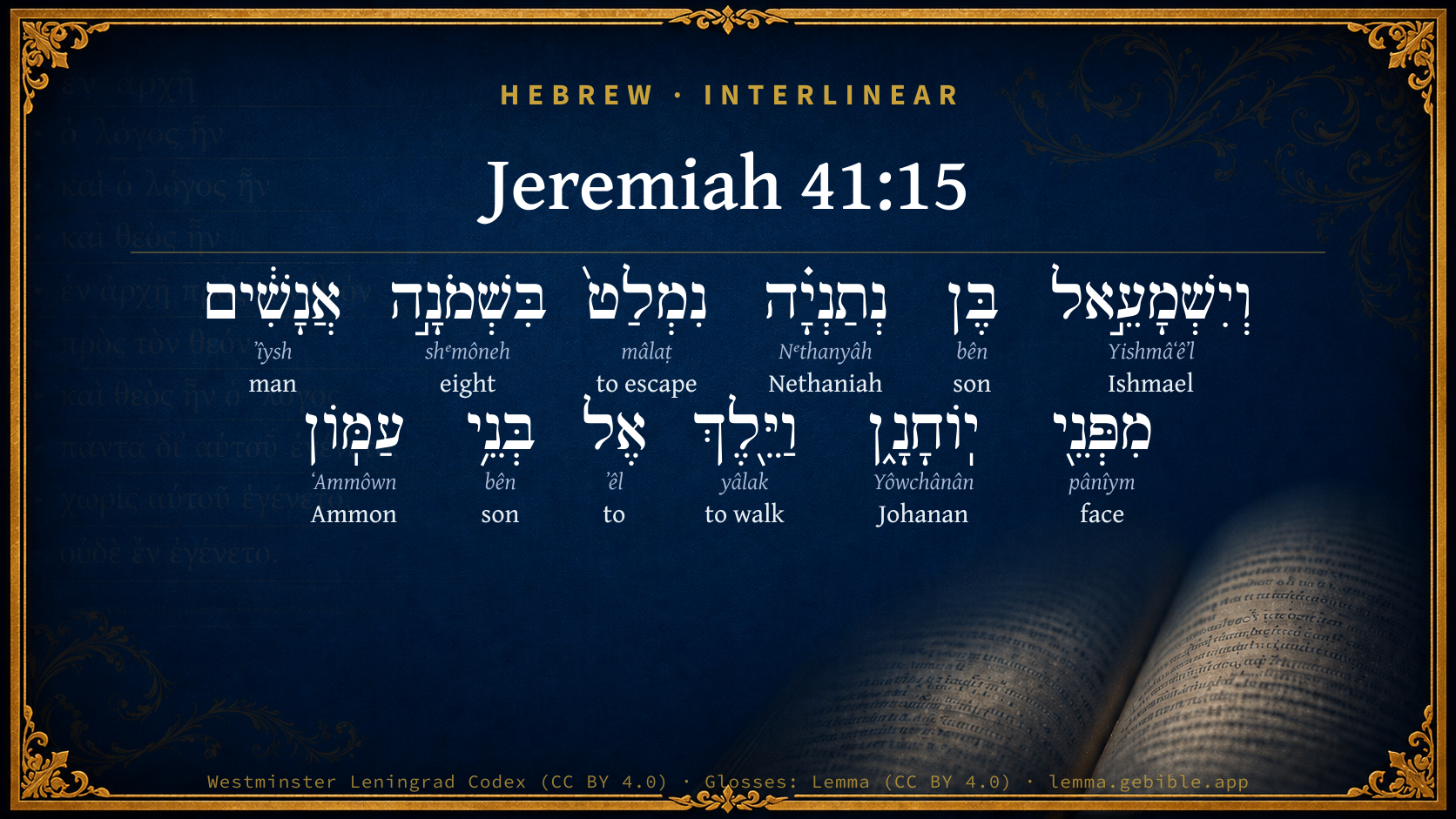
Jeremiah 41:15

Hebrew (Westminster Leningrad Codex) Jeremiah 41:15 appears in the Hebrew Old Testament. The text above is from the Westminster Leningrad Codex. Each word links to its Strong’s number, a concise gloss, and parsing drawn from the Open Scriptures Hebrew Bible morphology. Click any word for its full Brown-Driver-Briggs (BDB) entry.
Download image
Cite this verse

Jeremiah 41:15 (World English Bible). Public Domain. Lemma interlinear Bible study tool, https://lemma.gebible.app/v/jeremiah/41/15.

Show BibTeX & RIS
BibTeX
RIS
English Translation
But Ishmael the son of Nethaniah escaped from Johanan with eight men, and went to the children of Ammon.
World English Bible · Public Domain
Download a study sheet

One document with this verse’s original text, its word-by-word gloss line, the meaning frame, cross-references with their text, attributed commentary, and full source and license credits — printable, and it pastes into notes with its structure intact.

This verse Autodidact and up

Study sheet (.html) Plain text (.txt)

A passage Seminary Student

Up to 50 verses in one chapter. A passage sheet keeps up to 6 commentary sources and 12 cross-references per verse, in the order this page ranks them, and says so on the sheet whenever that leaves anything out. Ask for a single verse and you get the Autodidact verse sheet above.

Everything on this page stays free to read, with no account — the sheet is a download of what is already on screen, not access to it.

Want to remove ads? Support Godless Engineer
Compare translations 3

The same verse in 3 English versions, stacked beneath the original-language interlinear above. Click any original word for its lexicon entry.

Each is an independent rendering of the whole verse — the interlinear is not word-aligned to these translations.

Highlighted words mark where these versions differ — a whole-verse word diff, not a word-by-word alignment.

  • World English Bible Public Domain
    But Ishmael the son of Nethaniah escaped from Johanan with eight men, and went to the children of Ammon.
  • King James Version Public Domain
    But Ishmael the son of Nethaniah escaped from Johanan with eight men, and went to the Ammonites.
  • unfoldingWord Literal Text CC BY-SA 4.0
    But Ishmael son of Nethaniah fled with eight men from Johanan. He went to the people of Ammon.

unfoldingWord Literal Text — © unfoldingWord, licensed CC BY-SA 4.0. Word-aligned USFM3 via Door43 (git.door43.org/unfoldingWord/en_ult).

Versions to compare (up to 4)

3 of 4 selected

Show all 18 translations

Every available English version of this verse, each an independent rendering of the whole verse.

  • World English Bible Public Domain
    But Ishmael the son of Nethaniah escaped from Johanan with eight men, and went to the children of Ammon.
  • Berean Standard Bible Public Domain
    But Ishmael son of Nethaniah and eight of his men escaped from Johanan and went to the Ammonites.
  • Majority Standard Bible Public Domain
    But Ishmael son of Nethaniah and eight of his men escaped from Johanan and went to the Ammonites.
  • King James Version Public Domain
    But Ishmael the son of Nethaniah escaped from Johanan with eight men, and went to the Ammonites.
  • American Standard Version (1901) Public Domain
    But Ishmael the son of Nethaniah escaped from Johanan with eight men, and went to the children of Ammon.
  • Revised Version (1885) Public Domain
    But Ishmael the son of Nethaniah escaped from Johanan with eight men, and went to the children of Ammon.
  • Geneva Bible (1599) Public Domain
    But Ishmael the sonne of Nethaniah, escaped from Iohanan with eight men, and went to the Ammonites.
  • Douay-Rheims (1899) Public Domain
    But Ismahel the son of Nathanias fled with eight men, from the face of Johanan, and went to the children of Ammon.
  • Young's Literal Translation Public Domain
    And Ishmael son of Nethaniah hath escaped, with eight men, from the presence of Johanan, and he goeth unto the sons of Ammon.
  • Literal Standard Version CC BY-SA 4.0
    And Ishmael son of Nethaniah has escaped, with eight men, from the presence of Johanan, and he goes to the sons of Ammon.
  • Unlocked Literal Bible CC BY-SA 4.0
    But Ishmael son of Nethaniah fled with eight men from Johanan. He went to the people of Ammon.
  • unfoldingWord Literal Text CC BY-SA 4.0
    But Ishmael son of Nethaniah fled with eight men from Johanan. He went to the people of Ammon.
  • Darby Bible Public Domain
    But Ishmael the son of Nethaniah escaped from Johanan with eight men, and went to the children of Ammon.
  • World Messianic Bible Public Domain
    But Ishmael the son of Nethaniah escaped from Yochanan with eight men, and went to the children of Ammon.
  • Webster's Bible Public Domain
    But Ishmael the son of Nethaniah escaped from Johanan with eight men, and went to the Ammonites.
  • Free Bible Version CC BY-SA 4.0
    Ishmael and eight of his men managed to escape from Johanan and get away to the Ammonites.
  • Bible in Basic English Public Domain
    But Ishmael, the son of Nethaniah, got away from Johanan, with eight men, and went to the children of Ammon.
  • JPS Tanakh (1917) Public Domain
    But Ishmael the son of Nethaniah escaped from Johanan with eight men, and went to the children of Ammon.

Literal Standard Version (2020), Covenant Press — licensed CC BY-SA 4.0. Text via the HelloAO Bible API (eBible.org). Unlocked Literal Bible (unfoldingWord) — licensed CC BY-SA 4.0. Text via the HelloAO Bible API (eBible.org). unfoldingWord Literal Text — © unfoldingWord, licensed CC BY-SA 4.0. Word-aligned USFM3 via Door43 (git.door43.org/unfoldingWord/en_ult). Free Bible Version, Dr. Jonathan Gallagher — licensed CC BY-SA 4.0. Text via the HelloAO Bible API (eBible.org).

Word by word

More ways to search: Search by grammar → Find every occurrence → Compare this word →

Practice this passage: Drill this verse → Learn its vocabulary →

נְתַנְיָ֗ה
Nᵉthanyâh
H5418
“Nethaniah”
Noun, Proper
Part of Speech
Noun
Type
Proper
Full BDB Definition

Origin: from H5414 and H3050

TWOT: None

Nethaniah = "given of Jehovah" - son of Elishama of the royal family of Judah and father of Ishmael who murdered Gedaliah - father of Jehudi - a Levite, one of the 4 sons of Asaph the minstrel - a Levite in the reign of king Jehoshaphat of Judah
  1. וְיִשְׁמָעֵ֣אל Yishmâʻêʼl H3458 “and · Ishmael” Conjunction + Noun, Proper
  2. בֶּן bên H1121 “son of” Noun, Common, Masculine, Singular, Construct
  3. נִמְלַט֙ mâlaṭ H4422 “to escape” Verb, Niphal, Perfect, 3rd Person, Masculine, Singular
  4. בִּשְׁמֹנָ֣ה shᵉmôneh H8083 “in/at · eight” Preposition + Adjective, Cardinal number, Masculine, Singular, Absolute
  5. אֲנָשִׁ֔ים ʼîysh H376 “men” Noun, Common, Masculine, Plural, Absolute
  6. מִפְּנֵ֖י pânîym H6440 “from · face(s) of” Preposition + Noun, Common, Both, Plural, Construct
  7. יֽוֹחָנָ֑ן Yôwchânân H3110 “Johanan” Noun, Proper
  8. וַיֵּ֖לֶךְ yâlak H3212 “and · to walk” Conjunction + Verb, Qal, Sequential Imperfect, 3rd Person, Masculine, Singular
  9. אֶל ʼêl H413 “to” Preposition
  10. בְּנֵ֥י bên H1121 “sons of” Noun, Common, Masculine, Plural, Construct
  11. עַמּֽוֹן ʻAmmôwn H5983 “Ammon” Noun, Proper

About this verse

These counts appear in no published source. They are computed here, from the morphology-tagged text and Lemma’s own curated glosses. What Lemma adds →

12
words
11
distinct lemmas
Prophets
section

Notable vocabulary

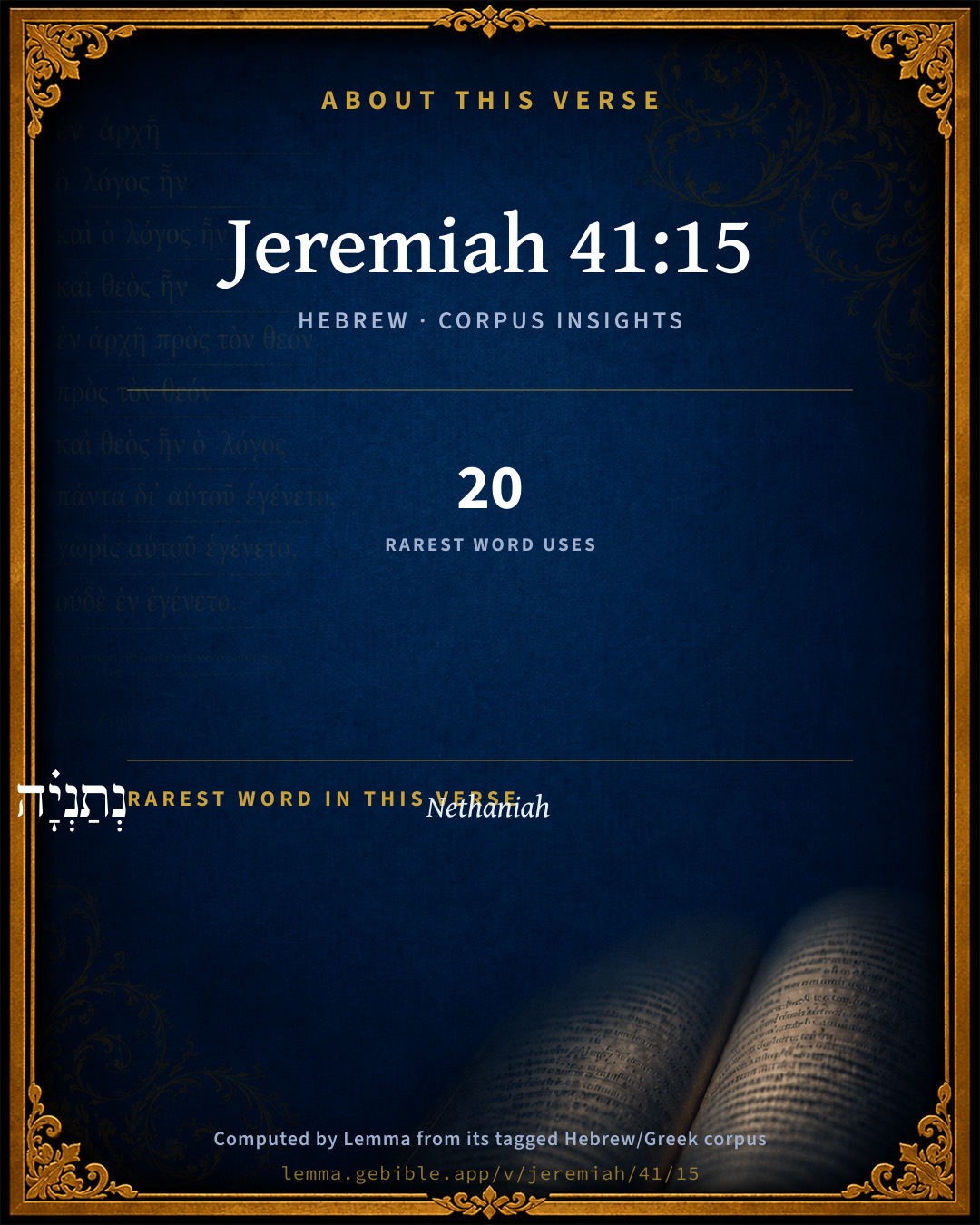
The rarest word here is נְתַנְיָ֗ה Nethaniah H5418 — appearing just 20 times in the whole Hebrew Bible.

Shared distinctive vocabulary

נְתַנְיָ֗ה Nethaniah H5418 occurs in 20 verses of the Hebrew Bible. Also found in:

Grammatical profile

  • 2 verbs
  • 8 nouns
  • 1 adjective
  • 1 preposition

Verb forms

  • נִמְלַט֙ Niphal · Perfect
  • וַיֵּ֖לֶךְ Qal · Sequential Imperfect

Repetition

A word recurs within this verse — often emphatic in Hebrew:

Cross-references

8

Topical passages linked to Jeremiah 41:15 in the Treasury of Scripture Knowledge — connected by theme and wording, ordered by reader-vote popularity; previews shown in the World English Bible.

  • Job 21:30 That the evil man is reserved to the day of calamity? That they are led forth to the day of wrath?
  • Proverbs 28:17 A man who is tormented by life blood will be a fugitive until death; No one will support him.
  • 1 Samuel 30:17 David struck them from the twilight even to the evening of the next day: and there not a man of them escaped, except four hundred young men, who rode on camels and fled.
  • 1 Kings 20:20 They killed everyone his man; and the Syrians fled, and Israel pursued them: and Ben Hadad the king of Syria escaped on a horse with horsemen.
  • 2 Kings 25:25 But it happened in the seventh month, that Ishmael the son of Nethaniah, the son of Elishama, of the royal seed came, and ten men with him, and struck Gedaliah, so that he died, and the Jews and the Chaldeans that were with him at Mizpah.
  • Ecclesiastes 8:11–12 Because sentence against an evil work is not executed speedily, therefore the heart of the sons of men is fully set in them to do evil.
  • Jeremiah 41:2 Then arose Ishmael the son of Nethaniah, and the ten men who were with him, and struck Gedaliah the son of Ahikam the son of Shaphan with the sword, and killed him, whom the king of Babylon had made governor over the land.
  • Acts 28:4 When the natives saw the creature hanging from his hand, they said one to another, "No doubt this man is a murderer, whom, though he has escaped from the sea, yet Justice has not allowed to live."

Cross-references courtesy of OpenBible.info (CC BY 4.0).

Hebrew and Greek witnesses Masoretic Hebrew ↔ Greek Septuagint

The same verse in the two great witnesses to the Old Testament, shown verse-for-verse.

These are two independent witnesses, not word-aligned to each other, and the Septuagint is shown in lemma (dictionary) form.

Hebrew Jeremiah 41:15 Masoretic · Westminster Leningrad Codex

וְיִשְׁמָעֵ֣אל בֶּן נְתַנְיָ֗ה נִמְלַט֙ בִּשְׁמֹנָ֣ה אֲנָשִׁ֔ים מִפְּנֵ֖י יֽוֹחָנָ֑ן וַיֵּ֖לֶךְ אֶל בְּנֵ֥י עַמּֽוֹן

But Ishmael the son of Nethaniah escaped from Johanan with eight men, and went to the children of Ammon.

World English Bible · Public Domain

Greek LXX Structure differs

In the Septuagint, Jeremiah is about an eighth shorter than the Hebrew and arranges its material differently — the Oracles Against the Nations (Hebrew chapters 46–51) appear in the middle of the Greek book, after 25:13. Because the chapter and verse boundaries do not line up, a verse-for-verse comparison with the Hebrew is not shown.

A verse-for-verse comparison isn’t shown here because the chapters and verses don’t line up. Switch to the LXX edition with the MT / LXX toggle above to read the Greek directly.

Hebrew: Westminster Leningrad Codex (CC BY 4.0). Greek: Septuagint (public domain); English from a public-domain English Septuagint. How the Septuagint differs from the Hebrew →

Targum (Aramaic paraphrase)

1

The Targum is the ancient Jewish Aramaic paraphrase of the Hebrew Scriptures — an interpretive translation, not the Hebrew text itself. Onkelos (literal) and Pseudo-Jonathan (expansive) render the Torah, and Jonathan the Prophets. Coverage is partial: where no permissively-licensed English translation exists for a verse, only the Aramaic is shown. This is verse-level text, not a word-by-word alignment to the Hebrew.

  1. Targum Jonathan Prophets (Joshua–Malachi)
    וְיִשְׁמָעֵאל בַּר נְתַנְיָה אִשְׁתֵּיזֵיב בִּתְמַנְיָא גַבְרָא מִן קֳדָם יוֹחָנָן בַּר קָרֵחַ וַאֲזַל לְוַת בְּנֵי עַמוֹן:

    (no public-domain English translation for this verse)

    Targum Jonathan — Aramaic: “Mikraot Gedolot” (public domain). English: “Sefaria Community Translation” (CC0 1.0 (public-domain dedication)); “London "Chaldee Paraphrase," 1871” (public domain). Text via Sefaria.

Commentary

Notes on Jeremiah 41:15 from classic Christian and Jewish commentators (each source and its license shown beneath its notes). The classic Christian expositions comment on the surrounding passage and are grouped to its opening verse, so a note may address several verses; the Jewish commentaries on the Tanakh (Rashi and others) are per-verse, so they appear only where the commentator wrote on this verse.

Lemma curates 59 commentaries, every one of them public domain or Creative Commons licensed, each selected and text-cleaned for this edition rather than reprinted as found. About our sources →

Trapp's Complete Commentary

John Trapp

Jer 41:15 But Ishmael the son of Nethaniah escaped from Johanan with eight men, and went to the Ammonites.

Ver. 15. But Ishmael the son of Nethaniah escaped.] But with what honour, with what conscience could this Judas live among the Ammonites? Surely this defeat could not but be more shame to him before the King of Ammon, and more vexation to his proud heart, than death itself. The like befell Stukely, the English traitor, in Spain.

John Trapp, A Commentary or Exposition upon All the Books of the Old and New Testament (1647–1656) — public domain. Text from a community e-Sword module.

Geneva Bible (1599)

Geneva Bible translators

For Baalis the king of the Ammonites was the cause of this murder.

Geneva Bible (1599) marginal notes — public domain. Text via Bolls.life.

John Calvin's Commentaries

He indeed met with bad success; he fled before his enemy, when the whole people forsook him, when he lost his soldiers; and he could not come without the greatest disgrace before the king of Ammon. It seems, however, very strange that he was allowed to flee away; for how was it that God did not execute those well-known sentences, —

“He who smites with the sword shall perish by the sword;” “Whosoever sheds man’s blood, his blood shall be shed?” (Matthew 26:52; Revelation 13:10; Genesis 9:6)

Ishmael had not only killed a man, but the governor of the people, and that governor by whose protection and favor a remnant had been preserved as a seed; and he had also killed all whom he had found with him; and lastly, he had killed seventy men, with whom he had no strife, no war, no quarrel. As, then, Ishmael had so polluted himself with innocent blood, and with so many murders of good men, how was it that he was suffered to escape?

As we have before said, God does not now observe an equal, or the same course in his judgments; for he often extends the life of the most wicked, that they may be exhibited, as it were, as a spectacle; nor does the truth of the words, “Whosoever sheds man’s blood, his blood shall be shed,” become evanescent; but God has various ways by which he renders a just reward to murderers and assassins. And we ought to notice what is said in the book of Psalms,

“Slay them not, lest my people should forget.” (Psalm 59:11)

The Psalmist there asks God not to destroy immediately the wicked; for an oblivion of a remarkable punishment might easily creep in, if God executed it suddenly and instantly. But when God impresses a mark of his curse on the impious and the wicked, and prolongs their life, it is the same as though he placed them in a theater to be looked on leisurely and for a long time. Conspicuous, then, are the marks of God on the impious, when God pursues them slowly and by degrees, and summons them, in a manner, day by day before his tribunal. There is, therefore, no doubt but that God thus executed vengeance on the barbarity of Ishmael.

For how was it that he killed Gedaliah? even because he was of the royal seed, and foolish pride still filled his heart, though God by his powerful hand had broken down whatever dignity that once belonged to the royal seed, sea, he had completely torn it to pieces; and yet this man cherished his own ferocity. Hence God executed on him a two-fold punishment, by depriving him of his company; for he went to the king of Ammon, whom he had no doubt flattered with great promises, and from whom he also expected no common rewards, — he went there a fugitive with his eight companions, and also filled with confusion, and he saw no hope of a return. Thus, then, it happened that he was despised and reprobated; and this was, no doubt, more bitter to him than if he had suffered ten deaths.

Let us then learn not to form our judgment according to the present appearance of things; but let us patiently wait while God makes openly known to us the various ways he adopts in punishing the wicked; nay, this ought especially to serve as a confirmation to our faith, when we see the godly cruelly slain, and the wicked remaining in security; for it hence follows that we are to look for another judgment of God, which does not yet appear. For if God rendered to each his just reward, then the Sadducees would have some ground to boast that there is not another life; but when things are thus in a state of confusion in the world, we know that God’s judgment is suspended and deferred to another time. Then this variety or confusion, if you please, confirms our minds in the hope of the last judgment, and of a blessed resurrection. I cannot now proceed further.

John Calvin's Commentaries (1540-1563) — public domain. Text from the Calvin Translation Society English edition (1840s-50s) via the Christian Classics Ethereal Library (ccel.org). Calvin's coverage is partial (roughly two-thirds of the Bible); uncommented books and verses are honest gaps, never fabricated. The 19th-century editor's footnotes and remarks are omitted so the notes are faithfully Calvin's own voice.

Ellicott's Commentary for English Readers

(15) With eight men.—He had come with ten (Jer_41:1), and it is a natural inference that two had perished in one or other of the conflicts of Jer_41:2; Jer_41:12.

A Bible Commentary for English Readers, edited by Charles John Ellicott (1878–1897) — public domain. Text from a community e-Sword module.

The Cambridge Bible for Schools and Colleges

gen. ed. J. J. S. Perowne

15. went to the children of Ammon] Cp. Jer_40:14.

The Cambridge Bible for Schools and Colleges (gen. ed. J. J. S. Perowne; Cambridge University Press, 1878–1918) — public domain. Text from a community e-Sword module.

John Gill's Exposition

But Ishmael the son of Nethaniah escaped from Johanan with eight men,.... Of the ten he brought with hin), Jer 41:1; two of them being slain in this skirmish, or taken by Johanan, or they fled another way:

and went to the Ammonites; who had put him upon, or however encouraged and assisted him in, his wicked attempts; though he returned to them not according to their wishes, nor with that honour and glory he thought to have done.

John Gill's Exposition of the Whole Bible (1746–1763) — public domain (CC PDM 1.0). Text via the HelloAO Bible API.

Haydock's Catholic Bible Commentary

Eight. He had brought ten, ver. 1.

George Leo Haydock (1774–1849), Haydock's Catholic Family Bible and Commentary, 1859 edition — public domain. Excludes Psalms (Douay-Rheims chapter numbering differs from Protestant) and Deuterocanonical books (Catholic canon only).

Matthew Poole's English Annotations

When the people whom Ishmael had carried away prisoners saw Johanan coming with greater forces, they contrived and wheeled about and went to him, only Ishmael and eight men escaped and went to the land of Ammon.

Matthew Poole's English Annotations on the Holy Bible (1683–1685) — public domain. Text from a community e-Sword/MySword module.

unfoldingWord translationNotes

Door43 World Missions Community

He went to the people of Ammon

"He" refers to Ishmael who represents himself and the eight men with him. AT: "They went to the people of Ammon" (See: Synecdoche)

who had been rescued

This can be stated in active form. AT: "whom they had rescued" (See: Active or Passive)

This was after Ishmael had killed Gedaliah son of Ahikam

The author stops the story to refer to a previous event so that the order of events are understood. (See: Background Information)

the strong men, the fighting men

These both refer to soldiers. AT: "the soldiers"

who had been rescued at Gibeon

This can be stated in active form. AT: "whom they had rescued at Gibeon" (See: Active or Passive)

translationWords

Ammon

commander

companion

eunuch

Gibeon

unfoldingWord translationNotes — © Distant Shores Media and the Door43 World Missions Community, licensed CC BY-SA 4.0. Source: git.door43.org/Door43/en_tn.

Lesson kit

Teaching starters — assembled from the data on this page, not authored interpretation. Every prompt links to the verse data it draws on. Edit before teaching.

Jeremiah, in the Prophets, opens this verse with 12 words (11 distinct Hebrew lemmas). Its most distinctive word is Nᵉthanyâh (“Nethaniah”). A historical commentator’s framing appears above. Read the whole chapter for the surrounding context.

Discussion questions

  1. How does “Nethaniah” (Nᵉthanyâh) shape what this verse is saying?
  2. 2 Kings 25:23 shares the word «Nethaniah» with this verse. How do the two illuminate each other?
  3. “son” occurs 2× in this one verse. What is the effect of the repetition?
  4. The translations on this page render this verse differently — a whole-verse word diff, not a word-by-word alignment. What might account for the different wordings?
  5. The verb «נִמְלַט֙» is Niphal Perfect. How does its form color the action?
  6. Reading how Trapp's Complete Commentary and Geneva Bible (1599) read this verse, where do the two commentators agree and where do they part?

Things to notice

Reading settings

Reading text

Shown beneath each verse's original-language words.

Old Testament
Old Testament edition

Read the OT as the Masoretic Hebrew (MT) or the Greek Septuagint (LXX).

English shown for the Greek Septuagint (in the Hebrew ↔ Greek comparison).

Comparing translations? Open the Compare panel on any verse page to stack up to four side by side.