
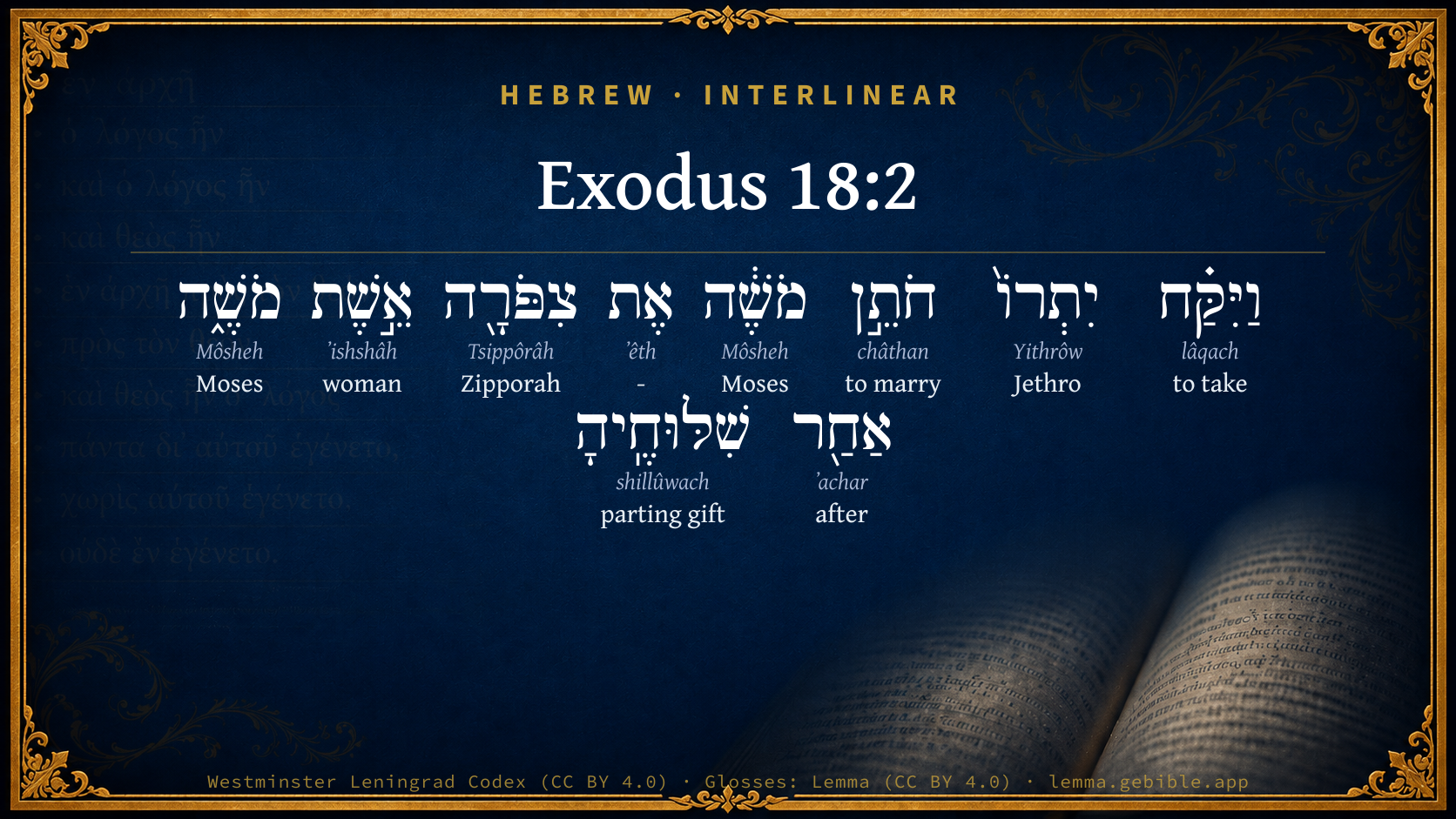
Exodus 18:2

Hebrew (Westminster Leningrad Codex) Exodus 18:2 appears in the Hebrew Old Testament. The text above is from the Westminster Leningrad Codex. Each word links to its Strong’s number, a concise gloss, and parsing drawn from the Open Scriptures Hebrew Bible morphology. Click any word for its full Brown-Driver-Briggs (BDB) entry.
Download image
Cite this verse

Exodus 18:2 (World English Bible). Public Domain. Lemma interlinear Bible study tool, https://lemma.gebible.app/v/exodus/18/2.

Show BibTeX & RIS
BibTeX
RIS
English Translation
Jethro, Moses' father-in-law, received Zipporah, Moses' wife, after he had sent her away,
World English Bible · Public Domain
Highlights
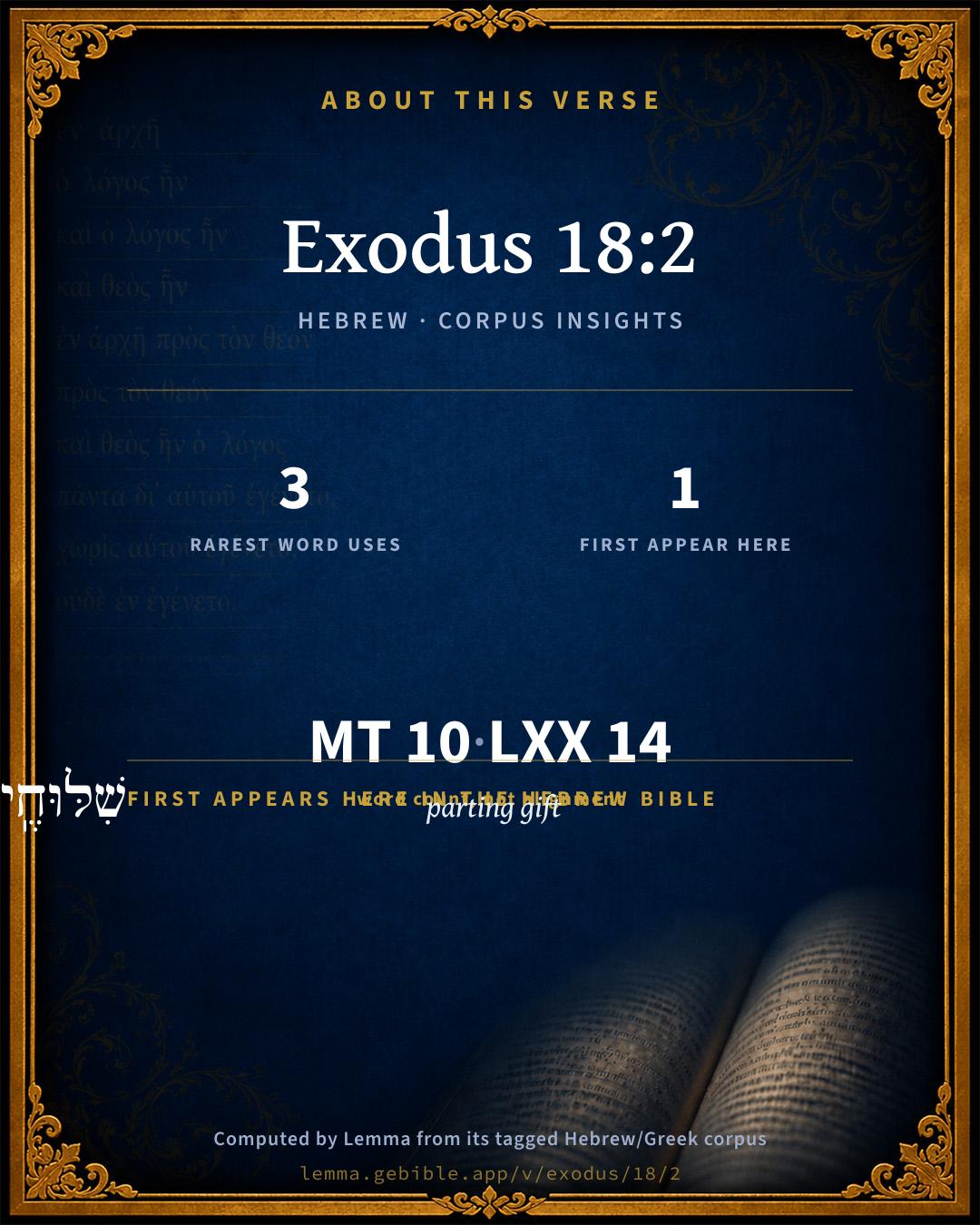
  • 1 first appearance in the Hebrew Bible
Full analysis ↓
Download a study sheet

One document with this verse’s original text, its word-by-word gloss line, the meaning frame, cross-references with their text, attributed commentary, and full source and license credits — printable, and it pastes into notes with its structure intact.

This verse Autodidact and up

Study sheet (.html) Plain text (.txt)

A passage Seminary Student

Up to 50 verses in one chapter. A passage sheet keeps up to 6 commentary sources and 12 cross-references per verse, in the order this page ranks them, and says so on the sheet whenever that leaves anything out. Ask for a single verse and you get the Autodidact verse sheet above.

Everything on this page stays free to read, with no account — the sheet is a download of what is already on screen, not access to it.

Want to remove ads? Support Godless Engineer
Compare translations 3

The same verse in 3 English versions, stacked beneath the original-language interlinear above. Click any original word for its lexicon entry.

Each is an independent rendering of the whole verse — the interlinear is not word-aligned to these translations.

Highlighted words mark where these versions differ — a whole-verse word diff, not a word-by-word alignment.

  • World English Bible Public Domain
    Jethro, Moses' father-in-law, received Zipporah, Moses' wife, after he had sent her away,
  • King James Version Public Domain
    Then Jethro, Moses' father in law, took Zipporah, Moses' wife, after he had sent her back,
  • unfoldingWord Literal Text CC BY-SA 4.0
    And Jethro, father-in-law of Moses, took Zipporah, wife of Moses, after he had sent her back,

unfoldingWord Literal Text — © unfoldingWord, licensed CC BY-SA 4.0. Word-aligned USFM3 via Door43 (git.door43.org/unfoldingWord/en_ult).

Versions to compare (up to 4)

3 of 4 selected

Show all 18 translations

Every available English version of this verse, each an independent rendering of the whole verse.

  • World English Bible Public Domain
    Jethro, Moses' father-in-law, received Zipporah, Moses' wife, after he had sent her away,
  • Berean Standard Bible Public Domain
    After Moses had sent back his wife Zipporah, his father-in-law Jethro had received her,
  • Majority Standard Bible Public Domain
    After Moses had sent back his wife Zipporah, his father-in-law Jethro had received her,
  • King James Version Public Domain
    Then Jethro, Moses' father in law, took Zipporah, Moses' wife, after he had sent her back,
  • American Standard Version (1901) Public Domain
    And Jethro, Moses' father-in-law, took Zipporah, Moses' wife, after he had sent her away,
  • Revised Version (1885) Public Domain
    And Jethro, Moses’ father in law, took Zipporah, Moses’ wife, after he had sent her away,
  • Geneva Bible (1599) Public Domain
    Then Iethro the father in lawe of Moses, tooke Zipporah Moses wife, (after he had sent her away)
  • Douay-Rheims (1899) Public Domain
    He took Sephora the wife of Moses whom he had sent back:
  • Young's Literal Translation Public Domain
    and Jethro, father-in-law of Moses, taketh Zipporah, wife of Moses, besides her parents,
  • Literal Standard Version CC BY-SA 4.0
    and Jethro, father-in-law of Moses, takes Zipporah, wife of Moses, after her parting,
  • Unlocked Literal Bible CC BY-SA 4.0
    Jethro, Moses' father-in-law, took Zipporah, Moses' wife, after he had sent her home,
  • unfoldingWord Literal Text CC BY-SA 4.0
    And Jethro, father-in-law of Moses, took Zipporah, wife of Moses, after he had sent her back,
  • Darby Bible Public Domain
    And Jethro, Moses' father-in-law, took Zipporah, Moses' wife, after he had sent her back,
  • World Messianic Bible Public Domain
    Jethro, Moses’ father-in-law, received Zipporah, Moses’ wife, after he had sent her away,
  • Webster's Bible Public Domain
    Then Jethro, Moses's father-in-law, took Zipporah Moses's wife, after he had sent her back,
  • Free Bible Version CC BY-SA 4.0
    When Moses had sent home his wife Zipporah, his father-in-law Jethro had welcomed her,
  • Bible in Basic English Public Domain
    And Jethro, Moses' father-in-law, took Zipporah, Moses' wife, after he had sent her away,
  • JPS Tanakh (1917) Public Domain
    And Jethro, Moses' father-in-law, took Zipporah, Moses' wife, after he had sent her away,

Literal Standard Version (2020), Covenant Press — licensed CC BY-SA 4.0. Text via the HelloAO Bible API (eBible.org). Unlocked Literal Bible (unfoldingWord) — licensed CC BY-SA 4.0. Text via the HelloAO Bible API (eBible.org). unfoldingWord Literal Text — © unfoldingWord, licensed CC BY-SA 4.0. Word-aligned USFM3 via Door43 (git.door43.org/unfoldingWord/en_ult). Free Bible Version, Dr. Jonathan Gallagher — licensed CC BY-SA 4.0. Text via the HelloAO Bible API (eBible.org).

Word by word

More ways to search: Search by grammar → Find every occurrence → Compare this word →

Practice this passage: Drill this verse → Learn its vocabulary →

About this verse

These counts appear in no published source. They are computed here, from the morphology-tagged text and Lemma’s own curated glosses. What Lemma adds →

10
words
9
distinct lemmas
Pentateuch
section

Notable vocabulary

The rarest word here is צִפֹּרָ֖ה Zipporah H6855 — appearing just 3 times in the whole Hebrew Bible.

First appearance in Scripture

This word makes its first canonical appearance in the Hebrew Bible here:

  • שִׁלּוּחֶֽיהָ parting gift H7964

Shared distinctive vocabulary

צִפֹּרָ֖ה Zipporah H6855 occurs in 3 verses of the Hebrew Bible. Also found in:

Grammatical profile

  • 2 verbs
  • 6 nouns
  • 1 preposition
  • 1 particle

Verb forms

  • וַיִּקַּ֗ח Qal · Sequential Imperfect
  • חֹתֵ֣ן Qal · Participle Active

Repetition

A word recurs within this verse — often emphatic in Hebrew:

  • מֹשֶׁ֔ה Moses H4872 ×2

Hebrew & Septuagint length

In English translation the verse runs 13 words from the Hebrew and 18 from the Septuagint (LXX English) — closely comparable.

A rough comparison of the two English renderings, which tokenize alike — not a word-level alignment.

Word counts can differ between the Hebrew and the Greek without any difference in meaning — e.g. the Hebrew direct-object marker אֵת has no separate Greek word, and Greek often adds the article ὁ.

In the original languages it is 10 Hebrew tokens and 14 Greek tokens — but the two are counted differently (Hebrew bundles its prefixes and suffixes into one token; the Greek is in lemma form), so that isn’t a like-for-like length.

Cross-references

2

Topical passages linked to Exodus 18:2 in the Treasury of Scripture Knowledge — connected by theme and wording, ordered by reader-vote popularity; previews shown in the World English Bible.

  • Exodus 2:21 Moses was content to dwell with the man. He gave Moses Zipporah, his daughter.
  • Exodus 4:25–26 Then Zipporah took a flint, and cut off the foreskin of her son, and cast it at his feet; and she said, "Surely you are a bridegroom of blood to me."

Cross-references courtesy of OpenBible.info (CC BY 4.0).

Hebrew and Greek witnesses Masoretic Hebrew ↔ Greek Septuagint

The same verse in the two great witnesses to the Old Testament, shown verse-for-verse.

These are two independent witnesses, not word-aligned to each other, and the Septuagint is shown in lemma (dictionary) form.

Hebrew Exodus 18:2 Masoretic · Westminster Leningrad Codex

וַיִּקַּ֗ח יִתְרוֹ֙ חֹתֵ֣ן מֹשֶׁ֔ה אֶת צִפֹּרָ֖ה אֵ֣שֶׁת מֹשֶׁ֑ה אַחַ֖ר שִׁלּוּחֶֽיהָ

Jethro, Moses' father-in-law, received Zipporah, Moses' wife, after he had sent her away,

World English Bible · Public Domain

Greek LXX Exodus 18:2 Septuagint · lemma form

λαμβάνω δέ ιοθορ ὁ γαμβρός μωυσῆς σεπφωρα ὁ γυνή μωυσῆς μετά ὁ ἄφεσις αὐτός

And Jothor the father-in-law of Moses, took Sepphora the wife of Moses after she had been sent away,

LXX2012 (modern English Septuagint) · Public Domain

Hebrew: Westminster Leningrad Codex (CC BY 4.0). Greek: Septuagint (public domain); English from LXX2012 (modern English Septuagint) (Public Domain). How the Septuagint differs from the Hebrew →

Targum (Aramaic paraphrase)

2

The Targum is the ancient Jewish Aramaic paraphrase of the Hebrew Scriptures — an interpretive translation, not the Hebrew text itself. Onkelos (literal) and Pseudo-Jonathan (expansive) render the Torah, and Jonathan the Prophets. Coverage is partial: where no permissively-licensed English translation exists for a verse, only the Aramaic is shown. This is verse-level text, not a word-by-word alignment to the Hebrew.

  1. Targum Onkelos Torah (Genesis–Deuteronomy)
    וּדְבַר יִתְרוֹ חֲמוּהִי דְמשֶׁה יָת צִפֹּרָה אִתַּת משֶׁה בָּתַר דְפַטְרַהּ:

    (no public-domain English translation for this verse)

    Targum Onkelos — Aramaic: “Onkelos Genesis” (public domain); “Onkelos Exodus” (public domain); “Onkelos Leviticus” (public domain); “Onkelos Numbers” (public domain); “Onkelos Deuteronomy” (public domain). English: “Sefaria Community Translation” (CC0 1.0 (public-domain dedication)); “J.W. Etheridge. The Targums of Onkelos and Jonathan Ben Uzziel on the Pentateuch. London: Longmans, Green, 1862” (public domain). Text via Sefaria.

  2. Targum Pseudo-Jonathan Torah (Genesis–Deuteronomy)
    וּדְבַר יִתְרוֹ חָמוּי דְמשֶׁה יַת צִפּוֹרָה אִנְתְּתֵיהּ דְּמשֶׁה בָּתַר דְּשַׁלְּחָהּ מִלְּוָתֵיהּ כַּד הֲוָה אָזִיל לְמִצְרָיִם

    And Jethro the father-in-law of Mosheh took Zipporah his wife, whom Mosheh had sent back from him after going into Mizraim,

    Targum Pseudo-Jonathan — Aramaic: “Targum Jonathan on Genesis” (public domain); “Targum Jonathan on Exodus” (public domain); “Targum Jonathan on Leviticus” (public domain); “Targum Jonathan on Numbers” (public domain); “Targum Jonathan on Deuteronomy” (public domain). English: “The Targum of Jonathan ben Uzziel, trans. J. W. Etheridge, London, 1862” (public domain). Text via Sefaria.

Commentary

Notes on Exodus 18:2 from classic Christian and Jewish commentators (each source and its license shown beneath its notes). The classic Christian expositions comment on the surrounding passage and are grouped to its opening verse, so a note may address several verses; the Jewish commentaries on the Tanakh (Rashi and others) are per-verse, so they appear only where the commentator wrote on this verse.

Lemma curates 59 commentaries, every one of them public domain or Creative Commons licensed, each selected and text-cleaned for this edition rather than reprinted as found. About our sources →

Trapp's Complete Commentary

John Trapp

Exo 18:2 Then Jethro, Moses’ father in law, took Zipporah, Moses’ wife, after he had sent her back,

Ver. 2. After he had sent her back.] Because she was troublesome with her peevishness, and a hindrance to the good work in hand. {Exo 4:25-26} Sulla felix fuisset ni uxorem duxisset; Adrianus ni imperitasset; Moses, both.

John Trapp, A Commentary or Exposition upon All the Books of the Old and New Testament (1647–1656) — public domain. Text from a community e-Sword module.

Geneva Bible (1599)

Geneva Bible translators

It may seem that he sent her back for a time to her father for her impatience, lest she should be a let to his vocation, which was so dangerous, Exod. 4:25.

Geneva Bible (1599) marginal notes — public domain. Text via Bolls.life.

Adam Clarke's Commentary

Verse 2. After he had sent her back] Why Zipporah and her two sons returned to Midian, is not certainly known. From the transaction recorded Ex 4:20; Ex 4:24, it seems as if she had been alarmed at the danger to which the life of one of her sons had been exposed, and fearing worse evils, left her husband and returned to her father. It is however possible that Moses, foreseeing the troubles to which his wife and children were likely to be exposed had he taken them down to Egypt, sent them back to his father-in-law till it should please God to deliver his people.

Jethro, now finding that God had delivered them, and totally discomfited the Egyptians, their enemies, thought it proper to bring Zipporah and her sons to Moses, while he was in the vicinity of Horeb.

Adam Clarke's Commentary on the Bible (1810–1826) — public domain. Text from a community e-Sword/MySword module.

Ellicott's Commentary for English Readers

(2)After he had sent her back.—Heb., after her dismissal. The fact had not been previously stated, but is in harmony with the general narrative, which has been absolutely silent concerning Zipporah since Exo_4:26. Moses had sent Zipporah back to her own relations, either in anger, on account of the scene described in Exo_4:24-26, or simply that he might not be encumbered with wife and children during the dangers and troubles which he anticipated in Egypt. Jethro assumed that, as the main troubles were now over, he would be glad to have his wife and children restored to him.

(2) He does not simply judge—i.e., decide the particular question brought before him; but he takes the opportunity to educate and instruct the people in delivering his judgments—he “makes them know the statutes of God and His laws”—he expounds principles and teaches morality. Both reasons were clearly of great weight, and constituted strong arguments in favour of his practice.

A Bible Commentary for English Readers, edited by Charles John Ellicott (1878–1897) — public domain. Text from a community e-Sword module.

The Cambridge Bible for Schools and Colleges

gen. ed. J. J. S. Perowne

2–4. In all probability an addition of the compiler, made for the purpose of harmonizing the statement in v. 5 that Moses’ sons (in the plural) and his wife were with Jethro, with Exo_2:15 (J) which mentions the birth of Gershom only, and Exo_4:25 (J) which implies that Moses had no other son, and with Exo_4:20 a, 24–26 (also J), where it is stated that Moses took Zipporah back with him to Egypt. The compiler removes the first of these difficulties by supplying the name of Moses’ younger son, and the second by the statement that Moses had ‘sent’ Zipporah ‘away,’ i.e. had sent her back to Midian at some time after the incident Exo_4:24-26.

The Cambridge Bible for Schools and Colleges (gen. ed. J. J. S. Perowne; Cambridge University Press, 1878–1918) — public domain. Text from a community e-Sword module.

John Gill's Exposition

Then Jethro, Moses's father-in-law, took Zipporah, Moses's wife,.... When he had heard of the above things, he determined to pay Moses a visit, and congratulate him on that account; and he took his daughter, the wife of Moses, along with him, to deliver her to her husband, to share with him in his cares and troubles; as to partake with him of his honours and dignity, so to bear part with him in his burdens, so far as she was capable of:

after he had sent her back: upon his call and mission to Egypt, he took his wife and children with him; but upon an affair which occurred in the inn by the way, he sent them back again to his father-in-law, where they had remained ever since, see Exo 4:24. Jarchi says this was done at meeting with Aaron his brother, Exo 4:27, and relates a conversation between them upon it. As that Aaron should say to him, who are these? to which he replied, this is my wife, I married her in Midian, and these are my sons: he further said to him, and where art thou carrying them? he replied, to Egypt; says he, by reason of those who are before there, we are in straits, and thou wilt add unto them; upon which he said to his wife, go back to thy father's house, and she took her sons and went thither. Kimchi (f) observes, that some render the words "after her gifts"; whose sense, according to Aben Ezra, is, after she had sent gifts to her husband; but others more probably interpret it of gifts sent by him to her to engage his father-in-law to let her come to him, as well as to prevail upon her to come; perhaps it may be better rendered, "after her messenger"; that is, either after the messenger sent to her by Moses, to acquaint her and her father of what had been done for him, or after the messenger she sent to him, to let him know that she intended shortly to be with him; though perhaps, after all, nearer to our version and others, it may be rendered, "after her dismissions" (g); the dismission or sending away of her and her sons, as before related; for this is by no means to be interpreted of a divorce of her; after which she was brought again to her husband; for there is no reason to believe that ever anything of that kind had passed, as some have thought (h): the plain case seems to be this, that Moses finding his family would be exposed to danger, or would be too great an incumbrance upon him in the discharge of his great work he had to do in Egypt, sent them back to his father-in-law until a fit opportunity should offer of their coming to him, as now did.

(f) Sepher Shorash. rad. "post dona vel donationes ejus"; so some in Vatablus and Drusius. (g) "post dimissiones ejus", Pagninus, Montanus, Drusius. (h) Vid. Selden. Uxor. Hebr. p. 629.

John Gill's Exposition of the Whole Bible (1746–1763) — public domain (CC PDM 1.0). Text via the HelloAO Bible API.

Haydock's Catholic Bible Commentary

Back, with her consent, when he was going to the court of Pharao. (Menochius) --- Since he had the vision of God, St. Epiphanius says, he lived in continence with her. (Hœr. 78.)

George Leo Haydock (1774–1849), Haydock's Catholic Family Bible and Commentary, 1859 edition — public domain. Excludes Psalms (Douay-Rheims chapter numbering differs from Protestant) and Deuterocanonical books (Catholic canon only).

Matthew Poole's English Annotations

From the way to Egypt, upon the occasion mentioned Exo 4:24,25, and because he found by experience that she was likely to hinder him from, or discourage him in, the discharge of his great and dangerous office, and to give an ill example to the Israelites.

Matthew Poole's English Annotations on the Holy Bible (1683–1685) — public domain. Text from a community e-Sword/MySword module.

Whedon's Commentary on the Bible

Daniel D. Whedon

2. After he had sent her back — See notes on Exo_4:24-26. The discrepancies which some interpreters find between this account and Moses’s return into Egypt narrated in Exo_4:18-26, are creations of their own fancy. Our historian has not given us all the details. The statement of Exo_4:20, that Moses took his wife and sons, and “returned to the land of Egypt,” is seen from the immediate context to mean that he started with them to return, and that they accompanied him until the incident which occurred by the way (Exo_18:24-26) served as an occasion for her returning with her sons to her father’s house. This simple and natural supposition solves all the difficulties, and is itself suggested by the record here given. The work and exposures of Moses in Egypt made it expedient that his wife and children return and abide in Midian until he should return home from Egypt at the head of his people. Another reasonable hypothesis is, that Moses took his wife and sons to Egypt, and that after the opposition to his mission became formidable, he secretly sent them back from Egypt to the home of Jethro.

Daniel D. Whedon (gen. ed.), Commentary on the Old and New Testaments (1874–1909) — public domain. Text from a community e-Sword module.

The Pulpit Commentary

After he had sent her back. Literally "after her dismissal." It is curious that the fact of the dismissal had not been previously mentioned, yet is here assumed as known. Some commentators (as Knobel) find, in what is said of Zipporah, the trace of two distinct writers who give two contradictory narratives; but the difficulties and obscurities of the history are sufficiently intelligible, if we hear in mind

1. That Moses was addressing immediately those who knew the facts; and

2. That he was studious of brevity.

The Pulpit Commentary (1880–1919), ed. H.D.M. Spence-Jones & Joseph S. Exell — public domain. Text from a community e-Sword module.

Rashi

Rabbi Shlomo Yitzchaki (Rashi)

אחר שלוחיה AFTER HIS HAVING SENT HER AWAY — When God said to him in Midian, (Exodus 4:19, 20) “Go, return to Egypt … and Moses took his wife and his sons etc…. and Aaron went forth towards him and met him at the Mount of God”, he (Aaron) said to him, “Who are these?” He answered him, “This is my wife whom I married in Midian and these are my children”. He, thereupon, asked him, “Whither are you taking them?” He replied, “To Egypt”. Where-upon he said to him, “We have cause to grieve over the former ones (the Israelites already there), and you propose to add to their number!” Moses therefore said to her, “Return to your father’s house” — she took her two sons and went away (Mekhilta).

Rashi on the Tanakh — English translations: “The Judaica Press complete Tanach with Rashi, translated by A. J. Rosenberg” (CC BY 4.0); “Pentateuch with Rashi's commentary by M. Rosenbaum and A.M. Silbermann, 1929-1934” (public domain); “The Metsudah Tanach series, Lakewood, N.J” (CC BY 4.0); and “The Book of Joshua, Metsudah Publications, 1997” (CC BY 4.0). Text via Sefaria.

Ramban (Nachmanides)

Rabbi Moshe ben Nachman (Ramban / Nachmanides)

AFTER HE HAD SENT HER AWAY. Because Scripture had [previously] mentioned, And Moses took his wife and his sons… and he returned to the land of Egypt, it became necessary to state here that she was in her father’s house, as Moses had sent her there. It is possible that Scripture is stating that Jethro took [Zipporah, Moses’s wife], to return her to him although he had sent her away. Having heard all that G-d had done for Moses, he thought that it was now time for her to follow the king wherever he would go.

Ramban (Nachmanides) on the Tanakh — English translation: “Commentary on the Torah by Ramban (Nachmanides). Translated and annotated by Charles B. Chavel. New York, Shilo Pub. House, 1971-1976” (CC BY 4.0). Text via Sefaria.

Lesson kit

Teaching starters — assembled from the data on this page, not authored interpretation. Every prompt links to the verse data it draws on. Edit before teaching.

Exodus, in the Pentateuch, opens this verse with 10 words (9 distinct Hebrew lemmas). Its most distinctive word is Tsippôrâh (“Zipporah”). A historical commentator’s framing appears above. Read the whole chapter for the surrounding context.

Discussion questions

  1. How does “Zipporah” (Tsippôrâh) shape what this verse is saying?
  2. This is the first place “parting gift” appears in Scripture (first appears here). What does its debut here establish?
  3. How does Exodus 2:21, which shares the word «Zipporah», read alongside this verse?
  4. What does the repetition of “Moses” (2× in this one verse) do in this verse?
  5. The translations on this page render this verse differently — a whole-verse word diff, not a word-by-word alignment. What might account for the different wordings?
  6. «וַיִּקַּ֗ח» is a Qal Sequential Imperfect verb. How does that grammatical form shape the action described?
  7. Compare how Trapp's Complete Commentary and Geneva Bible (1599) read this verse. Where do they agree or differ?

Things to notice

Reading settings

Reading text

Shown beneath each verse's original-language words.

Old Testament
Old Testament edition

Read the OT as the Masoretic Hebrew (MT) or the Greek Septuagint (LXX).

English shown for the Greek Septuagint (in the Hebrew ↔ Greek comparison).

Comparing translations? Open the Compare panel on any verse page to stack up to four side by side.